

A synonym for addict usually means a word or phrase describing someone who cannot easily stop using a substance or engaging in a behavior. Depending on context, alternatives include dependent, user, devotee, enthusiast, compulsive user, and more.
Synonyms for addict can change the tone of a sentence, especially when discussing sensitive topics. Choosing the right alternative can make your English more respectful and precise.
Imagine a student writing, “He is a social media addict,” when “He is heavily dependent on social media” sounds more careful. That small change can improve clarity.
The word addict is common because it quickly communicates intense dependence or devotion. Learning alternatives helps students, bloggers, writers, and daily English users avoid repetition.
A strong synonym for addict also helps you match your message to the situation. Formal writing, conversation, journalism, and storytelling often need different vocabulary.
What Does “Addict” Really Mean?
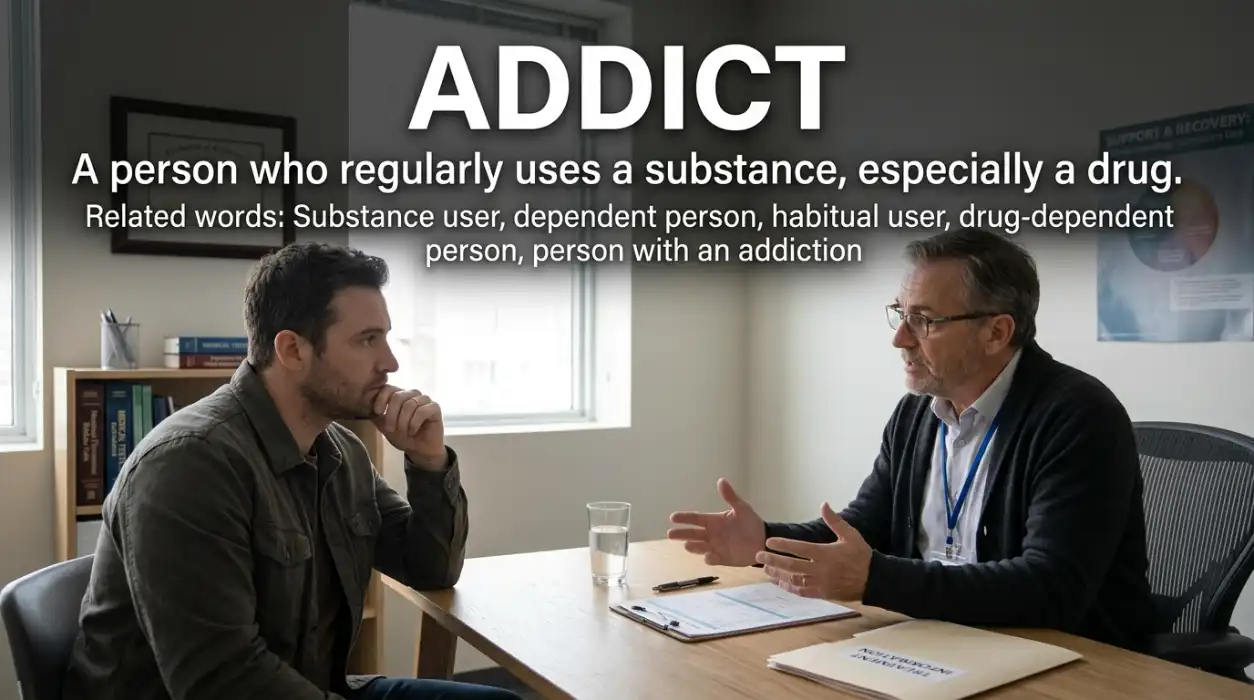
An addict is a person who has a strong dependence on a substance, activity, or behavior and finds it difficult to stop.
Cambridge defines an addict as a person who cannot stop doing or using something, particularly something harmful. It also recognizes humorous uses such as chocolate addict or shopping addict.
Part of Speech
Addict is primarily a noun when it describes a person.
- Noun: She is a recovering addict.
- Noun: He is a gambling addict.
- Verb: Some substances can addict a person.
The pronunciation also changes according to grammatical function.
As a noun:
US: /ˈæd.ɪkt/
UK: /ˈæd.ɪkt/
As a verb:
US: /əˈdɪkt/
UK: /əˈdɪkt/
Cambridge gives the same noun pronunciation in American and British English.
Simple Definition
Addict: a person who is unable or finds it very difficult to stop using a substance or engaging in a behavior.
The word can describe drug or alcohol dependence, gambling, excessive internet use, or even humorous enthusiasm for books, sports, food, or entertainment.
Native speakers understand the meaning from context. In serious health-related writing, however, a person with an addiction or a person with a substance use disorder can be more respectful than labeling someone an addict.
🧠 Connotative Meaning of “Addict”
Connotation (the emotional or cultural feeling a word carries beyond its basic dictionary meaning) matters when choosing a synonym.
Positive Tone
In informal or humorous contexts, addict can sound playful.
- “I’m a total book addict.”
- “She’s a coffee addict.”
Here, the speaker usually means “enthusiast,” not someone experiencing a serious disorder.
Negative Tone
When connected with drugs, alcohol, or harmful behavior, addict can sound judgmental or stigmatizing.
For example, drug addict may label the person by the condition. Person with a substance use disorder uses person-first language.
Neutral Tone
In some factual contexts, addict is simply descriptive. However, careful modern writing often chooses a more specific expression.
The safest choice depends on your audience, purpose, and subject.
📖 Etymology
The history of addict is surprisingly different from its modern meaning.
The English word ultimately comes from Latin addictus, the past participle of addicere, meaning “to deliver,” “assign,” “award,” or “give over.” The Latin root developed through ideas of being assigned, bound, devoted, or surrendered.
Old English: 450–1100
There was no established everyday Old English noun addict in the modern sense.
Historical sources note that Latin addictus could be glossed in Old English with forscrifen, reflecting the idea of someone formally assigned or condemned. This is important because the modern English word was not inherited as a native Old English term.
Middle English: 1100–1500
The modern English form had not yet developed into its current noun meaning.
The underlying Latin concept remained connected with being assigned, delivered over, bound, or devoted. These older meanings helped prepare the semantic path toward the later English word.
Modern English: 1500–Present
The English verb addict appeared in the 1530s with the sense of devoting or giving oneself to a habit or occupation.
The adjective addicted developed around the same period. The noun addict, meaning a person given over to a practice, appeared much later, with evidence from around 1909. The specifically drug-related sense developed in the early twentieth century.
This history explains why addict can still describe both harmful dependence and enthusiastic devotion.
Pronunciation
US: /ˈæd.ɪkt/
UK: /ˈæd.ɪkt/
Syllables
ad-dict
Affixation Pattern of “Addict”
Root: Historically related to Latin addicere and addictus.
Prefix: ad-, historically meaning “to” or “toward.”
Suffix: No productive English suffix creates the modern noun addict. Historically, Latin addictus contains a participial formation.
Modern English treats addict as an established lexical word rather than a transparent prefix-root-suffix construction.
Synonyms List
The following list includes exact or close alternatives, informal expressions, descriptive phrases, and context-specific substitutes. They are not all interchangeable in every sentence.
1. Dependent (noun/adjective) — US /dəˈpendənt/ | UK /dɪˈpendənt/
Meaning: A person who relies heavily on a substance or activity and may struggle to function without it.
Tone/Register: Neutral, formal, health-related.
Examples:
The clinic supports people who are dependent on opioids.
She became dependent on sleeping medication.
2. User (noun) — US /ˈjuːzər/ | UK /ˈjuːzə/
Meaning: A person who regularly uses a substance, especially a drug.
Tone/Register: Neutral to informal.
Examples:
The program helps young drug users find support.
He was once a regular cocaine user.
3. Drug User (noun phrase) — US /ˈdrʌɡ ˌjuːzər/ | UK /ˈdrʌɡ ˌjuːzə/
Meaning: A person who uses drugs, whether or not dependence is established.
Tone/Register: Neutral.
Examples:
The study included current drug users.
Health workers spoke with several drug users.
4. Substance User (noun phrase) — US /ˈsʌbstəns ˌjuːzər/ | UK /ˈsʌbstəns ˌjuːzə/
Meaning: A person who uses alcohol or another psychoactive substance.
Tone/Register: Formal, clinical.
Examples:
The center provides services for substance users.
Researchers interviewed people with different patterns of substance use.
5. Substance-Dependent Person (noun phrase) — US /ˈsʌbstəns dɪˈpendənt ˌpɜːrsən/ | UK /ˈsʌbstəns dɪˈpendənt ˌpɜːsən/
Meaning: A person whose physical or psychological functioning has become strongly dependent on a substance.
Tone/Register: Clinical, formal.
Examples:
The program offers treatment for substance-dependent people.
Doctors assessed each substance-dependent patient individually.
6. Person With an Addiction (noun phrase) — US /ˈpɜːrsən wɪð ən əˈdɪkʃən/ | UK /ˈpɜːsən wɪð ən əˈdɪkʃən/
Meaning: A person experiencing addiction without defining the person entirely by the condition.
Tone/Register: Neutral, respectful, professional.
Examples:
The counselor works with people with addiction.
Support can help a person with an addiction rebuild daily routines.
7. Compulsive User (noun) — US /kəmˈpʌlsɪv ˈjuːzər/ | UK /kəmˈpʌlsɪv ˈjuːzə/
Meaning: Someone who repeatedly uses something despite difficulty controlling the behavior.
Tone/Register: Formal, descriptive.
Examples:
He was described as a compulsive user of online gambling sites.
The program focuses on compulsive users.
8. Habitual User (noun) — US /həˈbɪtʃuəl ˈjuːzər/ | UK /həˈbɪtʃuəl ˈjuːzə/
Meaning: Someone who uses a substance or engages in an activity regularly.
Tone/Register: Neutral.
Examples:
He is a habitual smoker.
Habitual users may find routines difficult to change.
9. Habitual Drinker (noun) — US /həˈbɪtʃuəl ˈdrɪŋkər/ | UK /həˈbɪtʃuəl ˈdrɪŋkə/
Meaning: A person who drinks alcohol regularly, especially as an established habit.
Tone/Register: Neutral to formal.
Examples:
He had been a habitual drinker for years.
The doctor asked about his habits as a habitual drinker.
10. Problem Drinker (noun) — US /ˈprɑːbləm ˈdrɪŋkər/ | UK /ˈprɒbləm ˈdrɪŋkə/
Meaning: A person whose drinking creates significant personal, social, or health problems.
Tone/Register: Neutral, health-related.
Examples:
The support group welcomes problem drinkers.
She realized that her drinking had become a serious problem.
11. Heavy User (noun) — US /ˈhevi ˈjuːzər/ | UK /ˈhevi ˈjuːzə/
Meaning: A person who uses a substance, service, or activity much more frequently than average.
Tone/Register: Neutral, descriptive.
Examples:
He is a heavy user of social media.
Heavy users may spend several hours online each day.
12. Compulsive User (noun) — US /kəmˈpʌlsɪv ˈjuːzər/ | UK /kəmˈpʌlsɪv ˈjuːzə/
Meaning: Someone who feels a powerful and difficult-to-control urge to continue using something.
Tone/Register: Clinical, descriptive.
Examples:
The therapist works with compulsive users.
Her compulsive use of gambling apps affected her finances.
13. Junkie (noun) — US /ˈdʒʌŋki/ | UK /ˈdʒʌŋki/
Meaning: An informal word traditionally referring to someone addicted to drugs.
Tone/Register: Very informal; potentially offensive or stigmatizing.
Examples:
The movie uses the word “junkie” to portray a troubled character.
Avoid this term in respectful clinical writing.
14. Fiend (noun) — US /fiːnd/ | UK /fiːnd/
Meaning: An informal word for someone extremely dependent on or enthusiastic about something.
Tone/Register: Informal, sometimes humorous.
Examples:
He is a coffee fiend who drinks several cups before noon.
She is a fitness fiend who rarely misses a workout.
15. Fanatic (noun) — US /fəˈnætɪk/ | UK /fəˈnætɪk/
Meaning: A person with extremely strong enthusiasm for a particular interest or belief.
Tone/Register: Strong, informal to neutral.
Examples:
He is a football fanatic.
She is a fitness fanatic who trains every morning.
16. Devotee (noun) — US /ˌdevəˈtiː/ | UK /ˌdevəˈtiː/
Meaning: Someone deeply devoted to a person, activity, subject, or interest.
Tone/Register: Neutral to positive.
Examples:
She is a devoted devotee of classical music.
The restaurant attracts loyal devotees of traditional cooking.
17. Enthusiast (noun) — US /ɪnˈθuːziæst/ | UK /ɪnˈθjuːziæst/
Meaning: A person who shows strong interest and excitement about something.
Tone/Register: Positive, neutral.
Examples:
He is a photography enthusiast.
The event brought together cycling enthusiasts.
18. Aficionado (noun) — US /əˌfɪʃiəˈnɑːdoʊ/ | UK /əˌfɪʃiəˈnɑːdəʊ/
Meaning: Someone with strong knowledge and appreciation of a particular subject or activity.
Tone/Register: Sophisticated, positive.
Examples:
She is a coffee aficionado.
He is a film aficionado with an impressive collection.
19. Hobbyist (noun) — US /ˈhɑːbiɪst/ | UK /ˈhɒbiɪst/
Meaning: Someone who regularly pursues an activity for pleasure rather than as a profession.
Tone/Register: Neutral, positive.
Examples:
He is a photography hobbyist.
Many hobbyists spend weekends building models.
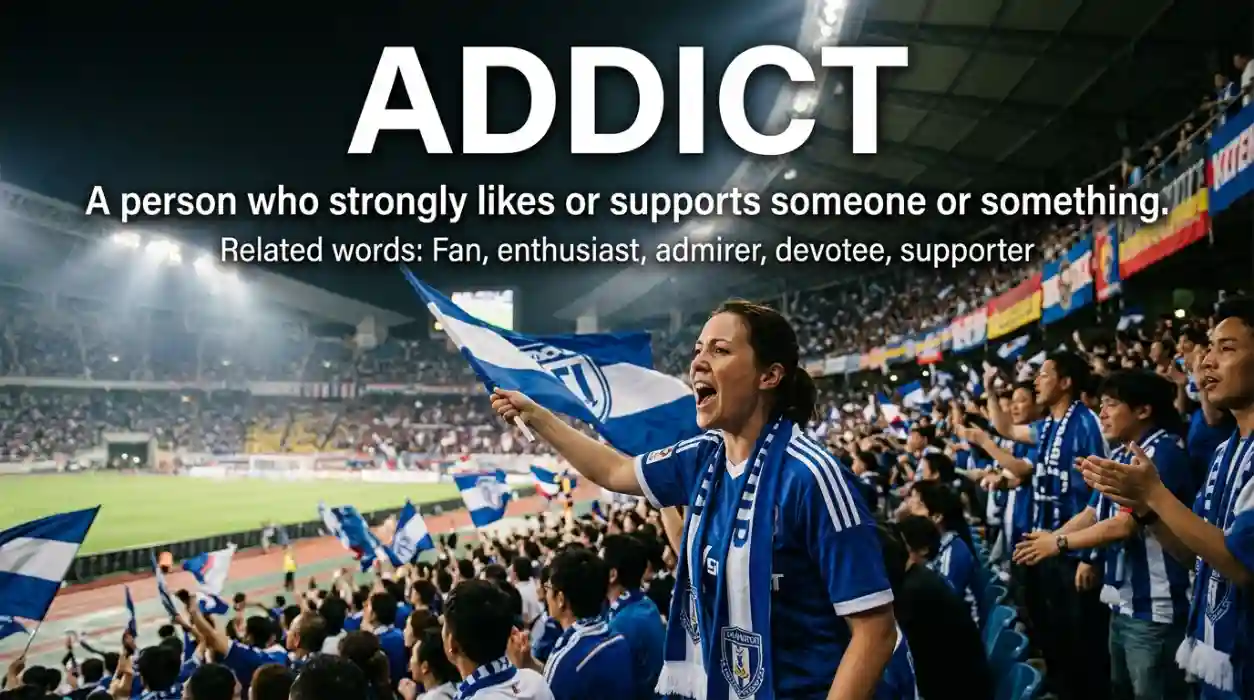
20. Fan (noun) — US /fæn/ | UK /fæn/
Meaning: A person who strongly likes or supports someone or something.
Tone/Register: Informal, neutral.
Examples:
She is a huge fan of mystery novels.
He has been a fan of the series for years.
21. Admirer (noun) — US /ədˈmaɪrər/ | UK /ədˈmaɪərə/
Meaning: A person who likes, respects, or appreciates someone or something.
Tone/Register: Neutral to positive.
Examples:
She is an admirer of modern architecture.
He has long been an admirer of the artist.
22. Follower (noun) — US /ˈfɑːloʊər/ | UK /ˈfɒləʊə/
Meaning: Someone who regularly supports or follows a person, movement, interest, or activity.
Tone/Register: Neutral.
Examples:
The musician has millions of followers online.
He became a follower of the minimalist lifestyle.
23. Regular User (noun phrase) — US /ˈreɡjələr ˈjuːzər/ | UK /ˈreɡjələ ˈjuːzə/
Meaning: Someone who uses a substance, product, service, or activity repeatedly.
Tone/Register: Neutral.
Examples:
She is a regular user of social media.
Regular users often develop familiar routines.
24. Frequent User (noun phrase) — US /ˈfriːkwənt ˈjuːzər/ | UK /ˈfriːkwənt ˈjuːzə/
Meaning: Someone who uses something often.
Tone/Register: Neutral, factual.
Examples:
He is a frequent user of online gaming platforms.
Frequent users may spend more time on the service.
25. Habitual Consumer (noun phrase) — US /həˈbɪtʃuəl kənˈsuːmər/ | UK /həˈbɪtʃuəl kənˈsjuːmə/
Meaning: Someone who repeatedly consumes a substance or product as part of a regular habit.
Tone/Register: Formal, analytical.
Examples:
The report examined habitual consumers of sugary drinks.
Habitual consumers may not notice how often they use a product.
26. Compulsive Consumer (noun phrase) — US /kəmˈpʌlsɪv kənˈsuːmər/ | UK /kəmˈpʌlsɪv kənˈsjuːmə/
Meaning: Someone who feels a difficult-to-control need to consume or purchase something repeatedly.
Tone/Register: Formal, psychological.
Examples:
The article explores compulsive consumers of online content.
Compulsive consumption can interfere with daily responsibilities.
27. Habitual Smoker (noun) — US /həˈbɪtʃuəl ˈsmoʊkər/ | UK /həˈbɪtʃuəl ˈsməʊkə/
Meaning: A person who smokes regularly as an established habit.
Tone/Register: Neutral.
Examples:
He was a habitual smoker for decades.
The doctor encouraged the habitual smoker to seek support.
28. Heavy Smoker (noun) — US /ˈhevi ˈsmoʊkər/ | UK /ˈhevi ˈsməʊkə/
Meaning: Someone who smokes a large amount or very frequently.
Tone/Register: Neutral.
Examples:
His father was a heavy smoker.
Heavy smokers may benefit from professional support when quitting.
29. Alcohol-Dependent Person (noun phrase) — US /ˈælkəhɔːl dɪˈpendənt ˈpɜːrsən/ | UK /ˈælkəhɒl dɪˈpendənt ˈpɜːsən/
Meaning: A person experiencing alcohol dependence.
Tone/Register: Clinical, formal.
Examples:
The service supports alcohol-dependent people.
Doctors created an individual treatment plan for each patient.
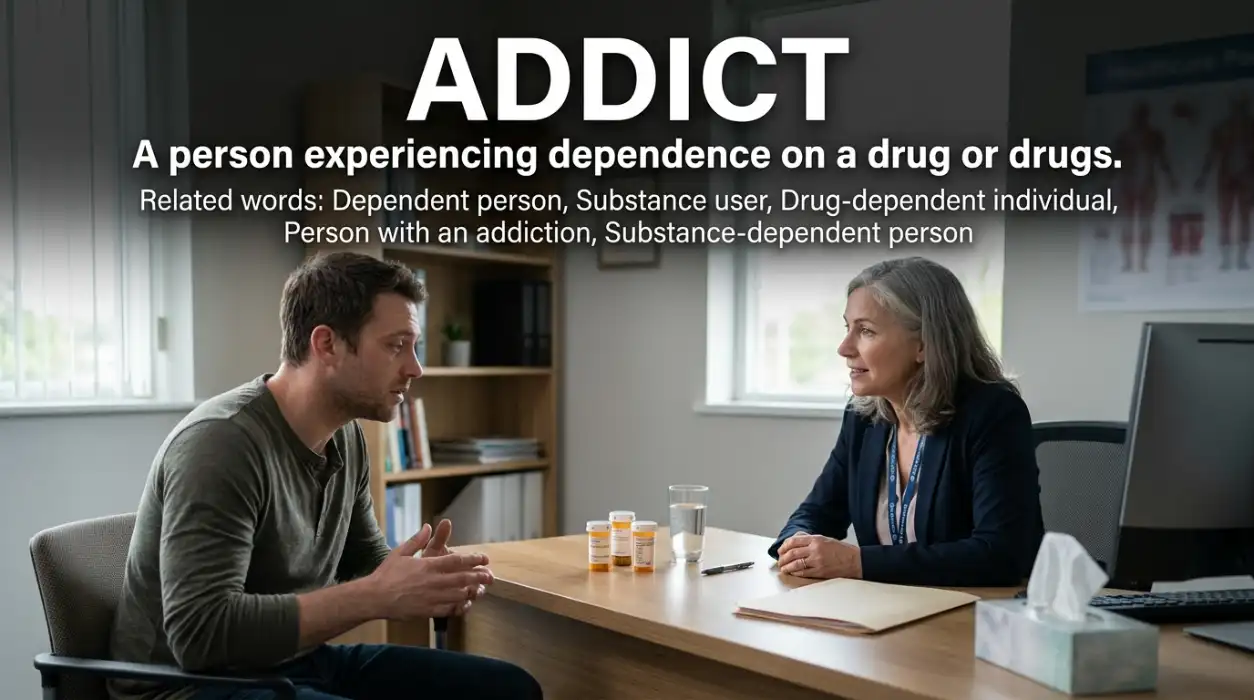
30. Drug-Dependent Person (noun phrase) — US /ˈdrʌɡ dɪˈpendənt ˈpɜːrsən/ | UK /ˈdrʌɡ dɪˈpendənt ˈpɜːsən/
Meaning: A person experiencing dependence on a drug or drugs.
Tone/Register: Clinical, formal.
Examples:
The program provides care for drug-dependent people.
Treatment can help drug-dependent patients regain stability.
31. Gambling Addict (noun phrase) — US /ˈɡæmblɪŋ ˈædɪkt/ | UK /ˈɡæmblɪŋ ˈædɪkt/
Meaning: A person whose gambling has become difficult or impossible to control.
Tone/Register: Common, direct.
Examples:
He described himself as a recovering gambling addict.
The campaign highlights the risks faced by gambling addicts.
32. Alcoholic (noun) — US /ˌælkəˈhɑːlɪk/ | UK /ˌælkəˈhɒlɪk/
Meaning: A traditional term for a person with alcohol dependence.
Tone/Register: Common but potentially stigmatizing.
Examples:
The novel describes an alcoholic struggling to change.
Modern health writing may prefer “person with alcohol use disorder.”
33. Workaholic (noun) — US /ˌwɜːrkəˈhɑːlɪk/ | UK /ˌwɜːkəˈhɒlɪk/
Meaning: An informal word for someone who works excessively and finds it difficult to stop.
Tone/Register: Informal.
Examples:
She is a self-described workaholic.
His workaholic lifestyle left little time for family.
34. Shopaholic (noun) — US /ˌʃɑːpəˈhɑːlɪk/ | UK /ˌʃɒpəˈhɒlɪk/
Meaning: An informal term for someone who shops excessively or compulsively.
Tone/Register: Informal, often playful.
Examples:
My sister jokingly calls herself a shopaholic.
The character is portrayed as a wealthy shopaholic.
35. Food Addict (noun phrase) — US /ˈfuːd ˈædɪkt/ | UK /ˈfuːd ˈædɪkt/
Meaning: An informal expression for someone who feels unable to control certain patterns of eating.
Tone/Register: Informal; use carefully in health contexts.
Examples:
He described himself as a food addict.
The documentary explores his relationship with food.
36. Social Media Addict (noun phrase) — US /ˈsoʊʃəl ˈmiːdiə ˈædɪkt/ | UK /ˈsəʊʃəl ˈmiːdiə ˈædɪkt/
Meaning: An informal description of someone who feels unable to stop using social media.
Tone/Register: Informal.
Examples:
She jokes that she is a social media addict.
He checks his phone constantly and calls himself an addict.
37. Internet Addict (noun phrase) — US /ˈɪntərnet ˈædɪkt/ | UK /ˈɪntənet ˈædɪkt/
Meaning: An informal term for someone who spends excessive or difficult-to-control amounts of time online.
Tone/Register: Informal.
Examples:
He jokingly calls himself an internet addict.
The story follows a teenager who becomes increasingly dependent on online activities.
38. Gaming Addict (noun phrase) — US /ˈɡeɪmɪŋ ˈædɪkt/ | UK /ˈɡeɪmɪŋ ˈædɪkt/
Meaning: An informal expression for someone who spends excessive time gaming.
Tone/Register: Informal.
Examples:
He calls himself a gaming addict.
The character is a gaming addict who rarely leaves his room.
39. Bookworm (noun) — US /ˈbʊkwɜːrm/ | UK /ˈbʊkwɜːm/
Meaning: A person who loves reading and spends a great deal of time with books.
Tone/Register: Informal, positive.
Examples:
She has always been a bookworm.
The little bookworm reads before bed every night.
40. Screen Addict (noun phrase) — US /ˈskriːn ˈædɪkt/ | UK /ˈskriːn ˈædɪkt/
Meaning: An informal description of someone who spends excessive time looking at digital screens.
Tone/Register: Informal.
Examples:
He jokes that he is a screen addict.
The campaign encourages screen addicts to take regular breaks.
41. News Junkie (noun phrase) — US /ˈnuːz ˌdʒʌŋki/ | UK /ˈnjuːz ˌdʒʌŋki/
Meaning: An informal person who constantly follows news and current events.
Tone/Register: Informal, often playful.
Examples:
She is a news junkie who checks several apps each morning.
As a news junkie, he rarely misses a major headline.
42. Adrenaline Junkie (noun phrase) — US /əˈdrenəlɪn ˌdʒʌŋki/ | UK /əˈdrenəlɪn ˌdʒʌŋki/
Meaning: Someone who strongly seeks exciting, risky, or thrilling experiences.
Tone/Register: Informal, playful.
Examples:
He is an adrenaline junkie who loves skydiving.
The adrenaline junkie signed up for another extreme race.
43. Thrill-Seeker (noun) — US /ˈθrɪl ˌsiːkər/ | UK /ˈθrɪl ˌsiːkə/
Meaning: A person who actively seeks exciting or risky experiences.
Tone/Register: Informal to neutral.
Examples:
The thrill-seeker planned another mountain expedition.
She has always been a thrill-seeker.
44. Obsessive (noun/adjective) — US /əbˈsesɪv/ | UK /əbˈsesɪv/
Meaning: A person or behavior characterized by persistent and excessive attention to something.
Tone/Register: Neutral to negative.
Examples:
He became obsessive about checking his phone.
Her obsessive interest affected her sleep.
45. Compulsive (noun/adjective) — US /kəmˈpʌlsɪv/ | UK /kəmˈpʌlsɪv/
Meaning: Describing behavior that feels difficult to resist or control.
Tone/Register: Formal, psychological.
Examples:
His compulsive gambling caused serious problems.
She described the behavior as compulsive.
46. Habitual (adjective) — US /həˈbɪtʃuəl/ | UK /həˈbɪtʃuəl/
Meaning: Done repeatedly because it has become an established habit.
Tone/Register: Neutral, formal.
Examples:
He was a habitual smoker.
Habitual drinking had become part of his routine.
47. Hooked (adjective) — US /hʊkt/ | UK /hʊkt/
Meaning: An informal expression meaning strongly dependent on or unable to stop something.
Tone/Register: Informal.
Examples:
He is hooked on online games.
She became hooked on the television series.
48. Dependent (adjective) — US /dɪˈpendənt/ | UK /dɪˈpendənt/
Meaning: Unable to function normally without a substance or repeated behavior.
Tone/Register: Neutral, formal.
Examples:
He became dependent on pain medication.
She was dependent on alcohol for many years.
49. Addicted Person (noun phrase) — US /əˈdɪktɪd ˈpɜːrsən/ | UK /əˈdɪktɪd ˈpɜːsən/
Meaning: A direct descriptive phrase for a person experiencing addiction.
Tone/Register: Neutral but less person-first than “person with an addiction.”
Examples:
The story follows an addicted person seeking recovery.
The organization provides support for addicted people.
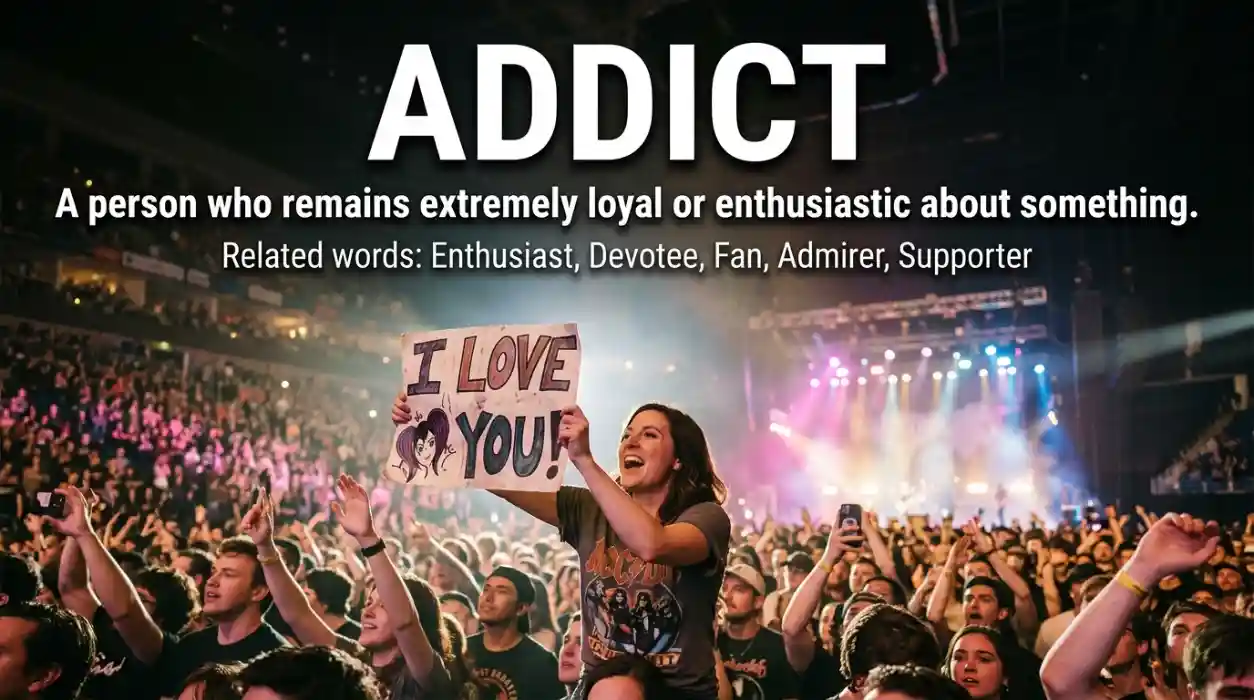
50. Diehard (noun/adjective) — US /ˈdaɪhɑːrd/ | UK /ˈdaɪhɑːd/
Meaning: A person who remains extremely loyal or enthusiastic about something.
Tone/Register: Informal, often positive.
Examples:
He is a die-hard football fan.
The die-hard supporters stayed until the final whistle.
Synonyms by Tone
Positive
Use these when the person has strong enthusiasm without implying harmful dependence:
- devotee
- enthusiast
- aficionado
- hobbyist
- fan
- admirer
- bookworm
- diehard
These words are useful for hobbies, sports, music, books, films, food, and other interests.
Neutral
Use these when you want factual or professional language:
- dependent
- habitual user
- regular user
- frequent user
- substance user
- substance-dependent person
- person with an addiction
- person with substance dependence
These choices are especially useful in reports, educational writing, and health-related content.
Negative or Strong
These expressions can suggest loss of control or serious dependence:
- junkie
- fiend
- compulsive user
- compulsive consumer
- obsessive
- alcoholic
Use them carefully. Some can sound judgmental or stigmatizing.
Playful or Informal
These words often appear in everyday speech or humorous writing:
- workaholic
- shopaholic
- news junkie
- adrenaline junkie
- gaming addict
- internet addict
- social media addict
- hooked
The playful sense is especially common when people exaggerate their enthusiasm.
Why Tone Matters When Choosing a Synonym
A synonym does more than replace a word.
Compare these sentences:
He is a drug addict.
He is a person with a substance-use problem.
He is a substance-dependent person.
The basic topic is similar, but the tone changes.
The first is direct and commonly understood. The second sounds more person-centered. The third sounds clinical.
Now consider a harmless interest:
She is a coffee addict.
She is a coffee enthusiast.
She is a coffee aficionado.
The first sounds humorous. The second sounds friendly. The third suggests knowledge and appreciation.
That difference is why good vocabulary choices depend on context.
“Addict” vs Close Alternatives
Dependent vs Addict
Addict is more direct and familiar. It can sound informal or stigmatizing in sensitive contexts.
Dependent is more neutral and clinical. It focuses on reliance rather than labeling the whole person.
Use addict in ordinary conversation when appropriate. Use dependent in formal or health-related writing when it accurately describes the situation.
Addict vs Enthusiast
An addict suggests unusually strong dependence or difficulty stopping.
An enthusiast simply means someone who strongly enjoys something.
He is a gaming addict.
This can suggest excessive or uncontrolled gaming.
He is a gaming enthusiast.
This usually sounds positive and simply describes strong interest.
Addict vs Fanatic
A fanatic has extremely strong enthusiasm. It does not necessarily involve physical or psychological dependence.
An addict normally suggests a stronger inability to stop.
She is a football fanatic.
This means she loves football intensely.
She is addicted to gambling.
This suggests a serious loss of control.
How “Addict” Changes by Context
Daily Conversation
In everyday speech, addict is often used casually.
People may say:
I’m a coffee addict.
She’s a podcast addict.
He’s addicted to that new series.
These expressions can be exaggerated and humorous.
Context tells listeners whether the speaker is discussing a real problem or simply strong enthusiasm.
Writing and Blogging
Bloggers often use addict because it is short, familiar, and emotionally strong.
However, repeated use can make writing sound dramatic or judgmental.
A lifestyle article might use:
coffee lover
instead of:
coffee addict
A health article might use:
person with an addiction
instead of:
addict
This creates a more thoughtful tone.
Professional or Academic Writing
Professional writing usually benefits from precise terminology.
Depending on the subject, alternatives such as person with an addiction, person with substance dependence, substance user, or person experiencing problematic use may be more appropriate.
Avoid using informal labels simply because they are shorter.
Creative and Informal Writing
Creative writing gives you more freedom.
Words such as junkie, fiend, fanatic, and diehard can create a stronger character voice.
For example:
He was a news junkie who could quote yesterday’s headlines from memory.
The word choice immediately creates personality.
Common Mistakes Learners Make
Mistake 1: Treating Every Synonym as Identical
Addict, enthusiast, and dependent do not have the same meaning.
A synonym must fit the context, not simply match the dictionary definition.
Mistake 2: Using “Junkie” in Formal Writing
Junkie is strongly informal.
It can also be stigmatizing. Avoid it in academic essays, medical writing, professional reports, and respectful discussions about addiction.
Mistake 3: Calling Every Enthusiast an Addict
Someone can love football without being addicted to it.
Someone can enjoy coffee without having an addiction.
Use enthusiast, fan, or devotee when you mean strong interest rather than dependence.
Mistake 4: Confusing “Addict” and “Addictive”
These words have different grammatical roles.
Addict is usually a noun.
He is an addict.
Addictive is an adjective.
The game is addictive.
Addicted is also an adjective.
She is addicted to the game.
Mistake 5: Forgetting the Preposition
The usual structure is:
addicted to something
Not:
addicted with something
For example:
He is addicted to gambling.
She became addicted to social media.
Native Usage Note
Native speakers often use addict humorously with harmless interests.
For example:
I’m a chocolate addict.
This does not necessarily mean the speaker has a clinical addiction.
The same word can therefore carry very different meanings depending on context, tone, and subject.
For sensitive topics, person-first language can sound more respectful:
a person with an addiction
rather than:
an addict
For additional vocabulary practice, an internal article about words for strong interest and enthusiasm would pair naturally with this topic.
Real-Life Mini Scenarios
Workplace
A manager might describe an employee as a workaholic when the employee regularly works late and struggles to disconnect.
For formal writing, a better description may be:
The employee frequently works beyond normal hours.
This gives information without labeling the person.
Social Situations
Someone might say:
I’m a coffee addict.
The statement is usually playful.
A more neutral version is:
I drink coffee several times a day.
The second sentence provides more precise information.
Media and Pop Culture
A character in a film might be called a junkie because the word fits informal dialogue.
A news report about addiction would normally need more careful terminology.
The genre changes the appropriate vocabulary.
Writing and Storytelling
A novelist can use fiend, fanatic, diehard, or junkie to create a memorable voice.
For example:
Maya was a news junkie who woke up before sunrise to read every headline.
The synonym adds personality without requiring a long explanation.
How to Choose the Best Synonym for “Addict”
Ask three questions before replacing addict.
- First: Is the behavior harmful?
- If yes, dependent, person with an addiction, or another precise health-related expression may be more suitable.
- Second: Is the sentence humorous?
- If yes, fiend, junkie, workaholic, or addict may work in informal contexts.
- Third: Is the person simply enthusiastic?
- If so, choose enthusiast, fan, devotee, or aficionado.
- This simple check prevents most vocabulary mistakes.
Practice Quiz
1. Your friend loves coffee and jokingly drinks six cups a day. Which word sounds most natural?
A. dependent
B. coffee addict
C. substance user
D. drug user
2. A medical report needs a respectful phrase for someone experiencing addiction. Which is best?
A. junkie
B. fiend
C. person with an addiction
D. addict
3. Someone loves football intensely but has no harmful dependence. Which word fits best?
A. fanatic
B. dependent
C. drug user
D. substance user
4. A person regularly uses a drug, but the writer does not claim dependence. Which term is most precise?
A. drug user
B. devotee
C. enthusiast
D. hobbyist
5. Someone is deeply knowledgeable about coffee and enjoys discussing its quality. Which word fits best?
A. junkie
B. aficionado
C. dependent
D. compulsive
6. A person repeatedly gambles despite serious problems. Which expression best communicates loss of control?
A. hobbyist
B. fan
C. compulsive user
D. admirer
7. A person spends almost all free time working. Which informal word is common?
A. workaholic
B. aficionado
C. bookworm
D. follower
8. Someone loves books and reads every evening. Which friendly word fits?
A. junkie
B. bookworm
C. dependent
D. user
9. A professional health article needs neutral language. Which option is safest?
A. junkie
B. fiend
C. person with an addiction
D. addict
10. Someone seeks risky and exciting experiences for fun. Which word fits?
A. thrill-seeker
B. dependent
C. habitual user
D. alcoholic
Reflection task: Write one sentence using a synonym for addict. Then rewrite the sentence with a different synonym and notice how the tone changes.
Answer key: 1-B, 2-C, 3-A, 4-A, 5-B, 6-C, 7-A, 8-B, 9-C, 10-A
External sources
For a published version, these authoritative dictionary sources are useful for checking definitions, pronunciation, usage, and word history:
- Cambridge Dictionary — addict — confirms the core noun meaning and modern usage.
- Oxford Learner’s Dictionaries — addict — useful for American English definitions and usage.
- Oxford Learner’s Dictionaries — addicted — provides the word-origin information for addicted.
- Cambridge Dictionary — pronunciation of addict — confirms US and UK pronunciation.
Conclusion
Choosing the right synonym for addict makes English more precise. The best word depends on whether you mean dependence, habit, enthusiasm, humor, or serious loss of control.
For students and writers, these distinctions make essays clearer. Bloggers can create a warmer voice, while speakers can choose words that sound natural and respectful.
A strong vocabulary is not about using the biggest words. It is about choosing the word that expresses exactly what you mean in that moment.
Practice these alternatives in emails, essays, blog posts, and daily conversations. Try one synonym today, then compare how its tone changes your sentence.
Frequently Asked Questions
1. What is the best synonym for addict in formal English?
The best formal alternative depends on meaning. For a person experiencing addiction, person with an addiction is respectful and clear. In clinical contexts, a person with substance dependence may be more precise. Avoid assuming that every person who uses a substance is dependent.
2. What is a polite way to say “drug addict”?
A more person-centered expression is a person with a drug addiction or a person with a substance-use disorder, depending on the intended meaning. These phrases focus on the person rather than defining the individual entirely by a condition. In sensitive writing, this approach is generally more respectful.
3. Is “junkie” a synonym for addict?
Yes, junkie can refer informally to a person addicted to drugs, but it is not a neutral replacement. The word is strongly informal and can sound offensive or stigmatizing. It may appear in dialogue, fiction, or quoted speech, but it should be used carefully in professional writing.
4. What is a positive synonym for addict?
If you mean someone who strongly enjoys something without suggesting harmful dependence, use enthusiast, devotee, fan, aficionado, hobbyist, or admirer. For example, coffee enthusiast sounds positive, while coffee addict is more humorous and exaggerated.
5. What is the difference between addict and enthusiast?
An addict suggests dependence or difficulty stopping, although the word is often used humorously. An enthusiast simply describes someone with strong interest or enjoyment. Calling someone an enthusiast is usually positive, while calling someone an addict can imply a problem.

Hasnain Ali is an SEO Content Strategist and the founder of wordvora.com, a trusted vocabulary platform that helps writers, students, professionals, and English learners find accurate synonyms, antonyms, word meanings, and real-life usage examples. He specializes in keyword research, on-page SEO, topical authority, and creating search-first content that aligns with Google’s latest Search Quality and E-E-A-T guidelines. His work focuses on producing clear, well-structured, and reader-friendly resources that satisfy search intent while maintaining high editorial standards.
Through extensive hands-on experience with SEO tools such as Google Search Console, Google Analytics, SEMrush, and Ahrefs, Hasnain researches user search behavior and develops content that is both informative and easy to understand. Every article published on wordvora.com is carefully reviewed for accuracy, readability, and contextual relevance before publication. His mission is to build one of the web’s most reliable English vocabulary resources by providing practical language guidance, trustworthy explanations, and content that helps readers improve their writing, communication, and vocabulary with confidence.