
Synonym for days depends on the meaning you want. Useful alternatives include periods, times, dates, eras, ages, daylight hours, weekdays, workdays, stretches, and daily periods. Each fits a different context, so choosing the right alternative makes your English more precise.
You check your calendar and realize the exam is only three days away. In another sentence, “days” might mean an old historical period. The same word can carry several meanings.
That is why learning a synonym for days can make your English more flexible. Students, bloggers, and writers can avoid repetition while keeping their meaning clear and natural.
The word “days” appears constantly in everyday English because it describes time, routines, dates, history, and ordinary life. Daily English users need it often.
For example, “I will finish it in three days” and “In those days, people traveled differently” use the same word in very different ways.
What Does “Days” Really Mean?
Days is the plural form of day. Its basic meaning is a collection of 24-hour periods, but English uses the word in several broader senses.
A day can mean:
- A period of 24 hours
- The part of a 24-hour period when there is daylight
- A particular date
- A period of someone’s life
- A historical period
- A working period
- A repeated period of ordinary activity
For example:
I will call you in two days.
Here, days means 24-hour periods.
But consider:
In those days, people wrote letters more often.
Here, days means a period in the past.
Cambridge lists these different senses, including a 24-hour period, daylight hours, working time, and a period in history. It also gives related expressions such as “day after day,” “day by day,” and “these days.”
Part of Speech
Days is a plural countable noun.
Singular:
day
Plural:
days
It can appear in many common structures:
- three days
- several days
- those days
- these days
- the old days
- working days
- summer days
- difficult days
How Native Speakers Understand “Days”
Native speakers usually understand the intended meaning from context.
If someone says:
I will be there in five days.
They mean five 24-hour periods.
If they say:
In my younger days, I played football.
They mean a period of their life.
If they say:
Those were the days.
They are referring nostalgically to an earlier period.
That context-based flexibility is one reason days is such a useful word.
Connotative Meaning
Connotation (the emotional feeling or association connected with a word beyond its basic literal meaning) can change depending on the expression.
Positive Tone
“Days” can suggest happiness, freedom, youth, or nostalgia.
Example:
Those were some of the happiest days of my life.
Negative Tone
It can also suggest difficulty, hardship, or sadness.
Example:
She went through some difficult days after the accident.
Neutral Tone
In schedules and factual statements, the word is usually neutral.
Example:
The course lasts ten days.
The emotional meaning often comes from the adjective or surrounding phrase rather than from days itself.
Etymology of “Days”
The word day is extremely old. It comes from Old English dæg, which referred to the period when the sun was above the horizon and could also refer to a lifetime or definite period of existence. Its deeper history is connected with Proto-Germanic forms such as dages-.
Old English: 450–1100
Old English used dæg for daylight and for a period of time. The meaning was already broader than simply “sunlight.”
Over time, the concept expanded toward the 24-hour period familiar in modern English.
Middle English: 1100–1500
During Middle English, forms related to day continued to develop.
Expressions involving repeated or historical time also became established. The word increasingly worked as both a literal measure of time and a broader reference to a period.
Modern English: 1500–Present
Modern English uses day and days in an enormous range of expressions.
These include:
- these days
- in those days
- day by day
- day after day
- day and night
- day off
- one day
- one of these days
- nowadays
Many of these expressions are now ordinary parts of everyday English.
Pronunciation
Days — US: /deɪz/
Days — UK: /deɪz/
Day — US: /deɪ/
Day — UK: /deɪ/
Syllables
days
One syllable.
Affixation Pattern of “Days”
Root: day
Prefix: none
Suffix: -s, marking the plural.
The singular word is day. Adding -s creates days.
List of Synonyms
Important: There is no single list of perfect replacements for days. The word has several meanings. The alternatives below include direct semantic equivalents, context-specific substitutes, and phrases that native speakers use when “days” has a particular meaning.
1. Periods (Noun) — US /ˈpɪr.i.ədz/ — UK /ˈpɪə.ri.ədz/
Meaning: Periods are stretches of time and can replace “days” when the exact number of days is not important.
Tone/Register: Neutral, formal.
Examples:
The project went through several difficult periods.
She remembers those periods clearly.
2. Times (Noun) — US /taɪmz/ — UK /taɪmz/
Meaning: Times refers broadly to periods or circumstances, especially in expressions about the past or present.
Tone/Register: Neutral, versatile.
Examples:
These are challenging times.
People behaved differently in those times.
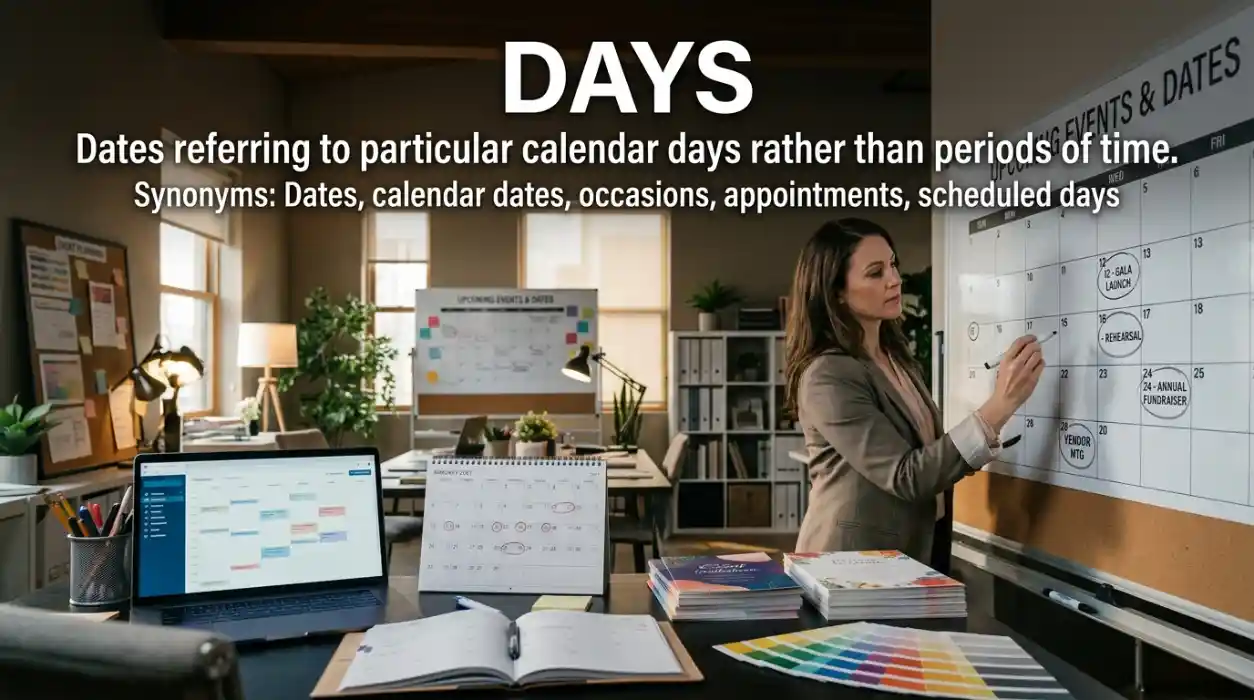
3. Dates (Noun) — US /deɪts/ — UK /deɪts/
Meaning: Dates refer to particular calendar days rather than periods of time.
Tone/Register: Neutral, practical.
Examples:
Please check the important dates.
We agreed on three possible dates.
4. Eras (Noun) — US /ˈɪr.əz/ — UK /ˈɪə.rəz/
Meaning: Eras are long and clearly defined periods in history.
Tone/Register: Formal, academic.
Examples:
The invention changed an entire era.
Historians often divide the period into different eras.
5. Ages (Noun) — US /ˈeɪ.dʒɪz/ — UK /ˈeɪ.dʒɪz/
Meaning: Ages are very long historical or cultural periods.
Tone/Register: Literary, historical.
Examples:
The building has survived for ages.
People have told this story for ages.
6. Epochs (Noun) — US /ˈɛp.əkz/ — UK /ˈiː.pɒks/
Meaning: Epochs are significant periods marked by particular developments or characteristics.
Tone/Register: Formal, academic.
Examples:
The discovery marked a new epoch.
The book describes two major historical epochs.
7. Spans (Noun) — US /spænz/ — UK /spænz/
Meaning: Spans are lengths or stretches of time.
Tone/Register: Neutral, academic.
Examples:
The study covered short time spans.
The illness lasted for several weeks and extended across long spans.
8. Stretches (Noun) — US /stretʃɪz/ — UK /stretʃɪz/
Meaning: Stretches are continuous periods of time.
Tone/Register: Informal, neutral.
Examples:
I worked for three long stretches without a break.
She had several busy stretches during the semester.
9. Intervals (Noun) — US /ˈɪn.t̬ɚ.vəlz/ — UK /ˈɪn.tə.vəlz/
Meaning: Intervals are periods between events or activities.
Tone/Register: Formal, technical.
Examples:
The treatment was given at regular intervals.
There were short intervals between meetings.
10. Durations (Noun) — US /duˈreɪ.ʃənz/ — UK /djʊˈreɪ.ʃənz/
Meaning: Durations describe how long something continues.
Tone/Register: Formal, academic.
Examples:
The study measured different durations.
The treatments had different durations.
11. Daylight Hours (Noun Phrase) — US /ˈdeɪ.laɪt aʊrz/ — UK /ˈdeɪ.laɪt aʊəz/
Meaning: Daylight hours are the part of the day when natural light is present.
Tone/Register: Neutral.
Examples:
The birds are most active during daylight hours.
We traveled during the daylight hours.
12. Daytime (Noun) — US /ˈdeɪ.taɪm/ — UK /ˈdeɪ.taɪm/
Meaning: Daytime means the part of the day when it is light rather than night.
Tone/Register: Neutral.
Examples:
The museum is quieter during the daytime.
Some animals sleep during the daytime.
13. Workdays (Noun) — US /ˈwɝːk.deɪz/ — UK /ˈwɜːk.deɪz/
Meaning: Workdays are days when people normally work.
Tone/Register: Business, everyday.
Examples:
The repair should take three workdays.
I usually exercise after my workdays.
14. Weekdays (Noun) — US /ˈwiːk.deɪz/ — UK /ˈwiːk.deɪz/
Meaning: Weekdays are the ordinary working days from Monday through Friday in many contexts.
Tone/Register: Neutral.
Examples:
The office is open on weekdays.
I take the train on weekdays.
15. Weekends (Noun) — US /ˌwiːkˈɛndz/ — UK /ˌwiːkˈendz/
Meaning: Weekends are Saturday and Sunday or the customary days of rest in a workweek.
Tone/Register: Everyday.
Examples:
We visit our grandparents on weekends.
The store gets busy on weekends.
16. Working Days (Noun Phrase) — US /ˈwɝːkɪŋ deɪz/ — UK /ˈwɜːkɪŋ deɪz/
Meaning: Working days are days counted as normal business or workdays.
Tone/Register: Business, formal.
Examples:
The application takes five working days.
Please allow three working days for a response.
17. Business Days (Noun Phrase) — US /ˈbɪz.nəs deɪz/ — UK /ˈbɪz.nəs deɪz/
Meaning: Business days are days on which businesses or offices normally operate.
Tone/Register: Business, formal.
Examples:
The payment should arrive within two business days.
The office will respond within five business days.
18. Calendar Days (Noun Phrase) — US /ˈkæl.ən.dɚ deɪz/ — UK /ˈkæl.ən.də deɪz/
Meaning: Calendar days count every day on the calendar, including weekends and holidays.
Tone/Register: Administrative, formal.
Examples:
The notice period is thirty calendar days.
The deadline falls ten calendar days after the announcement.
19. Twenty-Four-Hour Periods (Noun Phrase) — US /ˈtwenti fɔːr aʊr ˈpɪr.i.ədz/ — UK /ˈtwenti fɔːr aʊə ˈpɪə.ri.ədz/
Meaning: This phrase gives the precise literal meaning of a day as a full 24-hour period.
Tone/Register: Formal, technical.
Examples:
The experiment lasted three twenty-four-hour periods.
Samples were collected during separate twenty-four-hour periods.
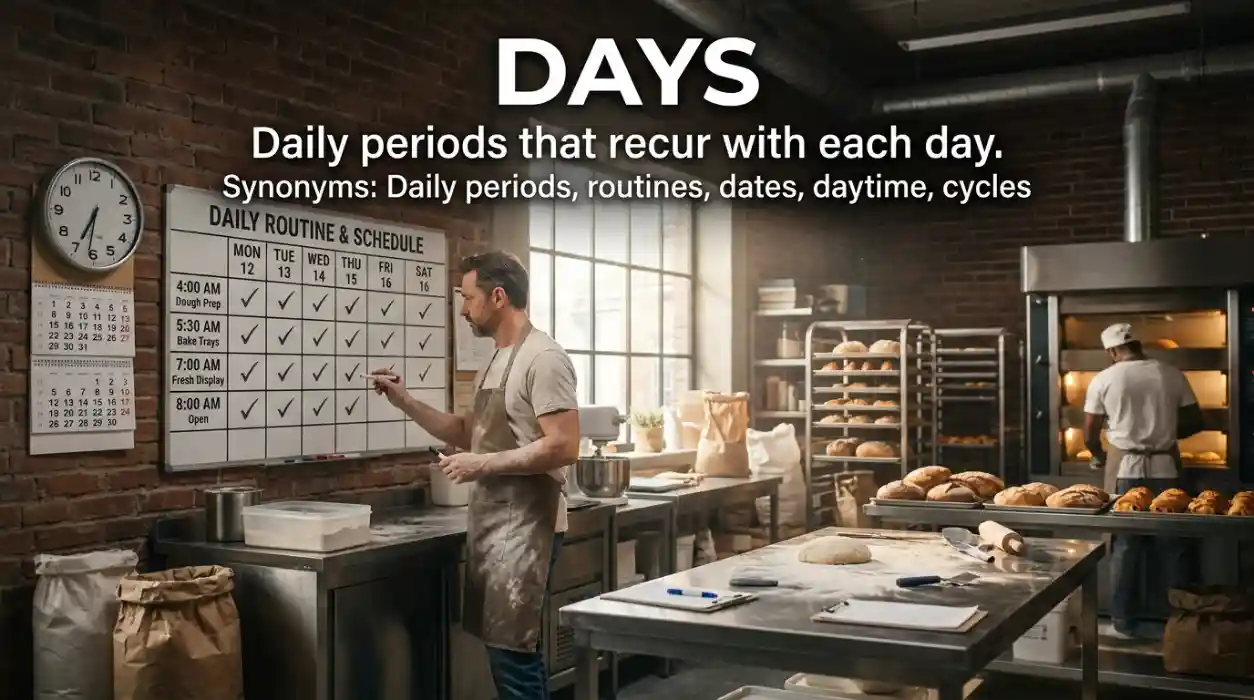
20. Daily Periods (Noun Phrase) — US /ˈdeɪ.li ˈpɪr.i.ədz/ — UK /ˈdeɪ.li ˈpɪə.ri.ədz/
Meaning: Daily periods are recurring periods associated with each day.
Tone/Register: Technical.
Examples:
The readings were taken during daily periods.
The researchers compared the daily periods.
21. Mornings (Noun) — US /ˈmɔːr.nɪŋz/ — UK /ˈmɔː.nɪŋz/
Meaning: Mornings are the early parts of days.
Tone/Register: Everyday.
Examples:
I enjoy quiet mornings.
The meetings usually happen on Monday mornings.
22. Afternoons (Noun) — US /ˌæf.tɚˈnuːnz/ — UK /ˌɑːf.təˈnuːnz/
Meaning: Afternoons are the parts of days between midday and evening.
Tone/Register: Everyday.
Examples:
The library is busy on afternoons.
We spent several afternoons studying together.
23. Evenings (Noun) — US /ˈiːv.nɪŋz/ — UK /ˈiːv.nɪŋz/
Meaning: Evenings are the later parts of days before nighttime.
Tone/Register: Everyday.
Examples:
We usually cook together in the evenings.
The park is beautiful on summer evenings.
24. Dawn-to-Dusk Periods (Noun Phrase) — US /dɔːn tə dʌsk ˈpɪr.i.ədz/ — UK /dɔːn tə dʌsk ˈpɪə.ri.ədz/
Meaning: This phrase describes periods extending from sunrise or dawn to sunset or dusk.
Tone/Register: Literary, descriptive.
Examples:
Farmers often work through dawn-to-dusk periods.
The journey continued through several dawn-to-dusk periods.
25. Today (Noun/Adverb) — US /təˈdeɪ/ — UK /təˈdeɪ/
Meaning: Today refers specifically to the current day.
Tone/Register: Everyday.
Examples:
I have a meeting today.
Today feels much warmer than yesterday.
26. Tomorrow (Noun/Adverb) — US /təˈmɑː.roʊ/ — UK /təˈmɒr.əʊ/
Meaning: Tomorrow refers to the day immediately after today.
Tone/Register: Everyday.
Examples:
We will finish it tomorrow.
Tomorrow is another busy day.
27. Yesterday (Noun/Adverb) — US /ˈjes.tɚ.deɪ/ — UK /ˈjes.tə.deɪ/
Meaning: Yesterday refers to the day immediately before today.
Tone/Register: Everyday.
Examples:
I saw her yesterday.
Yesterday was much colder.
28. Yesterdays (Noun) — US /ˈjes.tɚ.deɪz/ — UK /ˈjes.tə.deɪz/
Meaning: Yesterdays is a poetic plural referring to past days or memories.
Tone/Register: Literary, poetic.
Examples:
He often thinks about his yesterdays.
The song brings back forgotten yesterdays.
29. Nowadays (Adverb) — US /ˈnaʊ.ə.deɪz/ — UK /ˈnaʊ.ə.deɪz/
Meaning: Nowadays means at the present time, especially when comparing the present with the past.
Tone/Register: Neutral, conversational.
Examples:
Nowadays, people communicate instantly.
Nowadays, many students study online.
30. Present Times (Noun Phrase) — US /ˈprez.ənt taɪmz/ — UK /ˈprez.ənt taɪmz/
Meaning: Present times refers to the current period.
Tone/Register: Formal, literary.
Examples:
Technology shapes our present times.
The issue matters greatly in present times.
31. Current Times (Noun Phrase) — US /ˈkɝː.ənt taɪmz/ — UK /ˈkʌr.ənt taɪmz/
Meaning: Current times means the period we are living through now.
Tone/Register: Neutral, formal.
Examples:
Life moves quickly in current times.
These issues are especially relevant in current times.
32. Modern Times (Noun Phrase) — US /ˈmɑː.dɚn taɪmz/ — UK /ˈmɒ.dən taɪmz/
Meaning: Modern times refers broadly to the contemporary world.
Tone/Register: Neutral, historical.
Examples:
Communication has changed dramatically in modern times.
The custom has survived into modern times.
33. Former Times (Noun Phrase) — US /ˈfɔːr.mɚ taɪmz/ — UK /ˈfɔː.mə taɪmz/
Meaning: Former times refers to earlier periods.
Tone/Register: Formal, literary.
Examples:
The building looked very different in former times.
Stories from former times still influence the culture.
34. Earlier Times (Noun Phrase) — US /ˈɝː.li.ɚ taɪmz/ — UK /ˈɜː.li.ə taɪmz/
Meaning: Earlier times means periods before the present or another reference point.
Tone/Register: Neutral.
Examples:
In earlier times, travel was much slower.
The village looked different in earlier times.
35. Past Times (Noun Phrase) — US /pæst taɪmz/ — UK /pɑːst taɪmz/
Meaning: Past times refers generally to periods that have already ended.
Tone/Register: Neutral, literary.
Examples:
The museum tells stories from past times.
He enjoys reading about past times.
36. Bygone Days (Noun Phrase) — US /ˈbaɪ.ɡɑːn deɪz/ — UK /ˈbaɪ.ɡɒn deɪz/
Meaning: Bygone days refers nostalgically to times that have passed.
Tone/Register: Literary, nostalgic.
Examples:
The photographs reminded her of bygone days.
The novel celebrates the charm of bygone days.
37. Old Days (Noun Phrase) — US /oʊld deɪz/ — UK /əʊld deɪz/
Meaning: Old days refers informally to a period in the past.
Tone/Register: Informal, nostalgic.
Examples:
My grandfather often talks about the old days.
Things were different in the old days.
38. Former Days (Noun Phrase) — US /ˈfɔːr.mɚ deɪz/ — UK /ˈfɔː.mə deɪz/
Meaning: Former days means earlier days or a previous period.
Tone/Register: Formal, literary.
Examples:
She remembered her former days at school.
The town was smaller in former days.
39. Good Old Days (Noun Phrase) — US /ɡʊd oʊld deɪz/ — UK /ɡʊd əʊld deɪz/
Meaning: The good old days refers nostalgically to a period remembered as better or happier.
Tone/Register: Informal, nostalgic.
Examples:
He loves talking about the good old days.
We laughed about the good old days at university.
40. Golden Days (Noun Phrase) — US /ˈɡoʊl.dən deɪz/ — UK /ˈɡəʊl.dən deɪz/
Meaning: Golden days refers to a particularly happy, successful, or memorable period.
Tone/Register: Literary, positive.
Examples:
Those were the golden days of the club.
She remembers her golden days as a young athlete.

41. Prime (Noun) — US /praɪm/ — UK /praɪm/
Meaning: A person’s prime is the period when they are at their strongest, most successful, or most active.
Tone/Register: Neutral, literary.
Examples:
He was a talented athlete in his prime.
The company grew rapidly during its prime.
42. Heyday (Noun) — US /ˈheɪ.deɪ/ — UK /ˈheɪ.deɪ/
Meaning: Heyday means a period when someone or something was especially successful or popular.
Tone/Register: Neutral, literary.
Examples:
The theater was famous in its heyday.
The band attracted huge crowds in its heyday.
43. Lifetime (Noun) — US /ˈlaɪf.taɪm/ — UK /ˈlaɪf.taɪm/
Meaning: Lifetime means the entire period during which a person or thing exists.
Tone/Register: Neutral.
Examples:
She learned many languages during her lifetime.
The museum has changed dramatically in my lifetime.
44. Generation (Noun) — US /ˌdʒen.əˈreɪ.ʃən/ — UK /ˌdʒen.əˈreɪ.ʃən/
Meaning: A generation is a broad period associated with people born or living around the same time.
Tone/Register: Neutral, academic.
Examples:
The technology transformed an entire generation.
The tradition has lasted for generations.
45. Season (Noun) — US /ˈsiː.zən/ — UK /ˈsiː.zən/
Meaning: A season can describe a period of activity or development, especially in sports, entertainment, or life.
Tone/Register: Neutral, figurative.
Examples:
The team had a difficult season.
She went through a quiet season in her career.
46. Spell (Noun) — US /spel/ — UK /spel/
Meaning: A spell is a relatively short, continuous period of a particular activity or condition.
Tone/Register: Informal, British-influenced.
Examples:
We had a spell of warm weather.
He spent a short spell working abroad.
47. While (Noun) — US /waɪl/ — UK /waɪl/
Meaning: A while means a period of time, usually an unspecified length.
Tone/Register: Everyday.
Examples:
I haven’t seen you for a while.
Stay here for a while.
48. Time (Noun) — US /taɪm/ — UK /taɪm/
Meaning: Time is a broad word for a period or duration and can replace “days” when the exact length is unimportant.
Tone/Register: Neutral, extremely versatile.
Examples:
We spent a wonderful time together.
Things were different at that time.
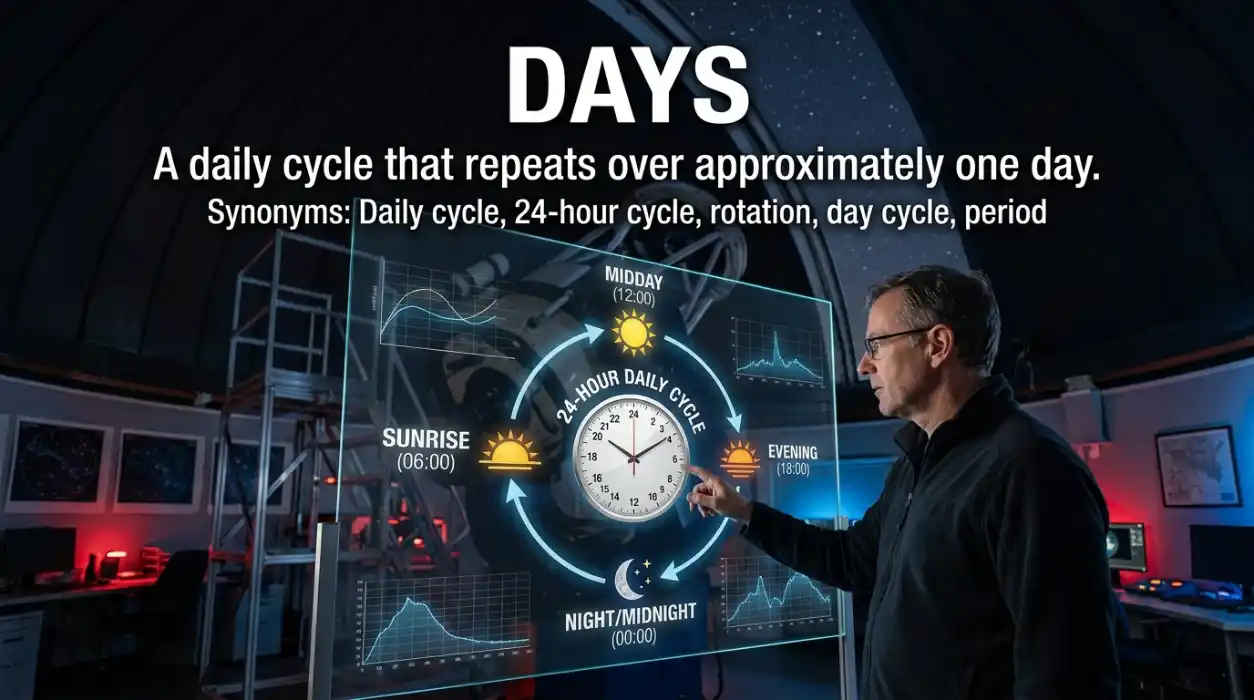
49. Daily Cycle (Noun Phrase) — US /ˈdeɪ.li ˈsaɪ.kəl/ — UK /ˈdeɪ.li ˈsaɪ.kəl/
Meaning: A daily cycle is a repeating sequence that occurs over approximately one day.
Tone/Register: Scientific, technical.
Examples:
Plants respond to the daily cycle of light and darkness.
The system follows a regular daily cycle.
50. Twenty-Four-Hour Cycle (Noun Phrase) — US /ˈtwenti fɔːr aʊr ˈsaɪ.kəl/ — UK /ˈtwenti fɔːr aʊə ˈsaɪ.kəl/
Meaning: A twenty-four-hour cycle describes one complete cycle corresponding to a day.
Tone/Register: Scientific, technical.
Examples:
The body follows a roughly twenty-four-hour cycle.
The machine repeats the process every twenty-four-hour cycle.
Synonyms by Tone
Positive
Use these when the idea of days carries happiness, nostalgia, or success:
- golden days
- good old days
- heyday
- prime
- happy periods
- bygone days
These words can create warmth or nostalgia.
Neutral
These work in ordinary descriptions:
- periods
- times
- dates
- spans
- stretches
- weekdays
- workdays
- time
- while
They are useful when you want clear, natural English.
Negative
The word itself does not have to be negative. The surrounding expression creates the feeling.
Examples include:
- difficult periods
- hard times
- troubled times
- dark days
- challenging periods
- bad spells
These expressions are useful when discussing hardship or struggle.
Playful or Informal
For casual English, try:
- old days
- good old days
- a while
- a spell
- those days
These are especially natural in conversation and storytelling.
“Days” vs Close Alternatives
Periods vs Days
Days is more specific when you mean actual calendar days.
The course lasts five days.
Periods is broader.
The company went through several difficult periods.
Use periods when the exact number of days does not matter.
Days vs Times
Times often refers to a general historical or social period.
People lived differently in those times.
“Days” can do this too, but often sounds more conversational.
Days vs Dates
A date identifies a particular point on the calendar.
What date is the meeting?
A day can refer to the same calendar occasion in ordinary speech.
What day is the meeting?
However, “date” is more precise when the calendar number or exact appointment matters.
Days vs Eras
An era is much longer and more historically significant.
The Roman era lasted centuries.
It would be inaccurate to use “era” for a normal three-day period.
How “Days” Changes by Context
Daily Conversation
In everyday speech, days is usually the simplest choice.
I haven’t slept well for three days.
Native speakers would not normally replace it with a formal word such as “periods.”
Writing and Blogging
Writers may use alternatives to prevent repetition.
Instead of:
In those days, people lived differently. Those days were difficult.
Try:
In that period, people lived differently. Those were challenging times.
The change makes the paragraph smoother.
Professional or Academic Writing
Precision matters more in formal writing.
Use calendar days, business days, working days, periods, intervals, or durations when the exact meaning requires them.
For example:
The study continued for fourteen calendar days.
That is more precise than simply saying:
The study continued for fourteen days.
Creative or Informal Use
Creative writing often benefits from emotional alternatives.
Compare:
She remembered those days.
with:
She remembered the golden days of her childhood.
The second version adds emotion and imagery.
Common Mistakes and Native Usage
Mistake 1: Using “dates” for every meaning of days
A date identifies a particular calendar point.
“Days” can describe a duration.
Correct:
I will stay for five days.
Not:
I will stay for five dates.
Mistake 2: Using “eras” for short periods
An era usually suggests a long historical period.
Avoid:
I waited for three eras.
Use:
I waited for three days.
Mistake 3: Confusing “daily” with “days”
Daily means happening every day.
Days refers to multiple days.
Correct:
I exercise daily.
I exercised for five days.
Mistake 4: Overusing “period”
“Period” is useful, but it can sound formal when “days” is perfectly natural.
Natural:
I will return in three days.
More formal:
I will return within a three-day period.
The second sentence is not automatically better.
Mistake 5: Ignoring the difference between “workdays” and “calendar days”
If someone says “five working days,” weekends may not be included.
If someone says “five calendar days,” every calendar day is counted.
This distinction matters in professional communication.
Register Notes
Formal
- periods
- epochs
- durations
- intervals
- calendar days
- business days
- twenty-four-hour periods
Neutral
- days
- times
- dates
- spans
- stretches
- weekdays
- workdays
Informal
- a while
- a spell
- old days
- good old days
Literary
- bygone days
- golden days
- former days
- yesterdays
- ages
For related vocabulary practice, an internal article on synonyms for time would pair naturally with this topic.
Real-Life Mini Scenarios
Workplace
A manager says:
The report will be ready in three working days.
Here, working days is more precise than simply saying “days.”
Social Situation
A friend says:
I haven’t seen you in ages!
The word ages is not literal. It simply means a long time.
Media and Pop Culture
A documentary might say:
The band reached its heyday in the 1990s.
Here, heyday describes the period of greatest popularity.
Writing and Storytelling
A novelist might write:
In those bygone days, the village was surrounded by fields.
The phrase creates a historical and nostalgic feeling.
Why Choosing the Right Synonym Matters
A synonym is not just a replacement word.
It changes the focus.
Days emphasizes ordinary units of time.
Periods emphasizes duration.
Dates emphasizes specific calendar points.
Eras emphasizes historical significance.
Workdays emphasizes employment schedules.
Golden days emphasizes positive memories.
Heyday emphasizes peak success.
- This is why strong vocabulary is about precision rather than using the longest or most sophisticated word available.
- For students, this distinction can improve essays.
- For bloggers, it can make articles less repetitive.
- For content writers, it can improve tone.
- For everyday speakers, it can make communication more natural.
Practice Exercise
1. You mean five normal 24-hour periods. Which word is best?
A. Eras
B. Days
C. Epochs
D. Ages
2. You are talking about a specific calendar occasion. Which word fits best?
A. Date
B. Era
C. Span
D. Heyday
3. A company needs three normal office days to process a request. Which phrase is clearest?
A. Three eras
B. Three golden days
C. Three business days
D. Three ages
4. You are describing a major historical period. Which word is strongest?
A. While
B. Era
C. Morning
D. Workday
5. Which expression describes a successful period?
A. Heyday
B. Interval
C. Calendar day
D. Date
6. Which word means a period between events?
A. Interval
B. Generation
C. Golden day
D. Date
7. Which expression has a nostalgic feeling?
A. Business days
B. Calendar days
C. Good old days
D. Twenty-four-hour periods
8. Which sentence sounds most natural in everyday English?
A. I will return in three epochs.
B. I will return in three days.
C. I will return in three eras.
D. I will return in three durations.
9. Which phrase refers specifically to Monday through Friday in a typical workweek?
A. Weekdays
B. Epochs
C. Ages
D. Yesterdays
10. Which word means the period when someone or something was most successful?
A. Interval
B. Heyday
C. Date
D. Duration
Answer key: 1-B | 2-A | 3-C | 4-B | 5-A | 6-A | 7-C | 8-B | 9-A | 10-B
Reflection Task
Write one sentence using days, then rewrite it with a more precise alternative such as periods, dates, times, workdays, eras, heyday, or bygone days.
External Reference
Cambridge Dictionary is particularly useful for the multiple meanings and common expressions associated with day, while Etymonline provides historical information about its Old English and Germanic origins. Cambridge Dictionary — day Etymonline — day
Conclusion
Learning a synonym for days is really about understanding context. Words like periods, dates, times, and eras each highlight a different meaning of time.
Good vocabulary does not mean replacing simple words with difficult ones. It means choosing the clearest word for the exact idea, tone, and audience.
These alternatives can strengthen essays, blogs, emails, stories, and everyday conversations. They also help writers avoid repeating “days” when a more precise phrase would work better.
Practice these words in your own sentences today. Try them in an email, essay, or conversation, and notice how each choice changes the meaning.
FAQs
1. What is the best synonym for days in a sentence?
The best synonym depends on what “days” means in the sentence. Periods works for stretches of time, dates works for specific calendar points, times works for general periods, and eras works for long historical periods. In ordinary conversation, however, days is often the clearest and most natural choice.
2. What is a synonym for days in the past?
Common alternatives include old days, bygone days, former days, earlier times, past times, and those times. The best choice depends on tone. “Old days” sounds conversational, while “bygone days” sounds more literary and nostalgic. “Earlier times” is more neutral and works well in educational or historical writing.
3. What can I say instead of “a few days”?
Depending on the context, you can say a short period, a few days’ time, several days, a brief stretch, or a short while. These are not exact equivalents in every sentence. If the exact number matters, keeping “a few days” is usually clearer than replacing it with a more general expression.
4. What is a formal synonym for days?
Formal alternatives include periods, durations, calendar days, working days, business days, intervals, and twenty-four-hour periods. The correct choice depends on meaning. In academic or professional writing, precision matters more than simply avoiding repetition. Do not use a formal alternative if “days” communicates the idea more clearly.
5. What is a synonym for days in historical writing?
Historical writing commonly uses eras, ages, epochs, periods, earlier times, former times, bygone days, and past times. “Era” and “epoch” suggest significant historical divisions. “Bygone days” creates a nostalgic literary tone. “Period” is usually the safest neutral choice for academic history writing.

Hasnain Ali is an SEO Content Strategist and the founder of wordvora.com, a trusted vocabulary platform that helps writers, students, professionals, and English learners find accurate synonyms, antonyms, word meanings, and real-life usage examples. He specializes in keyword research, on-page SEO, topical authority, and creating search-first content that aligns with Google’s latest Search Quality and E-E-A-T guidelines. His work focuses on producing clear, well-structured, and reader-friendly resources that satisfy search intent while maintaining high editorial standards.
Through extensive hands-on experience with SEO tools such as Google Search Console, Google Analytics, SEMrush, and Ahrefs, Hasnain researches user search behavior and develops content that is both informative and easy to understand. Every article published on wordvora.com is carefully reviewed for accuracy, readability, and contextual relevance before publication. His mission is to build one of the web’s most reliable English vocabulary resources by providing practical language guidance, trustworthy explanations, and content that helps readers improve their writing, communication, and vocabulary with confidence.