
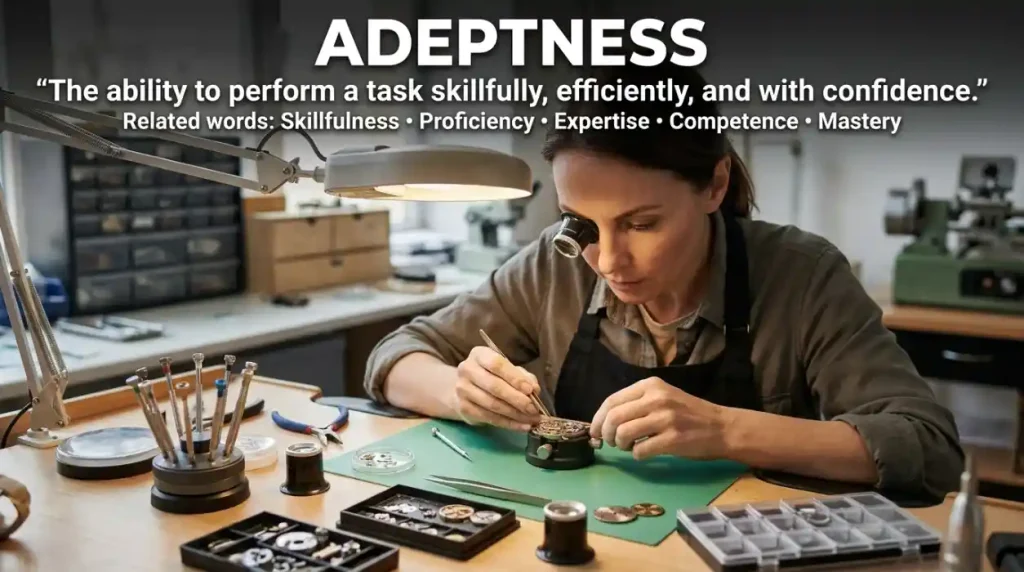
A synonym for adeptness is proficiency, skill, expertise, or competence. These words describe the ability to perform a task well. Some emphasize practical experience, while others highlight natural talent, technical knowledge, or precise execution. The best alternative depends on the skill being described and the level of ability you want to express.
Imagine a colleague who can solve a difficult technical problem in minutes. You might describe their adeptness, but technical expertise could communicate the same idea more clearly in a professional report.
The phrase synonym for adeptness is useful when you want to describe someone’s skill without repeating the same word. A carefully chosen alternative makes your meaning more precise.
Students can use these words in essays and assignments. Bloggers and content writers can improve descriptions, while everyday English users can express admiration for someone’s abilities more naturally.
Adeptness often appears in discussions about work, learning, communication, creativity, and performance. Learning its alternatives helps you explain not only that someone is skilled, but also how that person demonstrates the skill.
What Does “Adeptness” Really Mean?
Adeptness is the quality of being highly skilled or capable at doing something. It suggests that a person performs a task effectively, often with confidence, control, or ease.
For example, a teacher may show adeptness at explaining difficult ideas. A designer may demonstrate adeptness at solving visual problems. A negotiator may be adept at finding common ground.
Native English speakers generally understand adeptness as a positive quality. It often describes a person’s ability to handle a particular task or situation successfully.
The word is a noun. Its related adjective is adept, as in “She is adept at managing complex projects.”
Adeptness appears in professional writing, academic discussion, reviews, performance evaluations, and descriptions of practical or creative ability. It is somewhat formal, so skill or ability may sound more natural in everyday conversation.
Connotative Meaning
(Connotation is the feeling, association, or attitude a word suggests beyond its basic dictionary meaning.)
- Positive tone: “Her adeptness at teaching impressed the students.” This highlights strong ability.
- Negative tone: “His adeptness at manipulating people made the team uncomfortable.” The word remains descriptive, but the action creates a negative impression.
- Neutral tone: “The report examined the operator’s adeptness with the equipment.” This describes a skill without directly praising or criticizing it.
Adeptness usually carries a positive association. However, it can describe someone’s ability to perform an unethical or harmful action. The context determines the overall impression.
Etymology of “Adeptness”
The word adeptness comes from adept plus the noun-forming suffix -ness. The adjective adept entered English from Latin adeptus, meaning “having attained” or “having achieved.” It is connected to the Latin verb adipisci, meaning “to attain” or “to acquire.” The word originally carried an idea of having gained knowledge or mastery.
A Short History
- Old English (450–1100): Adeptness was not an established word in Old English. Speakers used other words and expressions to describe ability, knowledge, and practical skill. The suffix -ness, however, has Old English roots.
- Middle English (1100–1500): The noun-forming suffix continued to develop in English. The word adept itself became established later, through Latin and French influence.
- Modern English (1500–present): Adept appeared in English in the seventeenth century. Adeptness developed as the noun describing the quality of being adept. Today, it appears in formal and descriptive writing, although skill and proficiency are often more common alternatives.
Pronunciation
- US: /əˈdɛptnəs/
- UK: /əˈdɛptnəs/
Pronunciation guides may divide the word slightly differently, but the main stress falls on the second syllable.
Syllables
adeptness: a-dept-ness — three syllables.
Affixation Pattern
- Root/base: adept
- Prefix: None in the modern word.
- Suffix: -ness, which forms a noun expressing a quality or state.
The same pattern appears in words such as kindness, readiness, and effectiveness.
Synonyms List
The following alternatives are numbered for easy reference. They share the broad idea of ability, skill, or effective performance, but they are not exact substitutes in every sentence. Choose the word that matches the type of ability you mean.
1. Proficiency (noun) — US / UK: /prəˈfɪʃənsi/
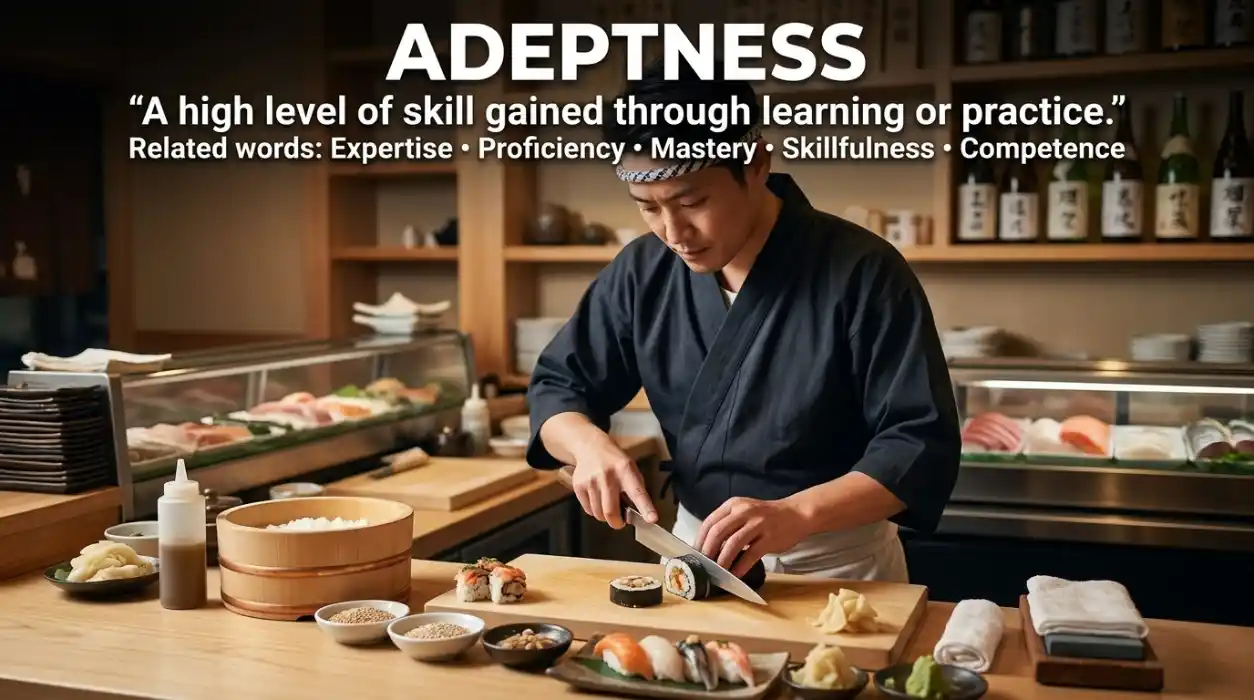
Meaning: A high level of skill gained through learning or practice.
Tone/Register: Professional, academic, and neutral.
Examples:
Her proficiency in Spanish helped her communicate with international clients.
The course measures students’ proficiency in written English.
2. Skill (noun) — US / UK: /skɪl/
Meaning: The ability to do something well through practice, training, or experience.
Tone/Register: Neutral and widely used.
Examples:
Good listening skills can prevent misunderstandings.
His skill in repairing old bicycles impressed everyone.
3. Expertise (noun) — US / UK: /ˌɛkspɜːrˈtiːz/
Meaning: Specialized knowledge and strong ability in a particular field.
Tone/Register: Professional and formal.
Examples:
We asked a cybersecurity specialist for her expertise.
His expertise in environmental science shaped the research.
4. Competence (noun) — US / UK: /ˈkɑːmpɪtəns/
Meaning: The ability to perform a task to an acceptable or required standard.
Tone/Register: Professional and evaluative.
Examples:
The role requires competence in data analysis.
She demonstrated competence throughout the training period.
5. Capability (noun) — US / UK: /ˌkeɪpəˈbɪləti/
Meaning: The ability or capacity to perform an action or achieve a result.
Tone/Register: Neutral to formal.
Examples:
The new employee showed the capability to lead a small team.
The assessment tests the system’s capability to process large files.
6. Ability (noun) — US / UK: /əˈbɪləti/
Meaning: The power or skill to do something successfully.
Tone/Register: Neutral and versatile.
Examples:
Her ability to explain complex topics makes her a strong tutor.
The job depends on your ability to solve problems independently.
7. Aptitude (noun) — US / UK: /ˈæptɪtuːd/
Meaning: A natural tendency or potential to learn a particular skill.
Tone/Register: Educational and professional.
Examples:
Omar has a strong aptitude for mathematics.
The program helps students discover their aptitude for design.
8. Talent (noun) — US / UK: /ˈtælənt/
Meaning: A natural ability to perform something especially well.
Tone/Register: Positive and conversational.
Examples:
Her talent for storytelling keeps the audience engaged.
He has a real talent for making difficult subjects understandable.
9. Mastery (noun) — US / UK: /ˈmæstəri/
Meaning: A very high level of knowledge or control over a subject or skill.
Tone/Register: Formal, academic, and strongly positive.
Examples:
Mastery of the basics made the advanced course easier.
The pianist’s mastery of the instrument was clear.
10. Dexterity (noun) — US / UK: /dɛkˈstɛrəti/
Meaning: Skill and control in using the hands or performing precise movements.
Tone/Register: Technical and descriptive.
Examples:
The jeweler used impressive dexterity to repair the tiny clasp.
Playing the instrument requires finger dexterity.
11. Adroitness (noun) — US / UK: /əˈdrɔɪtnəs/
Meaning: Cleverness and skill in handling a situation or performing an action.
Tone/Register: Formal and polished.
Examples:
The mediator showed adroitness during the tense discussion.
Her adroitness with difficult questions impressed the panel.
12. Deftness (noun) — US / UK: /dɛftnəs/
Meaning: The ability to perform actions quickly, neatly, and skillfully.
Tone/Register: Descriptive and often complimentary.
Examples:
The chef’s deftness with a knife made preparation look effortless.
He answered the tricky question with deftness.
13. Facility (noun) — US / UK: /fəˈsɪləti/
Meaning: Ease and natural skill in doing a particular activity.
Tone/Register: Formal and literary in this sense.
Examples:
She writes with remarkable facility.
His facility with languages helped him settle abroad.
14. Knack (noun) — US / UK: /næk/
Meaning: A natural or easily developed skill for doing something well.
Tone/Register: Informal and friendly.
Examples:
My brother has a knack for fixing household gadgets.
She has a knack for remembering people’s names.
15. Know-how (noun) — US / UK: /ˈnoʊˌhaʊ/
Meaning: Practical knowledge of how to complete a task.
Tone/Register: Conversational and business-friendly.
Examples:
We need someone with the know-how to manage the equipment.
His technical know-how helped the project move forward.
16. Skillfulness (noun) — US / UK: /ˈskɪlfəlnəs/
Meaning: The quality of performing tasks with skill and care.
Tone/Register: Neutral to formal.
Examples:
The review praised the skillfulness of the repair work.
Her skillfulness as an editor improved the final manuscript.
17. Accomplishment (noun) — US / UK: /əˈkɑːmplɪʃmənt/
Meaning: A demonstrated achievement that often reflects ability and effort.
Tone/Register: Positive and professional.
Examples:
Completing the project ahead of schedule was a major accomplishment.
Her musical accomplishments reflect years of practice.
Usage note: This word refers more directly to an achievement than to the ability itself.
18. Effectiveness (noun) — US / UK: /ɪˈfɛktɪvnəs/
Meaning: The quality of producing the intended result.
Tone/Register: Professional and analytical.
Examples:
The manager reviewed the effectiveness of the training.
Her effectiveness as a coach improved team performance.
19. Efficiency (noun) — US / UK: /ɪˈfɪʃənsi/
Meaning: The ability to achieve results with little wasted time, effort, or resources.
Tone/Register: Business and technical.
Examples:
The new process increased the team’s efficiency.
His efficiency at organizing tasks helped everyone meet the deadline.
20. Prowess (noun) — US / UK: /ˈpraʊəs/
Meaning: Exceptional skill or ability, especially in a demanding activity.
Tone/Register: Strong, positive, and sometimes literary.
Examples:
Her athletic prowess earned her a place on the national team.
The developer’s coding prowess impressed the hiring panel.

21. Acumen (noun) — US / UK: /əˈkjuːmən/
Meaning: The ability to make quick, accurate judgments in a particular area.
Tone/Register: Formal and professional.
Examples:
His business acumen helped the company avoid a costly mistake.
She showed financial acumen when planning the budget.
22. Ingenuity (noun) — US / UK: /ˌɪndʒəˈnuːəti/
Meaning: The ability to develop clever and original solutions.
Tone/Register: Positive, creative, and professional.
Examples:
The team’s ingenuity turned discarded materials into useful furniture.
Her ingenuity helped solve a difficult design problem.
23. Resourcefulness (noun) — US / UK: /rɪˈsɔːrsfəlnəs/
Meaning: The ability to find practical ways to handle difficulties with available resources.
Tone/Register: Positive and practical.
Examples:
His resourcefulness kept the event running during the power cut.
The teacher used resourcefulness to support students with different needs.
24. Cleverness (noun) — US / UK: /ˈklɛvərnəs/
Meaning: The ability to think quickly and find smart solutions.
Tone/Register: Neutral to positive, depending on context.
Examples:
The puzzle required cleverness rather than advanced mathematics.
Her cleverness helped her find a simple shortcut.
25. Astuteness (noun) — US / UK: /əˈstuːtnəs/
Meaning: The ability to understand situations accurately and make shrewd judgments.
Tone/Register: Formal and analytical.
Examples:
The journalist’s astuteness exposed a contradiction in the interview.
His astuteness in negotiations saved the team time.
26. Savvy (noun) — US / UK: /ˈsævi/
Meaning: Practical understanding and good judgment in a particular area.
Tone/Register: Informal and modern.
Examples:
Her digital savvy made the online campaign more effective.
You need some financial savvy to compare those options.
27. Flair (noun) — US / UK: /flɛr/
Meaning: A distinctive natural talent or stylish way of doing something.
Tone/Register: Positive and expressive.
Examples:
He has a flair for creating memorable headlines.
The designer added flair to an otherwise simple room.
28. Gift (noun) — US / UK: /ɡɪft/
Meaning: A natural ability to do something especially well.
Tone/Register: Positive and personal.
Examples:
She has a gift for explaining science to children.
His gift for music became clear at an early age.
29. Genius (noun) — US / UK: /ˈdʒiːniəs/
Meaning: Exceptional intellectual or creative ability.
Tone/Register: Strong praise; sometimes informal or exaggerated.
Examples:
The invention showed real engineering genius.
Her genius for storytelling made the novel memorable.
Usage note: Genius is much stronger than adeptness. Use it when the level of ability justifies the emphasis.
30. Ingenuousness (noun) — US / UK: /ˌɪndʒəˈnuːəsnəs/
Meaning: The quality of being innocent, open, or sincere.
Tone/Register: Formal and descriptive.
Examples:
His ingenuousness made the interview feel refreshingly honest.
The character’s ingenuousness was central to the story.
Usage note: This is not a true synonym for adeptness. It is included as a contrast because learners sometimes confuse ingenuousness with ingenuity. Use ingenuity when you mean clever skill.
31. Craftsmanship (noun) — US / UK: /ˈkræftsmənʃɪp/
Meaning: The quality and skill shown in making or building something.
Tone/Register: Professional and appreciative.
Examples:
The table’s craftsmanship was visible in every joint.
The reviewer praised the craftsmanship of the handmade shoes.
32. Technique (noun) — US / UK: /tɛkˈniːk/
Meaning: A particular method or way of performing a task skillfully.
Tone/Register: Technical, educational, and neutral.
Examples:
Her breathing technique helped her sing with control.
The coach demonstrated a safer lifting technique.
33. Precision (noun) — US / UK: /prɪˈsɪʒən/
Meaning: The quality of being accurate and exact in an action or result.
Tone/Register: Technical and professional.
Examples:
The surgeon’s work required exceptional precision.
He edited the document with precision.
34. Finesse (noun) — US / UK: /fɪˈnɛs/
Meaning: Refined skill in handling a delicate or complicated task.
Tone/Register: Polished and often complimentary.
Examples:
She handled the sensitive conversation with finesse.
The chef used finesse to balance the flavors.
35. Coordination (noun) — US / UK: /koʊˌɔːrdəˈneɪʃən/
Meaning: The ability to organize movements or activities so they work together smoothly.
Tone/Register: Neutral and technical.
Examples:
The dance routine requires excellent coordination.
Strong coordination helped the teams finish the event setup.
36. Control (noun) — US / UK: /kənˈtroʊl/
Meaning: The ability to direct an action or manage a situation effectively.
Tone/Register: Neutral and context-dependent.
Examples:
The goalkeeper showed remarkable control under pressure.
She maintained control of the discussion without interrupting anyone.
37. Judgment (noun) — US / UK: /ˈdʒʌdʒmənt/
Meaning: The ability to make sensible decisions after considering relevant information.
Tone/Register: Professional and everyday.
Examples:
Good judgment helped him choose the safer route.
The editor used careful judgment when reviewing the sensitive passage.
38. Versatility (noun) — US / UK: /ˌvɜːrsəˈtɪləti/
Meaning: The ability to perform well in different roles or situations.
Tone/Register: Positive and professional.
Examples:
Her versatility allows her to teach several subjects.
The actor’s versatility impressed both directors.
39. Adaptability (noun) — US / UK: /əˌdæptəˈbɪləti/
Meaning: The ability to adjust effectively when circumstances change.
Tone/Register: Professional and positive.
Examples:
Adaptability is important in a fast-changing workplace.
His adaptability helped him learn the new system quickly.
40. Ingenuity of Thought (noun phrase) — US / UK: /ˌɪndʒəˈnuːəti əv θɔːt/
Meaning: The ability to produce clever ideas or original ways of thinking.
Tone/Register: Formal and descriptive.
Examples:
The proposal showed ingenuity of thought.
Her ingenuity of thought gave the team a fresh direction.

41. Proficiency in Practice (noun phrase) — US / UK: /prəˈfɪʃənsi ɪn ˈpræktɪs/
Meaning: The demonstrated ability to use a skill effectively in real situations.
Tone/Register: Educational and professional.
Examples:
The course assesses proficiency in practice, not just theory.
His proficiency in practice improved after several supervised projects.
42. Technical Ability (noun phrase) — US / UK: /ˈtɛknɪkəl əˈbɪləti/
Meaning: The capacity to use specialized methods, systems, or equipment effectively.
Tone/Register: Professional and technical.
Examples:
The role requires strong technical ability.
Her technical ability helped the team troubleshoot the device.
43. Practical Skill (noun phrase) — US / UK: /ˈpræktɪkəl skɪl/
Meaning: The ability to perform useful tasks in real-world settings.
Tone/Register: Neutral and educational.
Examples:
The course builds practical skills in first aid.
He developed practical skills through hands-on training.
44. Professional Competence (noun phrase) — US / UK: /prəˈfɛʃənəl ˈkɑːmpɪtəns/
Meaning: The ability to meet the standards and responsibilities of a profession.
Tone/Register: Formal and workplace-focused.
Examples:
Professional competence includes clear communication and sound judgment.
The assessment measures professional competence in nursing.
45. Operational Skill (noun phrase) — US / UK: /ˌɑːpəˈreɪʃənəl skɪl/
Meaning: The ability to carry out the practical tasks needed to run a process or system.
Tone/Register: Business and technical.
Examples:
The role requires operational skill and careful planning.
Her operational skill kept the busy office organized.
46. Interpersonal Skill (noun phrase) — US / UK: /ˌɪntərˈpɜːrsənəl skɪl/
Meaning: The ability to communicate and work effectively with other people.
Tone/Register: Professional and social.
Examples:
His interpersonal skills helped settle the disagreement.
Strong interpersonal skills are valuable in customer service.
47. Communication Skill (noun phrase) — US / UK: /kəˌmjuːnɪˈkeɪʃən skɪl/
Meaning: The ability to express ideas and understand others clearly.
Tone/Register: Educational, professional, and everyday.
Examples:
Her communication skills made the presentation easy to follow.
The job requires clear written communication skills.
48. Problem-Solving Ability (noun phrase) — US / UK: /ˈprɑːbləm ˌsɑːlvɪŋ əˈbɪləti/
Meaning: The ability to identify difficulties and develop effective solutions.
Tone/Register: Professional and educational.
Examples:
The interview includes a task that tests problem-solving ability.
His problem-solving ability helped the team recover from the setback.
49. Manual Skill (noun phrase) — US / UK: /ˈmænjuəl skɪl/
Meaning: The ability to use the hands effectively to make, repair, or handle things.
Tone/Register: Practical and descriptive.
Examples:
The restoration work requires manual skill and patience.
She developed manual skills while learning pottery.
50. Mastery of a Craft (noun phrase) — US / UK: /ˈmæstəri əv ə kræft/
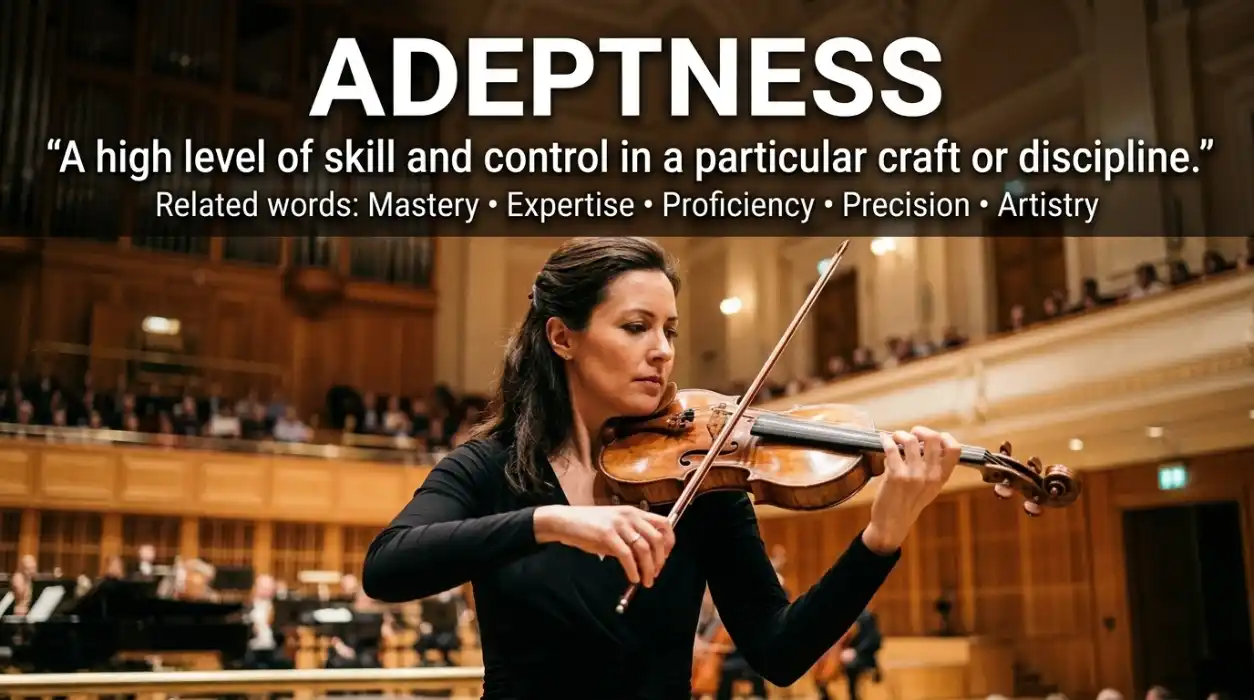
Meaning: A high level of skill and control in a particular craft or discipline.
Tone/Register: Appreciative, formal, and achievement-focused.
Examples:
His mastery of the craft took years of practice.
The exhibition celebrates her mastery of traditional weaving.
Synonyms by Tone
The tone of a synonym shapes the impression your sentence creates. Some words highlight training, others suggest natural talent, and a few emphasize exceptional achievement.
Positive
Use these words to praise someone’s ability:
- Mastery: Suggests a very high level of control.
- Expertise: Highlights specialized knowledge.
- Prowess: Emphasizes exceptional performance.
- Flair: Suggests distinctive talent or style.
- Resourcefulness: Praises practical problem-solving.
Neutral
These words describe ability without strong praise:
- Skill
- Ability
- Competence
- Capability
- Technique
- Proficiency
They fit reports, essays, explanations, and everyday conversations.
Formal or Academic
These alternatives work well in research and professional writing:
- Acumen
- Adroitness
- Dexterity
- Precision
- Professional competence
Choose them when their specific meanings fit the situation. A sophisticated word does not automatically make a sentence more accurate.
Informal
These words sound more relaxed and conversational:
- Knack
- Know-how
- Savvy
- Skill
For example, “She has a knack for explaining grammar” sounds more casual than “She demonstrates proficiency in grammatical instruction.”
Negative or Critical Contexts
Adeptness is not inherently negative, but it can describe harmful skills. Expressions such as skill at manipulation or expertise in deception highlight ability while criticizing its use.
Use a negative description only when the context supports it. The noun itself does not tell readers whether the skill is ethical.
Adeptness vs. Close Alternatives
| Word | Main difference | Best use |
|---|---|---|
| Adeptness | Strong ability to handle a particular task | General descriptions of skillful performance |
| Proficiency | A demonstrated level of skill, often gained through practice | Language learning, technical tasks, assessments |
| Expertise | Specialized knowledge and skill in a field | Professional qualifications and subject knowledge |
| Aptitude | Potential or natural ability to learn | Describing someone’s suitability for a new skill |
| Mastery | Very high control or command of a subject | Advanced achievement and deep understanding |
Example comparison:
- “Her aptitude for coding became clear early.” This emphasizes potential.
- “Her proficiency in coding improved through practice.” This emphasizes demonstrated skill.
- “Her expertise in cybersecurity made her a trusted adviser.” This emphasizes specialized knowledge.
- “Her mastery of the language allowed her to interpret complex texts.” This suggests a very high level of ability.
How “Adeptness” Changes by Context
Daily Conversation
In everyday English, skill, ability, knack, and know-how often sound more natural than adeptness.
You might say, “He has a knack for fixing things,” instead of “He has adeptness in repair work.” The first sentence sounds relaxed and familiar.
Writing and Blogging
Writers can use proficiency, expertise, flair, or resourcefulness to avoid repetition. Choose the word that explains the ability rather than simply replacing one noun with another.
For instance, a blog post about writing may discuss a writer’s flair for storytelling, while a post about software training may focus on technical proficiency.
Professional and Academic Writing
In a résumé, research paper, or performance review, use terms such as professional competence, technical ability, expertise, and proficiency when they accurately describe the evidence.
Avoid claiming mastery when someone is still learning. A precise description is more credible than exaggerated praise.
Creative and Informal Use
In stories, finesse, deftness, and flair can make descriptions more vivid. They help readers imagine how a character acts rather than simply telling readers that the character is skilled.
For example, “She negotiated with finesse” gives a more specific impression than “She showed adeptness.”
Common Mistakes Learners Make
Confusing Ability With Achievement
Adeptness describes a quality or capability. Accomplishment describes something achieved. Someone’s skill may contribute to an accomplishment, but the two words are not interchangeable.
Confusing Natural Talent With Learned Skill
Aptitude often points to potential or a natural inclination. Proficiency usually refers to a demonstrated level of ability. Practice can turn aptitude into proficiency.
Overusing Formal Vocabulary
Words such as adroitness and astuteness can be useful, but they may sound unnatural in a casual chat. Use simple vocabulary when it communicates the idea clearly.
Choosing a Word That Is Too Strong
Genius and mastery suggest a very high level of ability. Do not use them as automatic replacements for adeptness. Match the strength of the word to the evidence.
Register Notes
- Formal: expertise, proficiency, competence, acumen.
- Neutral: ability, skill, capability, effectiveness.
- Informal: knack, know-how, savvy.
- Creative: flair, finesse, deftness.
For related vocabulary practice, you could explore synonyms for skill, competence, or expertise in a separate lesson.
Real-Life Mini Scenarios
Workplace:
A colleague handles a difficult customer conversation calmly. You might praise their interpersonal skill or their finesse in managing conflict.
Education:
A student learns a new language and gradually communicates with fewer mistakes. Their proficiency improves through regular practice.
Media and entertainment:
A reviewer describes a musician’s dexterity or technical mastery after watching a challenging performance.
Writing and storytelling:
A character solves an unexpected problem with ingenuity. This word highlights creative thinking rather than general ability.
Practice Quiz
1. A learner can now speak French comfortably after years of study. Which word fits best?
A. Aptitude
B. Proficiency
C. Ingenuity
D. Flair
2. A person naturally learns mathematical concepts quickly. Which word emphasizes that potential?
A. Aptitude
B. Mastery
C. Precision
D. Accomplishment
3. A cybersecurity specialist has deep knowledge of digital threats.
A. Knack
B. Flair
C. Expertise
D. Coordination
4. A craftsperson makes delicate repairs with steady, precise hand movements.
A. Dexterity
B. Savvy
C. Acumen
D. Versatility
5. A colleague finds a clever way to solve a problem with limited resources.
A. Ingenuity
B. Qualification
C. Control
D. Technique
6. A friend is unusually good at remembering names.
A. Mastery
B. Knack
C. Professional competence
D. Precision
7. A person makes sensible business decisions after quickly assessing a situation.
A. Acumen
B. Manual skill
C. Coordination
D. Flair
8. A musician has achieved a very high level of control over an instrument.
A. Potential
B. Aptitude
C. Mastery
D. Capability
9. A worker completes tasks quickly without wasting resources.
A. Efficiency
B. Ingenuousness
C. Talent
D. Dexterity
10. A designer performs well across several different types of projects.
A. Versatility
B. Precision
C. Technique
D. Facility
Answer key: 1-B | 2-A | 3-C | 4-A | 5-A | 6-B | 7-A | 8-C | 9-A | 10-A | 11-A | 12-B
Reflection task:
Write two sentences describing a skill you have or admire. Use adeptness in one sentence and a more specific synonym in the other. Explain what the second word adds to the meaning.
External reference
The Cambridge Dictionary provides definitions and related words for adeptness, including skill, expertise, proficiency, and adroitness. See the Cambridge Thesaurus entry for “adeptness”. The word’s Latin origin and the history of -ness can also be explored through Etymonline’s “adept” entry
Conclusion
Adeptness describes the ability to perform a task skillfully. Words such as proficiency, expertise, and competence help you express that idea with greater precision.
Students can use these alternatives in essays, while bloggers and content writers can create clearer descriptions. In conversation, the right word makes your meaning easier to understand.
You do not need to memorize all 50 options at once. Start with a few common words and learn the differences between natural talent, practiced skill, and mastery.
Practice by using one new synonym in an email, essay, or everyday conversation today. Small steps will help you build a stronger vocabulary and communicate with confidence.
FAQs
1. What is the best synonym for adeptness on a résumé?
Proficiency, expertise, and competence are strong choices for a résumé, depending on the evidence you can provide. Use proficiency for a demonstrated skill level, expertise for specialized knowledge, and competence for the ability to meet role requirements. Whenever possible, support the word with a concrete example of your work.
2. Is adeptness the same as talent?
No. Adeptness describes a high level of skill or capability, while talent often suggests a natural ability. A talented person may learn quickly, but adeptness usually emphasizes how well someone can perform a task. Practice and experience can help develop talent into strong practical ability.
3. What is the difference between adeptness and proficiency?
Adeptness describes being skilled at a task, often with an emphasis on ease or effectiveness. Proficiency commonly refers to a demonstrated level of competence gained through learning and practice. For example, you might describe someone’s adeptness at negotiation or measure their proficiency in a language.
4. Can I use adeptness in academic writing?
Yes. Adeptness can work in academic writing when you are discussing someone’s skill in a particular activity. However, proficiency, competence, or expertise may be more precise in research reports or formal assessments. Choose the word that matches the skill and the evidence being discussed.
5. What is a simple everyday word for adeptness?
Skill is usually the simplest everyday alternative. You can also use ability or knack, depending on the sentence. For example, “She has a knack for explaining things” sounds friendly and conversational. “She has strong skills in teaching” is more direct and broadly applicable.

Hasnain Ali is an SEO Content Strategist and the founder of wordvora.com, a trusted vocabulary platform that helps writers, students, professionals, and English learners find accurate synonyms, antonyms, word meanings, and real-life usage examples. He specializes in keyword research, on-page SEO, topical authority, and creating search-first content that aligns with Google’s latest Search Quality and E-E-A-T guidelines. His work focuses on producing clear, well-structured, and reader-friendly resources that satisfy search intent while maintaining high editorial standards.
Through extensive hands-on experience with SEO tools such as Google Search Console, Google Analytics, SEMrush, and Ahrefs, Hasnain researches user search behavior and develops content that is both informative and easy to understand. Every article published on wordvora.com is carefully reviewed for accuracy, readability, and contextual relevance before publication. His mission is to build one of the web’s most reliable English vocabulary resources by providing practical language guidance, trustworthy explanations, and content that helps readers improve their writing, communication, and vocabulary with confidence.