
Synonyms for proof become useful when you keep writing “proof” but want your sentences to sound clearer, stronger, or more precise.
Imagine writing an essay and using “proof” five times. Words like evidence, verification, confirmation, and support can make your writing more natural.
The word proof is common because we use it whenever we need to show that something is true. Learning synonyms for proof gives students and writers more control.
For students, bloggers, content writers, and daily English users, these alternatives help express certainty, support ideas, and explain facts without sounding repetitive.
What Does “Proof” Really Mean?
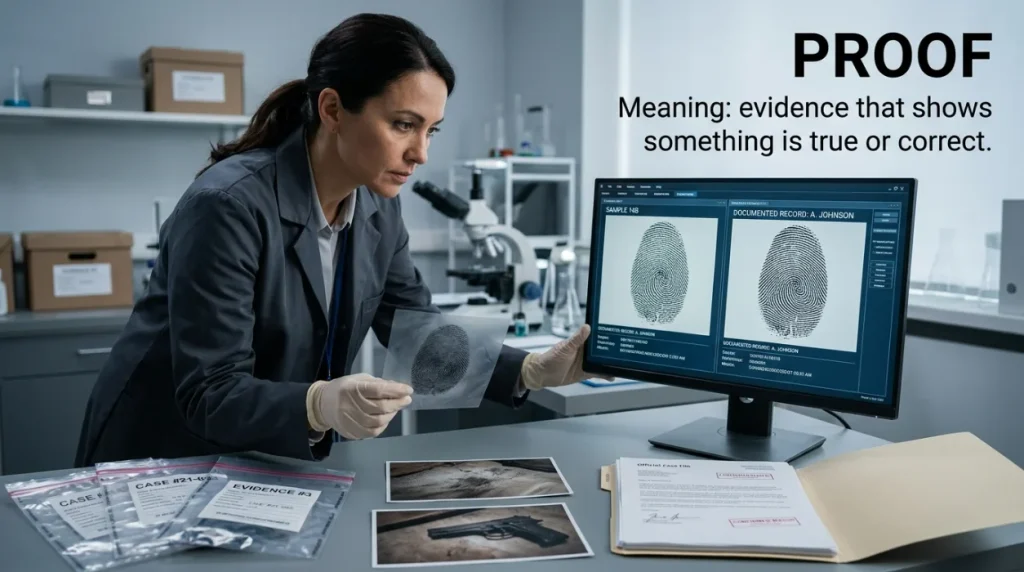
Proof is a noun that usually means information, evidence, or a fact that shows something is true or correct.
For example:
“Do you have proof that the payment was made?”
Here, proof means evidence that supports a claim.
The word can also mean the process of showing that something is true, especially in mathematics and logic.
“The student provided a proof of the theorem.”
In another context, proof can describe something that has been tested against a particular condition.
“The material is waterproof.”
The word is therefore highly flexible.
Part of Speech
Proof can function mainly as:
- Noun: evidence that establishes truth
- Verb: to check or examine something for errors
- Adjective element: as in waterproof or fireproof
Simple Definition
Proof means evidence or reasoning that shows something is true, correct, or genuine.
Native speakers commonly use proof in conversations, schoolwork, legal contexts, science, journalism, business, mathematics, and everyday situations.
Emotional Tone of “Proof”
The word proof is generally neutral.
However, its tone can change with context.
“The photograph is proof of what happened.”
This sounds factual.
“I need proof before I believe you.”
This may sound skeptical or challenging.
“Your progress is proof that your hard work matters.”
This sounds encouraging and positive.
So, the word itself is usually neutral, but the surrounding language creates the emotional effect.
Connotative Meaning
Connotation (the feeling or association a word carries beyond its basic dictionary meaning) can affect how proof sounds.
Positive Tone
Proof can suggest achievement, reliability, or success.
“Her results are proof of her dedication.”
Negative Tone
It can suggest doubt, suspicion, conflict, or accusation.
“The police searched for proof of the crime.”
Neutral Tone
It can simply describe supporting information.
“The report provides proof of the claim.”
The right synonym depends on what you want the reader to feel.

Etymology of “Proof”
The English word proof developed from Anglo-French and Old French forms related to the idea of testing, proving, or establishing something as true.
It is connected to the Latin probare, meaning “to test, approve, or prove.”
The same historical family gives English words such as prove, probable, and probation.
Old English: 450–1100
The modern word proof was not a normal Old English form.
Old English had native vocabulary for ideas such as testing, showing, establishing, and demonstrating truth. Later French influence introduced related forms that developed into modern prove and proof.
Middle English: 1100–1500
After the Norman Conquest, English absorbed many French and Latin words.
Forms related to proof became increasingly established during Middle English. The meaning developed around testing, evidence, and demonstration.
Modern English: 1500–Present
In Modern English, proof developed several specialized meanings.
It became central to legal evidence, scientific reasoning, mathematics, publishing, printing, and ordinary communication.
Today, phrases such as proof of identity, proof of ownership, mathematical proof, and proofreading show how widely the word is used.
Pronunciation of “Proof”
US: /pruːf/
UK: /pruːf/
The pronunciation is essentially the same in standard American and British English.
Syllables
proof
The word has one syllable.
Affixation Pattern of “Proof”
Root/Base: proof
Prefix: None in the modern word
Suffix: None in the basic noun proof
The word belongs to the same historical word family as prove.
Examples include:
- prove
- proof
- proven
- proofless
- proofread
- waterproof
- foolproof
Synonyms List
Evidence (Noun) — US / UK: /ˈɛvɪdəns/ / /ˈevɪdəns/
Meaning: Information or facts that support the truth of a claim.
Tone/Register: Neutral, academic, professional
Example: The photograph provided evidence of the event.
Example: Researchers found new evidence supporting the theory.
Verification (Noun) — US / UK: /ˌvɛrəfəˈkeɪʃən/ / /ˌverɪfɪˈkeɪʃən/
Meaning: The process of checking whether something is accurate or true.
Tone/Register: Formal, technical, professional
Example: The website requires email verification.
Example: The data needs verification before publication.
Confirmation (Noun) — US / UK: /ˌkɑnfərˈmeɪʃən/ / /ˌkɒnfəˈmeɪʃən/
Meaning: Information that establishes that something is true or correct.
Tone/Register: Neutral, professional
Example: We received confirmation of the appointment.
Example: The message confirmed that the order was complete.
Substantiation (Noun) — US / UK: /səbˌstænʃiˈeɪʃən/ / /səbˌstænʃiˈeɪʃən/
Meaning: Evidence that supports or establishes a claim.
Tone/Register: Formal, academic, legal
Example: The journalist requested substantiation for the accusation.
Example: The claim lacks sufficient substantiation.
Corroboration (Noun) — US / UK: /kəˌrɑbəˈreɪʃən/ / /kəˌrɒbəˈreɪʃən/
Meaning: Additional evidence that confirms information already given.
Tone/Register: Formal, legal, academic
Example: The witness provided corroboration of her story.
Example: Investigators searched for independent corroboration.
Support (Noun) — US / UK: /səˈpɔrt/ / /səˈpɔːt/
Meaning: Facts or information that strengthen an argument or claim.
Tone/Register: Neutral, academic, professional
Example: The study provides strong support for the argument.
Example: His explanation had little supporting evidence.
Backing (Noun) — US / UK: /ˈbækɪŋ/ / /ˈbækɪŋ/
Meaning: Support that gives an idea or claim greater credibility.
Tone/Register: Informal, business, conversational
Example: The proposal needs stronger factual backing.
Example: Her argument has solid scientific backing.
Validation (Noun) — US / UK: /ˌvæləˈdeɪʃən/ / /ˌvælɪˈdeɪʃən/
Meaning: Evidence or a process that confirms that something is valid or acceptable.
Tone/Register: Formal, technical, professional
Example: The results require independent validation.
Example: The test provided validation for the new method.
Authentication (Noun) — US / UK: /ɔːˌθɛntɪˈkeɪʃən/ / /ɔːˌθentɪˈkeɪʃən/
Meaning: The process of establishing that something is genuine or authentic.
Tone/Register: Formal, technical, business
Example: The document requires authentication.
Example: Experts completed the painting’s authentication.
Attestation (Noun) — US / UK: /ˌætɛˈsteɪʃən/ / /ˌæteˈsteɪʃən/
Meaning: A formal declaration or confirmation that something is true.
Tone/Register: Formal, legal, official
Example: The form requires an attestation from the applicant.
Example: Her signature served as an attestation of the statement.
Testimony (Noun) — US / UK: /ˈtɛstəˌmoʊni/ / /ˈtestɪməni/
Meaning: A person’s spoken or written account used as evidence.
Tone/Register: Legal, formal
Example: The witness gave testimony in court.
Example: Her testimony helped investigators understand the case.
Witness Statement (Noun Phrase) — US / UK: /ˈwɪtnəs ˈsteɪtmənt/ / /ˈwɪtnəs ˈsteɪtmənt/
Meaning: A formal account provided by someone who knows about an event.
Tone/Register: Legal, formal
Example: The police recorded his witness statement.
Example: Her witness statement supported the investigation.
Documentation (Noun) — US / UK: /ˌdɑkjəmənˈteɪʃən/ / /ˌdɒkjʊmenˈteɪʃən/
Meaning: Documents that provide information or support a claim.
Tone/Register: Professional, formal
Example: Please provide documentation of your qualifications.
Example: The company requested documentation of ownership.
Record (Noun) — US / UK: /ˈrɛkərd/ / /ˈrekɔːd/
Meaning: A stored account that can provide evidence of an event or fact.
Tone/Register: Neutral, professional
Example: The medical record confirmed the date.
Example: We checked the public record for details.
Certificate (Noun) — US / UK: /sərˈtɪfɪkət/ / /səˈtɪfɪkət/
Meaning: An official document that confirms a fact, status, or qualification.
Tone/Register: Formal, official
Example: She showed her birth certificate.
Example: The certificate proves that he completed the course.
Certification (Noun) — US / UK: /ˌsɜrtəfəˈkeɪʃən/ / /ˌsɜːtɪfɪˈkeɪʃən/
Meaning: Official confirmation that a person, product, or process meets a standard.
Tone/Register: Professional, technical
Example: The product received safety certification.
Example: His certification confirmed his professional training.
Credential (Noun) — US / UK: /krəˈdɛnʃəl/ / /krəˈdenʃəl/
Meaning: A qualification or document that establishes someone’s identity, authority, or expertise.
Tone/Register: Professional, academic
Example: Her teaching credential was checked.
Example: His credentials support his claim of expertise.
Exhibit (Noun) — US / UK: /ɪɡˈzɪbɪt/ / /ɪɡˈzɪbɪt/
Meaning: An object or document formally presented as evidence.
Tone/Register: Legal, formal
Example: The photograph was introduced as an exhibit.
Example: The attorney presented the document as an exhibit.
Demonstration (Noun) — US / UK: /ˌdɛmənˈstreɪʃən/ / /ˌdemənˈstreɪʃən/
Meaning: A showing or explanation that makes something clear or establishes how something works.
Tone/Register: Neutral, academic, professional
Example: The experiment was a demonstration of the principle.
Example: The teacher gave a demonstration before the class began.
Demonstration of Truth (Noun Phrase) — US / UK: /ˌdɛmənˈstreɪʃən əv truːθ/ / /ˌdemənˈstreɪʃən əv truːθ/
Meaning: Information or reasoning that establishes that something is true.
Tone/Register: Formal, academic
Example: The findings offer a demonstration of the theory’s value.
Example: The paper provides a clear demonstration of the principle.
Indication (Noun) — US / UK: /ˌɪndəˈkeɪʃən/ / /ˌɪndɪˈkeɪʃən/
Meaning: A sign that suggests something may be true.
Tone/Register: Neutral, academic
Example: The results are an indication of improvement.
Example: There was no indication that the system had failed.
Sign (Noun) — US / UK: /saɪn/ / /saɪn/
Meaning: Something that suggests or reveals a particular fact or condition.
Tone/Register: Everyday, neutral
Example: The dark clouds were a sign of rain.
Example: Her smile was a sign that she felt relieved.
Clue (Noun) — US / UK: /kluː/ / /kluː/
Meaning: A piece of information that helps solve a problem or discover the truth.
Tone/Register: Informal, neutral
Example: The receipt gave detectives an important clue.
Example: That small detail was the clue we needed.

Hint (Noun) — US / UK: /hɪnt/ / /hɪnt/
Meaning: A small piece of information that suggests something without proving it.
Tone/Register: Informal, conversational
Example: His comment was a hint that something had changed.
Example: The first chapter gives a hint about the ending.
Indication of Truth (Noun Phrase) — US / UK: /ˌɪndəˈkeɪʃən əv truːθ/ / /ˌɪndɪˈkeɪʃən əv truːθ/
Meaning: Information that points toward something being true.
Tone/Register: Formal, academic
Example: The results indicate truth rather than certainty.
Example: The pattern indicates that the theory may work.
Grounds (Plural Noun) — US / UK: /ɡraʊndz/ / /ɡraʊndz/
Meaning: Facts or reasons that justify a belief, action, or conclusion.
Tone/Register: Formal, legal, professional
Example: The complaint has reasonable grounds.
Example: There are grounds for further investigation.
Basis (Noun) — US / UK: /ˈbeɪsɪs/ / /ˈbeɪsɪs/
Meaning: The underlying facts or reasons supporting an idea or decision.
Tone/Register: Neutral, academic, professional
Example: The report provides a basis for further research.
Example: We need a reliable basis for the decision.
Justification (Noun) — US / UK: /ˌdʒʌstəfəˈkeɪʃən/ / /ˌdʒʌstɪfɪˈkeɪʃən/
Meaning: A reason or explanation that shows why something is reasonable or acceptable.
Tone/Register: Formal, academic, professional
Example: She gave a clear justification for her decision.
Example: The data justifies the new policy.
Warrant (Noun) — US / UK: /ˈwɔrənt/ / /ˈwɒrənt/
Meaning: A reason or basis that makes an action or conclusion reasonable.
Tone/Register: Formal, academic, philosophical
Example: The evidence gives us warrant to investigate further.
Example: The claim has little warrant without supporting data.
Grounds for Belief (Noun Phrase) — US / UK: /ɡraʊndz fər bɪˈliːf/ / /ɡraʊndz fə bɪˈliːf/
Meaning: Facts or reasons that make a belief reasonable.
Tone/Register: Formal, academic
Example: The discovery gives scientists grounds for belief.
Example: We need stronger grounds for belief before accepting the claim.
Supporting Evidence (Noun Phrase) — US / UK: /səˈpɔrtɪŋ ˈɛvɪdəns/ / /səˈpɔːtɪŋ ˈevɪdəns/
Meaning: Information that strengthens a statement or argument.
Tone/Register: Academic, professional
Example: The researcher included supporting evidence.
Example: The article needs more supporting evidence.
Factual Support (Noun Phrase) — US / UK: /ˈfæktʃuəl səˈpɔrt/ / /ˈfæktʃuəl səˈpɔːt/
Meaning: Facts that strengthen the credibility of an idea.
Tone/Register: Academic, professional
Example: The argument lacks factual support.
Example: The writer added factual support to the conclusion.
Documentary Evidence (Noun Phrase) — US / UK: /ˌdɑkjəˈmɛntəri ˈɛvɪdəns/ / /ˌdɒkjʊˈmentəri ˈevɪdəns/
Meaning: Documents used to establish or support a fact.
Tone/Register: Legal, formal
Example: The case included documentary evidence.
Example: Investigators reviewed the documentary evidence carefully.
Physical Evidence (Noun Phrase) — US / UK: /ˈfɪzɪkəl ˈɛvɪdəns/ / /ˈfɪzɪkəl ˈevɪdəns/
Meaning: A physical object or material that supports a claim or investigation.
Tone/Register: Legal, investigative
Example: Police discovered physical evidence at the scene.
Example: The laboratory examined the physical evidence.
Material Evidence (Noun Phrase) — US / UK: /məˈtɪriəl ˈɛvɪdəns/ / /məˈtɪəriəl ˈevɪdəns/
Meaning: Evidence that is relevant and significant to an issue.
Tone/Register: Legal, formal
Example: The court considered the material evidence.
Example: The new document could become material evidence.
Tangible Evidence (Noun Phrase) — US / UK: /ˈtændʒəbəl ˈɛvɪdəns/ / /ˈtændʒəbəl ˈevɪdəns/
Meaning: Evidence that has a concrete or physical form.
Tone/Register: Formal, professional
Example: The report provides tangible evidence of progress.
Example: The team wanted tangible evidence before changing the plan.
Hard Evidence (Noun Phrase) — US / UK: /hɑrd ˈɛvɪdəns/ / /hɑːd ˈevɪdəns/
Meaning: Strong, concrete evidence that is difficult to dispute.
Tone/Register: Informal, journalistic
Example: We need hard evidence before making an accusation.
Example: The investigators found hard evidence of the fraud.
Solid Evidence (Noun Phrase) — US / UK: /ˈsɑlɪd ˈɛvɪdəns/ / /ˈsɒlɪd ˈevɪdəns/
Meaning: Strong and reliable information supporting a conclusion.
Tone/Register: Neutral, professional
Example: The researchers found solid evidence.
Example: There is solid evidence that the method works.
Conclusive Evidence (Noun Phrase) — US / UK: /kənˈkluːsɪv ˈɛvɪdəns/ / /kənˈkluːsɪv ˈevɪdəns/
Meaning: Evidence strong enough to settle an issue or establish a conclusion.
Tone/Register: Formal, academic, legal
Example: The investigation did not produce conclusive evidence.
Example: The new test provided conclusive evidence.
Proof of Identity (Noun Phrase) — US / UK: /pruːf əv aɪˈdɛntəti/ / /pruːf əv aɪˈdentəti/
Meaning: A document or information establishing who someone is.
Tone/Register: Formal, administrative
Example: The office requested proof of identity.
Example: A passport can serve as proof of identity.
Proof of Ownership (Noun Phrase) — US / UK: /pruːf əv ˈoʊnərʃɪp/ / /pruːf əv ˈəʊnəʃɪp/
Meaning: Evidence establishing that something belongs to a person or organization.
Tone/Register: Legal, administrative
Example: The buyer provided proof of ownership.
Example: The document served as proof of ownership.
Verification of Facts (Noun Phrase) — US / UK: /ˌvɛrəfəˈkeɪʃən əv fækts/ / /ˌverɪfɪˈkeɪʃən əv fækts/
Meaning: The process of checking whether factual claims are accurate.
Tone/Register: Formal, journalistic, academic
Example: The editor requested verification of the facts.
Example: Fact-checking involves careful verification of facts.
Establishment (Noun) — US / UK: /ɪˈstæblɪʃmənt/ / /ɪˈstæblɪʃmənt/
Meaning: The act of proving or firmly demonstrating something.
Tone/Register: Formal, academic
Example: The study contributed to the establishment of the result.
Example: The evidence supported the establishment of a clear connection.

Finding (Noun) — US / UK: /ˈfaɪndɪŋ/ / /ˈfaɪndɪŋ/
Meaning: A conclusion reached after examination or investigation.
Tone/Register: Academic, professional
Example: The findings support the original hypothesis.
Example: The investigation produced an important finding.
Result (Noun) — US / UK: /rɪˈzʌlt/ / /rɪˈzʌlt/
Meaning: An outcome that may demonstrate what happened or whether something worked.
Tone/Register: Neutral, academic
Example: The test result confirmed the diagnosis.
Example: The results gave the team useful information.
Demonstrable Fact (Noun Phrase) — US / UK: /dɪˈmɑnstrəbəl fækt/ / /dɪˈmɒnstrəbəl fækt/
Meaning: A fact that can be shown or established through evidence.
Tone/Register: Formal, academic
Example: The improvement is a demonstrable fact.
Example: The researchers focused on demonstrable facts.
Certainty (Noun) — US / UK: /ˈsɜrtənti/ / /ˈsɜːtənti/
Meaning: A state in which something is considered unquestionably true.
Tone/Register: Neutral, formal
Example: The new evidence brought greater certainty.
Example: The investigation did not establish complete certainty.
Conviction (Noun) — US / UK: /kənˈvɪkʃən/ / /kənˈvɪkʃən/
Meaning: A strong belief that something is true.
Tone/Register: Neutral, formal
Example: She spoke with conviction about her findings.
Example: His conviction came from years of experience.
Believable Evidence (Noun Phrase) — US / UK: /bɪˈliːvəbəl ˈɛvɪdəns/ / /bɪˈliːvəbəl ˈevɪdəns/
Meaning: Evidence that appears credible and trustworthy.
Tone/Register: Neutral
Example: The story contains believable evidence.
Example: Readers need believable evidence before accepting the claim.
Credibility (Noun) — US / UK: /ˌkrɛdəˈbɪləti/ / /ˌkredəˈbɪləti/
Meaning: The quality of being trusted or considered reliable.
Tone/Register: Professional, academic
Example: The source’s credibility was questioned.
Example: Independent research increased the article’s credibility.
Reliability (Noun) — US / UK: /rɪˌlaɪəˈbɪləti/ / /rɪˌlaɪəˈbɪləti/
Meaning: The quality of being dependable or trustworthy.
Tone/Register: Neutral, professional
Example: The reliability of the evidence matters.
Example: Researchers tested the reliability of the results.
Authentication Record (Noun Phrase) — US / UK: /ɔːˌθɛntɪˈkeɪʃən ˈrɛkərd/ / /ɔːˌθentɪˈkeɪʃən ˈrekɔːd/
Meaning: A documented record showing that something has been confirmed as genuine.
Tone/Register: Formal, technical
Example: The museum kept an authentication record.
Example: The authentication record supported the artwork’s history.
Audit Trail (Noun Phrase) — US / UK: /ˈɔdɪt treɪl/ / /ˈɔːdɪt treɪl/
Meaning: A documented sequence showing how actions or transactions occurred.
Tone/Register: Business, technical, formal
Example: The system keeps an audit trail of every change.
Example: The audit trail helped explain the missing payment.
Paper Trail (Noun Phrase) — US / UK: /ˈpeɪpər treɪl/ / /ˈpeɪpə treɪl/
Meaning: A series of documents that records events or transactions.
Tone/Register: Informal, professional, journalistic
Example: The investigators followed the paper trail.
Example: The emails created a clear paper trail.
Track Record (Noun Phrase) — US / UK: /ˈtræk ˌrɛkərd/ / /ˈtræk ˌrekɔːd/
Meaning: A person’s or organization’s history of past performance used to support judgments about reliability.
Tone/Register: Business, professional
Example: The company has a strong track record.
Example: Her track record gives clients confidence.
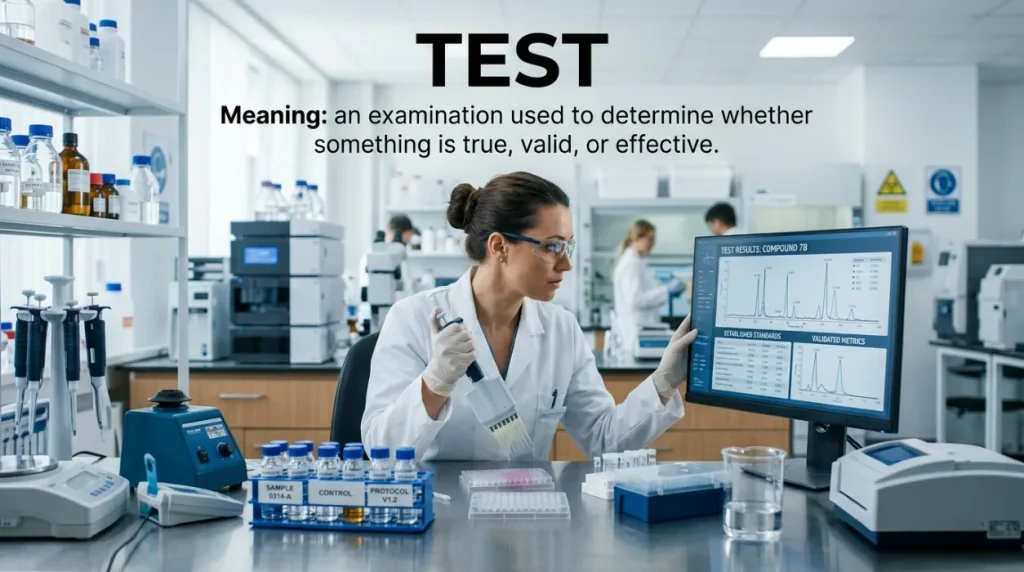
Test (Noun) — US / UK: /tɛst/ / /test/
Meaning: An examination used to determine whether something is true, valid, or effective.
Tone/Register: Neutral, scientific, everyday
Example: The experiment was a useful test of the theory.
Example: We ran another test to check the result.
Synonyms by Tone
Word choice changes the feeling and precision of your sentence.
Positive or Confidence-Building
- Confirmation
- Validation
- Support
- Solid evidence
- Credibility
- Reliability
- Demonstration
- Track record
These words can emphasize confidence, success, trust, or achievement.
Neutral
- Proof
- Evidence
- Indication
- Sign
- Record
- Finding
- Result
- Verification
- Test
These work in most everyday and educational situations.
Formal or Academic
- Substantiation
- Corroboration
- Authentication
- Attestation
- Justification
- Warrant
- Documentary evidence
- Conclusive evidence
- Substantiate
- Verify
These choices are useful when precision matters.
Informal or Conversational
- Clue
- Hint
- Backing
- Hard evidence
- Paper trail
- Sign
These expressions often sound more natural in conversation or journalism.
Why Tone Matters
Consider these two sentences:
“That is proof that he lied.”
“That is evidence suggesting that his statement was inaccurate.”
The first sounds stronger and more direct. The second leaves more room for uncertainty.
Therefore, vocabulary should reflect the strength of your evidence.
“Proof” vs Close Alternatives
Proof vs Evidence
Evidence is usually broader than proof.
Evidence can support an idea without completely establishing it.
“There is evidence that the plan worked.”
Proof often suggests a stronger level of certainty.
“We need proof before making the accusation.”
Proof vs Confirmation
Confirmation means information that verifies something already suspected or believed.
“The email confirmed the appointment.”
Proof can be broader and may establish a claim from the beginning.
Proof vs Verification
Verification focuses on the process of checking accuracy.
“The information needs verification.”
Proof usually refers to the evidence or result that establishes something.
How “Proof” Changes by Context
Daily Conversation
In everyday speech, proof, evidence, sign, clue, and confirmation are common.
You might say:
“Do you have proof?”
Or:
“That message is enough evidence for me.”
Keep the language simple unless the situation requires more precision.
Writing and Blogging
Bloggers should avoid repeating proof throughout an article.
For example, instead of writing:
“This is proof that exercise helps. Another proof is the study.”
A smoother version would be:
“This is evidence that exercise helps. The study provides further support.”
This creates better rhythm and more natural vocabulary.
Professional or Academic Writing
Academic writers often prefer evidence, substantiation, corroboration, verification, validation, findings, and support.
However, stronger words should only be used when the evidence deserves them.
Calling something conclusive evidence is much stronger than calling it an indication.
Creative or Informal Writing
Creative writing gives you more freedom.
A detective story might use:
“That receipt was the clue.”
A character might say:
“I need hard evidence.”
The vocabulary can help create suspense, confidence, doubt, or tension.
Common Mistakes Learners Make
Mistake 1: Using “Proof” for Every Kind of Evidence
Not every piece of evidence is conclusive proof.
A clue may point toward an answer. Evidence may support an argument. Proof usually suggests a stronger demonstration.
Mistake 2: Confusing “Proof” and “Prove”
Proof is commonly a noun.
“We need proof.”
Prove is a verb.
“We need to prove the claim.”
Avoid:
“Can you proof that?”
Use:
“Can you prove that?”
Mistake 3: Confusing “Proof” and “Evidence”
These words overlap, but they are not always interchangeable.
A photograph may be evidence without being sufficient proof by itself.
This distinction becomes especially important in academic and legal writing.
Mistake 4: Using “Conclusive” Too Easily
Conclusive means strong enough to settle an issue.
Therefore, do not describe weak or incomplete information as conclusive evidence.
If the information only suggests something, use:
- indication
- sign
- clue
- suggestion
- evidence
Mistake 5: Using “Confirmation” When You Mean “Evidence”
Confirmation often means that something already suspected has been verified.
If you are introducing support for a completely new claim, evidence may be more accurate.
Native Usage Tip
Native speakers often choose the shortest suitable word.
In conversation:
“Do you have proof?”
sounds natural.
In academic writing:
“The evidence supports the hypothesis.”
sounds more precise.
In a legal context:
“The prosecution presented documentary evidence.”
sounds appropriate.
Good vocabulary is not about choosing the biggest word. It is about choosing the right word.
Real-Life Mini Scenarios
Workplace
A manager questions whether a task was completed.
An employee can provide documentation, a record, or an audit trail.
The exact choice depends on what kind of information exists.
Social Situation
A friend claims that a celebrity appeared at a local event.
You might ask:
“Do you have any proof?”
A photograph or video could provide evidence.
Media and Pop Culture
Journalists often use evidence, confirmation, sources, and reports when discussing claims.
They may avoid calling something proof until the available information strongly establishes the claim.
Writing and Storytelling
A mystery writer may use a clue rather than proof.
A character might discover a receipt, then realize:
“This was the clue that solved everything.”
The word clue creates suspense because it does not necessarily reveal the entire truth.
Practice Exercise
1. Which word is the broadest and most common alternative to “proof”?
A. Evidence
B. Gravid
C. Antenatal
D. Credential
2. Which word describes additional evidence supporting an existing account?
A. Corroboration
B. Hint
C. Track record
D. Certificate
3. Which word is most appropriate for a formal process of checking accuracy?
A. Clue
B. Verification
C. Backing
D. Sign
4. A detective discovers a receipt that helps solve a mystery. What is the most natural word?
A. Clue
B. Certification
C. Attestation
D. Validation
5. Which word means evidence strong enough to settle an issue?
A. Indication
B. Hint
C. Conclusive evidence
D. Sign
6. Which alternative is especially appropriate for a document showing ownership?
A. Proof of ownership
B. Hint of ownership
C. Clue of ownership
D. Backing of ownership
7. Which word is especially common in academic writing?
A. Evidence
B. Hunch
C. Guess
D. Gossip
8. Which verb means “to provide evidence supporting a claim”?
A. Substantiate
B. Hint
C. Track
D. Witness
9. Which expression describes a documented sequence of transactions or actions?
A. Audit trail
B. Little clue
C. Strong hint
D. Personal sign
10. Which word means an official confirmation that something is genuine?
A. Authentication
B. Suggestion
C. Indication
D. Guess
Answer key: 1-A | 2-A | 3-B | 4-A | 5-C | 6-A | 7-A | 8-A | 9-A | 10-A
Reflection Task:
Choose one alternative to proof, such as evidence, confirmation, verification, support, or corroboration. Write one sentence using it.
Conclusion
Learning synonyms for proof gives you more than extra vocabulary. It helps you express certainty, support, doubt, and verification with greater accuracy.
Words such as evidence, confirmation, verification, corroboration, and substantiation each add a different shade of meaning.
For students, bloggers, and professionals, these alternatives make essays, articles, reports, and conversations clearer while reducing unnecessary repetition.
Keep practicing by replacing proof in your emails, essays, and daily conversations. Choose the word that best matches your evidence and intended meaning.
FAQs
1. What is the best synonym for proof in academic writing?
Evidence is usually the safest and most natural alternative to proof in academic writing. It refers to facts, observations, data, or information that support a claim. Depending on the context, academic writers may also use support, substantiation, corroboration, findings, or verification. The best choice depends on whether the information supports, checks, or firmly establishes the argument.
2. What is a stronger word than proof?
There is not one universally stronger synonym for proof. Conclusive evidence can express a very high level of certainty because it suggests that the evidence settles an issue. However, writers should use this expression carefully. If the information only suggests a conclusion, words such as indication or evidence may be more accurate.
3. What is the difference between proof and evidence?
Evidence is information that supports a claim, while proof usually suggests evidence or reasoning strong enough to establish that something is true. Evidence does not always settle an issue. In contrast, proof often carries a stronger sense of certainty. In mathematics, however, proof has an especially precise meaning: a logical demonstration that establishes a proposition.
4. What are formal synonyms for proof?
Useful formal alternatives include substantiation, corroboration, verification, validation, authentication, attestation, documentary evidence, justification, and conclusive evidence. These words are common in academic, legal, scientific, and professional contexts. They are not interchangeable in every sentence, though. For example, authentication focuses on genuineness, while verification focuses on checking accuracy.
5. What is a casual synonym for proof?
In casual English, evidence, sign, clue, hint, backing, and hard evidence can work depending on the situation. For example, “That photo is evidence” sounds natural, while “That receipt is a clue” works well in a mystery or investigation. Choose the word according to whether you mean support, suggestion, or strong confirmation.

Hasnain Ali is an SEO Content Strategist and the founder of wordvora.com, a trusted vocabulary platform that helps writers, students, professionals, and English learners find accurate synonyms, antonyms, word meanings, and real-life usage examples. He specializes in keyword research, on-page SEO, topical authority, and creating search-first content that aligns with Google’s latest Search Quality and E-E-A-T guidelines. His work focuses on producing clear, well-structured, and reader-friendly resources that satisfy search intent while maintaining high editorial standards.
Through extensive hands-on experience with SEO tools such as Google Search Console, Google Analytics, SEMrush, and Ahrefs, Hasnain researches user search behavior and develops content that is both informative and easy to understand. Every article published on wordvora.com is carefully reviewed for accuracy, readability, and contextual relevance before publication. His mission is to build one of the web’s most reliable English vocabulary resources by providing practical language guidance, trustworthy explanations, and content that helps readers improve their writing, communication, and vocabulary with confidence.