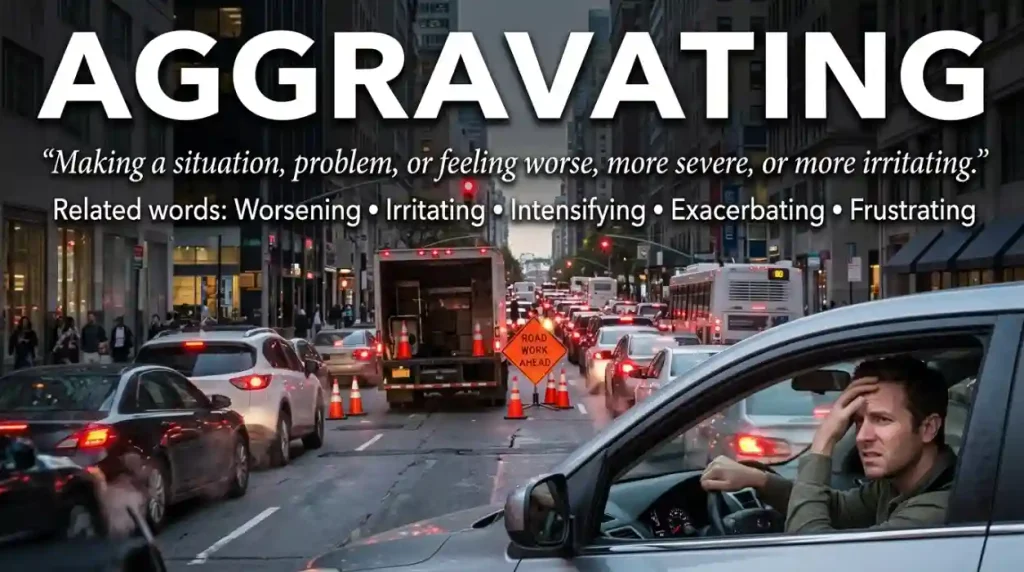
A synonym for aggravating is a word that describes something irritating, annoying, frustrating, or increasingly upsetting. Common alternatives include irritating, annoying, frustrating, exasperating, and infuriating. The best choice depends on how strongly something affects you.
Imagine waiting for an important email while your computer freezes again. You might call the situation annoying, frustrating, or downright infuriating. Each word describes irritation, but the emotional intensity differs.
The word aggravating is common in daily English because it describes small annoyances and serious frustrations. People use it for delays, repeated mistakes, unpleasant habits, and difficult situations.
Finding the right synonym for aggravating helps you communicate more precisely. Students can strengthen essays, bloggers can write vivid descriptions, and content writers can avoid repeating the same adjective.
For everyday speakers, choosing words such as irksome, exasperating, or maddening adds variety and emotional detail. You can express mild irritation without sounding dramatic, or strong anger without losing clarity.
What Does “Aggravating” Really Mean?
Aggravating is an adjective that describes something that annoys, irritates, or makes a difficult situation feel worse. It often suggests that a person, action, delay, or problem tests someone’s patience.
For example, repeated interruptions during a meeting can be aggravating. A website that crashes just before you submit an assignment can also be aggravating.
Native English speakers usually understand the word as negative. It often describes something that causes growing frustration rather than a single moment of surprise or disappointment.
The word appears in several everyday contexts:
- Work: An aggravating colleague who repeatedly interrupts.
- Technology: An aggravating error that keeps appearing.
- Daily life: An aggravating traffic jam or long queue.
- Relationships: An aggravating habit that tests someone’s patience.
- Writing: An aggravating obstacle that creates tension in a story.
Part of Speech and Simple Definition
- Part of speech: Adjective; it can also function as the present participle of aggravate.
- Easy-English definition: Causing annoyance, irritation, or frustration.
- Comparative form: More aggravating.
- Superlative form: Most aggravating.
- Related verb: Aggravate.
- Related noun: Aggravation.
Example: “The constant notifications were aggravating while I tried to study.”
The verb aggravate can also mean to make an existing problem more serious. This meaning is especially common in phrases such as “aggravate an injury” or “aggravate a difficult situation.” The adjective aggravating, however, often focuses on how irritating something feels.
Connotative Meaning
(Connotation means the feelings, associations, or emotional impressions a word carries beyond its basic dictionary meaning.)
- Positive tone: Aggravating is rarely positive. In a humorous situation, someone may use it playfully to describe a harmless annoyance.
- Negative tone: It commonly suggests irritation, impatience, or frustration.
- Neutral tone: In objective writing, it can describe behavior or circumstances that annoy without directly insulting a person.
For example, “The repeated delays were aggravating” criticizes a situation. “You are aggravating” sounds more personal and may hurt someone’s feelings.
Etymology
The word aggravating comes from the verb aggravate, which entered English through Latin. The Latin verb aggravare meant “to make heavier” or “to make more severe.” It combines ad- (“toward”) with gravis (“heavy”).
Over time, the word developed two related uses: making a problem worse and causing irritation. Modern English frequently uses aggravating in the second sense.
Historical Development
Old English (450–1100): The modern word aggravating was not established in Old English. Speakers used native words and expressions to describe annoyance, anger, burdens, and worsening conditions.
Middle English (1100–1500): French and Latin influenced English vocabulary during this period. The Latin-based word family associated with aggravate entered English later in the medieval period, with historical forms and dates varying by dictionary source.
Modern English (1500–present): Aggravate and its related forms became established in English. Today, aggravating often describes behavior or situations that test patience, while aggravate can also mean to worsen an existing problem.
Pronunciation of “Aggravating”
- US IPA: /ˈæɡrəˌveɪtɪŋ/
- UK IPA: /ˈæɡrəˌveɪtɪŋ/
- Syllables: ag-gra-vat-ing
- Primary stress: The first syllable, ag.
Word Structure and Affixation
- Root/base: Grav, from Latin gravis, meaning “heavy.”
- Prefix: Ad- is historically connected to the word’s Latin formation. In modern English, it is not usually treated as a productive prefix in aggravating.
- Suffixes: -ate forms the verb aggravate; -ing creates the present participle and adjective aggravating.
- Related forms: Aggravate, aggravation, aggravated, aggravatingly.
The word’s history reflects its connection to making something heavier or more severe. Its everyday emotional meaning now focuses on irritation and impatience.
Synonyms List
The following list includes common alternatives and several more specific words. They do not all express the same degree of irritation. Some describe mild annoyance, while others suggest intense anger or a situation that becomes harder to tolerate.
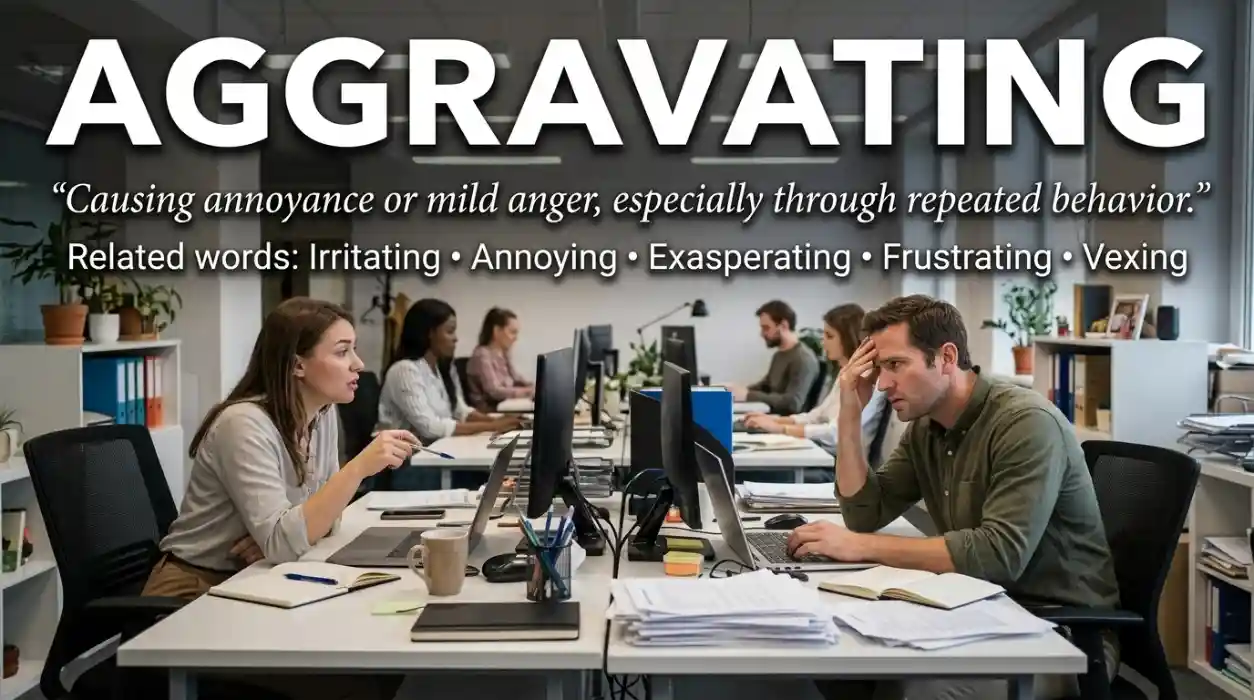
1. Irritating (Adjective) — US / UK: /ˈɪrəˌteɪtɪŋ/
Meaning: Causing annoyance or mild anger, especially through repeated behavior.
Tone/Register: Everyday, neutral to negative.
Examples: The irritating alarm went off every five minutes.
It’s irritating when someone keeps talking over you.
2. Annoying (Adjective) — US / UK: /əˈnɔɪɪŋ/
Meaning: Making someone feel slightly angry, impatient, or bothered.
Tone/Register: Informal, common, mildly negative.
Examples: That annoying pop-up keeps covering the page.
My little brother can be annoying when I’m trying to concentrate.
3. Frustrating (Adjective) — US / UK: /ˈfrʌstreɪtɪŋ/
Meaning: Causing upset because something prevents you from achieving what you want.
Tone/Register: Everyday, professional, academic.
Examples: It was frustrating to lose my work before saving it.
The application process became frustrating after the third delay.
4. Exasperating (Adjective) — US / UK: /ɪɡˈzæspəˌreɪtɪŋ/
Meaning: Extremely irritating in a way that tests someone’s patience.
Tone/Register: Expressive, slightly formal.
Examples: His exasperating habit of arriving late upset the whole team.
It’s exasperating to explain the same instructions every morning.
5. Infuriating (Adjective) — US / UK: /ɪnˈfjʊriˌeɪtɪŋ/
Meaning: Causing intense anger or outrage.
Tone/Register: Strong, emotional, negative.
Examples: It was infuriating to discover that someone had deleted the shared file.
The unfair decision was infuriating to everyone involved.
6. Maddening (Adjective) — US / UK: /ˈmædənɪŋ/
Meaning: So annoying or frustrating that it feels difficult to tolerate.
Tone/Register: Informal, emphatic.
Examples: The maddening noise continued long after midnight.
It’s maddening when the connection fails during an important call.
7. Exasperatingly Difficult (Adjective Phrase) — US / UK: /ɪɡˈzæspəˌreɪtɪŋli ˈdɪfɪkəlt/
Meaning: Describing a task or problem that is difficult in a way that causes strong frustration.
Tone/Register: Descriptive, conversational to formal.
Examples: The form was exasperatingly difficult to complete.
Finding the missing document became an exasperatingly difficult task.
8. Infuriatingly Slow (Adjective Phrase) — US / UK: /ɪnˈfjʊriˌeɪtɪŋli sloʊ/; /ɪnˈfjʊəriˌeɪtɪŋli sləʊ/
Meaning: Describing a process that moves so slowly that it provokes anger.
Tone/Register: Informal, emphatic.
Examples: The website was infuriatingly slow this morning.
Our train moved at an infuriatingly slow pace.
9. Bothersome (Adjective) — US / UK: /ˈbɑðərsəm/; /ˈbɒðəsəm/
Meaning: Causing inconvenience, concern, or mild annoyance.
Tone/Register: Neutral, polite, slightly formal.
Examples: The bothersome paperwork took longer than expected.
A bothersome cough kept him awake during the night.
10. Irrksome (Adjective) — US / UK: /ˈɜrksəm/; /ˈɜːksəm/
Meaning: Annoying in a persistent or tiresome way.
Tone/Register: Formal or literary, less common in conversation.
Examples: The irksome delay left us waiting in the lobby.
She found the repeated reminders increasingly irksome.
11. Vexing (Adjective) — US / UK: /ˈvɛksɪŋ/
Meaning: Causing annoyance or worry, often because a problem is difficult to resolve.
Tone/Register: Formal, written, thoughtful.
Examples: The missing figures presented a vexing problem.
It’s vexing when a simple question has no clear answer.
12. Irritatingly Persistent (Adjective Phrase) — US / UK: /ˈɪrəˌteɪtɪŋli pərˈsɪstənt/; /ˈɪrəˌteɪtɪŋli pəˈsɪstənt/
Meaning: Continuing to annoy by refusing to stop or change.
Tone/Register: Descriptive, everyday.
Examples: An irritatingly persistent notification appeared every hour.
The irritatingly persistent salesperson kept calling after I declined.
13. Trying (Adjective) — US / UK: /ˈtraɪɪŋ/
Meaning: Difficult to endure because it tests someone’s patience or emotional strength.
Tone/Register: Neutral to formal, understated.
Examples: It has been a trying week at work.
His trying behavior made the long journey even harder.
14. Tiresome (Adjective) — US / UK: /ˈtaɪərsəm/
Meaning: Causing annoyance or boredom through repetition or excessive length.
Tone/Register: Neutral, slightly formal.
Examples: The tiresome debate continued long after everyone had made their point.
I find these repeated security checks tiresome.
15. Tedious (Adjective) — US / UK: /ˈtiːdiəs/
Meaning: So repetitive or lengthy that it becomes boring and frustrating.
Tone/Register: Academic, professional, everyday.
Examples: Entering every record manually was tedious.
The tedious instructions made a simple task feel complicated.
16. Aggravating (Adjective) — US / UK: /ˈæɡrəˌveɪtɪŋ/
Meaning: Causing irritation or making an already difficult experience feel worse.
Tone/Register: Everyday, negative.
Examples: The aggravating error returned as soon as I restarted the app.
It’s aggravating when people ignore the agreed schedule.
17. Provoking (Adjective) — US / UK: /prəˈvoʊkɪŋ/; /prəˈvəʊkɪŋ/
Meaning: Likely to trigger a strong emotional reaction, such as irritation or anger.
Tone/Register: Context-dependent, descriptive.
Examples: His provoking comments turned a calm discussion into an argument.
The deliberately provoking message upset several readers.
18. Incensing (Adjective) — US / UK: /ɪnˈsɛnsɪŋ/
Meaning: Causing intense anger, especially when an action seems unfair or offensive.
Tone/Register: Formal, emphatic, relatively uncommon.
Examples: The incensing accusation damaged their working relationship.
It was an incensing display of dishonesty.
19. Galling (Adjective) — US / UK: /ˈɡɔlɪŋ/; /ˈɡɔːlɪŋ/
Meaning: Deeply irritating because something feels unfair, insulting, or humiliating.
Tone/Register: Formal, expressive.
Examples: It was galling to receive criticism from someone who had not helped.
The galling decision ignored years of hard work.
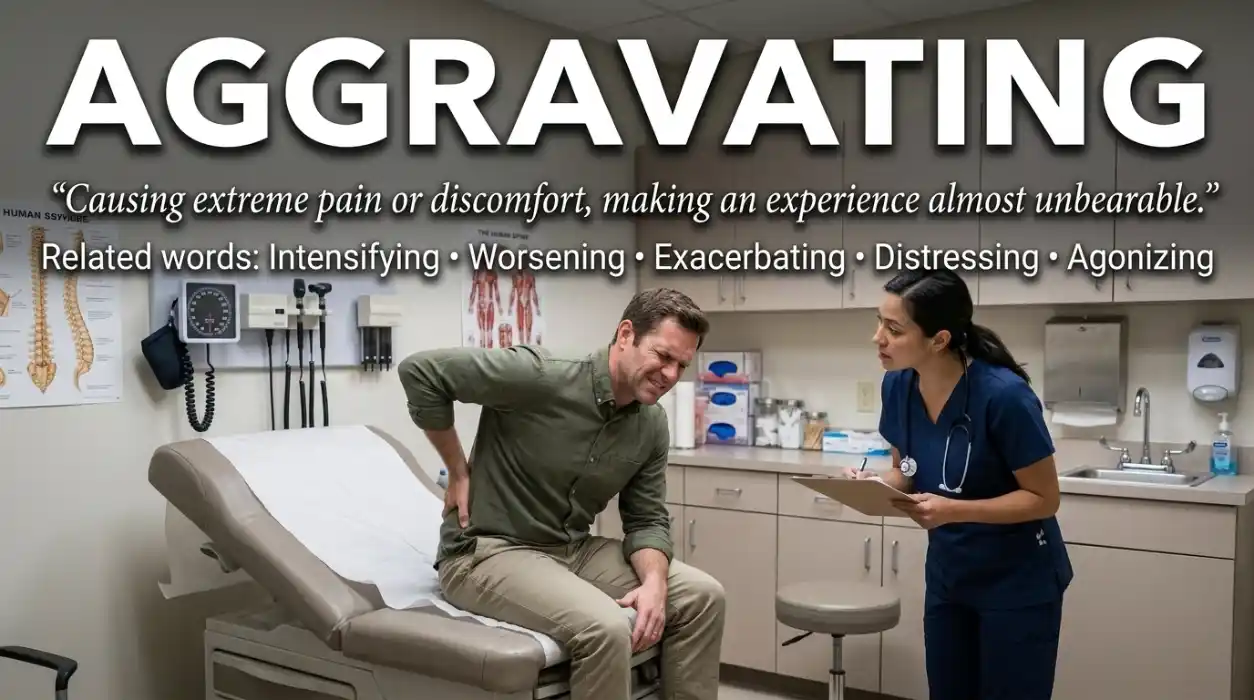
20. Excruciating (Adjective) — US / UK: /ɪkˈskruːʃiˌeɪtɪŋ/
Meaning: Extremely painful or uncomfortable; it can describe an experience that is almost unbearable.
Tone/Register: Strong, dramatic.
Examples: The excruciating wait for the final results felt endless.
Sitting through the awkward silence was excruciating.
21. Agonizing (Adjective) — US / UK: /ˈæɡəˌnaɪzɪŋ/
Meaning: Causing intense distress or discomfort, often over an extended period.
Tone/Register: Emotional, emphatic.
Examples: The agonizing delay left the family desperate for news.
Choosing between two difficult options was agonizing.
22. Frustratingly Complicated (Adjective Phrase) — US / UK: /ˈfrʌstreɪtɪŋli ˈkɑmplɪˌkeɪtɪd/; /ˈfrʌstreɪtɪŋli ˈkɒmplɪˌkeɪtɪd/
Meaning: More complicated than expected in a way that creates frustration.
Tone/Register: Everyday, professional.
Examples: The frustratingly complicated form asked for the same details twice.
Their booking system was frustratingly complicated to navigate.
23. Nerve-Racking (Adjective) — US / UK: /ˈnɜrv ˌrækɪŋ/; /ˈnɜːv ˌrækɪŋ/
Meaning: Causing anxiety or nervous tension rather than simple annoyance.
Tone/Register: Informal, emotional.
Examples: Waiting for the interview results was nerve-racking.
Driving through the storm was a nerve-racking experience.
24. Stressful (Adjective) — US / UK: /ˈstrɛsfəl/
Meaning: Causing mental or emotional pressure.
Tone/Register: Everyday, professional.
Examples: The stressful morning left me needing a quiet break.
Managing three deadlines at once can be stressful.
25. Disheartening (Adjective) — US / UK: /dɪsˈhɑrtənɪŋ/; /dɪsˈhɑːtənɪŋ/
Meaning: Causing someone to lose confidence, hope, or enthusiasm.
Tone/Register: Reflective, formal or everyday.
Examples: It was disheartening to receive no response after several applications.
The repeated setbacks felt disheartening to the whole group.
26. Discouraging (Adjective) — US / UK: /dɪsˈkɜrɪdʒɪŋ/; /dɪsˈkʌrɪdʒɪŋ/
Meaning: Making someone less hopeful or less willing to continue.
Tone/Register: Neutral, educational, professional.
Examples: The discouraging feedback made her question her progress.
It’s discouraging when your efforts seem to make no difference.
27. Disconcerting (Adjective) — US / UK: /ˌdɪskənˈsɜrtɪŋ/; /ˌdɪskənˈsɜːtɪŋ/
Meaning: Causing unease or confusion by disrupting someone’s expectations.
Tone/Register: Formal, restrained.
Examples: His sudden change in attitude was disconcerting.
The disconcerting silence made everyone glance at one another.
28. Disturbing (Adjective) — US / UK: /dɪˈstɜrbɪŋ/; /dɪˈstɜːbɪŋ/
Meaning: Causing worry, discomfort, or emotional upset.
Tone/Register: Serious, often strong.
Examples: The disturbing footage left viewers shaken.
I found the unexplained changes in the report disturbing.
29. Unsettling (Adjective) — US / UK: /ʌnˈsɛtəlɪŋ/
Meaning: Making someone feel uneasy, uncertain, or uncomfortable.
Tone/Register: Neutral to serious.
Examples: The unsettling message arrived from an unknown number.
There was something unsettling about the empty building.
30. Frictional (Adjective) — US / UK: /ˈfrɪkʃənəl/
Meaning: Related to friction or resistance; it is not a natural general synonym for aggravating.
Tone/Register: Technical, specialized.
Examples: The report examined frictional forces between the surfaces.
Their frictional relationship caused problems for the team.
Usage note: In ordinary English, use irritating, frustrating, or contentious when those are the intended meanings. Frictional is mainly technical.
31. Exasperated (Adjective) — US / UK: /ɪɡˈzæspəˌreɪtɪd/
Meaning: Feeling intense irritation or loss of patience because of something aggravating.
Tone/Register: Everyday, expressive.
Examples: She sounded exasperated after repeating the instructions.
I was exasperated by the endless hold music.
Usage note: Exasperating describes what causes the frustration; exasperated describes the person experiencing it.
32. Frustrated (Adjective) — US / UK: /ˈfrʌstreɪtɪd/
Meaning: Feeling upset because progress is blocked or a desired result remains out of reach.
Tone/Register: Everyday, professional.
Example: He felt frustrated when the printer stopped working.
The students were frustrated by the unclear assignment.
33. Annoyed (Adjective) — US / UK: /əˈnɔɪd/
Meaning: Feeling bothered or mildly angry about something.
Tone/Register: Common, conversational.
Examples: I was annoyed when the meeting started late again.
She looked annoyed by the constant tapping.
34. Irritated (Adjective) — US / UK: /ˈɪrəˌteɪtɪd/
Meaning: Feeling impatience or displeasure because of something bothersome.
Tone/Register: Neutral, everyday.
Examples: He became irritated when the same question came up again.
I felt irritated by the buzzing sound near my desk.
35. Aggravated (Adjective) — US / UK: /ˈæɡrəˌveɪtɪd/
Meaning: Made worse, or feeling irritated, depending on the context.
Tone/Register: Everyday, professional, context-dependent.
Examples: She sounded aggravated after another schedule change.
The aggravated injury required extra care.
Usage note: This word can describe a person’s emotional state or a condition that has become more severe.
36. Testy (Adjective) — US / UK: /ˈtɛsti/
Meaning: Easily annoyed and likely to respond impatiently.
Tone/Register: Informal, conversational.
Examples: He became testy when we asked for an update.
I get testy when I haven’t slept enough.
37. Touchy (Adjective) — US / UK: /ˈtʌtʃi/
Meaning: Easily upset or offended by certain remarks or situations.
Tone/Register: Informal, context-sensitive.
Examples: She’s touchy about comments on her work.
He became touchy when the subject of money came up.
38. Peeved (Adjective) — US / UK: /piːvd/
Meaning: Slightly annoyed or displeased.
Tone/Register: Informal, mild.
Examples: I was peeved when my lunch disappeared from the fridge.
She seemed peeved about the last-minute change.
39. Irked (Adjective) — US / UK: /ɜrkt/; /ɜːkt/
Meaning: Annoyed by something that feels unnecessary or irritating.
Tone/Register: Informal to neutral.
Examples: It irked him that nobody acknowledged his contribution.
I was irked by the repeated interruptions.
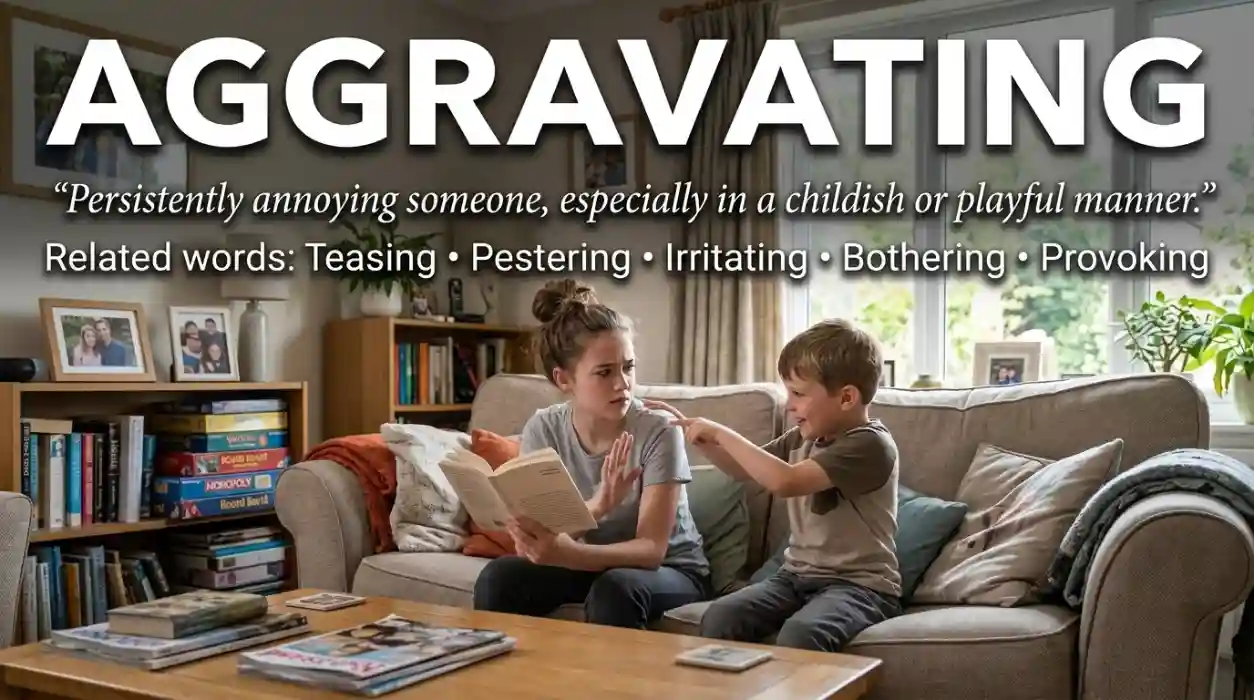
40. Pesty (Adjective) — US / UK: /ˈpɛsti/
Meaning: Persistently annoying, especially childishly or playfully.
Tone/Register: Informal, often playful.
Examples: The pesty fly kept circling my drink.
My cousin was being pesty during the car ride.
41. Pestering (Adjective or Present Participle) — US / UK: /ˈpɛstərɪŋ/; /ˈpestərɪŋ/
Meaning: Repeatedly bothering someone with requests, questions, or demands.
Tone/Register: Everyday, negative.
Examples: The pestering calls continued throughout the afternoon.
I ignored the pestering messages until I finished work.
42. Pushy (Adjective) — US / UK: /ˈpʊʃi/
Meaning: Trying too hard to get one’s way in a manner that annoys others.
Tone/Register: Informal, critical.
Examples: The pushy salesperson wouldn’t accept a polite refusal.
His pushy approach made the discussion uncomfortable.
43. Overbearing (Adjective) — US / UK: /ˌoʊvərˈbɛrɪŋ/; /ˌəʊvəˈbeərɪŋ/
Meaning: Controlling or domineering in a way that makes others uncomfortable.
Tone/Register: Strong, critical, formal or everyday.
Examples: Her overbearing manager checked every minor detail.
The overbearing behavior made it hard for the team to speak freely.
44. Obnoxious (Adjective) — US / UK: /əbˈnɑkʃəs/; /əbˈnɒkʃəs/
Meaning: Extremely unpleasant or offensive in a way that annoys other people.
Tone/Register: Strong, informal to neutral.
Examples: The obnoxious guest kept insulting the staff.
His obnoxious comments ruined an otherwise pleasant evening.
45. Offensive (Adjective) — US / UK: /əˈfɛnsɪv/
Meaning: Causing upset or anger because something seems insulting, disrespectful, or inappropriate.
Tone/Register: Serious, formal, or everyday.
Examples: The offensive remark prompted an apology.
I found the joke offensive rather than funny.
46. Agitating (Adjective) — US / UK: /ˈædʒɪˌteɪtɪŋ/
Meaning: Causing emotional disturbance, nervousness, or irritation.
Tone/Register: Descriptive, context-dependent.
Examples: The agitating noise made it hard to focus.
The constant uncertainty was emotionally agitating for the family.
47. Provocative (Adjective) — US / UK: /prəˈvɑkətɪv/; /prəˈvɒkətɪv/
Meaning: Intended or likely to provoke a reaction, disagreement, or strong emotion.
Tone/Register: Formal, media, academic.
Examples: His provocative remarks started a heated debate.
The article raises provocative questions about fairness.
48. Outrageous (Adjective) — US / UK: /aʊtˈreɪdʒəs/
Meaning: Shockingly unacceptable, unreasonable, or offensive.
Tone/Register: Strong, emphatic.
Examples: The outrageous fee was far higher than we expected.
It was outrageous to blame the entire team for one mistake.
49. Maddeningly Repetitive (Adjective Phrase) — US / UK: /ˈmædənɪŋli rɪˈpɛtətɪv/
Meaning: Repeated so often that it causes strong irritation.
Tone/Register: Informal, descriptive.
Examples: The maddeningly repetitive sound continued all afternoon.
The training video was maddeningly repetitive and difficult to finish.
50. Hard to Tolerate (Adjective Phrase) — US / UK: /hɑrd tə ˈtɑləˌreɪt/; /hɑːd tə ˈtɒləˌreɪt/
Meaning: So unpleasant or frustrating that enduring it requires considerable patience.
Tone/Register: Neutral, conversational.
Examples: The constant construction noise was hard to tolerate.
His refusal to listen became hard to tolerate after a while.
Vocabulary note: Some entries above describe the cause of irritation, while others describe a person’s reaction or a related kind of discomfort. For direct, everyday substitutions for aggravating, prioritize annoying, irritating, frustrating, exasperating, and maddening.
Synonyms by Tone
The tone of a synonym affects how readers interpret your message. A word such as annoying sounds relatively mild, while infuriating suggests intense anger. Choosing the right level keeps your writing accurate and natural.
Mild or Neutral Irritation
Use these words when you want to express annoyance without sounding overly angry.
- Annoying: A common word for everyday irritation.
- Irritating: Suggests something that repeatedly bothers you.
- Bothersome: Highlights inconvenience or minor trouble.
- Peeved: Expresses mild displeasure in an informal way.
- Irked: Describes a specific source of annoyance.
- Tedious: Focuses on boredom caused by repetitive work.
- Tiresome: Highlights something exhausting or monotonous.
Strong Frustration or Anger
These words suit situations that seriously test someone’s patience.
- Exasperating: Strong irritation after repeated difficulty.
- Infuriating: Intense anger.
- Maddening: An almost unbearable level of annoyance.
- Gall ing: Irritation caused by unfairness or humiliation.
- Incensing: Strong anger in response to an offensive action.
- Obnoxious: Extremely unpleasant or offensive behavior.
- Outrageous: Something shockingly unreasonable or unacceptable.
Formal or Literary Choices
These alternatives work well in essays, reports, reviews, and more descriptive writing.
- Vexing: A troublesome problem that annoys.
- Irksome: Persistent irritation.
- Disconcerting: Unease or confusion.
- Disheartening: Loss of hope or enthusiasm.
- Disconcerting: Something that disrupts expectations and creates discomfort.
- Galling: An experience that feels insulting or unfair.
Playful or Informal Choices
Use these expressions in relaxed conversation when the situation is not especially serious.
- Peeved: Mildly annoyed.
- Testy: Easily irritated.
- Touchy: Easily upset by a particular subject.
- Pesty: Persistently annoying, often in a playful way.
- Pushy: Too forceful or insistent.
- Maddening: Dramatic and conversational.
Why Tone Matters
Imagine that a friend arrives ten minutes late. Calling the delay annoying communicates mild frustration. Calling it infuriating suggests a much stronger reaction.
A professional report may describe a process as inefficient and frustrating. A personal message might simply say, “That was so irritating.” The situation determines which wording sounds appropriate.
“Aggravating” vs. Close Alternatives
These three alternatives are especially useful because they overlap with aggravating but emphasize different feelings.
| Word | Meaning difference | Tone | When to use it |
|---|---|---|---|
| Annoying | Causes general irritation or displeasure. | Common, relatively mild. | Everyday habits, noises, and small inconveniences. |
| Frustrating | Creates difficulty or blocks progress toward a goal. | Practical, emotional. | Delays, failed attempts, confusing systems, or obstacles. |
| Exasperating | Tests patience, often through repetition or stubborn difficulty. | Stronger, expressive. | Repeated mistakes, ignored instructions, or persistent problems. |
Consider these examples:
- “The buzzing sound is annoying.” The sound bothers you.
- “The broken printer is frustrating.” It prevents you from finishing a task.
- “It’s exasperating to explain the same problem for the fifth time.” Repetition has tested your patience.
These distinctions help you choose a precise adjective rather than using the strongest word available.
How “Aggravating” Changes by Context
Daily Conversation
In casual English, annoying, irritating, and frustrating sound natural in most everyday situations. You might call traffic annoying, a delayed delivery frustrating, or repeated interruptions aggravating.
Use infuriating only when the situation genuinely makes you very angry. Otherwise, the word can sound exaggerated.
Writing and Blogging
Writers can use synonyms to make descriptions more specific. A frustrating process blocks progress, a tiresome routine feels repetitive, and an infuriating decision provokes anger.
When writing a blog post, describe the reader’s experience. Precise wording often communicates more than adding several dramatic adjectives.
Professional or Academic Writing
In professional writing, frustrating, problematic, inconvenient, and disruptive may sound more constructive than emotionally intense words.
For example, “The repeated system failures were disruptive” explains the impact without blaming a person. In academic writing, vexing may describe a difficult question, while disconcerting may describe an unexpected result.
Creative or Informal Use
Fiction and personal storytelling allow stronger emotional language. Maddening can build tension, galling can highlight unfairness, and exasperating can portray a character who has reached the end of their patience.
In dialogue, natural expressions such as “That’s so annoying” often sound more believable than formal words such as irksome.
Common Mistakes Learners Make
Mistake 1: Confusing “Aggravating” With “Aggravated”
Aggravating describes something that irritates. Aggravated can describe a person who feels irritated or a condition that has become worse.
- Correct: “The repeated delays are aggravating.”
- Correct: “I’m aggravated by the repeated delays.”
- Correct: “The injury was aggravated by strenuous exercise.”
Mistake 2: Using “Frustrating” and “Annoying” Interchangeably Every Time
The words overlap, but frustration often involves a blocked goal. Annoyance can occur without any goal being blocked.
A loud ticking clock may be annoying. A computer that prevents you from submitting your work may be frustrating.
Mistake 3: Choosing a Strong Word for a Minor Problem
Calling a small inconvenience infuriating may sound dramatic. Save intense words for experiences that justify the emotional strength.
Mistake 4: Assuming “Aggravating” Always Means “Making Worse”
The verb aggravate often means to worsen a condition or problem. However, the adjective aggravating frequently means annoying.
For example, “The aggravating delay upset us” describes irritation. “The activity aggravated his injury” means the activity made the injury worse.
Mistake 5: Using Uncommon Alternatives Too Often
Words such as irksome and vexing can enrich writing, but they may sound formal or literary in casual conversation. Words like frictional are not ordinary substitutes for aggravating.
Choose familiar vocabulary unless the context calls for a more specialized expression.
Register Notes
- Formal: Vexing, disconcerting, galling.
- Everyday: Annoying, irritating, frustrating.
- Strong and emotional: Infuriating, exasperating, maddening.
- Informal: Peeved, testy, irked.
- Professional and constructive: Disruptive, inconvenient, frustrating.
Real-Life Examples Using
Workplace
A colleague repeatedly changes a deadline without informing the team. You might call the behavior frustrating because it disrupts your work, or exasperating if it happens repeatedly despite several discussions.
Social Situations
Someone interrupts every time you begin speaking. Describing the behavior as annoying is natural. If the interruptions continue after you politely ask them to stop, maddening may convey stronger irritation.
Media and Pop Culture
A television character who repeatedly ignores obvious warnings may seem exasperating. A villain who deliberately insults others may seem provocative or obnoxious, depending on the behavior.
Writing and Storytelling
A writer might describe an aggravating delay to build tension before an important event. A character’s frustrated response can reveal how much the delay matters to them.

Practice Quiz
Question 1
Your phone keeps making a small noise while you study. Which word fits best?
- A. Annoying
- B. Outrageous
- C. Disheartening
- D. Devoted
Question 2
A website repeatedly crashes before you can submit an assignment. How would you describe the experience?
- A. Cordial
- B. Frustrating
- C. Hospitable
- D. Sentimental
Question 3
You have explained the same instructions several times, but someone continues to ignore them. Which word best describes the situation?
- A. Exasperating
- B. Heartwarming
- C. Companionable
- D. Encouraging
Question 4
A decision feels deeply unfair and humiliating. Which adjective is especially suitable?
- A. Galling
- B. Cuddly
- C. Amiable
- D. Relaxing
Question 5
You feel slightly annoyed because your lunch has disappeared from the office fridge. Which informal word could describe your feeling?
- A. Peeved
- B. Infuriating
- C. Excruciating
- D. Nurturing
Question 6
A task involves entering hundreds of similar records and becomes boring through repetition. Which word fits best?
- A. Tedious
- B. Romantic
- C. Protective
- D. Gracious
Question 7
A colleague is easily irritated and responds impatiently to simple questions. Which adjective describes the colleague?
- A. Testy
- B. Tender
- C. Hospitable
- D. Lovable
Question 8
A remark is insulting and causes people to feel disrespected. Which word is most appropriate?
- A. Offensive
- B. Companionable
- C. Cuddly
- D. Thoughtful
Question 9
A confusing change makes you feel uneasy because you do not understand what will happen next. Which word fits best?
- A. Disconcerting
- B. Devoted
- C. Endearing
- D. Amiable
Question 10
A process moves extremely slowly and makes you very angry. Which phrase communicates the intensity?
- A. Infuriatingly slow
- B. Warmhearted
- C. Cordially slow
- D. Thoughtfully slow
Reflection Task
Write one sentence about an irritating experience you have had. Use a synonym for aggravating, then explain why that word expresses the situation better than annoying.
Answer key: 1-A, 2-B, 3-A, 4-A, 5-A, 6-A, 7-A, 8-A, 9-A, 10-A,
External Source
For further study, consult the Cambridge Dictionary for definitions, UK and US pronunciation, and example sentences.
Conclusion
Learning a synonym for aggravating helps you describe frustration with greater accuracy. Annoying, frustrating, and exasperating each communicate a different level or kind of irritation.
A varied vocabulary makes essays, blog posts, emails, and conversations more engaging. The strongest word is not always the most dramatic one; it is the word that best fits the situation.
Start with a few everyday alternatives, then explore stronger or more formal choices as your confidence grows. Pay attention to how native speakers use each word in context.
Practice by writing a sentence with one new synonym today. Try using it in an email, an essay, or a daily conversation, and notice how precisely you can express your meaning.
FAQs
1. What is the best synonym for aggravating in a professional email?
Frustrating, disruptive, or inconvenient can work well in professional emails. For example, “The repeated delays have been frustrating” expresses concern without sounding unnecessarily hostile. If you want to focus on the practical impact, say that the issue is disruptive. Describe the specific problem and its effect rather than labeling a colleague as aggravating.
2. What is a synonym for aggravating that starts with I?
Common choices include irritating, infuriating, and irksome. Irritating is suitable for everyday annoyances, infuriating expresses intense anger, and irksome sounds more formal or literary. Choose according to the severity of the situation. For most daily conversations, irritating is the most natural general-purpose alternative.
3. Is aggravating a stronger word than annoying?
Often, aggravating suggests persistent irritation or a situation that makes frustration worse, while annoying can describe a relatively small inconvenience. However, the difference depends on context and speaker. “An annoying noise” sounds ordinary, whereas “an aggravating series of delays” can emphasize how a problem repeatedly tests someone’s patience.
4. What is the difference between aggravating and frustrating?
Aggravating generally emphasizes irritation, while frustrating emphasizes difficulty or blocked progress. A repetitive noise may be aggravating even when it does not stop you from achieving a goal. A computer error that prevents you from finishing a task is frustrating because it obstructs your progress. Many situations can be both.
5. Can aggravating describe a person?
Yes. You can describe someone’s behavior or manner as aggravating when it repeatedly annoys you. For example, “His aggravating habit of interrupting made meetings difficult” focuses on a specific behavior. Calling the person aggravating directly can sound more critical, so describing the action is often more tactful in professional or sensitive situations.

Hasnain Ali is an SEO Content Strategist and the founder of wordvora.com, a trusted vocabulary platform that helps writers, students, professionals, and English learners find accurate synonyms, antonyms, word meanings, and real-life usage examples. He specializes in keyword research, on-page SEO, topical authority, and creating search-first content that aligns with Google’s latest Search Quality and E-E-A-T guidelines. His work focuses on producing clear, well-structured, and reader-friendly resources that satisfy search intent while maintaining high editorial standards.
Through extensive hands-on experience with SEO tools such as Google Search Console, Google Analytics, SEMrush, and Ahrefs, Hasnain researches user search behavior and develops content that is both informative and easy to understand. Every article published on wordvora.com is carefully reviewed for accuracy, readability, and contextual relevance before publication. His mission is to build one of the web’s most reliable English vocabulary resources by providing practical language guidance, trustworthy explanations, and content that helps readers improve their writing, communication, and vocabulary with confidence.