A synonym for aimed is a word or phrase that expresses direction, intention, purpose, or a goal. A synonym for aimed depends on the meaning of the sentence. Common alternatives include targeted, directed, intended, focused, pointed, and sought. Some describe where something was directed, while others explain a goal or purpose.
Imagine preparing a presentation for a specific audience. You might say the presentation was aimed at beginners, designed for beginners, or intended for beginners. Each phrase communicates a similar purpose in a slightly different way.
The word aimed appears frequently in everyday English, education, business, sports, and journalism. It can describe pointing at a target or directing an action toward a particular result.
Learning a synonym for aimed helps students write clearer essays, bloggers reach their intended audiences, and content writers avoid repetitive phrasing. It also helps everyday English users explain goals more precisely.
The key is context. A camera can be pointed at a subject, a campaign can target a group, and a plan can be intended to solve a problem. These meanings overlap, but they are not identical.
What Does “Aimed” Really Mean?
Aimed is the past tense and past participle of the verb aim. It means directed toward a target, person, purpose, or desired result. It can describe a physical movement or an action designed to achieve a goal.
For example, “She aimed the camera at the mountain” describes physical direction. “The course was aimed at new learners” means the course was designed for that audience.
Native English speakers understand aimed through its context. When it refers to a physical object, it often means pointed or directed. When it refers to a message, plan, or service, it usually means intended for a particular audience or outcome.
Common Contexts
- Physical direction: He aimed the flashlight at the door.
- Education: The lesson was aimed at intermediate learners.
- Marketing and communication: The campaign aimed to raise awareness.
- Personal goals: She aimed to improve her writing.
- Sports: The player aimed at the center of the goal.
- Criticism or conflict: His remarks were aimed at the manager.
Part of Speech and Simple Definition
- Part of speech: Verb form; it can also function as an adjective in phrases such as aimed communication.
- Simple definition: Directed something toward a target, purpose, or desired result.
- Base verb: Aim.
- Present tense: Aim/aims.
- Past tense: Aimed.
- Present participle: Aiming.
- Related noun: Aim.
Example: “The workshop was aimed at helping students build confidence.”
In this sentence, aimed at identifies the workshop’s intended purpose and audience.
Connotative Meaning
(Connotation means the feelings, associations, or impressions a word carries beyond its basic dictionary meaning.)
- Positive tone: Aimed can suggest focus, planning, and purposeful effort. For example, “The program was aimed at improving literacy.”
- Negative tone: It can imply hostility or deliberate criticism. For example, “The accusation was aimed at her.”
- Neutral tone: It can simply describe direction or intention. For example, “The camera was aimed at the stage.”
The word itself is generally neutral. The surrounding sentence determines whether the action sounds helpful, strategic, aggressive, or purely descriptive.
Etymology of “Aimed”
The word aim entered English through Old French esmer or related Anglo-French forms associated with estimating, directing, or calculating. Its history is not entirely straightforward, and dictionaries differ in how they describe the precise route of development.
Over time, the English verb came to express directing an object or effort toward a target. Its modern meanings include physical direction, intention, and purposeful action.
Historical Development
Old English (450–1100): The modern verb aim was not a standard Old English word in its present form. Speakers used other words to express targeting, directing, intending, and striving toward a goal.
Middle English (1100–1500): French influence contributed to the development of aim in English. Its early uses were connected with estimating, directing, and choosing a target.
Modern English (1500–present): The verb developed its familiar physical and figurative meanings. Today, people aim objects, aim criticism at someone, aim to achieve goals, and design programs aimed at particular audiences.
Pronunciation of “Aimed”
- US IPA: /eɪmd/
- UK IPA: /eɪmd/
- Syllables: aimed — one syllable.
- Sound pattern: The word rhymes with claimed and named.
Word Structure and Affixation
- Root/base: Aim.
- Prefix: None.
- Suffix: -ed, marking the past tense or past participle.
- Related forms: Aim, aims, aiming, aimed, aimless, aimlessly.
The spelling -ed does not create an extra syllable here. In aimed, the ending sounds like /d/, so the word has one syllable.
Synonyms List
The best synonym depends on whether aimed describes physical direction, a planned purpose, an intended audience, or an effort to reach a goal. The following alternatives cover these common meanings. Some are close synonyms, while others work only in particular sentence patterns.
1. Targeted (Verb/Adjective) — US / UK: /ˈtɑrɡɪtɪd/; /ˈtɑːɡɪtɪd/
Meaning: Directed toward a specific person, group, place, or objective.
Tone/Register: Neutral, professional, business.
Examples:
The campaign targeted first-time voters.
The lesson was targeted at students who needed extra practice.
2. Directed (Verb/Adjective) — US / UK: /dəˈrɛktɪd/ or /daɪˈrɛktɪd/
Meaning: Sent or guided toward a particular destination, person, or purpose.
Tone/Register: Neutral, formal, versatile.
Examples:
She directed the beam of light toward the ceiling.
The support program was directed at families in need.
3. Pointed (Verb/Adjective) — US / UK: /ˈpɔɪntɪd/
Meaning: Turned or positioned something so that it faced a particular target.
Tone/Register: Neutral, conversational.
Examples:
He pointed the remote at the television.
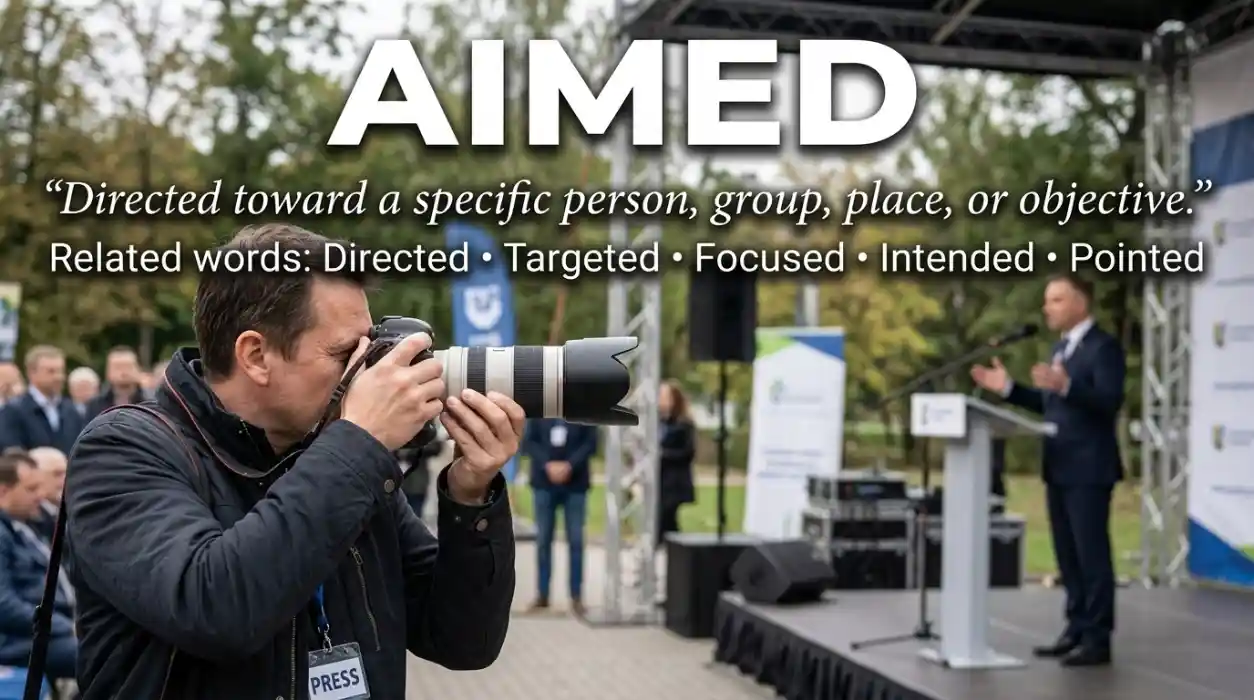
The photographer pointed her camera toward the sunset.
4. Intended (Adjective/Verb) — US / UK: /ɪnˈtɛndɪd/
Meaning: Planned or designed for a particular purpose or recipient.
Tone/Register: Neutral, formal or everyday.
Examples:
This guide is intended for new employees.
The message was intended to reassure the team.
5. Focused (Verb/Adjective) — US / UK: /ˈfoʊkəst/; /ˈfəʊkəst/
Meaning: Concentrated on a particular task, goal, or subject.
Tone/Register: Positive, professional, academic.
Examples:
The workshop focused on improving communication skills.
Her efforts were focused on completing the project.
6. Directed Toward (Phrase) — US / UK: /dəˈrɛktɪd təˈwɔrd/; /dəˈrektɪd təˈwɔːd/
Meaning: Oriented toward a person, objective, or intended result.
Tone/Register: Neutral, formal.
Examples:
The funding was directed toward rural schools.
His attention was directed toward the speaker.
7. Designed (Verb/Adjective) — US / UK: /dɪˈzaɪnd/
Meaning: Created or planned with a specific purpose or audience in mind.
Tone/Register: Neutral, professional, educational.
Examples:
The course was designed for adult learners.
They designed the survey to measure customer satisfaction.
8. Planned (Verb/Adjective) — US / UK: /plænd/
Meaning: Arranged or intended in advance to achieve a particular result.
Tone/Register: Neutral, everyday, professional.
Examples:
The meeting was planned to resolve the disagreement.
She planned her studies around the final examination.
9. Intended for (Phrase) — US / UK: /ɪnˈtɛndɪd fɔr/; /ɪnˈtendɪd fɔː/
Meaning: Created, selected, or meant for a particular person or group.
Tone/Register: Neutral, versatile.
Examples:
The booklet is intended for parents of young children.
This exercise is intended for intermediate English learners.
10. Geared Toward (Phrase) — US / UK: /ɡɪrd təˈwɔrd/; /ɡɪəd təˈwɔːd/
Meaning: Adapted or organized to suit a particular audience or purpose.
Tone/Register: Conversational, business, educational.
Examples:
The seminar is geared toward small business owners.
The activities are geared toward younger students.
11. Oriented (Verb/Adjective) — US / UK: /ˈɔriˌɛntɪd/; /ˈɔːriˌentɪd/
Meaning: Organized or positioned in relation to a particular purpose or direction.
Tone/Register: Professional, academic.
Examples:
The course is oriented toward practical skills.
Their strategy was oriented toward long-term growth.
12. Addressed (Verb) — US / UK: /əˈdrɛst/
Meaning: Directed a message, remark, or action to a particular person or issue.
Tone/Register: Neutral, formal, professional.
Examples:
The letter was addressed to the school principal.
Her comments addressed the concerns raised by students.
13. Meant (Verb) — US / UK: /mɛnt/
Meaning: Intended to communicate, accomplish, or be suitable for something.
Tone/Register: Everyday, conversational.
Examples:
The reminder was meant to help everyone prepare.
This activity is meant for beginners.
14. Sought (Verb) — US / UK: /sɔt/
Meaning: Tried to achieve, obtain, or find a particular result.
Tone/Register: Formal, literary, professional.
Examples:
The organization sought to improve access to education.
She sought a peaceful solution to the conflict.
15. Pursued (Verb) — US / UK: /pərˈsuːd/
Meaning: Actively worked toward achieving a goal or ambition.
Tone/Register: Neutral, professional, academic.
Examples:
He pursued a career in environmental science.
The team pursued its goal despite several setbacks.
16. Strived (Verb) — US / UK: /straɪvd/
Meaning: Made a determined effort to achieve a goal.
Tone/Register: Positive, formal, motivational.
Examples:
She strived to make the classroom welcoming for everyone.
The organization strived to improve its public services.
17. Worked Toward (Phrase) — US / UK: /wɜrkt təˈwɔrd/; /wɜːkt təˈwɔːd/
Meaning: Made ongoing efforts to reach a particular outcome.
Tone/Register: Everyday, professional.
Examples:
They worked toward an agreement everyone could accept.
I worked toward improving my speaking skills each week.
18. Endeavored (Verb) — US / UK: /ɪnˈdɛvərd/; /ɪnˈdevəd/
Meaning: Made a serious or deliberate effort to accomplish something.
Tone/Register: Formal, written.
Examples:
The researchers endeavored to explain the unusual results.
She endeavored to treat every student fairly.
19. Sought to (Verb Phrase) — US / UK: /sɔt tə/
Meaning: Tried or intended to achieve a specific purpose.
Tone/Register: Formal, academic, professional.
Examples:
The report sought to clarify the new policy.
The project sought to improve access to public transport.
20. Aspired (Verb) — US / UK: /əˈspaɪərd/
Meaning: Had a strong desire or ambition to achieve something significant.
Tone/Register: Positive, formal, motivational.
Examples:
As a child, he aspired to become a doctor.
The organization aspired to create a more inclusive community.

21. Focused On (Phrase) — US / UK: /ˈfoʊkəst ɑn/; /ˈfəʊkəst ɒn/
Meaning: Gave special attention or effort to a particular subject or goal.
Tone/Register: Neutral, professional, academic.
Examples:
The research focused on childhood language development.
Our team focused on reducing unnecessary delays.
22. Concentrated On (Phrase) — US / UK: /ˈkɑnsənˌtreɪtɪd ɑn/; /ˈkɒnsənˌtreɪtɪd ɒn/
Meaning: Directed mental effort or resources toward one specific activity or objective.
Tone/Register: Neutral, academic, professional.
Examples:
She concentrated on finishing her assignment.
The investigation concentrated on the main cause of the failure.
23. Aimed At (Phrase) — US / UK: /eɪmd æt/
Meaning: Intended for a particular audience or designed to produce a certain effect.
Tone/Register: Neutral, versatile.
Examples:
The announcement was aimed at residents.
The exercise is aimed at building confidence.
24. Pointed At (Phrase) — US / UK: /ˈpɔɪntɪd æt/
Meaning: Positioned so that something faces a specific person or object.
Tone/Register: Neutral, everyday.
Examples:
The flashlight was pointed at the locked gate.
He pointed the microphone at the person speaking.
25. Directed At (Phrase) — US / UK: /dəˈrɛktɪd æt/ or /daɪˈrɛktɪd æt/
Meaning: Intended to reach a particular person, group, or target.
Tone/Register: Neutral, professional.
Examples:
The advertisement was directed at college students.
Her criticism was directed at the policy, not its supporters.
26. Targeted At (Phrase) — US / UK: /ˈtɑrɡɪtɪd æt/; /ˈtɑːɡɪtɪd æt/
Meaning: Specifically designed to reach or affect a selected audience or target.
Tone/Register: Business, education, media.
Examples:
The reading program targeted struggling learners.
The public message targeted first-time visitors.
27. Destined (Adjective) — US / UK: /ˈdɛstɪnd/
Meaning: Expected or believed to be intended for a particular future outcome.
Tone/Register: Literary, dramatic, sometimes formal.
Examples:
The letter seemed destined for the wrong department.
She felt destined to work with young children.
Usage note: Destined suggests an expected future or fate. It is not a direct substitute for aimed in most practical instructions.
28. Allocated (Verb/Adjective) — US / UK: /ˈæləˌkeɪtɪd/
Meaning: Assigned resources, time, or responsibility for a particular purpose.
Tone/Register: Formal, business, administrative.
Examples:
They allocated more time to reading practice.
They allocated the funds to community health projects.
29. Assigned (Verb/Adjective) — US / UK: /əˈsaɪnd/
Meaning: Given a specific task, role, or responsibility.
Tone/Register: Neutral, professional, educational.
Examples:
The teacher assigned the class a short writing exercise.
She was assigned to the research team.
30. Directed Toward a Goal (Phrase) — US / UK: /dəˈrɛktɪd təˈwɔrd ə ɡoʊl/; /dəˈrektɪd təˈwɔːd ə ɡəʊl/
Meaning: Organized or carried out with a particular result in mind.
Tone/Register: Formal, academic, professional.
Examples:
They directed their efforts toward improving student attendance.
The new policy directs efforts toward safer roads.
31. Purposeful (Adjective) — US / UK: /ˈpɜrpəsfəl/; /ˈpɜːpəsfəl/
Meaning: Showing a clear intention or a definite reason for acting.
Tone/Register: Positive, professional.
Examples:
She took purposeful steps to improve her writing.
His purposeful approach kept the project on track.
32. Intentional (Adjective) — US / UK: /ɪnˈtɛnʃənəl/
Meaning: Done deliberately rather than by accident.
Tone/Register: Neutral, professional, academic.
Examples:
The change was intentional, not a mistake.
They made an intentional effort to include every student.
33. Deliberate (Adjective/Verb) — US / UK: /dɪˈlɪbərət/ (adjective); /dɪˈlɪbəˌreɪt/ (verb)
Meaning: Carefully considered or consciously planned.
Tone/Register: Neutral, formal.
Examples:
The team took a deliberate approach to solving the problem.
She made a deliberate choice to study every evening.
34. Goal-Oriented (Adjective) — US / UK: /ˈɡoʊl ˌɔriˌɛntɪd/; /ˈɡəʊl ˌɔːriˌentɪd/
Meaning: Focused on achieving clearly defined results.
Tone/Register: Professional, motivational.
Examples:
He is goal-oriented and tracks his progress carefully.
The program uses a goal-oriented approach to learning.
35. Mission-Driven (Adjective) — US / UK: /ˈmɪʃən ˌdrɪvən/
Meaning: Guided by a clear purpose or larger objective.
Tone/Register: Professional, organizational.
Examples:
The mission-driven team works to improve literacy.
Their mission-driven project supports underserved communities.
36. Strategic (Adjective) — US / UK: /strəˈtiːdʒɪk/
Meaning: Carefully planned to achieve a larger objective.
Tone/Register: Business, professional, academic.
Examples:
The company made a strategic effort to improve customer support.
Her strategic decisions helped the team reach its goal.
37. Calculated (Adjective) — US / UK: /ˈkælkjəˌleɪtɪd/
Meaning: Carefully planned to produce a particular effect or result.
Tone/Register: Formal, analytical, sometimes negative.
Examples:
His calculated remarks were intended to attract attention.
The move was a calculated attempt to reduce risk.
38. Focused in Its Efforts (Phrase) — US / UK: /ˈfoʊkəst ɪn ɪts ˈɛfərts/; /ˈfəʊkəst ɪn ɪts ˈefəts/
Meaning: Directing effort toward a clearly defined objective.
Tone/Register: Professional, descriptive.
Examples:
The team remained focused in its efforts to meet the deadline.
The campaign was focused in its efforts to raise awareness.
39. Concentrated (Adjective) — US / UK: /ˈkɑnsənˌtreɪtɪd/; /ˈkɒnsənˌtreɪtɪd/
Meaning: Gathered or directed into one place, area, or activity.
Tone/Register: Neutral, technical, everyday.
Examples:
Most of the work was concentrated in the final week.
The discussion concentrated on the main question.
40. Orchestrated (Verb/Adjective) — US / UK: /ˈɔrkəˌstreɪtɪd/; /ˈɔːkɪˌstreɪtɪd/
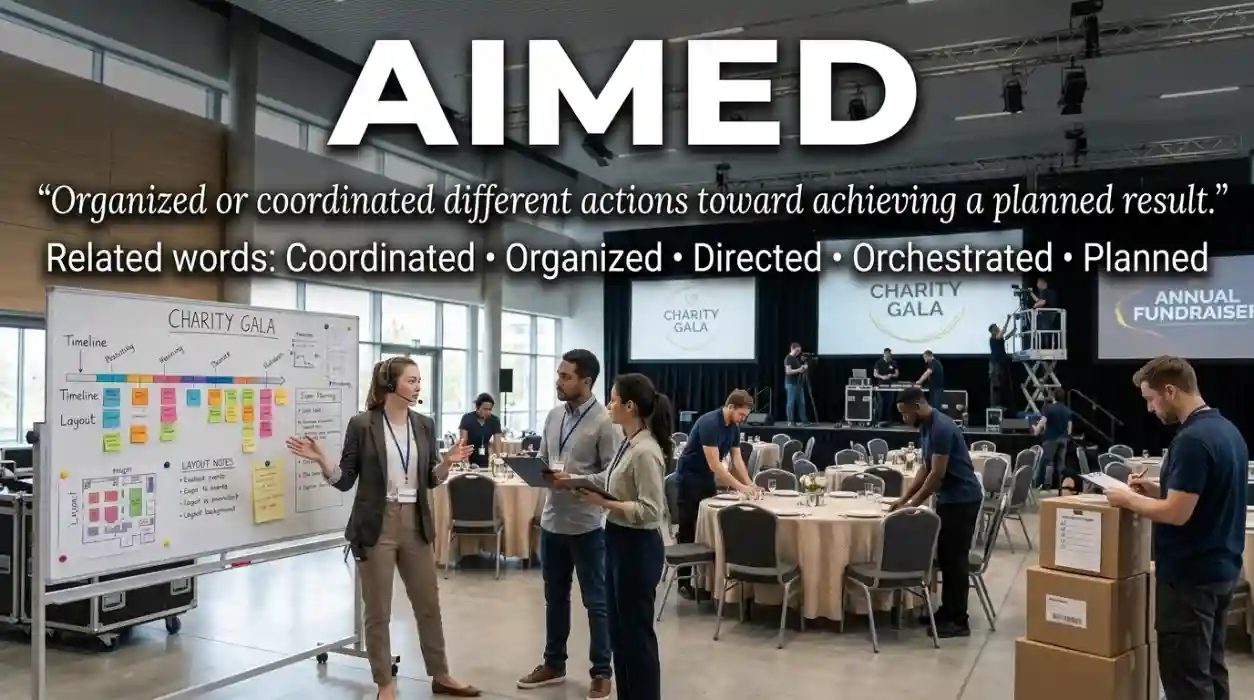
Meaning: Organized or coordinated different actions to achieve a planned result.
Tone/Register: Professional, formal, sometimes dramatic.
Examples:
She orchestrated the event with careful attention to detail.
The organization orchestrated a campaign to improve public awareness.
41. Calibrated (Verb/Adjective) — US / UK: /ˈkæləˌbreɪtɪd/
Meaning: Adjusted carefully for a specific measurement, result, or level of performance.
Tone/Register: Technical, professional.
Examples:
The technicians calibrated the camera for low-light photography.
The trainers calibrated the training to suit different skill levels.
Usage note: Calibrated is suitable when precise adjustment matters. It is not a general replacement for aimed.
42. Aligned (Adjective/Verb) — US / UK: /əˈlaɪnd/
Meaning: Brought into agreement with a particular goal, principle, or direction.
Tone/Register: Professional, academic, neutral.
Examples:
The curriculum aligned with national standards.
Their plans aligned with the community’s priorities.
43. Tailored (Verb/Adjective) — US / UK: /ˈteɪlərd/
Meaning: Adapted to meet the needs of a specific person or group.
Tone/Register: Professional, educational, business.
Examples:
The lesson was tailored to beginner-level readers.
She received advice tailored to her career goals.
44. Customized (Verb/Adjective) — US / UK: /ˈkʌstəˌmaɪzd/
Meaning: Changed or designed to suit a particular need or preference.
Tone/Register: Neutral, professional.
Examples:
The activity was customized for younger students.
They customized the presentation for the local audience.
45. Crafted (Verb) — US / UK: /kræftɪd/
Meaning: Carefully created with a particular purpose or effect in mind.
Tone/Register: Positive, professional, creative.
Examples:
The message was crafted to reassure worried parents.
She crafted a speech that encouraged the team to keep going.
46. Formulated (Verb) — US / UK: /ˈfɔrmjəˌleɪtɪd/; /ˈfɔːmjəˌleɪtɪd/
Meaning: Developed or expressed a plan, idea, or method in a deliberate way.
Tone/Register: Formal, academic, scientific.
Examples:
The researchers formulated a plan to test their hypothesis.
A new strategy was formulated to improve attendance.
47. Intended to (Phrase) — US / UK: /ɪnˈtɛndɪd tə/
Meaning: Planned or designed to produce a specific effect.
Tone/Register: Neutral, versatile.
Examples:
The reminder was intended to prevent missed appointments.
The activity was intended to strengthen reading skills.
48. Striving (Verb) — US / UK: /ˈstraɪvɪŋ/
Meaning: Making a determined effort to achieve a goal.
Tone/Register: Positive, motivational.
Examples:
She is striving to become a more confident speaker.
The group is striving to make its services more accessible.
49. Directed Deliberately (Phrase) — US / UK: /dəˈrɛktɪd dɪˈlɪbərətli/; /dəˈrektɪd dɪˈlɪbərətli/
Meaning: Intentionally sent, pointed, or focused toward a particular target.
Tone/Register: Formal, descriptive.
Examples:
The beam was directed deliberately toward the marked area.
His remarks were directed deliberately at the policy’s weaknesses.
50. Set on (Phrase) — US / UK: /sɛt ɑn/; /set ɒn/
Meaning: Determined to achieve or do something.
Tone/Register: Informal, conversational.
Examples:
She is set on finishing the course this year.
They were set on finding a solution before the meeting ended.
Vocabulary note: Not all 50 alternatives are interchangeable with aimed. The closest choices are usually targeted, directed, pointed, intended, and focused. Words such as strived and pursued describe efforts toward goals, while tailored and designed emphasize preparation for a purpose or audience.
Synonyms by Tone
The right alternative depends on what you want to communicate. Some words describe direction, while others emphasize planning, determination, or the intended audience.
Positive and Goal-Oriented
Use these words to emphasize ambition, preparation, or purposeful action.
- Focused: Concentrating on a goal.
- Purposeful: Acting with a clear reason.
- Goal-oriented: Working toward defined results.
- Strategic: Following a carefully planned approach.
- Mission-driven: Guided by a larger purpose.
- Pursued: Actively working toward an objective.
- Aspired: Holding an ambition or ideal.
Neutral and Descriptive
These words work well when you simply want to explain direction or intention.
- Directed: Sent toward a destination or purpose.
- Pointed: Positioned toward a target.
- Intended: Planned for a purpose or recipient.
- Targeted: Focused on a particular group or objective.
- Designed: Created for a specific purpose.
- Addressed: Directed toward a person or issue.
- Aligned: Brought into agreement with a goal.
Critical or Potentially Negative
These alternatives can suggest calculated action, confrontation, or a strong attempt to influence someone.
- Calculated: Carefully planned to produce an effect.
- Provocative: Intended or likely to trigger a reaction.
- Directed at: Sometimes used to describe criticism or accusations.
- Targeted at: Can imply focused pressure or scrutiny.
- Set on: May suggest determination that others find difficult to change.
Formal and Academic Choices
In reports, research papers, and professional documents, consider:
- Intended to
- Formulated
- Oriented toward
- Concentrated on
- Directed toward
- Designed to
- Allocated to
These phrases help explain a plan’s purpose without adding unnecessary emotional language.
Why Tone Matters
Compare “The campaign was aimed at young adults” with “The campaign targeted young adults.” Both are natural, but targeted can sound more strategic and specific.
Likewise, “Her comments were directed at the proposal” sounds neutral, while “Her comments were aimed at the director” may suggest personal criticism. Context changes the impression a word creates.
How “Aimed” Changes by Context
Daily Conversation
In casual speech, people often use meant to, intended to, pointed at, and trying to.
For example, “I meant to call you yesterday” expresses intention. “He pointed the camera at the dog” describes physical direction.
Writing and Blogging
Writers can use designed for, intended for, tailored to, and targeted at when describing content for a particular audience.
For example, “This article is designed for beginners” sounds natural when explaining its readership. “The article pursued beginners” would not make sense because pursue usually describes an active effort to obtain or achieve something.
Professional or Academic Writing
Words such as directed, formulated, aligned, and oriented toward can communicate a plan or research objective precisely.
For example, “The study focused on reading development” is straightforward. “The study was oriented toward reading development” is more formal and emphasizes the study’s overall direction.
Creative or Informal Use
In stories, aimed at can describe physical action, criticism, or intention. A character might aim a flashlight at a doorway or direct a sarcastic remark at a friend.
Choose a verb that makes the action clear. Physical scenes often need pointed or directed, while scenes about ambition may call for pursued or strived.
Common Mistakes Learners Make
Mistake 1: Confusing Physical Direction With Purpose
“Pointed at” usually describes the direction something faces. “Intended for” describes the person or group something is meant for.
- Correct: She pointed the telescope at the moon.
- Correct: The booklet was intended for new students.
Mistake 2: Using “Aimed” and “Achieved” as Synonyms
Aimed describes direction or intention. Achieved means successfully reached or completed a goal.
For example, “She aimed to improve her score” describes her intention. “She achieved a higher score” confirms that she succeeded.
Mistake 3: Forgetting the Preposition
The usual patterns include:
- Aim at: “He aimed at the target.”
- Aim for: “She aimed for a higher score.”
- Aim to: “They aimed to reduce waste.”
- Aim something at someone: “He aimed the flashlight at the wall.”
Some alternatives take different prepositions. You focus on a subject, strive for a result, and tailor a lesson to a learner’s needs.
Mistake 4: Treating Every Alternative as Interchangeable
A campaign can be targeted at an audience. A message can be intended for someone. A person can strive for success. These expressions overlap in meaning but follow different grammatical patterns.
Mistake 5: Overusing Formal Vocabulary
Words such as formulated and oriented may sound stiff in a casual conversation. “We planned to help” often sounds more natural than “We formulated an intention to assist.”
Register notes:
- Informal: Meant to, set on, worked toward.
- Neutral: Aimed at, directed, intended, pointed.
- Professional: Targeted, designed, aligned, tailored.
- Academic: Formulated, concentrated on, oriented toward.
- Motivational: Pursued, aspired, strived.
For additional definitions and pronunciation guidance, consult the Cambridge Dictionary.
Real-Life Examples Using
Workplace
A manager creates a training session aimed at helping new employees understand workplace policies. The session is designed for new staff and intended to improve their confidence.
Social Situations
A friend aims to organize a surprise birthday party. You could say that the friend planned the event or intended to make the birthday person feel special.
Media and Pop Culture
A documentary may be targeted at younger viewers. A filmmaker may have aimed to raise awareness of an environmental issue.
Writing and Storytelling
A novelist might write that a character pointed a torch toward a dark staircase. Later, the same character may pursue a goal or strive to overcome a personal challenge.
Practice Quiz
1. The educational campaign ______ to help children improve their reading.
A. Sought
B. Pointed
C. Bent
D. Calibrated
2. The advertisement was ______ at university students.
A. Striven
B. Targeted
C. Resolved
D. Meant
3. I ______ to send you the document yesterday, but I forgot.
A. Engineered
B. Aligned
C. Meant
D. Oriented
4. The research team ______ to understand how sleep affects memory.
A. Sought
B. Pointed
C. Tailored
D. Geared
5. The school ______ its efforts on improving science education.
A. Focused
B. Aspired
C. Bent
D. Striven
6. She was firmly determined to finish the novel before her holiday.
A. Intended for
B. Intent on
C. Directed at
D. Pursuant to
7. The course was created specifically for beginners.
A. Designed
B. Sought
C. Steered
D. Resolved
8. The manager carefully coordinated several events for a successful launch.
A. Tried
B. Orchestrated
C. Pointed
D. Meant
9. The organization made a serious effort to provide clean drinking water.
A. Endeavored
B. Geared
C. Targeted
D. Calibrated
10. The teacher changed the lesson to suit individual learners.
A. Pursued
B. Tailored
C. Sought
D. Strived
Answer Key: 1-A | 2-B | 3-C | 4-A | 5-A | 6-B | 7-A | 8-B | 9-A | 10-B
Reflection Task
Write a sentence about a goal you have or a message you recently created. Replace aimed with a suitable alternative and explain why it fits your meaning.
External reference:
Cambridge Dictionary — https://dictionary.cambridge.org/
Conclusion
Choosing a synonym for aimed helps you express direction, purpose, and determination with greater precision. Words such as targeted, intended, and focused suit different situations.
A stronger vocabulary makes essays, blogs, emails, and conversations clearer. The goal is not to replace every familiar word, but to choose the expression that best matches your meaning.
Start with a few common alternatives, then practise more formal choices as your confidence grows. Notice how grammar and context affect the words that sound natural.
Try writing three sentences today using targeted, intended, and pursued. Practise them in an email, an essay, or a daily conversation to make each expression easier to remember.
Frequently Asked Questions
1. What is the best synonym for aimed at a specific audience?
Targeted at, designed for, and intended for are useful choices. Targeted at often emphasizes selecting a particular audience, while designed for highlights how something was created to meet that audience’s needs. Intended for is a flexible option when you simply want to identify the people who should receive or use something.
2. What is another word for aimed that starts with T?
Targeted is a common alternative when an action or message focuses on a particular group or objective. For example, “The campaign targeted young adults.” The best replacement still depends on the sentence. If you mean physical direction, turned toward or pointed at may be more accurate than targeted.
3. What is the difference between aimed to and aimed at?
Aimed to is commonly followed by a verb and describes an intended action or result: “The team aimed to improve attendance.” Aimed at is followed by a noun or an -ing form in many uses: “The program was aimed at beginners” or “The policy was aimed at reducing waste.” The grammatical structure helps determine the meaning.
4. Can “aimed” be replaced with “focused”?
Often, yes, when the sentence describes attention or effort directed toward a subject. “The project aimed to improve literacy” can sometimes become “The project focused on improving literacy.” However, focused emphasizes concentration, while aimed can more broadly express an intended result. Check that the revised sentence preserves the original meaning.
5. What is a formal synonym for aimed in academic writing?
Directed toward, intended to, oriented toward, and designed to can suit academic writing. For example, “The study was designed to examine reading development” clearly identifies its purpose. Use formulated when discussing a plan or hypothesis, not simply as a substitute for every occurrence of aimed.

Hasnain Ali is an SEO Content Strategist and the founder of wordvora.com, a trusted vocabulary platform that helps writers, students, professionals, and English learners find accurate synonyms, antonyms, word meanings, and real-life usage examples. He specializes in keyword research, on-page SEO, topical authority, and creating search-first content that aligns with Google’s latest Search Quality and E-E-A-T guidelines. His work focuses on producing clear, well-structured, and reader-friendly resources that satisfy search intent while maintaining high editorial standards.
Through extensive hands-on experience with SEO tools such as Google Search Console, Google Analytics, SEMrush, and Ahrefs, Hasnain researches user search behavior and develops content that is both informative and easy to understand. Every article published on wordvora.com is carefully reviewed for accuracy, readability, and contextual relevance before publication. His mission is to build one of the web’s most reliable English vocabulary resources by providing practical language guidance, trustworthy explanations, and content that helps readers improve their writing, communication, and vocabulary with confidence.