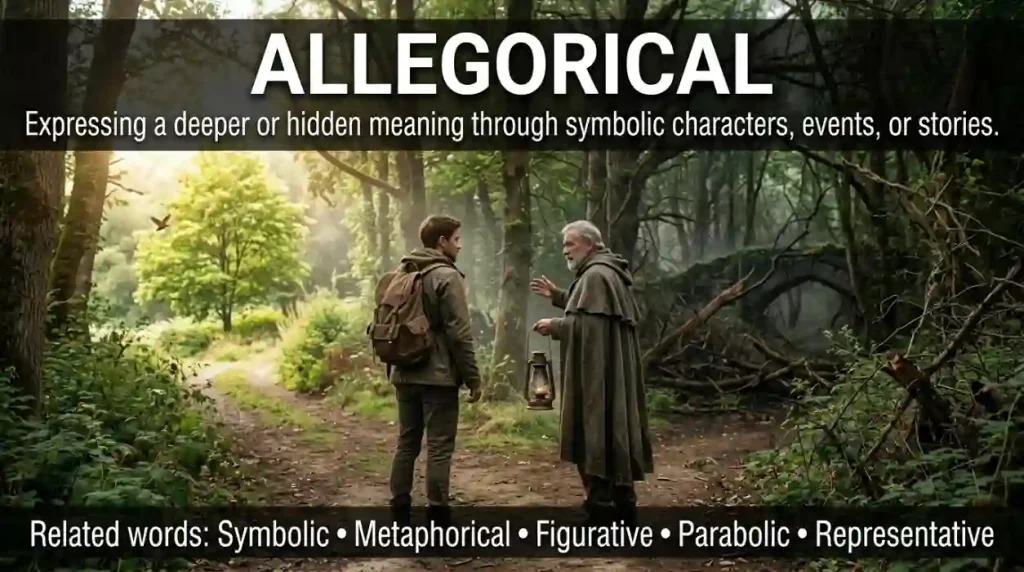
A synonym for allegorical is symbolic, metaphorical, figurative, emblematic, or representative, depending on the context. These words describe language, stories, images, or characters that communicate a deeper meaning beyond their literal interpretation.
Imagine reading a story about a journey through a dark forest. On the surface, it describes an adventure. Beneath the surface, the forest may represent fear, and the journey may symbolize personal growth. This is an example of allegorical storytelling.
Finding the right synonym for allegorical helps you explain hidden meanings more precisely. It also makes literary analysis, academic essays, and creative writing more engaging.
The word allegorical commonly appears in discussions of literature, mythology, art, religion, film, and political commentary. It helps readers recognize ideas that writers communicate through symbols and extended comparisons.
Students, bloggers, content writers, and everyday English learners can benefit from these alternatives. Each word offers a slightly different perspective on symbolism, interpretation, and deeper meaning.
What Does “Allegorical” Really Mean?
Allegorical describes a story, image, character, or artistic work that communicates a deeper meaning through symbols, characters, events, or actions. The literal story often represents an abstract idea, moral lesson, political message, or spiritual truth.
For example, a story about a farmer fighting a powerful storm might represent humanity’s struggle against adversity. The storm is part of the plot, but it can also symbolize hardship.
Native English speakers usually understand allegorical as a literary or artistic term. It often appears in book reviews, classroom discussions, film analysis, religious interpretation, and cultural criticism.
Part of Speech
Allegorical is an adjective. It describes a noun.
Examples include an allegorical novel, an allegorical painting, and an allegorical interpretation.
Simple Definition
In simple English, allegorical means using a story, image, or character to represent a deeper idea beyond its literal meaning.
The deeper meaning may be moral, political, social, philosophical, or spiritual.
Connotative Meaning of “Allegorical”
(Connotation is the emotional association or additional meaning that a word carries beyond its basic definition.)
Positive tone: Allegorical works can suggest wisdom, creativity, insight, and intellectual depth.
Example: “The film offers an allegorical exploration of courage and forgiveness.”
Negative tone: In some contexts, an allegorical work may seem obscure, overly complicated, or deliberately indirect.
Example: “The novel’s allegorical message was difficult to follow.”
Neutral tone: The word can simply describe a technique in which characters or events represent broader ideas.
Example: “The teacher discussed the allegorical elements in the story.”
The word itself is generally neutral. The surrounding context determines whether the work seems insightful, confusing, or simply symbolic.
Etymology
The word allegorical comes through Latin and French from the Greek word allēgoria, meaning “speaking otherwise” or “figurative speech.”
The Greek term combines elements associated with allos, meaning “other,” and agoreuein, meaning “to speak publicly.”
Old English (450–1100)
The modern adjective allegorical was not an established everyday English word during the Old English period. However, biblical interpretation, religious teaching, and symbolic storytelling already existed in the broader literary tradition.
Middle English (1100–1500)
During the Middle English period, English writers increasingly encountered allegorical traditions through Latin scholarship, French literature, and Christian teaching. Works such as Piers Plowman used characters and events to explore moral and religious questions.
Modern English (1500–Present)
The words allegory and allegorical became established in English literary and critical vocabulary. Writers and scholars used them to discuss stories that communicated moral, political, religious, or philosophical ideas through symbolic representation.
Today, the term applies to literature, visual art, theater, animation, films, and other creative forms.
Pronunciation
- US IPA: /ˌæl.əˈɡɔːr.ɪ.kəl/
- UK IPA: /ˌæl.ɪˈɡɒr.ɪ.kəl/
Syllables: al-le-gor-i-cal
Affixation pattern: allegory + -ical, with a spelling adjustment.
- Root: Allegory
- Prefix: None in the modern English formation
- Suffix: -ical
- Related noun: Allegory
- Related adjective: Allegorical
The suffix -ical helps form adjectives associated with a particular concept or subject. In this case, allegorical means relating to allegory or using allegorical techniques.
Synonyms List
The following alternatives explore the main shades of meaning associated with allegorical. Some are close synonyms, while others describe particular techniques used in allegorical works. The best choice depends on whether you mean symbolism, indirect meaning, representation, or figurative language.
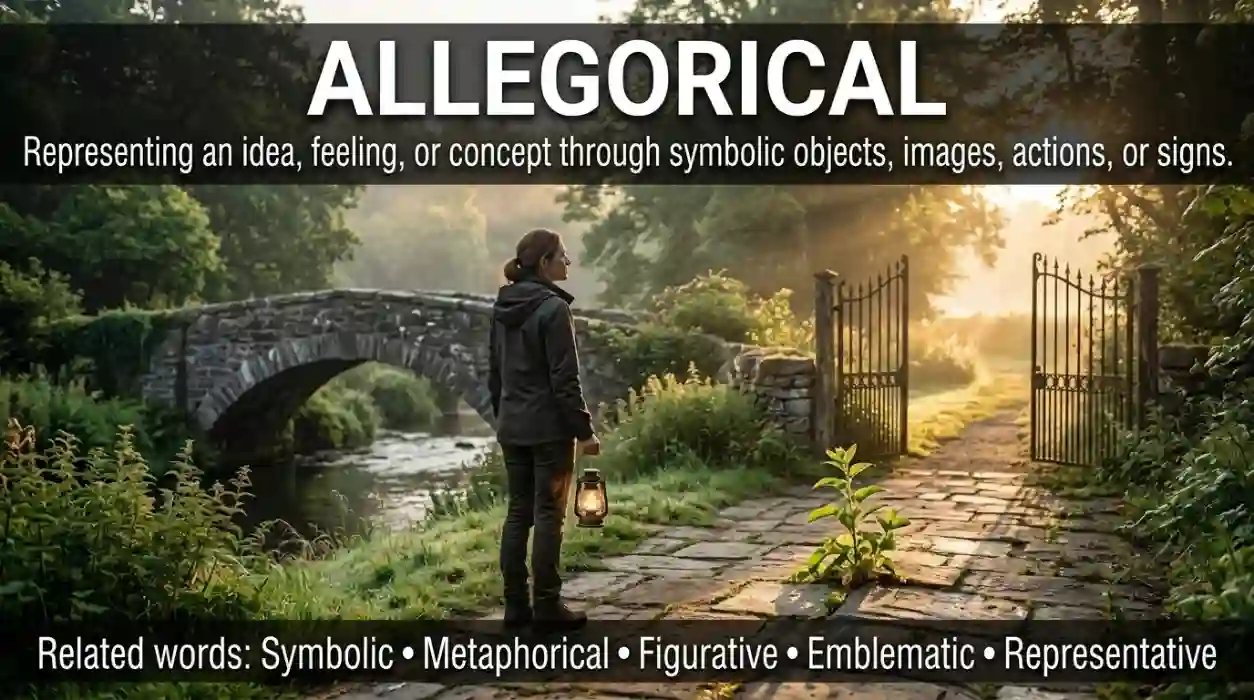
1. Symbolic (Adjective) — US / UK: /sɪmˈbɑː.lɪk/; /sɪmˈbɒl.ɪk/
Meaning: Representing an idea, feeling, or concept through an object, image, action, or sign.
Tone/Register: Neutral to positive; literature, art, and everyday English.
Examples:
The white dove is symbolic of peace in the painting.
Her final gesture carried a symbolic meaning.
2. Metaphorical (Adjective) — US / UK: /ˌmet.əˈfɔːr.ɪ.kəl/; /ˌmet.əˈfɒr.ɪ.kəl/
Meaning: Expressing an idea by comparing it indirectly with something else.
Tone/Register: Neutral to academic; literature, communication, and criticism.
Examples:
The author describes grief as a long winter.
His metaphorical language makes the speech memorable.
3. Figurative (Adjective) — US / UK: /ˈfɪɡ.jɚ.ə.tɪv/; /ˈfɪɡ.ər.ə.tɪv/
Meaning: Using language or representation that goes beyond a strictly literal meaning.
Tone/Register: Neutral; literary, educational, and creative writing.
Examples:
The phrase “a heart of stone” is figurative.
Her figurative description helped readers imagine the scene.
4. Emblematic (Adjective) — US / UK: /ˌem.bləˈmæt.ɪk/
Meaning: Serving as a recognizable symbol of a larger idea, quality, or movement.
Tone/Register: Formal; literary, cultural, and academic.
Examples:
The broken chain became emblematic of freedom.
That photograph is emblematic of the entire historical period.
5. Representative (Adjective) — US / UK: /ˌrep.rɪˈzen.tə.tɪv/
Meaning: Standing for or illustrating a wider group, quality, or idea.
Tone/Register: Neutral; academic, professional, and general writing.
Examples:
The character represents ordinary working people.
The scene offers a representative view of the town’s struggles.
6. Analogical (Adjective) — US / UK: /ˌæn.əˈlɑː.dʒɪ.kəl/; /ˌæn.əˈlɒdʒ.ɪ.kəl/
Meaning: Using a comparison between two situations to explain an idea.
Tone/Register: Academic; teaching, philosophy, and argument.
Examples:
The lecturer used an analogy to explain memory.
Her analogical reasoning made the difficult concept easier to grasp.
7. Parabolic (Adjective) — US / UK: /ˌper.əˈbɑː.lɪk/; /ˌpær.əˈbɒl.ɪk/
Meaning: Relating to a parable or a short story that teaches a moral or spiritual lesson.
Tone/Register: Literary and religious; formal.
Examples:
The novel uses parabolic storytelling to explore forgiveness.
His parabolic tale encourages readers to question their choices.
8. Fabled (Adjective) — US / UK: /ˈfeɪ.bəld/
Meaning: Associated with a traditional or imaginary story that often conveys a lesson.
Tone/Register: Literary; storytelling and descriptive writing.
Examples:
The fabled city represents humanity’s search for perfection.
She retold a fabled encounter between a king and a traveler.
9. Mythic (Adjective) — US / UK: /ˈmɪθ.ɪk/
Meaning: Relating to myths or using myth-like characters and events to explore broader ideas.
Tone/Register: Literary and academic; mythology, film, and cultural criticism.
Examples:
The hero’s journey follows a mythic pattern.
The mountain becomes a mythic place of transformation.
10. Mythological (Adjective) — US / UK: /ˌmɪθ.əˈlɑː.dʒɪ.kəl/; /ˌmɪθ.əˈlɒdʒ.ɪ.kəl/
Meaning: Relating to myths, legendary beings, or traditional stories about gods and heroes.
Tone/Register: Academic and descriptive; mythology and literature.
Examples:
The sculpture depicts a mythological battle.
The novel combines mythological figures with modern city life.
11. Archetypal (Adjective) — US / UK: /ˌɑːr.kəˈtaɪ.pəl/; /ˌɑː.kɪˈtaɪ.pəl/
Meaning: Representing a widely recognized model, character type, or recurring pattern.
Tone/Register: Academic and literary; storytelling and psychology.
Examples:
The wise mentor is an archetypal figure in adventure stories.
Her character follows an archetypal pattern of transformation.
12. Metonymic (Adjective) — US / UK: /ˌmet.əˈnɪm.ɪk/
Meaning: Using the name of something closely associated with an idea to refer to that idea.
Tone/Register: Academic; rhetoric, literature, and linguistics.
Examples:
The article uses “the crown” as a metonymic reference to the monarchy.
That metonymic expression appears frequently in political writing.
13. Metonymical (Adjective) — US / UK: /ˌmet.əˈnɪm.ɪ.kəl/
Meaning: Relating to metonymy, in which one closely associated term stands for another.
Tone/Register: Formal and academic; literary analysis.
Examples:
The critic identified a metonymical reference to government authority.
The poem’s metonymical language links the city with its leaders.
14. Symbolist (Adjective) — US / UK: /ˈsɪm.bə.lɪst/
Meaning: Relating to symbolism as an artistic or literary movement or approach.
Tone/Register: Literary and historical; art criticism.
Examples:
The painter adopted a symbolist approach to dreams.
Her symbolist imagery invites several interpretations.
15. Suggestive (Adjective) — US / UK: /səˈdʒes.tɪv/
Meaning: Hinting at a deeper meaning or idea without stating it directly.
Tone/Register: Neutral to literary; criticism and creative writing.
Examples:
The final image is suggestive of hope after loss.
His suggestive dialogue leaves the character’s motives uncertain.
16. Evocative (Adjective) — US / UK: /ɪˈvɑː.kə.tɪv/; /ɪˈvɒk.ə.tɪv/
Meaning: Bringing a feeling, memory, image, or idea vividly to mind.
Tone/Register: Positive to neutral; literary, artistic, and descriptive writing.
Examples:
The evocative landscape reflects the character’s loneliness.
Her evocative prose brings the old village to life.
17. Allusive (Adjective) — US / UK: /əˈluː.sɪv/
Meaning: Referring indirectly to another text, event, person, or cultural idea.
Tone/Register: Literary and academic; criticism and sophisticated writing.
Examples:
The poem contains allusive references to ancient myths.
His allusive style rewards readers who know the original story.
18. Referential (Adjective) — US / UK: /ˌref.əˈren.ʃəl/
Meaning: Relating to the act of referring to something or identifying a particular subject.
Tone/Register: Academic and technical; linguistics and literary analysis.
Examples:
The image has a referential connection to the historical event.
Her analysis explores the referential meaning of the recurring object.
19. Representational (Adjective) — US / UK: /ˌrep.rɪ.zenˈteɪ.ʃən.əl/
Meaning: Relating to the depiction of people, objects, ideas, or experiences.
Tone/Register: Academic; visual art, literature, and media studies.
Examples:
The artist uses representational imagery to explore identity.
The novel’s representational choices shape the reader’s perspective.
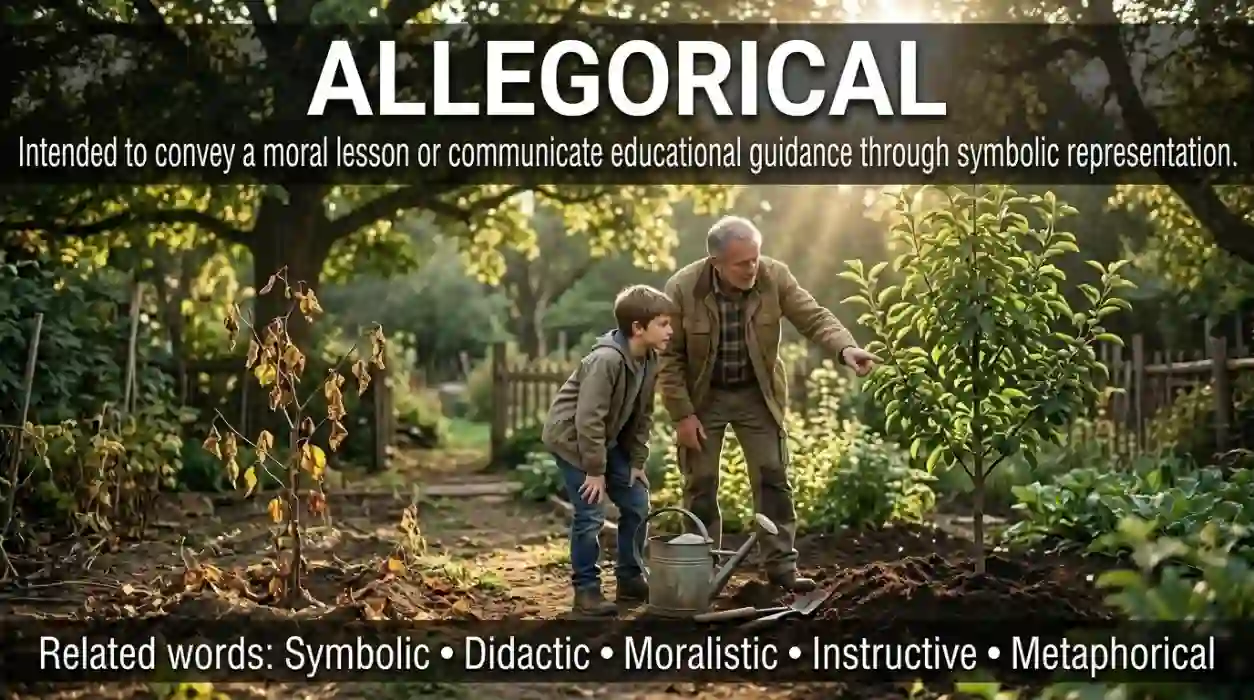
20. Didactic (Adjective) — US / UK: /daɪˈdæk.tɪk/
Meaning: Intended to teach a lesson or communicate moral or educational guidance.
Tone/Register: Academic and literary; sometimes critical.
Examples:
The fable has a didactic purpose.
Some readers find the novel’s ending too didactic.
21. Moralistic (Adjective) — US / UK: /ˌmɔː.rəˈlɪs.tɪk/
Meaning: Expressing strong judgments about right and wrong, often in a teaching tone.
Tone/Register: Neutral to negative; criticism and social commentary.
Examples:
The story takes a moralistic view of dishonesty.
Her review criticizes the film’s moralistic ending.
22. Allegorizing (Verb, Present Participle) — US / UK: /ˈæl.ə.ɡəˌraɪ.zɪŋ/
Meaning: Interpreting or presenting a story, event, or image as an allegory.
Tone/Register: Academic and literary; interpretation and criticism.
Examples:
The essay is allegorizing the journey as a search for identity.
Readers may disagree about whether the critic is allegorizing the final scene.
23. Figurative-Symbolic (Compound Adjective) — US / UK: /ˈfɪɡ.jɚ.ə.tɪv sɪmˈbɑː.lɪk/; /ˈfɪɡ.ər.ə.tɪv sɪmˈbɒl.ɪk/
Meaning: Combining nonliteral expression with symbolic representation.
Tone/Register: Academic and explanatory; literary analysis.
Examples:
The painting uses figurative-symbolic imagery to explore grief.
Her interpretation focuses on the work’s figurative-symbolic elements.
24. Imbued With Meaning (Adjective Phrase) — US / UK: /ɪmˈbjuːd wɪð ˈmiː.nɪŋ/
Meaning: Filled with a significance that extends beyond the immediate object or event.
Tone/Register: Literary and descriptive.
Examples:
The empty chair is imbued with meaning throughout the novel.
The recurring river becomes imbued with meaning as the story unfolds.
25. Signifying (Adjective or Verb Form) — US / UK: /ˈsɪɡ.nɪ.faɪ.ɪŋ/
Meaning: Indicating or representing an idea through a sign, gesture, object, or expression.
Tone/Register: Neutral to academic; semiotics and literary analysis.
Examples:
The red ribbon signifies loyalty within the story.
The gesture has a signifying role in the final scene.
26. Indicative (Adjective) — US / UK: /ɪnˈdɪk.ə.tɪv/
Meaning: Suggesting or pointing toward a particular quality, situation, or meaning.
Tone/Register: Neutral; academic, professional, and descriptive.
Examples:
The broken mirror is indicative of the character’s inner conflict.
The repeated image is indicative of a larger theme.
27. Suggestive of (Adjective Phrase) — US / UK: /səˈdʒes.tɪv əv/
Meaning: Giving the impression of an idea or feeling without expressing it explicitly.
Tone/Register: Literary and neutral; criticism and description.
Examples:
The fading light is suggestive of the character’s declining hope.
The recurring doorway is suggestive of new possibilities.
28. Implicit (Adjective) — US / UK: /ɪmˈplɪs.ɪt/
Meaning: Communicated indirectly rather than stated openly.
Tone/Register: Neutral to academic; analysis and formal writing.
Examples:
The story contains an implicit criticism of greed.
Her implicit message becomes clearer in the final chapter.
29. Indirect (Adjective) — US / UK: /ˌɪn.dəˈrekt/; /ˌɪn.daɪˈrekt/
Meaning: Communicated without stating the intended meaning plainly.
Tone/Register: Neutral; general, literary, and professional.
Examples:
The author uses an indirect approach to discuss corruption.
His indirect criticism encourages readers to think independently.
30. Figurative in Meaning (Adjective Phrase) — US / UK: /ˈfɪɡ.jɚ.ə.tɪv ɪn ˈmiː.nɪŋ/; /ˈfɪɡ.ər.ə.tɪv ɪn ˈmiː.nɪŋ/
Meaning: Intended to be understood beyond its literal interpretation.
Tone/Register: Neutral; educational and literary explanation.
Examples:
The phrase is figurative in meaning, not a literal description.
The teacher explained the expression’s figurative meaning with an example.
31. Metaphoric (Adjective) — US / UK: /ˌmet.əˈfɔːr.ɪk/; /ˌmet.əˈfɒr.ɪk/
Meaning: Relating to metaphors or comparisons that express one idea through another.
Tone/Register: Academic and literary.
Examples:
The novel’s metaphoric language connects illness with isolation.
The metaphoric image of a locked door appears throughout the poem.
32. Analogical in Structure (Adjective Phrase) — US / UK: /ˌæn.əˈlɑː.dʒɪ.kəl ɪn ˈstrʌk.tʃɚ/; /ˌæn.əˈlɒdʒ.ɪ.kəl ɪn ˈstrʌk.tʃə/
Meaning: Organized around a comparison between two related situations or systems.
Tone/Register: Academic; analysis, philosophy, and teaching.
Examples:
The novel has an analogical structure that links school life with politics.
Her argument follows an analogical pattern.
33. Personified (Adjective) — US / UK: /pɚˈsɑː.nə.faɪd/; /pəˈsɒn.ɪ.faɪd/
Meaning: Represented as a person or given human qualities, often to communicate an abstract idea.
Tone/Register: Literary; poetry, storytelling, and art.
Examples:
Death is personified as a traveler in the poem.
The personified storm reflects the hero’s anger.
34. Anthropomorphic (Adjective) — US / UK: /ˌæn.θrə.pəˈmɔːr.fɪk/; /ˌæn.θrə.pəˈmɔː.fɪk/
Meaning: Giving human characteristics, behavior, or emotions to nonhuman beings or objects.
Tone/Register: Academic and descriptive; mythology, animation, and literature.
Examples:
The story features anthropomorphic animals that discuss justice.
The anthropomorphic fox represents cleverness in the children’s tale.
35. Iconic (Adjective) — US / UK: /aɪˈkɑː.nɪk/; /aɪˈkɒn.ɪk/
Meaning: Widely recognized as a symbol of a person, idea, era, or cultural movement.
Tone/Register: Neutral to positive; art, media, and culture.
Examples:
The raised fist became an iconic image of resistance.
The film’s iconic doorway represents a turning point for the main character.
36. Significative (Adjective) — US / UK: /sɪɡˈnɪf.ɪ.kə.tɪv/
Meaning: Having meaning or serving to indicate something significant.
Tone/Register: Formal and uncommon; literary or philosophical discussion.
Examples:
The repeated color is significative within the poem’s structure.
The critic describes the final gesture as significative.
37. Connotative (Adjective) — US / UK: /ˈkɑː.nəˌteɪ.tɪv/; /ˈkɒn.əˌteɪ.tɪv/
Meaning: Carrying associations or implied meanings beyond a word’s direct definition.
Tone/Register: Academic; semantics, literature, and language study.
Examples:
The word has a connotative meaning associated with freedom.
The writer examines the connotative power of the image.
38. Evocational (Adjective) — US / UK: /ɪˌvoʊˈkeɪ.ʃən.əl/; /ɪˌvəʊˈkeɪ.ʃən.əl/
Meaning: Relating to the act of bringing memories, feelings, or associations to mind.
Tone/Register: Formal and uncommon; literary and artistic criticism.
Examples:
The critic discusses the evocational effect of the recurring landscape.
The artwork’s evocational qualities depend on its colors and shapes.
39. Symbol-Laden (Adjective) — US / UK: /ˈsɪm.bəl ˌleɪ.dən/
Meaning: Containing many symbols that suggest additional ideas or interpretations.
Tone/Register: Literary and descriptive.
Examples:
The symbol-laden film rewards careful viewing.
The author created a symbol-laden setting for the mystery.
40. Layered (Adjective) — US / UK: /ˈleɪ.ɚd/; /ˈleɪ.əd/
Meaning: Containing several levels of meaning that readers can interpret differently.
Tone/Register: Neutral to positive; literary and critical writing.
Examples:
The layered narrative explores family, identity, and memory.
Her layered story reveals a new theme with each reading.
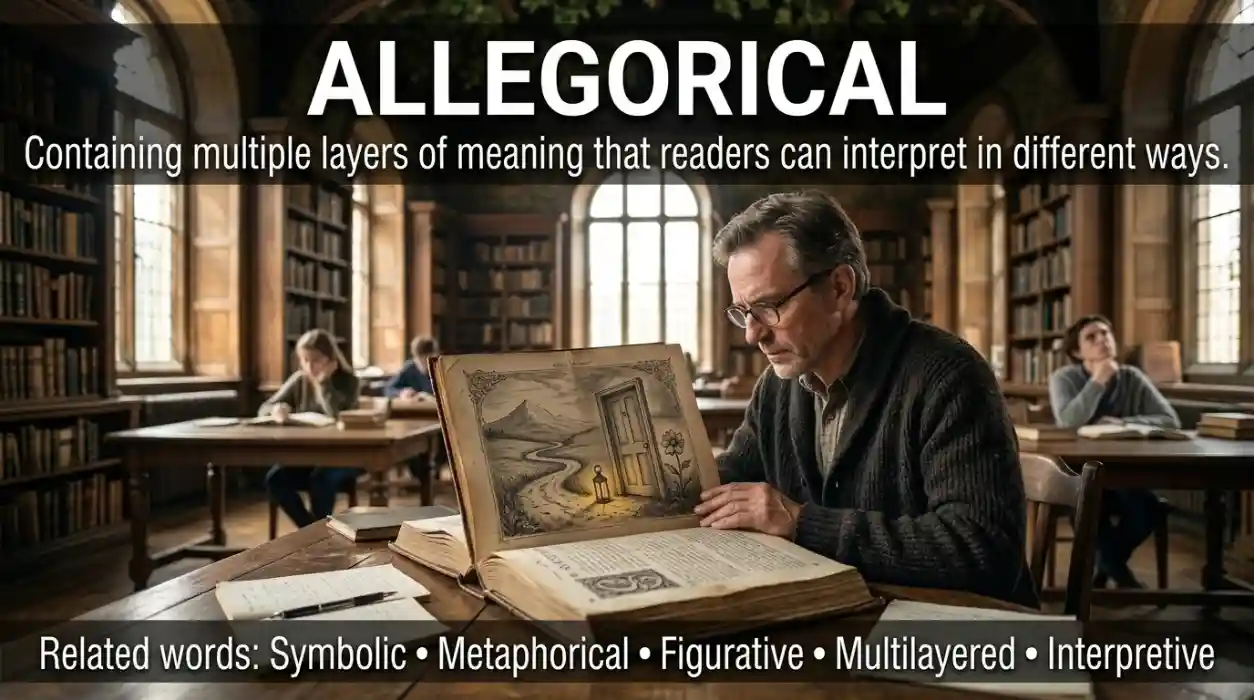
41. Multilayered (Adjective) — US / UK: /ˌmʌl.tiˈleɪ.ɚd/; /ˌmʌl.tiˈleɪ.əd/
Meaning: Containing multiple interconnected levels of meaning or interpretation.
Tone/Register: Academic and literary; criticism and analysis.
Examples:
The multilayered film combines a family drama with political commentary.
The novel offers a multilayered interpretation of the legend.
42. Nonliteral (Adjective) — US / UK: /ˌnɑːnˈlɪt̬.ɚ.əl/; /ˌnɒnˈlɪt.ər.əl/
Meaning: Not intended to be understood according to the direct, literal meaning of the words or images.
Tone/Register: Neutral; linguistics, education, and literary analysis.
Examples:
The phrase has a nonliteral meaning in this passage.
Readers should interpret the scene nonliterally.
43. Abstract (Adjective) — US / UK: /æbˈstrækt/
Meaning: Expressing ideas or qualities that are not physical objects or directly observable things.
Tone/Register: Neutral; philosophy, art, and academic writing.
Examples:
The painting transforms abstract ideas into shapes and colors.
The story explores abstract concepts such as justice and belonging.
44. Philosophical (Adjective) — US / UK: /ˌfɪl.əˈsɑː.fɪ.kəl/; /ˌfɪl.əˈsɒf.ɪ.kəl/
Meaning: Concerned with fundamental questions about existence, knowledge, morality, or human experience.
Tone/Register: Academic and reflective.
Examples:
The novel has a philosophical theme about freedom and responsibility.
Her interpretation connects the allegory with philosophical questions.
45. Moral (Adjective) — US / UK: /ˈmɔːr.əl/; /ˈmɒr.əl/
Meaning: Relating to principles of right and wrong or lessons about human behavior.
Tone/Register: Neutral; education, literature, and ethics.
Examples:
The tale carries a moral message about honesty.
Its moral significance becomes clearer at the end.
46. Spiritual (Adjective) — US / UK: /ˈspɪr.ɪ.tʃu.əl/
Meaning: Relating to the soul, faith, inner growth, or questions beyond material life.
Tone/Register: Neutral to positive; religious, philosophical, and literary.
Examples:
The pilgrimage becomes a spiritual journey for the main character.
The novel explores spiritual renewal through its central symbol.
47. Political (Adjective) — US / UK: /pəˈlɪt̬.ɪ.kəl/; /pəˈlɪt.ɪ.kəl/
Meaning: Relating to government, power, public affairs, or the organization of society.
Tone/Register: Neutral; literary criticism and social analysis.
Examples:
The fantasy kingdom offers a political critique of absolute power.
The allegorical plot carries a political message about freedom.
48. Satirical (Adjective) — US / UK: /səˈtɪr.ɪ.kəl/
Meaning: Using humor, irony, or exaggeration to criticize human behavior or social institutions.
Tone/Register: Critical and often humorous; literature, comedy, and media.
Examples:
The story presents a satirical portrait of corporate culture.
Its satirical characters expose the absurdity of political rivalries.
49. Parabolic in Form (Adjective Phrase) — US / UK: /ˌper.əˈbɑː.lɪk ɪn ˈfɔːrm/; /ˌpær.əˈbɒl.ɪk ɪn ˈfɔːm/
Meaning: Structured like a parable that communicates a broader lesson through a brief narrative.
Tone/Register: Literary, religious, and academic.
Examples:
The short film is parabolic in form and ends with a clear moral choice.
Her story is parabolic in form but open to several interpretations.
50. Symbolically Charged (Adjective Phrase) — US / UK: /sɪmˈbɑː.lɪ.kli ˈtʃɑːrdʒd/; /sɪmˈbɒl.ɪ.kli ˈtʃɑːdʒd/
Meaning: Rich in symbolic significance, often suggesting emotional, cultural, or historical meanings.
Tone/Register: Literary and academic; visual art, film, and criticism.
Examples:
The final scene is symbolically charged with images of renewal.
The red scarf becomes symbolically charged as the story develops.
Accuracy note: These 50 entries include direct synonyms, close alternatives, and context-specific expressions. Words such as symbolic, metaphorical, and figurative are not exact substitutes in every sentence. Terms such as satirical and political describe particular qualities an allegory may have rather than the meaning of allegory itself.
Synonyms by Tone
The best alternative depends on what the work communicates and how you want readers to interpret it. Some words emphasize hidden meanings, while others focus on lessons, comparisons, or emotional associations.
Positive Synonyms
These words can emphasize creativity, depth, or thoughtful interpretation.
- Symbolic
- Emblematic
- Evocative
- Archetypal
- Layered
- Multilayered
- Suggestive
Example: “The multilayered novel offers a thoughtful exploration of identity and belonging.”
Neutral Synonyms
These terms describe literary techniques or ways of communicating meaning without necessarily expressing approval or criticism.
- Figurative
- Metaphorical
- Representative
- Analogical
- Allusive
- Referential
- Implicit
- Indirect
- Nonliteral
Example: “The poem uses figurative language to describe the passage of time.”
Critical or Potentially Negative Descriptions
These words can suggest that a work teaches too forcefully, relies on criticism, or demands interpretation.
- Didactic
- Moralistic
- Satirical
- Abstract
Example: “Some readers consider the ending overly didactic because it explains the lesson instead of allowing readers to discover it.”
These words are not inherently negative. A satirical story can be entertaining, and a didactic work can communicate an important lesson. Context determines the tone.
Formal and Academic Alternatives
These terms are especially useful when discussing literature, rhetoric, philosophy, or visual art.
- Parabolic
- Metonymic
- Metonymical
- Connotative
- Significative
- Representational
- Anthropomorphic
Example: “The critic examines the representational role of animals in the novel.”
Why Tone Matters
Imagine describing a painting that represents freedom through a bird escaping from a cage.
Calling it evocative emphasizes the feelings it creates. Calling it emblematic suggests that the image has become a recognizable representation of freedom.
These distinctions help you describe creative works accurately without forcing every word into the same meaning.
“Allegorical” vs. Close Alternatives
| Word | Main distinction | Best context |
|---|---|---|
| Allegorical | Uses a story, character, or sequence of events to communicate a deeper meaning | Literary analysis and storytelling |
| Symbolic | Uses an object, image, action, or sign to represent an idea | Literature, art, and everyday descriptions |
| Metaphorical | Understands or describes one thing through another | Figurative language and creative writing |
| Figurative | Goes beyond literal meaning | Language, poetry, and rhetoric |
| Emblematic | Represents a broader idea or quality in a recognizable way | Culture, history, and public symbols |
| Parabolic | Resembles a parable that communicates a lesson | Religious, moral, and philosophical stories |
Allegorical vs. Symbolic
An allegorical work often develops its deeper meaning across several characters, events, or narrative elements. A symbolic image can communicate an idea on its own.
For example, a whole novel might portray a society as a garden divided by walls. A single flower within that novel might symbolize hope.
Allegorical vs. Metaphorical
A metaphor makes an indirect comparison between two things. An allegory often develops symbolic or figurative relationships throughout a larger work.
For example, “Time is a thief” is a metaphor. A story about a thief who steals people’s happiest memories could develop that metaphor into an allegorical narrative.
Allegorical vs. Didactic
Allegorical describes how a work communicates a deeper meaning through representation. Didactic describes its purpose of teaching or instructing.
An allegory may teach a lesson, but not every allegory is didactic. Some leave readers with difficult questions rather than a clear moral.
How “Allegorical” Changes by Context
Daily Conversation
In everyday conversation, symbolic is often more natural than allegorical. Most people use allegorical when discussing a story, film, or artistic work with a deeper message.
For example, “That scene is symbolic of growing up” sounds conversational. “The entire film is allegorical” suggests a more developed interpretation.
Writing and Blogging
Bloggers can use allegorical, symbolic, metaphorical, and emblematic to explain the meaning of images, stories, and cultural references.
For example, a film review might describe a collapsing bridge as symbolic of a broken relationship. A broader analysis could explain how the entire journey becomes an allegorical representation of reconciliation.
Use the more specific word when it adds meaning. Avoid replacing allegorical with a more familiar term if the distinction matters to your argument.
Professional and Academic Writing
Academic writing often distinguishes among allegory, metaphor, symbolism, and allusion.
A literary analysis might describe a character as emblematic of social inequality. A rhetoric paper might examine metaphorical language. A religious studies essay might discuss a parabolic narrative.
These terms help readers understand precisely how a work communicates meaning.
Creative and Informal Writing
Creative writers can use allegory to explore difficult subjects without explaining every idea directly.
A story about a city where every door gradually disappears might explore freedom, conformity, or fear. The reader discovers possible meanings through the narrative.
Words such as mythic, evocative, symbolic, and layered can help describe the effect of such writing.
Common Mistakes and Native Usage
Mistake 1: Treating Symbolism and Allegory as Identical
Symbolism can involve one image or object. Allegory generally involves a more sustained relationship between a narrative and its deeper meaning.
Better approach: Use symbolic for a particular image and allegorical when a larger work develops a connected pattern of representation.
Mistake 2: Assuming Every Metaphor Is an Allegory
A metaphor can be a single expression. An allegory usually extends beyond one comparison.
Better approach: Describe a phrase as metaphorical and reserve allegorical for a broader narrative, artistic structure, or interpretive framework.
Mistake 3: Using “Didactic” as an Exact Synonym
A didactic work aims to teach. An allegorical work communicates a deeper meaning through representation.
Better approach: Use didactic when discussing the teaching purpose and allegorical when explaining the method of conveying meaning.
Mistake 4: Assuming an Allegory Has Only One Meaning
Some allegories have a clear intended lesson. Others support several interpretations.
Better approach: Support your interpretation with details from the work. Phrases such as “may represent” or “can be interpreted as” help distinguish interpretation from fact.
Mistake 5: Overusing Academic Vocabulary
Words such as metonymical and significative can be appropriate in specialized analysis. They may sound unnatural in ordinary conversation.
Better approach: Choose clear language first. Use a specialized term when it communicates a distinction that a simpler word cannot express as accurately.
Register Notes
Formal and academic: Allegorical, parabolic, metonymic, representational, archetypal.
Everyday and accessible: Symbolic, metaphorical, figurative, indirect.
Literary and descriptive: Evocative, suggestive, layered, mythic.
Critical and interpretive: Didactic, moralistic, satirical.
For related vocabulary practice, consider an internal article about synonyms for symbolic and the difference between symbolism and metaphor.
Real-Life Mini Scenarios
Workplace
A company training video tells the story of a team trying to cross a river. Each person must cooperate for the group to succeed.
The story has an allegorical quality because the journey represents teamwork and shared responsibility.
Social Situations
A friend describes a relationship as a house with a locked door. The image may be metaphorical because it compares the relationship to a physical space.
If a longer story develops that house into a sustained representation of emotional isolation, it may become allegorical.
Media and Pop Culture
An animated film portrays a city where people’s memories disappear whenever they surrender their freedom. The plot may function as a political allegory about control and conformity.
The interpretation depends on the film’s details, not merely on the presence of unusual images.
Writing and Storytelling
A novelist creates a character who carries a heavy stone everywhere. As the story progresses, the stone represents guilt.
If this representation shapes the character’s journey and the narrative’s wider message, it contributes to the story’s allegorical structure.
Practice Exercise
1. A novel follows a journey through a dark forest that represents a character’s struggle with fear. The novel may be:
A. Literal
B. Allegorical
C. Referential
D. Documentary
2. A dove appears in a painting to represent peace. The dove is:
A. Symbolic
B. Didactic
C. Satirical
D. Analogical
3. A writer says, “Hope is a candle in the darkness.” This expression is:
A. Political
B. Metonymic
C. Metaphorical
D. Testimonial
4. A short story teaches readers not to judge others by appearances. Its teaching purpose is:
A. Archetypal
B. Didactic
C. Referential
D. Abstract
5. A film uses humor and exaggeration to criticize corruption. The film is:
A. Satirical
B. Parabolic
C. Referential
D. Nonliteral
6. A critic describes a recurring character type that appears across many traditional stories. The character is:
A. Significative
B. Archetypal
C. Metonymical
D. Literal
7. A story about a journey represents the struggle for independence throughout the entire plot. The story has an:
A. Allegorical structure
B. Announced purpose
C. Isolated allusion
D. Literal meaning only
8. A poet indirectly refers to an ancient Greek myth without explaining it. The reference is:
A. Didactic
B. Allusive
C. Anthropomorphic
D. Representative
9. A story gives human emotions and speech to animals. The animals are:
A. Referential
B. Political
C. Anthropomorphic
D. Connotative
10. A short religious story uses a simple narrative to teach a spiritual lesson. It is:
A. Parabolic
B. Iconic
C. Metonymic
D. Abstract
Answer key: 1-B, 2-A, 3-C, 4-B, 5-A, 6-B, 7-A, 8-B, 9-C, 10-A
Reflection Task
Choose a book, film, poem, or story you know well. Write two or three sentences explaining one deeper meaning it might communicate.
External Learning Sources
For authoritative definitions, pronunciation, and examples, consult these dictionaries:
- Cambridge Dictionary — learner-friendly definitions and UK and US pronunciation.
- Oxford Learner’s Dictionaries — usage examples, grammar patterns, and pronunciation guidance.
- Merriam-Webster — definitions, word history, and American English usage.
Conclusion
Learning a synonym for allegorical helps you explain deeper meanings in stories, films, paintings, and poems. The right word makes your interpretation clearer and more precise.
Each alternative offers a different perspective. Symbolic highlights representation, metaphorical emphasizes comparison, and didactic focuses on teaching a lesson.
Students, bloggers, and content writers can use these distinctions to strengthen essays, reviews, articles, and creative projects. A richer vocabulary also helps everyday English users discuss art and ideas with confidence.
Choose three new words and use them to analyze a favorite story or film. Practice explaining its deeper meaning in your own words, and let your vocabulary grow with every interpretation.
FAQs
1. What is the best synonym for allegorical in literary analysis?
Symbolic is often the most accessible alternative, but metaphorical, emblematic, and figurative may fit better in specific contexts. Use symbolic when an image represents an idea, metaphorical when a comparison shapes the meaning, and emblematic when something represents a broader quality or movement. For an extended narrative, allegorical may remain the most precise choice.
2. Is allegorical the same as symbolic in literature?
Not exactly. Symbolic describes an object, action, or image that represents something beyond itself. Allegorical usually describes a larger narrative or artistic structure that develops a deeper meaning through connected characters, events, or images. A story can contain symbolic objects without being a full allegory. The distinction depends on how extensively the work develops its underlying meaning.
3. What is a simple example of an allegorical story?
Imagine a story about a village divided by a wall. As the villagers learn to cooperate, they gradually remove the wall. The village may represent society, while the wall represents prejudice or division. The literal events form the plot, but the larger narrative communicates a broader idea about unity and understanding.
4. What is the difference between allegorical and metaphorical language?
Metaphorical language compares one thing with another to communicate an idea. Allegorical storytelling develops a deeper meaning across a broader narrative or artistic work. For example, “Life is a journey” is a metaphor. A novel that portrays an entire journey as a character’s search for purpose may use an allegorical structure built around that metaphor.
5. Can a film be allegorical without explaining its message?
Yes. An allegorical film can communicate meaning through characters, events, visual patterns, and recurring images without stating its message directly. Viewers may interpret these elements differently. A convincing interpretation should connect the proposed meaning to details in the film rather than assume that every unusual image must represent a hidden message.

Hasnain Ali is an SEO Content Strategist and the founder of wordvora.com, a trusted vocabulary platform that helps writers, students, professionals, and English learners find accurate synonyms, antonyms, word meanings, and real-life usage examples. He specializes in keyword research, on-page SEO, topical authority, and creating search-first content that aligns with Google’s latest Search Quality and E-E-A-T guidelines. His work focuses on producing clear, well-structured, and reader-friendly resources that satisfy search intent while maintaining high editorial standards.
Through extensive hands-on experience with SEO tools such as Google Search Console, Google Analytics, SEMrush, and Ahrefs, Hasnain researches user search behavior and develops content that is both informative and easy to understand. Every article published on wordvora.com is carefully reviewed for accuracy, readability, and contextual relevance before publication. His mission is to build one of the web’s most reliable English vocabulary resources by providing practical language guidance, trustworthy explanations, and content that helps readers improve their writing, communication, and vocabulary with confidence.