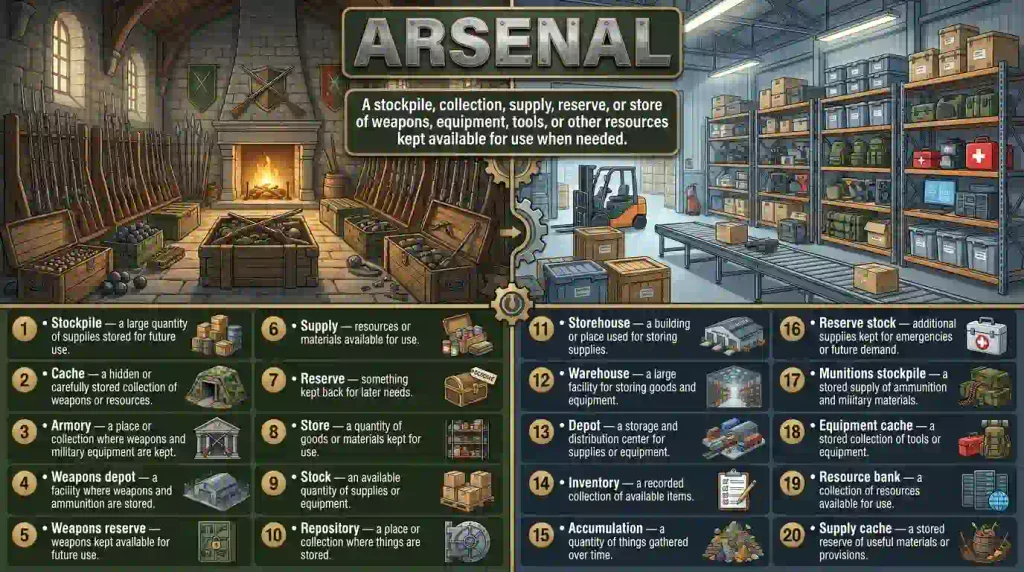
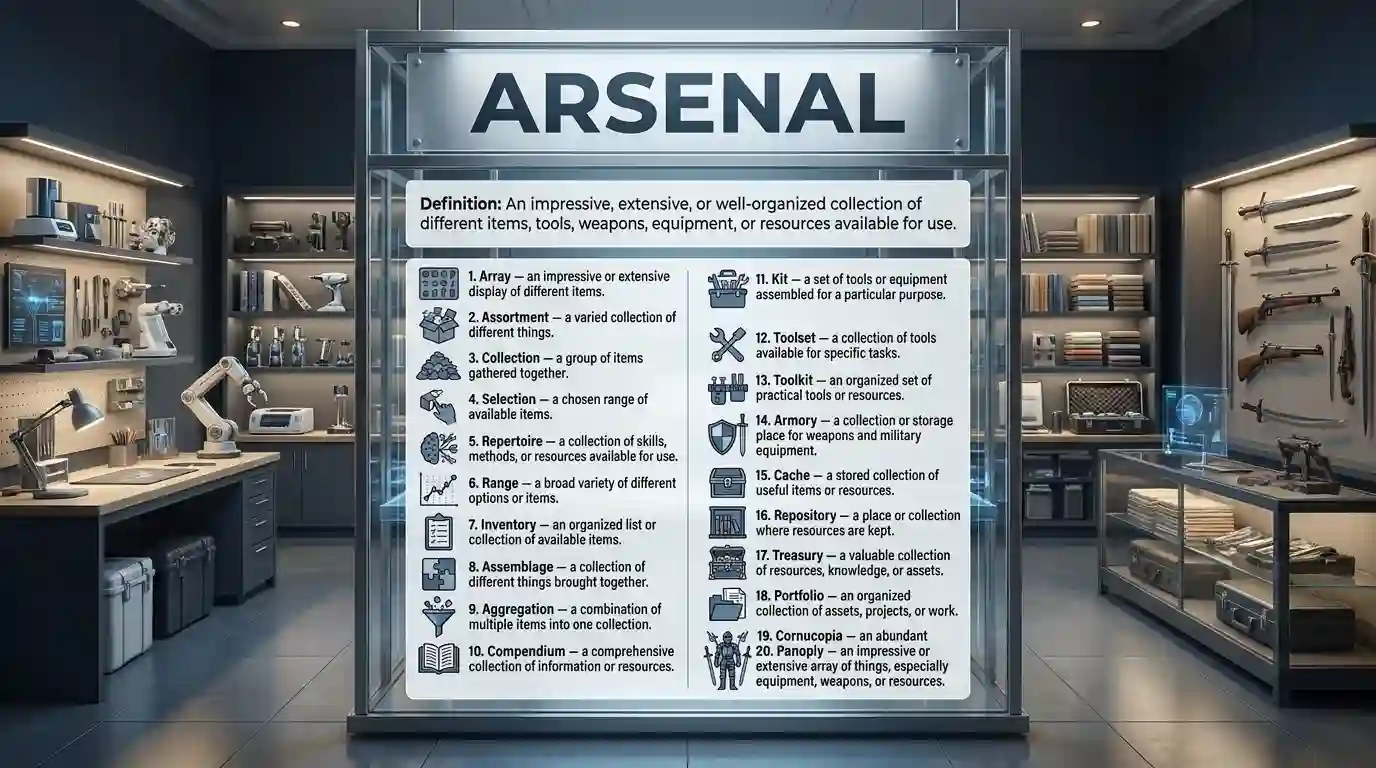
A synonym for arsenal is stockpile, supply, collection, reserve, store, or cache, depending on the context. The word can describe a collection of weapons, equipment, resources, or skills. The best alternative depends on what is being collected and how it is used.
Imagine a photographer preparing for a major event. She has a collection of cameras, lenses, batteries, and accessories. You could describe this collection as her arsenal of equipment.
The word arsenal appears in conversations about weapons, sports, business, technology, and personal skills. Its meaning changes slightly with the situation.
Learning a synonym for arsenal helps you avoid repetition and express ideas more precisely. Students and bloggers can use these alternatives to make their writing clearer.
Content writers and everyday English users can also benefit. The right word makes descriptions sound more natural, confident, and engaging.
What Does “Arsenal” Really Mean?
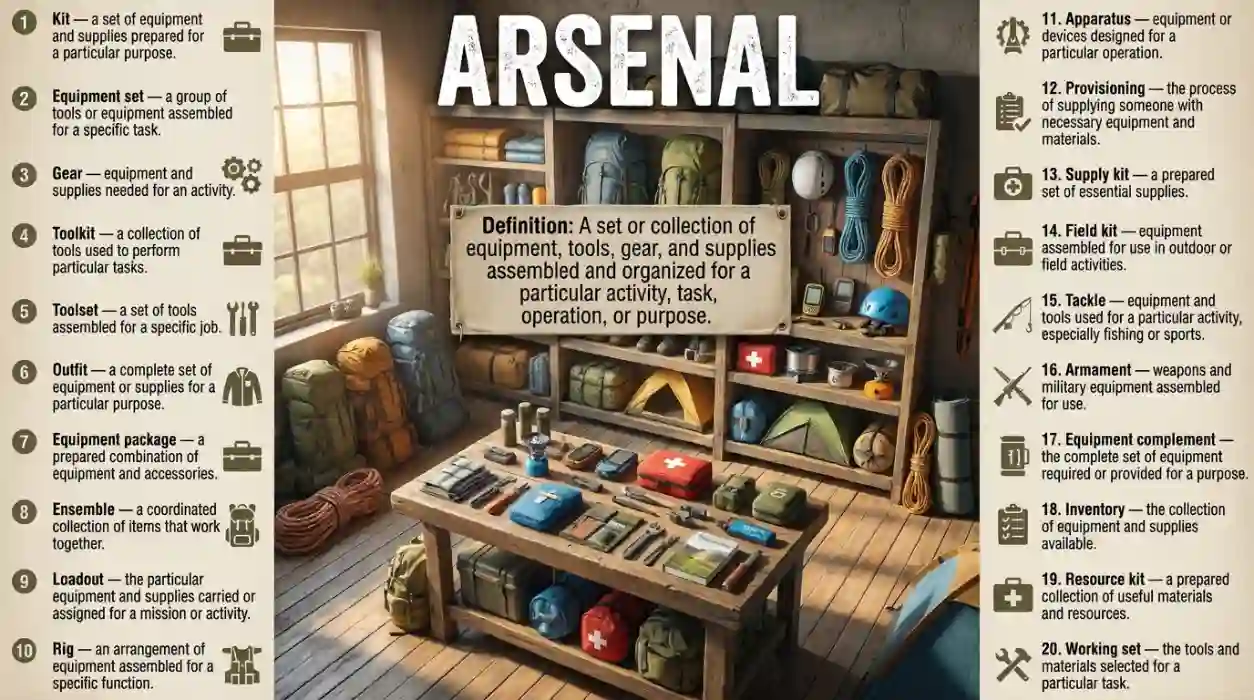
Arsenal is a noun that means a collection or supply of weapons, equipment, tools, or resources available for a particular purpose.
Traditionally, an arsenal is a place where weapons and military equipment are stored. In modern English, the word also has figurative meanings.
For example, someone may have an arsenal of business strategies, cooking techniques, study methods, or communication skills.
Native English speakers understand the word through context. In a military discussion, it usually refers to weapons and ammunition. In everyday or professional writing, it often describes a large and useful collection of resources.
Examples:
- The country expanded its military arsenal.
- The teacher has an arsenal of creative classroom activities.
- The athlete used an arsenal of techniques to win the competition.
The word often suggests variety, strength, preparation, and readiness. However, in military contexts, it can carry serious or threatening associations.
Connotative Meaning
(Connotation is the emotional feeling or association connected with a word beyond its basic dictionary meaning.)
Positive tone: In figurative use, arsenal can suggest preparation, capability, strength, and a wide range of useful resources.
Negative tone: In military or conflict-related contexts, it can suggest danger, destruction, aggression, or excessive force.
Neutral tone: When describing a collection of tools, equipment, or supplies, it can simply mean an available stock.
Etymology
The English word arsenal entered the language through French and Italian forms associated with an establishment where weapons and military supplies were stored or manufactured.
Its deeper history is connected to the Arabic expression dār aṣ-ṣināʿa, meaning a house or place of manufacture. This referred to a workshop or dockyard where ships and military equipment were made.
Old English (450–1100)
The word arsenal was not part of ordinary Old English vocabulary. English speakers used other words for weapons, military equipment, storage places, and supplies.
Middle English (1100–1500)
During the Middle English period, English borrowed many words from French and other European languages. Forms related to arsenal became established through European military and maritime contact.
Modern English (1500–Present)
In Modern English, arsenal became associated with military storage facilities and collections of weapons. Its figurative meaning developed further.
Today, writers use it for collections of resources, methods, techniques, and skills. For example, a person may have an arsenal of useful ideas.
Pronunciation, Syllables, and Affixation
US pronunciation: /ˈɑːr.sən.əl/
UK pronunciation: /ˈɑː.sən.əl/
Syllables: ar-se-nal
Root: Arsenal is a borrowed word with historical roots in Arabic through European languages.
Prefix: None
Suffix: No productive English suffix is added in the modern word.
Affixation pattern: Arsenal is a complete borrowed noun rather than a word formed by adding a modern English prefix or suffix.
Synonyms List
The most suitable synonym depends on the meaning of arsenal in your sentence. Some alternatives describe weapons, while others refer to supplies, equipment, tools, or figurative resources.
The list below includes close synonyms and context-specific alternatives. A few are broader terms rather than exact replacements, so always consider the intended meaning.
1. Stockpile (Noun) — US / UK: /ˈstɑːk.paɪl/ / /ˈstɒk.paɪl/
Meaning: A stockpile is a large quantity of supplies or materials stored for future use.
Tone/Register: Neutral, formal, and practical.
Examples:
The organization built a stockpile of emergency supplies.
The warehouse contains a stockpile of spare equipment.
2. Cache (Noun) — US / UK: /kæʃ/ / /kæʃ/
Meaning: A cache is a hidden or carefully stored collection of valuable items or supplies.
Tone/Register: Neutral, technical, and informal.
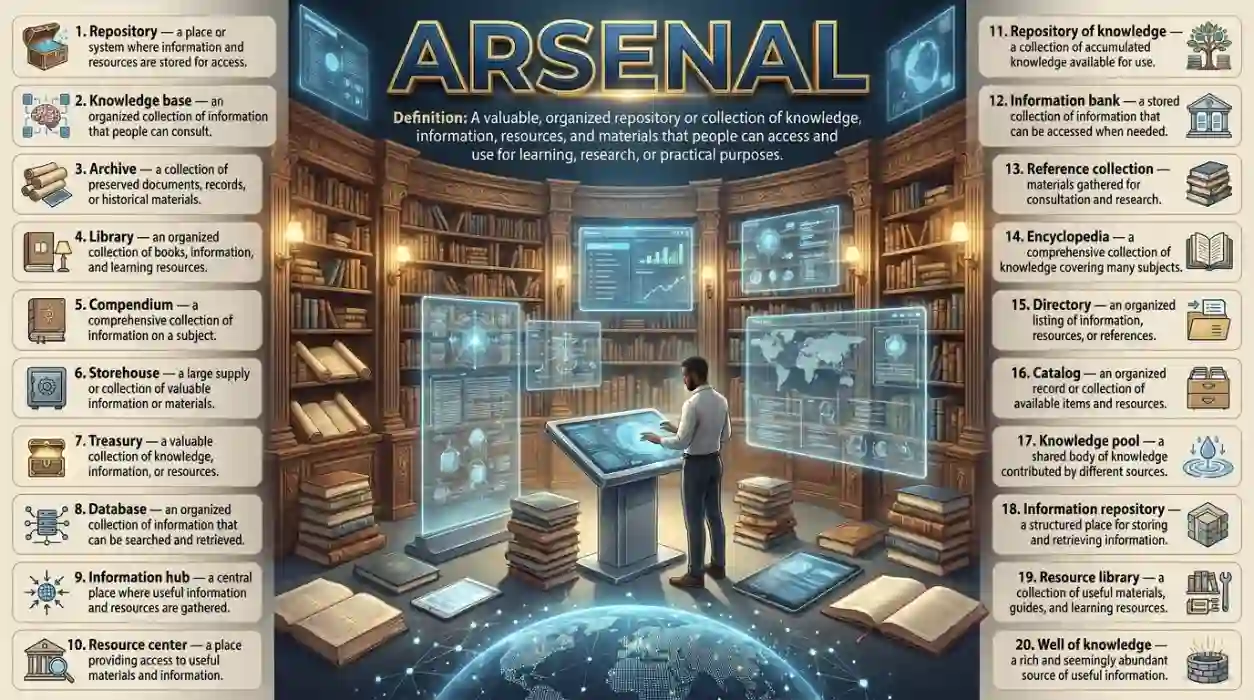
Examples:
The hikers discovered a cache of food near the shelter.
The team kept a small cache of spare batteries.
3. Supply (Noun) — US / UK: /səˈplaɪ/ / /səˈplaɪ/
Meaning: A supply is an available quantity of something needed for a particular purpose.
Tone/Register: Neutral, everyday, and professional.
Examples:
The hospital maintains a supply of essential medical equipment.
We have a limited supply of replacement parts.
4. Reserve (Noun) — US / UK: /rɪˈzɝːv/ / /rɪˈzɜːv/
Meaning: A reserve is an amount of something kept available for later use.
Tone/Register: Formal, neutral, and professional.
Examples:
The company keeps a reserve of emergency funds.
The unit maintained a reserve of essential supplies.
5. Stock (Noun) — US / UK: /stɑːk/ / /stɒk/
Meaning: Stock refers to a quantity of goods or materials available for use or distribution.
Tone/Register: Neutral, business, and everyday.
Examples:
The store received new stock of camping equipment.
The workshop has enough stock to complete the orders.
6. Store (Noun) — US / UK: /stɔːr/ / /stɔː/
Meaning: A store is a collection or quantity of something kept for future use.
Tone/Register: Neutral and slightly formal.
Examples:
The laboratory maintains a store of protective materials.
She has a store of useful ideas for her next project.
7. Collection (Noun) — US / UK: /kəˈlek.ʃən/ / /kəˈlek.ʃən/
Meaning: A collection is a group of items gathered or kept together.
Tone/Register: Neutral, everyday, and formal.
Examples:
His collection of antique tools fills an entire cabinet.
The designer has a collection of creative concepts.
8. Repository (Noun) — US / UK: /rɪˈpɑː.zə.tɔːr.i/ / /rɪˈpɒz.ɪ.tər.i/
Meaning: A repository is a place or system where information, resources, or materials are stored.
Tone/Register: Formal, academic, and technical.
Examples:
The website serves as a repository of research documents.
The archive is a repository of historical records.
9. Reserve stock (Noun phrase) — US / UK: /rɪˈzɝːv stɑːk/ / /rɪˈzɜːv stɒk/
Meaning: Reserve stock is a quantity of goods kept aside in case additional supplies are needed.
Tone/Register: Business, logistical, and formal.
Examples:
The manufacturer released its reserve stock during the shortage.
The shop keeps reserve stock for busy weekends.
10. Inventory (Noun) — US / UK: /ˈɪn.vən.tɔːr.i/ / /ˈɪn.vən.tər.i/
Meaning: Inventory is a complete list or supply of goods and materials held by a person or organization.
Tone/Register: Business, professional, and neutral.
Examples:
The manager checked the inventory before placing an order.
The company updated its inventory of technical equipment.
11. Armory (Noun) — US / UK: /ˈɑːr.mɚ.i/ / /ˈɑː.mər.i/
Meaning: An armory is a place where weapons and military equipment are stored.
Tone/Register: Military, formal, and historical.
Examples:
The soldiers returned their equipment to the armory.
The historic armory now serves as a museum.
12. Weapons cache (Noun phrase) — US / UK: /ˈwep.ənz kæʃ/ / /ˈwep.ənz kæʃ/
Meaning: A weapons cache is a stored collection of weapons kept in a particular location.
Tone/Register: Military, security-related, and serious.
Examples:
Investigators reported finding a weapons cache.
The documentary examines the history of hidden weapons caches.
13. Munitions stockpile (Noun phrase) — US / UK: /mjuːˈnɪʃ.ənz ˈstɑːk.paɪl/ / /mjuːˈnɪʃ.ənz ˈstɒk.paɪl/
Meaning: A munitions stockpile is a stored quantity of ammunition and military supplies.
Tone/Register: Military, technical, and formal.
Examples:
The report examined the country’s munitions stockpile.
Officials discussed the safety of the stored ammunition.
14. Equipment (Noun) — US / UK: /ɪˈkwɪp.mənt/ / /ɪˈkwɪp.mənt/
Meaning: Equipment refers to the tools and items needed for a particular activity.
Tone/Register: Neutral, professional, and everyday.
Examples:
The rescue team checked its equipment before leaving.
The studio has modern recording equipment.
15. Apparatus (Noun) — US / UK: /ˌæp.əˈræt̬/.əs/ / /ˌæp.əˈreɪ.təs/
Meaning: Apparatus is a set of equipment or devices designed for a specific function.
Tone/Register: Formal, scientific, and technical.
Examples:
The laboratory purchased new testing apparatus.
The firefighters inspected the breathing apparatus.
16. Toolkit (Noun) — US / UK: /ˈtuːl.kɪt/ / /ˈtuːl.kɪt/
Meaning: A toolkit is a set of tools or methods used to complete a task.
Tone/Register: Informal, professional, and figurative.
Examples:
The designer has a toolkit of useful editing techniques.
This course gives students a toolkit for solving problems.
17. Toolbox (Noun) — US / UK: /ˈtuːl.bɑːks/ / /ˈtuːl.bɒks/
Meaning: A toolbox is a container for tools or, figuratively, a collection of practical skills and methods.
Tone/Register: Everyday, informal, and professional.
Examples:
The mechanic left his toolbox beside the vehicle.
Good communication is an important part of a manager’s toolbox.
18. Repertoire (Noun) — US / UK: /ˈrep.ɚ.twɑːr/ / /ˈrep.ə.twɑː/
Meaning: A repertoire is a collection of skills, performances, techniques, or methods that someone can use.
Tone/Register: Formal, creative, and professional.
Examples:
The chef has a repertoire of traditional recipes.
The speaker added new techniques to her presentation repertoire.
19. Range (Noun) — US / UK: /reɪndʒ/ / /reɪndʒ/
Meaning: A range is a variety of different things available or included in a collection.
Tone/Register: Neutral and professional.
Examples:
The company offers a range of security products.
The coach uses a range of training methods.
20. Array (Noun) — US / UK: /əˈreɪ/ / /əˈreɪ/
Meaning: An array is an impressive or organized group of different items.
Tone/Register: Neutral, formal, and descriptive.
Examples:
The exhibition displayed an array of historical weapons.
The website features an array of learning resources.
21. Assortment (Noun) — US / UK: /əˈsɔːrt.mənt/ / /əˈsɔːt.mənt/
Meaning: An assortment is a varied collection of different things.
Tone/Register: Neutral, everyday, and commercial.
Examples:
The repair shop carries an assortment of spare parts.
She packed an assortment of useful travel accessories.
22. Selection (Noun) — US / UK: /səˈlek.ʃən/ / /sɪˈlek.ʃən/
Meaning: A selection is a group of items chosen from a larger number of possibilities.
Tone/Register: Neutral, professional, and everyday.
Examples:
The library has a selection of reference books.
The trainer prepared a selection of exercises for beginners.
23. Trove (Noun) — US / UK: /troʊv/ / /trəʊv/
Meaning: A trove is a valuable or interesting collection of things.
Tone/Register: Descriptive, literary, and informal.
Examples:
The old notebook was a trove of creative ideas.
The museum holds a trove of historical documents.
24. Hoard (Noun) — US / UK: /hɔːrd/ / /hɔːd/
Meaning: A hoard is a large quantity of things collected and stored, often secretly or excessively.
Tone/Register: Neutral to negative, depending on context.
Examples:
The explorer discovered a hoard of ancient coins.
The collector kept a hoard of unused supplies in his garage.
25. Reserve supply (Noun phrase) — US / UK: /rɪˈzɝːv səˈplaɪ/ / /rɪˈzɜːv səˈplaɪ/
Meaning: A reserve supply is an extra quantity kept ready for unexpected needs.
Tone/Register: Neutral, practical, and professional.
Examples:
The school maintained a reserve supply of stationery.
The team carried a reserve supply of drinking water.
26. Arsenal of skills (Noun phrase) — US / UK: /ˈɑːr.sən.əl əv skɪlz/ / /ˈɑː.sən.əl əv skɪlz/
Meaning: An arsenal of skills is a broad collection of abilities available to someone.
Tone/Register: Figurative, positive, and professional.
Examples:
The candidate has an arsenal of useful communication skills.
Years of experience gave her an arsenal of practical abilities.
27. Array of resources (Noun phrase) — US / UK: /əˈreɪ əv ˈriː.sɔːr.sɪz/ / /əˈreɪ əv rɪˈzɔː.sɪz/
Meaning: An array of resources is a varied group of materials, services, or capabilities available for a task.
Tone/Register: Professional, academic, and neutral.
Examples:
The school provides an array of resources for new learners.
The project requires an array of digital resources.
28. Repertory (Noun) — US / UK: /ˈrep.ɚ.tɔːr.i/ / /ˈrep.ə.tər.i/
Meaning: Repertory is a collection of works, skills, or methods that can be used or performed.
Tone/Register: Formal, artistic, and specialized.
Examples:
The theater expanded its repertory of classic plays.
The musician has a repertoire of familiar pieces.
29. Armament (Noun) — US / UK: /ˈɑːr.mə.mənt/ / /ˈɑː.mə.mənt/
Meaning: Armament refers to weapons and military equipment used by a force.
Tone/Register: Formal, military, and technical.
Examples:
The report described the aircraft’s armament.
The museum displays examples of historical armament.
30. Weaponry (Noun) — US / UK: /ˈwep.ən.ri/ / /ˈwep.ən.ri/
Meaning: Weaponry is the collection or type of weapons used by a person, group, or military force.
Tone/Register: Military, formal, and neutral.
Examples:
The exhibition explores the development of medieval weaponry.
The film features futuristic weaponry.
31. Arms (Noun) — US / UK: /ɑːrmz/ / /ɑːmz/
Meaning: Arms refers to weapons, especially those used by military forces.
Tone/Register: Formal, military, and political.
Examples:
The agreement placed restrictions on the trade in arms.
The country reviewed its supply of arms.
32. Ammunition (Noun) — US / UK: /ˌæm.jəˈnɪʃ.ən/ / /ˌæm.jəˈnɪʃ.ən/
Meaning: Ammunition refers to bullets, shells, and other materials used with weapons.
Tone/Register: Technical, military, and neutral.
Examples:
The military stored ammunition in a secure facility.
The report focused on ammunition safety.
33. Arsenal of ideas (Noun phrase) — US / UK: /ˈɑːr.sən.əl əv aɪˈdiː.əz/ / /ˈɑː.sən.əl əv aɪˈdɪəz/
Meaning: An arsenal of ideas is a wide selection of thoughts or possible solutions.
Tone/Register: Figurative, creative, and positive.
Examples:
The writer has an arsenal of ideas for future stories.
The workshop gave the students an arsenal of fresh ideas.
34. Battery (Noun) — US / UK: /ˈbæt̬.ɚ.i/ / /ˈbæt.ər.i/
Meaning: In formal use, a battery can refer to a group of similar devices or weapons arranged for a particular purpose.
Tone/Register: Technical, military, and formal.
Examples:
The facility operates a battery of testing instruments.
The historical site once contained a coastal artillery battery.
35. Armamentarium (Noun) — US / UK: /ˌɑːr.mə.mənˈter.i.əm/ / /ˌɑː.mə.mənˈteə.ri.əm/
Meaning: Armamentarium is a specialized collection of equipment, methods, or resources available to a professional.
Tone/Register: Highly formal, technical, and medical.
Examples:
The physician has a broad armamentarium of treatment options.
Modern medicine has expanded its diagnostic armamentarium.
36. Resources (Noun) — US / UK: /ˈriː.sɔːr.sɪz/ / /rɪˈzɔː.sɪz/
Meaning: Resources are useful supplies, materials, skills, or assets available for a particular purpose.
Tone/Register: Neutral, professional, and academic.
Examples:
The organization used its resources to support local families.
The teacher shared helpful learning resources with the class.
37. Implements (Noun) — US / UK: /ˈɪm.plə.mənts/ / /ˈɪm.plɪ.mənts/
Meaning: Implements are tools or objects used to perform a particular task.
Tone/Register: Neutral, practical, and slightly formal.
Examples:
The gardener cleaned her tools and implements after work.
The workshop provides the implements needed for basic repairs.
38. Gear (Noun) — US / UK: /ɡɪr/ / /ɡɪər/
Meaning: Gear is equipment or clothing used for a particular activity.
Tone/Register: Informal, everyday, and practical.
Examples:
The hikers checked their camping gear before sunrise.
The photographer packed her camera gear carefully.
39. Kit (Noun) — US / UK: /kɪt/ / /kɪt/
Meaning: A kit is a set of items supplied for a specific activity or purpose.
Tone/Register: Neutral, informal, and practical.
Examples:
The first-aid kit contains basic medical supplies.
The repair kit includes everything needed for minor adjustments.
40. Outfit (Noun) — US / UK: /ˈaʊt.fɪt/ / /ˈaʊt.fɪt/
Meaning: An outfit can refer to a set of equipment or supplies prepared for a particular purpose.
Tone/Register: Informal, practical, and sometimes technical.
Examples:
The camping outfit included a tent and cooking equipment.
The rescue crew checked its protective outfit before departure.
41. Provision (Noun) — US / UK: /prəˈvɪʒ.ən/ / /prəˈvɪʒ.ən/
Meaning: Provision refers to a supply of something provided or stored for future needs.
Tone/Register: Formal, practical, and professional.
Examples:
The expedition carried a provision of essential food.
The organization arranged provisions for emergencies.
42. Storehouse (Noun) — US / UK: /ˈstɔːr.haʊs/ / /ˈstɔː.haʊs/
Meaning: A storehouse is a building or place used to keep supplies or valuable materials.
Tone/Register: Neutral, descriptive, and sometimes literary.
Examples:
The old storehouse contained agricultural equipment.
The archive became a storehouse of historical knowledge.
43. Warehouse (Noun) — US / UK: /ˈwer.haʊs/ / /ˈweə.haʊs/
Meaning: A warehouse is a large building where goods and materials are stored.
Tone/Register: Business, logistical, and everyday.
Examples:
The warehouse holds spare parts for the factory.
Workers organized the equipment by category.
44. Armory of knowledge (Noun phrase) — US / UK: /ˈɑːr.mɚ.i əv ˈnɑː.lɪdʒ/ / /ˈɑː.mə.ri əv ˈnɒl.ɪdʒ/
Meaning: An armory of knowledge is a figurative collection of information and understanding that someone can use.
Tone/Register: Literary, educational, and figurative.
Examples:
Reading gave the student an armory of knowledge.
Her experience became an armory of practical wisdom.
45. Arsenal of techniques (Noun phrase) — US / UK: /ˈɑːr.sən.əl əv tekˈniːks/ / /ˈɑː.sən.əl əv tekˈniːks/
Meaning: An arsenal of techniques is a broad collection of methods available for completing a task.
Tone/Register: Professional, creative, and figurative.
Examples:
The photographer has an arsenal of editing techniques.
The coach introduced an arsenal of training methods.
46. Battery of equipment (Noun phrase) — US / UK: /ˈbæt̬.ɚ.i əv ɪˈkwɪp.mənt/ / /ˈbæt.ər.i əv ɪˈkwɪp.mənt/
Meaning: A battery of equipment is a group of devices or instruments assembled for a particular function.
Tone/Register: Technical and formal.
Examples:
The laboratory uses a battery of testing equipment.
The inspection included a battery of measuring devices.
47. Armament collection (Noun phrase) — US / UK: /ˈɑːr.mə.mənt kəˈlek.ʃən/ / /ˈɑː.mə.mənt kəˈlek.ʃən/
Meaning: An armament collection is a group of weapons or military equipment gathered for display, study, or storage.
Tone/Register: Military, historical, and descriptive.
Examples:
The museum displayed its armament collection.
Researchers studied the collection of historical military equipment.
48. Tool collection (Noun phrase) — US / UK: /ˈtuːl kəˈlek.ʃən/ / /ˈtuːl kəˈlek.ʃən/
Meaning: A tool collection is a group of tools gathered for practical use or personal interest.
Tone/Register: Neutral, informal, and practical.
Examples:
His tool collection includes everything needed for basic woodworking.
The school donated a tool collection to the workshop.
49. Resource pool (Noun phrase) — US / UK: /ˈriː.sɔːrs puːl/ / /rɪˈzɔːs puːl/
Meaning: A resource pool is a shared supply of people, materials, skills, or assets available to a group.
Tone/Register: Business, professional, and organizational.
Examples:
The department created a resource pool for major projects.
The shared resource pool reduced unnecessary duplication.
50. Repository of knowledge (Noun phrase) — US / UK: /rɪˈpɑː.zə.tɔːr.i əv ˈnɑː.lɪdʒ/ / /rɪˈpɒz.ɪ.tər.i əv ˈnɒl.ɪdʒ/
Meaning: A repository of knowledge is a collection of information that people can access and use.
Tone/Register: Formal, academic, and technical.
Examples:
The digital archive is a repository of knowledge for researchers.
The library remains a repository of valuable information.
Synonyms by Tone
The tone of a synonym affects how readers interpret your message. A military term may sound serious, while a figurative expression can sound creative or encouraging.
Neutral and practical
- Stockpile
- Supply
- Reserve
- Stock
- Collection
- Inventory
- Equipment
- Range
- Selection
- Resources
These words suit ordinary descriptions of stored goods, materials, and available items.
Positive and figurative
- Repertoire
- Toolkit
- Toolbox
- Trove
- Array
- Arsenal of ideas
- Arsenal of skills
- Arsenal of techniques
These expressions emphasize ability, preparation, creativity, and useful variety.
Military and serious
- Armory
- Weaponry
- Armament
- Arms
- Ammunition
- Weapons cache
- Munitions stockpile
- Armament collection
These terms are suitable when discussing weapons, military history, or defense.
Formal and technical
- Repository
- Apparatus
- Armamentarium
- Repertory
- Resource pool
- Battery
- Provision
Use these in professional, academic, scientific, or technical writing.
“Arsenal” vs. Close Alternatives
| Word | Meaning difference | Best context |
|---|---|---|
| Arsenal | A collection of weapons or a broad set of resources | Military, business, sports, or figurative writing |
| Armory | A building or place where weapons are stored | Military facilities and history |
| Stockpile | A quantity of supplies stored for future use | Emergency supplies and stored materials |
| Repertoire | A collection of skills, methods, or performances | Creative work and professional abilities |
| Toolkit | A practical set of tools or methods | Everyday tasks and problem-solving |
Which should you choose?
Use arsenal when you want to emphasize a powerful or varied collection. Choose armory for a weapons-storage location. Use stockpile for stored quantities, repertoire for skills, and toolkit for practical methods.
How “Arsenal” Changes by Context
Daily Conversation
In everyday English, arsenal often has a figurative meaning. Someone might say, “I have an arsenal of recipes for quick dinners.”
You can replace it with collection, range, or toolkit, depending on the sentence.
Writing and Blogging
Bloggers can use arsenal to make descriptions more vivid. For example, “Build an arsenal of simple writing techniques” suggests a useful variety of methods.
Alternatives such as repertoire, collection, and resource pool can reduce repetition.
Professional or Academic Tone
In business writing, resources, inventory, repository, and range often sound more precise.
For example, “The company has an extensive range of customer support resources” is clearer than using arsenal in every context.
Creative or Informal Use
In storytelling, arsenal can create a strong image of preparation or power. A character might have an arsenal of clever tricks or unexpected talents.
Words such as treasure trove, toolbox, and repertoire can offer a different style.
Common Mistakes Learners Make
1. Treating every alternative as an exact synonym
An armory is generally a place where weapons are stored. An arsenal can refer to the weapons themselves or a broader collection. The words overlap, but they are not always interchangeable.
2. Confusing a stockpile with a repertoire
A stockpile usually refers to stored quantities of physical goods. A repertoire refers to skills, performances, or methods someone can use.
3. Using military terms in the wrong context
Words such as weaponry, arms, and ammunition have specific military meanings. Avoid using them as casual replacements for ordinary office equipment or personal skills.
4. Using arsenal when you mean a building
If you mean a place where weapons are stored, armory may be more precise. If you mean the weapons or equipment available, arsenal may work better.
5. Overusing figurative language
Expressions such as “an arsenal of ideas” can make writing lively. However, repeating the phrase too often may sound exaggerated. Consider simpler alternatives such as range of ideas or collection of methods.
Register Notes: Formal vs. Informal
- Formal writing: stockpile, repository, inventory, armament, provision.
- Everyday speech: collection, supply, gear, kit, toolbox.
- Professional settings: resources, repertoire, toolkit, resource pool.
- Military contexts: armory, weaponry, ammunition, arms.
For additional vocabulary practice, explore an English guide to synonyms, antonyms, and word connotations.
Real-Life Mini Scenarios
Workplace: A project manager has an arsenal of planning methods. She chooses the best approach for each deadline.
Social situation: A friend has an arsenal of funny stories. Every gathering becomes more entertaining.
Media and pop culture: A film character uses an arsenal of advanced equipment to complete a mission. The word creates a sense of preparation and capability.
Writing and storytelling: A novelist describes a detective with an arsenal of investigative techniques. This suggests experience and resourcefulness.
Practice Exercise
1. A country stores a large quantity of emergency food for future use. Which word fits best?
A. Stockpile
B. Repertoire
C. Affinity
D. Apparatus
2. A musician has a collection of songs ready to perform. Which word is most suitable?
A. Inventory
B. Repertoire
C. Armory
D. Warehouse
3. A building stores military weapons and equipment. What is it called?
A. Toolkit
B. Repository
C. Armory
D. Selection
4. A designer has many practical methods for solving creative problems. Which phrase works best?
A. Arsenal of skills
B. Munitions stockpile
C. Weapons cache
D. Reserve supply
5. A business checks the quantity of products it has available. Which word should it use?
A. Camaraderie
B. Inventory
C. Repertory
D. Ammunition
6. A photographer carries cameras, lenses, and accessories. Which informal word describes this equipment?
A. Gear
B. Concord
C. Affiliation
D. Armament
7. A scientist uses several devices designed for laboratory testing. Which word is appropriate?
A. Friendship
B. Apparatus
C. Trove
D. Brotherhood
8. A writer discovers a valuable collection of historical documents. Which word best describes it?
A. Trove
B. Battery
C. Arms
D. Outfit
9. A teacher has a practical set of methods for helping students learn. Which word fits best?
A. Toolkit
B. Armament
C. Weapons cache
D. Warehouse
10. A military report discusses the weapons used by an army. Which word is most precise?
A. Repertoire
B. Weaponry
C. Selection
D. Resource pool
Reflection Task
Write two sentences about something you know or use regularly.
- In the first sentence, use the word arsenal.
- In the second sentence, replace it with a suitable alternative such as collection, toolkit, repertoire, or stockpile.
Answer key: 1-A, 2-B, 3-C, 4-A, 5-B, 6-A, 7-B, 8-A, 9-A, 10-B
External Sources for Further Learning
Use these established references to check definitions, pronunciation, usage, and word history:
- Oxford Learner’s Dictionaries — learner-friendly definitions and pronunciation.
- Cambridge Dictionary — British and American pronunciation and example sentences.
- Merriam-Webster — definitions, usage notes, and etymology.
- Online Etymology Dictionary — historical origins and development of English words.
Conclusion
An arsenal is more than a collection of weapons. It can also describe the resources, equipment, ideas, and skills that help people prepare for different challenges.
Learning alternatives such as stockpile, repertoire, toolkit, and collection makes your writing clearer. Each word gives readers a slightly different picture.
A stronger vocabulary improves essays, blogs, emails, and everyday conversations. It helps you communicate the exact meaning without repeating the same expression.
Practice using three new alternatives today. Try them in your own sentences, messages, and stories to build confidence and make your English more expressive.
Frequently Asked Questions
1. What is the best synonym for arsenal in a sentence about skills?
Repertoire is often the best choice when arsenal refers to someone’s skills or techniques. For example, “The coach has a repertoire of training methods.” You can also use toolkit for practical problem-solving abilities or range of skills when you want simple, natural language.
2. What is another word for a military arsenal?
Depending on the sentence, you can use armory, weapons stockpile, weapons cache, or munitions stockpile. An armory usually refers to a storage place, while a weapons cache refers to a stored collection of weapons. These terms have distinct meanings, so choose according to the situation.
3. Is arsenal a positive or negative word?
Arsenal can have either positive or negative associations. In a military context, it may suggest danger or destructive power. In figurative writing, such as “an arsenal of useful skills,” it often suggests preparation, ability, and confidence. The surrounding sentence determines its tone.
4. What is the plural form of arsenal?
The plural form is arsenals. For example, “Several countries maintain large arsenals.” The word follows the regular English rule of adding -s to form the plural. It can refer to multiple weapons collections or military storage facilities.
5. Can arsenal be used for knowledge and ideas?
Yes. Arsenal is commonly used figuratively to describe a broad collection of knowledge, ideas, skills, or techniques. For example, “She has an arsenal of creative ideas.” The expression suggests that the person has many useful options available when facing a challenge.

Hasnain Ali is an SEO Content Strategist and the founder of wordvora.com, a trusted vocabulary platform that helps writers, students, professionals, and English learners find accurate synonyms, antonyms, word meanings, and real-life usage examples. He specializes in keyword research, on-page SEO, topical authority, and creating search-first content that aligns with Google’s latest Search Quality and E-E-A-T guidelines. His work focuses on producing clear, well-structured, and reader-friendly resources that satisfy search intent while maintaining high editorial standards.
Through extensive hands-on experience with SEO tools such as Google Search Console, Google Analytics, SEMrush, and Ahrefs, Hasnain researches user search behavior and develops content that is both informative and easy to understand. Every article published on wordvora.com is carefully reviewed for accuracy, readability, and contextual relevance before publication. His mission is to build one of the web’s most reliable English vocabulary resources by providing practical language guidance, trustworthy explanations, and content that helps readers improve their writing, communication, and vocabulary with confidence.