
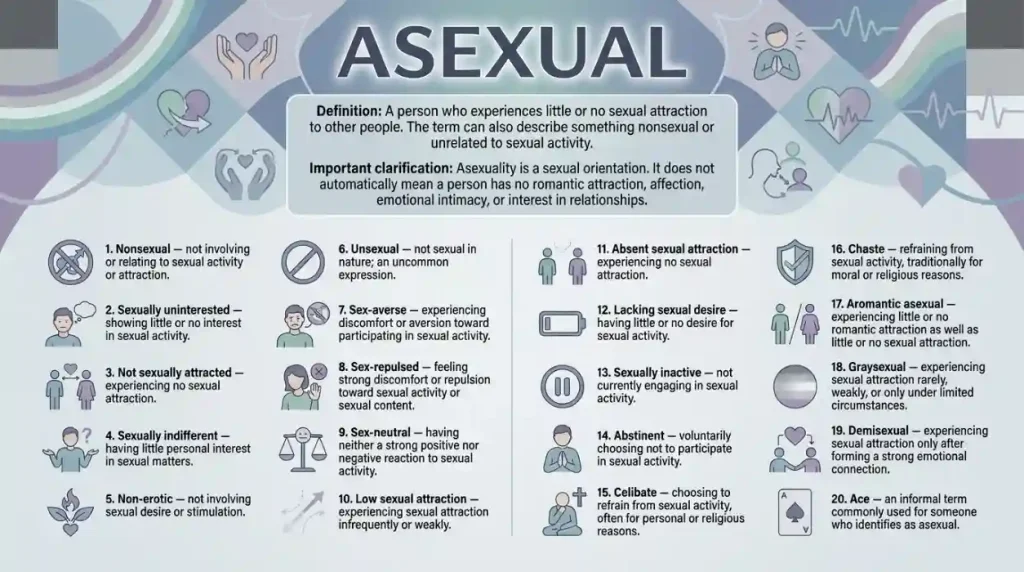
A synonym for asexual depends on the context. The most common informal alternative is ace. Other useful expressions include asexual person, on the asexual spectrum, and experiences little or no sexual attraction. These terms describe a sexual orientation, not simply a lack of sexual activity.
Imagine someone explaining that they rarely or never experience sexual attraction. They may use the word asexual to describe that part of their identity. A friend might say ace instead.
The phrase synonym for asexual is common in vocabulary searches, but not every related term means the same thing. Choosing carefully helps you communicate with respect.
Learning these expressions can help students, bloggers, content writers, and everyday English users discuss identity with greater accuracy. It also makes sensitive conversations clearer and more considerate.
What Does “Asexual” Really Mean?
Asexual is an adjective that describes a person who experiences little or no sexual attraction to other people. It is also used as a noun in some contexts, although asexual person is usually more natural and respectful. Asexuality is a sexual orientation, not a decision to avoid sex.
Native English speakers generally understand asexual as an identity related to sexual attraction. It does not automatically describe romantic feelings, physical affection, libido, relationship preferences, or sexual behavior.
For example, an asexual person might enjoy dating, cuddling, or having a romantic partner. Another might prefer close friendships and have no interest in romance. People experience the orientation in different ways. thetrevorproject.org+2
Connotative Meaning
(Connotation means the feelings, associations, or attitudes a word carries beyond its basic dictionary definition.)
- Positive tone: In affirming conversations, asexual communicates self-understanding, identity, and belonging.
- Negative tone: The word itself is not negative. However, using it mockingly or treating it as a defect can make the conversation disrespectful.
- Neutral tone: In educational, academic, and everyday writing, it is a descriptive term for a sexual orientation.
The safest approach is to use the label a person chooses for themselves. Do not assume that every person who experiences little sexual attraction uses the word asexual.
Etymology and History of “Asexual”
The word asexual combines the prefix a-, meaning “without” or “not,” with sexual. The prefix comes from Greek through Latin word formation. The word has been used in biological contexts as well as discussions of human sexuality.
- Old English (450–1100):
- The modern word asexual was not part of ordinary Old English vocabulary. English used other words and expressions to discuss reproduction and sex.
- Middle English (1100–1500):
- The modern term was not yet established in its present form. English vocabulary continued to develop through French and Latin influences.
- Modern English (1500–present):
- Asexual developed as a scientific and descriptive term. It has been used in biology to describe reproduction without sexual processes. In modern discussions of human identity, it describes a sexual orientation involving little or no sexual attraction.
Pronunciation (IPA)
- US: /ˌeɪˈsɛk.ʃu.əl/
- UK: /ˌeɪˈsek.ʃu.əl/
Pronunciation can vary slightly by accent.
Syllables: a-sex-u-al
Affixation pattern
- Root/base: sexual
- Prefix: a- (meaning “without” or “not”)
- Suffix: None added to asexual in this formation
Synonyms List
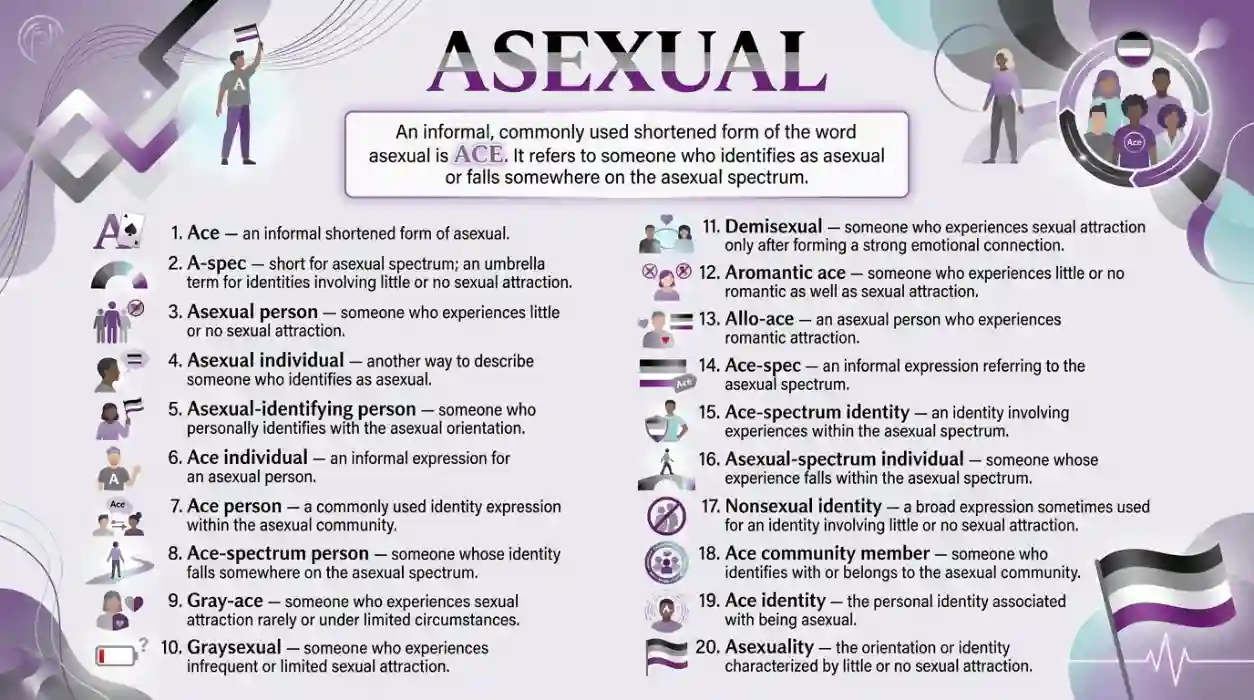
1. Ace (noun/adjective) — US: /eɪs/ | UK: /eɪs/
Meaning: An informal, widely used short form of asexual.
Tone/Register: Informal, friendly, and community-affirming.
Examples:
- “My friend is ace and feels comfortable talking about it.”
- “The character is an ace teenager.”
2. Asexual person (noun phrase) — US: /ˌeɪˈsɛk.ʃu.əl ˈpɝː.sən/ | UK: /ˌeɪˈsek.ʃu.əl ˈpɜː.sən/
Meaning: A person who identifies as asexual.
Tone/Register: Neutral, respectful, and suitable for most contexts.
Examples:
- “An asexual person can have a romantic relationship.”
- “The article features the experiences of an asexual person.”
3. Ace person (noun phrase) — US: /eɪs ˈpɝː.sən/ | UK: /eɪs ˈpɜː.sən/
Meaning: A person who identifies with the ace label.
Tone/Register: Informal and affirming.
Examples:
- “An ace person may have different relationship preferences.”
- “The group welcomes ace people.”
4. Asexual individual (noun phrase) — US: /ˌeɪˈsɛk.ʃu.əl ˌɪn.dəˈvɪdʒ.u.əl/ | UK: /ˌeɪˈsek.ʃu.əl ˌɪn.dɪˈvɪdʒ.u.əl/
Meaning: A formal way to refer to someone who is asexual.
Tone/Register: Formal, academic, and professional.
Examples:
- “The study included an asexual individual.”
- “Each asexual individual may describe their experience differently.”
5. Ace-spectrum person (noun phrase) — US: /eɪs ˈspek.trəm ˈpɝː.sən/ | UK: /eɪs ˈspek.trəm ˈpɜː.sən/
Meaning: Someone whose identity falls somewhere on the asexual spectrum.
Tone/Register: Inclusive and educational.
Examples:
- “An ace-spectrum person may experience attraction occasionally.”
- “The support group includes ace-spectrum people.”
6. A-spec (noun/adjective) — US: /ˌeɪˈspek/ | UK: /ˌeɪˈspek/
Meaning: A broad abbreviation associated with the asexual and aromantic spectrums.
Tone/Register: Community-based and informal.
Examples:
- “They use a-spec as an umbrella identity.”
- “The event discusses a-spec experiences.”
7. Ace-spec (noun/adjective) — US: /ˈeɪs spek/ | UK: /ˈeɪs spek/
Meaning: A shortened expression for the asexual spectrum.
Tone/Register: Informal, community, and educational.
Examples:
- “The guide explains several ace-spec identities.”
- “She is learning about ace-spec terminology.”
8. Asexual-spectrum person (noun phrase) — US: /ˌeɪˈsɛk.ʃu.əl ˈspek.trəm ˈpɝː.sən/ | UK: /ˌeɪˈsek.ʃu.əl ˈspek.trəm ˈpɜː.sən/
Meaning: A person who identifies somewhere within the asexual spectrum.
Tone/Register: Neutral and inclusive.
Examples:
- “An asexual-spectrum person may use a more specific label.”
- “The resource was created for asexual-spectrum readers.”
9. Gray-asexual (adjective/noun) — US: /ˌɡreɪ eɪˈsɛk.ʃu.əl/ | UK: /ˌɡreɪ eɪˈsek.ʃu.əl/
Meaning: Describes someone who experiences sexual attraction rarely, weakly, or under limited circumstances.
Tone/Register: Specific identity terminology.
Examples:
- “He identifies as gray-asexual.”
- “Gray-asexual experiences can differ from person to person.”
10. Grey-asexual (adjective/noun) — US: /ˌɡreɪ eɪˈsɛk.ʃu.əl/ | UK: /ˌɡreɪ eɪˈsek.ʃu.əl/
Meaning: The British spelling variant of gray-asexual.
Tone/Register: Neutral; spelling varies by region.
Examples:
- “The UK article uses the term grey-asexual.”
- “She found the grey-asexual label useful.”
11. Graysexual (adjective/noun) — US: /ˈɡreɪˌsek.ʃu.əl/ | UK: /ˈɡreɪˌsek.ʃu.əl/
Meaning: A shorter label for a person who experiences sexual attraction infrequently or in limited circumstances.
Tone/Register: Community terminology.
Examples:
- “They describe themselves as graysexual.”
- “Graysexuality is often discussed within the ace spectrum.”
12. Greysexual (adjective/noun) — US: /ˈɡreɪˌsek.ʃu.əl/ | UK: /ˈɡreɪˌsek.ʃu.əl/
Meaning: A regional spelling variant of graysexual.
Tone/Register: Neutral and identity-specific.
Examples:
- “The glossary includes greysexual as a term.”
- “He prefers the spelling greysexual.”
13. Demisexual (adjective/noun) — US: /ˌdem.iˈsek.ʃu.əl/ | UK: /ˌdem.iˈsek.ʃu.əl/
Meaning: Describes someone who experiences sexual attraction only after forming a strong emotional connection.
Tone/Register: Specific, educational, and identity-based.
Examples:
- “She identifies as demisexual.”
- “A demisexual person may need a close bond before attraction develops.”
14. Demi-asexual (adjective/noun) — US: /ˌdem.i eɪˈsɛk.ʃu.əl/ | UK: /ˌdem.i eɪˈsek.ʃu.əl/
Meaning: A term sometimes used for a person whose experience falls within both demi and asexual-spectrum language.
Tone/Register: Specific community terminology.
Examples:
- “The glossary discusses demi-asexual identities.”
- “They use demi-asexual to explain their experience.”
15. Gray-A (noun/adjective) — US: /ˌɡreɪ ˈeɪ/ | UK: /ˌɡreɪ ˈeɪ/
Meaning: An abbreviated label for an identity in the gray area of asexuality.
Tone/Register: Informal and community-specific.
Examples:
- “The online group has a Gray-A discussion space.”
- “She came across the Gray-A label while researching identities.”
16. Grey-A (noun/adjective) — US: /ˌɡreɪ ˈeɪ/ | UK: /ˌɡreɪ ˈeɪ/
Meaning: A spelling variant of Gray-A.
Tone/Register: Informal and identity-specific.
Examples:
- “The UK resource uses Grey-A.”
- “He found the Grey-A description relatable.”
17. Aegosexual (adjective/noun) — US: /ˌiː.ɡoʊˈsek.ʃu.əl/ | UK: /ˌiː.ɡəʊˈsek.ʃu.əl/
Meaning: Describes a person who may experience sexual fantasies or arousal without wanting to participate in partnered sexual activity.
Tone/Register: Specialized identity terminology.
Examples:
- “The glossary explains what aegosexual means.”
- “Aegosexual experiences do not look identical for everyone.”
18. Autochorissexual (adjective/noun) — US: /ˌɔː.toʊˌkɔːr.ɪˈsek.ʃu.əl/ | UK: /ˌɔː.təʊˌkɒr.ɪˈsek.ʃu.əl/
Meaning: A less common term historically associated with a separation between sexual fantasy and personal involvement.
Tone/Register: Highly specialized; definitions and preferences vary.
Examples:
- “The academic discussion mentions autochorissexuality.”
- “She checked a specialist glossary before using the label.”
19. Cupiosexual (adjective/noun) — US: /ˌkjuː.pi.oʊˈsek.ʃu.əl/ | UK: /ˌkjuː.pi.əʊˈsek.ʃu.əl/
Meaning: Describes someone who experiences little or no sexual attraction but may still desire a sexual relationship.
Tone/Register: Specific and community-based.
Examples:
- “He uses cupiosexual to describe his identity.”
- “The term helped her explain attraction and relationship desire separately.”
20. Ace-flux (adjective/noun) — US: /ˈeɪs flʌks/ | UK: /ˈeɪs flʌks/
Meaning: Describes someone whose experience of sexual attraction fluctuates within the asexual spectrum.
Tone/Register: Specialized identity terminology.
Examples:
- “They describe their changing experience as ace-flux.”
- “The article introduces ace-flux as a spectrum term.”
21. Abrosexual (adjective/noun) — US: /ˌæb.roʊˈsek.ʃu.əl/ | UK: /ˌæb.rəʊˈsek.ʃu.əl/
Meaning: Describes a person whose sexual orientation changes over time; it is not a synonym for asexual.
Tone/Register: Specific identity terminology.
Examples:
- “An abrosexual person may notice changes in their orientation.”
- “The guide distinguishes abrosexuality from a fixed label.”

22. Quoisexual (adjective/noun) — US: /ˌkwɔɪˈsek.ʃu.əl/ | UK: /ˌkwɔɪˈsek.ʃu.əl/
Meaning: Describes someone who finds the concept of sexual attraction difficult to understand or apply to their own experience.
Tone/Register: Community-specific and reflective.
Examples:
- “They use quoisexual because attraction feels hard to define.”
- “The term appears in some ace-spectrum glossaries.”
23. Apothisexual (adjective/noun) — US: /ˌæp.əʊ.θaɪˈsek.ʃu.əl/ | UK: /ˌæp.əʊ.θaɪˈsek.ʃu.əl/
Meaning: A term used by some asexual people who feel repulsed by sex.
Tone/Register: Specialized and personal.
Examples:
- “The glossary describes apothisexual as a specific label.”
- “He chose the term because it reflects his personal boundaries.”
24. Nonsexual (adjective) — US: /ˌnɑːnˈsek.ʃu.əl/ | UK: /ˌnɒnˈsek.ʃu.əl/
Meaning: Describes something that is not sexual in nature; it does not always describe a person’s orientation.
Tone/Register: Neutral, but context-dependent.
Examples:
- “They share a close, nonsexual friendship.”
- “The scene focuses on nonsexual affection.”
25. Not sexually attracted (descriptive phrase) — US: /nɑːt ˈsek.ʃu.ə.li əˈtræk.tɪd/ | UK: /nɒt ˈsek.ʃu.ə.li əˈtræk.tɪd/
Meaning: A direct description of not experiencing sexual attraction.
Tone/Register: Clear, neutral, and conversational.
Examples:
- “He is not sexually attracted to anyone.”
- “She explained that she is not sexually attracted to her dates.”
26. Experiences little sexual attraction (descriptive phrase) — US: /ɪkˈspɪr.i.ən.sɪz ˈlɪt.əl ˈsek.ʃu.əl əˈtræk.ʃən/ | UK: /ɪkˈspɪə.ri.ən.sɪz ˈlɪt.əl ˈsek.ʃu.əl əˈtræk.ʃən/
Meaning: Describes someone who experiences sexual attraction rarely or at a low level.
Tone/Register: Neutral and explanatory.
Examples:
- “She experiences little sexual attraction.”
- “The interviewee experiences little sexual attraction but enjoys dating.”
27. Experiences no sexual attraction (descriptive phrase) — US: /ɪkˈspɪr.i.ən.sɪz noʊ ˈsek.ʃu.əl əˈtræk.ʃən/ | UK: /ɪkˈspɪə.ri.ən.sɪz nəʊ ˈsek.ʃu.əl əˈtræk.ʃən/
Meaning: Describes a person who does not experience sexual attraction.
Tone/Register: Direct and neutral.
Examples:
- “He experiences no sexual attraction.”
- “The speaker experiences no sexual attraction but values companionship.”
28. Rarely experiences sexual attraction (descriptive phrase) — US: /ˈrer.li ɪkˈspɪr.i.ən.sɪz ˈsek.ʃu.əl əˈtræk.ʃən/ | UK: /ˈreə.li ɪkˈspɪə.ri.ən.sɪz ˈsek.ʃu.əl əˈtræk.ʃən/
Meaning: Describes someone whose sexual attraction occurs infrequently.
Tone/Register: Neutral and precise.
Examples:
- “They rarely experience sexual attraction.”
- “He rarely experiences sexual attraction, so the graysexual label feels right.”
29. Little-to-no sexual attraction (descriptive phrase) — US: /ˈlɪt.əl tə noʊ ˈsek.ʃu.əl əˈtræk.ʃən/ | UK: /ˈlɪt.əl tə nəʊ ˈsek.ʃu.əl əˈtræk.ʃən/
Meaning: A concise phrase describing a range from very limited to absent sexual attraction.
Tone/Register: Neutral and educational.
Examples:
- “Asexuality is often described as little-to-no sexual attraction.”
- “The survey asked about experiences of little-to-no sexual attraction.”
30. On the asexual spectrum (descriptive phrase) — US: /ɑːn ðiː ˌeɪˈsɛk.ʃu.əl ˈspek.trəm/ | UK: /ɒn ðiː ˌeɪˈsek.ʃu.əl ˈspek.trəm/
Meaning: Describes someone whose identity or experience falls within the broader asexual spectrum.
Tone/Register: Inclusive and educational.
Examples:
- “They identify as being on the asexual spectrum.”
- “The podcast features people on the asexual spectrum.”
31. Within the ace spectrum (descriptive phrase) — US: /wɪˈðɪn ðiː eɪs ˈspek.trəm/ | UK: /wɪˈðɪn ðiː eɪs ˈspek.trəm/
Meaning: Another way to say that someone identifies within the asexual spectrum.
Tone/Register: Informal and inclusive.
Examples:
- “Her identity falls within the ace spectrum.”
- “The discussion explores experiences within the ace spectrum.”
32. Asexual-spectrum identity (noun phrase) — US: /ˌeɪˈsɛk.ʃu.əl ˈspek.trəm aɪˈden.t̬ə.t̬i/ | UK: /ˌeɪˈsek.ʃu.əl ˈspek.trəm aɪˈden.tɪ.ti/
Meaning: An identity associated with the range of experiences under the asexual umbrella.
Tone/Register: Formal and educational.
Examples:
- “The chapter discusses asexual-spectrum identity.”
- “Asexual-spectrum identity can be personal and varied.”
33. Ace identity (noun phrase) — US: /eɪs aɪˈden.t̬ə.t̬i/ | UK: /eɪs aɪˈden.tɪ.ti/
Meaning: A person’s self-understanding as asexual or part of the ace spectrum.
Tone/Register: Neutral and affirming.
Examples:
- “He feels confident in his ace identity.”
- “The memoir explores the writer’s ace identity.”
34. Asexual orientation (noun phrase) — US: /ˌeɪˈsɛk.ʃu.əl ˌɔːr.i.enˈteɪ.ʃən/ | UK: /ˌeɪˈsek.ʃu.əl ˌɒr.i.enˈteɪ.ʃən/
Meaning: The sexual orientation characterized by little or no sexual attraction.
Tone/Register: Formal, accurate, and educational.
Examples:
- “Asexual orientation is not a medical condition.”
- “The lesson explains asexual orientation in simple terms.”
35. Ace umbrella (noun phrase) — US: /eɪs ʌmˈbrel.ə/ | UK: /eɪs ʌmˈbrel.ə/
Meaning: An informal expression for the range of identities included under the asexual umbrella.
Tone/Register: Community and educational.
Examples:
- “Several labels fit under the ace umbrella.”
- “The resource introduces the ace umbrella to new readers.”
36. Asexual umbrella (noun phrase) — US: /ˌeɪˈsɛk.ʃu.əl ʌmˈbrel.ə/ | UK: /ˌeɪˈsek.ʃu.əl ʌmˈbrel.ə/
Meaning: A broad category that includes asexuality and related spectrum identities.
Tone/Register: Neutral and inclusive.
Examples:
- “Demisexuality is often discussed under the asexual umbrella.”
- “The guide explains identities under the asexual umbrella.”
37. Ace community member (noun phrase) — US: /eɪs kəˈmjuː.nə.t̬i ˈmem.bɚ/ | UK: /eɪs kəˈmjuː.nə.ti ˈmem.bər/
Meaning: A person who identifies with or participates in the ace community.
Tone/Register: Neutral and social.
Examples:
- “An ace community member led the discussion.”
- “The event gives ace community members a place to connect.”
38. Asexual-identifying (adjective) — US: /ˌeɪˈsɛk.ʃu.əl aɪˈden.t̬əˌfaɪ.ɪŋ/ | UK: /ˌeɪˈsek.ʃu.əl aɪˈden.tɪˌfaɪ.ɪŋ/
Meaning: Describes someone who identifies as asexual.
Tone/Register: Formal and descriptive.
Examples:
- “The survey included asexual-identifying participants.”
- “The speaker is an asexual-identifying writer.”
39. Ace-identifying (adjective) — US: /eɪs aɪˈden.t̬əˌfaɪ.ɪŋ/ | UK: /eɪs aɪˈden.tɪˌfaɪ.ɪŋ/
Meaning: Describes someone who personally uses an ace-spectrum label.
Tone/Register: Neutral and community-aware.
Examples:
- “The project interviewed ace-identifying adults.”
- “An ace-identifying student shared their perspective.”
40. Non-allosexual (adjective) — US: /ˌnɑːnˌæl.oʊˈsek.ʃu.əl/ | UK: /ˌnɒnˌæl.əʊˈsek.ʃu.əl/
Meaning: A broad term for someone who does not identify as allosexual; it can include people on the ace spectrum.
Tone/Register: Academic and community-specific.
Examples:
- “The paper discusses non-allosexual experiences.”
- “Some non-allosexual people prefer more specific labels.”
41. Asexual-spectrum (adjective) — US: /ˌeɪˈsɛk.ʃu.əl ˈspek.trəm/ | UK: /ˌeɪˈsek.ʃu.əl ˈspek.trəm/
Meaning: Relating to identities, experiences, or topics within the asexual spectrum.
Tone/Register: Educational and neutral.
Examples:
- “The university hosted an asexual-spectrum awareness event.”
- “She reads asexual-spectrum literature.”
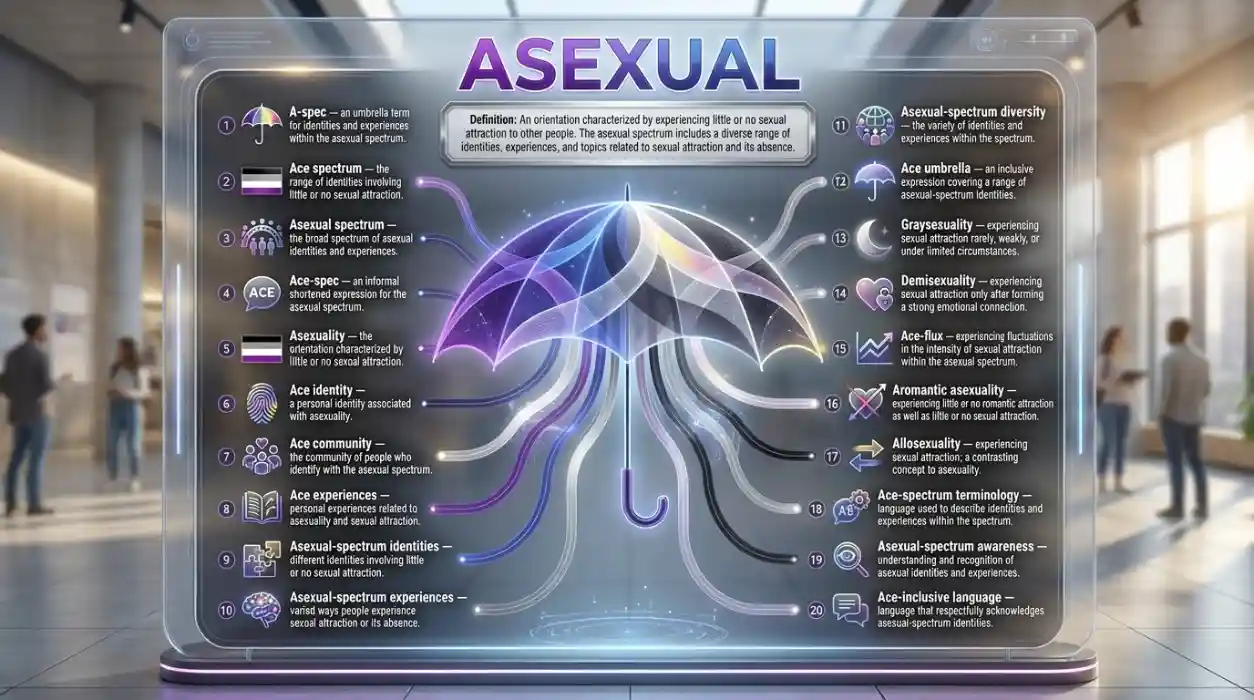
42. Ace-spectrum (adjective) — US: /eɪs ˈspek.trəm/ | UK: /eɪs ˈspek.trəm/
Meaning: A shorter adjective describing something related to the ace spectrum.
Tone/Register: Informal and community-based.
Examples:
- “The group shares ace-spectrum resources.”
- “They discussed ace-spectrum representation in television.”
43. Sex-indifferent asexual (noun phrase) — US: /seks ɪnˈdɪf.ɚ.ənt eɪˈsɛk.ʃu.əl/ | UK: /seks ɪnˈdɪf.ər.ənt eɪˈsek.ʃu.əl/
Meaning: An asexual person who feels neutral or largely indifferent toward sexual activity.
Tone/Register: Specific and explanatory.
Examples:
- “He describes himself as a sex-indifferent asexual.”
- “A sex-indifferent asexual may have personal boundaries that differ from another person’s.”
44. Sex-favorable asexual (noun phrase) — US: /seks ˈfeɪ.vɚ.ə.bəl eɪˈsɛk.ʃu.əl/ | UK: /seks ˈfeɪ.vər.ə.bəl eɪˈsek.ʃu.əl/
Meaning: An asexual person who may enjoy or willingly choose sexual activity.
Tone/Register: Specific and explanatory.
Examples:
- “A sex-favorable asexual may enjoy intimacy with a partner.”
- “The article explains why attraction and activity are different.”
45. Sex-repulsed asexual (noun phrase) — US: /seks rɪˈpʌlst eɪˈsɛk.ʃu.əl/ | UK: /seks rɪˈpʌlst eɪˈsek.ʃu.əl/
Meaning: An asexual person who feels strong discomfort or aversion toward sexual activity.
Tone/Register: Specific and personal.
Examples:
- “She identifies as a sex-repulsed asexual.”
- “A sex-repulsed asexual may set clear boundaries around intimacy.”
46. Sex-averse asexual (noun phrase) — US: /seks əˈvɝːs eɪˈsɛk.ʃu.əl/ | UK: /seks əˈvɜːs eɪˈsek.ʃu.əl/
Meaning: An asexual person who prefers to avoid sexual activity.
Tone/Register: Specific and explanatory.
Examples:
- “He describes himself as a sex-averse asexual.”
- “The counselor listened carefully to the sex-averse client’s boundaries.”
47. Sex-neutral asexual (noun phrase) — US: /seks ˈnuː.trəl eɪˈsɛk.ʃu.əl/ | UK: /seks ˈnjuː.trəl eɪˈsek.ʃu.əl/
Meaning: An asexual person who has neither a strongly positive nor a strongly negative attitude toward sex.
Tone/Register: Specific and neutral.
Examples:
- “They use the phrase, sex-neutral asexual.”
- “A sex-neutral asexual may not feel either way strongly.”
48. Romance-favorable asexual (noun phrase) — US: /ˈroʊ.mæns ˈfeɪ.vɚ.ə.bəl eɪˈsɛk.ʃu.əl/ | UK: /ˈrəʊ.mæns ˈfeɪ.vər.ə.bəl eɪˈsek.ʃu.əl/
Meaning: An asexual person who welcomes or desires romantic relationships.
Tone/Register: Specific and explanatory.
Examples:
- “A romance-favorable asexual may want a committed partnership.”
- “The character is a romance-favorable asexual who enjoys dating.”
49. Alloromantic asexual (noun phrase) — US: /ˌæl.oʊ.roʊˈmæn.tɪk eɪˈsɛk.ʃu.əl/ | UK: /ˌæl.əʊ.rəʊˈmæn.tɪk eɪˈsek.ʃu.əl/
Meaning: An asexual person who does experience romantic attraction.
Tone/Register: Specific, educational, and identity-based.
Examples:
- “She is an alloromantic asexual.”
- “An alloromantic asexual may fall in love without experiencing sexual attraction.”
50. Aromantic asexual (noun phrase) — US: /ˌer.oʊˈmæn.tɪk eɪˈsɛk.ʃu.əl/ | UK: /ˌær.əʊˈmæn.tɪk eɪˈsek.ʃu.əl/
Meaning: A person who experiences little or no romantic attraction and little or no sexual attraction.
Tone/Register: Specific and neutral.
Examples:
- “The character is aromantic and asexual.”
- “An aromantic asexual may prefer friendships or other forms of connection.”
A Note on These 50 Terms
The first few entries are the closest alternatives to asexual. Others describe particular experiences, attitudes, or identities within the broader spectrum. Some terms, such as abrosexual, describe changing experiences rather than asexuality itself. The distinctions matter. A person may be asexual and sex-favorable, sex-indifferent, or sex-repulsed. None of those attitudes alone define the orientation.
Synonyms by Tone
Not all alternatives work equally well in every conversation. The right choice depends on the audience and the meaning you want to communicate.
Positive or affirming
- Ace
- Ace identity
- Ace-spectrum person
- A-spec
- Asexual person
These terms can feel welcoming when someone uses them for themselves.
Neutral or descriptive
- Asexual individual
- Asexual orientation
- Experiences little sexual attraction
- On the asexual spectrum
- Asexual-spectrum identity
These are useful for educational writing, reports, and general explanations.
Specific or technical
- Gray-asexual
- Demisexual
- Aegosexual
- Cupiosexual
- Alloromantic asexual
Use these only when the specific meaning is relevant. Do not assign one to someone based on assumptions.
Informal or community-based
- Ace
- Ace-spec
- Gray-A
- Grey-A
- Ace umbrella
These expressions are common in some online and community discussions. Explain unfamiliar terms when writing for a general audience.
“Asexual” vs. Close Alternatives
| Term | Meaning difference | Best use |
|---|---|---|
| Asexual | A sexual orientation involving little or no sexual attraction | General, clear, and respectful writing |
| Ace | An informal short form of asexual; may also refer to the wider spectrum | Casual conversation and community contexts |
| Demisexual | Sexual attraction occurs only after a strong emotional bond | When describing this particular experience |
| Gray-asexual | Sexual attraction occurs rarely or under limited circumstances | When a person identifies with this part of the spectrum |
The main difference is precision. Asexual is the broad term. Ace is its familiar short form. Demisexual and gray-asexual describe more specific experiences.
How “Asexual” Changes by Context
Daily conversation
In everyday speech, ace can sound more relaxed than asexual. For example, someone might say, “I’m ace,” when sharing their identity with a friend. Follow the person’s preferred wording.
Writing or blogging
Use asexual early in an article because it is clear to a broad audience. You can introduce ace as a common alternative. Explain specialized labels rather than assuming every reader knows them.
Professional or academic writing
Choose precise language such as asexual orientation, asexual participants, or people on the asexual spectrum. Avoid treating an identity as a diagnosis or a behavior.
Creative or informal use
Characters may describe themselves as ace, gray-asexual, or demisexual. Give them individual personalities and relationship preferences. Avoid making one character represent every asexual person.
Common Mistakes Learners Make
Mistake 1: Treating asexuality and celibacy as identical
Asexuality describes sexual attraction. Celibacy describes a choice or practice involving sexual activity. A person can be celibate and experience sexual attraction. An asexual person may or may not choose to have sex.
Mistake 2: Confusing asexual with aromantic
Asexuality relates to sexual attraction. Aromanticism relates to romantic attraction. Someone can be asexual and romantic, aromantic and sexual, both, or neither.
Mistake 3: Assuming every asexual person dislikes sex
People’s attitudes toward sex vary. Some are repulsed, some are indifferent, and some are favorable. Don’t guess a person’s boundaries from their orientation.
Mistake 4: Using “nonsexual” as an exact replacement
Nonsexual often describes an activity, relationship, or situation rather than a person’s identity. It may not communicate asexuality clearly.
Mistake 5: Calling someone a label they have not chosen
A person may experience little sexual attraction without identifying as asexual. Respect self-description. Ask politely if the label matters and the person is comfortable discussing it.
Register Notes
- Formal vs. informal: Asexual is broadly suitable. Ace is more informal.
- Spoken vs. written: Ace works naturally in casual speech. Define it when it first appears in formal writing.
- Specialist vs. general: Terms such as aegosexual and cupiosexual need explanation for general audiences.
- Respectful usage: Prefer person-first phrases such as asexual person when describing someone, unless they have expressed another preference.
For related vocabulary, an internal glossary on sexual orientation and romantic attraction can help readers distinguish similar terms.
Real-Life Examples Using
Workplace
A colleague is preparing an inclusion presentation. They write, “Asexual people may experience romantic attraction, even when they do not experience sexual attraction.” The wording is clear and avoids assumptions.
Social situations
A friend says, “I’m ace.” You respond, “Thanks for telling me. Is there a term you prefer I use?” This keeps the conversation respectful without asking intrusive questions.
Media and pop culture
A reviewer discusses an ace character in a television series. They focus on the character’s personality, friendships, and goals instead of making asexuality the character’s only defining feature.
Writing and storytelling
A novelist creates a demisexual character. The character develops sexual attraction after forming a close emotional connection. The identity informs the story without replacing the character’s wider personality.

Practice Exercise
1. Someone wants a short, commonly used word for asexual. Which term fits best?
- A. Celibate
- B. Ace
- C. Aromantic
2. A person experiences sexual attraction only after building a strong emotional bond. Which label may describe them?
- A. Demisexual
- B. Allosexual
- C. Aromantic
3. Which term describes little or no romantic attraction?
- A. Asexual
- B. Aromantic
- C. Graysexual
4. A person chooses not to have sex but still experiences sexual attraction. Which word describes the choice?
- A. Celibacy
- B. Asexuality
- C. Ace-spectrum
5. Which phrase is most suitable for a formal educational article?
- A. “An asexual individual”
- B. “A person who hates romance”
- C. “Someone who never dates”
6. Someone experiences sexual attraction rarely. Which label might they use?
- A. Gray-asexual
- B. Allosexual
- C. Aromantic
7. Which statement is accurate?
- A. Every asexual person dislikes sex.
- B. Asexuality and romantic attraction are the same.
- C. Asexual people can experience romantic attraction.
8. A person says they are ace. What is the most respectful response?
- A. Tell them they will change their mind.
- B. Respect their chosen identity.
- C. Assume they do not want relationships.
9. Which term describes someone who experiences sexual attraction?
- A. Allosexual
- B. Asexual
- C. Aromantic
10. Which expression describes the wider range of asexual identities?
- A. Ace spectrum
- B. Celibacy
- C. Romance
Reflection task:
Write two short sentences about an imaginary character who identifies as asexual. Use ace in one sentence and asexual person in the other.
Answer key: 1-B | 2-A | 3-B | 4-A | 5-A | 6-A | 7-C | 8-B | 9-A | 10-A
Suggested external reading and reference sources
- The Ace and Aro Advocacy Project: Identity Terminology
- The Trevor Project: Understanding Asexuality
- PFLAG: LGBTQ+ Terminology Glossary
- University of California, Santa Barbara: Asexual/Aromantic Glossary
- Human Rights Campaign: Glossary of Terms
Conclusion
Choosing a synonym for asexual starts with understanding the meaning behind the word. Ace is a useful short form, while spectrum terms describe more specific experiences.
The right vocabulary helps students write clearly, bloggers explain identity accurately, and everyday speakers communicate with greater care. Small word choices can make important conversations easier.
Practice these expressions in essays, emails, and everyday conversations. Choose precise language, respect personal labels, and keep learning at your own pace.
FAQs
1. Is “ace” always an acceptable replacement for “asexual”?
Ace is a widely recognized informal short form of asexual. Many people use it for themselves, and it can also refer to the broader asexual spectrum. However, not everyone prefers the same label. In personal conversations, use the wording someone chooses. In formal writing, introduce ace after explaining asexual.
2. Can someone be asexual but still fall in love?
Yes. Sexual attraction and romantic attraction are different experiences. An asexual person may fall in love, want a romantic relationship, enjoy dating, or seek long-term companionship. Some asexual people are aromantic, while others are not. The word asexual alone does not tell you whether someone wants romance.
3. What is the difference between asexual and demisexual?
Asexuality generally describes little or no sexual attraction. Demisexuality describes experiencing sexual attraction only after forming a strong emotional connection. Demisexuality is often discussed within the asexual spectrum. The terms are related, but they do not mean the same thing. People choose the label that best describes their experience.
4. Is “nonsexual” the same as “asexual”?
No. Nonsexual usually describes an activity, relationship, or situation that is not sexual. Asexual describes a sexual orientation. For example, a friendship can be nonsexual without either friend being asexual. If you mean someone’s orientation, asexual person or ace person is clearer.
5. What is the opposite of asexual?
- The term allosexual describes someone who experiences sexual attraction. It is commonly used as the counterpart to asexual. It does not specify whether someone is straight, gay, bisexual, or another orientation. It simply refers to experiencing sexual attraction rather than identifying within the asexual spectrum.

Hasnain Ali is an SEO Content Strategist and the founder of wordvora.com, a trusted vocabulary platform that helps writers, students, professionals, and English learners find accurate synonyms, antonyms, word meanings, and real-life usage examples. He specializes in keyword research, on-page SEO, topical authority, and creating search-first content that aligns with Google’s latest Search Quality and E-E-A-T guidelines. His work focuses on producing clear, well-structured, and reader-friendly resources that satisfy search intent while maintaining high editorial standards.
Through extensive hands-on experience with SEO tools such as Google Search Console, Google Analytics, SEMrush, and Ahrefs, Hasnain researches user search behavior and develops content that is both informative and easy to understand. Every article published on wordvora.com is carefully reviewed for accuracy, readability, and contextual relevance before publication. His mission is to build one of the web’s most reliable English vocabulary resources by providing practical language guidance, trustworthy explanations, and content that helps readers improve their writing, communication, and vocabulary with confidence.