

The word branch commonly describes a part of a tree that grows from the trunk or another larger branch. It can also refer to a division of an organization, business, subject, or field of study.
Understanding branch can help you recognize its different meanings in everyday conversations, academic writing, business, and nature-related contexts. Learning its synonyms, meaning, and examples can also expand your English vocabulary.
The meaning of branch depends on the context. It may describe a tree limb, a local office of a company or bank, or a specialized area within a particular subject or profession.
By learning branch, its synonyms, meaning, and examples, you can improve your vocabulary and communication skills. This guide will help you understand the word clearly and use it naturally and confidently in different English contexts.
What Does “Synonym for Branch” Really Mean?
The word branch has several important meanings, so there is no single replacement that works everywhere.
As a noun, branch can mean a part growing from a tree, a local office of an organization, a division of a subject, a family line, or a smaller route leading from a main road, railway, or river. Cambridge and Oxford both document these major senses.
For example:
- Tree: The bird landed on a branch.
- Business: She works at the bank’s local branch.
- Academic subject: Linguistics is a branch of the social sciences.
- Family: That branch of the family moved abroad.
- Road or river: A small branch of the river runs through the valley.
As a verb, branch means to divide or separate into smaller parts. A road can branch into two directions, while a discussion can branch into several topics.
Native speakers usually choose a replacement based on the specific meaning. Bough sounds natural for a large tree limb, while office works for a local business location. Field works for an area of study.
So, the best synonym depends on what kind of branch you mean.
Connotative Meaning
Connotation means the feeling, association, or emotional shade that a word can carry beyond its basic dictionary meaning.
Positive tone
Words such as offshoot, specialty, field, and avenue can suggest growth, development, opportunity, or expansion when used figuratively.
Negative tone
Words such as division, split, or offshoot can sometimes suggest separation, especially when discussing organizations, groups, or families.
Neutral tone
Bough, limb, office, department, division, field, line, fork, and tributary are generally neutral when used in their appropriate contexts.
The word branch itself is usually neutral. Its emotional effect comes mainly from the context around it.
Etymology of “Branch”
The English noun branch entered Middle English around the early 14th century. Oxford traces it to Middle English from Old French branche, ultimately from Late Latin branca, meaning “paw.”
Etymonline records the form braunch around 1300 and explains that it originally referred to a division or subdivision of a tree stem. The word was then extended to things that resemble a tree branch, including geographical features and family lines.
Old English: 450–1100
The modern word branch was not the usual Old English term. English commonly used bough, from Old English bog, which originally referred to a shoulder or arm and later developed the tree meaning.
Middle English: 1100–1500
During Middle English, French influence introduced branche into English. By around 1300, braunch referred to a division of a tree and was also used metaphorically for family descent and similar structures.
Modern English: 1500–Present
The word expanded into many specialized meanings. It can now describe parts of knowledge, organizations, transportation systems, rivers, families, and government structures.
The business meaning of a local office is recorded from the early 19th century, while the broader meaning of a component or division of a system developed earlier.
Pronunciation of “Branch”
- US: /bræntʃ/
- UK: /brɑːntʃ/
Syllables
branch — one syllable
Affixation Pattern of “Branch”
- Root: branch
- Prefix: none
- Suffix: none
The word is a simple lexical root rather than a word formed with a productive English prefix or suffix.
Synonyms List
Bough (Noun) — US /baʊ/ — UK /baʊ/
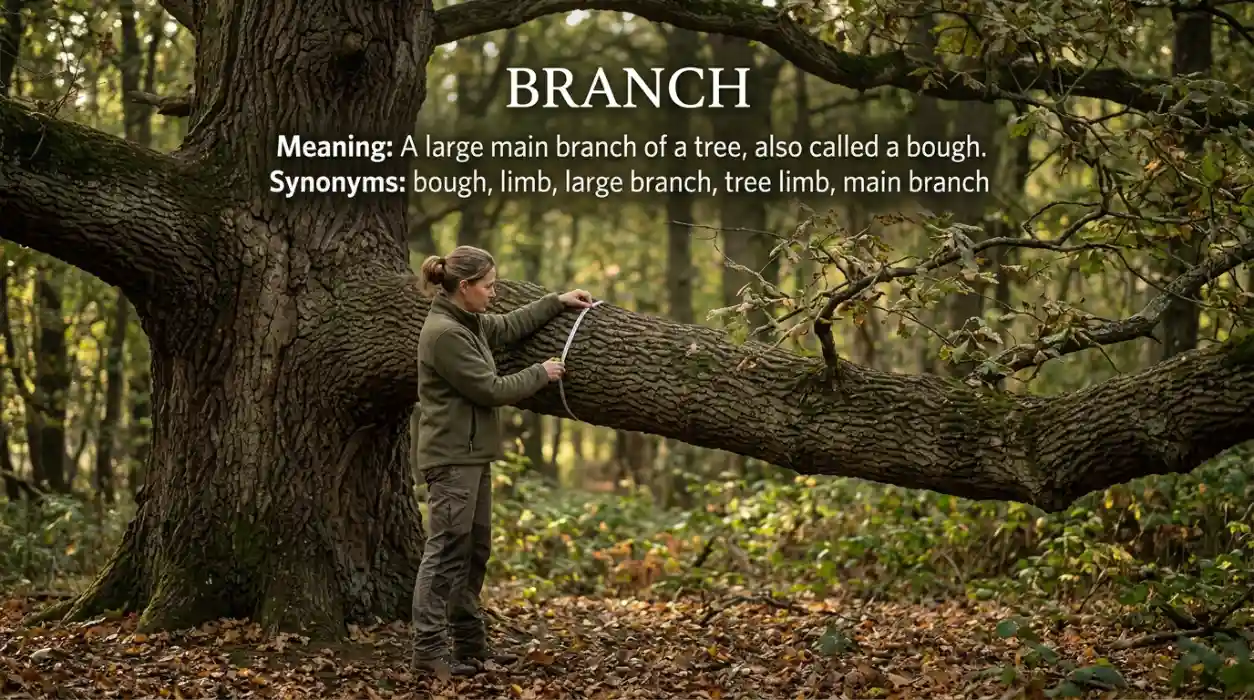
Meaning: A bough is a large main branch of a tree.
Tone/Register: Neutral, literary, descriptive.
Example:
The children sat on a sturdy bough.
Snow covered the old oak boughs.
Limb (Noun) — US /lɪm/ — UK /lɪm/
Meaning: A limb is a large structural branch growing from a tree.
Tone/Register: Neutral, everyday, horticultural.
Example:
A heavy limb fell during the storm.
The gardener removed the damaged limb.
Twig (Noun) — US /twɪɡ/ — UK /twɪɡ/
Meaning: A twig is a small, thin branch.
Tone/Register: Neutral, everyday.
Example:
She picked up a dry twig from the ground.
The bird carried a twig to its nest.
Branchlet (Noun) — US /ˈbræntʃlət/ — UK /ˈbrɑːntʃlət/
Meaning: A branchlet is a small branch, especially in botanical descriptions.
Tone/Register: Technical, botanical.
Example:
Tiny branchlets appeared after the spring growth.
The botanist examined each branchlet carefully.
Sprig (Noun) — US /sprɪɡ/ — UK /sprɪɡ/
Meaning: A sprig is a small shoot or branch, often with leaves, flowers, or berries.
Tone/Register: Neutral, descriptive.
Example:
She placed a sprig of rosemary on the plate.
A green sprig grew from the damaged stem.
Shoot (Noun) — US /ʃuːt/ — UK /ʃuːt/
Meaning: A shoot is a new growth emerging from a plant or tree.
Tone/Register: Neutral, gardening, botanical.
Example:
New shoots appeared after the rain.
The gardener protected the young shoots from frost.
Stem (Noun) — US /stɛm/ — UK /stem/
Meaning: A stem is the main supporting structure of a plant, though it is not always a direct synonym for branch.
Tone/Register: Neutral, scientific.
Example:
The flower has a long green stem.
A side stem developed near the base.
Offshoot (Noun) — US /ˈɔfˌʃuːt/ — UK /ˈɒfʃuːt/
Meaning: An offshoot is something that develops from a larger plant, group, organization, or idea.
Tone/Register: Neutral, figurative, formal.
Example:
The project began as an offshoot of a university program.
The new group became an independent offshoot.
Ramification (Noun) — US /ˌræməfəˈkeɪʃən/ — UK /ˌræmɪfɪˈkeɪʃən/
Meaning: A ramification is a division into smaller branches or parts.
Tone/Register: Formal, academic.
Example:
The report examines the many ramifications of the system.
The network has several complex ramifications.
Fork (Noun) — US /fɔrk/ — UK /fɔːk/
Meaning: A fork is a point where one route, structure, or path divides.
Tone/Register: Neutral, geographical, technical.
Example:
We reached a fork in the trail.
Take the left fork after the bridge.
Crotch (Noun) — US /krɑːtʃ/ — UK /krɒtʃ/
Meaning: In tree terminology, a crotch is the angle or point where two branches divide.
Tone/Register: Technical, horticultural.
Example:
Water collected in the tree’s crotch.
The arborist inspected the weak crotch carefully.
Spray (Noun) — US /spreɪ/ — UK /spreɪ/
Meaning: A spray is a group or small branch of leaves, flowers, or twigs.
Tone/Register: Literary, botanical.
Example:
A spray of blossoms filled the vase.
The tree had delicate sprays of white flowers.
Arm (Noun) — US /ɑrm/ — UK /ɑːm/
Meaning: An arm can describe a projecting part of a larger structure, including a branch of a river or organization.
Tone/Register: Neutral, figurative.
Example:
A narrow arm of the lake reached the village.
The organization created a new research arm.
Division (Noun) — US /dɪˈvɪʒən/ — UK /dɪˈvɪʒən/
Meaning: A division is a distinct part separated from a larger organization, subject, or system.
Tone/Register: Formal, academic, business.
Example:
Ecology is an important division of biology.
The company created a new sales division.
Department (Noun) — US /dɪˈpɑrtmənt/ — UK /dɪˈpɑːtmənt/
Meaning: A department is an organized section of a business, institution, or government.
Tone/Register: Professional, institutional.
Example:
She works in the marketing department.
Contact the admissions department for details.
Office (Noun) — US /ˈɔfɪs/ — UK /ˈɒfɪs/
Meaning: An office can mean a local location belonging to a larger organization.
Tone/Register: Neutral, business.
Example:
Please visit our local office tomorrow.
The regional office handles customer requests.
Outlet (Noun) — US /ˈaʊtˌlɛt/ — UK /ˈaʊtlet/
Meaning: An outlet can refer to a local shop or operating location of a larger organization.
Tone/Register: Business, neutral.
Example:
The company opened another retail outlet.
This outlet serves customers from nearby towns.
Location (Noun) — US /loʊˈkeɪʃən/ — UK /ləʊˈkeɪʃən/
Meaning: Location is a broad term for a particular place where an organization operates.
Tone/Register: Neutral, business.
Example:
Our newest location opened downtown.
The company now has three locations in the city.
Unit (Noun) — US /ˈjuːnɪt/ — UK /ˈjuːnɪt/
Meaning: A unit is a separate functional part of a larger organization or system.
Tone/Register: Formal, business, academic.
Example:
The research unit published its findings.
Each unit has a different responsibility.
Arm (Noun) — US /ɑrm/ — UK /ɑːm/
Meaning: An arm can mean a specialized part of a larger organization.
Tone/Register: Formal, figurative.
Example:
The charity created an education arm.
Its media arm manages public communications.
Subsidiary (Noun) — US /səbˈsɪdiˌɛri/ — UK /səbˈsɪdiəri/
Meaning: A subsidiary is a company controlled by another company.
Tone/Register: Formal, corporate.
Example:
The group operates through a regional subsidiary.
The subsidiary has its own management team.
Affiliate (Noun) — US /əˈfɪliət/ — UK /əˈfɪliət/
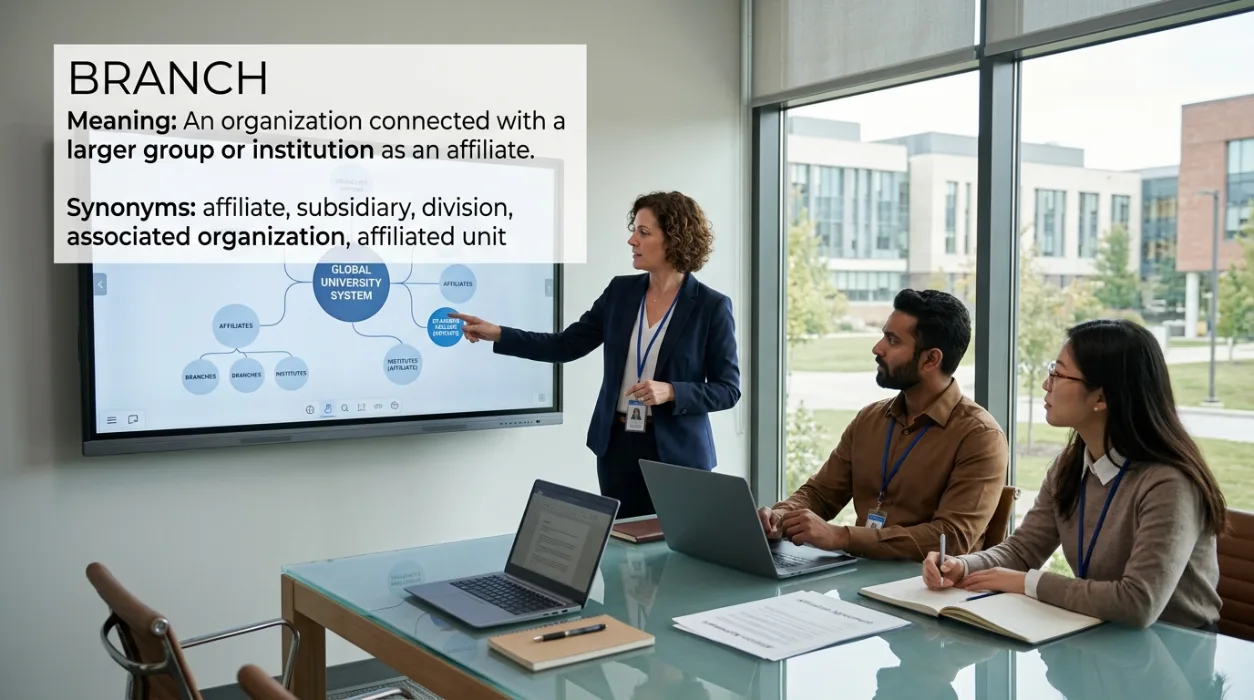
Meaning: An affiliate is an organization connected with a larger group or institution.
Tone/Register: Business, formal.
Example:
The university works with several international affiliates.
Its local affiliate organized the event.
Field (Noun) — US /fiːld/ — UK /fiːld/
Meaning: A field is an area of study, research, work, or knowledge.
Tone/Register: Neutral, academic, professional.
Example:
Medicine is a broad field.
She wants to work in the field of linguistics.
Discipline (Noun) — US /ˈdɪsəplɪn/ — UK /ˈdɪsəplɪn/
Meaning: A discipline is a recognized area of academic or professional study.
Tone/Register: Academic, formal.
Example:
Psychology is an established academic discipline.
The course combines several disciplines.
Subfield (Noun) — US /ˈsʌbfiːld/ — UK /ˈsʌbfiːld/
Meaning: A subfield is a specialized part of a larger academic field.
Tone/Register: Academic, technical.
Example:
Syntax is a subfield of linguistics.
She specializes in a narrow subfield of biology.
Area (Noun) — US /ˈɛriə/ — UK /ˈeəriə/
Meaning: An area is a broad part or category within a subject or activity.
Tone/Register: Neutral, academic, professional.
Example:
Data analysis is an important area of research.
This area of science is changing quickly.
Specialty (Noun) — US /ˈspɛʃəlti/ — UK /ˈspeʃəlti/
Meaning: A specialty is a particular area in which someone has advanced knowledge or skill.
Tone/Register: Professional, academic.
Example:
Her specialty is child language development.
Cardiology became his medical specialty.
Domain (Noun) — US /doʊˈmeɪn/ — UK /dəʊˈmeɪn/
Meaning: A domain is a particular area of knowledge, activity, or expertise.
Tone/Register: Formal, academic, technical.
Example:
The study belongs to the domain of cognitive science.
Cybersecurity is a rapidly developing domain.
Sector (Noun) — US /ˈsɛktər/ — UK /ˈsektə/
Meaning: A sector is a distinct part of an industry, economy, or organized activity.
Tone/Register: Business, economic, formal.
Example:
She works in the education sector.
The technology sector continues to evolve.
Strand (Noun) — US /strænd/ — UK /strænd/
Meaning: A strand is one distinct line, theme, or part within a larger subject or body of work.
Tone/Register: Academic, literary, neutral.
Example:
One strand of the research focuses on memory.
The article follows a separate strand of the debate.
Area of Study (Noun Phrase) — US /ˈɛriə əv ˈstʌdi/ — UK /ˈeəriə əv ˈstʌdi/
Meaning: An area of study is a particular subject or academic specialization.
Tone/Register: Academic, neutral.
Example:
Translation is her main area of study.
He chose an area of study related to environmental science.
Specialty Area (Noun Phrase) — US /ˈspɛʃəlti ˈɛriə/ — UK /ˈspeʃəlti ˈeəriə/
Meaning: A specialty area is a focused part of a wider professional or academic field.
Tone/Register: Professional, formal.
Example:
The clinic has a specialty area for pediatric care.
Her specialty area is language assessment.
Line (Noun) — US /laɪn/ — UK /laɪn/
Meaning: A line can describe a particular family descent, development, or division.
Tone/Register: Neutral, flexible.
Example:
That family line settled in the north.
The story follows a separate line of descent.
Lineage (Noun) — US /ˈlɪniɪdʒ/ — UK /ˈlɪniɪdʒ/
Meaning: Lineage refers to a line of descent from an ancestor or earlier source.
Tone/Register: Formal, historical.
Example:
The family can trace its lineage back centuries.
The artist came from a long musical lineage.
Family Line (Noun Phrase) — US /ˈfæməli laɪn/ — UK /ˈfæməli laɪn/
Meaning: A family line is a group of relatives connected through common ancestry.
Tone/Register: Neutral, conversational.
Example:
That family line moved overseas.
She researched her father’s family line.
Descent (Noun) — US /dɪˈsɛnt/ — UK /dɪˈsent/
Meaning: Descent refers to the line through which someone or something is descended from an ancestor.
Tone/Register: Formal, genealogical.
Example:
The records show his descent from the original settlers.
Her family has Irish descent.
Offshoot (Noun) — US /ˈɔfˌʃuːt/ — UK /ˈɒfʃuːt/
Meaning: An offshoot can describe a group, tradition, or idea that develops from an earlier one.
Tone/Register: Neutral, figurative.
Example:
The club began as an offshoot of a university society.
The movement later produced several offshoots.
Fork (Noun) — US /fɔrk/ — UK /fɔːk/
Meaning: A fork is a point where a road, path, river, or structure divides.
Tone/Register: Neutral, geographical.
Example:
The trail forks near the old bridge.
Take the right fork toward the village.
Spur (Noun) — US /spɜr/ — UK /spɜː/
Meaning: A spur is a smaller route, railway, or line that leads away from a main route.
Tone/Register: Geographical, transportation, technical.
Example:
A railway spur connects the factory to the main line.
We followed a narrow trail spur into the hills.
Side Road (Noun Phrase) — US /ˈsaɪd roʊd/ — UK /ˈsaɪd rəʊd/
Meaning: A side road is a smaller road that leads away from a main road.
Tone/Register: Everyday, neutral.
Example:
Turn onto the side road after the gas station.
The side road leads to several farms.
Side Route (Noun Phrase) — US /ˈsaɪd ruːt/ — UK /ˈsaɪd ruːt/
Meaning: A side route is an alternative or smaller route connected to a main route.
Tone/Register: Neutral, travel-related.
Example:
We took a side route to avoid traffic.
The side route passes through a quiet village.
Feeder (Noun) — US /ˈfiːdər/ — UK /ˈfiːdə/
Meaning: A feeder is a smaller road, railway, river, or system that connects with a larger one.
Tone/Register: Technical, geographical.
Example:
A feeder road connects the village to the highway.
The canal receives water from several feeder channels.
Tributary (Noun) — US /ˈtrɪbjəˌtɛri/ — UK /ˈtrɪbjətəri/
Meaning: A tributary is a smaller river or stream that flows into a larger river.
Tone/Register: Geographic, academic.
Example:
The stream is a tributary of the main river.
Several tributaries join the river upstream.
Distributary (Noun) — US /dɪˈstrɪbjəˌtɛri/ — UK /dɪˈstrɪbjətəri/
Meaning: A distributary is a smaller river channel that branches away from a main river.
Tone/Register: Technical, geographic.
Example:
The delta contains several distributaries.
The distributary carries water toward the coast.
Branch Line (Noun Phrase) — US /ˈbræntʃ laɪn/ — UK /ˈbrɑːntʃ laɪn/
Meaning: A branch line is a railway line that separates from a main railway route.
Tone/Register: Transportation, technical.
Example:
The branch line serves several rural towns.
Passengers changed trains at the branch line junction.
Derivative (Noun) — US /dɪˈrɪvətɪv/ — UK /dɪˈrɪvətɪv/
Meaning: A derivative is something that develops from another source, idea, or system.
Tone/Register: Academic, technical.
Example:
The theory produced several useful derivatives.
The new method is a derivative of an older approach.

Subdivision (Noun) — US /ˌsʌbdɪˈvɪʒən/ — UK /ˌsʌbdɪˈvɪʒən/
Meaning: A subdivision is a smaller part created by dividing a larger category or structure.
Tone/Register: Formal, academic.
Example:
This topic is a subdivision of modern history.
The report contains several subdivisions.
Component (Noun) — US /kəmˈpoʊnənt/ — UK /kəmˈpəʊnənt/
Meaning: A component is one part of a larger system or whole.
Tone/Register: Technical, neutral.
Example:
Each component has a specific role.
The network includes several independent components.
Segment (Noun) — US /ˈsɛɡmənt/ — UK /ˈseɡmənt/
Meaning: A segment is a distinct part of a larger whole.
Tone/Register: Neutral, business, academic.
Example:
The market has several customer segments.
This segment of the course covers grammar.
Section (Noun) — US /ˈsɛkʃən/ — UK /ˈsekʃən/
Meaning: A section is a separate part of a larger text, organization, subject, or structure.
Tone/Register: Neutral, academic, professional.
Example:
Read the science section first.
The final section discusses future research.
Category (Noun) — US /ˈkætəɡɔri/ — UK /ˈkætəɡəri/
Meaning: A category is a group or class within a larger system of classification.
Tone/Register: Academic, neutral.
Example:
Grammar forms a major category of language study.
The products fall into several categories.
Subsection (Noun) — US /ˈsʌbˌsekʃən/ — UK /ˈsʌbˌsekʃən/
Meaning: A subsection is a smaller section within a larger section or subject.
Tone/Register: Formal, written.
Example:
The subsection explains the research method.
Add the definition to the relevant subsection.
Division (Noun) — US /dɪˈvɪʒən/ — UK /dɪˈvɪʒən/
Meaning: A division can describe a distinct part of a field, system, or organization.
Tone/Register: Formal, academic, business.
Example:
The company has a separate research division.
This division of mathematics is highly specialized.
Branching (Noun) — US /ˈbræntʃɪŋ/ — UK /ˈbrɑːntʃɪŋ/
Meaning: Branching describes the process or pattern of dividing into smaller parts.
Tone/Register: Technical, descriptive.
Example:
The river shows complex branching near the delta.
The diagram illustrates the branching pattern.
Bifurcation (Noun) — US /ˌbaɪfərˈkeɪʃən/ — UK /ˌbaɪfəˈkeɪʃən/
Meaning: Bifurcation is a division into two separate branches or paths.
Tone/Register: Formal, scientific, technical.
Example:
The road reaches a clear bifurcation.
The study examines the bifurcation of the system.
Route (Noun) — US /ruːt/ — UK /ruːt/
Meaning: A route is a path or direction leading from one place or point to another.
Tone/Register: Neutral, everyday, geographical.
Example:
We chose a quieter route through the hills.
The bus uses a separate route after noon.
Synonyms by Tone
Positive
Some alternatives can suggest growth, specialization, or opportunity:
- Offshoot
- Specialty
- Field
- Avenue
- Pathway
- Sprig
- Shoot
These choices work well when the context involves development, learning, creativity, or expansion.
Neutral
These are usually safe choices when you simply need a precise replacement:
- Branchlet
- Bough
- Limb
- Twig
- Office
- Location
- Unit
- Division
- Section
- Segment
- Area
- Line
- Fork
- Route
- Department
Negative or Separation-Focused
Some words can emphasize separation or division depending on context:
- Split
- Division
- Offshoot
- Bifurcation
- Subdivision
These words are not inherently negative. The surrounding sentence determines the emotional effect.
Playful or Informal
In everyday or creative language, these can feel lighter or more visual:
- Twig
- Sprig
- Arm
- Side road
- Offshoot
- Bough
Why Tone Matters
Choosing a synonym is not only about avoiding repetition.
A twig gives a small physical image. A bough suggests something larger and often more literary. A division sounds organized. A subfield sounds academic.
Good vocabulary selection helps readers understand both the meaning and the attitude behind your sentence.
“Branch” vs Close Alternatives
| Word | Meaning difference | Tone | Best use |
|---|---|---|---|
| Branch | General word for a part growing from or dividing from a larger whole | Neutral | Everyday English |
| Bough | Usually a large tree branch | Descriptive or literary | Trees and creative writing |
| Limb | Usually a large structural branch | Neutral | Trees, gardening, physical descriptions |
| Division | A distinct part of a larger system or organization | Formal | Business and academic contexts |
| Field | An area of study or professional knowledge | Academic/neutral | Education and research |
| Offshoot | Something developed from an earlier source | Figurative | Groups, ideas, movements |
The important point is simple: branch is broader than most of its alternatives.
If you are describing an academic subject, field, discipline, or subfield may sound more natural.
If you are describing a company, office, department, unit, or subsidiary may fit better.
How “Branch” Changes by Context
Daily Conversation
In casual conversation, branch is often used for trees, businesses, roads, and family relationships.
For example:
“The branch broke during the storm.”
Or:
“I’ll visit the downtown branch tomorrow.”
For everyday speech, simple alternatives such as limb, office, side road, and line are often more natural than highly technical terms.
Writing and Blogging
Writers often use synonyms to prevent repetition.
Instead of writing:
“The branch of the tree was long. The branch reached the window.”
You could write:
“The bough was long. Its heavy limb reached the window.”
Bloggers should still prioritize clarity. A rare technical term is not automatically better than a common word.
Professional and Academic English
Professional writing often needs precision.
For an organization, division, department, unit, or subsidiary can communicate structure more clearly than branch.
For academic subjects, field, discipline, subfield, and specialty can show exactly how broad or narrow the subject is.
Creative and Informal English
Creative writers can use bough, sprig, limb, or twig to create a visual image.
Figurative writing can use offshoot, pathway, avenue, or strand to show how ideas or stories develop.
Common Mistakes and Native Usage
Mistake 1: Using “bough” for every branch
A bough normally suggests a larger tree branch.
Calling a tiny twig a bough can sound unnatural.
Mistake 2: Using “office” for an academic branch
An academic branch is not normally an office.
Say:
“Linguistics is a branch of language study.”
Or:
“Linguistics is a field of language study.”
Mistake 3: Using “field” for a tree
Field does not normally replace branch when discussing a physical tree.
Say:
“A bird landed on a branch.”
Not:
“A bird landed on a field.”
Mistake 4: Treating every synonym as interchangeable
This is the biggest vocabulary mistake.
Tributary refers specifically to a smaller river or stream flowing into a larger one.
Branch line refers specifically to a railway line that separates from a main line.
Subfield refers to a narrower area within an academic field.
Context controls synonym choice.
Mistake 5: Overusing “branch”
Repeating the same word can make an article or essay feel flat.
However, replacing every occurrence can make writing unnatural.
Native speakers repeat a precise word when repetition improves clarity.
Register Notes
Bough, twig, limb, office, field, division, department, and line are common enough for many general contexts.
Ramification, bifurcation, distributary, and subfield are more specialized.
In formal writing, precision matters more than simply choosing a “fancier” synonym.
For another useful vocabulary lesson, an internal guide on synonyms for related structural words can help you build a stronger semantic vocabulary.
Real-Life Examples Using
Workplace
A company may have a branch, office, department, division, or subsidiary.
For example:
“Our regional office handles customer support.”
Here, office is more specific than the broad word branch.
Social Situations
Family discussions often use branch, lineage, or family line.
For example:
“That branch of our family lives overseas.”
A more formal version might be:
“That family line has lived overseas for generations.”
Media and Pop Culture
News articles often describe organizations as having different arms, divisions, or offshoots.
For example:
“The group later formed an independent offshoot.”
The word offshoot highlights development from an earlier group.
Writing and Storytelling
Creative writers often choose physical synonyms carefully.
Compare:
“The bird sat on a branch.”
with:
“The bird settled on a weathered bough.”
The second sentence creates a more literary image.

Practice Exercise
1. The bird built its nest on a thin ______.
A. subsidiary
B. twig
C. department
D. discipline
2. Neurology is a ______ of medicine.
A. bough
B. twig
C. branch
D. limb
3. The bank opened a new local ______ downtown.
A. office
B. tributary
C. bough
D. sprig
4. The river receives water from a small ______.
A. department
B. tributary
C. subsidiary
D. specialty
5. Syntax is a ______ of linguistics.
A. subfield
B. bough
C. branch line
D. side road
6. The old tree lost a large ______ during the storm.
A. field
B. limb
C. office
D. affiliate
7. The railway ______ connects the village to the main line.
A. branch line
B. lineage
C. specialty
D. strand
8. The movement later developed into several independent ______.
A. offshoots
B. twigs
C. boughs
D. offices
9. We turned onto a quiet ______ to avoid the highway.
A. discipline
B. side road
C. subsidiary
D. lineage
10. She specializes in a narrow ______ of environmental science.
A. bough
B. subfield
C. limb
D. office
Answer Key: 1-B | 2-C | 3-A | 4-B | 5-A | 6-B | 7-A | 8-A | 9-B | 10-B
Reflection and Application Task
Write four short sentences using four different alternatives for branch.
Try one sentence about:
- a tree
- an organization
- an academic subject
- a road, river, or family
Then ask yourself: Does my synonym match the exact context?
Conclusion
Understanding branch can help you describe a part of a tree, a division of an organization, or a separate area of study or activity. Learning its synonyms, meaning, and examples can improve your English vocabulary and make your communication more precise.
The word branch is commonly used in nature, business, education, science, and everyday conversations. Knowing its related synonyms can help you express ideas about divisions, sections, offices, limbs, or areas of specialization in different ways.
By practicing branch in sentences and exploring related words, you can strengthen your vocabulary and writing skills. A clear understanding of this word will help you use it naturally, accurately, and confidently in different English contexts.
FAQs
1. What is the best synonym for branch when talking about a tree?
The best synonym depends on the size and appearance of the tree part. Bough usually suggests a large branch, while limb often refers to a substantial structural branch. Twig means a small branch, and sprig usually suggests a small branch with leaves, flowers, or berries. For general use, branch remains the safest and most flexible word.
2. What is another word for branch of a company?
For a company, useful alternatives include office, location, outlet, unit, division, department, affiliate, and subsidiary. They are not identical. An office is usually a physical workplace, while a subsidiary is a separately organized company controlled by another company. Choose the word that describes the company’s actual structure rather than simply replacing branch mechanically.
3. What can I say instead of branch in an academic essay?
In academic writing, field, discipline, subfield, area, specialty, domain, division, and strand can work depending on meaning. For example, “linguistics is a field of study” sounds natural. “Syntax is a subfield of linguistics” is more precise because syntax represents a narrower area within the larger discipline.
4. Is “bough” a complete synonym for branch?
No. Bough is more specific. It generally refers to a large branch of a tree and often has a literary or descriptive feel. You would not normally use bough for a company office, academic subject, railway route, or family line. Therefore, it is a useful tree-related alternative rather than a universal replacement.
5. What is a synonym for branch in a family context?
Common choices include family line, lineage, line of descent, descent, and offshoot. “That branch of the family moved abroad” is neutral. “That family line moved abroad” is also natural. Lineage sounds more formal and often focuses on ancestry, while offshoot emphasizes a group that developed from an earlier family or tradition.

Hasnain Ali is an SEO Content Strategist and the founder of wordvora.com, a trusted vocabulary platform that helps writers, students, professionals, and English learners find accurate synonyms, antonyms, word meanings, and real-life usage examples. He specializes in keyword research, on-page SEO, topical authority, and creating search-first content that aligns with Google’s latest Search Quality and E-E-A-T guidelines. His work focuses on producing clear, well-structured, and reader-friendly resources that satisfy search intent while maintaining high editorial standards.
Through extensive hands-on experience with SEO tools such as Google Search Console, Google Analytics, SEMrush, and Ahrefs, Hasnain researches user search behavior and develops content that is both informative and easy to understand. Every article published on wordvora.com is carefully reviewed for accuracy, readability, and contextual relevance before publication. His mission is to build one of the web’s most reliable English vocabulary resources by providing practical language guidance, trustworthy explanations, and content that helps readers improve their writing, communication, and vocabulary with confidence.