

Synonyms for actionable can help when “actionable” feels too repetitive. Imagine writing a report and using the same word for every useful idea. Better choices add precision.
For example, “actionable advice” means advice that someone can actually use. Depending on the context, practical, usable, or implementable may sound more natural.
Learning synonyms for actionable gives students, bloggers, and content writers more control over tone. It also helps daily English users explain useful ideas clearly.
The word is common because modern English often needs a quick way to describe information, advice, plans, or solutions that can lead to action.
What Does “Actionable” Really Mean?
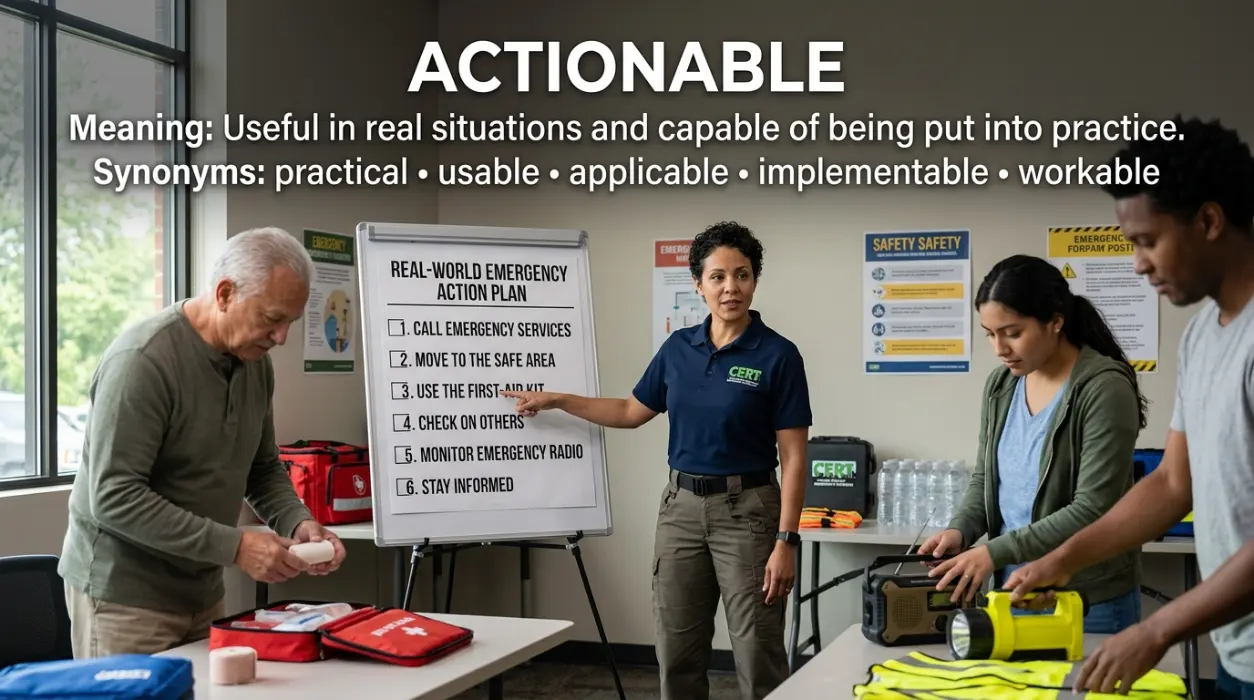
Actionable is an adjective with two important meanings.
In modern business, academic, technical, and everyday professional English, actionable usually means capable of being acted on or turned into a practical action. Oxford gives this sense as “that can be done or acted on.”
For example:
“The report provides actionable recommendations.”
This means the recommendations are specific and practical enough for someone to do something with them.
You will often see actionable with words such as:
- actionable advice
- actionable information
- actionable insights
- actionable steps
- actionable recommendations
- actionable solutions
- actionable feedback
- actionable data
- actionable strategy
- actionable plan
However, actionable also has a specialized legal meaning. In law, something actionable can provide a valid basis for bringing a legal case or lawsuit. Cambridge, Oxford, Collins, and Dictionary.com all record this legal sense.
Therefore, context matters.
Simple Definition
Actionable: something that can be acted on, used to make a decision, implemented, or, in legal contexts, used as a basis for legal action.
Part of Speech
Actionable is primarily an adjective.
Examples:
- actionable advice
- actionable information
- actionable evidence
- actionable recommendations
The noun actionability is also used, although it is much less common in everyday English.
Connotative Meaning
Connotation (the feeling, association, or attitude that a word suggests beyond its basic dictionary meaning) can change how a sentence feels.
Positive Tone
In professional English, actionable usually has a positive or useful connotation.
If someone calls advice “actionable,” they normally mean that the advice is practical, specific, and useful.
For example:
“The workshop gave us actionable strategies.”
The phrase suggests that participants can actually use what they learned.
Negative Tone
The word itself is rarely strongly negative in its practical sense.
However, it can sound negative when someone criticizes information for not being actionable.
For example:
“The report contains interesting observations, but few actionable recommendations.”
Here, the speaker suggests that the information is interesting but not sufficiently useful.
In legal contexts, actionable can have a more serious implication because it may mean that conduct provides grounds for legal proceedings.
Neutral Tone
In neutral professional writing, actionable simply means “able to be acted upon.”
That is why it appears frequently in reports, research, business communication, technical documentation, strategy discussions, and recommendations.
Etymology of “Actionable”
The word actionable comes from action + -able. Historical sources date the word to the late 16th century, with Dictionary.com giving 1585–95 and Etymonline describing the early form as referring to something that provided sufficient grounds for legal action.
The word action itself ultimately comes from Latin actio, meaning an act, doing, performance, or legal action. Latin actio is connected to agere, meaning “to do,” “drive,” or “move.”
The suffix -able is an English adjective-forming element with the general sense of “capable of,” “fit for,” or “able to be.”
Old English: 450–1100
The modern word actionable did not exist in Old English.
However, the deeper idea behind action can be traced to older Germanic and Indo-European concepts involving doing, moving, and performing.
The later English word action developed through French from Latin.
Middle English: 1100–1500
During Middle English, action entered English through Anglo-French and Old French forms connected with Latin actio.
At first, legal meanings were especially important. Over time, the word also developed broader meanings involving acts, activities, and things being done.
Modern English: 1500–Present
Actionable appeared in the late 16th century, originally with a strong legal meaning.
Modern professional English later developed the broader sense of something that can be acted upon or used to guide action. Dictionary sources now recognize both meanings.
Pronunciation: US & UK IPA
- US: /ˈæk.ʃə.nə.bəl/
- UK: /ˈæk.ʃə.nə.bəl/
Cambridge gives essentially the same pronunciation pattern for both varieties of English.
Syllables
actionable: ac-tion-a-ble
The word is normally pronounced with four syllables:
ac-ti-on-a-ble is not the correct syllable division for ordinary pronunciation.
A useful learner-friendly breakdown is:
ac-shuh-nuh-buhl
Affixation Pattern of “Actionable”
Root/base: action
Prefix: none
Suffix: -able
The structure is:
action + -able → actionable
The suffix -able creates an adjective describing something that can be acted upon or, historically and legally, something capable of forming the basis for action.
Synonyms List
Practical (Adjective) — US / UK: /ˈpræktɪkəl/ / /ˈpræktɪkəl/
Meaning: Useful in real situations and capable of being put into practice.
Tone/Register: Neutral, professional, academic.
Example:
The guide offers practical advice for new teachers.
We need practical solutions, not just theories.
Usable (Adjective) — US / UK: /ˈjuːzəbəl/ / /ˈjuːzəbəl/
Meaning: Suitable or useful for actual use.
Tone/Register: Neutral, everyday, professional.
Example:
The survey produced usable information.
Her feedback gave us several usable ideas.
Doable (Adjective) — US / UK: /ˈduːəbəl/ / /ˈduːəbəl/
Meaning: Possible to complete or accomplish.
Tone/Register: Informal, conversational.
Example:
The plan looks difficult but doable.
Can you give me a few doable steps?
Implementable (Adjective) — US / UK: /ˈɪmpləmentəbəl/ / /ˈɪmplɪmentəbəl/
Meaning: Capable of being put into practical operation.
Tone/Register: Formal, professional, business.
Example:
The committee proposed several implementable reforms.
We need an implementable plan by Friday.
Applicable (Adjective) — US / UK: /ˈæplɪkəbəl/ / /ˈæplɪkəbəl/
Meaning: Relevant or suitable for use in a particular situation.
Tone/Register: Formal, academic, professional.
Example:
The research offers applicable lessons for schools.
These rules apply to small businesses.
Workable (Adjective) — US / UK: /ˈwɜːrkəbəl/ / /ˈwɜːkəbəl/
Meaning: Practical enough to function successfully.
Tone/Register: Neutral, professional.
Example:
We finally found a workable solution.
The schedule is busy, but it is workable.
Feasible (Adjective) — US / UK: /ˈfiːzəbəl/ / /ˈfiːzəbəl/
Meaning: Realistically possible to carry out.
Tone/Register: Formal, academic, professional.
Example:
The engineers tested whether the proposal was feasible.
We need a feasible alternative before the meeting.
Viable (Adjective) — US / UK: /ˈvaɪəbəl/ / /ˈvaɪəbəl/
Meaning: Capable of succeeding or continuing successfully in real conditions.
Tone/Register: Professional, academic, business.
Example:
The study identified three viable options.
Is this a viable solution for rural schools?
Executable (Adjective) — US / UK: /ˈeksɪkjətəbəl/ / /ˈeksɪkjətəbəl/
Meaning: Capable of being carried out or performed.
Tone/Register: Formal, technical, professional.
Example:
The strategy is clear and executable.
We turned the broad idea into an executable plan.
Attainable (Adjective) — US / UK: /əˈteɪnəbəl/ / /əˈteɪnəbəl/
Meaning: Possible to achieve through reasonable effort.
Tone/Register: Neutral, professional, motivational.
Example:
The team set attainable targets for the quarter.
Choose goals that are ambitious but attainable.
Achievable (Adjective) — US / UK: /əˈtʃiːvəbəl/ / /əˈtʃiːvəbəl/
Meaning: Capable of being successfully reached or accomplished.
Tone/Register: Neutral, professional, educational.
Example:
The teacher gave us achievable weekly goals.
Breaking the task into parts made it achievable.
Realistic (Adjective) — US / UK: /ˌriːəˈlɪstɪk/ / /ˌrɪəˈlɪstɪk/
Meaning: Based on conditions that actually exist rather than unrealistic expectations.
Tone/Register: Neutral, professional, academic.
Example:
The manager asked for a realistic plan.
We need realistic steps for reducing delays.
Concrete (Adjective) — US / UK: /ˈkɑːnkriːt/ / /ˈkɒŋkriːt/
Meaning: Specific and definite rather than vague or theoretical.
Tone/Register: Professional, academic, neutral.
Example:
The report should include concrete recommendations.
She gave me a concrete way to improve the process.
Specific (Adjective) — US / UK: /spəˈsɪfɪk/ / /spəˈsɪfɪk/
Meaning: Clearly defined and detailed enough to guide action.
Tone/Register: Neutral, academic, professional.
Example:
Please give me specific instructions.
The feedback became more useful once it was specific.
Operational (Adjective) — US / UK: /ˌɑːpəˈreɪʃənəl/ / /ˌɒpəˈreɪʃənəl/
Meaning: Ready to function or designed for practical operation.
Tone/Register: Technical, professional, business.
Example:
The team created an operational response plan.
The recommendations need to become operational.
Practicable (Adjective) — US / UK: /ˈpræktɪkəbəl/ / /ˈpræktɪkəbəl/
Meaning: Capable of being done successfully in real circumstances.
Tone/Register: Formal, academic, British English.
Example:
The researchers proposed a practicable solution.
We chose the most practicable option.
Useful (Adjective) — US / UK: /ˈjuːsfəl/ / /ˈjuːsfəl/
Meaning: Providing a benefit or helping someone accomplish a purpose.
Tone/Register: Neutral, everyday, professional.
Example:
The article contains useful suggestions.
Her comments were simple but useful.
Effective (Adjective) — US / UK: /ɪˈfektɪv/ / /ɪˈfektɪv/
Meaning: Successful in producing the intended result.
Tone/Register: Neutral, professional, academic.
Example:
The team developed an effective response.
We need an effective way to reduce errors.
Functional (Adjective) — US / UK: /ˈfʌŋkʃənəl/ / /ˈfʌŋkʃənəl/
Meaning: Able to work or perform its intended purpose.
Tone/Register: Technical, professional, neutral.
Example:
The prototype is simple but functional.
We need a functional process before adding more features.
Ready-to-Use (Adjective) — US / UK: /ˌredi tə ˈjuːz/ / /ˌredi tə ˈjuːz/
Meaning: Prepared so that someone can use it immediately.
Tone/Register: Neutral, professional.
Example:
The teacher created ready-to-use activities.
The report includes ready-to-use templates.
Ready for Implementation (Adjective Phrase) — US / UK: /ˈredi fər ˌɪmpləmenˈteɪʃən/ / /ˈredi fə ˌɪmplɪmenˈteɪʃən/
Meaning: Sufficiently developed to be put into operation.
Tone/Register: Formal, business, professional.
Example:
The revised policy is ready for implementation.
The committee presented a plan ready for implementation.
Action-Oriented (Adjective) — US / UK: /ˈækʃən ˌɔːriˈentɪd/ / /ˈækʃən ˌɔːriˈentɪd/
Meaning: Focused on doing something rather than merely discussing it.
Tone/Register: Professional, business, motivational.
Example:
The meeting was short and action-oriented.
Her writing has an action-oriented style.
Results-Oriented (Adjective) — US / UK: /rɪˈzʌlts ˌɔːriˈentɪd/ / /rɪˈzʌlts ˌɔːriˈentɪd/
Meaning: Focused on achieving measurable or useful outcomes.
Tone/Register: Professional, business.
Example:
The team needs a results-oriented strategy.
His recommendations were practical and results-oriented.

Outcome-Focused (Adjective) — US / UK: /ˈaʊtkʌm ˌfoʊkəst/ / /ˈaʊtkʌm ˌfəʊkəst/
Meaning: Concentrated on achieving a defined result.
Tone/Register: Professional, academic.
Example:
The program uses an outcome-focused approach.
We need an outcome-focused discussion.
Task-Oriented (Adjective) — US / UK: /ˈtæsk ˌɔːriˈentɪd/ / /ˈtɑːsk ˌɔːriˈentɪd/
Meaning: Focused on completing clearly defined tasks.
Tone/Register: Professional, workplace.
Example:
The new system is highly task-oriented.
Her instructions are direct and task-oriented.
Implementation-Ready (Adjective) — US / UK: /ˌɪmpləmenˈteɪʃən ˌredi/ / /ˌɪmplɪmenˈteɪʃən ˌredi/
Meaning: Developed enough to be put into practice immediately.
Tone/Register: Business, technical, professional.
Example:
The consultants delivered an implementation-ready plan.
The proposal is nearly implementation-ready.
Decision-Ready (Adjective) — US / UK: /dɪˈsɪʒən ˌredi/ / /dɪˈsɪʒən ˌredi/
Meaning: Complete and clear enough to support an informed decision.
Tone/Register: Business, professional.
Example:
The analysis gives the board decision-ready information.
We need decision-ready evidence before voting internally.
Practical in Practice (Adjective Phrase) — US / UK: /ˈpræktɪkəl ɪn ˈpræktɪs/ / /ˈpræktɪkəl ɪn ˈpræktɪs/
Meaning: Useful not merely in theory but when actually applied.
Tone/Register: Academic, professional.
Example:
The model looks promising and is practical in practice.
We tested whether the recommendation was practical in practice.
Applicable in Practice (Adjective Phrase) — US / UK: /ˈæplɪkəbəl ɪn ˈpræktɪs/ / /ˈæplɪkəbəl ɪn ˈpræktɪs/
Meaning: Relevant and usable under real-world conditions.
Tone/Register: Academic, formal.
Example:
The principle is simple and applicable in practice.
We need guidance that is applicable in practice.
Capable of Implementation (Adjective Phrase) — US / UK: /ˈkeɪpəbəl əv ˌɪmpləmenˈteɪʃən/ / /ˈkeɪpəbəl əv ˌɪmplɪmenˈteɪʃən/
Meaning: Able to be put into practical operation.
Tone/Register: Formal, academic, professional.
Example:
The proposal is capable of implementation.
Only plans capable of implementation should be considered.
Capable of Being Acted Upon (Adjective Phrase) — US / UK: /ˈkeɪpəbəl əv ˈbiːɪŋ ˌæktɪd əˈpɑːn/ / /ˈkeɪpəbəl əv ˈbiːɪŋ ˌæktɪd əˈpɒn/
Meaning: Suitable for someone to use as a basis for action.
Tone/Register: Formal, academic.
Example:
The evidence is capable of being acted upon.
The report contains information capable of being acted upon.
Amenable to Action (Adjective Phrase) — US / UK: /əˈmiːnəbəl tə ˈækʃən/ / /əˈmiːnəbəl tə ˈækʃən/
Meaning: Suitable or responsive to being dealt with through action.
Tone/Register: Formal, academic.
Example:
The issue is amenable to action at the local level.
The proposal is amenable to action without major changes.
Immediately Useful (Adjective Phrase) — US / UK: /ɪˈmiːdiətli ˈjuːsfəl/ / /ɪˈmiːdiətli ˈjuːsfəl/
Meaning: Useful without requiring much additional preparation.
Tone/Register: Neutral, professional.
Example:
The workshop provided immediately useful advice.
The checklist contains immediately useful information.
Solution-Oriented (Adjective) — US / UK: /səˈluːʃən ˌɔːriˈentɪd/ / /səˈluːʃən ˌɔːriˈentɪd/
Meaning: Focused on finding practical ways to solve a problem.
Tone/Register: Professional, workplace.
Example:
Her feedback was constructive and solution-oriented.
The meeting became more solution-oriented after lunch.
Practice-Based (Adjective) — US / UK: /ˈpræktɪs beɪst/ / /ˈpræktɪs beɪst/
Meaning: Grounded in real activities or practical experience rather than theory alone.
Tone/Register: Academic, educational, professional.
Example:
The course offers practice-based guidance.
Teachers often prefer practice-based recommendations.
Usable in Practice (Adjective Phrase) — US / UK: /ˈjuːzəbəl ɪn ˈpræktɪs/ / /ˈjuːzəbəl ɪn ˈpræktɪs/
Meaning: Suitable for actual use under real conditions.
Tone/Register: Neutral, academic, professional.
Example:
The framework is easy to understand and usable in practice.
We tested whether the advice was usable in practice.
Ready for Action (Adjective Phrase) — US / UK: /ˈredi fər ˈækʃən/ / /ˈredi fə ˈækʃən/
Meaning: Prepared so that action can begin immediately.
Tone/Register: Neutral, professional, sometimes dramatic.
Example:
The emergency team was ready for action.
The new plan leaves everyone ready for action.
Actionable in Practice (Adjective Phrase) — US / UK: /ˈækʃənəbəl ɪn ˈpræktɪs/ / /ˈækʃənəbəl ɪn ˈpræktɪs/
Meaning: Specific enough to be converted into real-world action.
Tone/Register: Professional, business, academic.
Example:
The research becomes actionable in practice.
The recommendations are actionable in practice, not just in theory.
Legally Actionable (Adjective Phrase) — US / UK: /ˈliːɡəli ˈækʃənəbəl/ / /ˈliːɡəli ˈækʃənəbəl/
Meaning: Sufficiently connected to a legal right or wrong to support legal action.
Tone/Register: Legal, formal.
Example:
The lawyer considered whether the conduct was legally actionable.
The claim must be examined before anyone calls it legally actionable.
Suable (Adjective) — US / UK: /ˈsuːəbəl/ / /ˈsuːəbəl/
Meaning: Capable of being sued over or becoming the subject of a lawsuit.
Tone/Register: Legal, formal.
Example:
The lawyer examined whether the conduct was suable.
The court must determine whether the claim is justiciable.
Litigable (Adjective) — US / UK: /ˈlɪtɪɡəbəl/ / /ˈlɪtɪɡəbəl/
Meaning: Suitable for being taken to court or resolved through litigation.
Tone/Register: Legal, formal.
Example:
The dispute may be litigable under the relevant law.
The attorney reviewed whether the issue was litigable.
Justiciable (Adjective) — US / UK: /ˌdʒʌstɪˈʃəbəl/ / /ˌdʒʌstɪˈʃəbəl/
Meaning: Appropriate for determination by a court or judicial process.
Tone/Register: Legal, highly formal.
Example:
The court considered whether the issue was justiciable.
The lawyers debated whether the dispute presented a justiciable question.
Subject to Legal Action (Adjective Phrase) — US / UK: /ˈsʌbdʒɪkt tə ˈliːɡəl ˈækʃən/ / /ˈsʌbdʒɪkt tə ˈliːɡəl ˈækʃən/
Meaning: Capable of becoming the basis for legal proceedings.
Tone/Register: Legal, formal.
Example:
The conduct may be subject to legal action.
The company was warned that the behavior could be subject to legal action.
Grounds for a Lawsuit (Noun Phrase) — US / UK: /ɡraʊndz fər ə ˈlɔːsuːt/ / /ɡraʊndz fər ə ˈlɔːsuːt/
Meaning: Facts or circumstances that can provide a basis for bringing a lawsuit.
Tone/Register: Legal, formal.
Example:
The attorney looked for grounds for a lawsuit.
The complaint may provide grounds for a lawsuit.
Legally Viable (Adjective Phrase) — US / UK: /ˈliːɡəli ˈvaɪəbəl/ / /ˈliːɡəli ˈvaɪəbəl/
Meaning: Capable of succeeding or proceeding under applicable law.
Tone/Register: Legal, formal.
Example:
The lawyer assessed whether the claim was legally viable.
We need to know whether the argument is legally viable.

Enforceable (Adjective) — US / UK: /ɪnˈfɔːrsəbəl/ / /ɪnˈfɔːsəbəl/
Meaning: Capable of being legally required or upheld.
Tone/Register: Legal, formal, business.
Example:
The contract contains an enforceable obligation.
The parties wanted a clear and enforceable agreement.
Actionable Claim (Noun Phrase) — US / UK: /ˈækʃənəbəl kleɪm/ / /ˈækʃənəbəl kleɪm/
Meaning: A claim that may provide a recognized basis for legal proceedings.
Tone/Register: Legal, formal.
Example:
The attorney reviewed whether the complaint contained an actionable claim.
The court will determine whether the claim is actionable.
Legally Cognizable (Adjective) — US / UK: /ˈliːɡəli ˈkɑːɡnəzəbəl/ / /ˈliːɡəli ˈkɒɡnɪzəbəl/
Meaning: Recognized as a matter that a court can properly consider.
Tone/Register: Legal, highly formal.
Example:
The judge considered whether the dispute was legally cognizable.
The argument must involve a legally cognizable right.
Capable of Legal Redress (Adjective Phrase) — US / UK: /ˈkeɪpəbəl əv ˈliːɡəl rɪˈdres/ / /ˈkeɪpəbəl əv ˈliːɡəl rɪˈdres/
Meaning: Capable of being addressed through a legal remedy.
Tone/Register: Legal, formal.
Example:
The claimant argued that the harm was capable of legal redress.
The court examined whether the issue was capable of legal redress.
Action-Worthy (Adjective) — US / UK: /ˈækʃən ˌwɜːrði/ / /ˈækʃən ˌwɜːði/
Meaning: Deserving or requiring a practical response.
Tone/Register: Informal, modern, less common.
Example:
The findings revealed several action-worthy concerns.
The team separated interesting ideas from action-worthy ones.
Responsive (Adjective) — US / UK: /rɪˈspɑːnsɪv/ / /rɪˈspɒnsɪv/
Meaning: Designed or able to respond effectively to a need, issue, or situation.
Tone/Register: Professional, academic.
Example:
The policy should be responsive to community needs.
We need a responsive approach to customer concerns.
Outcome-Driven (Adjective) — US / UK: /ˈaʊtkʌm ˌdrɪvən/ / /ˈaʊtkʌm ˌdrɪvən/
Meaning: Organized around achieving a particular result.
Tone/Register: Professional, business.
Example:
The team adopted an outcome-driven approach.
The new strategy is more outcome-driven.
Results-Focused (Adjective) — US / UK: /rɪˈzʌlts ˌfoʊkəst/ / /rɪˈzʌlts ˌfəʊkəst/
Meaning: Concentrated on producing useful or measurable results.
Tone/Register: Professional, business.
Example:
Her recommendations are results-focused.
The program uses a results-focused framework.
Decision-Useful (Adjective) — US / UK: /dɪˈsɪʒən ˌjuːsfəl/ / /dɪˈsɪʒən ˌjuːsfəl/
Meaning: Useful for helping someone make a well-informed decision.
Tone/Register: Academic, professional, technical.
Example:
The report contains decision-useful information.
We need more decision-useful data before proceeding.
Recommendation-Ready (Adjective) — US / UK: /ˌrekəmenˈdeɪʃən ˌredi/ / /ˌrekəmenˈdeɪʃən ˌredi/
Meaning: Developed enough to support a clear recommendation.
Tone/Register: Professional, business.
Example:
The analysis is recommendation-ready.
The evidence is not yet recommendation-ready.
Implementation-Focused (Adjective) — US / UK: /ˌɪmpləmenˈteɪʃən ˌfoʊkəst/ / /ˌɪmplɪmenˈteɪʃən ˌfəʊkəst/
Meaning: Concentrated on how an idea or plan will actually be put into practice.
Tone/Register: Professional, academic.
Example:
The workshop was strongly implementation-focused.
We need an implementation-focused discussion.
Practice-Oriented (Adjective) — US / UK: /ˈpræktɪs ˌɔːriˈentɪd/ / /ˈpræktɪs ˌɔːriˈentɪd/
Meaning: Designed around real-world use rather than theory alone.
Tone/Register: Academic, educational, professional.
Example:
The course offers practice-oriented guidance.
Her research has a practice-oriented focus.
Directly Useful (Adjective Phrase) — US / UK: /dəˈrektli ˈjuːsfəl/ / /daɪˈrektli ˈjuːsfəl/
Meaning: Useful without requiring a major additional step before it can help.
Tone/Register: Neutral, professional.
Example:
The checklist is directly useful for new employees.
The findings are directly useful to teachers.
Ready to Implement (Adjective Phrase) — US / UK: /ˈredi tə ˈɪmpləment/ / /ˈredi tə ˈɪmplɪment/
Meaning: Developed sufficiently for immediate practical use.
Tone/Register: Professional, business.
Example:
The team delivered a ready-to-implement strategy.
The revised procedure is ready to implement.
Synonyms by Tone
Tone matters because the same basic idea can sound practical, formal, technical, or conversational depending on the word you choose.
Positive
These alternatives often emphasize usefulness, progress, or effectiveness:
- practical
- useful
- effective
- workable
- viable
- achievable
- feasible
- solution-oriented
- practice-oriented
- results-focused
For example, practical advice sounds helpful and friendly.
Neutral
These words describe whether something can be used or applied without adding a strong emotional judgment:
- usable
- applicable
- specific
- concrete
- functional
- realistic
- doable
- executable
- attainable
- directly useful
Professional or Academic
These are especially useful in reports, research, strategy documents, and formal communication:
- implementable
- operational
- practicable
- implementation-ready
- decision-ready
- outcome-focused
- task-oriented
- decision-useful
- practice-based
- ready for implementation
Legal
Use these only when the legal meaning is intended:
- suable
- litigable
- justiciable
- legally actionable
- legally viable
- enforceable
- subject to legal action
- grounds for a lawsuit
- legally cognizable
- capable of legal redress
Using a legal synonym in an ordinary business sentence can create an unintended meaning.
“Actionable” vs Close Alternatives
Practical vs Actionable
Actionable emphasizes the possibility of taking a specific action.
Practical emphasizes usefulness in real situations.
Compare:
“The report contains actionable recommendations.”
This suggests that the recommendations tell someone what to do.
“The report contains practical recommendations.”
This suggests that the recommendations are useful and realistic.
Therefore, actionable is often more action-focused, while practical is broader.
Actionable vs Feasible
Actionable means something can lead to action.
Feasible means something is realistically possible.
A plan may be actionable but still not feasible if it requires resources that are unavailable.
For example:
“The report gives us an actionable plan.”
The plan tells us what to do.
“The report gives us a feasible plan.”
The plan appears realistically possible.
Actionable vs Implementable
Actionable is broader.
It can describe information, insights, recommendations, advice, and steps.
Implementable is more specifically concerned with putting a plan, system, policy, or proposal into operation.
Therefore:
“Actionable feedback”
sounds natural.
“Implementable feedback”
sounds unusual because feedback itself is not normally “implemented.”
How “Actionable” Changes by Context
Daily Conversation
In casual conversation, people often choose simpler words.
Instead of:
“Give me actionable advice.”
you might hear:
“Give me some practical advice.”
Likewise, useful, doable, and realistic often sound more conversational.
“Actionable” is understandable, but it can feel more professional or business-like.
Writing and Blogging
Bloggers often use actionable when they want to promise useful information.
For example:
“Here are five actionable tips for better writing.”
This tells readers that the tips are intended to be used rather than simply read.
Still, repeating “actionable” in every section can make content sound formulaic.
You can vary the language with practical, specific, useful, step-by-step, doable, or ready-to-use.
Professional or Academic Writing
“Actionable” is especially common in reports and recommendations.
For example:
“The study produced actionable findings.”
However, formal writing should still be precise.
If the findings lead directly to decisions, decision-useful may be better.
If they can be put into operation, implementable may be more exact.
Creative or Informal Use
Creative writing usually benefits from more concrete language.
Instead of:
“She gave him actionable advice.”
you might write:
“She gave him three things he could do immediately.”
That sentence is longer, but it feels more natural in a story.
The best synonym is therefore influenced by both meaning and style.
Common Mistakes and Native Usage
Mistake 1: Assuming “Actionable” Always Means “Good”
Something can be actionable without being wise, effective, or beneficial.
Actionable mainly says that action can be taken.
For example, a recommendation can be very actionable but still produce poor results.
Mistake 2: Confusing “Actionable” With “Effective”
Effective means successful in producing the intended result.
Actionable means capable of being acted upon.
A plan can be actionable without being effective.
Mistake 3: Confusing “Actionable” With “Feasible”
Feasibility asks whether something is realistically possible.
Actionability asks whether something gives a clear basis for action.
The two ideas overlap, but they are not identical.
Mistake 4: Using Legal “Actionable” Casually
In legal English, “actionable” has a specialized meaning related to legal proceedings.
For example:
“The conduct may be actionable.”
This can suggest possible grounds for a lawsuit.
Therefore, learners should pay attention to context.
Mistake 5: Overusing Corporate Vocabulary
“Actionable insights,” “actionable strategies,” and “actionable recommendations” are common phrases.
However, repeating them too often can make writing sound generic.
Sometimes, useful, specific, practical, or clear is better.
Register Notes
Actionable is common in professional and business English.
It is also used in academic, technical, research, marketing, and policy-related writing.
In everyday conversation, however, simpler alternatives often sound more natural.
For example:
“What can I actually do?”
is more conversational than:
“What is the actionable response?”
Real-Life Mini Scenarios
Workplace
A manager receives a long customer report.
Instead of saying:
“The report is interesting.”
the manager might say:
“The report gives us actionable recommendations.”
The second sentence emphasizes what the company can do next.
Social Situation
A friend asks how to improve their study routine.
You could say:
“Here are three practical things you can try tonight.”
That is often more natural than calling the advice “actionable” in casual conversation.
Media and Pop Culture
A commentator might describe an interview as providing specific, useful, or actionable information.
The choice depends on whether the information merely informs people or gives them a clear next step.
Writing and Storytelling
A character might receive:
“clear, practical advice”
rather than:
“actionable advice.”
Creative writing often favors natural description over professional terminology.

Practice Quiz
1. A manager wants advice that employees can immediately use.
A. vague
B. actionable
C. theoretical
D. decorative
2. A plan is realistically possible with the available resources.
A. feasible
B. legal
C. emotional
D. historical
3. A recommendation is ready to be put into operation.
A. implementable
B. accidental
C. theoretical
D. uncertain
4. A casual friend gives you useful advice about studying.
A. practical
B. litigable
C. justiciable
D. enforceable
5. A report contains exact details rather than vague suggestions.
A. specific
B. dramatic
C. fictional
D. optional
6. A solution can function successfully even though it is not perfect.
A. workable
B. legal
C. historical
D. decorative
7. A plan is designed around achieving a measurable result.
A. outcome-focused
B. unrelated
C. passive
D. theoretical
8. Information helps a manager make an informed decision.
A. decision-useful
B. colorful
C. informal
D. fictional
9. A court can properly consider a particular legal question.
A. justiciable
B. practical
C. doable
D. usable
10. A contract obligation can legally be enforced.
A. enforceable
B. achievable
C. specific
D. task-oriented
Answer key: 1-B | 2-A | 3-A | 4-A | 5-A | 6-A | 7-A | 8-A | 9-A | 10-A | 11-A | 12-A
Reflection Task
Write one sentence with actionable and another with practical, then explain how the two sentences differ in meaning.
Conclusion
Knowing synonyms for actionable helps you express useful ideas with greater precision. The right word can make advice, research, plans, and recommendations easier to understand.
Students gain stronger vocabulary, while bloggers and writers can avoid repetitive language. In professional settings, precise alternatives can also make recommendations sound clearer and more purposeful.
The key is to match the word with the meaning. Use practical for real-world usefulness, feasible for possibility, and implementable for plans that can be put into practice.
Keep practicing these words in emails, essays, reports, and daily conversations. Try replacing “actionable” with one precise alternative each day and notice how the meaning changes.
FAQs
1. What is the best synonym for actionable advice?
The most natural synonym depends on the situation. Practical advice is usually the best everyday alternative because it suggests advice that can be used in real life. Specific advice works when the advice gives clear details, while implementable advice is better when the advice can be directly put into a process or plan.
2. What is a simple word instead of actionable?
A simple alternative is practical. Other easy choices include useful, usable, doable, specific, and realistic. For example, instead of “actionable tips,” you can say “practical tips.” The simpler option is often preferable in everyday conversation because it sounds natural and is immediately understood by a broad audience.
3. Is actionable a formal word?
“Actionable” is common in professional, business, academic, technical, and legal English. It is not extremely formal, but it can sound more corporate than everyday alternatives such as useful or practical. In casual conversation, speakers often choose simpler wording unless they are discussing work, research, strategy, or legal matters.
4. What is the difference between actionable and practical?
Actionable focuses on whether something can lead to a specific action. Practical focuses on whether something is useful or realistic in real situations. For example, “actionable recommendations” suggest clear next steps, while “practical recommendations” suggest advice that works well in real life. The meanings overlap, but they emphasize different qualities.
5. Can actionable be used for information?
Yes. Actionable information is a common phrase. It means information that gives someone a useful basis for deciding or doing something. For example, customer feedback may be actionable if it clearly identifies a problem that a company can address. If information is interesting but does not suggest a useful next step, it may not be actionable.

Hasnain Ali is an SEO Content Strategist and the founder of wordvora.com, a trusted vocabulary platform that helps writers, students, professionals, and English learners find accurate synonyms, antonyms, word meanings, and real-life usage examples. He specializes in keyword research, on-page SEO, topical authority, and creating search-first content that aligns with Google’s latest Search Quality and E-E-A-T guidelines. His work focuses on producing clear, well-structured, and reader-friendly resources that satisfy search intent while maintaining high editorial standards.
Through extensive hands-on experience with SEO tools such as Google Search Console, Google Analytics, SEMrush, and Ahrefs, Hasnain researches user search behavior and develops content that is both informative and easy to understand. Every article published on wordvora.com is carefully reviewed for accuracy, readability, and contextual relevance before publication. His mission is to build one of the web’s most reliable English vocabulary resources by providing practical language guidance, trustworthy explanations, and content that helps readers improve their writing, communication, and vocabulary with confidence.