Synonyms for validation became important to me when a simple “Your idea makes sense” changed a difficult conversation. Sometimes, one precise word can make our message clearer.
Imagine a student checking whether an answer is correct. They may seek confirmation. A writer defending an idea may need support or evidence instead.
Learning a synonym for validation helps you avoid repeating the same word. It also lets you express approval, proof, or acceptance more precisely.
The word “validation” appears often in school, work, technology, psychology, research, and everyday conversations. Its meaning shifts with the situation.
For students, bloggers, content writers, and daily English users, knowing alternatives makes writing more natural. It also makes speaking more precise.
What Does “Validation” Really Mean?
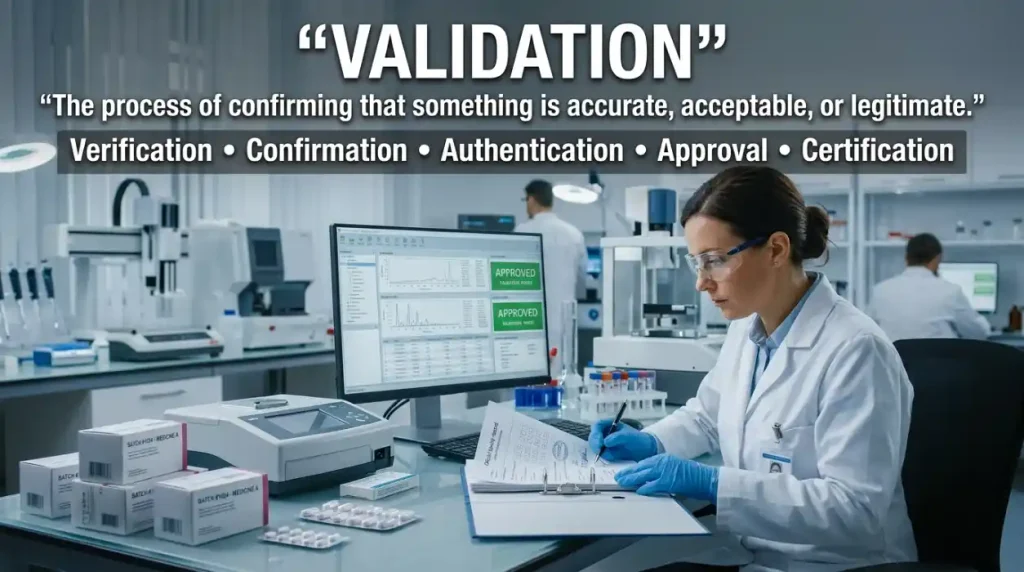
Validation is a noun. In simple English, it means the act of showing that something is correct, acceptable, approved, or worthy of recognition.
The exact meaning depends on context. Cambridge Dictionary identifies several major senses: official approval, proof that something is correct, and the feeling of being accepted or approved by others.
For example:
- Data validation means checking whether data is correct or acceptable.
- Emotional validation means acknowledging someone’s feelings or experience.
- Official validation can mean formal approval or acceptance.
- Validation of an argument can mean evidence or reasoning that supports it.
Native speakers usually understand the surrounding context before choosing the exact meaning.
Part of Speech
Validation is a noun.
Related forms include:
- validate — verb
- validated — adjective or past participle
- validating — present participle
- validity — noun describing the quality of being valid
Cambridge defines validate as making something officially acceptable or proving that something is correct.
Connotative Meaning
Connotation (the emotional or implied meaning a word carries beyond its basic dictionary definition) can change how “validation” feels.
Positive Tone
Validation can suggest encouragement, acceptance, confidence, or reassurance.
Her teacher’s feedback gave her validation.
Here, the word suggests emotional support and confidence.
Negative Tone
Validation can sometimes suggest excessive dependence on other people’s approval.
He constantly seeks validation from social media.
The word itself is not negative, but the surrounding context creates a negative implication.
Neutral Tone
In technical or academic writing, validation is often neutral.
The researchers completed validation of the model.
Here, it simply describes a checking process.
Etymology
The word validation comes from validate, which entered English in the 1640s. Etymological sources trace validate to Medieval Latin validatus, the past participle of validare, meaning “to make valid,” from Latin validus, meaning strong, effective, or powerful. Validation appeared in English in the 1650s.
Old English: 450–1100
The modern word validation did not exist in Old English. However, English already had vocabulary connected with ideas such as truth, strength, worth, proof, and acceptance.
Middle English: 1100–1500
During Middle English, English vocabulary absorbed many French and Latin terms. Ideas related to legal force, correctness, authority, and proof became increasingly important in formal language.
Modern English: 1500–Present
The direct English forms valid, validate, and validation developed later. The modern noun validation emerged in the seventeenth century and has since expanded into legal, academic, technical, professional, and psychological contexts.

Pronunciation
US: /ˌvæləˈdeɪʃən/
UK: /ˌvælɪˈdeɪʃən/
Syllables
val-i-da-tion
Affixation Pattern of “Validation”
Root: valid / val-
Prefix: none in the modern formation
Suffix: -ation
The ending -ation commonly forms nouns describing an action, process, or result.
Synonyms List
Not every synonym below works in every sentence. “Validation” covers several related ideas, including proof, approval, recognition, and confirmation. The most natural replacement depends on the intended meaning. Cambridge’s thesaurus groups related terms around areas such as endorsement, justification, evidence, verification, authentication, recognition, and acknowledgment.
1. Confirmation (Noun) — US / UK: /ˌkɑːnfərˈmeɪʃən/ /ˌkɒnfəˈmeɪʃən/
Meaning: Evidence or information showing that something is true or correct.
Tone/Register: Neutral, academic, professional.
Examples:
The email provided confirmation of my booking.
The test results confirmed that the method worked.
2. Approval (Noun) — US / UK: /əˈpruːvəl/ /əˈpruːvəl/
Meaning: Official or personal agreement that something is acceptable.
Tone/Register: Neutral, professional.
Examples:
We need the manager’s approval before publishing it.
Her parents gave their approval.
3. Verification (Noun) — US / UK: /ˌverɪfɪˈkeɪʃən/ /ˌverɪfɪˈkeɪʃən/
Meaning: The process of checking that something is true, accurate, or genuine.
Tone/Register: Formal, technical, academic.
Examples:
The account requires identity verification.
The researcher completed verification of the results.
4. Recognition (Noun) — US / UK: /ˌrekəɡˈnɪʃən/ /ˌrekəɡˈnɪʃən/
Meaning: Acceptance or acknowledgment of someone’s value, achievement, or existence.
Tone/Register: Neutral, positive.
Examples:
The award gave her recognition for years of work.
He appreciated the recognition from his team.
5. Endorsement (Noun) — US / UK: /ɪnˈdɔːrsmənt/ /ɪnˈdɔːsmənt/
Meaning: Public or explicit support for a person, idea, product, or position.
Tone/Register: Professional, public, formal.
Examples:
The expert’s endorsement strengthened the proposal.
Her endorsement helped the campaign gain attention.
6. Acknowledgment (Noun) — US / UK: /əkˈnɑːlɪdʒmənt/ /əkˈnɒlɪdʒmənt/
Meaning: An expression that recognizes something as true, important, or worthy of notice.
Tone/Register: Formal, neutral.
Examples:
His acknowledgment of the mistake restored trust.
The report includes an acknowledgment of earlier research.
7. Authentication (Noun) — US / UK: /ɔːˌθentɪˈkeɪʃən/ /ɔːˌθentɪˈkeɪʃən/
Meaning: Proof that something is genuine or belongs to the stated source.
Tone/Register: Technical, formal.
Examples:
The document needs authentication before use.
The museum requested authentication of the painting.
8. Justification (Noun) — US / UK: /ˌdʒʌstəfɪˈkeɪʃən/ /ˌdʒʌstɪfɪˈkeɪʃən/
Meaning: A reason or argument showing that an action or belief is reasonable.
Tone/Register: Academic, formal.
Examples:
She offered a clear justification for the decision.
The evidence provided justification for further research.
9. Evidence (Noun) — US / UK: /ˈevɪdəns/ /ˈevɪdəns/
Meaning: Facts or information used to show that something is true.
Tone/Register: Neutral, academic, professional.
Examples:
The study provides evidence for the theory.
We need more evidence before concluding.
10. Proof (Noun) — US / UK: /pruːf/ /pruːf/
Meaning: Strong evidence establishing that something is true or correct.
Tone/Register: Neutral, academic, everyday.
Examples:
Do you have proof that the file was sent?
The results offer proof of the connection.
11. Corroboration (Noun) — US / UK: /kəˌrɑːbəˈreɪʃən/ /kəˌrɒbəˈreɪʃən/
Meaning: Additional evidence that supports an existing statement or account.
Tone/Register: Formal, academic.
Examples:
The witness’s statement provided corroboration.
Researchers looked for independent corroboration.
12. Substantiation (Noun) — US / UK: /səbˌstænʃiˈeɪʃən/ /səbˌstænʃiˈeɪʃən/
Meaning: Evidence that supports a claim or argument.
Tone/Register: Formal, academic.
Examples:
The journalist requested substantiation for the claim.
The report lacked sufficient substantiation.
13. Attestation (Noun) — US / UK: /ˌæteˈsteɪʃən/ /ˌæteˈsteɪʃən/
Meaning: Formal evidence or testimony confirming that something is true.
Tone/Register: Legal, formal.
Examples:
The certificate requires official attestation.
Her signature served as attestation of the statement.
14. Certification (Noun) — US / UK: /ˌsɜːrtɪfɪˈkeɪʃən/ /ˌsɜːtɪfɪˈkeɪʃən/
Meaning: Official confirmation that someone or something meets a required standard.
Tone/Register: Professional, formal.
Examples:
The product received safety certification.
The course leads to professional certification.
15. Accreditation (Noun) — US / UK: /əˌkredɪˈteɪʃən/ /əˌkredɪˈteɪʃən/
Meaning: Official recognition that an institution or program meets established standards.
Tone/Register: Academic, professional.
Examples:
The university received accreditation.
Students checked the program’s accreditation status.
16. Ratification (Noun) — US / UK: /ˌrætəfɪˈkeɪʃən/ /ˌrætɪfɪˈkeɪʃən/
Meaning: Formal approval of an agreement or decision.
Tone/Register: Legal, diplomatic, formal.
Examples:
The treaty awaits ratification.
Parliament completed ratification of the agreement.
17. Acceptance (Noun) — US / UK: /əkˈseptəns/ /əkˈseptəns/
Meaning: Agreement to receive, recognize, or regard something as acceptable.
Tone/Register: Neutral.
Examples:
Her acceptance of the idea surprised us.
The application received formal acceptance.
18. Admission (Noun) — US / UK: /ədˈmɪʃən/ /ədˈmɪʃən/
Meaning: An acknowledgment that something is true, especially something previously denied or uncertain.
Tone/Register: Neutral, sometimes serious.
Examples:
His admission confirmed what we suspected.
The apology included an admission of error.
19. Support (Noun) — US / UK: /səˈpɔːrt/ /səˈpɔːrt/
Meaning: Evidence, agreement, or encouragement that strengthens a person or idea.
Tone/Register: Neutral, very common.
Examples:
The data offers strong support for the conclusion.
Her friends gave her emotional support.
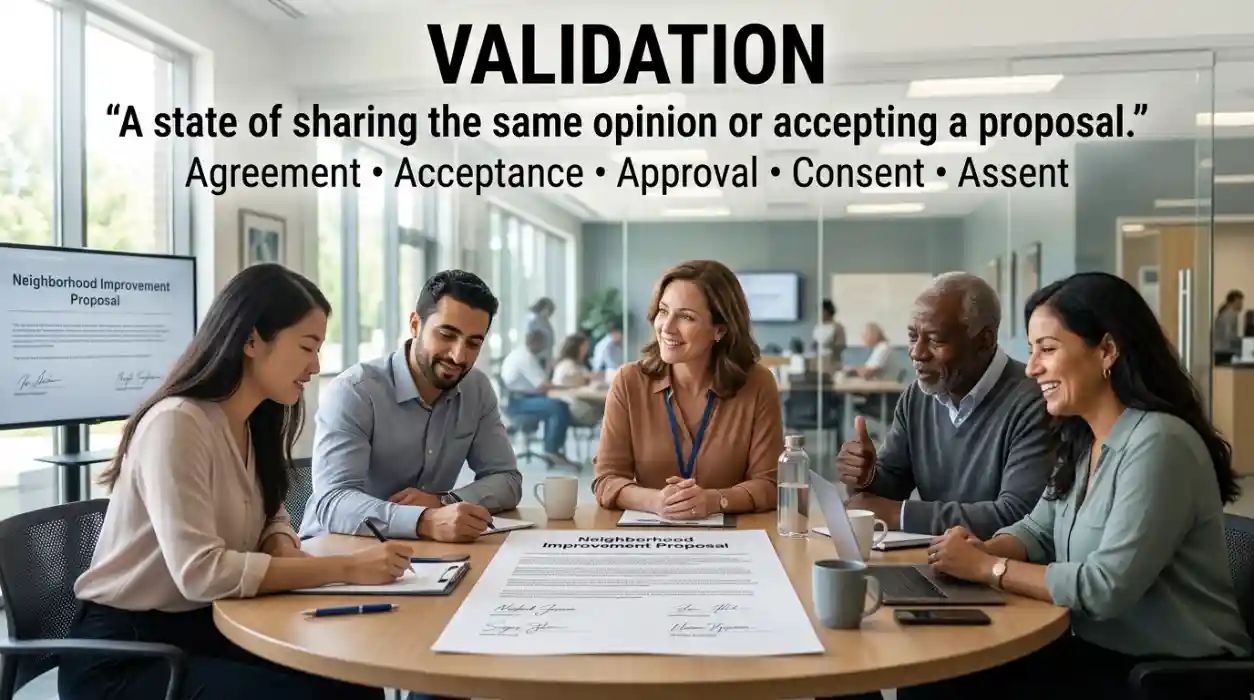
20. Agreement (Noun) — US / UK: /əˈɡriːmənt/ /əˈɡriːmənt/
Meaning: A state of sharing the same opinion or accepting a proposal.
Tone/Register: Neutral.
Examples:
The committee reached agreement.
His response showed agreement with the proposal.
21. Consent (Noun) — US / UK: /kənˈsent/ /kənˈsent/
Meaning: Permission or agreement given freely.
Tone/Register: Formal, legal, professional.
Examples:
The researcher obtained consent from participants.
You need parental consent for the activity.
22. Sanction (Noun) — US / UK: /ˈsæŋkʃən/ /ˈsæŋkʃən/
Meaning: Official permission or approval from an authority.
Tone/Register: Formal, legal.
Examples:
The project received official sanction.
The board gave its sanction to the plan.
23. Imprimatur (Noun) — US / UK: /ˌɪmprɪˈmɑːtər/ /ˌɪmprɪˈmɑːtə/
Meaning: Formal approval or authority to publish or proceed.
Tone/Register: Very formal, literary.
Examples:
The article carried the editor’s imprimatur.
The proposal received institutional imprimatur.
24. Seal of Approval (Noun Phrase) — US / UK: /ˌsiːl əv əˈpruːvəl/ /ˌsiːl əv əˈpruːvəl/
Meaning: A clear sign that an authority or person approves something.
Tone/Register: Neutral, idiomatic.
Examples:
The committee gave the plan its seal of approval.
Her teacher’s praise felt like a seal of approval.
25. Affirmation (Noun) — US / UK: /ˌæfərˈmeɪʃən/ /ˌæfəˈmeɪʃən/
Meaning: A statement or act that confirms something or expresses positive support.
Tone/Register: Neutral, positive.
Examples:
His response was an affirmation of her efforts.
She needed affirmation after the difficult presentation.
26. Reassurance (Noun) — US / UK: /ˌriːəˈʃʊrəns/ /ˌriːəˈʃʊərəns/
Meaning: Words or actions that reduce doubt, fear, or uncertainty.
Tone/Register: Friendly, emotional.
Examples:
Her message reassured me.
The doctor offered reassurance about the results.
27. Encouragement (Noun) — US / UK: /ɪnˈkɜːrɪdʒmənt/ /ɪnˈkʌrɪdʒmənt/
Meaning: Support that gives someone confidence or motivation.
Tone/Register: Positive, everyday.
Examples:
His teacher’s encouragement kept him going.
A little encouragement can make a big difference.
28. Commendation (Noun) — US / UK: /ˌkɑːmenˈdeɪʃən/ /ˌkɒmenˈdeɪʃən/
Meaning: Formal praise for good work or behavior.
Tone/Register: Formal, professional.
Examples:
She received a commendation for her service.
The report included a commendation for the team.
29. Praise (Noun) — US / UK: /preɪz/ /preɪz/
Meaning: Words expressing approval or admiration.
Tone/Register: Everyday, positive.
Examples:
The writer received praise from readers.
His manager praised his careful work.
30. Compliment (Noun) — US / UK: /ˈkɑːmpləmənt/ /ˈkɒmplɪmənt/
Meaning: A positive remark expressing admiration or approval.
Tone/Register: Informal, everyday.
Examples:
Her compliment gave him confidence.
I appreciated the compliment about my presentation.
31. Validation of Experience (Noun Phrase) — US / UK: /ˌvæləˈdeɪʃən əv ɪkˈspɪriəns/ /ˌvælɪˈdeɪʃən əv ɪkˈspɪəriəns/
Meaning: Recognition that someone’s personal experience is real, understandable, or meaningful.
Tone/Register: Emotional, social.
Examples:
Listening carefully can provide validation of someone’s experience.
Her response gave him a sense of validation.
32. Recognition of Worth (Noun Phrase) — US / UK: /ˌrekəɡˈnɪʃən əv wɜːrθ/ /ˌrekəɡˈnɪʃən əv wɜːθ/
Meaning: Acknowledgment that a person or contribution has value.
Tone/Register: Formal, positive.
Examples:
The award represented recognition of her worth.
He wanted recognition of the team’s contribution.
33. Confirmation of Accuracy (Noun Phrase) — US / UK: /ˌkɑːnfərˈmeɪʃən əv ˈækjərəsi/ /ˌkɒnfəˈmeɪʃən əv ˈækjərəsi/
Meaning: Evidence that information is accurate or correct.
Tone/Register: Technical, academic.
Examples:
The second test provided confirmation of accuracy.
We requested confirmation of the figures.
34. Verification of Authenticity (Noun Phrase) — US / UK: /ˌverɪfɪˈkeɪʃən əv ˌɔːθenˈtɪsəti/ /ˌverɪfɪˈkeɪʃən əv ˌɔːθenˈtɪsəti/
Meaning: A process used to establish that something is genuine.
Tone/Register: Technical, formal.
Examples:
The dealer requested verification of authenticity.
The archive completed verification of the document.
35. Corroboration (Noun) — US / UK: /kəˌrɑːbəˈreɪʃən/ /kəˌrɒbəˈreɪʃən/
Meaning: Independent information that strengthens an existing claim.
Tone/Register: Academic, formal.
Examples:
The second source provided corroboration.
Investigators searched for corroboration.
36. Documentation (Noun) — US / UK: /ˌdɑːkjəmenˈteɪʃən/ /ˌdɒkjumenˈteɪʃən/
Meaning: Records or written material that provide evidence or support.
Tone/Register: Professional, technical.
Examples:
The application requires documentation.
The researcher kept detailed documentation of the process.
37. Testimony (Noun) — US / UK: /ˈtestəmoʊni/ /ˈtestɪməni/
Meaning: A person’s formal statement or account used as evidence.
Tone/Register: Legal, formal.
Examples:
The witness gave testimony in court.
Her testimony supported the investigation.
38. Witness (Noun) — US / UK: /ˈwɪtnəs/ /ˈwɪtnəs/
Meaning: A person or thing that provides evidence of an event or fact.
Tone/Register: Neutral, legal.
Examples:
The document was a witness to the agreement.
Several people were witnesses to the event.
39. Rationale (Noun) — US / UK: /ˌræʃəˈnæl/ /ˌræʃəˈnɑːl/
Meaning: The reasoning that explains or supports a decision.
Tone/Register: Professional, academic.
Examples:
The report explains the rationale for the change.
She clearly stated her rationale.
40. Grounds (Noun) — US / UK: /ɡraʊndz/ /ɡraʊndz/
Meaning: Facts or reasons that provide a basis for an action or conclusion.
Tone/Register: Formal, legal.
Examples:
There are strong grounds for further research.
The decision was made on reasonable grounds.

41. Basis (Noun) — US / UK: /ˈbeɪsɪs/ /ˈbeɪsɪs/
Meaning: The underlying reason, evidence, or foundation for something.
Tone/Register: Neutral, academic.
Examples:
The claim has a scientific basis.
We need a stronger basis for the conclusion.
42. Defense (Noun) — US / UK: /dɪˈfens/ /dɪˈfens/
Meaning: An argument or evidence used to support or protect a position.
Tone/Register: Formal, academic.
Examples:
She prepared a strong defense of her argument.
The article offers a defense of the approach.
43. Advocacy (Noun) — US / UK: /ˈædvəkəsi/ /ˈædvəkəsi/
Meaning: Public or active support for an idea, cause, or position.
Tone/Register: Formal, social, professional.
Examples:
Her advocacy brought attention to the issue.
The organization is known for patient advocacy.
44. Justification for (Noun Phrase) — US / UK: /ˌdʒʌstəfɪˈkeɪʃən fɔːr/ /ˌdʒʌstɪfɪˈkeɪʃən fə/
Meaning: A reason showing why an action or decision is reasonable.
Tone/Register: Formal, academic.
Examples:
The committee asked for justification for the change.
He justified his decision.
45. Validation Through Evidence (Noun Phrase) — US / UK: /ˌvæləˈdeɪʃən θruː ˈevɪdəns/ /ˌvælɪˈdeɪʃən θruː ˈevɪdəns/
Meaning: Support for an idea that comes specifically from factual evidence.
Tone/Register: Academic, research-focused.
Examples:
The theory gained validation through evidence.
The study provides validation through evidence collected over time.
46. External Confirmation (Noun Phrase) — US / UK: /ɪkˈstɜːrnəl ˌkɑːnfərˈmeɪʃən/ /ɪkˈstɜːnəl ˌkɒnfəˈmeɪʃən/
Meaning: Confirmation supplied by an outside person, source, or authority.
Tone/Register: Academic, professional.
Examples:
The claim needs external confirmation.
The researcher sought external confirmation of the findings.
47. Peer Recognition (Noun Phrase) — US / UK: /pɪr ˌrekəɡˈnɪʃən/ /pɪə ˌrekəɡˈnɪʃən/
Meaning: Approval or acknowledgment from people in the same field or group.
Tone/Register: Academic, professional.
Examples:
The award brought peer recognition.
Peer recognition helped establish her reputation.
48. Social Acceptance (Noun Phrase) — US / UK: /ˈsoʊʃəl əkˈseptəns/ /ˈsəʊʃəl əkˈseptəns/
Meaning: Being accepted as a member of a social group or community.
Tone/Register: Social, neutral.
Examples:
Many teenagers care about social acceptance.
The new student gradually found social acceptance.
49. Emotional Acknowledgment (Noun Phrase) — US / UK: /ɪˈmoʊʃənəl əkˈnɑːlɪdʒmənt/ /ɪˈməʊʃənəl əkˈnɒlɪdʒmənt/
Meaning: Recognition that another person’s feelings or emotional experience matters.
Tone/Register: Supportive, interpersonal.
Examples:
Her response offered emotional acknowledgment.
Sometimes emotional acknowledgment is more helpful than advice.
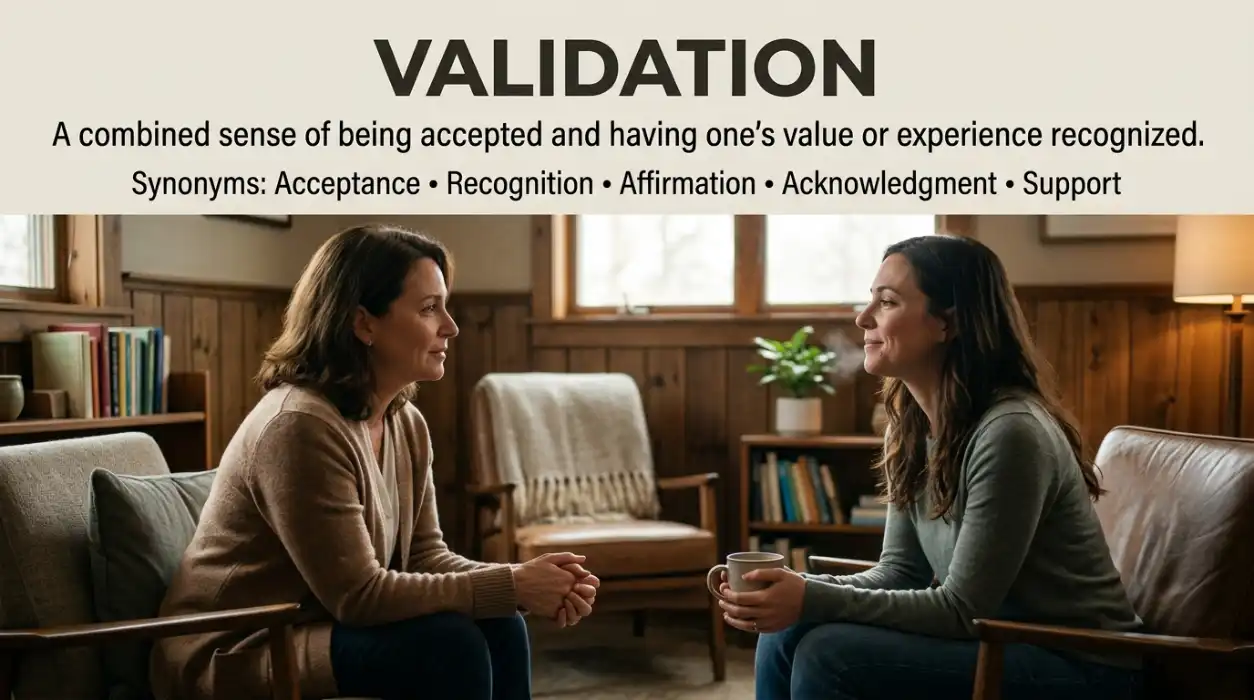
50. Acceptance and Recognition (Noun Phrase) — US / UK: /əkˈseptəns ənd ˌrekəɡˈnɪʃən/ /əkˈseptəns ənd ˌrekəɡˈnɪʃən/
Meaning: A combined sense of being accepted and having one’s value or experience noticed.
Tone/Register: Neutral, emotional.
Examples:
The conversation gave him a sense of acceptance and recognition.
People often look for acceptance and recognition in close relationships.
Synonyms by Tone
Tone matters because two words can have similar dictionary meanings but create different impressions.
Positive
Useful choices include recognition, encouragement, praise, affirmation, reassurance, commendation, endorsement, and acceptance.
These words often emphasize support, confidence, appreciation, or belonging.
Neutral
Good neutral choices include confirmation, verification, evidence, proof, acknowledgment, documentation, agreement, and support.
These work well when you want to communicate information without adding strong emotion.
Formal or Negative-Leaning Contexts
Justification, defense, rationale, grounds, attestation, ratification, and sanction work well in formal settings.
They can sound serious because they focus on reasons, authority, evidence, or official approval.
Playful or Informal
In everyday conversation, people often choose simple words such as praise, compliment, approval, support, or reassurance rather than the more abstract noun “validation.”
“Validation” vs. Close Alternatives
Confirmation vs. Validation
Validation can mean proving that something is correct or acceptable. Confirmation more directly emphasizes information that confirms an existing belief or fact.
Use validation for a checking or approval process. Use confirmation when you simply want to say that something has been confirmed.
Validation vs. Approval
Approval usually means agreement or permission. Validation has a broader range and can also mean proof or emotional acknowledgment.
The manager gave approval for the project.
The test results provided validation for the model.
Validation vs. Recognition
Recognition focuses on noticing or appreciating someone or something. Validation can include recognition but may also involve proof or official acceptance.
The award gave her recognition.
The research provided validation for the theory.
How “Validation” Changes by Context
Daily Conversation
In everyday speech, validation often relates to feelings and personal experiences.
“I understand why you’re upset” can provide emotional validation.
However, “approval” or “reassurance” may sound more natural in many casual conversations.
Writing and Blogging
Bloggers can use validation, confirmation, evidence, or recognition, depending on the point.
Instead of repeating “validation” several times, choose the word that communicates the exact idea.
For example, a blog about research may prefer evidence. A personal essay may prefer acknowledgment.
Professional or Academic English
Professional writing often favors precise terms such as verification, authentication, substantiation, certification, accreditation, or confirmation.
These terms make the process being described clearer.
Cambridge’s Business English definition connects validation with checking whether something is officially true and acceptable, especially for approval.
Creative or Informal English
Creative writing can use recognition, reassurance, praise, encouragement, or acceptance when the focus is emotional.
The best word depends on what the character wants: proof, support, attention, or belonging.
Common Mistakes Learners Make
Mistake 1: Treating Every Synonym as Interchangeable
“Approval” cannot replace “verification” in every sentence.
A manager can approve. A system can perform verification.
Mistake 2: Using “Validation” When You Mean “Validity”
Validation means the act or process of establishing acceptability or correctness.
Validity means the quality or state of being valid.
The researchers completed validation of the test.
The researchers questioned the validity of the test.
Cambridge defines validity as the quality of being based on truth or reason or being legally acceptable.
Mistake 3: Assuming Validation Is Always Emotional
Validation is widely used for feelings, but it is not limited to psychology.
It can describe data, research, identity, documents, systems, arguments, and official processes.
Mistake 4: Overusing the Word
Repeating “validation” can make writing sound mechanical.
Try confirmation, recognition, support, or evidence when those meanings are more precise.
Native Usage Note
Native speakers often choose a simpler word when the context is simple.
Instead of:
“I received validation from my friend.”
You might naturally say:
“My friend reassured me.”
The original sentence is correct, but the second can sound more conversational.
Register Notes
Validation is common in both speech and writing, but it can sound more abstract than everyday alternatives.
Formal writing often benefits from precise technical terms. Casual conversation usually favors shorter, familiar vocabulary.
For related vocabulary, an internal article about synonyms for approval would naturally complement this topic.
Real-Life Mini Scenarios
Workplace
A manager reviews an employee’s proposal.
Possible word: approval
The manager gave approval for the new schedule.
Social Situation
A friend listens without dismissing someone’s feelings.
Possible word: acknowledgment or reassurance
Her response gave me reassurance.
Media and Pop Culture
An actor receives an award after years of work.
Possible word: recognition
The award gave the actor international recognition.
Writing and Storytelling
A researcher discovers evidence supporting a controversial idea.
Possible word: corroboration or confirmation
The new study provided confirmation of the original finding.
Practice Exercise
1. The bank asked for a document to prove the customer’s identity.
A. Praise
B. Authentication
C. Encouragement
D. Recognition
2. The manager agreed that the employee could take Friday off.
A. Approval
B. Evidence
C. Corroboration
D. Testimony
3. A second study supported the findings of the first study.
A. Compliment
B. Corroboration
C. Consent
D. Acceptance
4. A friend listened carefully and acknowledged your feelings.
A. Emotional acknowledgment
B. Certification
C. Ratification
D. Documentation
5. A university receives official recognition for meeting educational standards.
A. Accreditation
B. Praise
C. Compliment
D. Reassurance
6. A scientist needs facts that support a theory.
A. Approval
B. Evidence
C. Consent
D. Encouragement
7. A government formally approves an international agreement.
A. Ratification
B. Compliment
C. Reassurance
D. Recognition
8. A teacher tells a nervous student, “You prepared well. You can do this.”
A. Encouragement
B. Authentication
C. Attestation
D. Verification
9. A lawyer gives reasons explaining why an action was reasonable.
A. Justification
B. Compliment
C. Acceptance
D. Recognition
10. An award acknowledges an artist’s achievements.
A. Recognition
B. Verification
C. Consent
D. Documentation
Reflection Task
Write one sentence using a synonym for validation that you could naturally use in an email, essay, workplace conversation, or daily discussion.
Answer key: 1-B, 2-A, 3-B, 4-A, 5-A, 6-B, 7-A, 8-A, 9-A, 10-A,
External reference sources
For dictionary definitions, pronunciation, and established synonym relationships, useful reference sources include:
- Cambridge Dictionary — validation
- Cambridge Dictionary — validation pronunciation
- Cambridge Thesaurus — validation synonyms
- Etymonline — validation etymology
This version is structured for featured-snippet extraction, semantic search, and practical vocabulary learning while keeping the distinctions between proof, approval, recognition, and emotional acknowledgment clear.
Final Takeaway
Finding the right synonym for validation is not simply about replacing one word. It is about choosing language that matches your exact meaning and tone.
Use confirmation for facts, verification for checking accuracy, and approval for permission. Choose recognition for appreciation and acknowledgment for noticing an experience.
For students and writers, this small distinction can make a big difference. Strong vocabulary creates clearer essays, blogs, emails, conversations, and professional messages.
Start practicing today by replacing repeated uses of “validation” with the most precise alternative. Try these words in an email, essay, or everyday conversation and notice how your meaning becomes sharper.
FAQs
1. What is the best synonym for validation in academic writing?
The best academic synonym depends on the intended meaning. Confirmation, verification, evidence, substantiation, corroboration, and support are common choices. If you mean that research demonstrates an idea is correct, “evidence” or “confirmation” may be appropriate. If you mean a formal checking process, “verification” or “validation” is usually more precise.
2. What is a synonym for validation in an emotional context?
In an emotional context, useful alternatives include acknowledgment, reassurance, affirmation, recognition, acceptance, and encouragement. The choice depends on what is being expressed. “Acknowledgment” emphasizes recognizing someone’s feelings, while “reassurance” emphasizes reducing doubt or anxiety.
3. What is another word for seeking validation?
Depending on the context, you can say seeking approval, seeking recognition, seeking reassurance, looking for acceptance, or wanting acknowledgment. “Seeking approval” often suggests wanting another person’s positive judgment, while “seeking reassurance” focuses more on reducing uncertainty.
4. What is a synonym for validation of information?
For information, strong alternatives include verification, confirmation, authentication, corroboration, and checking. “Verification” is especially useful when someone examines information to determine whether it is accurate. “Authentication” is more specific when the question is whether something is genuine or from a legitimate source.
5. Is confirmation the same as validation?
Not always. The two words overlap when both mean establishing that something is correct. However, validation can also refer to official acceptance or emotional acknowledgment. Confirmation usually focuses more narrowly on establishing that an existing belief, fact, or arrangement is correct.

Hasnain Ali is an SEO Content Strategist and the founder of wordvora.com, a trusted vocabulary platform that helps writers, students, professionals, and English learners find accurate synonyms, antonyms, word meanings, and real-life usage examples. He specializes in keyword research, on-page SEO, topical authority, and creating search-first content that aligns with Google’s latest Search Quality and E-E-A-T guidelines. His work focuses on producing clear, well-structured, and reader-friendly resources that satisfy search intent while maintaining high editorial standards.
Through extensive hands-on experience with SEO tools such as Google Search Console, Google Analytics, SEMrush, and Ahrefs, Hasnain researches user search behavior and develops content that is both informative and easy to understand. Every article published on wordvora.com is carefully reviewed for accuracy, readability, and contextual relevance before publication. His mission is to build one of the web’s most reliable English vocabulary resources by providing practical language guidance, trustworthy explanations, and content that helps readers improve their writing, communication, and vocabulary with confidence.