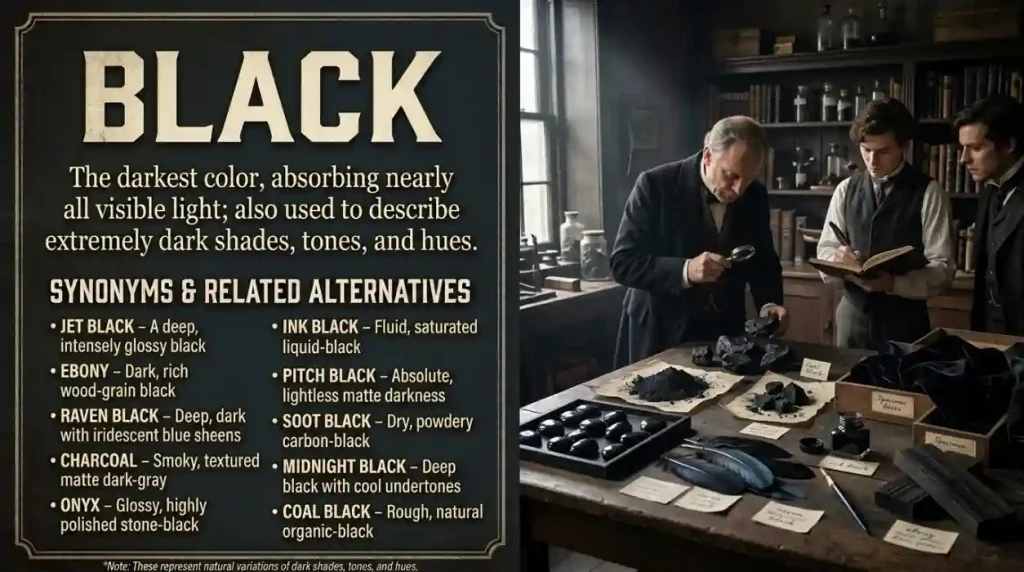
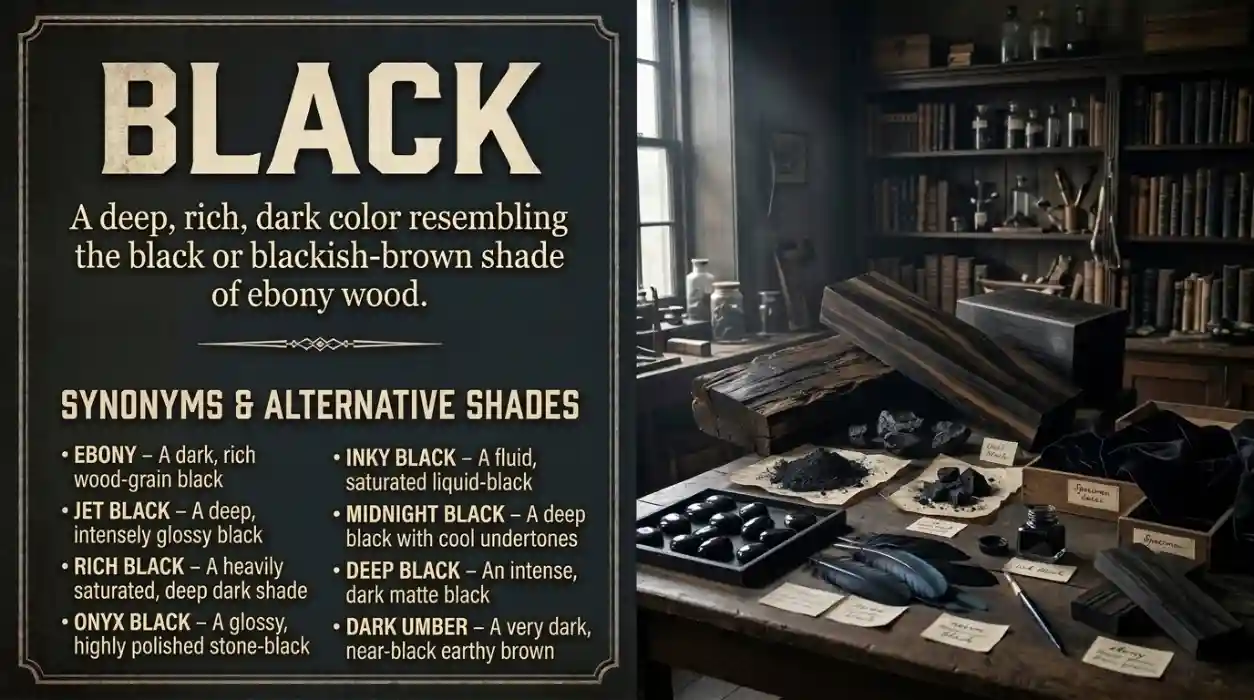
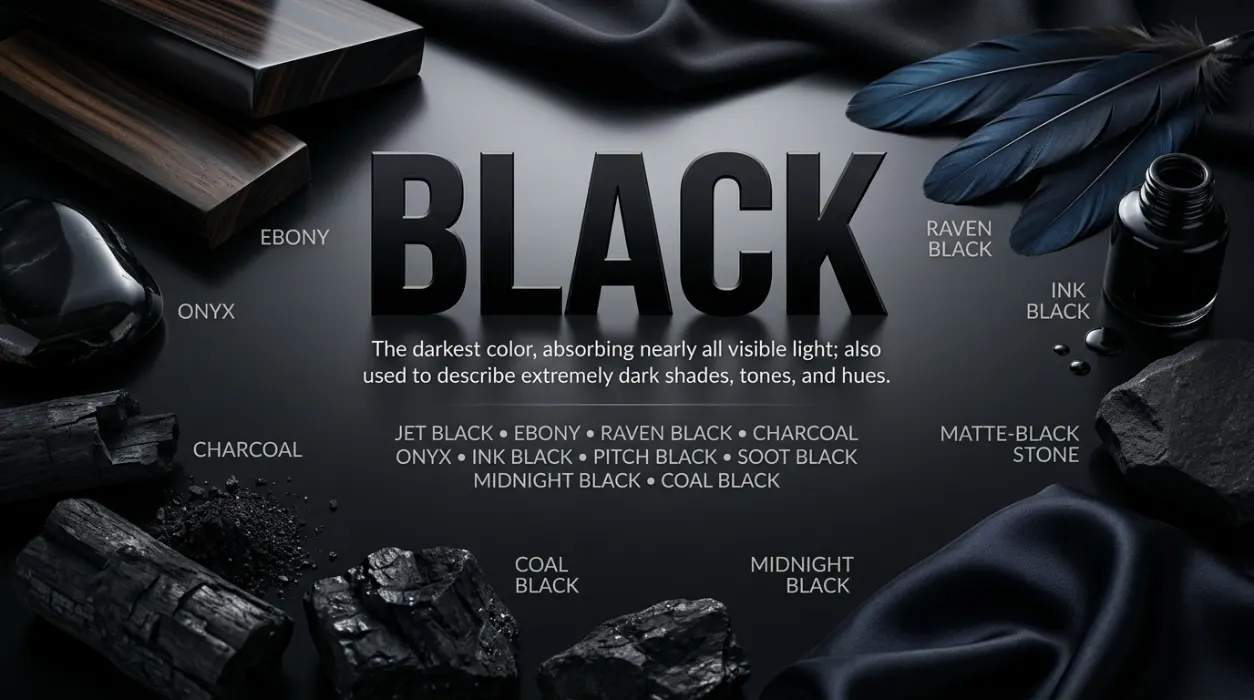
Synonyms for the color black include ebony, jet black, pitch-black, charcoal, onyx, ink-black, and raven black. Each describes a slightly different shade, texture, or impression. The best choice depends on whether you are describing clothing, hair, art, nature, design, or a fictional scene.
Imagine describing a black dress for a story. Calling it black gives readers the basic color, but calling it jet black suggests a deep, intense shade. Describing it as charcoal creates a softer, grayish impression.
Black is one of the most commonly used color words in English. It appears in everyday conversation, fashion, design, literature, photography, and nature descriptions.
Learning synonyms for the color black helps students, bloggers, content writers, and everyday English users express subtle differences. The right word can make a description clearer and more memorable.
Instead of repeating black in every sentence, you can choose a shade that matches the object and mood. This makes your writing more natural without adding unnecessary complexity.
What Does “Color Black” Really Mean?
Black is a color associated with very low visible-light reflection. In everyday language, it describes the darkest common color category, from black clothing and hair to dark surfaces, ink, and shadows.
The word can function as an adjective, as in “a black coat,” or as a noun, as in “Black is a powerful visual choice.” Its exact meaning depends on context.
Native English speakers understand black as a broad color term. However, related words can communicate more specific qualities. Jet black suggests intense darkness, charcoal often suggests dark gray, and ebony can evoke a rich, polished black.
Black also carries cultural and emotional associations. It can suggest elegance, mystery, seriousness, grief, strength, or danger. These associations are not fixed. They depend on the situation, culture, and individual interpretation.
Connotative Meaning of Black
(Connotation is the emotional or cultural association a word carries beyond its basic dictionary meaning.)
- Positive tone: Elegant, sophisticated, timeless, sleek, luxurious.
- Negative tone: Gloomy, sinister, threatening, bleak.
- Neutral tone: Dark, ink-black, charcoal, deep black.
For example, a sleek black car may sound stylish, while a sinister black figure creates a feeling of danger. The color is similar, but the surrounding words change the mood.
Etymology
The English word black comes from Old English blæc, meaning black or dark. Its earlier Germanic roots are associated with dark color and, in historical linguistic development, with ideas of burning or ink.
A short history of the word
- Old English (450–1100): Blæc was used for black or dark colors. The word appeared in descriptions of objects, clothing, and appearance.
- Middle English (1100–1500): Forms such as blak and black became established as spelling and pronunciation developed across English dialects.
- Modern English (1500–present): Black became the standard spelling and remained a common color term. It also developed many figurative uses, including expressions related to mood, secrecy, and social meaning.
Pronunciation, Syllables, and Word Structure
- US pronunciation: /blæk/
- UK pronunciation: /blæk/
- Syllables: black — one syllable
- Part of speech: Noun and adjective
Root: black, an Old English word.
Prefix: None.
Suffix: None in the basic word.
Many color alternatives use compounds rather than prefixes or suffixes. For example, jet-black combines jet, a naturally deep-black material, with black. Pitch-black uses pitch, a dark, sticky substance, to intensify the idea of darkness.
Synonyms List
1. Ebony (n/adj) — US: /ˈeb.ə.ni/ | UK: /ˈeb.ən.i/
- Meaning: A deep, dense dark shade resembling the hard wood of the ebony tree.
- Tone/Register: Elegant, Formal, Literary
- Example 1: The grand piano featured a polished ebony finish.
- Example 2: Her long ebony hair shimmered under the stage lights.
2. Jet (adj/n) — US: /dʒet/ | UK: /dʒet/
- Meaning: An intense, dark tone named after the polished mineral stone.
- Tone/Register: Descriptive, General
- Example 1: He drove a sleek jet sports car down the coastal highway.
- Example 2: The night sky turned jet as the storm rolled in.
3. Onyx (adj/n) — US: /ˈɑː.nɪks/ | UK: /ˈɒn.ɪks/
- Meaning: A smooth, solid dark hue resembling the natural gemstone.
- Tone/Register: Luxury, Formal, Business
- Example 1: The hotel lobby featured striking onyx marble countertops.
- Example 2: She wore an onyx ring that matched her evening gown.
4. Obsidian (adj/n) — US: /əbˈsɪd.i.ən/ | UK: /əbˈsɪd.i.ən/
- Meaning: A glassy, sharp, dark shade named after natural volcanic glass.
- Tone/Register: Descriptive, Literary, Scientific
- Example 1: The ancient knife had a blade made of sharp obsidian glass.
- Example 2: Dark obsidian rocks covered the shore near the volcano.
5. Pitch (adj/n) — US: /pɪtʃ/ | UK: /pɪtʃ/
- Meaning: An extremely dark tone resembling thick tar or resin.
- Tone/Register: Conversational, General
- Example 1: The basement was pitch dark when the power went out.
- Example 2: He stepped into the pitch alley without a flashlight.
6. Coal (adj/n) — US: /koʊl/ | UK: /kəʊl/
- Meaning: A dusty, deep,p dark shade like natural fossil fuel.
- Tone/Register: Everyday, Descriptive
- Example 1: The playful puppy had coal eyes and a soft tail.
- Example 2: Smoke rose from the coal fireplace during the winter night.
7. Sable (adj/n) — US: /ˈseɪ.bəl/ | UK: /ˈseɪ.bəl/
- Meaning: A rich, soft dark shade inspired by the fur of the sable animal.
- Tone/Register: Literary, Fashion, High-End
- Example 1: The knight wore a banner embroidered in rich sable thread.
- Example 2: She draped a soft sable coat over her shoulders.
8. Raven (adj/n) — US: /ˈreɪ.vən/ | UK: /ˈreɪ.vən/
- Meaning: A glossy, deep dark shade with subtle cool undertones like raven feathers.
- Tone/Register: Poetic, Descriptive
- Example 1: The prince had thick raven hair that fell over his brow.
- Example 2: A raven bird perched on the tall iron fence.
9. Charcoal (adj/n) — US: /ˈtʃɑːr.koʊl/ | UK: /ˈtʃɑː.kəʊl/
- Meaning: A dark grey-black shade resembling burnt wood residue.
- Tone/Register: Business, Casual, Design
- Example 1: He selected a tailored charcoal suit for the interview.
- Example 2: The artist drew a portrait using soft charcoal pencils.
10. Ink (adj/n) — US: /ɪŋk/ | UK: /ɪŋk/
- Meaning: A deep liquid dark shade like writing fluid.
- Tone/Register: Descriptive, Literary
- Example 1: An ink night settled over the quiet fishing harbour.
- Example 2: The dark squid left a cloud of ink in the water.
11. Midnight (adj/n) — US: /ˈmɪd.naɪt/ | UK: /ˈmɪd.naɪt/
- Meaning: A dark tone with subtle cool blue hints resembling the middle of the night.
- Tone/Register: General, Fashion
- Example 1: She chose midnight paint for her bedroom walls.
- Example 2: The dress was a stunning midnight shade under warm lamps.
12. Soot (adj/n) — US: /sʊt/ | UK: /sʊt/
- Meaning: A dull, powdery dark shade left by burned carbon.
- Tone/Register: Descriptive, Everyday
- Example 1: The old chimney sweeper was covered in dark soot.
- Example 2: Factory chimneys left soot marks on brick walls.
13. Carbon (adj/n) — US: /ˈkɑːr.bən/ | UK: /ˈkɑː.bən/
- Meaning: A sharp, dark modern shade inspired by pure chemical carbon.
- Tone/Register: Industrial, Tech, Modern
- Example 1: The race bike featured a lightweight carbon frame.
- Example 2: They installed carbon accents along the car dashboard.
14. Shadow (adj/n) — US: /ˈʃæd.oʊ/ | UK: /ˈʃæd.əʊ/
- Meaning: A dark, muted shade created by blocked light.
- Tone/Register: Poetic, General
- Example 1: A shadow tone covered the valley floor as the sun set.
- Example 2: The cat hid quietly in the shadow room.
15. Inky (adj) — US: /ˈɪŋ.ki/ | UK: /ˈɪŋ.ki/
- Meaning: Resembling liquid ink in darkness and depth.
- Tone/Register: Conversational, Descriptive
- Example 1: We looked out into the inky waters of the lake.
- Example 2: The sky grew inky as rain clouds merged.
16. Pitch-black (adj) — US: /ˌpɪtʃˈblæk/ | UK: /ˌpɪtʃˈblæk/
- Meaning: Completely dark with zero light visible.
- Tone/Register: Everyday, Informative
- Example 1: The cave interior was pitch-black and silent.
- Example 2: I could not see my hand in the pitch-black room.
17. Jet-black (adj) — US: /ˌdʒetˈblæk/ | UK: /ˌdʒetˈblæk/
- Meaning: Having a deep, glossy, intense dark color.
- Tone/Register: General, Fashion
- Example 1: He wore a jet-black leather jacket to the concert.
- Example 2: Her jet-black boots looked sharp on the street.
18. Coal-black (adj) — US: /ˌkoʊlˈblæk/ | UK: /ˌkəʊlˈblæk/
- Meaning: Extremely dark like natural mineral coal.
- Tone/Register: Descriptive, Literary
- Example 1: A coal-black stallion galloped across the open field.
- Example 2: The burnt logs turned coal-black in the pit.
19. Pitchy (adj) — US: /ˈpɪtʃ.i/ | UK: /ˈpɪtʃ.i/
- Meaning: Dark, sticky, or deep like natural tar pitch.
- Tone/Register: Literary, Formal
- Example 1: A pitchy darkness filled the thick oak forest.
- Example 2: The sailors worked through a pitchy night at sea.
20. Swarthy (adj) — US: /ˈswɔːr.ði/ | UK: /ˈswɔː.ði/
- Meaning: Having a dark or deep complexion or color tone.
- Tone/Register: Literary, Old-fashioned
- Example 1: The swarthy captain guided the ship into harbor.
- Example 2: His swarthy skin showed years of outdoor work.
21. Cimmerian (adj) — US: /sɪˈmɪr.i.ən/ | UK: /sɪˈmɪə.ri.ən/
- Meaning: Extremely dark, gloomy, or shrouded in perpetual darkness.
- Tone/Register: Academic, High Literary
- Example 1: The author described a Cimmerian landscape devoid of sunlight.
- Example 2: We entered a Cimmerian cavern deep underground.
22. Stygian (adj) — US: /ˈstɪdʒ.i.ən/ | UK: /ˈstɪdʒ.i.ən/
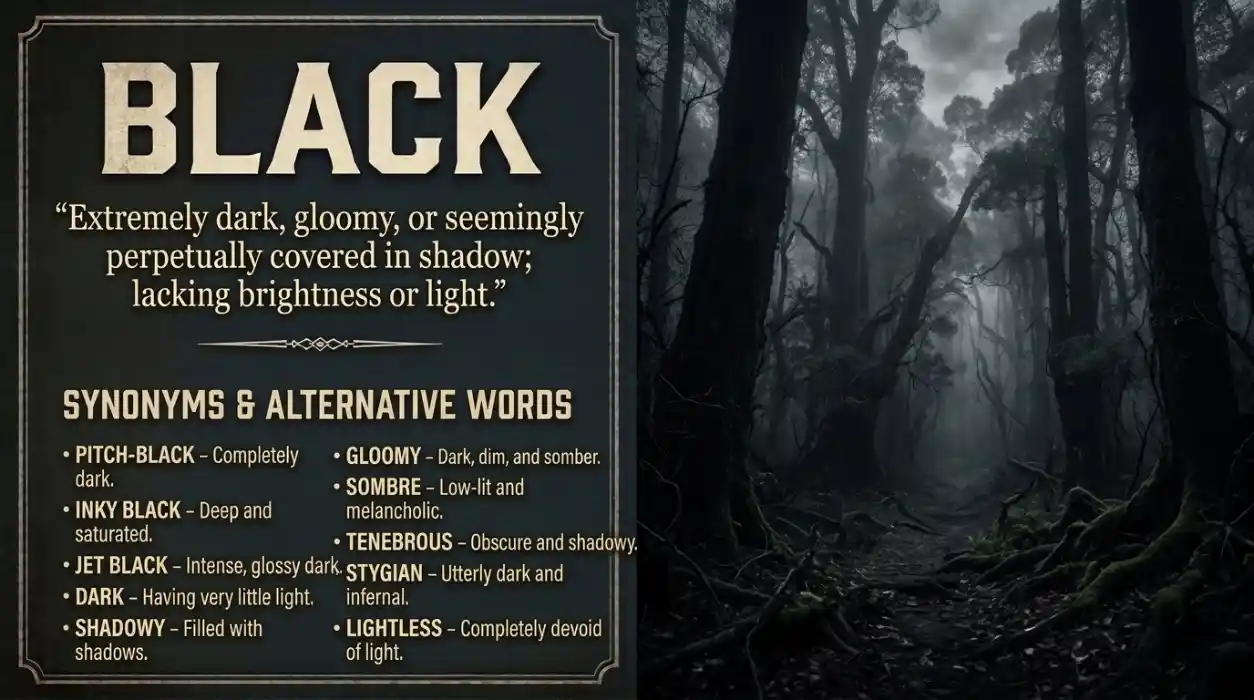
- Meaning: Dark, gloomy, and forbidding like the mythical River Styx.
- Tone/Register: Academic, Dramatic
- Example 1: Stygian darkness enveloped the ancient underground tomb.
- Example 2: The movie scene used Stygian shadows for suspense.
23. Ebon (adj/n) — US: /ˈeb.ən/ | UK: /ˈeb.ən/
- Meaning: A poetic shortened form describing deep ebony darkness.
- Tone/Register: Poetic, Classical
- Example 1: The knight rode under the ebon skies of midnight.
- Example 2: Her ebon locks blew gently in the night breeze.
24. Atramentous (adj) — US: /ˌæt.rəˈmen.təs/ | UK: /ˌæt.rəˈmen.təs/
- Meaning: Dark as writing ink or ink-like fluid.
- Tone/Register: Rare, Academic
- Example 1: The creature released an atramentous fluid into the deep sea.
- Example 2: An atramentous cloud covered the mountain peak.
25. Funereal (adj) — US: /fjuːˈnɪr.i.əl/ | UK: /fjuːˈnɪə.ri.əl/
- Meaning: Dark and somber, suitable for solemn ceremonies or mourning.
- Tone/Register: Serious, Formal
- Example 1: The hall was decorated in funereal colors for the ceremony.
- Example 2: He spoke in a funereal tone during the memorial service.
26. Sombre / Somber (adj) — US: /ˈsɑːm.bɚ/ | UK: /ˈsɒm.bə/
- Meaning: Dark, dull, shadow-like, and serious in mood or color.
- Tone/Register: General, Formal
- Example 1: She wore a somber wool coat to the official gathering.
- Example 2: The room was painted in somber dark grey shades.
27. Tenebrous (adj) — US: /ˈten.ə.brəs/ | UK: /ˈten.ə.brəs/
- Meaning: Dark, shadowy, and full of mysterious obscurity.
- Tone/Register: Literary, Gothic
- Example 1: Strange noises echoed down the tenebrous corridor.
- Example 2: The castle sat high on a tenebrous rocky cliff.
28. Caliginous (adj) — US: /kəˈlɪdʒ.ə.nəs/ | UK: /kəˈlɪdʒ.ɪ.nəs/
- Meaning: Mistily dark, dim, obscure, or shrouded in fog.
- Tone/Register: Academic, Literary
- Example 1: Fog rolled over the caliginous streets at midnight.
- Example 2: Travelers struggled through the caliginous mountain pass.
29. Fuliginous (adj) — US: /fjuːˈlɪdʒ.ə.nəs/ | UK: /fjuːˈlɪdʒ.ɪ.nəs/
- Meaning: Sooty, dark, smoke-colored, or murky.
- Tone/Register: Rare, Academic
- Example 1: Fuliginous smoke billowed from the industrial smokestacks.
- Example 2: The old fireplace left a fuliginous layer on bricks.
30. Murky (adj) — US: /ˈmɝː.ki/ | UK: /ˈmɜː.ki/
- Meaning: Dark, gloomy, and thick with fog or sediment.
- Tone/Register: Conversational, General
- Example 1: The divers swam into murky lake waters.
- Example 2: He stared into the murky woods behind the cottage.
31. Gloomy (adj) — US: /ˈɡluː.mi/ | UK: /ˈɡluː.mi/
- Meaning: Dark, poorly lit, and causing feelings of sadness.
- Tone/Register: General, Casual
- Example 1: Rain clouds made it a gloomy winter afternoon.
- Example 2: The unlit hallway looked gloomy and quiet.
32. Sunless (adj) — US: /ˈsʌn.ləs/ | UK: /ˈsʌn.ləs/
- Meaning: Lacking sunlight, shaded, or dark.
- Tone/Register: Descriptive, General
- Example 1: Moss grew thick in the sunless valley floor.
- Example 2: They lived in a sunless basement apartment during college.
33. Rayless (adj) — US: /ˈreɪ.ləs/ | UK: /ˈreɪ.ləs/
- Meaning: Devoid of light rays, completely dark.
- Tone/Register: Poetic, Literary
- Example 1: The sub sank into the rayless ocean depths.
- Example 2: A rayless night blanketed the prairie fields.
34. Lightless (adj) — US: /ˈlaɪt.ləs/ | UK: /ˈlaɪt.ləs/
- Meaning: Completely without light or illumination.
- Tone/Register: Descriptive, Simple
- Example 1: The miners moved carefully through lightless tunnels.
- Example 2: We stared into a lightless room before finding a switch.
35. Unlit (adj) — US: /ʌnˈlɪt/ | UK: /ʌnˈlɪt/
- Meaning: Not lit by lamps, candles, or natural light.
- Tone/Register: General, Everyday
- Example 1: She walked down the unlit street with caution.
- Example 2: The stage remained unlit until the music began.
36. Shadowy (adj) — US: /ˈʃæd.oʊ.i/ | UK: /ˈʃæd.əʊ.i/
- Meaning: Full of shadows or dark shapes.
- Tone/Register: Everyday, Descriptive
- Example 1: A shadowy figure moved near the garden fence.
- Example 2: The dimly lit room had a shadowy atmosphere.
37. Dusky (adj) — US: /ˈdʌs.ki/ | UK: /ˈdʌs.ki/
- Meaning: Somewhat dark or dim, like evening twilight.
- Tone/Register: Literary, General
- Example 1: The dusky sky turned pink and blue near sunset.
- Example 2: Owls flew out into the dusky forest air.
38. Off-black (adj) — US: /ˌɑːfˈblæk/ | UK: /ˌɒfˈblæk/
- Meaning: A shade slightly lighter than pure black.
- Tone/Register: Design, Fashion, Business
- Example 1: She chose off-black denim for a casual look.
- Example 2: The interior walls were painted a soft off-black.
39. Graphite (adj/n) — US: /ˈɡræf.aɪt/ | UK: /ˈɡræf.aɪt/
- Meaning: A metallic dark grey-black inspired by the pencil mineral.
- Tone/Register: Modern, Tech, Design
- Example 1: The smartphone comes in a sleek graphite casing.
- Example 2: He wore a modern graphite watch on his wrist.
40. Slate-black (adj) — US: /ˌsleɪtˈblæk/ | UK: /ˌsleɪtˈblæk/
- Meaning: A dark tone with subtle cool stone undertones.
- Tone/Register: Design, Formal
- Example 1: The roof tiles were crafted from slate-black stone.
- Example 2: He wore a slate-black coat to the meeting.
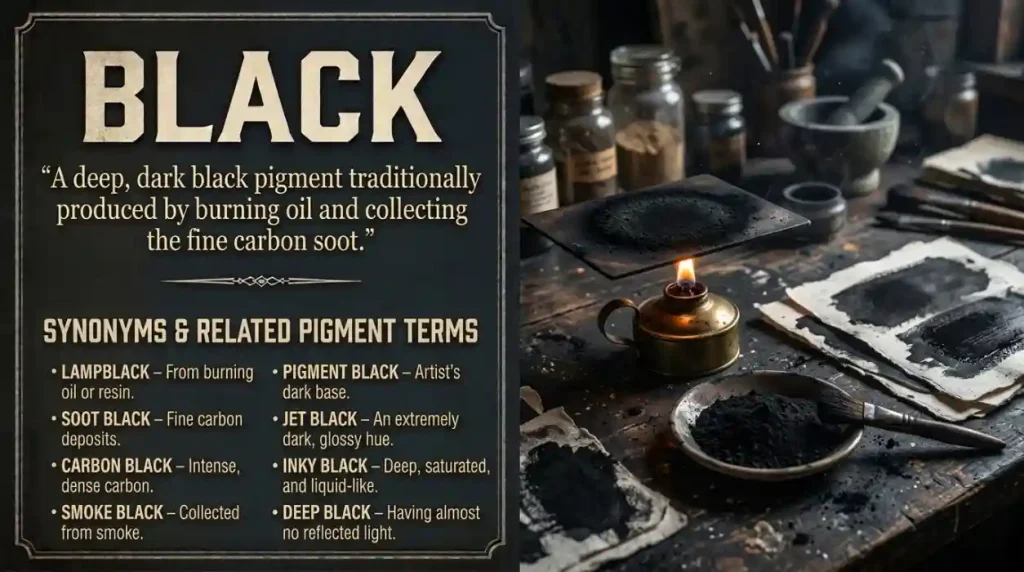
41. Lampblack (adj/n) — US: /ˈlæmp.blæk/ | UK: /ˈlæmp.blæk/
- Meaning: A fine, deep dark pigment formed from burning oil.
- Tone/Register: Artistic, Historical
- Example 1: Traditional calligraphers used pure lampblack ink.
- Example 2: The antique frame was painted in lampblack varnish.
42. Iron (adj/n) — US: /ˈaɪ.ɚn/ | UK: /ˈaɪ.ən/
- Meaning: A dark, heavy, metallic shade like unpolished metal.
- Tone/Register: Industrial, Descriptive
- Example 1: Heavy iron gates guarded the estate entrance.
- Example 2: The dark sky looked like cold iron before the storm.
43. Onyx-like (adj) — US: /ˈɑː.nɪks.laɪk/ | UK: /ˈɒn.ɪks.laɪk/
- Meaning: Smooth, dark, and shiny like an onyx stone.
- Tone/Register: Descriptive, General
- Example 1: The beetle had an onyx-like shell that reflected light.
- Example 2: Her dress had an onyx-like shine under stage lights.
44. Night-black (adj) — US: /ˌnaɪtˈblæk/ | UK: /ˌnaɪtˈblæk/
- Meaning: Dark like the night sky without a moon.
- Tone/Register: Poetic, Descriptive
- Example 1: A night-black cat crossed the stone path quietly.
- Example 2: The sea looked night-black under heavy storm clouds.
45. Midnight-black (adj) — US: /ˌmɪd.naɪtˈblæk/ | UK: /ˌmɪd.naɪtˈblæk/
- Meaning: Extremely dark with cool midnight undertones.
- Tone/Register: General, Fashion
- Example 1: He purchased a midnight-black leather jacket.
- Example 2: The car came painted in glossy midnight-black.
46. Raven-black (adj) — US: /ˌreɪ.vənˈblæk/ | UK: /ˌreɪ.vənˈblæk/
- Meaning: Deep, dark with a shiny feather-like gloss.
- Tone/Register: Descriptive, Poetic
- Example 1: She styled her raven-black hair before the show.
- Example 2: The horse had a smooth, raven-black coat.
47. Ink-black (adj) — US: /ˌɪŋkˈblæk/ | UK: /ˌɪŋkˈblæk/
- Meaning: Dark, rich, and solid like liquid writing ink.
- Tone/Register: Descriptive, General
- Example 1: He stared into the ink-black waters below the pier.
- Example 2: The cloud spread across the sky in an ink-black wave.
48. Velvet-black (adj) — US: /ˌvel.vɪtˈblæk/ | UK: /ˌvel.vɪtˈblæk/
- Meaning: Soft, deep, matte dark like plush velvet fabric.
- Tone/Register: Luxury, Fashion
- Example 1: She opened a velvet-black jewelry box.
- Example 2: The background was a smooth velvet-black curtain.
49. Vantablack (adj/n) — US: /ˈvæn.tə.blæk/ | UK: /ˈvæn.tə.blæk/
- Meaning: An ultra-dark synthetic shade absorbing almost all light.
- Tone/Register: Tech, Modern, Scientific
- Example 1: Scientists developed Vantablack coating for specialized telescopes.
- Example 2: The art exhibit showcased a Vantablack sculpture.
50. Darkling (adj) — US: /ˈdɑːrk.lɪŋ/ | UK: /ˈdɑːk.lɪŋ/
- Meaning: Growing dark or occurring in darkness.
- Tone/Register: Literary, Archaic
- Example 1: A darkling shadow fell across the garden path.
- Example 2: Nightingales sang in the darkling forest woods.
Synonyms by Tone
A shade name can suggest more than darkness. It can also communicate style, texture, atmosphere, or emotion. Choose a term that matches both the color and the feeling you want to create.
Elegant and luxurious
- Ebony: Rich and refined; useful for polished wood, fashion, and formal descriptions.
- Onyx: Sophisticated and glossy; often associated with stone and jewelry.
- Velvet black: Soft, deep, and luxurious.
- Satin black: Smooth with a gentle sheen.
- Jet black: Intense and polished.
Neutral and practical
- True black: Useful when a pure black is required.
- Deep black: Emphasizes richness and darkness.
- Matte black: Describes a non-shiny finish.
- Charcoal: Suitable for dark gray rather than pure black.
- Near-black: Useful when a color is almost black but has an undertone.
Dramatic and mysterious
- Pitch-black: Emphasizes a lack of light.
- Midnight black: Evokes a dark nighttime scene.
- Ink-black: Suggests dense, flowing darkness.
- Raven black: Creates a vivid, literary image.
- Murky black: Suggests something unclear, gloomy, or unsettling.
Modern and technical
- Carbon black: Refers to a pigment used in many materials.
- Graphite black: Suggests a cool, often slightly metallic shade.
- Metallic black: Emphasizes reflective shimmer.
- Rich black: Has a specific meaning in printing.
- Satin black: Describes a finish between matte and glossy.
Playful or informal
- Licorice black: A memorable comparison inspired by candy.
- Coal black: An accessible, familiar description.
- Crow black: A nature-inspired shade name.
- Washed black: Common in casual fashion.
- Almost black: Simple and conversational.
Tone matters because pitch-black may emphasize darkness, while ebony often sounds elegant. A technical description such as carbon black is appropriate in a materials discussion but may feel unnatural in a personal story.
“Black” vs. Close Color Alternatives
| Term | What it means | Best use |
|---|---|---|
| Black | The broad, basic color category | General descriptions |
| Jet black | An intense, very deep black | Hair, clothing, and glossy objects |
| Charcoal | A dark gray that may look nearly black | Suits, furniture, and interiors |
| Ebony | A rich black associated with dark wood | Literary descriptions and polished finishes |
| Pitch-black | Almost complete darkness | Rooms, nights, caves, and dramatic scenes |
| Onyx | A black shade inspired by dark stone | Jewelry, decor, and elegant descriptions |
Which should you choose?
Use black when the exact shade does not matter. Choose jet black when you want to emphasize depth. Use charcoal if the color has a visible gray cast. Choose pitch-black to describe darkness rather than the color of an object.
Ebony and onyx are more evocative choices. They work well when you want a polished or luxurious impression, but they should not replace a plain color label when technical accuracy is essential.
How to Use Black Color Synonyms in Different Contexts
Daily conversation
Everyday English favors familiar expressions such as dark black, jet black, almost black, and faded black. These terms are easy to understand and do not sound overly formal.
For example, “I bought a jet-black backpack” sounds natural when the color is especially intense. “The old shirt has faded to a softer black” explains the color change clearly.
Writing and blogging
Writers can use specific shade names to make descriptions more vivid. A fashion blogger might describe a satin black dress, while an interior design writer might recommend matte black fixtures.
Avoid inserting an elaborate color word into every sentence. Repeating ebony, onyx, and raven black can make simple writing sound forced if the context does not support those choices.
Professional and academic writing
In graphic design, printing, chemistry, and manufacturing, some terms have technical meanings. Carbon black refers to a pigment material, while rich black often describes a printing result created with a combination of inks.
In professional documents, use a recognized color specification when exact reproduction matters. Creative shade names are useful for communication, but they do not guarantee a consistent visual result across devices or materials.
Creative and informal writing
Fiction writers often use comparisons to create mood. Pitch-black builds suspense, raven black creates a vivid image, and velvet black can suggest luxurious darkness.
The best descriptions give readers one clear impression at a time. Rather than stacking several adjectives, choose the one that most closely matches the scene.
Common Mistakes and Native Usage
Confusing black with near-black
Charcoal, midnight blue, and graphite can appear almost black, but they are not always pure black. Use them when a gray, blue, or metallic undertone is part of the description.
Using “pitch-black” for a colored object
Pitch-black usually emphasizes complete darkness. It works naturally in “a pitch-black room,” but it may be less precise for a painted item that simply has a very dark finish.
Treating “ebony” as a universal replacement
Ebony is a useful color descriptor, but it also names a type of dark wood. In some contexts, it can carry cultural associations. Use it thoughtfully and make sure the intended meaning is clear.
Confusing finish with color
Matte, glossy, and satin describe how a surface reflects light. They do not necessarily identify a different black hue. A black surface can be matte, glossy, or satin depending on its finish.
Overusing poetic terms
Words such as obsidian, raven, and velvet black can improve a creative description, but too many can distract readers. Use plain black when it communicates the idea clearly.
Register notes
- Formal or technical: Carbon black, rich black, near-black, graphite black.
- Everyday: Jet black, dark, faded black, almost black.
- Creative: Raven black, midnight black, velvet black, ink-black.
- Design-focused: Matte black, satin black, metallic black, glossy black.
For more vocabulary practice, compare these shades with alternatives for white or gray. This can help you describe color contrast more precisely.
Real-Life Examples
Workplace
A graphic designer prepares a report and chooses a near-black background instead of pure black. The subtle difference makes the layout feel softer while keeping the text readable.
Social situations
Someone compliments a friend’s jet-black hair. This sounds more specific than simply saying the hair is black, especially when it looks very dark and glossy.
Media and pop culture
A film poster uses pitch-black shadows to create suspense. The description refers to the darkness and atmosphere rather than a specific paint shade.
Writing and storytelling
A novelist describes a raven-black horse standing under a pale moon. The phrase creates a clear visual image and gives the sentence a more literary tone.
External reference:
Merriam-Webster Dictionary: Black — check the standard definition, pronunciation, and usage of the base word. For exact color specifications, consult a relevant professional color standard or material reference.
Practice Exercise
Which word best describes a high-end luxury piano with a polished dark finish?
a) Ebony
b) Murky
c) Soot
A modern, dark grey-black suit worn for a business interview is best called:
a) Charcoal
b) Stygian
c) Pitch-black
If you step into a basement with zero light and cannot see anything, it is:
a) Off-black
b) Pitch-black
c) Dusky
A sci-fi material that absorbs almost all visible light is called:
a) Vantablack
b) Swarthy
c) Sunless
A term used in poetry to describe hair with a glossy dark feather shine is:
a) Raven
b) Fuliginous
c) Caliginous
Water filled with thick sediment that is difficult to see through is:
a) Murky
b) Sable
c) Onyx
A dark stone used in jewelry design that offers a smooth, solid black surface is:
a) Onyx
b) Soot
c) Rayless
A dark, sad, or serious atmosphere at a formal memorial is best described as:
a) Somber
b) Off-black
c) Inky
A modern smartphone built with dark grey metal casing is described as:
a) Graphite
b) Cimmerian
c) Darkling
Soft, matte fabric with a rich dark tone is often called:
a) Velvet-black
b) Caliginous
c) Fuliginous
Practical Writing Task
Write one short sentence describing a night landscape using a synonym from the list above.
Answer Key:
1-a, 2-a, 3-b, 4-a, 5-a, 6-a, 7-a, 8-a, 9-a, 10-a
Conclusion
Synonyms for the color black help you describe more than darkness. They can communicate a shade’s depth, undertone, finish, and emotional effect.
For students, bloggers, and content writers, precise color words make descriptions more vivid and reduce unnecessary repetition. They also help readers picture objects more clearly.
In everyday speech, a familiar word is often best. In creative writing, a phrase such as raven black or velvet black can add atmosphere when it suits the scene.
Practice using these shades in emails, essays, stories, and daily conversations. Try replacing one repeated use of black with a more exact term whenever it genuinely improves your meaning.
FAQs
1. What is the most professional synonym for the color black?
The most professional term depends on the subject. In design, matte black, satin black, and near-black can communicate specific visual qualities. In printing, rich black and carbon black have more technical meanings. For a general business document, plain black is often clearest unless the precise shade or finish matters.
2. What is a fancy word for black in creative writing?
Ebony, onyx, obsidian, and raven black can add elegance or vivid imagery. Each creates a slightly different impression: ebony suggests rich darkness, onyx evokes polished stone, and obsidian suggests glossy volcanic glass. Choose one that fits the object and tone rather than adding elaborate words simply to sound sophisticated.
3. What is the difference between jet black and pitch-black?
Jet black usually describes an object’s very deep black color, such as hair, fabric, or paint. Pitch-black most often describes a place or situation with almost no light, such as a dark room or unlit road. The terms overlap in the idea of intense darkness, but their typical uses differ.
4. What are good synonyms for black in fashion writing?
Fashion writing often uses jet black, matte black, satin black, washed black, charcoal, and midnight black. The best choice depends on the fabric and finish. Washed black suggests a softened, worn look, while satin black describes a gentle sheen. Use charcoal when the garment is dark gray rather than true black.
5. Is charcoal a synonym for black or gray?
Charcoal is primarily a very dark gray, although it can look nearly black in some lighting. It is a useful alternative when a color needs to feel softer than pure black. In clothing, interiors, and graphic design, charcoal can create strong contrast without the sharp appearance of a fully black surface.

Hasnain Ali is an SEO Content Strategist and the founder of wordvora.com, a trusted vocabulary platform that helps writers, students, professionals, and English learners find accurate synonyms, antonyms, word meanings, and real-life usage examples. He specializes in keyword research, on-page SEO, topical authority, and creating search-first content that aligns with Google’s latest Search Quality and E-E-A-T guidelines. His work focuses on producing clear, well-structured, and reader-friendly resources that satisfy search intent while maintaining high editorial standards.
Through extensive hands-on experience with SEO tools such as Google Search Console, Google Analytics, SEMrush, and Ahrefs, Hasnain researches user search behavior and develops content that is both informative and easy to understand. Every article published on wordvora.com is carefully reviewed for accuracy, readability, and contextual relevance before publication. His mission is to build one of the web’s most reliable English vocabulary resources by providing practical language guidance, trustworthy explanations, and content that helps readers improve their writing, communication, and vocabulary with confidence.