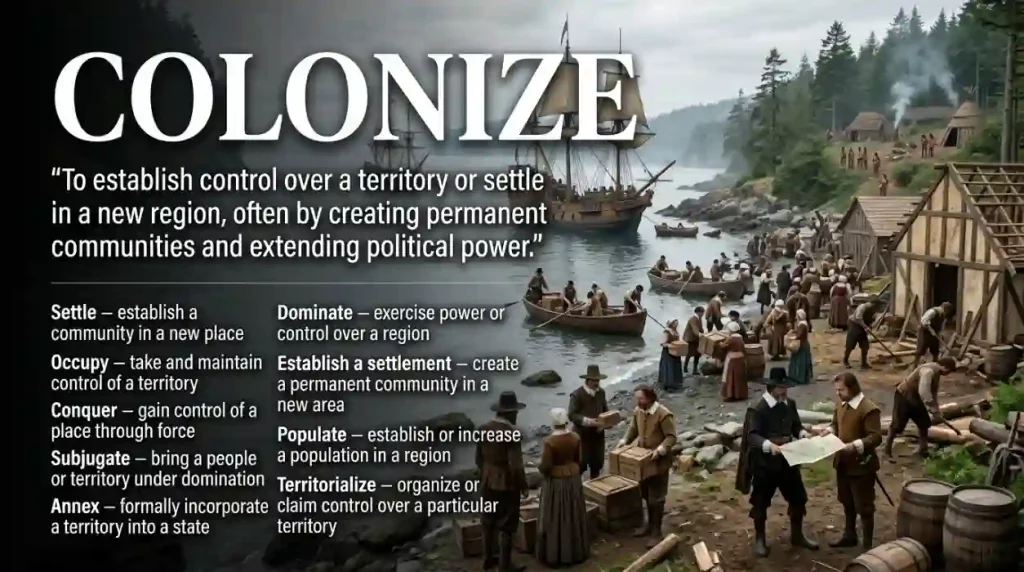
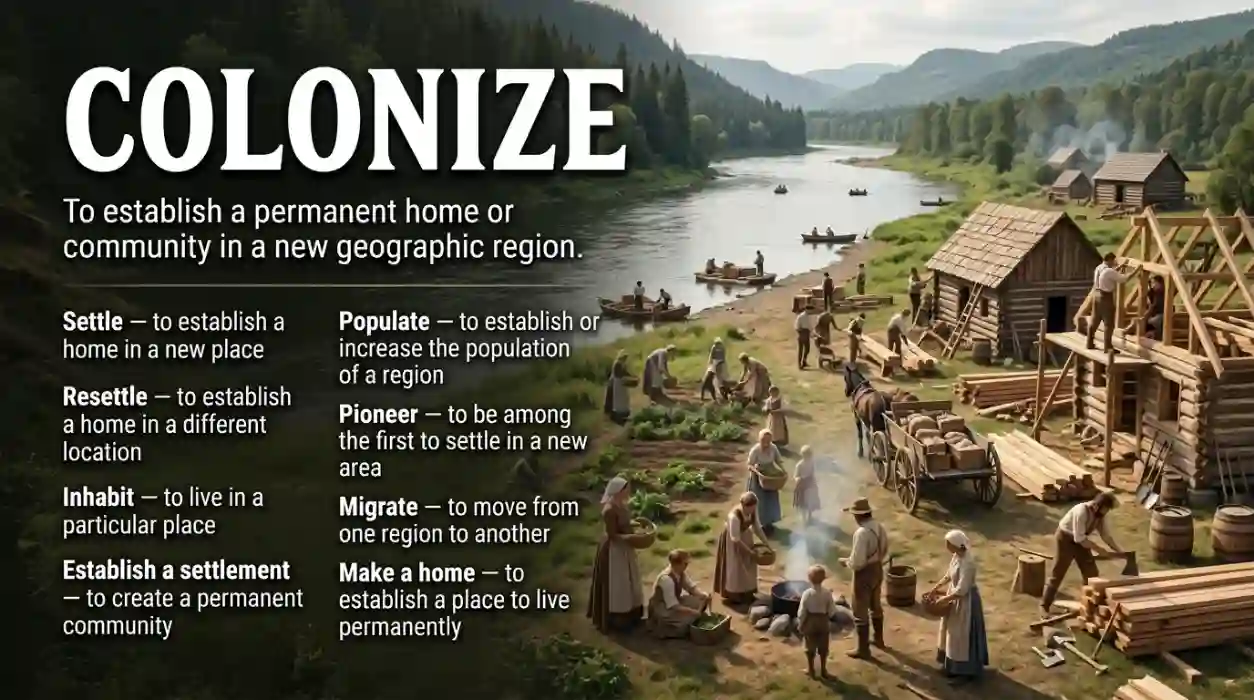
Synonyms for colonize include settle, establish a colony, inhabit, occupy, populate, and settle in. The best alternative depends on context. Some words describe people establishing a community, while others refer to political control, territorial expansion, or organisms spreading into a new environment.
Imagine reading a history lesson about a powerful country taking control of a distant territory. The word colonize may describe that process, but occupy, settle, or annex can highlight different aspects of the event.
Synonyms for colonize help you explain historical events, migration, territorial control, and scientific processes more precisely. Choosing the right term also helps you avoid implying that different actions mean the same thing.
The word appears in history books, political discussions, geography, ecology, microbiology, and space exploration. Its meaning changes with the subject, so context is essential.
Students, bloggers, content writers, and everyday English users can benefit from learning these alternatives. They make essays more accurate, articles easier to understand, and discussions about sensitive historical topics more thoughtful.
What Does “Colonize” Really Mean?
Colonize is a verb that means to establish control over a territory, settle people there, or establish a community in a new place. In science, it can also mean that organisms begin living and reproducing in a particular environment.
The exact meaning depends on the subject. In history, colonize often describes a country or power establishing settlements and political control over another territory. In biology, it can describe bacteria or other organisms establishing themselves in a habitat.
Consider these examples:
- “The empire colonized several islands.” This describes territorial expansion and colonial rule.
- “Early settlers colonized the region.” This focuses on people establishing communities in a new area.
- “Bacteria colonized the surface.” This describes microorganisms establishing a presence in an environment.
Native English speakers understand colonize through its surrounding context. In historical and political writing, it often carries associations with imperialism, displacement, exploitation, and unequal power. In ecology and microbiology, it is usually a technical term.
Part of speech: Verb.
Simple definition: To establish a settlement or control in a new territory, or to establish a population in a new environment.
The noun forms include colony and colonization. The adjective colonial describes something associated with a colony or colonial period.
Connotative Meaning of “Colonize”
Connotation (the emotional, cultural, or social associations that a word carries beyond its basic definition) affects how readers interpret colonize.
- Positive tone: In some discussions of future exploration, the word may suggest building habitats, establishing communities, or expanding human activity.
- Negative tone: In historical and political contexts, it can suggest conquest, exploitation, forced displacement, and the loss of local autonomy.
- Neutral tone: In biology and ecology, it often describes organisms establishing themselves in a particular place without expressing moral approval or criticism.
The word itself does not always express approval or disapproval. However, when describing human history, it is important to recognize that colonization often involved unequal power and serious consequences for Indigenous populations.
Etymology:
The English verb colonize developed from colony, which ultimately comes from Latin colonia, meaning a settlement or farm. The related Latin verb colere meant to cultivate, inhabit, or tend.
The word entered English through forms influenced by French and Latin. Its meaning gradually expanded from settlement to the establishment of political control over territories.
Old English (450–1100)
The modern word colonize did not exist in Old English in its current form. English speakers used other words to describe inhabiting land, establishing settlements, and cultivating fields. The Latin roots behind colonize were already associated with settlement and cultivation.
Middle English (1100–1500)
During the Middle English period, English vocabulary absorbed many words from French and Latin. Terms related to settlements, landholding, and political organization became more familiar. The modern verb colonize developed later, building on this vocabulary.
Modern English (1500–Present)
As European overseas expansion increased, colony and related terms became increasingly important in political and historical writing. Colonize came to describe the establishment of settlements and systems of control in territories beyond a ruling power’s original homeland.
In modern science, the term gained additional meanings. It now describes organisms establishing populations in new environments, as well as proposed human settlement beyond Earth.
Pronunciation
- US English: /ˈkɑː.lə.naɪz/
- UK English: /ˈkɒl.ə.naɪz/
Syllables: col-o-nize (3 syllables)
Affixation pattern:
- Root: colony, from Latin colonia
- Prefix: None
- Suffix: -ize, which forms verbs meaning to make, establish, or bring into a particular state
- Word formation: colony → colonize
Related forms include colonization (noun), colonizer (noun), colonized (past tense or past participle), and colonial (adjective).
Synonyms List
1. Settle (v) — US: /ˈset̬.əl/ | UK: /ˈset.əl/
- Meaning: To establish a permanent home or community in a new geographic region.
- Tone/Register: Neutral, General
- Example 1: Families traveled west to settle along the fertile riverbank.
- Example 2: They decided to settle in a quiet suburban town.
2. Populate (v) — US: /ˈpɑː.pjə.leɪt/ | UK: /ˈpɒp.jə.leɪt/
- Meaning: To fill an area with people, animals, or inhabitants.
- Tone/Register: Neutral, Academic
- Example 1: Migrating birds rapidly populate the coastal islands every spring.
- Example 2: Engineers hope to populate the new city center within five years.
3. Occupy (v) — US: /ˈɑː.kjə.paɪ/ | UK: /ˈɒk.jʊ.paɪ/
- Meaning: To take possession of a space or country by force or presence.
- Tone/Register: Serious, Military, Formal
- Example 1: Troops arrived to occupy the strategic mountain pass.
- Example 2: Demonstrators gathered to occupy the main public square.
4. Annex (v) — US: /æˈneks/ | UK: /æˈneks/
- Meaning: To incorporate a territory into an existing political state or country.
- Tone/Register: Formal, Political, Legal
- Example 1: The empire moved quickly to annex the neighboring island state.
- Example 2: The municipality chose to annex three small surrounding villages.
5. Subjugate (v) — US: /ˈsʌb.dʒə.ɡeɪt/ | UK: /ˈsʌb.dʒʊ.ɡeɪt/
- Meaning: To bring a group of people under complete political control by force.
- Tone/Register: Formal, Historical, Severe
- Example 1: Invading armies sought to subjugate the local population completely.
- Example 2: The tyrant worked to subjugate every opposing political faction.
6. Pioneer (v) — US: /ˌpaɪ.əˈnɪr/ | UK: /ˌpaɪ.əˈnɪə/
- Meaning: To open up or explore a new area as an early settler.
- Tone/Register: Positive, Inspirational, General
- Example 1: Brave explorers aimed to pioneer new routes through the tundra.
- Example 2: Researchers hope to pioneer settlements on distant planets.
7. Establish (v) — US: /ɪˈstæb.lɪʃ/ | UK: /ɪˈstæb.lɪʃ/
- Meaning: To set up or build a firm foundation for a community or system.
- Tone/Register: Formal, General
- Example 1: Settlers worked hard to establish trading posts along the border.
- Example 2: The firm plans to establish new offices across Asia.
8. Inhabit (v) — US: /ɪnˈhæb.ɪt/ | UK: /ɪnˈhæb.ɪt/
- Meaning: To live or reside continuously in a specific habitat or place.
- Tone/Register: Neutral, Scientific, General
- Example 1: Native species inhabit the deep tropical rainforest.
- Example 2: Nomadic tribes used to inhabit these open grassy plains.
9. Conquer (v) — US: /ˈkɑːŋ.kɚ/ | UK: /ˈkɒŋ.kə/
- Meaning: To take control of a land or people through military victory.
- Tone/Register: Dramatic, Historical, Serious
- Example 1: The king set out to conquer vast new lands across the sea.
- Example 2: The general managed to conquer the stubborn hilltop fortress.
10. People (v) — US: /ˈpiː.pəl/ | UK: /ˈpiː.pəl/
- Meaning: To fill a region with human inhabitants over time.
- Tone/Register: Literary, Formal
- Example 1: Immigrants helped to populate the vast interior plains.
- Example 2: Ancient groups began to populate the river valleys centuries ago.
11. Subdue (v) — US: /səbˈduː/ | UK: /səbˈdʒuː/
- Meaning: To overcome, quiet, or bring a region under control by power.
- Tone/Register: Serious, Military
- Example 1: Forces worked to subdue the rebellious northern provinces.
- Example 2: The ruler managed to subdue all opposition within months.
12. Plant (v) — US: /plænt/ | UK: /plɑːnt/
- Meaning: To establish a colony, town, or community in a new location.
- Tone/Register: Historical, Formal
- Example 1: Early settlers aimed to plant a new colony on the coast.
- Example 2: Leaders sought to plant permanent outposts along the trade route.
13. Seize (v) — US: /siːz/ | UK: /siːz/
- Meaning: To take hold of a territory suddenly and with force.
- Tone/Register: Strong, Dramatic, General
- Example 1: Rebel fighters attempted to seize control of the capital city.
- Example 2: Navy ships moved fast to seize the island port.
14. Dominate (v) — US: /ˈdɑː.mə.neɪt/ | UK: /ˈdɒm.ɪ.neɪt/
- Meaning: To exert supreme control and power over a region or group.
- Tone/Register: Strong, General, Business
- Example 1: The foreign power sought to dominate regional trade routes.
- Example 2: One large company continues to dominate the national energy market.
15. Take over (v) — US: /teɪk ˈoʊ.vɚ/ | UK: /teɪk ˈəʊ.və/
- Meaning: To assume control or ownership of an area or organization.
- Tone/Register: Informal, Everyday
- Example 1: Foreign investors managed to take over local farmland.
- Example 2: The military planned to take over public broadcasting stations.
16. Overrun (v) — US: /ˌoʊ.vɚˈrʌn/ | UK: /ˌəʊ.vəˈrʌn/
- Meaning: To spread over and occupy an area in overwhelming numbers.
- Tone/Register: Negative, Dramatic, General
- Example 1: Invasive weeds quickly overrun abandoned garden lots.
- Example 2: Enemy forces began to overrun defense posts along the border.
17. Encroach (v) — US: /ɪnˈkroʊtʃ/ | UK: /ɪnˈkrəʊtʃ/
- Meaning: To advance gradually beyond established or acceptable limits.
- Tone/Register: Formal, Legal
- Example 1: Suburban developments continue to encroach on wild forest land.
- Example 2: The neighboring nation began to encroach upon protected territory.
18. Infest (v) — US: /ɪnˈfest/ | UK: /ɪnˈfest/
- Meaning: To spread over or inhabit a space in troublesome numbers.
- Tone/Register: Negative, General, Scientific
- Example 1: Termites can quickly infest wooden house frames.
- Example 2: Pests started to infest stored grain in the warehouse.
19. Root (v) — US: /ruːt/ | UK: /ruːt/
- Meaning: To settle down firmly and establish deep ties in a location.
- Tone/Register: Informal, Descriptive
- Example 1: The immigrant family chose to root themselves in the community.
- Example 2: New businesses began to root along the renovated main street.
20. Expand into (v) — US: /ɪkˈspænd ˈɪn.tuː/ | UK: /ɪkˈspænd ˈɪn.tuː/
- Meaning: To grow larger and occupy additional surrounding territory.
- Tone/Register: Neutral, Business, General
- Example 1: The retail chain decided to expand into western states.
- Example 2: Cities naturally expand into rural farmland over time.

21. Naturalize (v) — US: /ˈnætʃ.ɚ.ə.laɪz/ | UK: /ˈnætʃ.ər.ə.laɪz/
- Meaning: To establish a plant or animal successfully in a non-native wild area.
- Tone/Register: Scientific, Academic
- Example 1: Foreign wildflowers quickly naturalize in roadside fields.
- Example 2: Several bird species managed to naturalize on the remote island.
22. Overspread (v) — US: /ˌoʊ.vɚˈspred/ | UK: /ˌəʊ.vəˈspred/
- Meaning: To cover or spread completely across a geographic area.
- Tone/Register: Literary, Formal
- Example 1: Thick clouds overspread the valley before the heavy storm.
- Example 2: Wild vines overspread the ancient stone walls.
23. Claim (v) — US: /kleɪm/ | UK: /kleɪm/
- Meaning: To state officially that a territory belongs to a nation or individual.
- Tone/Register: Legal, Formal, General
- Example 1: Explorers raised a flag to claim the uncharted island.
- Example 2: Settlers moved quickly to claim mineral rights on the land.
24. Command (v) — US: /kəˈmænd/ | UK: /kəˈmɑːnd/
- Meaning: To exercise absolute control, authority, or strategic dominance over an area.
- Tone/Register: Formal, Military
- Example 1: The fort was built to command the mouth of the river.
- Example 2: A strong navy allows the nation to command sea channels.
25. Domesticate (v) — US: /dəˈmes.tə.keɪt/ | UK: /dəˈmes.tɪ.keɪt/
- Meaning: To adapt wild land or organisms for human life and settlement.
- Tone/Register: Academic, Scientific
- Example 1: Early farmers worked to domesticate wild valley land.
- Example 2: Settlers learned to domesticate native crops for food.
26. Found (v) — US: /faʊnd/ | UK: /faʊnd/
- Meaning: To bring a new town, city, or settlement into existence.
- Tone/Register: Historical, Formal
- Example 1: Pioneers worked together to found a college town on the frontier.
- Example 2: Leaders met to found a trading outpost near the ocean.
27. Appropriate (v) — US: /əˈproʊ.pri.eɪt/ | UK: /əˈprəʊ.pri.eɪt/
- Meaning: To take possession of land or assets for one’s own use without permission.
- Tone/Register: Formal, Legal, Academic
- Example 1: The government moved to appropriate private land for the highway.
- Example 2: Invaders attempted to appropriate local natural resources.
28. Infiltrate (v) — US: /ˈɪn.fɪl.treɪt/ | UK: /ˈɪn.fɪl.treɪt/
- Meaning: To enter and establish a presence in a territory gradually and secretly.
- Tone/Register: Serious, Military, Descriptive
- Example 1: Scouts managed to infiltrate enemy border zones unnoticed.
- Example 2: Weeds began to infiltrate carefully tended crop rows.
29. Monopolize (v) — US: /məˈnɑː.pə.laɪz/ | UK: /məˈnɒp.əl.aɪz/
- Meaning: To take complete control of trade or space to exclude others.
- Tone/Register: Business, General
- Example 1: Foreign trading posts worked to monopolize spice exports.
- Example 2: Large vessels managed to monopolize shipping lanes.
30. Resettle (v) — US: /ˌriːˈset̬.əl/ | UK: /ˌriːˈset.əl/
- Meaning: To settle people again in a new or different country or region.
- Tone/Register: Neutral, Government, Formal
- Example 1: Agencies worked to resettle displaced citizens after the flood.
- Example 2: The government helped families resettle in northern towns.
31. Subdue (v) — US: /səbˈduː/ | UK: /səbˈdʒuː/
- Meaning: To bring a land under control by defeating resistance or wildness.
- Tone/Register: Formal, Historical
- Example 1: Pioneers worked tirelessly to subdue the wild wilderness.
- Example 2: Military garrisons helped to subdue frontier border towns.
32. Usurp (v) — US: /juːˈsɝːp/ | UK: /juːˈzɜːp/
- Meaning: To take power or territory illegally or by force from rightful owners.
- Tone/Register: Formal, Legal, Dramatic
- Example 1: The warlord tried to usurp control over the border region.
- Example 2: Officials warned that rebels might usurp authority in the province.
33. Expropriate (v) — US: /eksˈproʊ.pri.eɪt/ | UK: /eksˈprəʊ.pri.eɪt/
- Meaning: To dispossess owners of land or property for political or state use.
- Tone/Register: Legal, Academic, Formal
- Example 1: The regime moved to expropriate foreign-owned plantations.
- Example 2: Officials chose to expropriate farmland for public railway lines.
34. Take root (v) — US: /teɪk ruːt/ | UK: /teɪk ruːt/
- Meaning: To become firmly established and begin growing or expanding in a new place.
- Tone/Register: Informal, Descriptive
- Example 1: New plant species easily take root in rich volcanic soil.
- Example 2: Settler traditions began to take root in the river valley.
35. Overpower (v) — US: /ˌoʊ.vɚˈpaʊ.ɚ/ | UK: /ˌəʊ.vəˈpaʊ.ə/
- Meaning: To defeat and gain dominance over an existing population by superior strength.
- Tone/Register: Serious, Dramatic
- Example 1: The military managed to overpower regional border defenses.
- Example 2: High tides can overpower coastal settlements along the shore.
36. Encroach upon (v) — US: /ɪnˈkroʊtʃ əˈpɑːn/ | UK: /ɪnˈkrəʊtʃ əˈpɒn/
- Meaning: To advance gradually onto someone else’s land, rights, or territory.
- Tone/Register: Formal, Legal
- Example 1: Expanding suburbs encroach upon valuable natural wetlands.
- Example 2: The military camp began to encroach upon local farm boundaries.
37. Swarm (v) — US: /swɔːrm/ | UK: /swɔːm/
- Meaning: To move into and fill a location in large, dense numbers.
- Tone/Register: Descriptive, Informal
- Example 1: Tourists swarm small coastal towns during the summer peak.
- Example 2: Insects swarm lush crop fields after spring rains.
38. Impose upon (v) — US: /ɪmˈpoʊz əˈpɑːn/ | UK: /ɪmˈpəʊz əˈpɒn/
- Meaning: To force control, rules, or settlement upon an unwilling territory.
- Tone/Register: Formal, Serious
- Example 1: Foreign rulers sought to impose their rule upon local cultural practices.
- Example 2: The empire worked to impose its laws upon newly taken lands.
39. Spread over (v) — US: /spred ˈoʊ.vɚ/ | UK: /spred ˈəʊ.və/
- Meaning: To cover or expand across a wide geographical area.
- Tone/Register: Everyday, General
- Example 1: New settlements continue to spread over the open valley.
- Example 2: Ash began to spread over surrounding farmland after the eruption.
40. Preempt (v) — US: /priːˈempt/ | UK: /priːˈempt/
- Meaning: To acquire or settle public land before others can claim it.
- Tone/Register: Legal, Formal
- Example 1: Early arrival allowed homesteaders to preempt prime farmland.
- Example 2: The nation moved quickly to preempt rival territorial claims.

41. Enslave (v) — US: /ɪnˈsleɪv/ | UK: /ɪnˈsleɪv/
- Meaning: To force a population into human bondage during conquest or colonization.
- Tone/Register: Severe, Historical, Formal
- Example 1: Invaders attempted to enslave native workers on local farms.
- Example 2: Warring armies worked to enslave captured city residents.
42. Harness (v) — US: /ˈhɑːr.nəs/ | UK: /ˈhɑː.nəs/
- Meaning: To bring wild land or natural resources under productive human control.
- Tone/Register: Positive, General
- Example 1: Engineers worked to harness river power for new settlements.
- Example 2: Settlers sought to harness fertile soil for wheat production.
43. Subjugate politically (v) — US: /ˈsʌb.dʒə.ɡeɪt pəˈlɪt̬.kəl.i/ | UK: /ˈsʌb.dʒʊ.ɡeɪt pəˈlɪt.ɪ.kəl.i/
- Meaning: To bring a foreign region under absolute legal and government rule.
- Tone/Register: Formal, Academic
- Example 1: Imperial nations sought to subjugate politically independent kingdoms.
- Example 2: Rulers tried to subjugate politically distant coastal cities.
44. Seize land (v) — US: /siːz lænd/ | UK: /siːz lænd/
- Meaning: To forcefully confiscate geographic territory from existing residents.
- Tone/Register: Direct, Serious
- Example 1: Militias moved quickly to seize land along the disputed border.
- Example 2: Settlers attempted to seize land near key water sources.
45. Tame (v) — US: /teɪm/ | UK: /teɪm/
- Meaning: To bring wild, uncultivated wilderness under human settlement and use.
- Tone/Register: Historical, Descriptive
- Example 1: Early pioneers strove to tame the harsh mountain wilderness.
- Example 2: Farmers worked hard to tame dense coastal forests.
46. Establish outposts (v) — US: /ɪˈstæb.lɪʃ ˈaʊt.poʊsts/ | UK: /ɪˈstæb.lɪʃ ˈaʊt.pəʊsts/
- Meaning: To set up small, distant military or trading settlements in new territory.
- Tone/Register: Business, Military, Formal
- Example 1: Traders moved to establish outposts along northern river ways.
- Example 2: Scientists plan to establish outposts across the Antarctic ice.
47. Overrun territory (v) — US: /ˌoʊ.vɚˈrʌn ˈter.ə.tɔːr.i/ | UK: /ˌəʊ.vəˈrʌn ˈter.ɪ.tər.i/
- Meaning: To occupy a land rapidly by physical numbers or military force.
- Tone/Register: Serious, Military
- Example 1: Fast-moving forces managed to overrun territory near the border.
- Example 2: Floodwaters threatened to overrun territory around coastal villages.
48. Garrison (v) — US: /ˈɡær.ə.sən/ | UK: /ˈɡær.ɪ.sən/
- Meaning: To station military troops in a newly acquired town or settlement to maintain control.
- Tone/Register: Military, Formal
- Example 1: Generals chose to garrison troops in key coastal fortresses.
- Example 2: The empire moved to garrison northern trade centers.
49. Infiltrate land (v) — US: /ˈɪn.fɪl.treɪt lænd/ | UK: /ˈɪn.fɪl.treɪt lænd/
- Meaning: To enter and take up living space in a territory gradually or quietly.
- Tone/Register: Descriptive, Neutral
- Example 1: Non-native plant species infiltrate land along highway corridors.
- Example 2: Small groups managed to infiltrate land beyond border posts.
50. Hold sway over (v) — US: /hoʊld sweɪ ˈoʊ.vɚ/ | UK: /həʊld sweɪ ˈəʊ.və/
- Meaning: To maintain dominant influence, power, or territorial governance.
- Tone/Register: Literary, Formal
- Example 1: The ruling dynasty continued to hold sway over vast provinces.
- Example 2: Maritime powers sought to control international shipping lanes.
Synonyms by Tone
The tone of a synonym affects how readers understand an event. Some words emphasize settlement, while others highlight force, political control, or scientific change.
Neutral or descriptive
These words describe establishing a population, settlement, or presence without automatically judging the process.
- Settle: Focuses on people making homes in a place.
- Inhabit: Emphasizes living in an environment.
- Populate: Highlights the presence of people or organisms.
- Establish: Describes creating a lasting presence.
- Found: Emphasizes creating a settlement or institution.
- Migrate to: Focuses on movement from one place to another.
- Introduce: Often describes bringing organisms into an environment.
- Spread into: Emphasizes gradual expansion into an area.
Positive or constructive
These alternatives can suggest exploration, development, or organized growth. However, a positive tone does not mean every historical action was fair or peaceful.
- Pioneer: Suggests being among the first to explore or develop an area.
- Develop: Emphasizes building infrastructure or improving a place.
- Establish a foothold: Suggests gaining an initial position for future activity.
- Establish a presence: Highlights creating a lasting position.
- Establish an extraterrestrial settlement: Describes creating a human community beyond Earth.
Negative or forceful
These words emphasize coercion, territorial expansion, domination, or harm.
- Conquer: Highlights military victory and taking control.
- Invade: Emphasizes entering a territory by force.
- Subjugate: Suggests forcing people under domination.
- Annex: Describes formally adding a territory to another political unit.
- Exploit: Highlights using people or resources for benefit, often unfairly.
- Displace: Emphasizes forcing people or organisms from an established home.
- Encroach on: Suggests an unwelcome intrusion into another area.
- Appropriate: Can suggest taking land or resources without proper permission.
Formal or academic
These phrases are useful when a precise political, historical, or scientific meaning matters.
- Occupy: Describes taking or maintaining control of an area.
- Govern: Emphasizes administration and authority.
- Extend sovereignty over: Describes a claim to political authority.
- Expand territorial control: Highlights the growth of a state’s controlled territory.
- Incorporate: Describes bringing a region into a larger system.
- Colonize a habitat: Describes a biological population becoming established in an environment.
The central rule is simple: choose words based on what actually happened. Settle does not necessarily mean conquer, and inhabit does not necessarily mean colonize. Accurate vocabulary helps you avoid changing the meaning of a historical or scientific account.
“Colonize” vs. Close Alternatives
These three alternatives are particularly easy to confuse: settle, occupy, and conquer.
| Word | Main difference | Tone | When to use it |
|---|---|---|---|
| Colonize | Establish a settlement or system of control in a territory | Context-dependent; often politically sensitive | When describing colonial settlement or control |
| Settle | Make a home or establish a community | Usually neutral | When focusing on people living in a place |
| Occupy | Take or maintain control of a location | Often political or military | When control of the territory is the main point |
| Conquer | Defeat a people or state and gain control | Forceful | When military victory is central to the event |
For example, a group may settle in a region without controlling its government. An army may occupy a city without establishing a permanent colony. A ruler may conquer a kingdom but govern it indirectly rather than settling people there.
These differences matter in history essays and news reports. The wrong verb can imply a different event, motive, or outcome.
How “Colonize” Changes by Context
Daily conversation
In ordinary conversation, settle in, move to, or establish a community may sound more natural when discussing people moving somewhere new.
For example, “My grandparents settled in the northern region” describes their new home. It does not necessarily imply that they established political control over the area.
Use colonize when the broader historical, political, or scientific meaning is genuinely relevant.
Writing and blogging
Bloggers and content writers can use synonyms to avoid repetition while keeping their explanations accurate. A history article might use colonize, occupy, and annex to describe different stages of territorial expansion.
Avoid replacing every instance of colonize with a different word just for variety. Repetition is less harmful than a misleading synonym.
Professional or academic writing
Academic writing benefits from precise terms. Use extend sovereignty over when discussing legal authority, subjugate when describing forced domination, and populate when focusing on population.
In biology, colonize is often the correct technical term. For example, scientists may describe bacteria colonizing a surface or plants colonizing a newly formed habitat.
Creative or informal writing
In fiction, invade, conquer, settle, and establish a foothold create different impressions. A writer can use spread into for gradual expansion or overrun when a place becomes overwhelmed by an advancing force.
Choose the verb that fits the scene. Stronger words create more tension, but they can also exaggerate events if the context does not support them.
Common Mistakes Learners Make
Treating settlement as the same thing as colonization
People can settle in a new place without taking control of its existing population. Settle emphasizes making a home, while colonize can include settlement and wider systems of authority.
Example: “The family settled in the valley” does not necessarily mean “The family colonized the valley.”
Using “occupy” when you mean “govern”
Occupy describes presence or control in a place. Govern describes administering a territory or population. An occupying force may exercise authority, but the words highlight different aspects of that relationship.
Using “annex” for every type of colonization
Annexation refers specifically to incorporating territory into a political unit. Colonization can involve settlements, resource extraction, administration, and long-term political control without formal annexation.
Confusing “conquer” with “colonize”
Conquest generally involves defeating an opponent and gaining control. Colonization may follow conquest, but it can also develop through settlement, political pressure, or other processes. The terms overlap in some historical cases but are not identical.
Treating scientific colonization as political colonization
In biology, a microorganism can colonize a surface without any idea of conquest or government. This is a technical use of the same word, not a claim that the organism behaves like a human empire.
Overusing dramatic or critical terms
Words such as subjugate, exploit, and invade communicate strong meanings. Use them when force, domination, or harmful intrusion is relevant. Otherwise, a neutral description may be more accurate.
Register Notes: Formal vs. Informal English
Formal and academic: Annex, subjugate, incorporate, extend sovereignty over, and expand territorial control suit historical, political, and legal analysis.
Everyday English: Settle, move to, occupy, and take control of are generally easier to understand in conversation.
Scientific English: Colonize, inhabit, populate, introduce, and spread into can describe organisms and habitats, depending on the process.
Creative writing: Conquer, invade, establish a foothold, and pioneer can help convey action, conflict, or exploration.
For further vocabulary practice, you could compare these terms with synonyms for conquer or occupy. That comparison helps clarify where the meanings overlap and where they differ.
Real-Life Scenarios
Workplace and research
A research team introduces beneficial microorganisms to a controlled environment. If the organisms become established there, researchers may say they colonized the environment. The word describes a biological process rather than a political one.
Social and historical discussions
A student writes about newcomers settling on land already inhabited by Indigenous communities. The word settle may describe where the newcomers lived, while colonize can describe the wider process of settlement and political control. The surrounding historical facts determine which term is most accurate.
Media and pop culture
A science-fiction film imagines humans establishing a permanent community on Mars. Here, colonize Mars is common language for creating a human settlement beyond Earth. A more neutral alternative is to establish a settlement on Mars.
Writing and storytelling
A novelist describes an empire moving into a neighboring territory. If its army defeats the local ruler, conquer may describe the military victory. If the empire later establishes settlements and political institutions, colonize may better describe the longer process.

Practice Quiz
Which verb best describes a peaceful family building a farm in an unpopulated valley?
a) Subjugate
b) Settle
c) Expropriate
What is the most accurate term for an empire legally incorporating neighboring land into its territory?
a) Annex
b) Naturalize
c) Root
If foreign plants spread naturally across a wild meadow, they:
a) Usurp
b) Naturalize
c) Garrison
Bringing a defeated enemy under strict military rule is called:
a) Domesticating
b) Subjugating
c) Pioneering
A business expanding its presence into new overseas regions is attempting to:
a) Expand into
b) Infest
c) Swarm
Early space explorers building the first habitat on the Moon are aiming to:
a) Pioneer
b) Encroach
c) Expropriate
Taking private land away from owners without consent for state use is called:
a) Expropriating
b) Settling
c) Inhabiting
What informal phrase describes weeds growing fast across a patio?
a) Take over
b) Subjugate politically
c) Annex
Stationing troops inside a newly acquired town fort to maintain order is to:
a) Garrison
b) Naturalize
c) Preempt
A writer describing ancient cities being built along a river would say settlers met to:
a) Found
b) Infest
c) Usurp
Practical Application Task
Write one short, original sentence about human space travel using one synonym from the list above.
Answer Key:
1-b, 2-a, 3-b, 4-b, 5-a, 6-a, 7-a, 8-a, 9-a, 10-a
External Learning Sources
For authoritative definitions, pronunciation, and examples, consult these dictionaries:
Cambridge Dictionary — learner-friendly definitions and UK and US pronunciation.
Oxford Learner’s Dictionaries — usage examples, grammar patterns, and pronunciation guidance.
Merriam-Webster — definitions, word history, and American English usage.
Conclusion
Learning synonyms for colonize helps you describe settlement, territorial control, and scientific change more precisely. The best alternative depends on what happened and who or what was affected.
For students and bloggers, careful word choice makes history articles, essays, and explanations clearer. It also helps readers distinguish migration from conquest and biological growth from political control.
In everyday communication, accurate vocabulary reduces confusion and makes sensitive subjects easier to discuss. Think about the meaning and tone of a word before using it in a sentence.
Practice by using these words in an essay, a short story, or a daily conversation. Check a trusted dictionary when needed, and challenge yourself to choose the most precise synonym.
Frequently Asked Questions
1. What is the closest synonym for colonize in a history essay?
The closest alternative depends on the event. Establish a colony is useful when settlers create a new colony. Occupy emphasizes control over a territory, while conquer highlights military defeat. If the essay discusses long-term political domination and settlement, colonize may be the most accurate term. Avoid replacing it with a single synonym throughout the essay when the historical actions differ.
2. What is the difference between colonization and settlement?
Settlement means establishing a home or community in a place. Colonization can involve settlement, but it often includes wider political, economic, or cultural control over a territory and its population. A community can settle somewhere without colonizing it. In historical writing, the distinction is especially important when a region already has established Indigenous communities and systems of governance.
3. What is another word for colonize in biology?
In biology, inhabit, populate, and establish a population may work, depending on the process being described. Scientists also commonly use colonize when bacteria, fungi, plants, or animals become established in a habitat or on a surface. The word is useful because it describes the establishment of organisms, not merely their brief presence in an environment.
4. What word can replace colonize when discussing Mars?
Settle Mars, establish a settlement on Mars, and establish a human presence on Mars are possible alternatives. Settle emphasizes people living there, while establish a human presence is broader and can include research bases or temporary facilities. Colonize Mars remains common in science fiction and space exploration discussions, although some writers prefer settle because it avoids historical associations with colonialism.
5. Is colonize always a negative word?
No. In science, colonize is often a neutral technical term for organisms becoming established in an environment. In discussions of human history, however, it frequently carries negative associations because colonial systems often involved coercion, land dispossession, and exploitation. In future space exploration, the word may be used neutrally or positively, but its connotations can still influence how audiences respond.

Hasnain Ali is an SEO Content Strategist and the founder of wordvora.com, a trusted vocabulary platform that helps writers, students, professionals, and English learners find accurate synonyms, antonyms, word meanings, and real-life usage examples. He specializes in keyword research, on-page SEO, topical authority, and creating search-first content that aligns with Google’s latest Search Quality and E-E-A-T guidelines. His work focuses on producing clear, well-structured, and reader-friendly resources that satisfy search intent while maintaining high editorial standards.
Through extensive hands-on experience with SEO tools such as Google Search Console, Google Analytics, SEMrush, and Ahrefs, Hasnain researches user search behavior and develops content that is both informative and easy to understand. Every article published on wordvora.com is carefully reviewed for accuracy, readability, and contextual relevance before publication. His mission is to build one of the web’s most reliable English vocabulary resources by providing practical language guidance, trustworthy explanations, and content that helps readers improve their writing, communication, and vocabulary with confidence.