
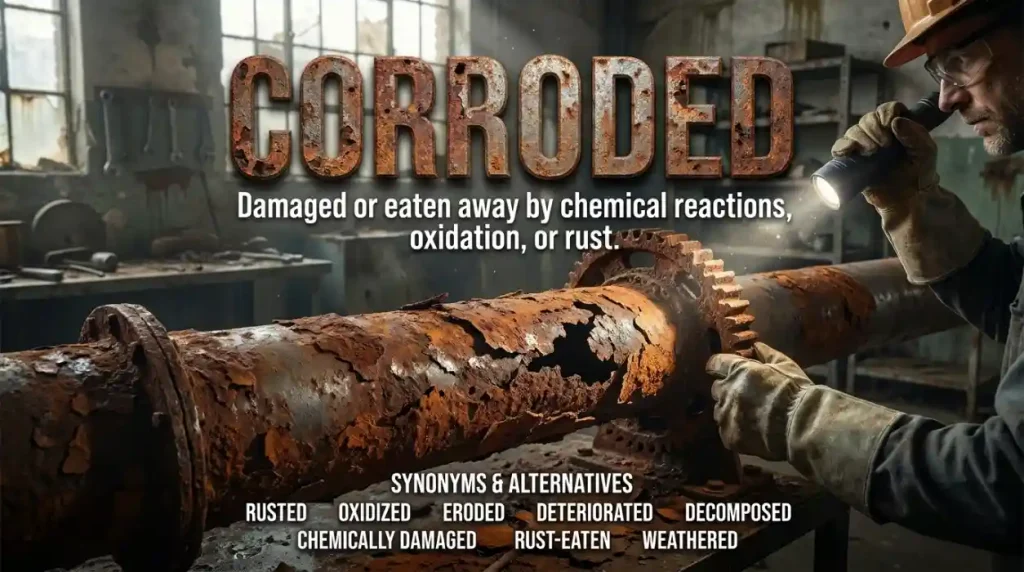
Synonyms for corroded include rusted, oxidized, eroded, deteriorated, decayed, eaten away, damaged, and weathered. The best alternative depends on the material, the cause of damage, and the context. These words describe different forms of gradual breakdown, especially in metal, surfaces, and physical structures.
Synonyms for corroded help when a rusty garden gate refuses to open, or an old pipe begins to leak. Choosing the right word makes that description more precise.
Imagine writing about a corroded iron fence. You could call it rusted, weather-beaten, or deteriorated, depending on what happened to it. Each choice creates a slightly different picture.
The word corroded appears in science, maintenance reports, everyday conversation, and descriptive writing. Learning its alternatives helps students understand technical texts and express ideas more accurately.
For bloggers, content writers, and everyday English users, a strong vocabulary makes descriptions clearer and more engaging. Understanding synonyms for corroded also helps you avoid repeating the same adjective in every sentence.
What Does “Corroded” Really Mean?
Corroded is an adjective, and the past participle of the verb corrode. It describes a material or surface that has gradually been damaged, eaten away, or weakened through a chemical reaction or a similar destructive process.
The word commonly describes metals exposed to moisture, oxygen, salt, acids, or other reactive substances. It can also describe gradual damage to other materials.
For example, a metal railing near the sea may become corroded because salty air accelerates corrosion. A corroded pipe may develop weak spots or holes.
As a verb, corrode means to destroy or wear away gradually. As an adjective, corroded describes the resulting condition.
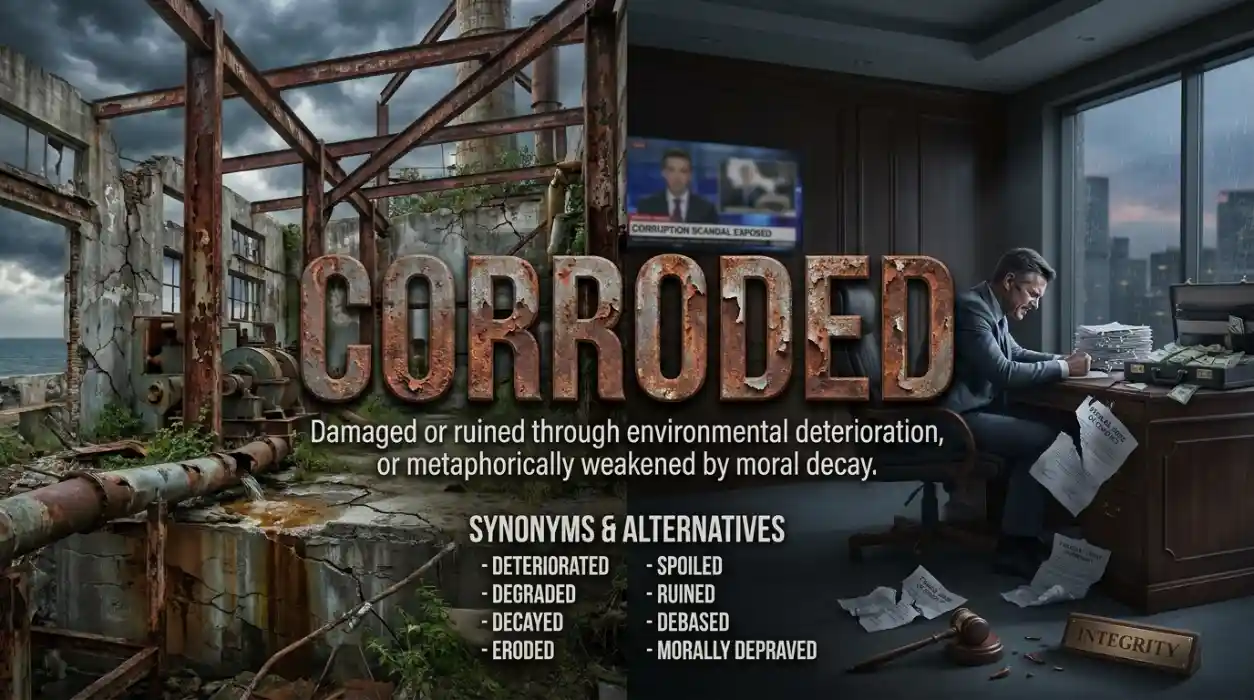
Native English speakers generally associate the word with physical deterioration. In figurative writing, it can also describe something gradually undermined, such as trust, confidence, or a relationship.
Connotative Meaning of “Corroded”
(Connotation is the emotional or cultural association a word carries beyond its basic dictionary meaning.)
- Positive tone: The word corroded rarely has a positive meaning on its own. However, corrosion may create visual interest in art, antiques, or industrial design.
- Negative tone: It often suggests damage, weakness, neglect, decay, or possible danger.
- Neutral tone: In engineering and scientific reports, it can simply describe an observable material condition without expressing an emotional judgment.
Etymology
The word corrode comes from Latin corrodere, meaning “to gnaw away” or “to eat away.” It combines com- (together or thoroughly) and rodere (to gnaw).
The English word entered through French and Latin-based forms. Its history reflects the idea of something being gradually consumed or worn away.
- Old English (450–1100): Corrode was not an established native Old English word. Related ideas were expressed through words associated with eating, gnawing, and wearing away.
- Middle English (1100–1500): Latin-derived vocabulary entered English through French and scholarly writing. Forms related to corrode developed within this broader linguistic influence.
- Modern English (1500–present): The word became established in scientific, medical, and technical language. Today, it also appears in ordinary conversation and figurative writing.

Pronunciation
- US IPA: /kəˈroʊdɪd/
- UK IPA: /kəˈrəʊdɪd/
Syllables
Syllable breakdown: cor-rod-ed
Number of syllables: 3
Affixation Pattern
- Root: rodere is the Latin root meaning “to gnaw,” preserved in the historical development of corrode.
- Prefix: cor- is part of the Latin-derived formation. Historically, it represents a form of com-.
- Suffix: -ed marks the past tense of the verb or its past participle.
- Word formation: corrode + -ed = corroded.
The spelling reflects a regular English past-participle pattern, although the underlying word has a Latin origin.
Synonyms List
1. Rusted (adj) — US: /ˈrʌs.tɪd/ | UK: /ˈrʌs.tɪd/
- Meaning: Damaged or coated with reddish-brown oxide caused by moisture on iron or steel.
- Tone/Register: Everyday, General
- Example 1: The rusted metal hinges creaked loudly as he opened the gate.
- Example 2: We replaced the rusted pipes under the kitchen sink.
2. Eroded (adj) — US: /ɪˈroʊ.dɪd/ | UK: /ɪˈrəʊ.dɪd/
- Meaning: Worn away gradually by the natural physical action of water, wind, or ice.
- Tone/Register: Academic, Scientific, General
- Example 1: The ocean waves left eroded cliffs along the coast.
- Example 2: Heavy rain eroded the soil along the hillside.
3. Tarnished (adj) — US: /ˈtɑːr.nɪʃt/ | UK: /ˈtɑː.nɪʃt/
- Meaning: Discolored or dulled on the outer surface due to exposure to air or moisture.
- Tone/Register: General, Descriptive
- Example 1: She polished the tarnished silver spoons before the holiday dinner.
- Example 2: His reputation was tarnished after the scandalous news broke.
4. Decayed (adj) — US: /dɪˈkeɪd/ | UK: /dɪˈkeɪd/
- Meaning: Rotted or decomposed through natural organic or chemical breakdown.
- Tone/Register: General, Scientific
- Example 1: The inspectors found decayed wooden beams inside the old barn.
- Example 2: Decayed leaves formed a rich layer of soil on the forest floor.
5. Eaten away (adj/phrase) — US: /ˈiː.tən əˈweɪ/ | UK: /ˈiː.tən əˈweɪ/
- Meaning: Consumed or destroyed progressively by chemical acid or environmental wear.
- Tone/Register: Casual, Descriptive
- Example 1: Battery acid had completely eaten away the copper connection.
- Example 2: The metal frame was eaten away by salty coastal air.
6. Oxidized (adj) — US: /ˈɑːk.sə.daɪzd/ | UK: /ˈɒk.sɪ.daɪzd/
- Meaning: Combined chemically with oxygen, resulting in an altered surface layer or patina.
- Tone/Register: Scientific, Technical
- Example 1: The copper roof took on a green oxidized layer over time.
- Example 2: Heat causes the exposed iron surface to become oxidized rapidly.
7. Deteriorated (adj) — US: /dɪˈtɪr.i.ə.reɪ.t̬ɪd/ | UK: /dɪˈtɪə.ri.ə.reɪ.tɪd/
- Meaning: Lowered in quality, strength, or condition over a period of time.
- Tone/Register: Formal, Professional
- Example 1: The building deteriorated after years of total abandonment.
- Example 2: Her health deteriorated during the harsh winter months.
8. Weathered (adj) — US: /ˈweð.ɚd/ | UK: /ˈweð.əd/
- Meaning: Changed, worn, or seasoned in texture by long exposure to the elements.
- Tone/Register: Descriptive, General
- Example 1: The captain looked out across the ocean with a weathered face.
- Example 2: We bought a dining table made from weathered barn wood.
9. Pitted (adj) — US: /ˈpɪt̬.ɪd/ | UK: /ˈpɪt.ɪd/
- Meaning: Covered with small hollows, tiny holes, or surface scars caused by corrosion.
- Tone/Register: Technical, Descriptive
- Example 1: Acid rain left the marble statue with a pitted surface.
- Example 2: The old brake rotors were heavily pitted and needed replacement.
10. Etched (adj.) — US: /etʃt/ | UK: /etʃt/
- Meaning: Corroded or marked with shallow grooves by acid or sharp chemical tools.
- Tone/Register: Technical, Artistic
- Example 1: The glass panels were beautifully etched with floral patterns.
- Example 2: Acid spills left an etched mark on the stone lab counter.
11. Dissolved (adj) — US: /dɪˈzɑːlvd/ | UK: /dɪˈzɒlvd/
- Meaning: Broken down and absorbed completely into a liquid solution.
- Tone/Register: Scientific, General
- Example 1: The harsh acid dissolved the metal casing in minutes.
- Example 2: Salt dissolved quickly in the pot of boiling water.
12. Consumed (adj) — US: /kənˈsuːmd/ | UK: /kənˈsjuːmd/
- Meaning: Destroyed, eaten up, or used up by chemical or natural action.
- Tone/Register: Dramatic, General
- Example 1: The old wooden shed was consumed by rust and rot.
- Example 2: Fire consumed the vacant building within an hour.
13. Worn away (adj/phrase) — US: /wɔːrn əˈweɪ/ | UK: /wɔːn əˈweɪ/
- Meaning: Diminished gradually in thickness or size through continuous friction or weathering.
- Tone/Register: Everyday, General
- Example 1: The stone steps were worn away by centuries of footsteps.
- Example 2: The tread on his hiking boots had completely worn away.
14. Damaged (adj) — US: /ˈdæm.ɪdʒd/ | UK: /ˈdæm.ɪdʒd/
- Meaning: Harmed or injured in a way that reduces value, usefulness, or strength.
- Tone/Register: Common, Neutral
- Example 1: Workers repaired the damaged water main under the street.
- Example 2: The storm left several cars damaged by falling branches.
15. Impaired (adj) — US: /ɪmˈperd/ | UK: /ɪmˈpeəd/
- Meaning: Weakened or damaged in functional ability, quality, or structural stability.
- Tone/Register: Formal, Technical
- Example 1: Corrosion impaired the structural integrity of the bridge beams.
- Example 2: Loud noise impaired his hearing over several years.
16. Weakened (adj) — US: /ˈwiː.kənd/ | UK: /ˈwiː.kənd/
- Meaning: Made less strong, durable, or resistant to external pressure.
- Tone/Register: General, Everyday
- Example 1: The wooden support post was weakened by termites.
- Example 2: Illness had weakened his immune system during the winter.
17. Compromised (adj) — US: /ˈkɑːm.prə.maɪzd/ | UK: /ˈkɒm.prə.maɪzd/
- Meaning: Made vulnerable to failure, damage, or hazard due to existing flaws.
- Tone/Register: Business, Engineering, Legal
- Example 1: The safety seal was compromised by moisture buildup.
- Example 2: Security was compromised after the password leak.
18. Gnawed (adj) — US: /nɑːd/ | UK: /nɔːd/
- Meaning: Bitten or chewed away gradually as if by teeth or chemical action.
- Tone/Register: Literary, Descriptive
- Example 1: Rust had gnawed away at the base of the iron fence.
- Example 2: A rodent had gnawed through the plastic electrical cable.
19. Cankered (adj) — US: /ˈkæŋ.kɚd/ | UK: /ˈkæŋ.kəd/
- Meaning: Infected, ulcerated, or slowly eaten away by decay or disease.
- Tone/Register: Literary, Historical
- Example 1: The fruit tree had cankered branches that produced no apples.
- Example 2: Jealousy left him with a cankered heart and bitter attitude.
20. Blighted (adj) — US: /ˈblaɪ.t̬ɪd/ | UK: /ˈblaɪ.tɪd/
- Meaning: Damaged, spoiled, or ruined by environmental or moral decay.
- Tone/Register: Literary, Formal
- Example 1: Industrial waste blighted the once fertile agricultural land.
- Example 2: His political career was blighted by early financial scandals.
21. Rotten (adj) — US: /ˈrɑː.tən/ | UK: /ˈrɒt.ən/
- Meaning: Suffering from decay, decomposition, or foul disintegration.
- Tone/Register: Informal, Everyday
- Example 1: Throw away those rotten tomatoes sitting on the counter.
- Example 2: The rotten wooden floorboards collapsed under his weight.
22. Crumbling (adj) — US: /ˈkrʌm.blɪŋ/ | UK: /ˈkrʌm.blɪŋ/
- Meaning: Breaking into small fragments or falling apart due to decay or age.
- Tone/Register: Descriptive, General
- Example 1: We walked carefully past the crumbling stone castle wall.
- Example 2: The old plaster on the ceiling was dry and crumbling.
23. Disintegrated (adj) — US: /dɪsˈɪn.t̬ə.ɡreɪ.t̬ɪd/ | UK: /dɪsˈɪn.tɪ.ɡreɪ.tɪd/
- Meaning: Broken down into small parts, dust, or fragments.
- Tone/Register: Scientific, Formal
- Example 1: The ancient paper disintegrated as soon as light hit it.
- Example 2: The rubber seal had disintegrated into black powder.
24. Wasted (adj) — US: /ˈweɪ.stɪd/ | UK: /ˈweɪ.stɪd/
- Meaning: Gradually worn down, thinned out, or consumed by neglect or decay.
- Tone/Register: General, Literary
- Example 1: The disease left him with a wasted, frail physical frame.
- Example 2: Years of abandonment left the historic estate wasted.
25. Subverted (adj) — US: /səbˈvɝː.t̬ɪd/ | UK: /səbˈvɜː.tɪd/
- Meaning: Weakened or undermined slowly from within (used figuratively).
- Tone/Register: Formal, Political, Academic
- Example 1: Corrupt officials subverted democratic institutions over a decade.
- Example 2: Bad habits gradually subverted her academic discipline.
26. Undermined (adj) — US: /ˌʌn.dɚˈmaɪnd/ | UK: /ˌʌn.dəˈmaɪnd/
- Meaning: Eroded or weakened at the base or foundation.
- Tone/Register: Business, Political, General
- Example 1: Water leaks had undermined the concrete foundation of the house.
- Example 2: Constant lying completely undermined his authority as a leader.
27. Severed (adj) — US: /ˈsev.ɚd/ | UK: /ˈsev.əd/
- Meaning: Cut or broken apart entirely due to structural wear or damage.
- Tone/Register: Dramatic, Serious
- Example 1: Corrosion severed the anchor line during the heavy sea storm.
- Example 2: The accident severed communications between the two outposts.
28. Leached (adj.) — US: /liːtʃt/ | UK: /liːtʃt/
- Meaning: Drained or washed of soluble chemical substances by percolating liquid.
- Tone/Register: Scientific, Environmental
- Example 1: Heavy rains leached vital nutrients from the topsoil.
- Example 2: Chemicals leached out of the discarded plastic containers.
29. Abraded (adj) — US: /əˈbreɪ.dɪd/ | UK: /əˈbreɪ.dɪd/
- Meaning: Scraped, rubbed down, or worn thin by physical friction.
- Tone/Register: Technical, Scientific
- Example 1: Sandstorms left the car windshield scratched and abraded.
- Example 2: Friction had abraded the protective rubber coating on the wire.
30. Chipped (adj) — US: /tʃɪpt/ | UK: /tʃɪpt/
- Meaning: Damaged by having small pieces broken off the edge or surface.
- Tone/Register: Everyday, General
- Example 1: She set the table with a set of old chipped ceramic mugs.
- Example 2: The paint on the windowsill was cracked and chipped.
31. Flaked (adj) — US: /fleɪkt/ | UK: /fleɪkt/
- Meaning: Coming off in small, thin, flat pieces due to surface damage.
- Tone/Register: Descriptive, General
- Example 1: The old varnish had flaked off the wooden front door.
- Example 2: Dried mud flaked off his boots as he walked inside.
32. Scaled (adj) — US: /skeɪld/ | UK: /skeɪld/
- Meaning: Covered in or losing rough, hard, flake-like crusts of rust or mineral deposit.
- Tone/Register: Technical, Descriptive
- Example 1: The inside of the iron boiler was heavily scaled with mineral crust.
- Example 2: Old metal pipes became scaled after years of hard water flow.
33. Rust-eaten (adj) — US: /ˈrʌst.iː.tən/ | UK: /ˈrʌst.iː.tən/
- Meaning: Severely damaged, full of holes, or weakened specifically by rust.
- Tone/Register: Descriptive, Informal
- Example 1: The yard was filled with old rust-eaten car parts.
- Example 2: He replaced the rust-eaten exhaust pipe on his truck.
34. Acid-etched (adj) — US: /ˈæs.ɪd.etʃt/ | UK: /ˈæs.ɪd.etʃt/
- Meaning: Chemically altered, corroded, or patterned by contact with acid.
- Tone/Register: Technical, Industrial
- Example 1: The factory installed acid-etched glass for privacy windows.
- Example 2: Battery leaks left acid-etched marks on the garage floor.
35. Incrusted / Encrusted (adj) — US: /ɪnˈkrʌs.tɪd/ | UK: /ɪnˈkrʌs.tɪd/
- Meaning: Covered with a hard, thick outer crust of mineral deposits or corrosion.
- Tone/Register: General, Descriptive
- Example 1: Shipwrecks on the ocean floor become encrusted with barnacles.
- Example 2: The old faucet was encrusted with white limescale deposits.
36. Scabbed (adj) — US: /skæbd/ | UK: /skæbd/
- Meaning: Rough and crusty on the surface due to corrosion or oxidation patches.
- Tone/Register: Literary, Informal
- Example 1: The iron gate had a scabbed surface of peeling red paint.
- Example 2: A scabbed layer of rust covered the abandoned machinery.
37. Frayed (adj) — US: /freɪd/ | UK: /freɪd/
- Meaning: Unraveled, worn, or strain-damaged along the edges or fibers.
- Tone/Register: Everyday, General
- Example 1: He noticed a frayed electrical cord behind the television.
- Example 2: Her nerves were frayed after a long week at the office.
38. Weather-beaten (adj) — US: /ˈweð.ɚ.biː.tən/ | UK: /ˈweð.ə.biː.tən/
- Meaning: Worn, hardened, or damaged by long exposure to harsh weather.
- Tone/Register: Descriptive, General
- Example 1: A weather-beaten wooden sign pointed toward the hiking trail.
- Example 2: The old fisherman had a weather-beaten face and kind eyes.
39. Salt-damaged (adj) — US: /ˈsɑːlt.dæm.ɪdʒd/ | UK: /ˈsɒlt.dæm.ɪdʒd/
- Meaning: Corroded, dried out, or weakened by exposure to salt or sea spray.
- Tone/Register: Technical, Regional
- Example 1: Cars driven near ocean beaches often become salt-damaged quickly.
- Example 2: Road crews repaired salt-damaged concrete near the highway.
40. Oxidized-green (adj) — US: /ˈɑːk.sə.daɪzd ɡriːn/ | UK: /ˈɒk.sɪ.daɪzd ɡriːn/
- Meaning: Coated with a greenish copper carbonate patina resulting from weathering.
- Tone/Register: Descriptive, Artistic
- Example 1: The Statue of Liberty displays an iconic oxidized-green color.
- Example 2: Antique copper lanterns featured a rich oxidized-green tone.

41. Verdigris-coated (adj) — US: /ˈvɝː.də.ɡriːs ˈkoʊ.t̬ɪd/ | UK: /ˈvɜː.dɪ.ɡriːs ˈkəʊ.tɪd/
- Meaning: Covered in a natural green-blue crust formed on copper, brass, or bronze.
- Tone/Register: Formal, Literary, Technical
- Example 1: We found a verdigris-coated bronze coin in the garden.
- Example 2: The historic dome looked striking with its verdigris-coated metal plates.
42. Honeycombed (adj) — US: /ˈhʌn.i.koʊmd/ | UK: /ˈhʌn.i.kəʊmd/
- Meaning: Filled with a network of small holes or cavities caused by internal corrosion.
- Tone/Register: Technical, Engineering
- Example 1: Internal rot left the support timber honeycombed and weak.
- Example 2: Severe corrosion left the metal pipe wall honeycombed with leaks.
43. Perforated (adj) — US: /ˈpɝː.fə.reɪ.t̬ɪd/ | UK: /ˈpɜː.fə.reɪ.tɪd/
- Meaning: Pierced with a series of small holes caused by rust or intentional punching.
- Tone/Register: Formal, Technical
- Example 1: Rust had perforated the bottom of the old steel bucket.
- Example 2: The metal sheet was perforated to allow airflow.
44. Hollowed out (adj/phrase) — US: /ˈhɑː.loʊd aʊt/ | UK: /ˈhɒl.əʊd aʊt/
- Meaning: Emptied from the inside out by rot, chemical decay, or excavation.
- Tone/Register: General, Descriptive
- Example 1: Termites had hollowed out the center of the wooden beam.
- Example 2: The old tree trunk was hollowed out by fungal decay.
45. Scaled-off (adj) — US: /skeɪld ɑːf/ | UK: /skeɪld ɒf/
- Meaning: Peeled or dropped away in hard crusts due to extreme surface corrosion.
- Tone/Register: Descriptive, Technical
- Example 1: Layers of scaled-off rust covered the garage floor underneath the car.
- Example 2: Paint scaled off the damp brick basement wall.
46. Taint-marked (adj) — US: /teɪnt mɑːrkt/ | UK: /teɪnt mɑːkt/
- Meaning: Showing visual signs of contamination, decay, or chemical spoilage.
- Tone/Register: Literary, Formal
- Example 1: The old copper bowl was taint-marked by years of exposure.
- Example 2: His reputation remained taint-marked after the trial.
47. Acid-damaged (adj) — US: /ˈæs.ɪd.dæm.ɪdʒd/ | UK: /ˈæs.ɪd.dæm.ɪdʒd/
- Meaning: Eaten away or discolored by contact with corrosive liquid acid.
- Tone/Register: Industrial, Scientific
- Example 1: Workers replaced acid-damaged piping in the chemical plant.
- Example 2: Battery fluid left acid-damaged spots on his work jeans.
48. Discolored (adj) — US: /dɪsˈkʌl.ɚd/ | UK: /dɪsˈkʌl.əd/
- Meaning: Changed in color or appearance, often in an unnatural or spoiled way.
- Tone/Register: Common, Neutral
- Example 1: Water leaks left a discolored patch on the bedroom ceiling.
- Example 2: The old silver tray was dark and discolored.
49. Tarnished-black (adj) — US: /ˈtɑːr.nɪʃt blæk/ | UK: /ˈtɑː.nɪʃt blæk/
- Meaning: Darkened to a black tone through silver or metal oxidation.
- Tone/Register: Descriptive, General
- Example 1: He cleaned the tarnished-black silverware with a special cloth.
- Example 2: The antique mirror frame turned a deep tarnished-black shade.
50. Decay-ridden (adj) — US: /dɪˈkeɪ.rɪd.ən/ | UK: /dɪˈkeɪ.rɪd.ən/
- Meaning: Filled with or heavily affected by advanced rot, breakdown, or ruin.
- Tone/Register: Dramatic, Descriptive
- Example 1: They demolished the decay-ridden house on the corner lot.
- Example 2: The forest path was filled with decay-ridden fallen trees.
Synonyms by Tone
Tone matters because a word can describe the same basic problem while creating a different impression. Choose the alternative that matches your audience and purpose.
Positive or Constructive Framing
These are not genuinely positive synonyms for physical corrosion. They are useful when discussing the appearance or creative value of aged materials.
- Weathered: Suggests age, character, or a naturally aged appearance.
- Tarnished: Can describe an attractive antique surface as well as unwanted discoloration.
- Worn: May imply familiar use and character rather than serious damage.
Neutral Synonyms
Use these when you want to describe a condition without exaggerating its severity.
- Rusted
- Oxidized
- Eroded
- Worn
- Damaged
- Deteriorated
- Pitted
- Thinned
- Surface-damaged
- Weather-damaged
Negative Synonyms
These emphasize harm, loss, weakness, or poor condition.
- Degraded
- Decayed
- Weakened
- Compromised
- Disintegrated
- Dilapidated
- Ravaged
- Rust-eaten
- Eaten through
- Chemically attacked
Playful or Informal Alternatives
Use these mainly in casual conversation or vivid storytelling.
- Eaten away
- Rust-eaten
- Acid-eaten
- Worn down
- Run-down
- Eaten through
Remember that playful wording may sound too casual in a scientific report. In professional writing, precise descriptions such as pitted by corrosion or reduced in wall thickness are often more helpful.
“Corroded” vs. Close Alternatives
The most accurate synonym depends on what caused the damage and what you want readers to notice.
| Word | Main difference | Best use |
|---|---|---|
| Corroded | Gradual material damage through chemical or electrochemical reactions | Engineering reports, maintenance, general descriptions |
| Rusted | Rust formation, especially on iron or steel | Everyday descriptions of rusty objects |
| Oxidized | A chemical change involving oxidation | Science and material analysis |
| Eroded | Material removed through friction or environmental forces | Water, wind, abrasion, and material loss |
| Deteriorated | General decline in condition or quality | Buildings, equipment, structures, and broad descriptions |
| Tarnished | Surface discoloration or loss of shine | Silverware, jewelry, brass, and figurative writing |
When Should You Use Each Word?
Use corroded when a chemical process has attacked the material. Choose rusted when rust is the visible or defining feature.
Use oxidized when the chemical change itself matters. Choose eroded when physical forces have worn material away.
Use deteriorated when you know something has declined but do not need to identify the exact mechanism. Use tarnished when the primary change is a dull or discolored surface.
How “Corroded” Changes by Context
Daily Conversation
In everyday speech, rusted, damaged, and eaten away often sound more natural than technical expressions.
For example, you might say, “The gate is badly rusted,” or “The acid ate away at the metal.” Both statements communicate the problem without requiring specialist vocabulary.
Writing and Blogging
Writers benefit from choosing alternatives that make descriptions more vivid without changing the facts.
A travel blogger might describe a weathered shipwreck. A home maintenance blogger might explain how rust damaged a railing. A history writer might mention tarnished brass fittings in an old building.
Professional and Academic Writing
In technical writing, accuracy matters more than variety. Pitted, oxidized, chemically degraded, and reduced in thickness describe different observations.
Use corroded when the evidence supports corrosion. Avoid calling a surface eroded if the damage resulted from a chemical reaction rather than physical wear.
Creative and Informal Writing
Creative writers can use expressions such as rust-eaten, eaten through, and weather-beaten to establish mood.
For example, “The rust-eaten gate guarded the abandoned house” creates a stronger visual impression than “The gate was damaged.” The best word supports the scene without exaggerating what happened.
Common Mistakes Learners Make
Even advanced English learners sometimes choose a synonym that sounds natural but changes the meaning. The following distinctions can help you avoid common errors.
Confusing Rust With Corrosion
Rust is a specific form of corrosion that affects iron and iron-containing materials. Corrosion is the broader process.
Incorrect: “The copper pipe is rusted.”
Better: “The copper pipe is corroded” or “The copper surface is oxidized,” depending on the observed condition.
Using Erosion for Every Type of Damage
Erosion usually involves material being removed by physical forces, such as flowing water or abrasion. Corrosion involves chemical or electrochemical reactions.
Choose eroded when physical wearing is the main process. Choose corroded when chemical attack is responsible.
Treating Tarnished as a Complete Synonym
Tarnished usually describes discoloration or loss of shine. It does not automatically mean that a metal object has suffered serious structural damage.
A tarnished silver spoon may still be perfectly usable. A deeply corroded steel support may be unsafe.
Overusing Dramatic Alternatives
Words such as ravaged, disintegrated, and consumed imply considerable damage. Using them for a small rust spot can exaggerate the situation.
Match the strength of the word to the actual condition.
Formal vs. Informal Register
- Formal: chemically degraded, compromised, oxidized.
- Neutral: corroded, rusted, damaged, deteriorated.
- Informal: eaten away, rust-eaten, worn down.
- Descriptive: weather-beaten, pockmarked, tarnished.
Spoken vs. Written English
In conversation, people often prefer short, familiar expressions. In academic and professional writing, specific terminology helps readers understand the cause and extent of damage.
For further vocabulary development, consider an internal article about synonyms for deteriorated or damaged. These related words can help you describe changes in condition more precisely.
Real-Life Mini Scenarios
Workplace
A maintenance engineer finds a corroded pipe during a routine inspection. The report states that corrosion has reduced the pipe’s wall thickness and recommends further assessment.
Social situations
A friend notices a rusty gate outside an old house. Instead of saying that it looks bad, they describe it as weathered and rust-eaten to convey its neglected appearance.
Media and pop culture
A documentary shows an abandoned factory. The narrator describes the machinery as corroded, while a film review calls the setting rust-eaten to create a darker atmosphere.
Writing and storytelling
A novelist describes a tarnished brass key hidden beneath floorboards. The word tarnished emphasizes its dull appearance, while corroded would suggest a broader process of material deterioration.
Further Reading and Trusted Sources
For authoritative definitions, pronunciation, and word history, consult these established references:
- Merriam-Webster Dictionary — Corrode: definition and usage.
- Cambridge Dictionary — Corrode: meaning and examples.
- Oxford English Dictionary — Historical meanings and etymology.
These sources can help you verify definitions, compare usage, and explore how English vocabulary has developed.

Practice Exercise
Which term best describes an iron gate covered in flaky red residue after sitting in the rain?
a) Rusted
b) Verdigris-coated
c) Leached
What is the correct term for beach cliffs being worn down slowly by ocean waves?
a) Eroded
b) Tarnished
c) Etched
If battery acid spills on a copper circuit board and eats tiny holes into it, the board is:
a) Corroded
b) Weathered
c) Frayed
Silver spoons that turn dark gray or black when exposed to air over time are:
a) Tarnished
b) Eroded
c) Perforated
A copper st
b) Severed
c) Abraded
What term best fits a technical safety report describing a weakened steel support beam?
a) Compromised
b) Snotty
c) Rayless
A wooden barn door that has turned gray and soft after decades of wind and rain is:
a) Weathered
b) Dissolved
c) Acid-etched
Soil losing its natural nutrients after heavy rain washes them out is being:
a) Leached
b) Pitted
c) Chipped
Glass marked with decorative patterns using chemical acid is:
a) Etched
b) Rust-eaten
c) Frayed
An old metal bucket full of tiny holes caused by advanced rust is:
a) Perforated
b) Verdigris-coated
c) Subverted
Practical Application Task
Write 1 short sentence describing an old boat anchor using one of the synonyms from the list above.
Answer Key:
1-a, 2-a, 3-a, 4-a, 5-a, 6-a, 7-a, 8-a, 9-a, 10-a
Conclusion
Learning synonyms for corroded helps you describe damaged materials with greater accuracy. The right word makes your writing clearer and helps readers understand exactly what has changed.
A richer vocabulary also strengthens essays, blog posts, professional reports, and everyday conversations. Small word choices can make your descriptions more natural, specific, and memorable.
You do not need to memorize all 50 alternatives at once. Start with rusted, oxidized, eroded, pitted, and deteriorated, then learn when each word fits.
Put your new vocabulary into practice today. Write a few sentences, revise an old paragraph, or use a suitable synonym in your next email or conversation.
FAQs
1. What is the closest synonym for corroded in everyday English?
The closest everyday synonym is usually rusted when the object is made of iron or steel and has developed rust. For other materials or less specific situations, damaged or deteriorated may fit better. The most accurate choice depends on the material, the cause of the damage, and whether you want to describe appearance, chemical change, or loss of strength.
2. What is a synonym for corroded that sounds professional in a report?
Chemically degraded, oxidized, pitted, and compromised can work in professional reports, but they describe different conditions. Use oxidized for an oxidation process, pitted for small surface cavities, and compromised when integrity or reliability has been reduced. Technical writing should identify the observed condition rather than use a sophisticated-sounding word without evidence.
3. Can corroded be used to describe something other than metal?
Yes. Although corroded most commonly describes metal, it can also refer to the gradual destruction of other materials through chemical action. Figuratively, writers may describe trust, confidence, or relationships as corroded when they have been gradually undermined. For ordinary physical damage to wood, fabric, or plastic, however, words such as degraded, damaged, or deteriorated may be more precise.
4. What is the difference between corroded, oxidized, and rusted?
Corroded describes material damage caused by chemical or electrochemical reactions. Oxidized refers to a chemical process involving oxidation, which does not always cause serious damage. Rusted specifically describes rust formation, especially on iron and steel. Rusting is a type of corrosion, while oxidation is a broader chemical process that can produce either protective or damaging surface changes.
5. What is a strong synonym for badly corroded?
For severe corrosion, heavily corroded is often the clearest choice. Rust-eaten creates a more vivid impression, while disintegrated suggests that the material has broken apart. In an engineering report, describe the actual damage and its extent whenever possible. Avoid stronger terms unless the condition justifies them.

Hasnain Ali is an SEO Content Strategist and the founder of wordvora.com, a trusted vocabulary platform that helps writers, students, professionals, and English learners find accurate synonyms, antonyms, word meanings, and real-life usage examples. He specializes in keyword research, on-page SEO, topical authority, and creating search-first content that aligns with Google’s latest Search Quality and E-E-A-T guidelines. His work focuses on producing clear, well-structured, and reader-friendly resources that satisfy search intent while maintaining high editorial standards.
Through extensive hands-on experience with SEO tools such as Google Search Console, Google Analytics, SEMrush, and Ahrefs, Hasnain researches user search behavior and develops content that is both informative and easy to understand. Every article published on wordvora.com is carefully reviewed for accuracy, readability, and contextual relevance before publication. His mission is to build one of the web’s most reliable English vocabulary resources by providing practical language guidance, trustworthy explanations, and content that helps readers improve their writing, communication, and vocabulary with confidence.