
Synonyms for benchmarking include comparison, evaluation, performance measurement, assessment, and standards-based review. The best alternative depends on whether you are comparing results, measuring progress, evaluating quality, or identifying best practices.
Imagine your team has improved its results but wants to know how it compares with leading organizations. Benchmarking helps you measure that gap. Words such as comparison and performance assessment can explain the process in different ways.
The term benchmarking appears in business, education, technology, research, and personal development. Choosing a precise alternative makes reports easier to understand and helps readers recognize the purpose of the comparison.
Learning synonyms for benchmarking helps students write clearer assignments, bloggers explain performance trends, and content writers avoid repetitive wording. Professionals can also communicate goals and results more accurately.
This guide explores synonyms for benchmarking by meaning and tone. You will find practical examples, close comparisons, common mistakes, and a quiz to help you use each expression naturally.
What Does “Benchmarking” Really Mean?
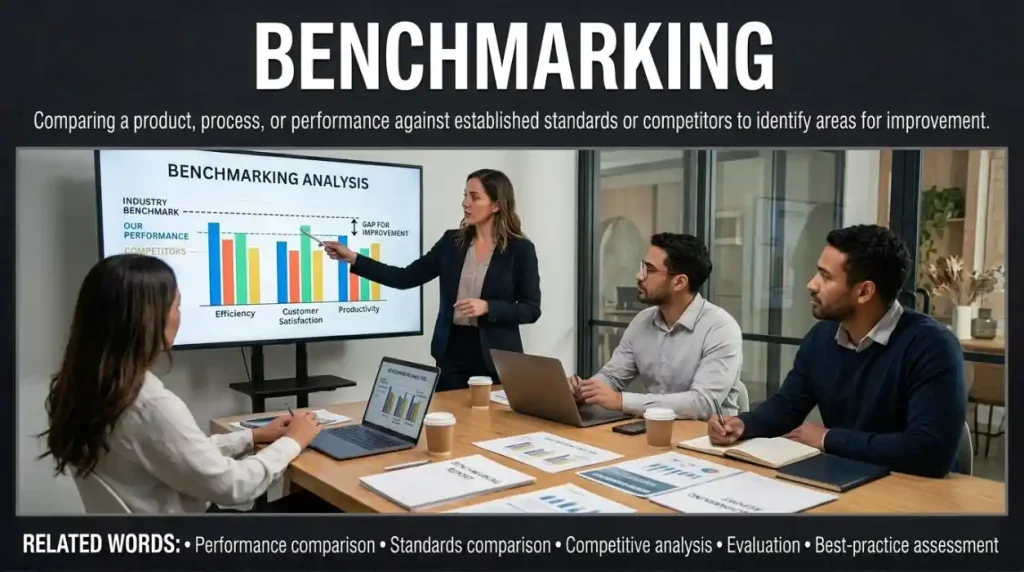
Benchmarking is the process of comparing a product, service, process, organization, or result against a reference point. That reference may be an industry standard, a competitor, a previous result, or a recognized best practice.
The goal is to understand performance, identify gaps, and discover ways to improve. For example, a school might compare its reading results with national averages. A business might compare delivery times with industry leaders.
The word is a noun formed from the verb benchmark. It can also describe an ongoing activity, as in “We are benchmarking our website performance.”
Native speakers often associate benchmarking with systematic comparison. In professional settings, it usually involves measurable criteria rather than a casual opinion. However, the word can also be used more broadly when someone compares results against a useful standard.
Connotative Meaning
(Connotation is the feeling, attitude, or association a word carries beyond its basic definition.)
- Positive tone: Improvement analysis, best-practice review, and performance optimization suggest progress and learning.
- Negative tone: Ranking, scrutiny, or competitive comparison can sound judgmental when the emphasis is on criticism or pressure.
- Neutral tone: Comparison, evaluation, measurement, and assessment describe the process without strong emotional associations.
Benchmarking is not automatically positive or negative. Its tone depends on the purpose, the standards selected, and how people use the findings.
Etymology
The word benchmark originally referred to a fixed reference mark used by surveyors. The mark provided a known point from which measurements could be made.
The word combines bench and mark. Historically, a benchmark could be a mark cut into a stable surface, such as a stone, to indicate a reference height. Over time, the idea expanded from physical measurement to general standards of comparison.
- Old English (450–1100): English had words related to benches, marks, and measuring, but benchmarking was not an established modern business term.
- Middle English (1100–1500): Forms of bench and mark continued to develop in English. Practical measuring and surveying created a need for fixed reference points.
- Modern English (1500–present): Benchmark became associated with surveying and measurement. In the twentieth century, the term gained broader use in business, management, computing, education, and performance improvement. Benchmarking came to describe comparing performance against a defined reference.
Pronunciation (US and UK IPA)
- US: /ˈbentʃˌmɑːrkɪŋ/
- UK: /ˈbentʃˌmɑːkɪŋ/
Syllables
Benchmarking: bench-mark-ing (three syllables)
Affixation Pattern
- Root/base: benchmark
- Prefix: None
- Suffix: -ing, which forms a gerund or present participle
- Word formation: Bench + mark → benchmark → benchmarking
Related forms include benchmark (noun or verb), benchmarked (past tense or participle), and benchmarking process (noun phrase).
Synonyms List
No single word replaces benchmarking in every context. Some alternatives describe comparison, others emphasize measurement, and some refer to the process of evaluating results against a standard. The following options are grouped by their main use.
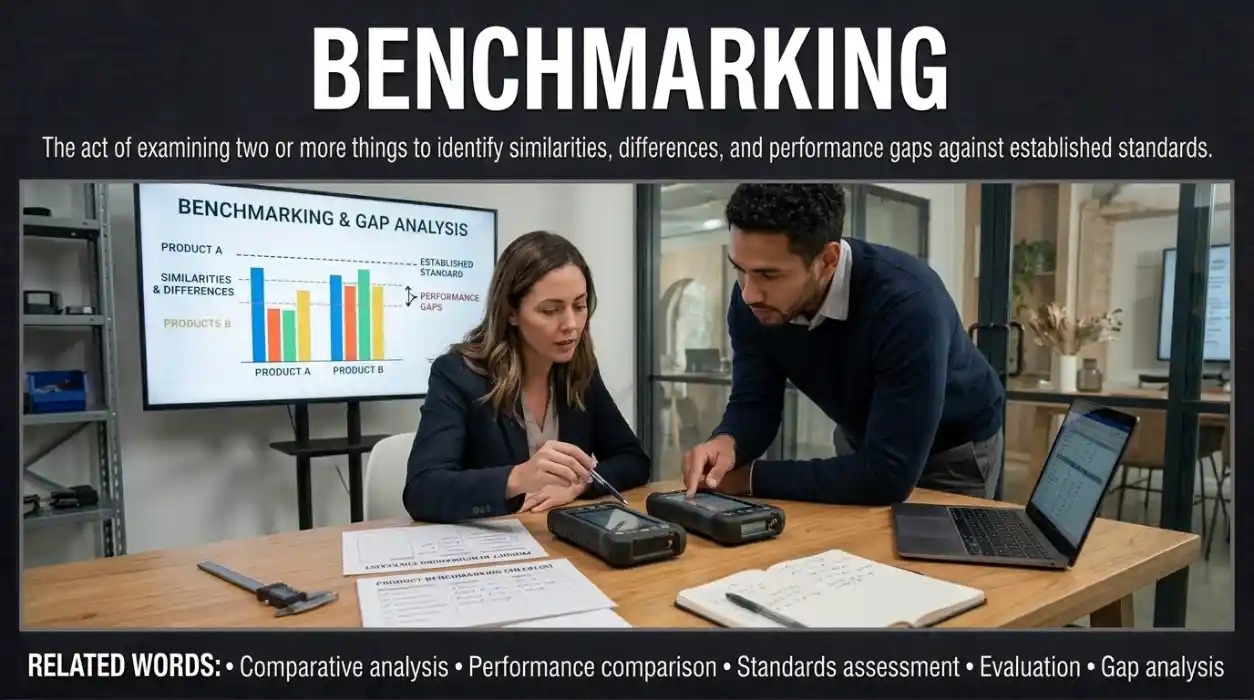
1. Comparison (noun) — US: /kəmˈpærɪsən/ | UK: /kəmˈpærɪsən/
Meaning: The act of examining two or more things to identify similarities and differences.
Tone/Register: Neutral, general, professional.
Examples:
- The report includes a comparison of delivery times across five regions.
- A comparison with last year’s results revealed steady progress.
2. Evaluation (noun) — US: /ɪˌvæljuˈeɪʃən/ | UK: /ɪˌvæljuˈeɪʃən/
Meaning: A systematic judgment of quality, effectiveness, or value.
Tone/Register: Formal, academic, professional.
Examples:
- The evaluation examined the quality of customer support.
- Our annual evaluation identified several areas for improvement.
3. Assessment (noun) — US: /əˈsesmənt/ | UK: /əˈsesmənt/
Meaning: A structured process for judging performance, ability, or condition.
Tone/Register: Neutral to formal.
Examples:
- The school completed an assessment of student progress.
- The assessment compared current outcomes with expected standards.
4. Comparative analysis (noun phrase) — US: /kəmˈpærətɪv əˈnæləsɪs/ | UK: /kəmˈpærətɪv əˈnæləsɪs/
Meaning: A detailed examination of multiple subjects to understand how they differ or resemble one another.
Tone/Register: Academic, analytical.
Examples:
- The team conducted a comparative analysis of three service models.
- A comparative analysis helped explain the differences in performance.
5. Performance comparison (noun phrase) — US: /pərˈfɔːrməns kəmˈpærɪsən/ | UK: /pəˈfɔːməns kəmˈpærɪsən/
Meaning: An examination of how well different people, systems, or organizations perform.
Tone/Register: Business, professional.
Examples:
- The performance comparison highlighted faster response times.
- Managers reviewed the performance comparison before setting targets.
6. Standards comparison (noun phrase) — US: /ˈstændərdz kəmˈpærɪsən/ | UK: /ˈstændədz kəmˈpærɪsən/
Meaning: A comparison between actual results and a set of defined standards.
Tone/Register: Formal, technical.
Examples:
- The audit included a standards comparison for safety procedures.
- The team used a standards comparison to identify missing requirements.
7. Relative assessment (noun phrase) — US: /ˈrelətɪv əˈsesmənt/ | UK: /ˈrelətɪv əˈsesmənt/
Meaning: An evaluation that judges something in relation to other examples or a reference group.
Tone/Register: Academic, analytical.
Examples:
- The relative assessment placed the results in a wider context.
- A relative assessment showed how the department compared with its peers.
8. Gap analysis (noun phrase) — US: /ˈɡæp əˌnæləsɪs/ | UK: /ˈɡæp əˌnæləsɪs/
Meaning: A method for identifying the difference between current performance and a desired state.
Tone/Register: Business, strategic.
Examples:
- The gap analysis revealed a shortage of trained staff.
- We used gap analysis to plan the next phase of improvement.
9. Peer comparison (noun phrase) — US: /pɪr kəmˈpærɪsən/ | UK: /pɪə kəmˈpærɪsən/
Meaning: Comparing a person, team, or organization with similar counterparts.
Tone/Register: Professional, academic.
Examples:
- The hospital reviewed its results through peer comparison.
- Peer comparison helped the school identify effective teaching practices.
10. Reference comparison (noun phrase) — US: /ˈrefərəns kəmˈpærɪsən/ | UK: /ˈrefərəns kəmˈpærɪsən/
Meaning: Comparing a result with a chosen reference point or example.
Tone/Register: Neutral, technical.
Examples:
- The reference comparison used last quarter’s figures.
- A reference comparison made the changes easier to interpret.
11. Performance measurement (noun phrase) — US: /pərˈfɔːrməns ˈmeʒərmənt/ | UK: /pəˈfɔːməns ˈmeʒəmənt/
Meaning: The process of measuring how effectively a person, team, or system achieves its objectives.
Tone/Register: Business, technical.
Examples:
- Performance measurement helped the company monitor service quality.
- The department revised its performance measurement criteria.
12. Metrics analysis (noun phrase) — US: /ˈmetrɪks əˌnæləsɪs/ | UK: /ˈmetrɪks əˌnæləsɪs/
Meaning: Examining numerical indicators to understand performance or trends.
Tone/Register: Analytical, business, technical.
Examples:
- Metrics analysis showed that response times had improved.
- The team used metrics analysis to review its monthly results.
13. Measurement (noun) — US: /ˈmeʒərmənt/ | UK: /ˈmeʒəmənt/
Meaning: The act of determining the size, amount, level, or value of something.
Tone/Register: Neutral, scientific, general.
Examples:
- Accurate measurement is essential for a fair comparison.
- The study used measurement to track changes over time.
14. Performance monitoring (noun phrase) — US: /pərˈfɔːrməns ˈmɑːnɪtərɪŋ/ | UK: /pəˈfɔːməns ˈmɒnɪtərɪŋ/
Meaning: The ongoing observation of results to see whether performance meets expectations.
Tone/Register: Business, technical.
Examples:
- Performance monitoring alerted the team to a service slowdown.
- The school introduced performance monitoring for its new program.
15. Progress tracking (noun phrase) — US: /ˈprɑːɡres ˌtrækɪŋ/ | UK: /ˈprəʊɡres ˌtrækɪŋ/
Meaning: Recording changes over time to understand movement toward a goal.
Tone/Register: Neutral, educational, professional.
Examples:
- Progress tracking showed that reading skills were improving.
- The project manager used progress tracking to review milestones.
16. Results analysis (noun phrase) — US: /rɪˈzʌlts əˌnæləsɪs/ | UK: /rɪˈzʌlts əˌnæləsɪs/
Meaning: Examining outcomes to understand what happened and why.
Tone/Register: Professional, academic.
Examples:
- Results analysis revealed a difference between the two groups.
- The researchers completed results analysis before publishing their findings.
17. Quantitative assessment (noun phrase) — US: /ˈkwɑːntəˌteɪtɪv əˈsesmənt/ | UK: /ˈkwɒntɪtətɪv əˈsesmənt/
Meaning: An evaluation based on numerical data or measurable values.
Tone/Register: Scientific, academic.
Examples:
- The study included a quantitative assessment of energy use.
- A quantitative assessment made the differences easier to measure.
18. KPI analysis (noun phrase) — US: /ˌkeɪ piː ˈaɪ əˌnæləsɪs/ | UK: /ˌkeɪ piː ˈaɪ əˌnæləsɪs/
Meaning: Reviewing key performance indicators to judge progress toward specific goals.
Tone/Register: Business, management.
Examples:
- KPI analysis showed that customer retention had improved.
- The leadership team reviewed KPI analysis during its monthly meeting.
19. Trend analysis (noun phrase) — US: /ˈtrend əˌnæləsɪs/ | UK: /ˈtrend əˌnæləsɪs/
Meaning: Studying data over time to identify patterns or changes.
Tone/Register: Analytical, business, academic.
Examples:
- Trend analysis revealed a seasonal rise in demand.
- The report used trend analysis to explain five years of results.
20. Outcome assessment (noun phrase) — US: /ˈaʊtkʌm əˈsesmənt/ | UK: /ˈaʊtkʌm əˈsesmənt/
Meaning: Evaluating the results or effects of an activity, program, or decision.
Tone/Register: Academic, public sector, professional.
Examples:
- The university conducted an outcome assessment of its mentoring program.
- Outcome assessment helped the team determine whether the project met its goals.

21. Standards assessment (noun phrase) — US: /ˈstændərdz əˈsesmənt/ | UK: /ˈstændədz əˈsesmənt/
Meaning: Evaluating whether a product, service, or process meets defined standards.
Tone/Register: Formal, regulatory, technical.
Examples:
- The standards assessment covered quality and safety requirements.
- The organization completed a standards assessment before the review.
22. Best-practice review (noun phrase) — US: /ˌbest ˈpræktɪs rɪˈvjuː/ | UK: /ˌbest ˈpræktɪs rɪˈvjuː/
Meaning: Examining proven methods to identify practices worth adopting or adapting.
Tone/Register: Professional, constructive.
Examples:
- The team held a best-practice review after the project ended.
- A best-practice review identified simpler ways to manage requests.
23. Quality assessment (noun phrase) — US: /ˈkwɑːləti əˈsesmənt/ | UK: /ˈkwɒləti əˈsesmənt/
Meaning: Evaluating whether something meets expected levels of quality.
Tone/Register: Neutral, professional.
Examples:
- The quality assessment found fewer errors in the latest release.
- A quality assessment is part of the school’s annual review.
24. Standards review (noun phrase) — US: /ˈstændərdz rɪˈvjuː/ | UK: /ˈstændədz rɪˈvjuː/
Meaning: Examining established standards to check relevance, compliance, or performance.
Tone/Register: Formal, regulatory.
Examples:
- The committee completed a standards review before updating its policy.
- The standards review identified outdated safety requirements.
25. Quality review (noun phrase) — US: /ˈkwɑːləti rɪˈvjuː/ | UK: /ˈkwɒləti rɪˈvjuː/
Meaning: A structured examination of quality, accuracy, or consistency.
Tone/Register: Professional, general.
Examples:
- Every report goes through a quality review before publication.
- The quality review uncovered a few missing details.
26. Compliance assessment (noun phrase) — US: /kəmˈplaɪəns əˈsesmənt/ | UK: /kəmˈplaɪəns əˈsesmənt/
Meaning: Checking whether actions or processes meet relevant rules, policies, or requirements.
Tone/Register: Formal, legal, regulatory.
Examples:
- The compliance assessment covered data-handling procedures.
- A compliance assessment helped the team prepare for the audit.
27. Process evaluation (noun phrase) — US: /ˈprɑːses ɪˌvæljuˈeɪʃən/ | UK: /ˈprəʊses ɪˌvæljuˈeɪʃən/
Meaning: Examining how a process operates and whether it works as intended.
Tone/Register: Professional, academic.
Examples:
- The process evaluation revealed unnecessary approval steps.
- The team used process evaluation to simplify its workflow.
28. Quality comparison (noun phrase) — US: /ˈkwɑːləti kəmˈpærɪsən/ | UK: /ˈkwɒləti kəmˈpærɪsən/
Meaning: Comparing the quality of different products, services, or outcomes.
Tone/Register: Neutral, professional.
Examples:
- The quality comparison considered reliability and ease of use.
- A quality comparison helped the buyer understand the differences.
29. Best-practice analysis (noun phrase) — US: /ˌbest ˈpræktɪs əˌnæləsɪs/ | UK: /ˌbest ˈpræktɪs əˌnæləsɪs/
Meaning: Studying effective methods to understand why they work and how they may be applied elsewhere.
Tone/Register: Business, academic.
Examples:
- Best-practice analysis helped the team redesign its onboarding process.
- The report included a best-practice analysis of leading schools.
30. Quality benchmarking (noun phrase) — US: /ˈkwɑːləti ˌbentʃˌmɑːrkɪŋ/ | UK: /ˈkwɒləti ˌbentʃˌmɑːkɪŋ/
Meaning: Comparing quality against a reference standard or other relevant organizations.
Tone/Register: Technical, professional.
Examples:
- Quality benchmarking helped the factory reduce defects.
- The hospital uses quality benchmarking to review patient outcomes.
31. Performance review (noun phrase) — US: /pərˈfɔːrməns rɪˈvjuː/ | UK: /pəˈfɔːməns rɪˈvjuː/
Meaning: A formal or informal examination of performance over a period.
Tone/Register: Professional, workplace.
Examples:
- Her performance review highlighted strong communication skills.
- The department scheduled a performance review at the end of the quarter.
32. Operational review (noun phrase) — US: /ˌɑːpəˈreɪʃənəl rɪˈvjuː/ | UK: /ˌɒpəˈreɪʃənəl rɪˈvjuː/
Meaning: An examination of how an organization’s day-to-day operations function.
Tone/Register: Business, management.
Examples:
- The operational review identified delays in order processing.
- Managers used the operational review to revise staffing plans.
33. Efficiency analysis (noun phrase) — US: /ɪˈfɪʃənsi əˌnæləsɪs/ | UK: /ɪˈfɪʃənsi əˌnæləsɪs/
Meaning: Studying how well resources such as time, money, or effort produce results.
Tone/Register: Business, technical.
Examples:
- Efficiency analysis showed where the team was losing time.
- The company conducted an efficiency analysis of its delivery process.
34. Productivity assessment (noun phrase) — US: /ˌproʊdʌkˈtɪvəti əˈsesmənt/ | UK: /ˌprɒdʌkˈtɪvəti əˈsesmənt/
Meaning: Evaluating how much useful output is produced from available resources.
Tone/Register: Professional, economic.
Examples:
- The productivity assessment compared output across shifts.
- The manager used the assessment to identify training needs.
35. Process comparison (noun phrase) — US: /ˈprɑːses kəmˈpærɪsən/ | UK: /ˈprəʊses kəmˈpærɪsən/
Meaning: Comparing how different workflows or procedures operate.
Tone/Register: Technical, professional.
Examples:
- The process comparison showed that one workflow required fewer steps.
- The team completed a process comparison before changing the system.
36. Continuous improvement review (noun phrase) — US: /kənˈtɪnjuəs ɪmˈpruːvmənt rɪˈvjuː/ | UK: /kənˈtɪnjuəs ɪmˈpruːvmənt rɪˈvjuː/
Meaning: A regular examination of results and methods to find ways to improve.
Tone/Register: Business, quality management.
Examples:
- The continuous improvement review produced three practical changes.
- The team holds a continuous improvement review every month.
37. Strategic assessment (noun phrase) — US: /strəˈtiːdʒɪk əˈsesmənt/ | UK: /strəˈtiːdʒɪk əˈsesmənt/
Meaning: Evaluating a situation, capability, or opportunity in relation to broader goals.
Tone/Register: Formal, executive.
Examples:
- The strategic assessment examined risks in the new market.
- Leaders used the strategic assessment to set future priorities.
38. Organizational assessment (noun phrase) — US: /ˌɔːrɡənəˈzeɪʃənəl əˈsesmənt/ | UK: /ˌɔːɡənaɪˈzeɪʃənəl əˈsesmənt/
Meaning: A structured review of an organization’s performance, structure, or capabilities.
Tone/Register: Professional, management.
Examples:
- The organizational assessment highlighted communication gaps.
- The board commissioned an organizational assessment before restructuring.
39. Capability assessment (noun phrase) — US: /ˌkeɪpəˈbɪləti əˈsesmənt/ | UK: /ˌkeɪpəˈbɪləti əˈsesmənt/
Meaning: Evaluating whether a person, team, or organization has the skills and resources needed to perform a task.
Tone/Register: Professional, technical.
Examples:
- The capability assessment identified gaps in cybersecurity skills.
- The agency completed a capability assessment before launching the project.
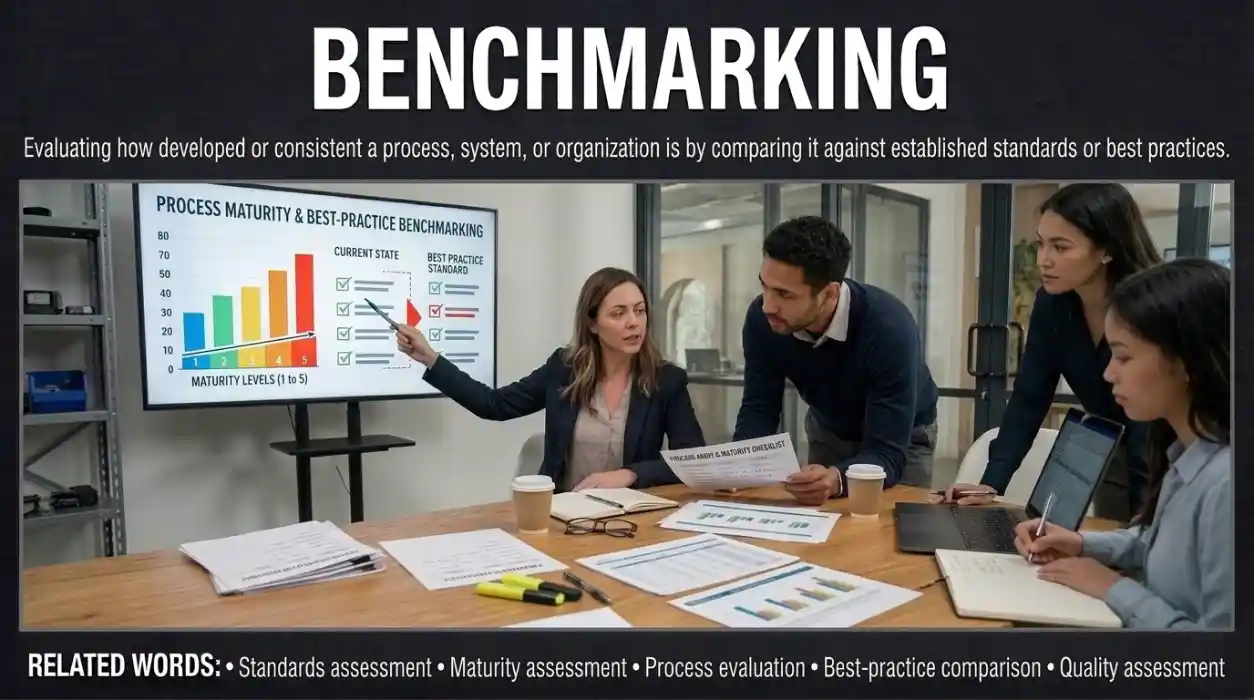
40. Maturity assessment (noun phrase) — US: /məˈtʃʊrəti əˈsesmənt/ | UK: /məˈtʃʊərəti əˈsesmənt/
Meaning: Evaluating how developed or consistent a process, system, or organization has become.
Tone/Register: Technical, strategic.
Examples:
- The maturity assessment placed the department at an early development stage.
- The team used a maturity assessment to plan future improvements.
41. Comparative evaluation (noun phrase) — US: /kəmˈpærətɪv ɪˌvæljuˈeɪʃən/ | UK: /kəmˈpærətɪv ɪˌvæljuˈeɪʃən/
Meaning: Evaluating two or more options against shared criteria.
Tone/Register: Academic, professional.
Examples:
- The comparative evaluation considered cost, reliability, and usability.
- Researchers used a comparative evaluation to examine the two methods.
42. Relative performance analysis (noun phrase) — US: /ˈrelətɪv pərˈfɔːrməns əˌnæləsɪs/ | UK: /ˈrelətɪv pəˈfɔːməns əˌnæləsɪs/
Meaning: Studying how performance compares with that of a reference group or alternative.
Tone/Register: Analytical, business.
Examples:
- Relative performance analysis showed where the branch stood among its peers.
- The team used relative performance analysis to review its results.
43. Competitive analysis (noun phrase) — US: /kəmˈpetətɪv əˌnæləsɪs/ | UK: /kəmˈpetətɪv əˌnæləsɪs/
Meaning: Examining competitors to understand their strengths, weaknesses, methods, or market position.
Tone/Register: Business, strategic.
Examples:
- The competitive analysis examined how rivals deliver customer support.
- A competitive analysis helped the company identify an unmet need.
44. Industry comparison (noun phrase) — US: /ˈɪndəstri kəmˈpærɪsən/ | UK: /ˈɪndəstri kəmˈpærɪsən/
Meaning: Comparing results or practices with those found across an industry.
Tone/Register: Business, analytical.
Examples:
- The industry comparison placed the company’s growth in context.
- An industry comparison showed that energy use was unusually high.
45. Normative comparison (noun phrase) — US: /ˈnɔːrmətɪv kəmˈpærɪsən/ | UK: /ˈnɔːmətɪv kəmˈpærɪsən/
Meaning: Comparing results with a norm or reference distribution to understand relative standing.
Tone/Register: Academic, statistical.
Examples:
- The researcher used a normative comparison to interpret test scores.
- A normative comparison showed how the sample differed from the reference group.
46. Ranking (noun/verb) — US: /ˈræŋkɪŋ/ | UK: /ˈræŋkɪŋ/
Meaning: Arranging people, products, or organizations in order according to selected criteria.
Tone/Register: Neutral, competitive.
Examples:
- The ranking considered reliability and customer satisfaction.
- The annual ranking placed the university among the region’s leading institutions.
47. Benchmark testing (noun phrase) — US: /ˈbentʃˌmɑːrk ˌtestɪŋ/ | UK: /ˈbentʃˌmɑːk ˌtestɪŋ/
Meaning: Testing a system or product using defined tasks or reference conditions to compare its performance.
Tone/Register: Technical, computing, engineering.
Examples:
- Benchmark testing showed that the updated program ran faster.
- The engineers repeated benchmark testing under consistent conditions.
48. Baseline comparison (noun phrase) — US: /ˈbeɪslaɪn kəmˈpærɪsən/ | UK: /ˈbeɪslaɪn kəmˈpærɪsən/
Meaning: Comparing current results with an initial measurement or starting point.
Tone/Register: Research, project management.
Examples:
- The baseline comparison showed progress since the project began.
- Researchers used a baseline comparison to interpret the final results.
49. External comparison (noun phrase) — US: /ɪkˈstɜːrnəl kəmˈpærɪsən/ | UK: /ɪkˈstɜːnəl kəmˈpærɪsən/
Meaning: Comparing an organization or result with information from outside its own operations.
Tone/Register: Professional, analytical.
Examples:
- The external comparison used publicly available industry data.
- An external comparison helped the team question its assumptions.
50. Reference-standard evaluation (noun phrase) — US: /ˈrefərəns ˈstændərd ɪˌvæljuˈeɪʃən/ | UK: /ˈrefərəns ˈstændəd ɪˌvæljuˈeɪʃən/
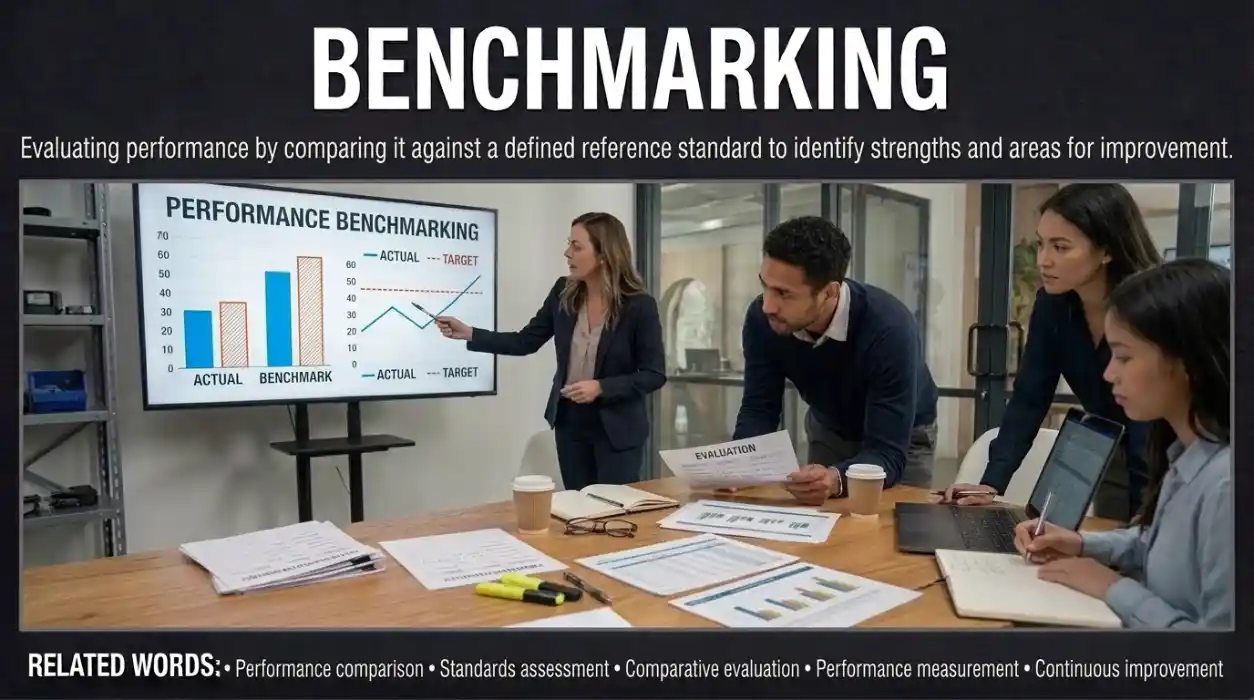
Meaning: Evaluating performance against a defined reference standard.
Tone/Register: Formal, technical.
Examples:
- The laboratory completed a reference-standard evaluation of the new method.
- A reference-standard evaluation made the results easier to validate.
Synonyms by Tone
The right wording depends on whether you want to sound neutral, analytical, encouraging, or competitive.
Positive and improvement-focused
- Best-practice review
- Continuous improvement review
- Performance measurement
- Efficiency analysis
- Capability assessment
These expressions focus on learning, progress, and practical change.
Neutral and descriptive
- Comparison
- Assessment
- Measurement
- Performance monitoring
- Baseline comparison
- Results analysis
These terms suit general explanations and factual reports.
Formal and technical
- Quantitative assessment
- Compliance assessment
- Reference-standard evaluation
- Benchmark testing
- Maturity assessment
These work well in research, engineering, auditing, and formal business documents.
Competitive or potentially negative
- Ranking
- Competitive analysis
- Peer comparison
- Relative performance analysis
These terms can be useful, but they may emphasize competition or judgment. Explain the criteria to prevent readers from interpreting the results as a simplistic measure of overall worth.
Tone matters because benchmarking can support learning or create pressure. A report that focuses on gaps and next steps often feels more constructive than one that only ranks people or teams.
“Benchmarking” vs. Close Alternatives
| Term | Main difference | Best use |
|---|---|---|
| Benchmarking | Comparing performance against a reference or recognized practice | Finding performance gaps and improvement opportunities |
| Comparison | Identifying similarities and differences | General descriptions of two or more things |
| Evaluation | Judging quality, value, or effectiveness | Reviewing a program, product, or outcome |
| Performance measurement | Quantifying performance against selected indicators | Tracking results over time |
| Gap analysis | Identifying the distance between current and desired performance | Planning specific improvements |
Quick comparison: Comparison is the broadest term. Evaluation adds judgment about quality or effectiveness. Benchmarking usually involves a reference point, while gap analysis focuses on the difference between current performance and a desired state. Use performance measurement when the emphasis is on collecting and tracking indicators.
How “Benchmarking” Changes by Context
Daily conversation:
In everyday speech, you might say, “We compared our results with last month’s figures.” This is simpler than benchmarking and works when the process is informal.
Writing and blogging:
Use comparison, performance review, or industry analysis to reduce repetition. Choose the phrase that reflects what the article actually describes. A comparison alone does not necessarily involve formal benchmarks.
Professional or academic tone:
Terms such as performance measurement, comparative evaluation, and reference-standard evaluation sound precise. Define the criteria and explain how you selected the reference group.
Creative or informal use:
In presentations or conversations, expressions such as measuring up, checking against the standard, or seeing where we stand can make the concept easier to understand. They are less formal than benchmarking but often more accessible.
Common Mistakes Learners Make
- Assuming every comparison is benchmarking: Comparing two products is not necessarily benchmarking. Benchmarking usually requires a meaningful reference point or standard.
- Confusing measurement with evaluation: Measurement collects or calculates information. Evaluation interprets that information to judge value or effectiveness.
- Using ranking as a complete substitute: A ranking orders options. It may not explain why one performs better or how improvement can happen.
- Ignoring the reference group: Comparing a small local organization with a global leader may produce misleading conclusions if their circumstances differ.
- Treating best practices as universal rules: A successful method in one organization may not work in another. Adapt it to the local context.
- Overusing technical language: In general writing, comparison or review may communicate the idea more clearly than a long technical phrase.
Register Notes
In informal conversation, comparison, review, and checking results are usually easy to understand. In formal business writing, performance measurement, gap analysis, and comparative evaluation may communicate the method more precisely.
Use technical phrases only when they describe the actual process. Clear language is more valuable than using a complex term simply to sound professional.
Real-Life Mini Scenarios
Workplace:
A customer service manager compares response times with industry figures. The manager uses benchmarking to identify delays and set a realistic improvement target.
Education:
A school compares reading results with regional averages. The comparison helps staff identify where students may need additional support.
Technology:
A developer tests two versions of an application under the same conditions. Benchmark testing reveals which version performs faster on the selected tasks.
Writing or storytelling:
A blogger explains how a small business improved delivery times. The writer uses industry comparison and performance measurement to explain the process without repeating benchmarking in every paragraph.
Practice Exercise
1. A team compares its delivery times with industry leaders to find ways to improve. What is this process called?
A. Ranking
B. Benchmarking
C. Storytelling
D. Brainstorming
2. A researcher examines similarities and differences between two teaching methods. Which term fits best?
A. Comparison
B. Compliance
C. Preservation
D. Monitoring
3. A company wants to identify the difference between its current results and its target. Which method is most suitable?
A. Trend analysis
B. Gap analysis
C. Competitive ranking
D. Peer review
4. A school measures how much students have improved since the beginning of the year. Which term best fits?
A. Progress tracking
B. Competitive analysis
C. Compliance assessment
D. Industry ranking
5. An auditor checks whether a department follows required regulations. What is this called?
A. Best-practice review
B. Compliance assessment
C. Trend analysis
D. Productivity comparison
6. A business studies rival companies to understand their strengths and weaknesses. Which term is most appropriate?
A. Competitive analysis
B. Baseline comparison
C. Outcome assessment
D. Process monitoring
7. A scientist uses numerical data to evaluate energy consumption. Which phrase fits best?
A. Informal review
B. Quantitative assessment
C. Creative comparison
D. Casual observation
8. A team wants to compare current results with its initial measurements. What should it use?
A. Baseline comparison
B. Competitive analysis
C. Quality review
D. Best-practice analysis
9. A report lists universities from highest to lowest according to selected criteria. Which term describes this order?
A. Measurement
B. Ranking
C. Gap analysis
D. Evaluation
Reflection task:
Write a sentence about a real goal, such as improving grades, website speed, or customer service. Use comparison, gap analysis, or performance measurement. Then explain why your chosen term fits.
Answer key: 1-B, 2-A, 3-B, 4-A, 5-B, 6-A, 7-B, 8-A, 9-B
External Sources
Use these established references to explore benchmarking concepts, terminology, and practical applications:
- Merriam-Webster Dictionary — definitions, word forms, and usage.
- Cambridge Dictionary — learner-friendly definitions and pronunciation.
- Oxford English Dictionary — word history and etymology.
- ASQ: American Society for Quality — quality management and process improvement concepts.
- APQC — organizational benchmarking, process improvement, and performance management.
Check specialist sources when a term has a precise meaning in a particular field. This helps ensure that your wording remains accurate as well as readable.
Conclusion
Learning synonyms for benchmarking helps you describe comparisons, measurements, and improvement efforts more precisely. The right term makes your reports and explanations easier to follow.
A broader vocabulary strengthens essays, blogs, presentations, and workplace communication. Words such as assessment, gap analysis, and performance measurement help explain different methods clearly.
Always match the term to the process. A ranking, a review, and a benchmark comparison can serve different purposes, even when they examine similar results.
Practice by writing a sentence with three new terms, then use them in an email, essay, or report. Small steps can make your English clearer and more confident.
FAQs
1. What is the best synonym for benchmarking in a business report?
The best choice depends on the process being described. Performance measurement fits when a report tracks indicators. Competitive analysis works when it examines rival organizations. Gap analysis is suitable when the report identifies differences between current results and targets. If the method compares performance with an external standard, benchmarking may remain the most accurate term.
2. Is benchmarking the same as performance measurement?
No. Performance measurement involves collecting or calculating information about results, often through indicators. Benchmarking compares those results with a reference point, such as an industry standard or another organization. Measurement can provide the data used in benchmarking, but collecting metrics alone does not necessarily mean that benchmarking has taken place.
3. What is another way to say “benchmark against industry standards”?
You could say compare performance with industry standards, evaluate results against established criteria, or measure performance relative to industry norms. In a formal report, choose the wording that reflects your method. If you are also identifying differences between current results and the required level, gap analysis may describe part of the process.
4. What is the difference between benchmarking and gap analysis?
Benchmarking compares performance with a reference point, such as a peer organization or recognized standard. Gap analysis focuses on the difference between the current state and the desired state. The two methods often work together: benchmarking can reveal how performance compares with others, while gap analysis helps identify what needs to change.
5. Can benchmarking be used in education?
Yes. Schools and universities can compare student outcomes, completion rates, attendance, or teaching practices with relevant standards or peer institutions. These comparisons can help identify strengths and areas for improvement. Results should be interpreted carefully because student populations, resources, and local circumstances can differ significantly between institutions.

Hasnain Ali is an SEO Content Strategist and the founder of wordvora.com, a trusted vocabulary platform that helps writers, students, professionals, and English learners find accurate synonyms, antonyms, word meanings, and real-life usage examples. He specializes in keyword research, on-page SEO, topical authority, and creating search-first content that aligns with Google’s latest Search Quality and E-E-A-T guidelines. His work focuses on producing clear, well-structured, and reader-friendly resources that satisfy search intent while maintaining high editorial standards.
Through extensive hands-on experience with SEO tools such as Google Search Console, Google Analytics, SEMrush, and Ahrefs, Hasnain researches user search behavior and develops content that is both informative and easy to understand. Every article published on wordvora.com is carefully reviewed for accuracy, readability, and contextual relevance before publication. His mission is to build one of the web’s most reliable English vocabulary resources by providing practical language guidance, trustworthy explanations, and content that helps readers improve their writing, communication, and vocabulary with confidence.