
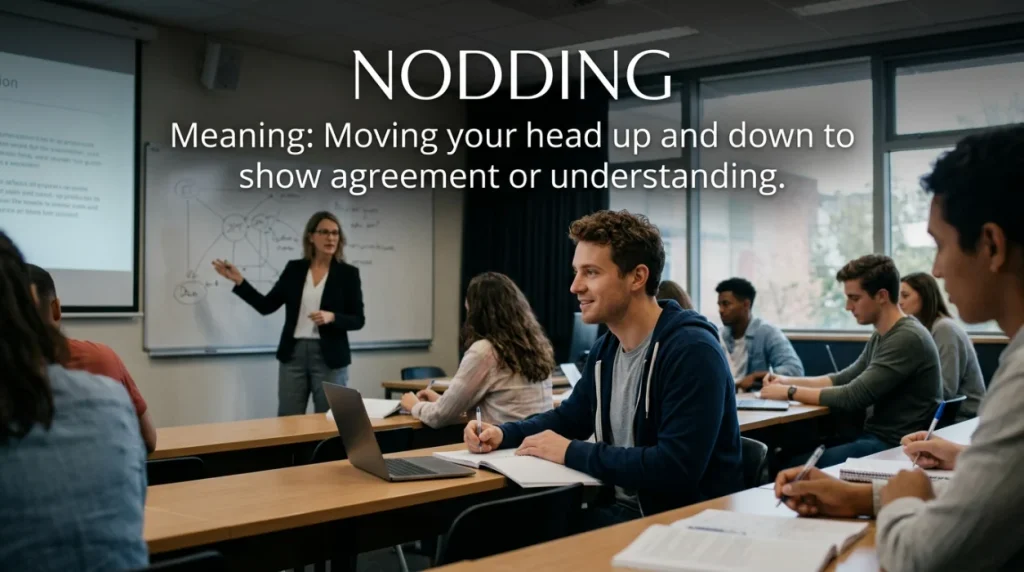
The word nodding describes the movement of moving your head up and down, often to show agreement, approval, understanding, or acknowledgment. It is a common form of nonverbal communication used in everyday conversations and social situations.
There are several synonyms and related expressions for nodding, including agreeing, acknowledging, signaling, approving, gesturing, and dipping the head. The best alternative depends on the meaning and situation in which the action is being described.
Understanding different alternatives to nodding can make your writing more descriptive and natural. These words can help you explain reactions, conversations, emotions, and gestures without repeating the same expression throughout your content.
In this article, we will explore nodding synonyms, their meanings, and useful examples. Learning these related words will help you expand your vocabulary and choose the most appropriate expression for different writing situations and contexts.
What Does “Synonyms for Nodding” Really Mean?
Nodding refers to moving your head up and down in a swift, gentle rhythm. Native speakers understand it as a universal signal for agreement, active listening, casual greeting, or quiet acceptance. Additionally, it describes the heavy droop of the head when someone feels sleepy.
The primary emotional tone is neutral, but context shifts it easily. For instance, a fast motion signals a warm greeting, whereas a slow movement can carry a reluctant tone.
Part of speech: Verb (present participle) or Gerund / Verbal Noun.
Definition: Moving the head downward and back up to signal agreement, greeting, or sleepiness.
Connotative Meaning
(Connotation is the emotional or cultural association connected to a word beyond its exact literal definition.)
- Positive tone: Expresses warm approval, active listening, genuine agreement, or a friendly hello.
- Negative tone: Suggests forced compliance, reluctant agreement, or drifting off into sleepy distraction.
- Neutral tone: Acts as a simple functional signal that shows a message was received.
Etymology
The term comes from the Middle English verb nodden (c. 1350–1400). Linguists link it to an unrecorded Old English root *hnodian or Low German dialects related to Old High German hnotōn, which originally meant “to shake, rattle, or push.”
- Old English (450–1100): Existed as a Germanic root describing physical shaking or quick movement.
- Middle English (1100–1500): Evolved into nodden, taking on the specific meaning of bowing the head in agreement.
- Modern English (1500–Present): Expanded to describe drowsy head droops, subconscious approval, and figurative endorsements.
Pronunciation
- US: /ˈnɑː.dɪŋ/
- UK: /ˈnɒd.ɪŋ/
Syllables & Structure
- Syllable breakdown: nod-ding
- Root: nod
- Prefix: None
- Suffix: -ing (present participle marker)
Synonyms List
Inclining (Verb) — US: /ɪnˈklaɪ.nɪŋ/ | UK: /ɪnˈklaɪ.nɪŋ/
Meaning: Bending or tilting the head or upper torso gracefully in a formal manner.
Tone/Register: Formal, Literary
Example:
The diplomat lowered his eyes, slowly inclining his head to accept the council’s final decision.
She greeted the distinguished panel by calmly inclining her chin toward the stage.
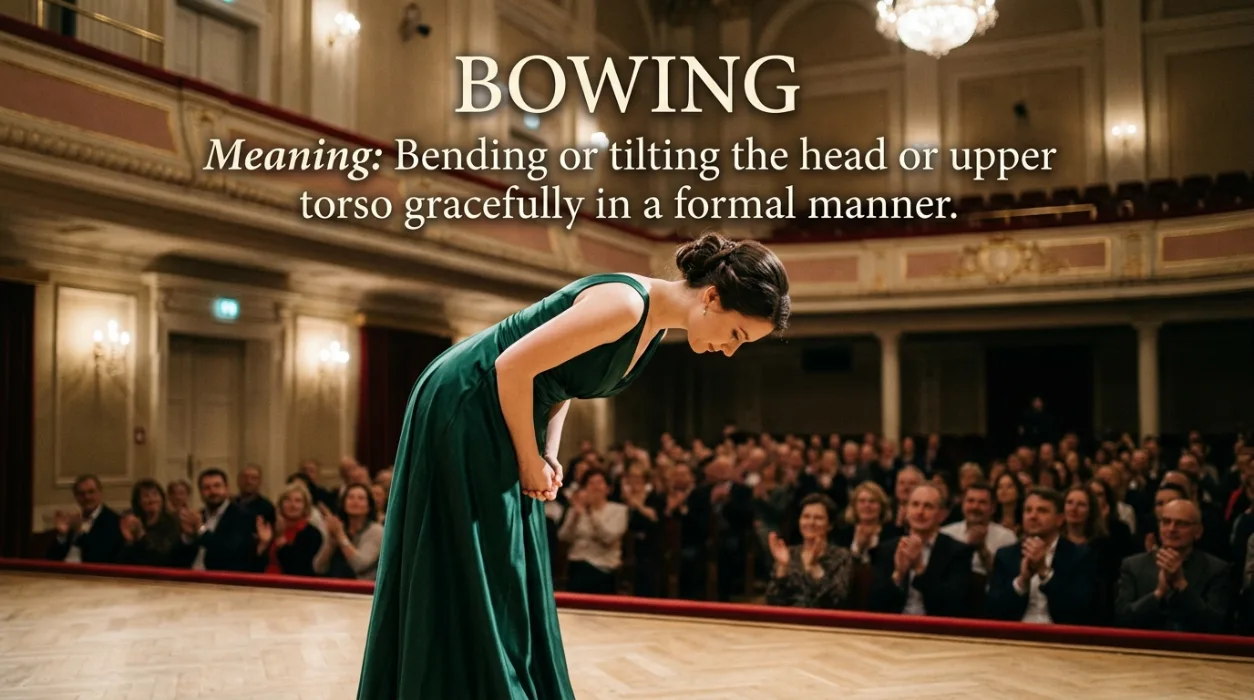
Bowing (Verb) — US: /ˈbaʊ.ɪŋ/ | UK: /ˈbaʊ.ɪŋ/
Meaning: Bending the head forward as a clear sign of respect, honor, or submission.
Tone/Register: Formal, Respectful
Example:
The instructor started the class by bowing deeply to the visiting grandmaster.
He stood near the altar, solemnly bowing his head in quiet reflection.
Gesturing (Verb) — US: /ˈdʒes.tʃɚ.ɪŋ/ | UK: /ˈdʒes.tʃər.ɪŋ/
Meaning: Making an expressive movement with the head or hands to signal an idea.
Tone/Register: Neutral, Conversational
Example:
The manager stayed quiet, simply gesturing toward the presentation slides.
She signaled her friend across the room by gesturing upward with her chin.
Signalling (Verb) — US: /ˈsɪɡ.nəl.ɪŋ/ | UK: /ˈsɪɡ.nəl.ɪŋ/
Meaning: Directing a cue to convey specific information silently to another person.
Tone/Register: Neutral, Business
Example:
The conductor was signalling the brass section to prepare for their entrance.
He caught my attention from across the room, signalling that the deal was closed.
Assenting (Verb) — US: /əˈsen.tɪŋ/ | UK: /əˈsen.tɪŋ/
Meaning: Expressing explicit formal agreement through a quiet physical motion.
Tone/Register: Formal, Academic, Legal
Example:
The committee members gave their approval by assenting with a silent movement.
She listened to the terms carefully before assenting to the project plan.
Acquiescing (Verb) — US: /ˌæk.wiˈes.ɪŋ/ | UK: /ˌæk.wiˈes.ɪŋ/
Meaning: Submitting or agreeing quietly without putting up open resistance.
Tone/Register: Formal, Literary
Example:
Rather than starting a loud debate, he ended up acquiescing to his supervisor’s demands.
She sighed softly during the talk, acquiescing with a quiet dip of her chin.
Motioning (Verb) — US: /ˈmoʊ.ʃən.ɪŋ/ | UK: /ˈməʊ.ʃən.ɪŋ/
Meaning: Using a physical movement to guide someone or show direction.
Tone/Register: Neutral, Everyday
Example:
The usher kept motioning for the arrivals to move into the side aisle.
He stepped back from the doorway, motioning for the guests to head inside.
Indicating (Verb) — US: /ˈɪn.də.keɪ.t̬ɪŋ/ | UK: /ˈɪn.dɪ.keɪ.tɪŋ/
Meaning: Showing understanding or direction through a subtle body movement.
Tone/Register: Professional, Academic
Example:
The researcher kept indicating agreement as her colleague explained the metrics.
He shifted toward the board, indicating that the trend line was rising.
Acknowledging (Verb) — US: /ækˈnɑː.lɪ.dʒɪŋ/ | UK: /əkˈnɒl.ɪ.dʒɪŋ/
Meaning: Showing that you have recognized or noticed a person or message.
Tone/Register: Neutral, Business
Example:
She walked past my desk, briefly acknowledging my presence with a tiny chin lift.
The speaker paused during the session, acknowledging the audience member.
Conceding (Verb) — US: /kənˈsiː.dɪŋ/ | UK: /kənˈsiː.dɪŋ/
Meaning: Yielding or reluctantly admitting that a point is true after an argument.
Tone/Register: Formal, Legal
Example:
After looking over the sales figures, he sat back, conceding that the error was his.
She dropped her stance on the issue, conceding to the majority opinion.
Bobbing (Verb) — US: /ˈbɑː.bɪŋ/ | UK: /ˈbɒb.ɪŋ/
Meaning: Moving the head up and down in rapid, short, rhythmic movements.
Tone/Register: Informal, Playful
Example:
The toddler sat on the floor, bobbing his head happily to the catchy song.
She wore headphones at her desk, constantly bobbing along to her favorite music.
Drooping (Verb) — US: /ˈdruː.pɪŋ/ | UK: /ˈdruː.pɪŋ/
Meaning: Bending downward heavily due to tiredness, fatigue, or weakness.
Tone/Register: Neutral, Descriptive
Example:
His eyelids felt heavy, and his tired head kept drooping lower during the study session.
The long evening train ride had almost every commuter drooping in their seats.
Dozing (Verb) — US: /ˈdoʊ.zɪŋ/ | UK: /ˈdəʊ.zɪŋ/
Meaning: Sleeping lightly or falling into a state of semi-consciousness.
Tone/Register: Informal, Everyday
Example:
Grandpa sat in his favorite comfortable armchair, dozing peacefully after lunch.
She sat near the window, slowly dozing off while reading her textbook.
Slumping (Verb) — US: /ˈslʌm.pɪŋ/ | UK: /ˈslʌm.pɪŋ/
Meaning: Leaning forward heavily with a complete collapse of posture.
Tone/Register: Informal, Descriptive
Example:
Exhausted from the long workout, he ended up slumping down onto the bench.
Her shoulders dropped forward as she sat slumping over her desk.
Tilting (Verb) — US: /ˈtɪl.t̬ɪŋ/ | UK: /ˈtɪl.tɪŋ/
Meaning: Slanting the head to one side to show interest or curiosity.
Tone/Register: Neutral, Visual
Example:
The puppy stared directly at the mirror, tilting its head in confusion.
She listened to the question carefully, tilting her head before answering.
Dipping (Verb) — US: /ˈdɪp.ɪŋ/ | UK: /ˈdɪp.ɪŋ/
Meaning: Lowering the head briefly in a swift downward motion.
Tone/Register: Neutral, Casual
Example:
He greeted his neighbor across the driveway by dipping his head casually.
She acknowledged the passing cyclist by dipping her chin in a quick salute.
Sagging (Verb) — US: /ˈsæɡ.ɪŋ/ | UK: /ˈsæɡ.ɪŋ/
Meaning: Sinking downward under heavy weight, pressure, or fatigue.
Tone/Register: Neutral, Descriptive
Example:
His heavy head kept sagging lower as he tried to stay awake through the night.
She felt her energy drop quickly, her posture sagging after hours of hard work.
Wandering (Verb) — US: /ˈwɑːn.dɚ.ɪŋ/ | UK: /ˈwɒn.dər.ɪŋ/
Meaning: Losing focus or drifting aimlessly away from the present moment.
Tone/Register: Neutral, Mental State
Example:
His attention started wandering halfway through the dry corporate lecture.
She sat near the window, her mind wandering off to memories of her trip.
Beckoning (Verb) — US: /ˈbek.ən.ɪŋ/ | UK: /ˈbek.ən.ɪŋ/
Meaning: Signaling or inviting someone to come closer using a head tilt.
Tone/Register: Descriptive, Literary
Example:
The guard stepped forward, beckoning us inside with a swift head motion.
She stood near the doorway, gently beckoning her assistant over.
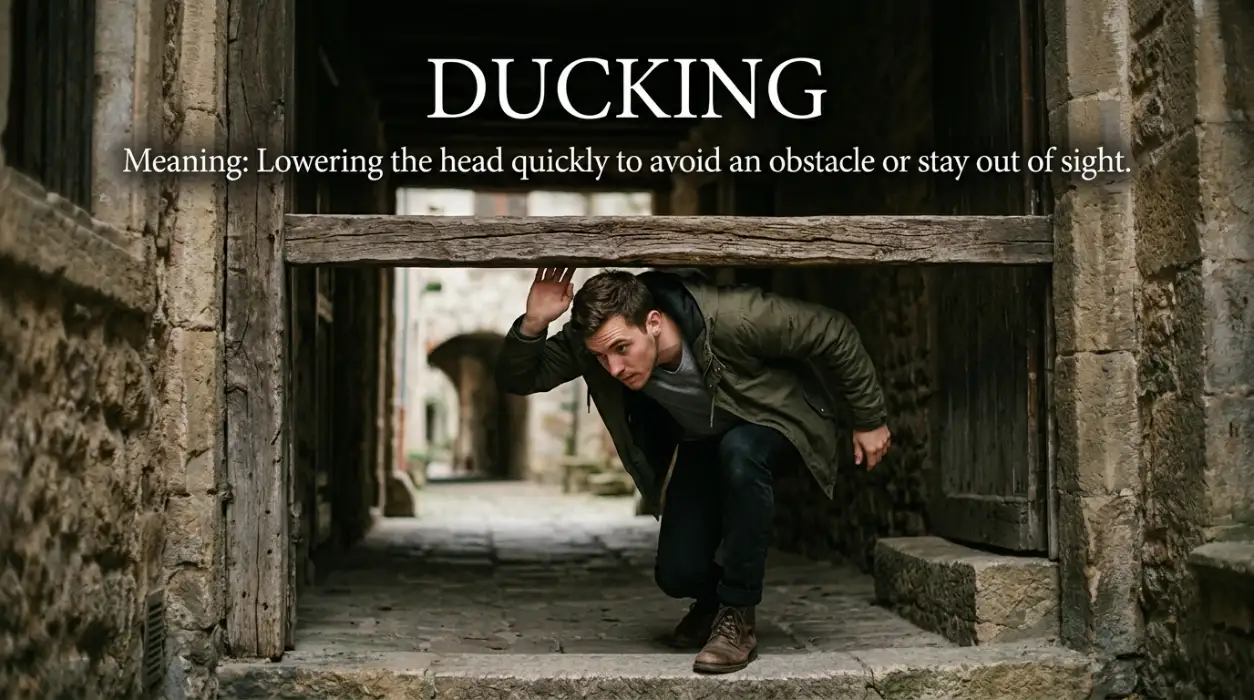
Ducking (Verb) — US: /ˈdʌk.ɪŋ/ | UK: /ˈdʌk.ɪŋ/
Meaning: Lowering the head quickly to avoid an obstacle or stay out of sight.
Tone/Register: Informal, Action
Example:
He had to duck his head quickly to clear the low doorway of the cottage.
She saw the ball flying toward her and managed to duck just in time.
Inclination (Noun) — US: /ˌɪn.kləˈneɪ.ʃən/ | UK: /ˌɪn.klɪˈneɪ.ʃən/
Meaning: A deliberate physical movement of leaning or bending the head.
Tone/Register: Formal, Literary
Example:
With a slight inclination of his head, the judge indicated that the lawyer could speak.
Her polite inclination communicated her full approval without needing words.
Assent (Noun) — US: /əˈsent/ | UK: /əˈsent/
Meaning: Official agreement expressed through words or physical cues.
Tone/Register: Formal, Legal
Example:
The board members indicated their unanimous assent with silent movements around the room.
He waited for her nod of assent before sharing the file with the team.
Gesture (Noun) — US: /ˈdʒes.tʃɚ/ | UK: /ˈdʒes.tʃər/
Meaning: A physical motion that conveys a specific thought or signal.
Tone/Register: Neutral, General
Example:
A quick downward head movement is a clear gesture of understanding in many places.
She made a subtle hand gesture to let her colleague know time was running out.
Salute (Noun) — US: /səˈluːt/ | UK: /səˈluːt/
Meaning: A formal sign of recognition, honor, or respectful greeting.
Tone/Register: Formal, Military, Respectful
Example:
The officer offered a crisp head salute as the visitors arrived at the gate.
He tipped the brim of his hat in a silent salute to the passing parade.
Drowsiness (Noun) — US: /ˈdraʊ.zi.nəs/ | UK: /ˈdraʊ.zi.nəs/
Meaning: A sleepy state where keeping your head up is difficult.
Tone/Register: Neutral, Academic
Example:
The medication caused heavy drowsiness, making it tough for him to stay upright.
She combated her afternoon drowsiness by drinking a cold glass of water.
Endorsing (Verb) — US: /ɪnˈdɔːr.sɪŋ/ | UK: /ɪnˈdɔː.sɪŋ/
Meaning: Expressing active approval or public support through physical agreement cues.
Tone/Register: Formal, Professional
Example:
The CEO sat at the table, endorsing the proposal with continuous, steady head movements.
She found herself endorsing her team’s idea before they even finished the presentation.
Sanctioning (Verb) — US: /ˈsæŋk.ʃən.ɪŋ/ | UK: /ˈsæŋk.ʃən.ɪŋ/
Meaning: Giving official authorization or explicit permission through a physical signal.
Tone/Register: Formal, Legal, Business
Example:
The director signaled his sanctioning of the budget by lowering his chin solemnly.
She gave a firm tilt, effectively sanctioning the immediate launch of the project.
Pitching (Verb) — US: /ˈpɪtʃ.ɪŋ/ | UK: /ˈpɪtʃ.ɪŋ/
Meaning: Tilting or plunging forward suddenly in a sharp downward trajectory.
Tone/Register: Descriptive, Visual
Example:
As exhaustion set in, his head kept pitching forward toward his desktop computer.
She snapped back awake after feeling her head pitching down unexpectedly during class.
Affirming (Verb) — US: /əˈfɝː.mɪŋ/ | UK: /əˈfɜː.mɪŋ/
Meaning: Confirming or validating a statement through a deliberate physical gesture.
Tone/Register: Formal, Academic
Example:
He kept affirming the witness’s testimony by maintaining steady visual eye contact and agreement.
She listened attentively, affirming every key point with a gentle downward chin tilt.
Approving (Verb) — US: /əˈpruː.vɪŋ/ | UK: /əˈpruː.vɪŋ/
Meaning: Showing that you consider something good, acceptable, or suitable.
Tone/Register: Neutral, Professional
Example:
The manager was approving each slide with a slight downward movement of her chin.
He gave an approving look across the room as his colleague completed the demonstration.
Lulling (Verb) — US: /ˈlʌl.ɪŋ/ | UK: /ˈlʌl.ɪŋ/
Meaning: Soothing someone into a relaxed, sleepy state marked by heavy head drops.
Tone/Register: Literary, Descriptive
Example:
The rhythmic hum of the train engine was lulling passengers into heavy afternoon naps.
She felt the quiet environment lulling her into a peaceful state of drowsiness.
Bowing Head (Verb Phrase) — US: /ˈbaʊ.ɪŋ hed/ | UK: /ˈbaʊ.ɪŋ hed/
Meaning: Lowering the head intentionally as an act of prayer, humility, or sorrow.
Tone/Register: Respectful, Cultural
Example:
The crowd stood in complete silence, bowing head after head during the memorial service.
She remained quiet in her seat, bowingher head forward to show respect to the elders.
Chin-Lifting (Verb / Noun Phrase) — US: /tʃɪn ˈlɪf.tɪŋ/ | UK: /tʃɪn ˈlɪf.tɪŋ/
Meaning: Raising the chin rapidly as an informal, confident, or upward gesture of greeting.
Tone/Register: Informal, Casual
Example:
He greeted his friend across the courtyard with a quick, confident chin-lifting motion.
She responded to my question with a smooth chin-lifting movement that signaled approval.
Bobbing Along (Verb Phrase) — US: /ˈbɑː.bɪŋ əˈlɑːŋ/ | UK: /ˈbɒb.ɪŋ əˈlɒŋ/
Meaning: Moving the head rhythmically in continuous sync with background music or speech.
Tone/Register: Informal, Playful
Example:
The commuters were bobbing along to the street musician’s upbeat acoustic performance.
He sat near the back of the auditorium, bobbing along to the keynote speaker’s rhythm.
Drooping Down (Verb Phrase) — US: /ˈdruː.pɪŋ daʊn/ | UK: /ˈdruː.pɪŋ daʊn/
Meaning: Descending slowly and limply because of extreme tiredness or heavy fatigue.
Tone/Register: Informal, Descriptive
Example:
After driving six straight hours, his heavy head was drooping down at every red light.
She tried focusing on her study materials, but her chin kept drooping down continuously.
Slumping Over (Verb Phrase) — US: /ˈslʌm.pɪŋ ˈoʊ.vɚ/ | UK: /ˈslʌm.pɪŋ ˈəʊ.vər/
Meaning: Collapsing forward with complete loss of muscular control or posture support.
Tone/Register: Informal, Visual
Example:
The tired student ended up slumping over her desk right after the final bell rang.
He sat slumping over the dining table after completing his double shift at work.
Nodding Off (Verb Phrase) — US: /ˈnɑː.dɪŋ ɒf/ | UK: /ˈnɒd.ɪŋ ɒf/
Meaning: Falling into a brief, unintended state of sleep while remaining seated upright.
Tone/Register: Informal, Everyday
Example:
Several audience members were nodding off during the late evening movie screening.
He kept nodding off in his armchair while trying to finish the daily news program.
Nodding Along (Verb Phrase) — US: /ˈnɑː.dɪŋ əˈlɑːŋ/ | UK: /ˈnɒd.ɪŋ əˈlɒŋ/
Meaning: Moving the head in continuous agreement with someone who is actively speaking.
Tone/Register: Conversational, Business
Example:
She sat in the front row, supportive nodding along as her teammate delivered the pitch.
The audience was nodding along enthusiastically throughout the entire keynote address.
Giving Consent (Verb Phrase) — US: /ˈɡɪv.ɪŋ kənˈsent/ | UK: /ˈɡɪv.ɪŋ kənˈsent/
Meaning: Authorizing or agreeing to a proposal non-verbally through physical signals.
Tone/Register: Formal, Professional
Example:
The supervisor was giving consent with a clear, deliberate downward motion of his head.
She indicated she was giving consent without having to interrupt the ongoing dialogue.
Granting Approval (Verb Phrase) — US: /ˈɡræn.tɪŋ əˈpruː.vəl/ | UK: /ˈɡrɑːn.tɪŋ əˈpruː.vəl/
Meaning: Formally confirming that an action, idea, or request is permitted.
Tone/Register: Formal, Business
Example:
The panel was approving the project leads with subtle, affirmative gestures.
He waited patiently until the board chair was approving taking the floor.
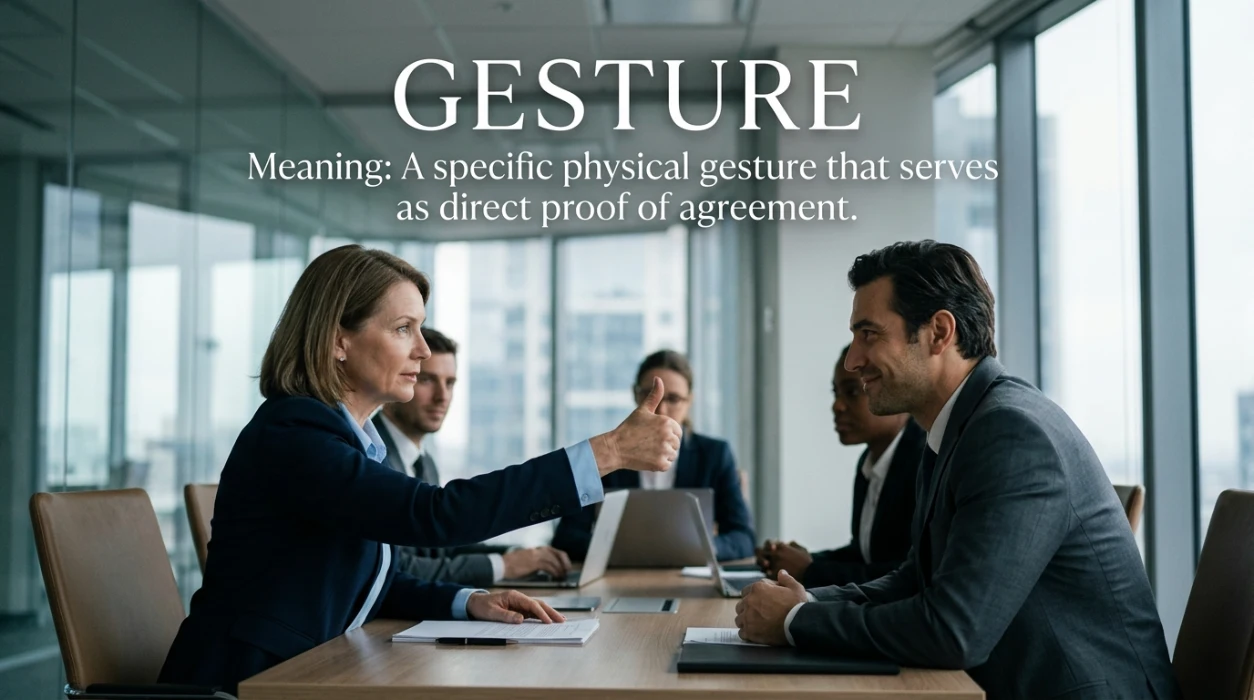
Signal of Assent (Noun Phrase) — US: /ˈsɪɡ.nəl əv əˈsent/ | UK: /ˈsɪɡ.nəl əv əˈsent/
Meaning: A specific physical gesture that serves as direct proof of agreement.
Tone/Register: Formal, Academic, Legal
Example:
His silent signal of assent was all the executive team needed to finalize the deal.
She provided a clear signal of assent to confirm her acceptance of the revised contract.
Head Motion (Noun Phrase) — US: /hed ˈmoʊ.ʃən/ | UK: /hed ˈməʊ.ʃən/
Meaning: Any general physical movement involving the head to convey non-verbal meaning.
Tone/Register: Neutral, Technical
Example:
The referee made a sharp head motion to direct the athletes toward the starting line.
Her subtle head motion indicated that we should exit the meeting room immediately.
Movement of Agreement (Noun Phrase) — US: /ˈmuːv.mənt əv əˈɡriː.mənt/ | UK: /ˈmuːv.mənt əv əˈɡriː.mənt/
Meaning: An explicit physical gesture performed to signify alignment with a thought.
Tone/Register: Formal, Academic
Example:
A clear movement of agreement rippled through the room as the speaker finished.
She offered a quick movement of agreement before taking detailed meeting notes.
Gesture of Respect (Noun Phrase) — US: /ˈdʒes.tʃɚ əv rɪˈspekt/ | UK: /ˈdʒes.tʃər əv rɪˈspekt/
Meaning: A physical tilt or bow intended to show honor, reverence, or deference.
Tone/Register: Formal, Cultural
Example:
Lowering your chin slightly upon entering the temple is considered a proper gesture of respect.
He offered a quiet gesture of respect to the elder before taking his seat at the table.
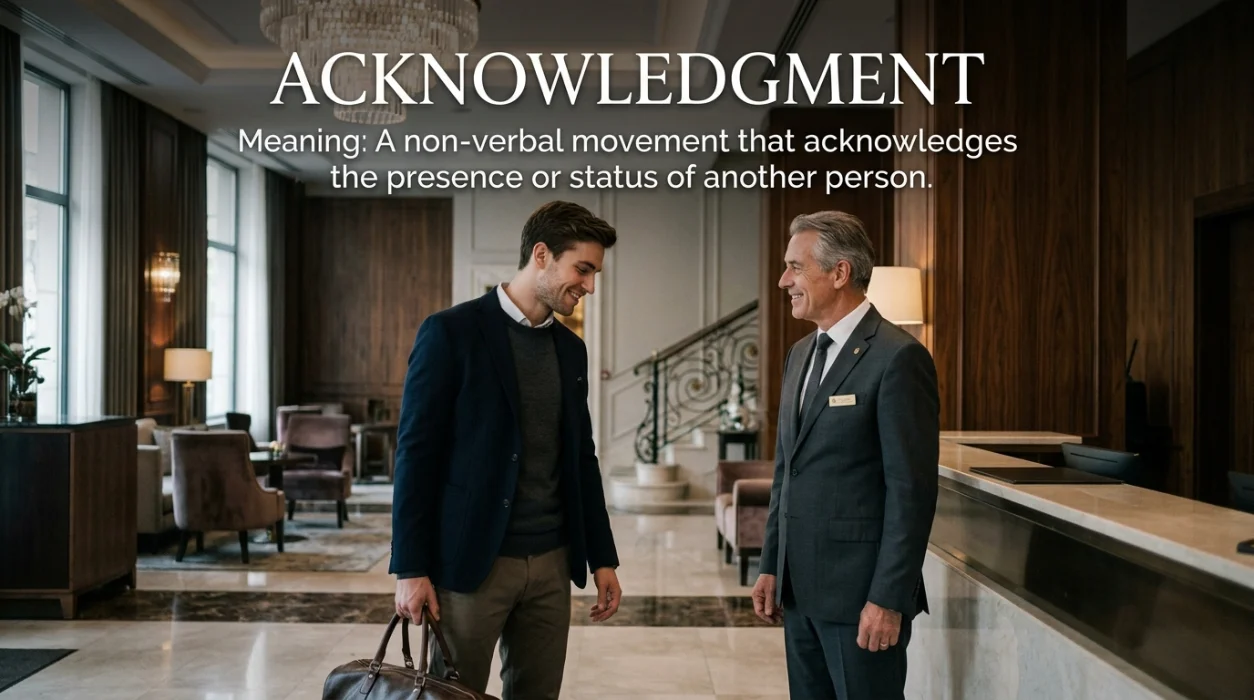
Sign of Recognition (Noun Phrase) — US: /saɪn əv ˌrek.əɡˈnɪʃ.ən/ | UK: /saɪn əv ˌrek.əɡˈnɪʃ.ən/
Meaning: A non-verbal movement that acknowledges the presence or status of another person.
Tone/Register: Neutral, Business
Example:
She gave a quick sign of recognition as her former colleague entered the lobby.
His brief chin lift served as a clear sign of recognition across the noisy, crowded hall.
Synonyms by Tone
Tone plays a vital role in vocabulary selection because picking the right word changes your character’s emotional intent. Therefore, choosing thoughtful variants adds precision to your prose.
Positive Tone
These words express warmth, respect, active agreement, or polite greeting:
- Assenting
- Bowing
- Inclining
- Acknowledging
- Affirming
- Approving
- Endorsing
- Sanctioning
- Assent
- Salute
- Giving Consent
- Granting Approval
- Signal of Assent
- Gesture of Respect
Neutral Tone
These terms carry no emotional bias and describe the movement directly:
- Gesturing
- Signalling
- Motioning
- Indicating
- Tilting
- Dipping
- Gesture
- Head Motion
- Movement of Agreement
- Sign of Recognition
Negative Tone
These words suggest tiredness, reluctance, forced agreement, or physical exhaustion:
- Acquiescing
- Conceding
- Drooping
- Slumping
- Sagging
- Pitching
- Drowsiness
- Drooping Down
- Slumping Over
Playful / Informal
These convey casual, energetic, or relaxed physical actions:
- Bobbing
- Dozing
- Wandering
- Beckoning
- Ducking
- Lulling
- Chin-Lifting
- Bobbing Along
- Nodding Off
- Nodding Along
Mini Comparison
Nodding vs. Inclining vs. Bowing
- Meaning Difference:
- Nodding is a rapid, common up-and-down movement used to show agreement.
- Inclining is a slow, controlled forward tilt showing deliberate focus or quiet dignity.
- Bowing involves bending the head and torso forward to show honor, deep submission, or formal respect.
- Tone Difference:
- Nodding is neutral, conversational, and direct.
- Inclining is elegant, literary, and formal.
- Bowing is highly ceremonial and reverent.
- When to Use Each:
- Use nodding for casual conversations, daily chats, or showing active listening.
- Use inclining in formal prose, historical fiction, or professional scenes.
- Use bowing when describing traditional cultural greetings or stage performances.
Context-Based Usage
Daily Conversation
In casual settings, people favor simple terms like nodding, bobbing, or dipping. For example, you might mention that a friend was “bobbing along to the music” or “dipping their chin in greeting.” Consequently, these choices keep spoken English smooth and friendly.
Writing or Blogging
For creative stories and blog posts, vary your verb choices to builda clear atmosphere. Words such as inclining, gesturing, or acknowledging bring depth to scenes. Thus, readers picture exact movements without encountering the same word twice.
Professional or Academic Tone
In corporate emails, academic papers, or formal speeches, rely on terms like assenting, indicating, acquiescing, or conceding. However, use them carefully. These choices show professional clarity while maintaining a sophisticated tone.
Creative or Informal Use
When writing fiction or expressive stories, select active verbs like slumping, drooping, or dozing. As a result, these vivid choices show tiredness or casual states directly to your reader.
Common Mistakes & Native Usage
Common Mistakes Learners Make
- Confusing nodding with shaking: Moving your head up and down means yes, while moving it side to side means no.
- Using formal terms in casual setups: Saying someone was “inclining his head in deep assent” at a fast-food counter sounds unnatural. Stick to “he gave a quick nod.”
- Overusing the same term: Repeating the same verb in dialogue turns writing monotonous. Instead, switch to alternatives like acknowledged, tilted her head, or signaled.
Register Notes
- Spoken English: Focus on nodding, bobbing, dozing, and gesturing.
- Written English: Utilize inclining, assenting, conceding, and acquiescing.
- For more insights on expanding your vocabulary, check out our descriptive language guide to improve your overall writing style.
Real-Life Mini Scenarios
Workplace
During an online team presentation, your camera is muted while your manager explains the quarterly plan. Instead of interrupting, you offer a clear movement toward the screen, indicating that you understand the proposed timelines.
Social Situations
You spot an old friend across a crowded coffee shop. Because shouting is impossible, you use a quick chin lift, gesturing a warm hello while acknowledging their arrival before they walk over.
Media / Pop Culture
In action movies, two partners often exchange a silent look before starting a mission. One character offers a subtle head inclination, signalling that it is time to move forward without making a sound.
Writing or Storytelling
A writer builds suspense during a courtroom scene. Rather than having the judge speak, the author describes the magistrate slowly assenting with a solemn tilt, letting readers feel the weight of the moment.
Practice Exercise
1. Which word best fits a formal business meeting where someone silently agrees to a proposal?
A) Bobbing
B) Assenting
C) Dozing
D) Ducking
2. If a character is falling asleep on a late-night train, their head is most likely:
A) Bowing
B) Inclining
C) Drooping
D) Saluting
3. What does moving the head up and down signal in Western communication?
A) Total disagreement
B) Active agreement or recognition
C) Anger
D) Confusion
4. Choose the term that best describes a child moving their head to a musical rhythm:
A) Acquiescing
B) Conceding
C) Bobbing
D) Bowing
5. Which synonym carries an elegant, polite, or formal tone?
A) Dipping
B) Inclining
C) Dozing
D) Wandering
6. If you reluctantly give in to an argument after a debate, you are:
A) Conceding
B) Bobbing
C) Slumping
D) Ducking
7. Which word is a neutral noun describing any body movement?
A) Gesture
B) Drowsiness
C) Droop
D) Compliance
8. What movement involves bending your head and upper body forward out of deep respect?
A) Tilting
B) Bowing
C) Dozing
D) Motioning
9. When a security guard signals you to enter with a head movement, they are:
A) Slumping
B) Motioning
C) Dozing
D) Sagging
10. What tone does the word “acquiescing” generally convey?
A) Playful energy
B) Reluctant agreement
C) Warm enthusiasm
D) Casual greeting
Application Task
Write one short sentence describing a person using one of the synonyms above (such as inclining, assenting, or bobbing).
Answer Key
1: B | 2: C | 3: B | 4: C | 5: B | 6: A | 7: A | 8: B | 9: B | 10: B
Conclusion
In conclusion, nodding is a common form of nonverbal communication used to show agreement, approval, understanding, or acknowledgment. It can convey meaning without the need for spoken words.
There are several useful alternatives to nodding, including agreeing, acknowledging, approving, signaling, gesturing, and dipping the head. Choosing the right expression depends on the context and the specific meaning you want to communicate.
By understanding nodding and its related synonyms, you can expand your vocabulary and make your writing more natural and descriptive. Using these alternatives appropriately can help you clearly describe gestures and reactions in different situations.
FAQs
1. What is the most common synonym for nodding in daily conversation?
The most natural everyday alternatives are gesturing, signalling, acknowledging, or giving a simple head tilt. In casual chats, native speakers often say someone “gave a quick nod” or “dipped their chin” to show agreement or hello.
2. Can synonyms for nodding express negative emotions in writing?
Yes, specific synonyms express negative or weary tones depending on context. Words like acquiescing or conceding show reluctant agreement, whereas terms like drooping or sagging show heavy fatigue, boredom, or physical exhaustion.
3. How does inclining differ from standard nodding?
Nodding is a rapid, everyday up-and-down motion used for casual agreement. In contrast, inclining is a slower, controlled forward movement of the head that conveys formal dignity, respect, or focused attention in literature.
4. How can writers avoid repeating head movement terms in dialogue?
Writers can avoid repetition by describing physical alternatives like gestured approval, tilted her chin, or lowered his head. Furthermore, using precise verbs like assented or acknowledged clarifies the character’s intent.
5. Are head agreement signals understood the same way everywhere?
While moving the head down and up signals yes in most Western countries, it is not universal. For example, in parts of Bulgaria and Greece, a single upward head movement means no, making cultural awareness essential.

Hasnain Ali is an SEO Content Strategist and the founder of wordvora.com, a trusted vocabulary platform that helps writers, students, professionals, and English learners find accurate synonyms, antonyms, word meanings, and real-life usage examples. He specializes in keyword research, on-page SEO, topical authority, and creating search-first content that aligns with Google’s latest Search Quality and E-E-A-T guidelines. His work focuses on producing clear, well-structured, and reader-friendly resources that satisfy search intent while maintaining high editorial standards.
Through extensive hands-on experience with SEO tools such as Google Search Console, Google Analytics, SEMrush, and Ahrefs, Hasnain researches user search behavior and develops content that is both informative and easy to understand. Every article published on wordvora.com is carefully reviewed for accuracy, readability, and contextual relevance before publication. His mission is to build one of the web’s most reliable English vocabulary resources by providing practical language guidance, trustworthy explanations, and content that helps readers improve their writing, communication, and vocabulary with confidence.