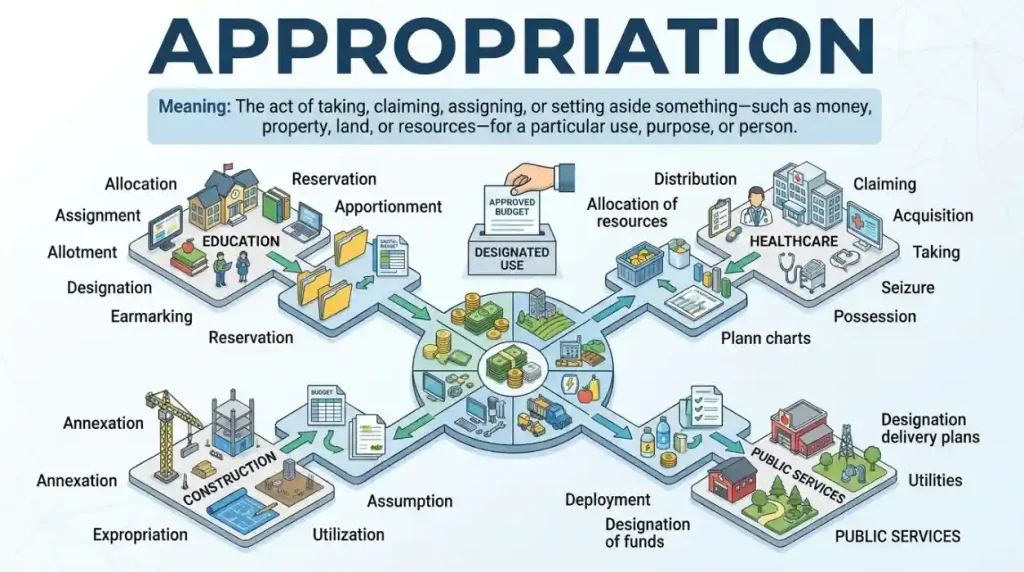
A synonym for appropriation depends on the context. Common alternatives include acquisition, taking, seizure, adoption, allocation, annexation, and misappropriation. The right word describes whether something is being claimed, borrowed, assigned, or taken without permission.
Imagine a company using an artist’s design without asking. You might describe this as unauthorized use, but misappropriation may communicate the problem more precisely.
The word appropriation appears in law, business, finance, politics, art, and cultural discussions. Its meaning changes depending on what is being taken or assigned.
Learning a synonym for appropriation helps you choose accurate words. Students can improve essays, while bloggers and content writers can explain complicated ideas more clearly.
A wider vocabulary also helps everyday English users avoid repetition. Words such as allocation, adoption, and seizure express different actions and should not be treated as identical.
What Does “Appropriation” Really Mean?
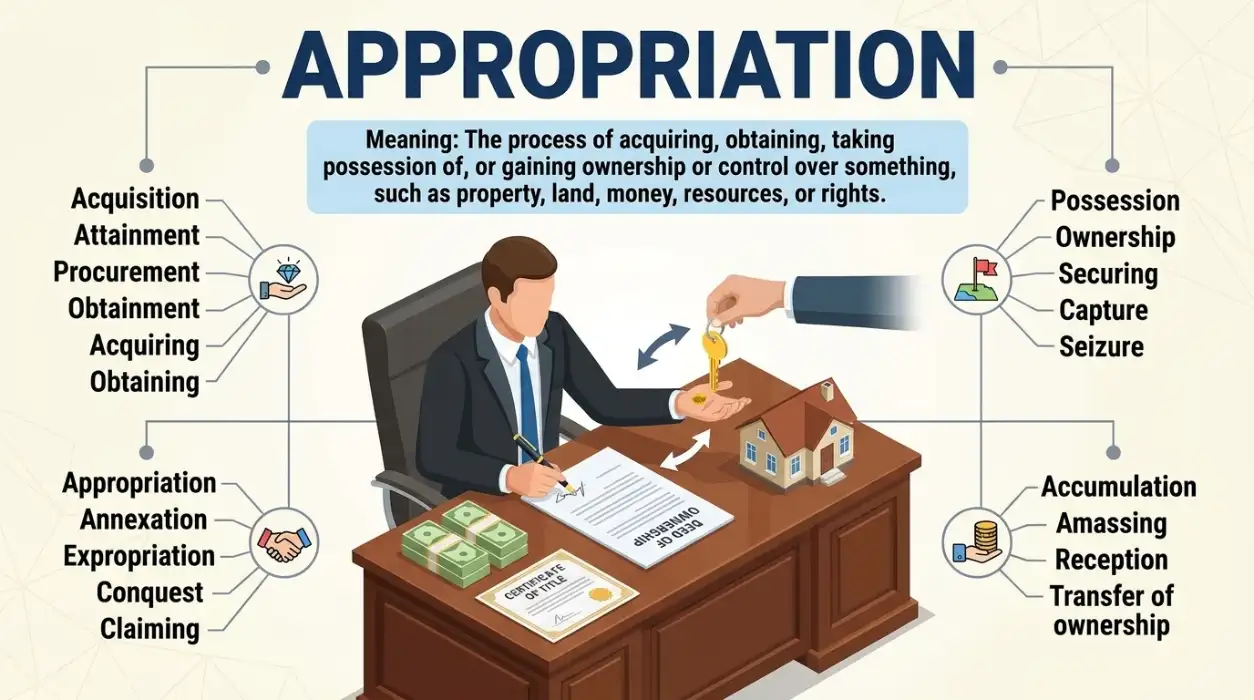
Appropriation means taking something for your own use, claiming it as your own, or setting something aside for a particular purpose. Its exact meaning depends on the context.
For example:
- Taking or claiming: The unauthorized appropriation of the artist’s work caused controversy.
- Assigning resources: The council approved the appropriation of funds for public transport.
- Cultural use: The discussion focused on the appropriation of traditional clothing by fashion brands.
Part of Speech
Appropriation is a noun. It describes an action, process, or result.
The related verb is appropriate.
- Noun: The appropriation of public funds requires oversight.
- Verb: The department will appropriate money for the project.
How Native English Speakers Understand the Word
Native speakers recognize several meanings.
- In law, it can refer to taking or using property without proper authorization. In government and finance, it often means officially assigning money for a particular purpose.
- In art and culture, it can describe borrowing or adopting existing images, styles, symbols, or traditions. The term may be neutral, critical, or controversial depending on the circumstances.
Connotative Meaning
(Connotation means the feelings, associations, or judgments a word suggests beyond its basic dictionary meaning.)
Positive tone: Appropriation can sound practical or positive when it refers to assigning resources for a useful purpose. For example, the appropriation of funds for schools may benefit a community.
Negative tone: It can suggest unfair taking, unauthorized use, or exploitation. This is especially common in discussions of intellectual property and cultural appropriation.
Neutral tone: In government budgets, accounting, and administration, appropriation can simply mean the official allocation of resources.
Etymology and History of “Appropriation”
The word appropriation entered English through French and Latin. It is related to the Latin verb appropriare, meaning to make something one’s own.
The Latin word combines ad- (to or toward) with proprius (one’s own). Its central idea is making something belong to or serve a particular person or purpose.
Old English (450–1100)
The modern word appropriation did not exist in Old English. However, Old English had words for possession, ownership, taking, and assigning things to particular uses.
The modern term developed later through Latin and French influence.
Middle English (1100–1500)
After the Norman Conquest, French and Latin contributed many words to English. Related forms of appropriation entered English during the Middle English period.
The idea of making something one’s own became associated with ownership, possession, and the assignment of resources.
Modern English (1500–Present)
The noun appropriation became established in Modern English. Its uses expanded across legal, financial, political, artistic, and cultural contexts.
Today, it can refer to government spending authority, the use of another person’s property, or the adoption of cultural material.
Pronunciation of Appropriation
- US IPA: /əˌproʊ.priˈeɪ.ʃən/
- UK IPA: /əˌprəʊ.priˈeɪ.ʃən/
Syllables: ap-pro-pri-a-tion
Part of speech: Noun
Affixation Pattern
- Root: propr — connected with the Latin idea of one’s own.
- Prefix: ad- in the Latin historical formation, changing to ap- through assimilation.
- Suffix: -ation — forms nouns describing an action, process, or result.
The word is related to appropriate, appropriated, and appropriateness. These words share a historical connection to ownership or suitability, although their modern meanings differ.
Synonyms List
The following alternatives cover the main meanings of appropriation: taking possession, unauthorized use, adopting ideas or styles, and assigning resources.
Not all 50 words are interchangeable. Some describe lawful transfers, while others suggest theft or misuse. Always consider the context before choosing a replacement.
1. Acquisition (Noun) — US / UK: /ˌæk.wəˈzɪʃ.ən/ / /ˌæk.wɪˈzɪʃ.ən/
Meaning: The process of obtaining or gaining ownership of something.
Tone/Register: Neutral to formal; common in business, finance, and everyday English.
Examples:
The company’s acquisition of new equipment improved production.
The museum announced the acquisition of several paintings.
2. Taking (Noun) — US / UK: /ˈteɪ.kɪŋ/ / /ˈteɪ.kɪŋ/
Meaning: The act of getting or removing something for personal use.
Tone/Register: Neutral; everyday English.
Examples:
The taking of private property requires legal authority.
He denied the taking of the documents.
3. Seizure (Noun) — US / UK: /ˈsiː.ʒɚ/ / /ˈsiː.ʒə/
Meaning: The act of taking possession of something, often through legal or official authority.
Tone/Register: Formal; common in legal and law-enforcement contexts.
Examples:
The court approved the seizure of the disputed assets.
Police reported the seizure of illegal goods.
4. Adoption (Noun) — US / UK: /əˈdɑːp.ʃən/ / /əˈdɒp.ʃən/
Meaning: The act of accepting or beginning to use an idea, practice, style, or method.
Tone/Register: Neutral to formal; common in business, education, and culture.
Examples:
The adoption of digital records reduced paperwork.
The designer’s adoption of traditional patterns attracted attention.
5. Allocation (Noun) — US / UK: /ˌæl.əˈkeɪ.ʃən/ / /ˌæl.əˈkeɪ.ʃən/
Meaning: The act of distributing or assigning resources for a particular purpose.
Tone/Register: Formal; common in finance, management, and government.
Examples:
The allocation of funds will support local schools.
The manager reviewed the allocation of staff hours.
6. Annexation (Noun) — US / UK: /ˌæn.ekˈseɪ.ʃən/ / /ˌæn.ekˈseɪ.ʃən/
Meaning: The act of taking territory and adding it to another country or political area.
Tone/Register: Formal; common in history, politics, and international law.
Examples:
The annexation of the territory changed the region’s borders.
Historians still debate the consequences of the annexation.
7. Misappropriation (Noun) — US / UK: /ˌmɪs.əˌproʊ.priˈeɪ.ʃən/ / /ˌmɪs.əˌprəʊ.priˈeɪ.ʃən/
Meaning: The dishonest or unauthorized use of money, property, or information.
Tone/Register: Negative and formal; common in legal and business writing.
Examples:
The audit revealed the misappropriation of company funds.
The lawsuit alleged misappropriation of confidential information.
8. Usurpation (Noun) — US / UK: /ˌjuː.sɚˈpeɪ.ʃən/ / /ˌjuː.zəˈpeɪ.ʃən/
Meaning: The act of taking power, authority, or a position without the right to do so.
Tone/Register: Formal and negative; common in politics and history.
Examples:
The general’s usurpation of power caused a political crisis.
The novel explores the usurpation of the throne.
9. Approaching (Noun) — US / UK: /əˈproʊ.tʃɪŋ/ / /əˈprəʊ.tʃɪŋ/
Meaning: This is not a direct synonym for appropriation; it means coming closer or beginning to deal with something.
Tone/Register: Neutral; everyday and professional English.
Examples:
The approaching deadline worried the team.
We discussed a new approach to the problem.
10. Confiscation (Noun) — US / UK: /ˌkɑːn.fəˈskeɪ.ʃən/ / /ˌkɒn.fɪˈskeɪ.ʃən/
Meaning: The official taking of property, usually as a penalty or under legal authority.
Tone/Register: Formal; common in legal and government contexts.
Examples:
The law allows the confiscation of prohibited items.
The court ordered the confiscation of the illegal goods.
11. Expropriation (Noun) — US / UK: /ˌek.sproʊ.priˈeɪ.ʃən/ / /ˌek.sprəʊ.priˈeɪ.ʃən/
Meaning: The taking of private property by a government, usually for public use and subject to legal rules.
Tone/Register: Formal and legal.
Examples:
The project required the expropriation of several properties.
The owners challenged the proposed expropriation.
12. Plagiarism (Noun) — US / UK: /ˈpleɪ.dʒəˌrɪ.zəm/ / /ˈpleɪ.dʒəˌrɪ.zəm/
Meaning: The presentation of another person’s words or ideas as your own without proper acknowledgment.
Tone/Register: Negative and academic.
Examples:
The university investigated the plagiarism allegation.
Proper citations help students avoid plagiarism.
13. Theft (Noun) — US / UK: /θeft/ / /θeft/
Meaning: The unlawful taking of another person’s property.
Tone/Register: Strongly negative; everyday and legal English.
Examples:
The theft of the bicycle was reported to the police.
The company introduced measures to prevent data theft.
14. Robbery (Noun) — US / UK: /ˈrɑː.bɚ.i/ / /ˈrɒb.ər.i/
Meaning: The crime of taking property from someone through force or the threat of force.
Tone/Register: Legal and negative.
Examples:
The robbery took place outside the bank.
Investigators reviewed footage of the robbery.
15. Usurpation of Rights (Noun phrase) — US / UK: /ˌjuː.sɚˈpeɪ.ʃən əv raɪts/ / /ˌjuː.zəˈpeɪ.ʃən əv raɪts/
Meaning: The improper taking or exercise of rights that belong to someone else.
Tone/Register: Formal and legal.
Examples:
The complaint described the decision as a usurpation of rights.
The debate focused on the usurpation of local authority.
16. Exploitation (Noun) — US / UK: /ˌek.splɔɪˈteɪ.ʃən/ / /ˌek.splɔɪˈteɪ.ʃən/
Meaning: The unfair use of someone or something for personal benefit.
Tone/Register: Negative; common in social, business, and cultural discussions.
Examples:
The report criticized the exploitation of vulnerable workers.
The documentary examined the exploitation of traditional knowledge.
17. Borrowing (Noun) — US / UK: /ˈbɑːr.oʊ.ɪŋ/ / /ˈbɒr.əʊ.ɪŋ/
Meaning: The act of taking and using something that belongs to another person, often with an expectation of return or acknowledgment.
Tone/Register: Neutral; everyday and academic English.
Examples:
The author’s borrowing of historical details made the story richer.
The library recorded the borrowing of rare books.
18. Appropriation of Funds (Noun phrase) — US / UK: /əˌproʊ.priˈeɪ.ʃən əv fʌndz/ / /əˌprəʊ.priˈeɪ.ʃən əv fʌndz/
Meaning: The official setting aside or authorization of money for a specific purpose.
Tone/Register: Formal; government and financial language.
Examples:
The council approved the appropriation of funds for road repairs.
The budget includes an appropriation for public libraries.
19. Assignment (Noun) — US / UK: /əˈsaɪn.mənt/ / /əˈsaɪn.mənt/
Meaning: The act of giving a task, right, or resource to a particular person or purpose.
Tone/Register: Neutral to formal; common in business and education.
Examples:
The assignment of responsibilities improved teamwork.
The department approved the assignment of additional resources.
20. Designation (Noun) — US / UK: /ˌdez.ɪɡˈneɪ.ʃən/ / /ˌdez.ɪɡˈneɪ.ʃən/
Meaning: The official selection or naming of something for a particular role or purpose.
Tone/Register: Formal and administrative.
Examples:
The designation of the land as a protected area prevented development.
The designation of funds was announced yesterday.

21. Distribution (Noun) — US / UK: /ˌdɪs.trəˈbjuː.ʃən/ / /ˌdɪs.trɪˈbjuː.ʃən/
Meaning: The process of sharing or delivering resources among people or places.
Tone/Register: Neutral to formal; business and administrative use.
Examples:
The distribution of emergency supplies began early.
Fair distribution of resources remains a priority.
22. Appropriation of Property (Noun phrase) — US / UK: /əˌproʊ.priˈeɪ.ʃən əv ˈprɑː.pɚ.ti/ / /əˌprəʊ.priˈeɪ.ʃən əv ˈprɒp.ə.ti/
Meaning: The taking or assignment of property for someone’s use or for a designated purpose.
Tone/Register: Formal and legal.
Examples:
The dispute concerned the appropriation of private property.
The agreement defined how the property could be used.
23. Incorporation (Noun) — US / UK: /ɪnˌkɔːr.pəˈreɪ.ʃən/ / /ɪnˌkɔː.pəˈreɪ.ʃən/
Meaning: The act of including something as part of a larger whole.
Tone/Register: Neutral to formal; business, academic, and creative writing.
Examples:
The incorporation of local stories strengthened the exhibition.
The report recommended the incorporation of new safety standards.
24. Integration (Noun) — US / UK: /ˌɪn.təˈɡreɪ.ʃən/ / /ˌɪn.tɪˈɡreɪ.ʃən/
Meaning: The process of combining something with an existing system or group.
Tone/Register: Neutral to formal; common in business, technology, and social contexts.
Examples:
The integration of new software improved communication.
The project encouraged the integration of traditional techniques.
25. Adaptation (Noun) — US / UK: /ˌæd.əpˈteɪ.ʃən/ / /ˌæd.əpˈteɪ.ʃən/
Meaning: The process of changing or modifying something to suit a new purpose or situation.
Tone/Register: Neutral; creative, academic, and everyday use.
Examples:
The adaptation of the novel became a successful film.
The designer’s adaptation of the original pattern was subtle.
26. Borrowed Use (Noun phrase) — US / UK: /ˈbɑːr.oʊd juːs/ / /ˈbɒr.əʊd juːs/
Meaning: The use of material or ideas taken from another source.
Tone/Register: Neutral; explanatory and academic.
Examples:
The essay discussed the borrowed use of historical imagery.
The exhibition acknowledged its borrowed use of traditional motifs.
27. Appropriation of Culture (Noun phrase) — US / UK: /əˌproʊ.priˈeɪ.ʃən əv ˈkʌl.tʃɚ/ / /əˌprəʊ.priˈeɪ.ʃən əv ˈkʌl.tʃə/
Meaning: The adoption or use of elements from another culture, sometimes without permission, context, or respect.
Tone/Register: Academic and socially sensitive.
Examples:
The article examined appropriation of culture in the fashion industry.
The discussion considered respect, credit, and cultural context.
28. Absorption (Noun) — US / UK: /əbˈzɔːrp.ʃən/ / /əbˈzɔːp.ʃən/
Meaning: The process of taking something in or incorporating it into a larger system.
Tone/Register: Neutral to formal; scientific, business, and cultural use.
Examples:
The absorption of smaller firms changed the market.
The study explored the absorption of new ideas into popular culture.
29. Assimilation (Noun) — US / UK: /əˌsɪm.əˈleɪ.ʃən/ / /əˌsɪm.ɪˈleɪ.ʃən/
Meaning: The process of adopting or absorbing characteristics, practices, or ideas from another group or system.
Tone/Register: Academic and social; can be sensitive when discussing identity and culture.
Examples:
The research examined cultural assimilation across generations.
The assimilation of new procedures took several months.
30. Co-option (Noun) — US / UK: /koʊˈɑːp.ʃən/ / /kəʊˈɒp.ʃən/
Meaning: The adoption or use of an idea, movement, or person for another group’s purposes, sometimes changing its original meaning.
Tone/Register: Formal; political, cultural, and organizational contexts.
Examples:
The activist criticized the co-option of the movement’s message.
The company faced questions about its co-option of community language.
31. Appropriation of Ideas (Noun phrase) — US / UK: /əˌproʊ.priˈeɪ.ʃən əv aɪˈdiː.əz/ / /əˌprəʊ.priˈeɪ.ʃən əv aɪˈdɪəz/
Meaning: The adoption or use of concepts developed by another person or group.
Tone/Register: Academic and professional; may be neutral or critical.
Examples:
The paper explored the appropriation of ideas in modern design.
The author acknowledged the sources behind the work.
32. Reallocation (Noun) — US / UK: /ˌriːˌæl.əˈkeɪ.ʃən/ / /ˌriːˌæl.əˈkeɪ.ʃən/
Meaning: The process of assigning resources to a different purpose or recipient.
Tone/Register: Formal; finance and management.
Examples:
The reallocation of funds helped complete the project.
Management announced a reallocation of staff responsibilities.
33. Earmarking (Noun) — US / UK: /ˈɪr.mɑːr.kɪŋ/ / /ˈɪə.mɑː.kɪŋ/
Meaning: The act of setting aside money or resources for a particular purpose.
Tone/Register: Neutral to formal; finance and government.
Examples:
The government announced the earmarking of money for hospitals.
Earmarking a portion of the budget protected the research program.
34. Reservation (Noun) — US / UK: /ˌrez.ɚˈveɪ.ʃən/ / /ˌrez.əˈveɪ.ʃən/
Meaning: The act of keeping something available for a specific person or purpose.
Tone/Register: Neutral; administrative and everyday English.
Examples:
The reservation of seats ensured space for guests.
The policy requires the reservation of funds for maintenance.
35. Appropriation of Authority (Noun phrase) — US / UK: /əˌproʊ.priˈeɪ.ʃən əv əˈθɔːr.ə.ti/ / /əˌprəʊ.priˈeɪ.ʃən əv ɔːˈθɒr.ə.ti/
Meaning: The taking or exercise of authority that may not properly belong to a person or group.
Tone/Register: Formal and critical.
Examples:
The committee questioned the appropriation of authority by the director.
The constitution limits the appropriation of executive powers.
36. Encroachment (Noun) — US / UK: /ɪnˈkroʊtʃ.mənt/ / /ɪnˈkrəʊtʃ.mənt/
Meaning: The gradual or unauthorized movement into another person’s rights, property, or space.
Tone/Register: Formal and usually negative; legal and social contexts.
Examples:
Residents complained about the encroachment onto public land.
The policy aims to prevent encroachment on personal freedoms.
37. Infringement (Noun) — US / UK: /ɪnˈfrɪndʒ.mənt/ / /ɪnˈfrɪndʒ.mənt/
Meaning: The violation of a law, right, rule, or agreement.
Tone/Register: Formal and legal.
Examples:
The court considered the infringement of copyright.
The organization challenged the infringement of its rights.
38. Violation (Noun) — US / UK: /ˌvaɪ.əˈleɪ.ʃən/ / /ˌvaɪ.əˈleɪ.ʃən/
Meaning: An act of breaking a law, rule, agreement, or right.
Tone/Register: Formal to neutral; legal and everyday use.
Examples:
The unauthorized use of the image was a violation of the agreement.
The report identified a violation of privacy.
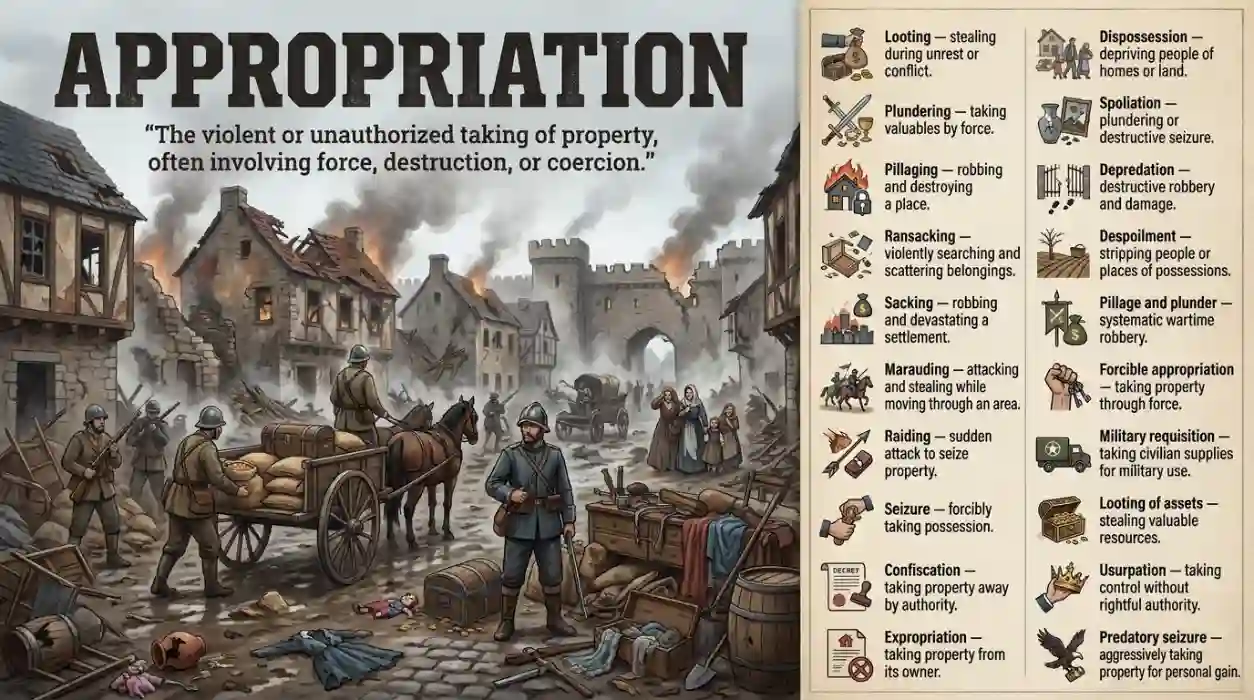
39. Plundering (Noun) — US / UK: /ˈplʌn.dɚ.ɪŋ/ / /ˈplʌn.dər.ɪŋ/
Meaning: The act of stealing or taking valuable things by force, often during conflict.
Tone/Register: Strongly negative; historical and journalistic writing.
Examples:
The documentary described the plundering of ancient treasures.
The invasion led to the plundering of local communities.
40. Pillaging (Noun) — US / UK: /ˈpɪl.ɪ.dʒɪŋ/ / /ˈpɪl.ɪ.dʒɪŋ/
Meaning: The violent or destructive taking of property, especially during war or unrest.
Tone/Register: Strongly negative; historical and literary.
Examples:
The account described the pillaging of the town.
The museum investigated objects taken during the pillaging.
41. Seizing (Noun/Gerund) — US / UK: /ˈsiː.zɪŋ/ / /ˈsiː.zɪŋ/
Meaning: The act of taking control or possession of something.
Tone/Register: Neutral to negative; depends on authority and circumstances.
Examples:
The seizing of the documents triggered a legal dispute.
The agency explained the procedure for seizing illegal goods.
42. Taking Over (Noun phrase) — US / UK: /ˌteɪ.kɪŋ ˈoʊ.vɚ/ / /ˌteɪ.kɪŋ ˈəʊ.və/
Meaning: The act of gaining control of a business, organization, property, or responsibility.
Tone/Register: Neutral; business and everyday English.
Examples:
The company’s taking over of the smaller firm attracted attention.
The new manager’s takeover went smoothly.
43. Possession (Noun) — US / UK: /pəˈzeʃ.ən/ / /pəˈzeʃ.ən/
Meaning: The state of owning, holding, or controlling something.
Tone/Register: Neutral; legal and everyday contexts.
Examples:
The documents remained in her possession.
The transfer gave the buyer possession of the property.
44. Claiming (Noun/Gerund) — US / UK: /ˈkleɪ.mɪŋ/ / /ˈkleɪ.mɪŋ/
Meaning: The act of asserting that something belongs to you or that you have a right to it.
Tone/Register: Neutral to formal.
Examples:
The claiming of the land led to a dispute.
The artist challenged the claiming of credit for her work.
45. Appropriation of Credit (Noun phrase) — US / UK: /əˌproʊ.priˈeɪ.ʃən əv ˈkred.ɪt/ / /əˌprəʊ.priˈeɪ.ʃən əv ˈkred.ɪt/
Meaning: The unfair taking of recognition for work or achievements completed by someone else.
Tone/Register: Negative; professional and academic.
Examples:
The employee complained about the appropriation of credit for her research.
The team agreed to recognize each contributor fairly.
46. Requisition (Noun) — US / UK: /ˌrek.wəˈzɪʃ.ən/ / /ˌrek.wɪˈzɪʃ.ən/
Meaning: A formal request or official demand for supplies, property, or resources.
Tone/Register: Formal; administrative, military, and business contexts.
Examples:
The department submitted a requisition for new computers.
The emergency requisition covered essential medical supplies.
47. Procurement (Noun) — US / UK: /prəˈkjʊr.mənt/ / /prəˈkjʊə.mənt/
Meaning: The process of obtaining goods or services, usually through an organized purchasing procedure.
Tone/Register: Formal and professional; business and government.
Examples:
The procurement of medical equipment took several weeks.
The agency revised its procurement policy.
48. Collection (Noun) — US / UK: /kəˈlek.ʃən/ / /kəˈlek.ʃən/
Meaning: The process of gathering or bringing things together.
Tone/Register: Neutral; everyday, business, and academic English.
Examples:
The collection of historical materials took years.
The project involved the collection of public records.
49. Utilization (Noun) — US / UK: /ˌjuː.t̬əl.əˈzeɪ.ʃən/ / /ˌjuː.tɪ.laɪˈzeɪ.ʃən/
Meaning: The act of putting something to practical use.
Tone/Register: Formal and technical.
Examples:
The utilization of available resources improved efficiency.
The report measured the utilization of public facilities.
50. Deployment (Noun) — US / UK: /dɪˈplɔɪ.mənt/ / /dɪˈplɔɪ.mənt/
Meaning: The organized use or positioning of people, equipment, or resources for a particular purpose.
Tone/Register: Formal; business, military, and technology contexts.
Examples:
The deployment of additional staff reduced waiting times.
The deployment of funds supported the emergency response.
Synonyms by Tone
The emotional effect of a synonym matters. Some words describe a routine administrative action. Others suggest unfairness, force, or a violation of rights.
Neutral or Administrative Alternatives
Use these when something is being obtained, assigned, or incorporated without implying wrongdoing:
- Acquisition
- Allocation
- Assignment
- Designation
- Distribution
- Adoption
- Incorporation
- Integration
- Reallocation
- Earmarking
- Reservation
- Procurement
- Utilization
- Deployment
Example: “The allocation of funds will support the new library.” This describes a planned financial decision without suggesting misconduct.
Negative or Critical Alternatives
These words suggest unauthorized taking, unfair use, or a violation:
- Misappropriation
- Theft
- Seizure
- Confiscation
- Usurpation
- Exploitation
- Plagiarism
- Encroachment
- Infringement
- Violation
- Plundering
- Pillaging
Example: “The misappropriation of public funds prompted an investigation.” This clearly suggests improper use.
Cultural and Creative Alternatives
These words can describe borrowing, adapting, or incorporating existing material:
- Adoption
- Borrowing
- Adaptation
- Assimilation
- Co-option
- Incorporation
- Integration
- Absorption
Example: “The adaptation of traditional patterns gave the collection a distinctive style.”
The choice between these words depends on whether the use is respectful, authorized, credited, or exploitative.
“Appropriation” vs. Close Alternatives
| Word | Meaning | Tone | When to use it |
|---|---|---|---|
| Appropriation | Taking something for use or assigning it to a purpose | Neutral or negative | General, legal, cultural, and financial contexts |
| Allocation | Assigning resources for a specific purpose | Neutral | Budgets, staffing, and planning |
| Acquisition | Obtaining ownership or control | Neutral | Business purchases, collections, and property |
| Misappropriation | Improper or unauthorized use | Negative | Financial misconduct and misuse of property |
| Expropriation | Government taking private property for public use | Formal and legal | Property and public-interest disputes |
Which Word Is Most Accurate?
Use allocation when money or resources are assigned to a particular purpose. Choose acquisition when ownership is obtained through a purchase or another legitimate process.
Use misappropriation when something is used dishonestly or without proper authorization. Choose expropriation for the legally specific act of government taking private property, subject to applicable law.
How “Appropriation” Changes by Context
Daily Conversation
In everyday English, people often use simpler words such as taking, borrowing, or using.
For example, “He took my idea without asking” sounds more natural in casual conversation than “He engaged in the appropriation of my idea.”
Writing and Blogging
Bloggers can choose adoption, borrowing, misuse, or misappropriation depending on the issue.
If discussing fashion, music, or cultural traditions, explain whether the subject involves respectful inspiration or a lack of acknowledgment. Avoid treating all cultural exchange as appropriation.
Professional and Academic Writing
In finance, allocation and appropriation are useful when discussing authorized budgets.
In law, misappropriation, infringement, and expropriation have more specific meanings. Check the relevant legal context before replacing one term with another.
Creative and Informal Writing
Writers may use borrowing, adaptation, or incorporation to describe the use of existing ideas or styles.
A novelist who adapts a folk tale is not necessarily misappropriating it. The surrounding details determine whether the use is respectful, authorized, or controversial.
Common Mistakes Learners Make
1. Confusing Appropriation With Misappropriation
Appropriation can be neutral. Misappropriation specifically suggests improper or unauthorized use.
For example, an approved government budget appropriation is not the same as the misappropriation of public money.
2. Treating Allocation and Appropriation as Identical
Both words can relate to resources. However, allocation emphasizes distribution or assignment, while appropriation can refer to formal authorization or setting aside resources.
3. Using Theft for Every Kind of Appropriation
Theft usually means unlawful taking of property. Cultural appropriation, for example, does not automatically mean theft in the legal sense.
Choose a word that accurately describes the situation.
4. Confusing Copyright Infringement With Plagiarism
Copyright infringement concerns the violation of legal rights in protected work. Plagiarism concerns presenting another person’s work or ideas as your own without proper acknowledgment. They can overlap, but they are not identical.
5. Assuming Cultural Appropriation Always Means Cultural Exchange
Cultural exchange can involve mutual sharing and respect. Cultural appropriation often raises concerns about unequal power, lack of acknowledgment, commercial exploitation, or removing cultural material from its context.
6. Using Legal Terms Without Checking Their Meaning
Words such as expropriation, confiscation, and usurpation have distinct legal or political implications. Do not use them simply because they sound formal.
Register Notes
- Formal and legal: Expropriation, confiscation, infringement, usurpation.
- Financial and administrative: Allocation, designation, earmarking, requisition.
- Academic and cultural: Assimilation, co-option, adaptation, incorporation.
- Everyday: Taking, borrowing, use, acquisition.
In conversation, plain language is often clearer. In academic writing, select the term that accurately reflects the process and its consequences.
For further vocabulary practice, explore a related lesson on synonyms for misappropriation and learn how to distinguish authorized use from misuse.
Real-Life Mini Scenarios
Workplace
An employee uses a colleague’s research in a presentation without giving credit. This may be described as the appropriation of ideas or, depending on the circumstances, plagiarism.
Social Situations
A person uses a traditional cultural symbol without understanding its significance. Friends may discuss cultural appropriation and the importance of context and respect.
Media and Pop Culture
A fashion company adopts designs inspired by a traditional community. The discussion may focus on cultural borrowing, adaptation, acknowledgment, and possible exploitation.
Writing and Storytelling
A novelist adapts a traditional folk tale. The writer should consider attribution, permission where necessary, and whether the adaptation respects the source material.

Practice Exercise
1. A city council officially sets aside money to repair roads. Which word fits best?
A. Misappropriation
B. Allocation
C. Theft
D. Plundering
2. A company uses another artist’s design without permission. Which term is most suitable?
A. Misappropriation
B. Distribution
C. Procurement
D. Reservation
3. A business purchases another company. Which word describes the process?
A. Infringement
B. Acquisition
C. Confiscation
D. Encroachment
4. A government takes private land for a public project under legal authority. Which term is most precise?
A. Borrowing
B. Expropriation
C. Plagiarism
D. Integration
5. A student presents another writer’s work as their own. What is this called?
A. Adaptation
B. Plagiarism
C. Allocation
D. Assimilation
6. A department assigns employees to different projects. Which word fits?
A. Assignment
B. Theft
C. Pillaging
D. Usurpation
7. A court orders authorities to take illegal goods. Which word is most appropriate?
A. Confiscation
B. Incorporation
C. Adoption
D. Collection
8. A designer modifies an existing pattern to suit a new collection. Which word best describes the process?
A. Robbery
B. Adaptation
C. Infringement
D. Usurpation
9. A person takes power without having the legal right to do so. Which term fits?
A. Distribution
B. Usurpation
C. Earmarking
D. Utilization
10. A company unfairly uses workers for its own benefit. Which word describes the behavior?
A. Exploitation
B. Acquisition
C. Integration
D. Procurement
Reflection Task
Write two original sentences using different synonyms for appropriation. Use one example involving a legitimate allocation of resources and another involving unauthorized use of someone else’s work.
Answer Key: 1-B, 2-A, 3-B, 4-B, 5-B, 6-A, 7-A, 8-B, 9-B, 10-A
External Sources for Further Learning
Consult these established references for definitions, pronunciation, etymology, and specialist explanations:
- Merriam-Webster Dictionary: https://www.merriam-webster.com/
- Cambridge Dictionary:
- Oxford Learner’s Dictionaries:
- Cornell Legal Information Institute:
- Online Etymology Dictionary:
Conclusion
Learning a synonym for appropriation helps you explain ownership, resource allocation, cultural borrowing, and unauthorized use with greater accuracy and confidence.
A stronger vocabulary improves essays, blogs, professional reports, and everyday communication. It also helps you avoid confusing neutral actions with unfair or unlawful behavior.
Remember that allocation, acquisition, and misappropriation describe different processes. The right choice depends on the facts, context, and tone.
Practice these words in emails, essays, and daily conversations. Write your own examples, check their meanings, and build confidence with precise English.
FAQs
1. What is the best synonym for appropriation in a legal document?
The best alternative depends on the legal action being described. Misappropriation refers to improper use of property or funds. Expropriation concerns government taking private property for public use. Confiscation describes official seizure. Legal writers should choose the term that matches the facts and the relevant law.
2. What is another word for appropriation of money?
Allocation, designation, and earmarking are useful alternatives when money is officially assigned to a purpose. Reallocation means assigning it to a different purpose. If someone uses money dishonestly or without authorization, misappropriation is more accurate. The distinction matters in budgets, audits, and financial reports.
3. What is the difference between appropriation and cultural appropriation?
Appropriation broadly means taking something for one’s use or assigning it to a purpose. Cultural appropriation specifically concerns adopting or using elements of another culture. It can become controversial when the use ignores cultural significance, lacks acknowledgment, or involves unequal power and commercial exploitation.
4. Is appropriation always illegal?
No. Appropriation is not automatically illegal. Governments can legally appropriate funds through authorized budget processes, and artists may legitimately adopt or adapt existing ideas. Whether an act is unlawful depends on ownership, permission, applicable law, and the circumstances. Misappropriation is the more specific term for improper use.
5. What is the difference between appropriation and infringement?
Appropriation is a broad term for taking or using something, or assigning it to a purpose. Infringement means violating a legal right, rule, or agreement. Unauthorized appropriation of copyrighted material may also involve copyright infringement, but the terms do not have identical meanings.

Hasnain Ali is an SEO Content Strategist and the founder of wordvora.com, a trusted vocabulary platform that helps writers, students, professionals, and English learners find accurate synonyms, antonyms, word meanings, and real-life usage examples. He specializes in keyword research, on-page SEO, topical authority, and creating search-first content that aligns with Google’s latest Search Quality and E-E-A-T guidelines. His work focuses on producing clear, well-structured, and reader-friendly resources that satisfy search intent while maintaining high editorial standards.
Through extensive hands-on experience with SEO tools such as Google Search Console, Google Analytics, SEMrush, and Ahrefs, Hasnain researches user search behavior and develops content that is both informative and easy to understand. Every article published on wordvora.com is carefully reviewed for accuracy, readability, and contextual relevance before publication. His mission is to build one of the web’s most reliable English vocabulary resources by providing practical language guidance, trustworthy explanations, and content that helps readers improve their writing, communication, and vocabulary with confidence.