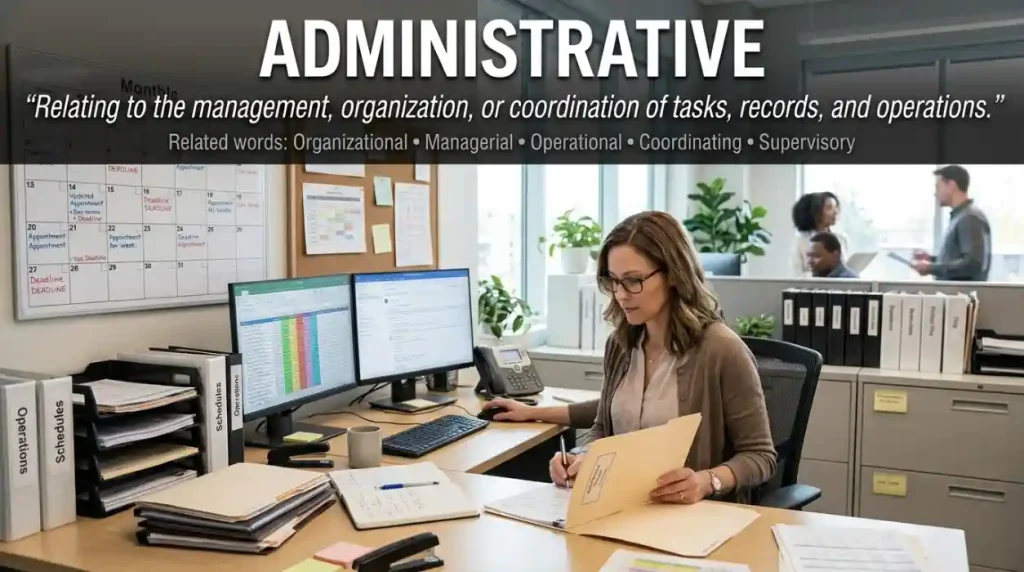
A synonym for administrative is a word that describes work related to organizing, managing, or operating an organization. Common alternatives include managerial, organizational, executive, clerical, and operational. The best choice depends on whether you mean office paperwork, leadership, coordination, or routine business support.
Imagine describing your job as administrative. That is accurate, but it may not explain your daily duties. If you organize schedules and records, clerical may fit. If you coordinate departments, organizational may be more precise.
The word administrative appears frequently in job descriptions, business reports, education, and government documents. It helps explain the systems and tasks that keep an organization running smoothly.
Learning alternatives improves vocabulary and reduces repetition. Students can write clearer assignments, bloggers can create more engaging articles, and content writers can describe workplace responsibilities accurately.
For everyday English users, the right synonym makes messages easier to understand. Choosing between managerial, procedural, and clerical can reveal exactly what a task involves.
What Does “Administrative” Really Mean?
Administrative is an adjective that describes activities related to organizing, managing, coordinating, or supporting the operation of a business, institution, department, or government body.
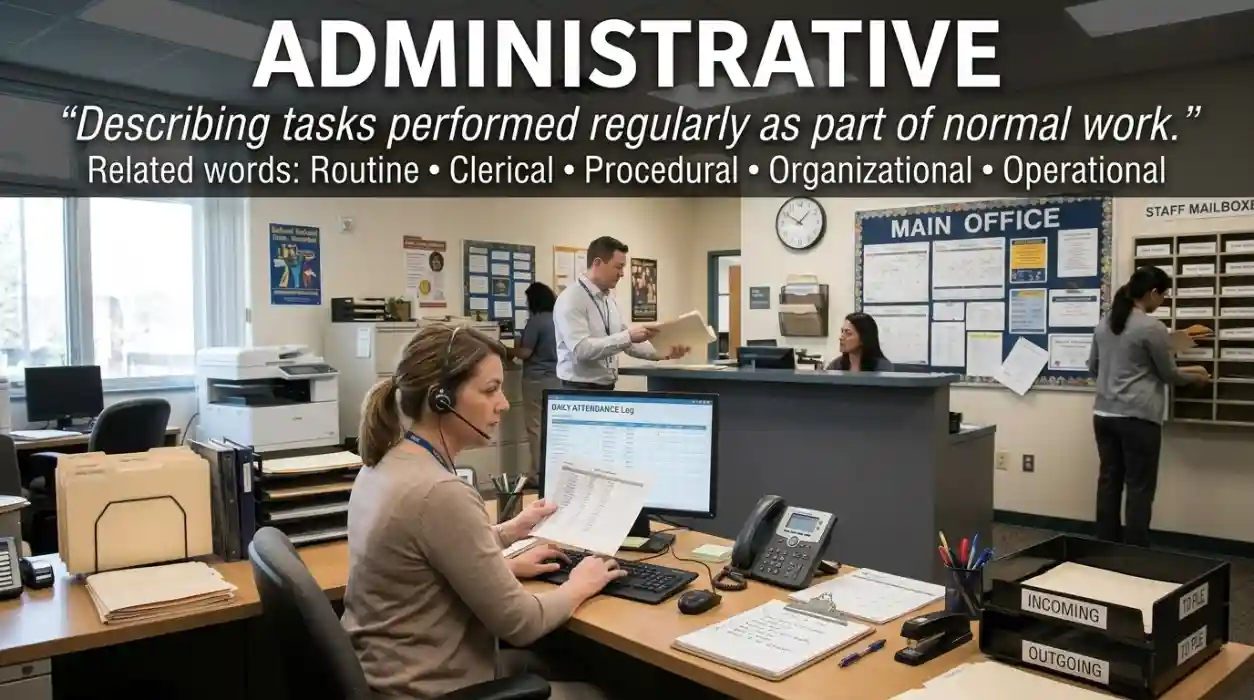
It often refers to tasks such as scheduling meetings, maintaining records, preparing documents, processing requests, coordinating staff, and managing procedures. In government, it can also describe the organization and operation of public authorities.
Native speakers commonly use the word in phrases such as:
- Administrative assistant
- Administrative duties
- Administrative support
- Administrative procedures
- Administrative decision
- Administrative department
For example, “She handles administrative duties” usually means she takes care of organizational tasks rather than the main technical or creative work.
The word does not always mean simple paperwork. An administrative decision can involve rules, authority, and organizational policy.
Connotative Meaning
(Connotation is the emotional or social association a word carries beyond its basic meaning.)
- Positive tone: Efficient, well-organized, and coordinated can emphasize the value of administrative work.
- Negative tone: Bureaucratic can suggest excessive rules, delays, or unnecessary paperwork.
- Neutral tone: Administrative, clerical, and procedural usually describe the nature of a task without praising or criticizing it.
The tone depends on context. Administrative work can be essential, complex, and highly skilled. It should not automatically be treated as unimportant.
Etymology
The word administrative comes from Latin through the vocabulary of administration and management. It is related to Latin administrare, meaning to manage, assist, direct, or attend to something. The Latin elements connect the idea of acting or attending with service.
According to Etymonline, administrative is recorded in English from 1731, originally referring to the management of public affairs. Its use later broadened across businesses, institutions, and other organized systems.
Old English (450–1100)
The modern word administrative was not part of Old English vocabulary. People organized households, communities, and rulers’ affairs, but they used different words and expressions to describe those activities.
Middle English (1100–1500)
English absorbed many French and Latin terms during this period. The related verb administer entered English through Old French and Latin influences, developing meanings connected with managing, helping, and directing.
Modern English (1500–Present)
The adjective administrative emerged in the eighteenth century. It became increasingly useful as governments, businesses, schools, and other institutions developed formal systems of management and recordkeeping.
Today, the word applies to office duties, organizational systems, public administration, and the procedures that support institutional operations.
Pronunciation,
- US IPA: /ædˈmɪn.ɪˌstreɪ.t̬ɪv/
- UK IPA: /ədˈmɪn.ɪ.strə.tɪv/
Pronunciation differs slightly between American and British English. In both varieties, the main stress falls on the second syllable.
Syllables: ad-min-is-tra-tive
Affixation pattern
- Root: administer / administration
- Prefix: ad- is part of the Latin historical formation; modern English speakers generally learn administrative as a complete word.
- Suffix: -ive, which commonly forms adjectives relating to an action, role, or quality.
- Word formation: An adjective formed from the administration word family.
Related forms include administer (verb), administration (noun), administrator (noun), and administratively (adverb).
Synonyms List
Not every alternative below is an exact synonym. Administrative covers several related ideas, including paperwork, office support, management, and organizational procedures. Choose the word that matches the specific meaning of your sentence.
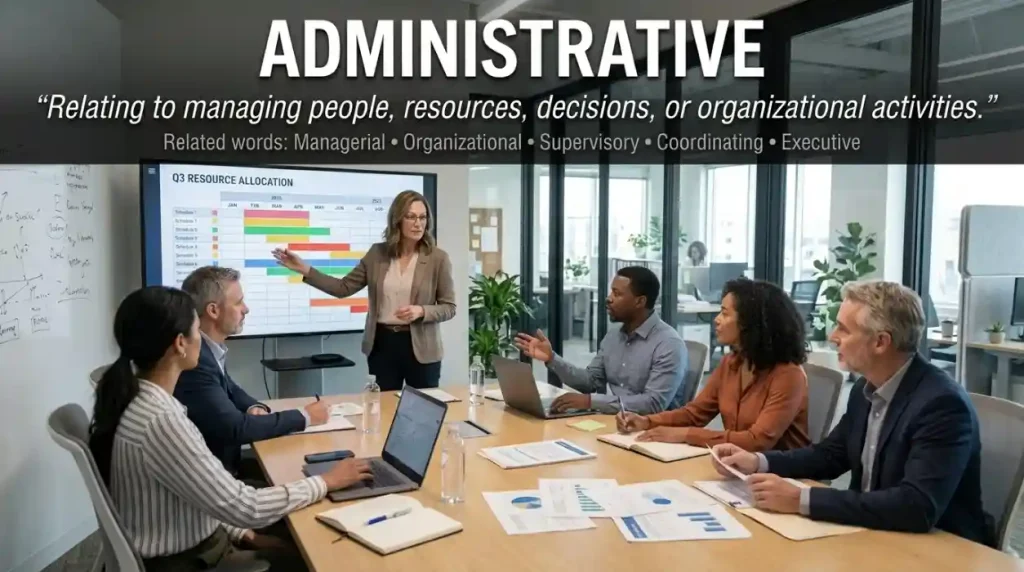
1. Managerial (Adjective) — US: /ˌmæn.əˈdʒɪr.i.əl/ | UK: /ˌmæn.əˈdʒɪə.ri.əl/
Meaning: Relating to managing people, resources, decisions, or organizational activities.
Tone/Register: Professional, business, formal.
Examples:
She has strong managerial responsibilities in the regional office.
He moved into a managerial position after five years.
2. Organizational (Adjective) — US: /ˌɔːr.ɡə.nəˈzeɪ.ʃən.əl/ | UK: /ˌɔː.ɡən.aɪˈzeɪ.ʃən.əl/
Meaning: Relating to the structure, coordination, or functioning of an organization.
Tone/Register: Neutral, academic, professional.
Examples:
The role requires excellent organizational skills.
We reviewed the company’s organizational structure.
3. Operational (Adjective) — US: /ˌɑː.pəˈreɪ.ʃən.əl/ | UK: /ˌɒp.əˈreɪ.ʃən.əl/
Meaning: Relating to the practical activities and processes that keep a business or service running.
Tone/Register: Business, technical, neutral.
Examples:
She coordinates operational activities across three branches.
The team introduced new operational procedures.
4. Clerical (Adjective) — US: /ˈkler.ɪ.kəl/ | UK: /ˈkler.ɪ.kəl/
Meaning: Relating mainly to routine office tasks such as filing, recordkeeping, and data entry.
Tone/Register: Office, formal, neutral.
Examples:
The position includes clerical duties and document management.
He completed the clerical work before lunch.
5. Executive (Adjective) — US: /ɪɡˈzek.jə.tɪv/ | UK: /ɪɡˈzek.jə.tɪv/
Meaning: Relating to the implementation of decisions or, in many contexts, senior management.
Tone/Register: Corporate, formal.
Examples:
The executive team approved the new policy.
She provides executive support to the director.
Note: Executive can imply senior authority, so it is not interchangeable with every use of administrative.
6. Managerial-support (Compound expression)
Meaning: Describing assistance that helps managers coordinate people, information, or tasks.
Tone/Register: Professional, business.
Examples:
The position combines managerial-support duties with scheduling.
Our department needs better managerial support during busy periods.
Usage note: Managerial support is more natural as a noun phrase than as a single adjective.
7. Coordinative (Adjective) — US: /koʊˈɔːr.dən.eɪ.tɪv/ | UK: /kəʊˈɔː.dɪ.nə.tɪv/
Meaning: Relating to the coordination of people, activities, or processes.
Tone/Register: Technical, formal.
Examples:
The project requires a strong coordinative role across departments.
Her work includes coordinative responsibilities for the annual conference.
Usage note: This word is relatively uncommon. Coordinating or coordination-related is often more natural.
8. Supervisory (Adjective) — US: /ˌsuː.pɚˈvaɪ.zɚ.i/ | UK: /ˌsuː.pəˈvaɪ.zər.i/
Meaning: Relating to overseeing people, tasks, or work quality.
Tone/Register: Professional, workplace.
Examples:
The position includes supervisory duties for a small team.
He completed supervisory training last month.
9. Procedural (Adjective) — US: /prəˈsiː.dʒɚ.əl/ | UK: /prəˈsiː.dʒər.əl/
Meaning: Relating to established steps, rules, or methods for completing a task.
Tone/Register: Formal, legal, academic.
Examples:
We resolved the procedural issue before approving the application.
The handbook explains the procedural requirements.
10. Bureaucratic (Adjective) — US: /ˌbjʊr.əˈkræt̬.ɪk/ | UK: /ˌbjʊə.rəˈkræt.ɪk/
Meaning: Relating to a system of official rules and procedures, sometimes with a negative implication of excessive complexity.
Tone/Register: Formal, often critical.
Examples:
The approval process became unnecessarily bureaucratic.
Small businesses often struggle with bureaucratic delays.
Usage note: This word can sound critical. It is not a neutral replacement in every sentence.
11. Office-related (Adjective)
Meaning: Connected with an office environment, its work, or its responsibilities.
Tone/Register: Neutral, conversational.
Examples:
My office-related responsibilities include booking rooms and updating records.
She prefers office-related work to frequent travel.
12. Secretariat (Noun, context-specific)
Meaning: An office or department that provides organizational and clerical support to an institution or committee.
Tone/Register: Formal, governmental, institutional.
Examples:
The secretariat prepared the meeting documents.
Please send the completed forms to the committee secretariat.
Usage note: Secretariat names an office or department, not an adjective. Use it only when that is the intended meaning.
13. Administrative support (Compound expression)
Meaning: Describing assistance with paperwork, scheduling, records, and routine organizational tasks.
Tone/Register: Professional, workplace.
Examples:
The nonprofit needs additional administrative support.
He provides administrative support to several project managers.
14. Organizationally focused (Adjective phrase)
Meaning: Emphasizing how a group, institution, or set of activities is arranged and coordinated.
Tone/Register: Academic, professional.
Examples:
The course takes an organizationally focused approach to leadership.
Her report examines the problem from an organizational perspective.
15. Management-related (Adjective)
Meaning: Connected with directing a team, planning work, or making management decisions.
Tone/Register: Business, neutral.
Examples:
The internship includes management-related assignments.
He wants to develop management-related skills.
16. Logistical (Adjective) — US: /ləˈdʒɪs.tɪ.kəl/ | UK: /ləˈdʒɪs.tɪ.kəl/
Meaning: Relating to the practical arrangements needed to organize an activity or deliver something.
Tone/Register: Professional, operational.
Examples:
We handled the logistical details of the workshop.
The trip requires careful logistical planning.
17. Supportive (Adjective) — US: /səˈpɔːr.tɪv/ | UK: /səˈpɔː.tɪv/
Meaning: Providing help or encouragement rather than directing an entire organization.
Tone/Register: Positive, general.
Examples:
The team created a supportive working environment.
Her role is supportive rather than managerial.
Usage note: This describes a quality or approach, not necessarily administrative duties.
18. Organizational management (Compound expression)
Meaning: Relating to the way an organization is structured, directed, and maintained.
Tone/Register: Academic, business.
Examples:
The program covers organizational management principles.
She is studying organizational management at university.
Usage note: The noun phrase organizational management is more idiomatic than the hyphenated form.
19. Supervisory support (Compound expression)
Meaning: Assistance provided to supervisors as they manage teams and daily tasks.
Tone/Register: Workplace, professional.
Examples:
The coordinator offers supervisory support to new team leaders.
They requested extra support during the staff transition.
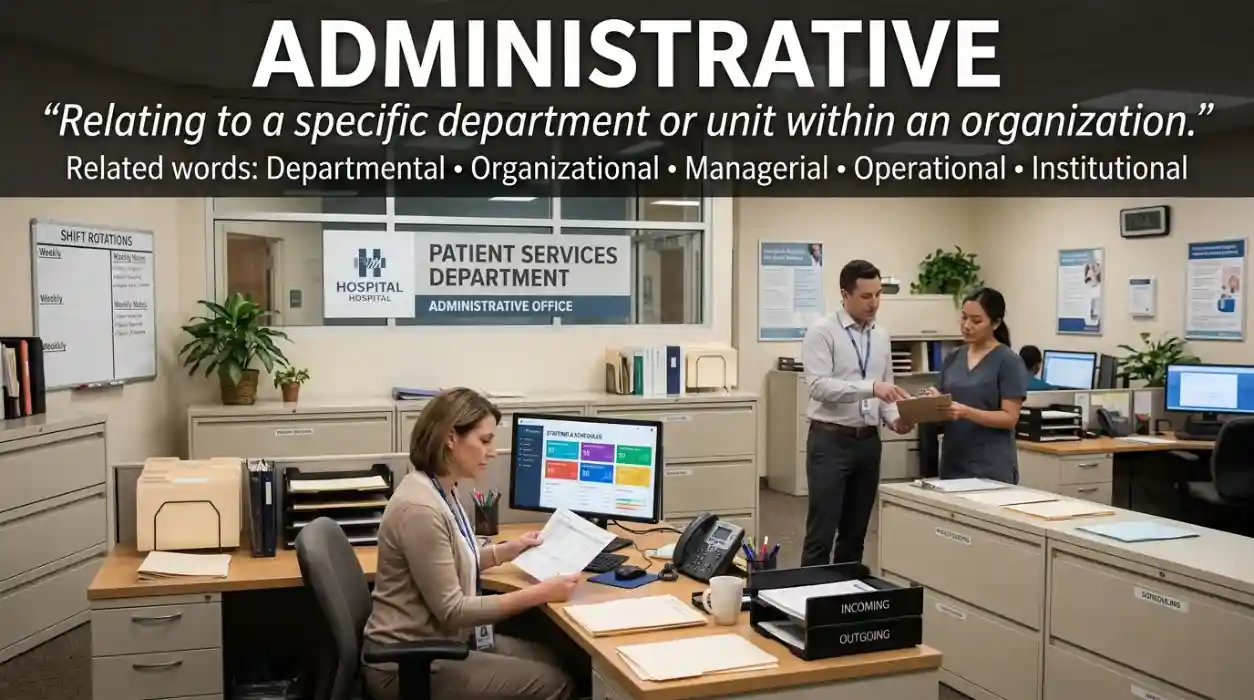
20. Departmental (Adjective) — US: /ˌdiː.pɑːrtˈmen.t̬əl/ | UK: /ˌdiː.pɑːtˈmen.təl/
Meaning: Relating to a particular department within an organization.
Tone/Register: Formal, business, academic.
Examples:
We discussed departmental budgets at the meeting.
The new policy affects departmental procedures.
21. Institutional (Adjective) — US: /ˌɪn.stəˈtuː.ʃən.əl/ | UK: /ˌɪn.stɪˈtjuː.ʃən.əl/
Meaning: Relating to an established organization, such as a university, hospital, or government body.
Tone/Register: Academic, formal.
Examples:
The research examines institutional policies.
She works in institutional planning at the university.
22. Governmental (Adjective) — US: /ˌɡʌv.ɚnˈmen.t̬əl/ | UK: /ˌɡʌv.ənˈmen.təl/
Meaning: Relating to a government or its departments and activities.
Tone/Register: Formal, public-sector.
Examples:
The report reviews governmental procedures.
He specializes in governmental affairs.
23. Regulatory (Adjective) — US: /ˈreɡ.jə.lə.tɔːr.i/ | UK: /ˈreɡ.jʊ.lə.tər.i/
Meaning: Relating to rules, standards, or the oversight used to control an activity.
Tone/Register: Legal, technical, formal.
Examples:
The company must meet regulatory requirements.
She works on regulatory compliance for the agency.
24. Compliance-related (Adjective)
Meaning: Connected with following laws, rules, policies, or professional standards.
Tone/Register: Business, legal.
Examples:
His responsibilities include compliance-related documentation.
The audit identified several compliance-related issues.
25. Recordkeeping (Noun or attributive noun)
Meaning: The activity of maintaining accurate records and documents.
Tone/Register: Office, professional.
Examples:
Accurate recordkeeping helps the team track applications.
The job includes recordkeeping and database updates.
Usage note: This is a specific task, not a full synonym for administrative.
26. Documentation-related (Adjective)
Meaning: Connected with preparing, maintaining, or reviewing documents.
Tone/Register: Technical, professional.
Examples:
The role includes documentation-related responsibilities.
We streamlined documentation-related procedures.
27. Secretariat-related (Adjective phrase)
Meaning: Connected with the work or functions of a secretariat.
Tone/Register: Institutional, formal.
Examples:
The committee assigned secretariat-related tasks to two officers.
Her experience includes secretariat-related duties for public meetings.
Usage note: This is a specialized phrase rather than a common general-purpose synonym.
28. Organizational coordination (Compound expression)
Meaning: Referring to the coordination of activities, schedules, or responsibilities across an organization.
Tone/Register: Professional, technical.
Examples:
Organizational coordination is essential during a major restructure.
The role focuses on coordination across several departments.
29. Planning-related (Adjective)
Meaning: Connected with deciding in advance how tasks, resources, or events should be arranged.
Tone/Register: Neutral, professional.
Examples:
She handles planning-related tasks for the annual event.
The course includes planning-related exercises.
30. Scheduling (Noun or attributive noun)
Meaning: The process of arranging times for appointments, meetings, or activities.
Tone/Register: Neutral, workplace.
Examples:
Scheduling takes up part of his morning.
The assistant manages scheduling for the entire department.
31. Coordination (Noun)
Meaning: The process of organizing different people or activities so they work together effectively.
Tone/Register: Neutral, professional.
Examples:
The event requires coordination between several teams.
Better coordination reduced the number of missed deadlines.
32. Management (Noun)
Meaning: The act or process of directing work, resources, or people.
Tone/Register: Professional, general.
Examples:
Project management keeps the work on schedule.
Good management helps employees understand their priorities.
33. Organization (Noun)
Meaning: The arrangement of people, tasks, or resources into an effective structure.
Tone/Register: Neutral, general.
Examples:
Organization is essential when several deadlines overlap.
Her organization of the files saved the team time.
34. Office administration (Noun phrase)
Meaning: The day-to-day management of office procedures, records, communication, and resources.
Tone/Register: Professional, standard.
Examples:
He studied office administration at college.
Office administration includes scheduling, correspondence, and record management.
35. Business operations (Noun phrase)
Meaning: The routine activities through which a business delivers its products or services.
Tone/Register: Business, professional.
Examples:
She helps improve business operations across the company.
The new system reduced delays in business operations.
36. Executive support (Noun phrase)
Meaning: Professional assistance provided to senior leaders with schedules, communication, documents, and priorities.
Tone/Register: Corporate, formal.
Examples:
He provides executive support to the chief operating officer.
Executive support often requires discretion and excellent organization.
37. Office management (Noun phrase)
Meaning: The coordination of office resources, procedures, facilities, and daily work.
Tone/Register: Professional, practical.
Examples:
Office management is part of her new role.
The course covers office management and communication.
38. Back-office (Adjective or noun)
Meaning: Relating to internal business functions that support an organization rather than directly serving customers.
Tone/Register: Business, industry-specific.
Examples:
The company moved several back-office functions to a shared service center.
He works in back-office operations.
39. Support services (Noun phrase)
Meaning: Services that help an organization or its main teams function effectively.
Tone/Register: Neutral, institutional.
Examples:
The school expanded its support services.
Facilities and records management are part of the department’s support services.
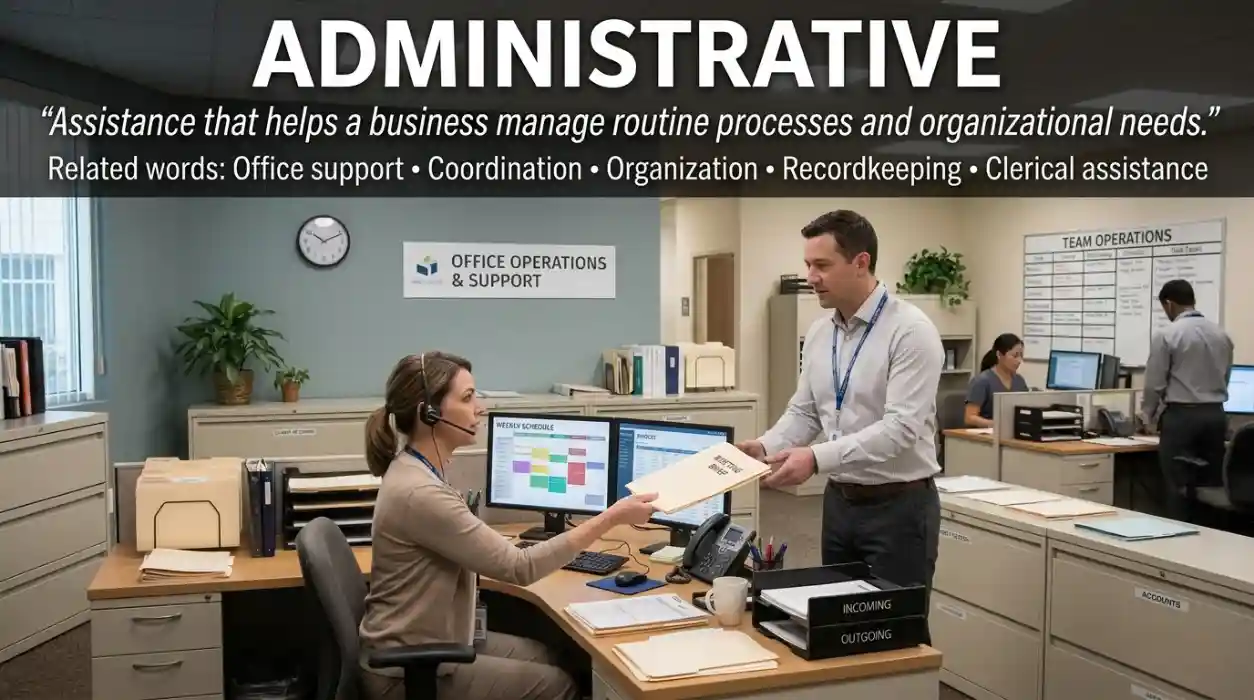
40. Business support (Noun phrase)
Meaning: Assistance that helps a business manage its routine processes and organizational needs.
Tone/Register: Business, neutral.
Examples:
The team provides business support to local offices.
She works in business support while completing her degree.
41. Governance-related (Adjective)
Meaning: Connected with how an organization is directed, overseen, and held accountable.
Tone/Register: Formal, legal, institutional.
Examples:
The committee reviewed governance-related policies.
The training covers governance-related responsibilities.
42. Policy-related (Adjective)
Meaning: Connected with the creation, interpretation, or implementation of policies.
Tone/Register: Formal, academic, public-sector.
Examples:
She handles policy-related correspondence.
The department published guidance on policy-related questions.
43. Process-oriented (Adjective)
Meaning: Focused on the steps and procedures used to complete work consistently.
Tone/Register: Business, technical.
Examples:
He takes a process-oriented approach to managing requests.
The team adopted a process-oriented workflow.
44. Systems-oriented (Adjective)
Meaning: Focused on how connected parts, procedures, or resources work together.
Tone/Register: Technical, analytical.
Examples:
Her systems-oriented approach improved information flow.
The course develops systems-oriented thinking.
45. Service-oriented (Adjective)
Meaning: Focused on meeting the needs of people who use a service.
Tone/Register: Positive, professional.
Examples:
The office aims to provide service-oriented support.
A service-oriented approach can improve public experiences.
Usage note: This describes a priority or attitude, not administration itself.
46. Task-oriented (Adjective)
Meaning: Focused on completing specific duties, assignments, or objectives.
Tone/Register: Neutral, professional.
Examples:
The supervisor prefers a task-oriented work plan.
Her task-oriented approach helps her meet deadlines.
47. Detail-oriented (Adjective)
Meaning: Careful about small details, accuracy, and completeness.
Tone/Register: Positive, professional.
Examples:
A detail-oriented assistant checks every entry.
He is detail-oriented when preparing official records.
Usage note: This describes a personal quality that can be useful in administrative work, not a direct synonym.
48. Paperwork-heavy (Adjective)
Meaning: Involving a large amount of forms, records, and written documentation.
Tone/Register: Informal, sometimes critical.
Examples:
The application process is paperwork-heavy.
She wants a role with fewer paperwork-heavy responsibilities.
49. Routine (Adjective)
Meaning: Describing tasks performed regularly as part of normal work.
Tone/Register: Neutral, everyday.
Examples:
Routine office tasks include answering emails and updating calendars.
He completed the routine checks before the meeting.
50. Non-managerial (Adjective)
Meaning: Describing a role that does not primarily involve managing staff or making management decisions.
Tone/Register: Formal, workplace.
Examples:
The position is non-managerial but involves coordinating several projects.
She moved from a managerial role to a non-managerial specialist position.
Usage note: This is a contrast term, not a direct synonym. It may describe some administrative jobs, but it does not mean administrative.
Synonyms by Tone
The best alternative depends on the impression you want to create. A résumé, a university essay, and a casual conversation may require different wording.
Positive Alternatives
Use these when emphasizing effectiveness, helpfulness, or strong organizational skills:
- Managerial: Highlights management responsibilities.
- Organizational: Emphasizes structure and planning.
- Supportive: Highlights assistance and cooperation.
- Service-oriented: Emphasizes the needs of service users.
- Detail-oriented: Highlights care and accuracy.
Example: “Her detail-oriented approach helps maintain accurate records.”
Neutral Alternatives
Use these when you want a clear, factual description:
- Operational: Focuses on daily processes.
- Clerical: Refers to routine office duties.
- Procedural: Emphasizes rules and steps.
- Departmental: Identifies work within a department.
- Institutional: Refers to a larger organization.
- Scheduling: Specifies the task of arranging times.
- Office management: Describes the coordination of office activities.
Example: “The position includes operational responsibilities and scheduling.”
Negative or Critical Alternatives
These words can introduce criticism or highlight a problem:
- Bureaucratic: Suggests excessive official procedures.
- Paperwork-heavy: Emphasizes a large amount of documentation.
- Routine: Can sound repetitive or unchallenging in some contexts.
Example: “The team lost time to a bureaucratic approval process.”
These terms are not always negative. Context and tone determine how readers interpret them.
Informal or Everyday Alternatives
In conversation, a plain phrase is often more natural than a formal adjective:
- Office-related
- Back-office
- Routine office work
- Paperwork
- Scheduling
- Business support
Example: “I mostly handle office-related tasks and scheduling.”
Why tone matters: Choosing a suitable synonym helps you communicate the exact responsibility without accidentally making a job sound more senior, more negative, or more technical than it is.
“Administrative” vs. Close Alternatives
Three common alternatives are managerial, clerical, and operational. Each describes a different aspect of organizational work.
| Word | Main meaning | Best used when |
|---|---|---|
| Administrative | General organizational and office-related duties | Describing a broad range of responsibilities |
| Managerial | Managing people, decisions, or resources | Discussing leadership or management duties |
| Clerical | Routine paperwork and recordkeeping | Describing filing, data entry, or document tasks |
| Operational | Practical activities that keep a service or business running | Discussing processes and day-to-day delivery |
Example Comparison
- Administrative assistant: A broad title for someone who supports office operations.
- Clerical assistant: A more specific title that emphasizes paperwork and records.
- Operations coordinator: A title that emphasizes coordinating practical business activities.
The titles can overlap, but they are not interchangeable in every workplace. Always match the term to the actual duties.
How “Administrative” Changes by Context
Daily Conversation
In casual speech, people often use simple expressions such as office work, paperwork, scheduling, or organizing tasks.
Instead of saying, “I perform administrative functions,” you might say, “I organize meetings and handle paperwork.”
The simpler sentence sounds more natural in most everyday conversations.
Writing and Blogging
Bloggers and content writers can use organizational, operational, or office-related when the meaning fits. These alternatives can improve readability and prevent repeated wording.
For example, an article about workplace efficiency might discuss “administrative procedures” in one section and “office processes” in another.
Avoid changing words only for SEO. A natural, accurate sentence is more helpful than a sentence packed with alternatives.
Professional or Academic Writing
Formal writing may require terms such as procedural, institutional, managerial, or regulatory. Select one based on the subject.
For example, a university report might refer to “institutional policies,” while a business document might describe “operational procedures.”
Specific terms make your argument clearer because they identify the exact type of activity.
Creative or Informal Writing
In stories, dialogue, and personal essays, plain expressions can make characters sound realistic.
A character might complain about “endless paperwork” rather than describe a situation as “administratively burdensome.”
Choose language that suits the speaker, setting, and mood.
Common Mistakes Learners Make
1. Treating Every Alternative as an Exact Synonym
Clerical usually refers to routine office work. Managerial emphasizes management. Regulatory relates to rules and oversight.
These words overlap with administrative only in particular contexts.
2. Making a Job Sound More Senior Than It Is
Calling every office role executive or managerial can misrepresent the person’s responsibilities.
Use the official job title where necessary, and describe the actual duties accurately.
3. Using “Bureaucratic” as a Neutral Replacement
Bureaucratic often suggests excessive rules or red tape. It can make a sentence sound critical.
If you simply mean ordinary office procedures, administrative or procedural may be more appropriate.
4. Choosing Unnatural Expressions
Phrases such as coordinative responsibilities or organizational-coordination tasks may sound awkward in everyday English.
Prefer natural wording such as “coordination duties,” “organizational tasks,” or “responsibility for scheduling.”
5. Overusing Formal Vocabulary
A sentence does not become better merely because it contains longer words. “She organizes meetings” is often clearer than “She facilitates administrative coordination of scheduled engagements.”
Register Notes
Formal versus informal: Procedural, institutional, and regulatory language often suits formal writing. Office work, paperwork, and scheduling are usually more accessible in conversation.
Spoken versus written English: Spoken English often favors short phrases. Professional documents may need more specific terms, especially when describing responsibilities.
For related vocabulary practice, you can connect this topic to a future article about synonyms for organized or managerial.
Real-Life Examples Using
Workplace Scenario
Maya works at a medical clinic. Her duties include scheduling appointments, updating patient records, and organizing documents.
A suitable description is: “Maya handles administrative duties and patient scheduling.”
If her work focuses mainly on records, clerical duties may be more precise.
Social Situation
A friend asks what Daniel does at work. He replies, “I help organize meetings, answer emails, and keep our office records up to date.”
This response communicates his responsibilities without relying on formal vocabulary.
Media and Public Services
A news report might discuss “administrative delays” in a public benefits program. If the report criticizes unnecessary rules, it might instead describe a “bureaucratic process.”
The second phrase signals a more critical perspective.
Writing and Storytelling
A fictional manager may say, “We cannot launch the project until the operational details are settled.”
That wording suggests practical arrangements, not just paperwork. It gives readers a clearer idea of what remains unfinished.
Practice Exercise
1. A job involves filing documents and entering information into a database. Which word fits best?
A. Regulatory
B. Clerical
C. Managerial
D. Executive
2. A company wants to describe the practical processes that keep its service running. Which word is most suitable?
A. Operational
B. Supportive
C. Bureaucratic
D. Institutional
3. A sentence describes someone who supervises staff and makes team decisions. Which alternative fits best?
A. Routine
B. Clerical
C. Managerial
D. Paperwork-heavy
4. A writer wants to criticize a process that has too many official rules. Which word is most appropriate?
A. Service-oriented
B. Bureaucratic
C. Supportive
D. Detail-oriented
5. A university report discusses policies that affect the entire institution. Which word fits best?
A. Institutional
B. Routine
C. Clerical
D. Task-oriented
6. An assistant arranges meeting times and appointments. Which task-specific term is best?
A. Governance
B. Scheduling
C. Regulatory work
D. Supervision
7. A company checks whether its activities follow legal requirements. Which term is most suitable?
A. Support services
B. Compliance-related
C. Office-related
D. Task-oriented
8. A person carefully checks every entry for accuracy. Which adjective describes this quality?
A. Detail-oriented
B. Bureaucratic
C. Non-managerial
D. Governmental
9. A team wants to describe the structure and arrangement of its departments. Which word is best?
A. Organizational
B. Paperwork-heavy
C. Clerical
D. Routine
Answer key: 1-B | 2-A | 3-C | 4-B | 5-A | 6-B | 7-B | 8-A | 9-A
Reflection Task
Choose one of these alternatives: organizational, operational, clerical, managerial, or logistical.
Write one original sentence about your studies, work, or daily life. Then check whether the word describes the exact task or responsibility you intended.
Suggested external sources
For editorial accuracy and further vocabulary research, link to these reputable references:
- Cambridge Dictionary — definitions and UK/US pronunciation.
- Oxford Learner’s Dictionaries — learner-friendly definitions, usage examples, and word forms.
- Merriam-Webster — American English definitions and usage notes.
- Online Etymology Dictionary — historical word origins and development.
Conclusion
Learning alternatives to administrative helps you describe office work, coordination, management, and organizational processes more precisely. The right word makes your meaning easier to understand.
You do not need to memorize all 50 alternatives at once. Start with a few common choices, such as organizational, operational, clerical, and managerial, and learn when each one fits.
A stronger vocabulary can improve your writing, blogging, speaking, and everyday communication. It also helps you explain professional responsibilities without sounding repetitive or unclear.
Practice using these words in emails, essays, workplace descriptions, and daily conversations. Over time, you will choose synonyms more naturally and communicate with greater confidence.
FAQs
1. What is the best synonym for administrative on a résumé?
The best choice depends on the duties you performed. Use organizational when you coordinated tasks, clerical when you handled records and paperwork, and operational when you supported daily business processes. For leadership responsibilities, managerial may fit. Keep your wording accurate, and do not use a more senior-sounding term unless it reflects your actual role.
2. What is another way to say administrative duties?
You can say office duties, organizational responsibilities, clerical tasks, or operational responsibilities. Choose the phrase that describes the work most precisely. For example, scheduling appointments is an office duty, while maintaining files is a clerical task. If you coordinate several business processes, operational responsibilities may be a better fit.
3. Is administrative the same as managerial?
No. Administrative usually describes organizing, coordinating, and supporting an organization’s activities. Managerial specifically relates to directing people, resources, or decisions. Some managers perform administrative work, and some administrative employees coordinate projects, but the words do not mean the same thing. Choose the term that reflects the responsibilities being described.
4. What is a professional alternative to administrative assistant?
Depending on the actual role, possible titles include office coordinator, operations assistant, executive assistant, or administrative coordinator. These titles have different implications. An executive assistant often supports senior leaders, while an operations assistant may focus on practical business processes. Check the employer’s terminology and job duties before choosing an alternative.
5. What is the difference between administrative and clerical work?
Administrative work is a broad category that can include scheduling, communication, coordination, policy support, and office management. Clerical work usually focuses on routine tasks such as filing, entering data, and maintaining records. Clerical duties can be part of an administrative role, but administrative responsibilities may extend beyond paperwork.

Hasnain Ali is an SEO Content Strategist and the founder of wordvora.com, a trusted vocabulary platform that helps writers, students, professionals, and English learners find accurate synonyms, antonyms, word meanings, and real-life usage examples. He specializes in keyword research, on-page SEO, topical authority, and creating search-first content that aligns with Google’s latest Search Quality and E-E-A-T guidelines. His work focuses on producing clear, well-structured, and reader-friendly resources that satisfy search intent while maintaining high editorial standards.
Through extensive hands-on experience with SEO tools such as Google Search Console, Google Analytics, SEMrush, and Ahrefs, Hasnain researches user search behavior and develops content that is both informative and easy to understand. Every article published on wordvora.com is carefully reviewed for accuracy, readability, and contextual relevance before publication. His mission is to build one of the web’s most reliable English vocabulary resources by providing practical language guidance, trustworthy explanations, and content that helps readers improve their writing, communication, and vocabulary with confidence.