
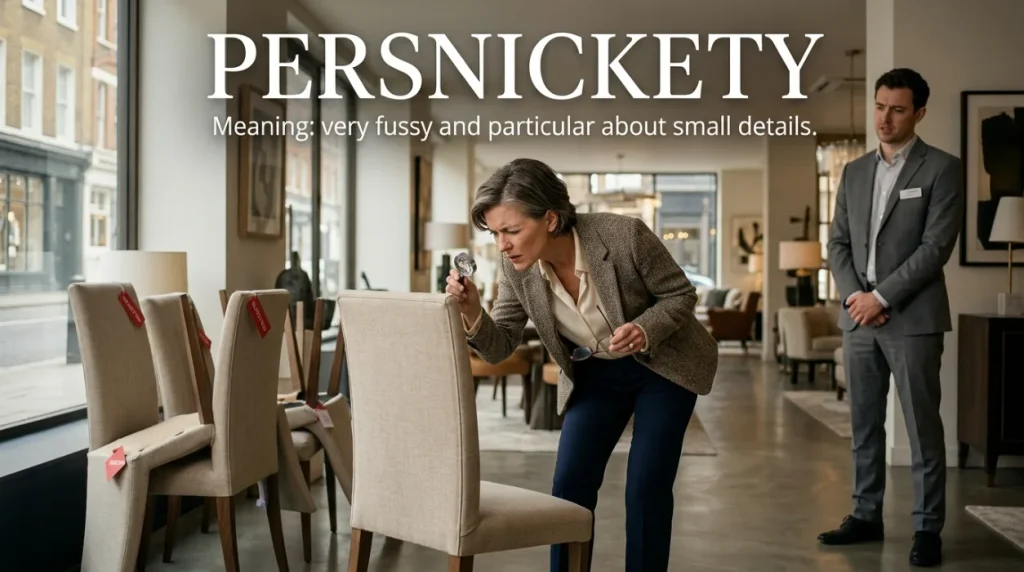
Synonyms for persnickety can rescue your writing when “picky” feels too plain. Imagine a friend rejecting three restaurants because every menu has one tiny flaw.
A persnickety person notices small details and often wants things done in a very specific way. That trait can sound funny, negative, or even admirable.
Learning synonyms for persnickety helps you choose the right shade of meaning. Students, bloggers, writers, and everyday speakers can all benefit.
The word appears often when people discuss food, habits, style, rules, or personal preferences. Knowing synonyms for persnickety makes your English more precise.
What Does “Persnickety” Really Mean?
Persnickety is an adjective that describes someone who is unusually particular about small details, standards, choices, or arrangements.
In simple English, persnickety means very fussy, picky, or difficult to please about small things.
For example:
My brother is persnickety about how his coffee is prepared.
The sentence suggests that he has very specific expectations. A small change may bother him.
Native speakers often use persnickety in everyday conversation. It can describe people, preferences, habits, requirements, or even objects that seem overly sensitive to details.
The word is usually more expressive than simply saying “careful.” It often suggests that the person cares too much about minor details.
Part of Speech
Persnickety is an adjective.
Definition: Very particular about details, especially in a way that can seem fussy, picky, or difficult to satisfy.
Connotative Meaning
Connotation (the feeling or association a word carries beyond its basic dictionary meaning) matters with persnickety.
Positive tone:
The word can sometimes suggest carefulness, high standards, or attention to detail.
Negative tone:
More often, it suggests excessive fussiness, unreasonable preferences, or difficulty pleasing someone.
Neutral tone:
In some contexts, it simply describes someone with very specific preferences without strongly criticizing them.
Etymology of “Persnickety”
The exact origin of persnickety is uncertain. It is generally associated with American English and appears to have developed in the 19th century as a variant or alteration of words such as pernickety.
The history is not connected to a clear Old English root in the way that many familiar English words are. Because of this, claims that divide persnickety neatly into ancient English roots should be treated cautiously.
Old English: 450–1100
There is no established Old English form that directly developed into modern persnickety.
Old English had many words for carefulness, exactness, and troublesome behavior, but persnickety is not one of them.
Middle English: 1100–1500
There is also no secure Middle English ancestor that directly explains the modern word.
The vocabulary of English changed substantially during this period, but the known history of persnickety begins much later.
Modern English: 1500–Present
The word emerged in later English, particularly in American usage, during the 19th century.
Its spelling has appeared in forms such as persnickety and pernickety, with persnickety becoming a familiar modern form.
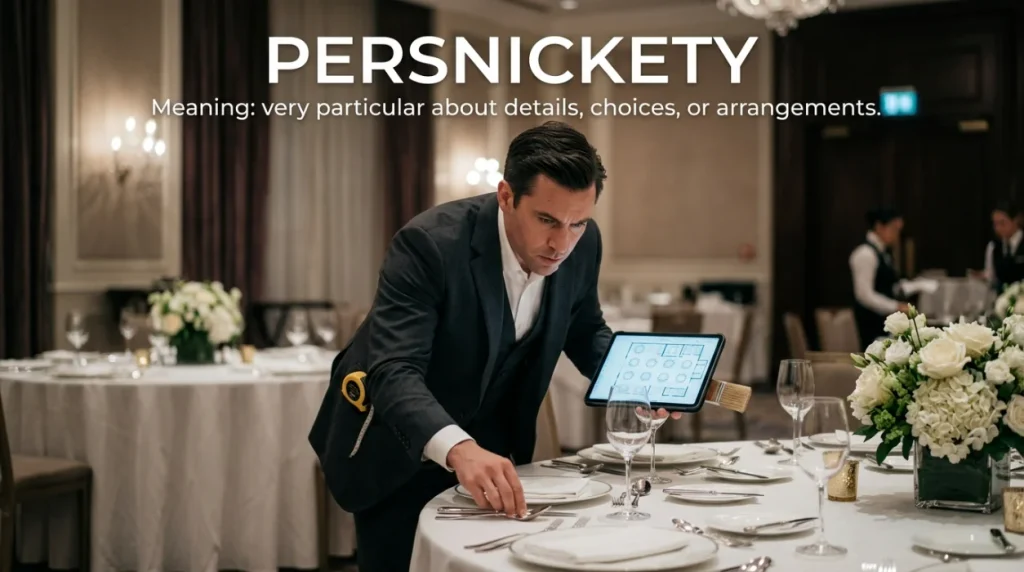
Pronunciation
US: /pərˈsnɪkəti/
UK: /pəˈsnɪkəti/
The strongest stress falls on the second syllable: SNIK.
Syllables
per-snick-et-y
Affixation Pattern of “Persnickety”
Persnickety is best treated as a lexical word rather than a transparent modern prefix-and-suffix construction.
Root: No confidently established modern root
Prefix: None
Suffix: -y appears in the spelling, but the word’s historical formation is not securely explained as a simple root + suffix construction.
Synonyms List
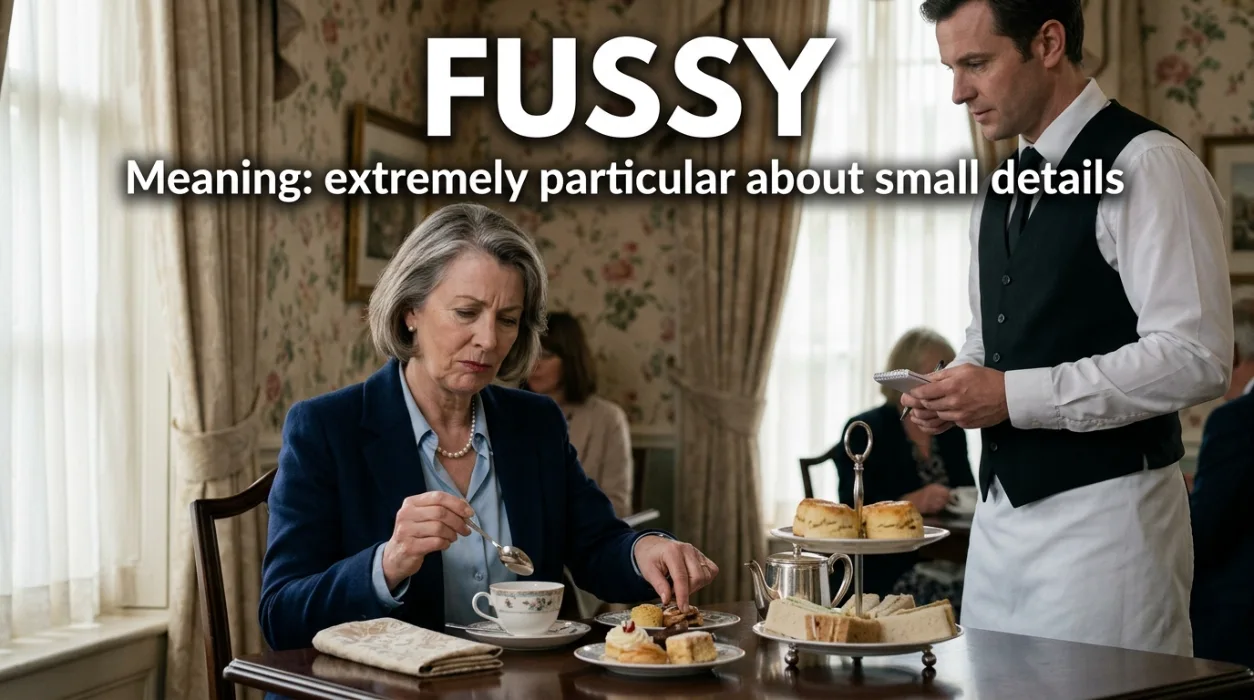
Fussy (Adjective) — US /ˈfʌsi/ | UK /ˈfʌsi/
Meaning: Very particular about details, choices, or arrangements.
Tone/Register: Informal, everyday.
Example:
She is fussy about the vegetables in her salad.
He is fussy about keeping his desk perfectly organized.
Finicky (Adjective) — US /ˈfɪnɪki/ | UK /ˈfɪnɪki/
Meaning: Difficult to satisfy because of very specific preferences.
Tone/Register: Informal to neutral.
Example:
My cat is finicky about its food.
He is finicky when choosing a hotel room.
Picky (Adjective) — US /ˈpɪki/ | UK /ˈpɪki/
Meaning: Choosing carefully and rejecting many options.
Tone/Register: Informal, very common.
Example:
She is picky about the books she reads.
Don’t be so picky about the seating arrangement.
Choosy (Adjective) — US /ˈtʃuːzi/ | UK /ˈtʃəʊzi/
Meaning: Selective because someone wants only certain options.
Tone/Register: Informal.
Example:
He’s choosy about the restaurants he visits.
You can afford to be choosy when you have several options.
Particular (Adjective) — US /pərˈtɪkjələr/ | UK /pəˈtɪkjʊlə/
Meaning: Having very specific preferences or standards.
Tone/Register: Neutral, versatile.
Example:
She is particular about how her tea is served.
I’m particular about grammar in professional emails.
Fastidious (Adjective) — US /fæˈstɪdiəs/ | UK /fæˈstɪdiəs/
Meaning: Extremely careful about details, cleanliness, accuracy, or standards.
Tone/Register: Formal, educated.
Example:
The editor is fastidious about punctuation.
He keeps a fastidious record of every experiment.
Exacting (Adjective) — US /ɪɡˈzæktɪŋ/ | UK /ɪɡˈzæktɪŋ/
Meaning: Requiring a very high level of quality or precision.
Tone/Register: Formal, professional.
Example:
The chef has exacting standards.
Her exacting requirements make the project challenging.
Demanding (Adjective) — US /dɪˈmændɪŋ/ | UK /dɪˈmɑːndɪŋ/
Meaning: Expecting a great deal from people, products, or situations.
Tone/Register: Neutral to negative.
Example:
The client is demanding about presentation quality.
Caring for a newborn can be demanding.
Selective (Adjective) — US /sɪˈlɛktɪv/ | UK /sɪˈlektɪv/
Meaning: Carefully choosing from available possibilities.
Tone/Register: Neutral to positive.
Example:
She is selective about the projects she accepts.
Being selective can protect your time.
Meticulous (Adjective) — US /məˈtɪkjələs/ | UK /məˈtɪkjʊləs/
Meaning: Extremely careful and precise about details.
Tone/Register: Formal, professional, positive.
Example:
He is meticulous when checking financial reports.
Her meticulous notes helped the whole team.
Punctilious (Adjective) — US /pʌŋkˈtɪliəs/ | UK /pʌŋkˈtɪliəs/
Meaning: Extremely attentive to rules, etiquette, or formal details.
Tone/Register: Formal.
Example:
The diplomat was punctilious about protocol.
She is punctilious about meeting official deadlines.
Nitpicky (Adjective) — US /ˈnɪtˌpɪki/ | UK /ˈnɪtˌpɪki/
Meaning: Paying excessive attention to tiny or unimportant faults.
Tone/Register: Informal, negative.
Example:
That review feels unnecessarily nitpicky.
Don’t get nitpicky over a minor spelling error.
Perfectionistic (Adjective) — US /pərˌfɛkʃəˈnɪstɪk/ | UK /pəˌfekʃəˈnɪstɪk/
Meaning: Expecting things to be nearly or completely perfect.
Tone/Register: Neutral to negative.
Example:
Her perfectionistic habits slow down simple tasks.
He can be perfectionistic about his presentations.
Overparticular (Adjective) — US /ˌoʊvərpərˈtɪkjələr/ | UK /ˌəʊvəpəˈtɪkjʊlə/
Meaning: More particular than a situation reasonably requires.
Tone/Register: Formal or literary.
Example:
He is overparticular about table settings.
Her overparticular instructions confused the new staff.
Overscrupulous (Adjective) — US /ˌoʊvərˈskruːpjələs/ | UK /ˌəʊvəˈskruːpjʊləs/
Meaning: Excessively careful about rules, correctness, or moral details.
Tone/Register: Formal.
Example:
His overscrupulous approach delayed the decision.
She became overscrupulous about every minor procedure.
Pedantic (Adjective) — US /pɪˈdæntɪk/ | UK /pɪˈdæntɪk/
Meaning: Excessively concerned with small rules, facts, or technical details.
Tone/Register: Formal, academic, often negative.
Example:
His pedantic correction interrupted the discussion.
You don’t need to be pedantic about every word.
Captious (Adjective) — US /ˈkæpʃəs/ | UK /ˈkæpʃəs/
Meaning: Inclined to find faults or raise objections over small matters.
Tone/Register: Formal, literary.
Example:
The article received a captious response from one critic.
Her captious comments focused on minor flaws.
Hypercritical (Adjective) — US /ˌhaɪpərˈkrɪtɪkəl/ | UK /ˌhaɪpəˈkrɪtɪkəl/
Meaning: Excessively critical of other people or their work.
Tone/Register: Formal to neutral.
Example:
He can be hypercritical of his own writing.
A hypercritical manager may discourage creative ideas.
Overcritical (Adjective) — US /ˌoʊvərˈkrɪtɪkəl/ | UK /ˌəʊvəˈkrɪtɪkəl/
Meaning: More critical than is fair, useful, or necessary.
Tone/Register: Neutral.
Example:
Try not to be overcritical of your first draft.
She became overcritical after reading too many reviews.
Fault-finding (Adjective/Phrase) — US /ˈfɔːltˌfaɪndɪŋ/ | UK /ˈfɔːltˌfaɪndɪŋ/
Meaning: Focused mainly on discovering mistakes or weaknesses.
Tone/Register: Neutral to negative.
Example:
His fault-finding attitude frustrated the group.
The meeting became a fault-finding exercise.

Quibbling (Adjective/Participle) — US /ˈkwɪbəlɪŋ/ | UK /ˈkwɪbəlɪŋ/
Meaning: Arguing about small or unimportant details.
Tone/Register: Neutral to formal.
Example:
They wasted time quibbling over a tiny wording issue.
Stop quibbling and focus on the main problem.
Hair-splitting (Adjective/Noun Phrase) — US /ˈherˌsplɪtɪŋ/ | UK /ˈheəˌsplɪtɪŋ/
Meaning: Making extremely fine distinctions that have little practical importance.
Tone/Register: Formal to conversational.
Example:
The debate turned into hair-splitting over definitions.
That distinction feels like unnecessary hair-splitting.
Overly Particular (Phrase) — US /ˈoʊvərli pərˈtɪkjələr/ | UK /ˈəʊvəli pəˈtɪkjʊlə/
Meaning: More selective or demanding than seems reasonable.
Tone/Register: Neutral.
Example:
She is overly particular about office supplies.
Being overly particular can make teamwork harder.
Overly Fussy (Phrase) — US /ˈoʊvərli ˈfʌsi/ | UK /ˈəʊvəli ˈfʌsi/
Meaning: Excessively concerned with small details or preferences.
Tone/Register: Informal.
Example:
The instructions are overly fussy for such a simple task.
He gets overly fussy when decorating his room.
Overly Picky (Phrase) — US /ˈoʊvərli ˈpɪki/ | UK /ˈəʊvəli ˈpɪki/
Meaning: Too selective and unwilling to accept reasonable choices.
Tone/Register: Informal.
Example:
You’re being overly picky about the menu.
She became overly picky after trying several alternatives.
Overly Selective (Phrase) — US /ˈoʊvərli sɪˈlɛktɪv/ | UK /ˈəʊvəli sɪˈlektɪv/
Meaning: Choosing from options with unusually strict standards.
Tone/Register: Neutral.
Example:
The company may be overly selective during recruitment.
He is overly selective about which invitations he accepts.
Too Particular (Phrase) — US /tuː pərˈtɪkjələr/ | UK /tuː pəˈtɪkjʊlə/
Meaning: So particular that the preference becomes inconvenient or excessive.
Tone/Register: Conversational.
Example:
She’s too particular about the color of the walls.
Don’t be too particular when traveling.
Too Fussy (Phrase) — US /tuː ˈfʌsi/ | UK /tuː ˈfʌsi/
Meaning: Excessively concerned about small details.
Tone/Register: Informal.
Example:
The recipe doesn’t need to be perfect, so don’t be too fussy.
He is too fussy about how the pillows look.
Too Picky (Phrase) — US /tuː ˈpɪki/ | UK /tuː ˈpɪki/
Meaning: Excessively selective about choices.
Tone/Register: Informal.
Example:
You might be too picky when choosing a movie.
She is too picky about where she sits.
Hard to Please (Phrase) — US /hɑːrd tə pliːz/ | UK /hɑːd tə pliːz/
Meaning: Difficult to satisfy because expectations are high or preferences are strict.
Tone/Register: Everyday.
Example:
My dad is hard to please when it comes to restaurants.
The reviewer is hard to please but usually fair.
Difficult to Please (Phrase) — US /ˈdɪfɪkəlt tə pliːz/ | UK /ˈdɪfɪkəlt tə pliːz/
Meaning: Not easily satisfied by available choices or efforts.
Tone/Register: Neutral, professional.
Example:
She is difficult to please when choosing furniture.
Some customers are difficult to please.
Hard to Satisfy (Phrase) — US /hɑːrd tə ˈsætɪsfaɪ/ | UK /hɑːd tə ˈsætɪsfaɪ/
Meaning: Requiring more than ordinary effort or quality to feel satisfied.
Tone/Register: Neutral.
Example:
He is hard to satisfy when it comes to coffee.
The audience can be hard to satisfy.
Difficult to Satisfy (Phrase) — US /ˈdɪfɪkəlt tə ˈsætɪsfaɪ/ | UK /ˈdɪfɪkəlt tə ˈsætɪsfaɪ/
Meaning: Unlikely to accept something without meeting demanding standards.
Tone/Register: Formal.
Example:
She is difficult to satisfy when reviewing technical work.
The committee proved difficult to satisfy.
Demanding About (Phrase) — US /dɪˈmændɪŋ əˈbaʊt/ | UK /dɪˈmɑːndɪŋ əˈbaʊt/
Meaning: Expecting unusually high standards in a particular area.
Tone/Register: Neutral.
Example:
He is demanding about customer service.
She’s demanding about the quality of ingredients.
Exacting About (Phrase) — US /ɪɡˈzæktɪŋ əˈbaʊt/ | UK /ɪɡˈzæktɪŋ əˈbaʊt/
Meaning: Insisting on a very high degree of precision or quality.
Tone/Register: Formal.
Example:
The architect is exacting about measurements.
She is exacting about the final presentation.
Particular About (Phrase) — US /pərˈtɪkjələr əˈbaʊt/ | UK /pəˈtɪkjʊlə əˈbaʊt/
Meaning: Having specific preferences concerning something.
Tone/Register: Neutral, very common.
Example:
I’m particular about the coffee I drink.
He’s particular about keeping his shoes clean.
Fussy About (Phrase) — US /ˈfʌsi əˈbaʊt/ | UK /ˈfʌsi əˈbaʊt/
Meaning: Showing excessive concern about a particular detail.
Tone/Register: Informal.
Example:
She’s fussy about the temperature in the room.
He’s fussy about how his clothes are folded.
Finicky About (Phrase) — US /ˈfɪnɪki əˈbaʊt/ | UK /ˈfɪnɪki əˈbaʊt/
Meaning: Very selective about a particular choice or condition.
Tone/Register: Informal.
Example:
The child is finicky about vegetables.
My dog is finicky about where it sleeps.
Picky About (Phrase) — US /ˈpɪki əˈbaʊt/ | UK /ˈpɪki əˈbaʊt/
Meaning: Selective in a way that involves rejecting many options.
Tone/Register: Informal.
Example:
He’s picky about his breakfast.
She is picky about the music played in her car.
Choosy About (Phrase) — US /ˈtʃuːzi əˈbaʊt/ | UK /ˈtʃəʊzi əˈbaʊt/
Meaning: Careful about selecting one option instead of another.
Tone/Register: Informal.
Example:
Be choosy about the people you trust.
She is choosy about which films she watches.
Selective About (Phrase) — US /sɪˈlɛktɪv əˈbaʊt/ | UK /sɪˈlektɪv əˈbaʊt/
Meaning: Deliberately limiting choices according to specific standards.
Tone/Register: Neutral to positive.
Example:
He is selective about the information he shares.
She is selective about her social commitments.

Discriminating (Adjective) — US /dɪˈskrɪməneɪtɪŋ/ | UK /dɪˈskrɪməneɪtɪŋ/
Meaning: Showing refined judgment when choosing among alternatives.
Tone/Register: Formal, often positive.
Example:
She is a discriminating reader of contemporary fiction.
A discriminating buyer notices subtle differences in quality.
Discerning (Adjective) — US /dɪˈsɜːrnɪŋ/ | UK /dɪˈsɜːnɪŋ/
Meaning: Good at recognizing important differences in quality or value.
Tone/Register: Formal, positive.
Example:
He is a discerning reader who notices weak arguments.
Her discerning taste makes her a thoughtful editor.
Scrupulous (Adjective) — US /ˈskruːpjələs/ | UK /ˈskruːpjʊləs/
Meaning: Extremely careful about correctness, standards, or ethical details.
Tone/Register: Formal, positive or neutral.
Example:
The researcher was scrupulous about citing sources.
She is scrupulous when checking confidential records.
Meticulous About (Phrase) — US /məˈtɪkjələs əˈbaʊt/ | UK /məˈtɪkjʊləs əˈbaʊt/
Meaning: Extremely careful about a specific detail or procedure.
Tone/Register: Formal, professional.
Example:
He is meticulous about formatting reports.
She is meticulous about keeping accurate notes.
Punctilious About (Phrase) — US /pʌŋkˈtɪliəs əˈbaʊt/ | UK /pʌŋkˈtɪliəs əˈbaʊt/
Meaning: Extremely careful about formal rules, manners, or procedures.
Tone/Register: Formal.
Example:
The manager is punctilious about workplace etiquette.
He was punctilious about following the ceremony’s rules.
Perfectionist (Noun) — US /pərˈfekʃənɪst/ | UK /pəˈfekʃənɪst/
Meaning: A person who expects an exceptionally high or flawless standard.
Tone/Register: Neutral.
Example:
As a perfectionist, she rewrites every paragraph several times.
The designer is a perfectionist about small visual details.
Faddy (Adjective) — US /ˈfædi/ | UK /ˈfædi/
Meaning: Having changing or unusual preferences, especially about food or lifestyle.
Tone/Register: Informal, especially British.
Example:
He is faddy about what he eats.
Her faddy habits make group dinners complicated.
Finickety (Adjective) — US /fɪˈnɪkəti/ | UK /fɪˈnɪkəti/
Meaning: A variant meaning extremely fussy or particular.
Tone/Register: Informal, less common.
Example:
She’s finicky about the arrangement of her books.
He can be finicky when choosing clothes.
Pernickety (Adjective) — US /pərˈnɪkəti/ | UK /pəˈnɪkəti/
Meaning: Extremely particular about small details, especially in British English.
Tone/Register: Informal, especially British.
Example:
He’s pernickety about how the kitchen is cleaned.
She is pernickety about punctuation.
Synonyms by Tone
Not every alternative should be used in the same situation. Tone can completely change how your sentence sounds.
Positive
Use these when the person’s attention to detail is admirable:
- Meticulous
- Discerning
- Discriminating
- Scrupulous
- Selective
- Punctilious
- Fastidious
For example, calling an editor meticulous usually sounds like praise. Calling the same editor nitpicky sounds critical.
Neutral
These describe specific preferences without automatically insulting someone:
- Particular
- Demanding
- Exacting
- Selective
- Perfectionist
- Difficult to satisfy
- Hard to please
These are useful in professional writing because they can be more precise than the informal persnickety.
Negative
These emphasize excessive criticism or unreasonable attention to small details:
- Nitpicky
- Hypercritical
- Overcritical
- Captious
- Fault-finding
- Pedantic
- Hair-splitting
- Overly fussy
- Overly picky
Use these when you want the reader to notice the negative side of someone’s behavior.
Playful or Informal
These can sound humorous rather than harsh:
- Fussy
- Picky
- Finicky
- Choosy
- Fussbudget
- High-maintenance
- Too particular
Tone matters because persnickety itself can sound mildly humorous. A stronger word can make the same behavior seem much more serious.
“Persnickety” vs. Close Alternatives
Fussy vs. Persnickety
Persnickety often suggests excessive concern with small details or specific standards.
Fussy is broader and more common. It can describe a person, child, object, design, or situation.
Use persnickety when you want a slightly colorful description. Use fussy for everyday conversation.
Persnickety vs. Picky
Picky usually focuses on choosing between options.
Persnickety can involve choices, behavior, appearance, procedures, or tiny details.
For example, someone can be picky about food, while someone can be persnickety about how food is served.
Persnickety vs. Fastidious
Fastidious often has a more positive or professional tone.
It suggests exceptional care and precision. Persnickety more strongly suggests that the attention to detail may be excessive.
How “Persnickety” Changes by Context
Daily Conversation
In casual speech, persnickety often sounds playful.
You might use it when describing someone who refuses a meal because the vegetables are slightly overcooked.
For everyday situations, fussy, picky, and particular are usually more common.
Writing and Blogging
Writers can use persnickety when they want personality.
It is more vivid than saying someone is “very particular.” It can add humor to lifestyle articles, reviews, storytelling, and personal essays.
However, avoid repeating it in every paragraph. Rotate between suitable semantic alternatives.
Professional or Academic English
Formal writing often benefits from words such as fastidious, meticulous, punctilious, exacting, or scrupulous.
Choose based on the exact behavior.
For example, scrupulous works well for ethical accuracy, while meticulous works well for detailed work.
Creative and Informal Use
Creative writing gives you more freedom.
Fussbudget, finicky, nitpicky, and high-maintenance can create a stronger personality than a plain adjective.
The best choice depends on whether you want humor, criticism, admiration, or neutrality.
Common Mistakes Learners Make
Mistake 1: Treating Every Synonym as Identical
The words are related, but their meanings are not perfectly interchangeable.
Discerning can praise someone’s judgment. Nitpicky usually criticizes unnecessary attention to minor flaws.
Mistake 2: Using “Persnickety” as a Pure Compliment
Persnickety can describe high standards, but it often carries a mildly negative or humorous implication.
If you want clear praise, meticulous or discerning may be safer.
Mistake 3: Confusing “Picky” With “Meticulous”
A picky person rejects choices.
A meticulous person carefully handles details.
Someone can be both, but the words focus on different behaviors.
Mistake 4: Using Formal Words in Casual Situations
Saying, “My friend is punctilious about pizza toppings” can sound deliberately formal.
In everyday conversation, picky, fussy, or particular will usually sound more natural.
Mistake 5: Overusing Negative Synonyms
Words such as hypercritical, captious, and nitpicky can make a sentence sound judgmental.
Use them only when that negative meaning is intended.
Register Notes
Persnickety is conversational and expressive.
Fastidious, punctilious, captious, scrupulous, and exacting are more formal.
Picky, fussy, finicky, and fussbudget are more casual.
For related vocabulary, an internal article about synonyms for picky would make a useful next reading resource.
Real-Life Mini Scenarios
Workplace
A manager checks every tiny formatting issue before approving a report.
You might call the manager meticulous if the attention helps quality.
You might call the manager nitpicky if the corrections are unnecessary.
Social Situations
A friend refuses several restaurants because the lighting, seating, or menu is not quite right.
Persnickety, fussy, or hard to please can all work.
Media and Pop Culture
A fictional character may insist that every object be placed in a precise position.
A writer could describe the character as persnickety, fastidious, or perfectionistic, depending on the intended personality.
Writing and Storytelling
A novelist might introduce a character who spends ten minutes choosing the perfect pen.
Calling that character persnickety immediately suggests a strong preference for tiny details.
Practice Quiz
1. Your friend rejects every restaurant because the tables are not arranged correctly. Which word fits best?
A. Relaxed
B. Persnickety
C. Generous
D. Casual
2. An editor carefully checks every comma and citation. Which word sounds most positive?
A. Nitpicky
B. Captious
C. Meticulous
D. Fussy
3. Someone refuses most foods because of small differences in taste. Which informal word fits?
A. Picky
B. Scrupulous
C. Punctilious
D. Rigorous
4. A manager insists on following every formal workplace rule. Which word is most precise?
A. Choosy
B. Punctilious
C. Faddy
D. Fussy
5. A critic complains about extremely minor flaws. Which word fits best?
A. Discerning
B. Nitpicky
C. Selective
D. Meticulous
6. A reader has excellent judgment about literature. Which word can sound positive?
A. Discerning
B. Captious
C. Overcritical
D. Quibbling
7. Someone expects nearly perfect results from every task. Which word fits?
A. Perfectionistic
B. Casual
C. Flexible
D. Unconcerned
8. Which word is especially common in informal American English?
A. Picky
B. Punctilious
C. Captious
D. Scrupulous
9. Which word best describes excessive concern with rules or technical details?
A. Pedantic
B. Friendly
C. Flexible
D. Relaxed
10. A person is difficult to satisfy when choosing a hotel. Which phrase works naturally?
A. Hard to please
B. Easy to please
C. Quick to please
D. Ready to please
Reflection task: Write one sentence about a real person, habit, character, or situation using a synonym for persnickety. Then explain why you chose that word instead of picky.
Answer key: 1-B | 2-C | 3-A | 4-B | 5-B | 6-A | 7-A | 8-A | 9-A | 10-A
Conclusion
Understanding persnickety can help you describe someone very particular about details, choices, or standards. Learning its synonyms, meaning, and examples can make your English vocabulary more varied and precise.
The word persnickety is often used for people who are excessively careful or difficult to please about small matters. Knowing its related synonyms can help you choose the most suitable word for different situations and improve your writing.
By practicing persnickety in sentences and exploring its related words, you can communicate your ideas more naturally and confidently. A clear understanding of this word will strengthen your vocabulary and help you use it effectively.
Frequently Asked Questions
1. What is the closest synonym for persnickety in everyday English?
The closest everyday synonyms are fussy, picky, finicky, and particular. The best choice depends on context. “Picky” often focuses on choices, especially food or entertainment. “Fussy” is broader and can sound playful. “Particular” is more neutral and works well when you want to describe specific preferences without strongly criticizing the person.
2. Is persnickety a positive or negative word?
Persnickety is usually mildly negative or humorous, although context can soften it. It suggests that someone pays unusually close attention to small details or has strict preferences. If you want to praise that quality, words such as meticulous, discerning, or fastidious may communicate admiration more clearly.
3. What is the difference between persnickety and fastidious?
Both words describe strong attention to detail, but fastidious is usually more formal and can be strongly positive. It often suggests excellent care, cleanliness, or precision. Persnickety is more conversational and commonly implies that someone is excessively particular. Therefore, “a fastidious editor” sounds professional, while “a persnickety customer” sounds more colorful.
4. Can persnickety describe things as well as people?
Yes. Although it commonly describes people, persnickety can also describe things, systems, or requirements that are unusually difficult to satisfy or handle. For example, someone might describe a delicate machine as persnickety if it works only under very specific conditions. The usage is informal and often adds a humorous tone.
5. What is the difference between persnickety, picky, and choosy?
Picky and choosy mainly describe careful selection between options. Persnickety has a wider meaning and can involve small details, standards, arrangements, or procedures. “She is picky about food” focuses on choices. “She is persnickety about how food is served” emphasizes the exact details surrounding those choices.

Hasnain Ali is an SEO Content Strategist and the founder of wordvora.com, a trusted vocabulary platform that helps writers, students, professionals, and English learners find accurate synonyms, antonyms, word meanings, and real-life usage examples. He specializes in keyword research, on-page SEO, topical authority, and creating search-first content that aligns with Google’s latest Search Quality and E-E-A-T guidelines. His work focuses on producing clear, well-structured, and reader-friendly resources that satisfy search intent while maintaining high editorial standards.
Through extensive hands-on experience with SEO tools such as Google Search Console, Google Analytics, SEMrush, and Ahrefs, Hasnain researches user search behavior and develops content that is both informative and easy to understand. Every article published on wordvora.com is carefully reviewed for accuracy, readability, and contextual relevance before publication. His mission is to build one of the web’s most reliable English vocabulary resources by providing practical language guidance, trustworthy explanations, and content that helps readers improve their writing, communication, and vocabulary with confidence.