
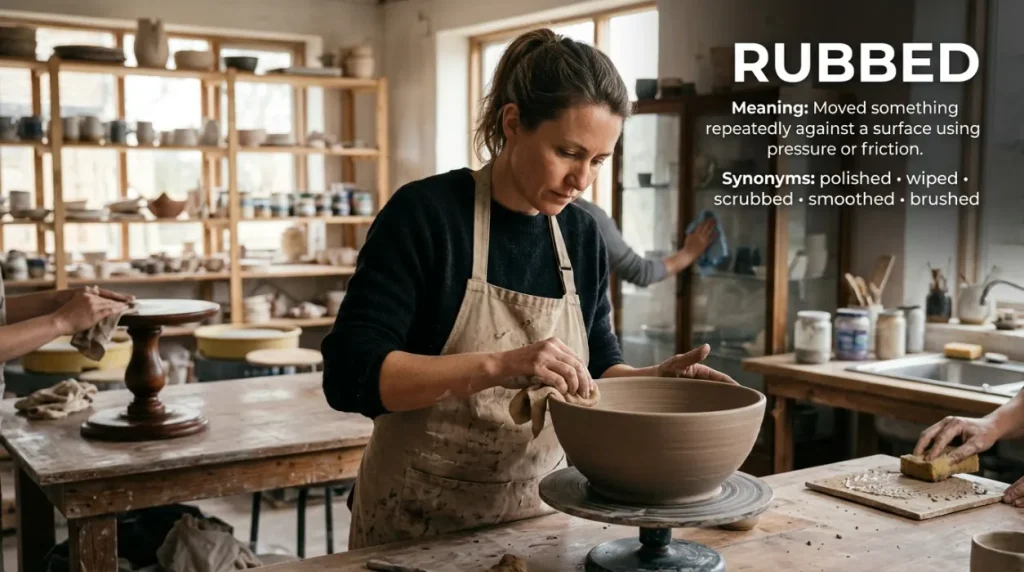
The word rubbed is commonly used to describe the action of moving one surface against another with pressure or repeated motion. It can appear in everyday conversations, stories, instructions, and descriptions of physical actions.
Understanding rubbed can help you describe actions such as cleaning, polishing, drying, or soothing a surface. Learning its synonyms can also give you more ways to express similar actions while making your English vocabulary more varied.
The meaning of this word can change slightly depending on the context in which it is used. Exploring different examples and related terms can help you understand how to use it accurately in both speaking and writing.
By learning rubbed, its synonyms, meanings, and examples, you can strengthen your English vocabulary and communicate physical actions more clearly. This guide will help you understand its usage in different contexts.
What Does “Rubbed” Really Mean?
The word “rubbed” functions as the past tense of the verb “rub.” It describes moving something back and forth against a surface with friction or gentle pressure. Native speakers understand it as a simple physical action used for cleaning, warming, or soothing. Furthermore, it appears in daily chats, literature, and medical notes.
The emotional tone of the word remains neutral on its own. However, the exact context determines if the action feels soothing or uncomfortable.
Part of speech: Transitive and intransitive verb (past tense).
Definition: Moved an object, hand, or material repeatedly back and forth against a surface using pressure or friction.
Connotative Meaning
(Connotation is the emotional feeling or cultural association attached to a word beyond its direct dictionary definition.)
- Positive tone: Conveys comfort, soothing relief, warmth, and gentle affection.
- Negative tone: Highlights physical irritation, painful chafing, erosion, or tension.
- Neutral tone: States simple physical contact, cleaning routines, or mechanical friction.
Etymology
The verb rub entered Middle English around 1300. It likely originated from Low German rubben or Old Norse rubba, meaning “to scrape” or “to move roughly.”
- Old English (450–1100): English speakers used verbs like frican to express physical friction.
- Middle English (1100–1500): Adopted rubben from Germanic languages to describe scrubbing or scraping actions.
- Modern English (1500–Present): Evolved into rubbed to mark completed actions involving friction, massage, or contact.
Pronunciation
- US: /rʌbd/
- UK: /rʌbd/
Syllables & Structure
- Syllable breakdown: rubbed
- Root: rub
- Prefix: None
- Suffix: -ed (past tense marker)
Synonyms List
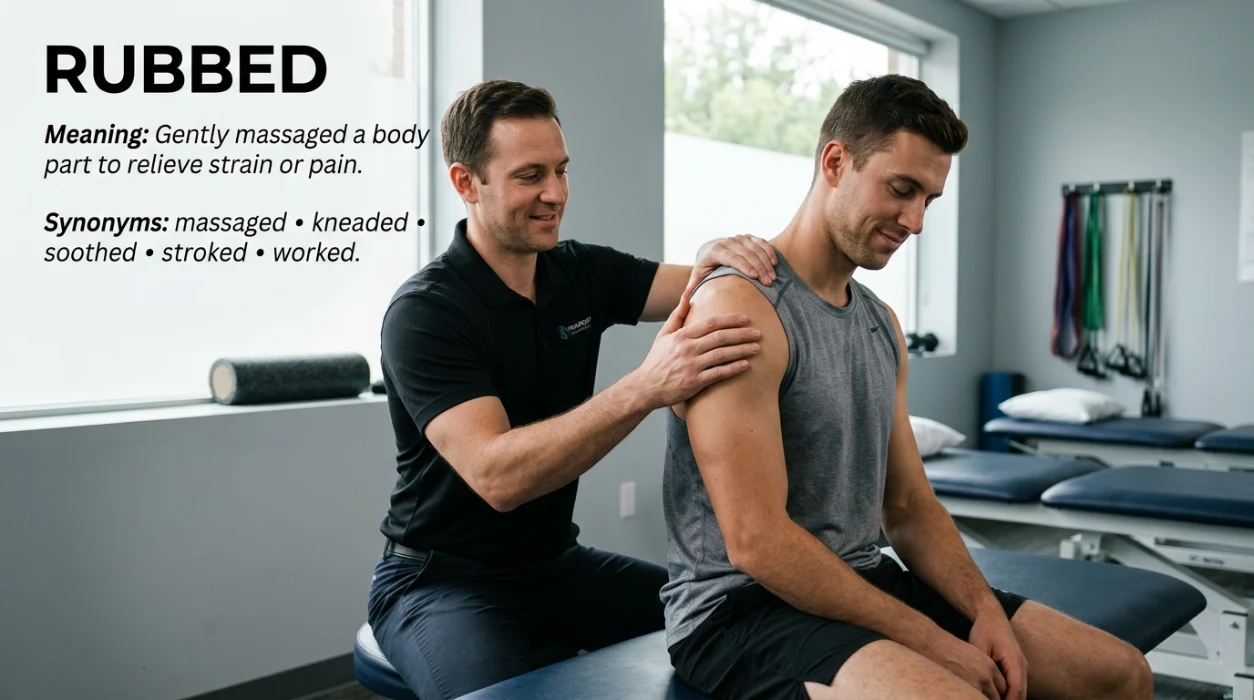
Massaged (Verb) — US: /məˈsɑːʒd/ | UK: /ˈmæs.ɑːʒd/
Meaning: Manipulated body muscles gently with hands to relieve strain or pain.
Tone/Register: Relaxing, Professional
Example:
The trainer massaged her sore shoulder after practice.
He massaged his temples to ease the headache.
Stroked (Verb) — US: /stroʊkt/ | UK: /strəʊkt/
Meaning: Moved a hand or soft object gently and smoothly over a surface.
Tone/Register: Gentle, Affectionate
Example:
She stroked the sleeping cat’s soft fur.
He gently stroked his chin while thinking.
Scrubbed (Verb) — US: /skrʌbd/ | UK: /skrʌbd/
Meaning: Cleansed a hard surface by applying strong pressure and back-and-forth movement.
Tone/Register: Active, Practical
Example:
They scrubbed the kitchen floor until it shone.
She scrubbed the stubborn stain off her apron.
Buffed (Verb) — US: /bʌft/ | UK: /bʌft/
Meaning: Polished a smooth surface using a soft cloth to make it shine.
Tone/Register: Technical, Maintenance
Example:
The worker buffed the car hood until it gleamed.
She buffed her leather shoes before the job interview.
Polished (Verb) — US: /ˈpɑː.lɪʃt/ | UK: /ˈpɒl.ɪʃt/
Meaning: Made a surface smooth and glossy by friction using dedicated cleaning materials.
Tone/Register: Neat, Professional
Example:
He polished the silver spoons before dinner began.
She polished the wooden desk with natural oil.
Smudged (Verb) — US: /smʌdʒd/ | UK: /smʌdʒd/
Meaning: Spread or smeared a soft substance accidentally across a surface by touching.
Tone/Register: Informal, Casual
Example:
He smudged the wet ink with his sleeve.
She smudged her makeup during the movie.
Smeared (Verb) — US: /smɪrd/ | UK: /smɪəd/
Meaning: Spread an oily or sticky substance messily over a wide area using pressure.
Tone/Register: Informal, Messy
Example:
The toddler smeared jam across the table.
He smeared sunscreen over his nose.
Chafed (Verb) — US: /tʃeɪft/ | UK: /tʃeɪft/
Meaning: Wore away or irritated skin through continuous physical friction and movement.
Tone/Register: Uncomfortable, Physical
Example:
Tight, stiff boots chafed his heels during the hike.
The rough fabric chafed her neck.
Scraped (Verb) — US: /skreɪpt/ | UK: /skreɪpt/
Meaning: Pulled a hard or sharp edge across a surface, causing friction or scratches.
Tone/Register: Harsh, Physical
Example:
He scraped the ice off his car windshield.
The tree branches scraped against the window pane.
Abraded (Verb) — US: /əˈbreɪ.dɪd/ | UK: /əˈbreɪ.dɪd/
Meaning: Damaged or wore down a surface through harsh mechanical scraping or friction.
Tone/Register: Formal, Technical
Example:
Coarse sand abraded the outer hull of the boat.
Rope friction abraded the leather gloves quickly.
Frayed (Verb) — US: /freɪd/ | UK: /freɪd/
Meaning: Unraveled threads at the edge of fabric through repeated rubbing or wear.
Tone/Register: Casual, Descriptive
Example:
Frequent use frayed the cuffs of his favorite jacket.
The old climbing rope frayed near the knot.
Swabbed (Verb) — US: /swɑːbd/ | UK: /swɒbd/
Meaning: Cleaned or applied liquid to a surface using an absorbent pad or mop.
Tone/Register: Medical, Practical
Example:
The nurse swabbed his skin before applying the bandage.
Deckhands swabbed the wooden ship floor thoroughly.
Scoured (Verb) — US: /skaʊɚd/ | UK: /skaʊəd/
Meaning: Cleaned a dirty surface forcefully by hard rubbing with abrasive material.
Tone/Register: Intensive, Practical
Example:
She scoured the burnt metal pot with steel wool.
Floods scoured the riverbank after heavy rains.
Frictioned (Verb) — US: /ˈfrɪk.ʃənd/ | UK: /ˈfrɪk.ʃənd/
Meaning: Applied mechanical pressure or rubbing force between two contacting surfaces.
Tone/Register: Scientific, Rare
Example:
Engineers tested how the parts frictioned under pressure.
The brake pads frictioned against the metal wheel.
Caressed (Verb) — US: /kəˈrest/ | UK: /kəˈrest/
Meaning: Touched or stroked someone lovingly, gently, and with deep affection.
Tone/Register: Gentle, Romantic
Example:
She softly caressed her newborn baby’s cheek.
A warm sea breeze caressed their skin.
Kneaded (Verb) — US: /ˈniː.dɪd/ | UK: /ˈniː.dɪd/
Meaning: Pressed and squeezed dough or soft tissue firmly and repeatedly with hands.
Tone/Register: Practical, Physical
Example:
The baker kneaded the bread dough on the board.
She kneaded her tight calf muscle after running.
Grazed (Verb) — US: /ɡreɪzd/ | UK: /ɡreɪzd/
Meaning: Touched or scraped a surface lightly in passing without major damage.
Tone/Register: Casual, Mild
Example:
The car bumper grazed the yellow curb.
A stray pebble grazed his elbow during the fall.
Scratched (Verb) — US: /skrætʃt/ | UK: /skrætʃt/
Meaning: Rubbed skin with fingernails to relieve an itch or marked a surface sharply.
Tone/Register: Everyday, Physical
Example:
He scratched his mosquito bite absentmindedly.
The dog scratched at the back door.
Burnished (Verb) — US: /ˈbɝː.nɪʃt/ | UK: /ˈbɜː.nɪʃt/
Meaning: Polished metal or leather by rubbing to achieve an impressive smooth luster.
Tone/Register: Formal, Artistic
Example:
The artisan burnished the brass antique lantern carefully.
Sunlight burnished the calm lake surface.
Sheared (Verb) — US: /ʃɪrd/ | UK: /ʃɪəd/
Meaning: Cut or wore down material through intense sliding force and pressure.
Tone/Register: Industrial, Mechanical
Example:
Heavy grinding machinery sheared the top metal layer.
Strong forces sheared the outer bolt heads.
Wiped (Verb) — US: /waɪpt/ | UK: /waɪpt/
Meaning: Cleaned or dried a surface by passing a cloth or hand over it.
Tone/Register: Common, Daily
Example:
He wiped the spilled milk from the table.
She wiped her dusty glasses with a soft rag.
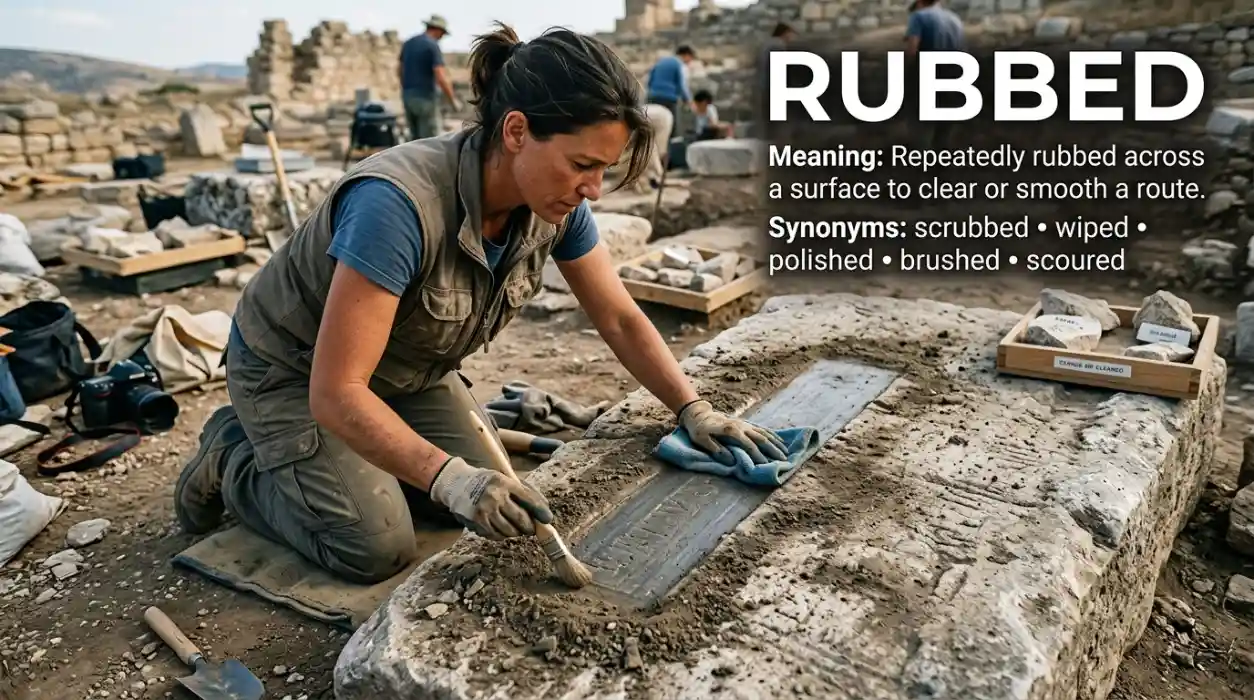
Pathed (Verb) — US: /pæθt/ | UK: /pɑːθt/
Meaning: Cleared a route across a textured surface through repeated rubbing motion.
Tone/Register: Literary, Descriptive
Example:
Her fingers pathed a clear line through dust.
He pathed a path across fogged glass.
Smoothed (Verb) — US: /smuːðd/ | UK: /smuːðd/
Meaning: Made a rough surface even or flat through gentle, continuous hand pressure.
Tone/Register: Calm, Helpful
Example:
She smoothed the wrinkles out of her dress.
He smoothed the fresh bedsheets neatly.
Patted (Verb) — US: /ˈpæt̬.ɪd/ | UK: /ˈpæt.ɪd/
Meaning: Touched something lightly and repeatedly with an open hand.
Tone/Register: Friendly, Casual
Example:
He patted his coat pocket for his keys.
She gently patted the puppy on its head.
Glided (Verb) — US: /ˈɡlaɪ.dɪd/ | UK: /ˈɡlaɪ.dɪd/
Meaning: Moved smoothly and continuously over a surface with minimal friction.
Tone/Register: Graceful, Elegant
Example:
The ice skates glided over the frozen pond.
Her hand glided along the smooth wooden railing.
Squeegee (Verb) — US: /ˈskwiː.dʒiːd/ | UK: /ˈskwiː.dʒiːd/
Meaning: Scraped water or cleaning liquid off glass using a rubber-edged tool.
Tone/Register: Practical, Utility
Example:
The worker squeegeed the store windows clean.
She squeegeed the shower glass after bathing.
Grate (Verb) — US: /ɡreɪt/ | UK: /ɡreɪt/
Meaning: Caused irritation or hard friction by scraping small particles repeatedly.
Tone/Register: Annoying, Harsh
Example:
The sliding door grated against the metal track.
Harsh noise grated on his nervous system.
Touched (Verb) — US: /tʌtʃt/ | UK: /tʌtʃt/
Meaning: Came into physical contact with a surface using fingers or body parts.
Tone/Register: Simple, Direct
Example:
She gently touched the delicate silk fabric.
He touched his forehead to check his temperature.
Erased (Verb) — US: /ɪˈreɪst/ | UK: /ɪˈreɪst/
Meaning: Removed pencil or chalk marks by rubbing an eraser across paper.
Tone/Register: Educational, Functional
Example:
The student erased the mistake from his notebook.
She erased the entire whiteboard after class.
Anointed (Verb) — US: /əˈnɔɪn.tɪd/ | UK: /əˈnɔɪn.tɪd/
Meaning: Rubbed oil or holy liquid onto skin as part of a ritual.
Tone/Register: Religious, Formal
Example:
The priest anointed the believers during the ceremony.
Ancient people anointed skin with scented oil.
Soothed (Verb) — US: /suːðd/ | UK: /suːðd/
Meaning: Eased pain or distress by applying gentle rubbing motions or creams.
Tone/Register: Comforting, Medical
Example:
Cooling aloe vera lotion soothed her sunburned skin.
Her calm touch soothed the crying baby.
Pet (Verb) — US: /pet/ | UK: /pet/
Meaning: Stroked or patted an animal affectionately with gentle hand pressure.
Tone/Register: Informal, Warm
Example:
He petted the friendly golden retriever on his walk.
She petted her sleeping rabbit carefully.
Brushed (Verb) — US: /brʌʃt/ | UK: /brʌʃt/
Meaning: Swept a surface lightly using bristles, a cloth, or a quick touch.
Tone/Register: Light, Quick
Example:
She brushed the dry crumbs off her coat.
His arm brushed against hers in the hallway.
Cleaned (Verb) — US: /kliːnd/ | UK: /kliːnd/
Meaning: Removed dirt or stains from an object using friction and liquid.
Tone/Register: General, Daily
Example:
He cleaned the dirty kitchen counter thoroughly.
She cleaned her muddy shoes before going inside.
Worked in (Verb Phrase) — US: /wɝːkt ɪn/ | UK: /wɜːkt ɪn/
Meaning: Rubbed a cream or lotion until absorbed completely into a surface.
Tone/Register: Practical, Beauty
Example:
She worked in the moisturizing lotion onto her hands.
He worked in the leather conditioner evenly.
Pressed (Verb) — US: /prest/ | UK: /prest/
Meaning: Applied firm, direct weight or pressure against a surface without moving.
Tone/Register: Firm, Direct
Example:
He pressed a cold compress against his forehead.
She pressed her palm onto the door handle.
Skimmed (Verb) — US: /skɪmd/ | UK: /skɪmd/
Meaning: Passed over a surface lightly, barely touching the top layer.
Tone/Register: Light, Rapid
Example:
The flat stone skimmed across the quiet river.
Her fingers skimmed the titles on the shelf.
Scuff (Verb) — US: /skʌf/ | UK: /skʌf/
Meaning: Marked or scraped a clean surface by dragging footwear across it.
Tone/Register: Casual, Careless
Example:
He scuffed his shoes on the concrete floor.
Heavy boots scuffed the wooden hallway panels.
Flapped (Verb) — US: /flæpt/ | UK: /flæpt/
Meaning: Struck a surface repeatedly with a loose cloth or flexible material.
Tone/Register: Descriptive, Visual
Example:
The wet sail flapped against the boat mast.
Hanging curtains flapped against the open window frame.
Lathered (Verb) — US: /ˈlæð.ɚd/ | UK: /ˈlæð.əd/
Meaning: Rubbed soap with water until it formed thick white foam.
Tone/Register: Hygiene, Daily
Example:
He lathered his hands thoroughly before eating dinner.
She lathered her hair with scented shampoo.
Mopped (Verb) — US: /mɑːpt/ | UK: /mɒpt/
Meaning: Wiped sweat or liquid off a surface using an absorbent material.
Tone/Register: Physical, Practical
Example:
The runner mopped his sweaty brow with towels.
She mopped the kitchen floor after dinner.
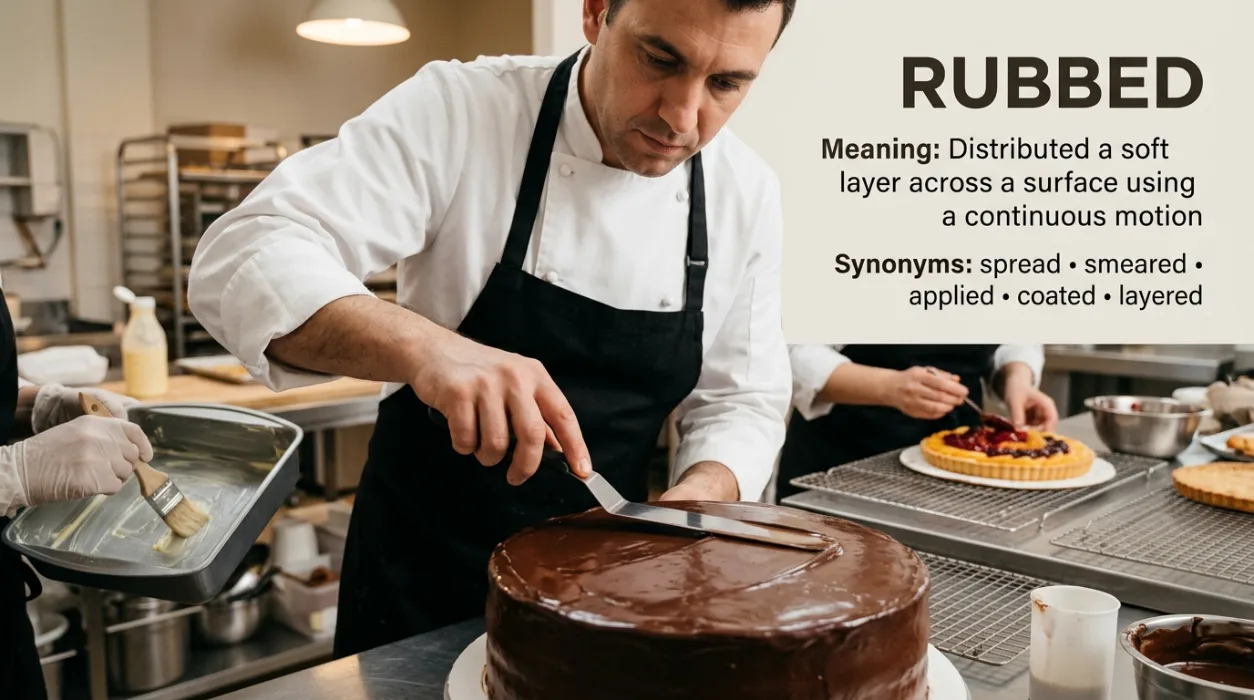
Spread (Verb) — US: /spred/ | UK: /spred/
Meaning: Distributed a soft layer across a wide surface using continuous motion.
Tone/Register: Functional, Simple
Example:
He spread butter over the warm morning toast.
She spread cream across her dry elbows.
Nuzzled (Verb) — US: /ˈnʌz.əld/ | UK: /ˈnʌz.əld/
Meaning: Rubbed gently with the nose or face as an affectionate gesture.
Tone/Register: Warm, Intimate
Example:
The horse nuzzled against its owner’s shoulder.
The puppy nuzzled into the warm blanket.
Cleansed (Verb) — US: /klensd/ | UK: /klensd/
Meaning: Purified or made thoroughly clean through careful washing or rubbing.
Tone/Register: Formal, Skincare
Example:
She cleansed her skin before applying night cream.
Special soap cleansed the dirty industrial machine.
Contacted (Verb) — US: /ˈkɑːn.tæk.tɪd/ | UK: /ˈkɒn.tæk.tɪd/
Meaning: Came into physical contact with a designated object or surface directly.
Tone/Register: Technical, Neutral
Example:
The sensor contacted the metal arm during testing.
Her tires contacted the wet asphalt road.
Washed (Verb) — US: /wɑːʃt/ | UK: /wɒʃt/
Meaning: Cleaned body parts or objects using water, soap, and friction.
Tone/Register: Essential, Routine
Example:
He washed his face with cold water.
She washed the greasy pots in warm water.
Dried (Verb) — US: /draɪd/ | UK: /draɪd/
Meaning: Removed moisture from skin or objects by rubbing with a towel or cloth.
Tone/Register: Simple, Everyday
Example:
He dried his hands on the kitchen towel.
She dried her hair thoroughly with a cloth.
Slathered (Verb) — US: /ˈslæð.ɚd/ | UK: /ˈslæð.əd/
Meaning: Applied a thick, generous layer of liquid or ointment loosely.
Tone/Register: Informal, Generous
Example:
He slathered butter on his pancakes generously.
She slathered sunscreen on before visiting the beach.
Polished off (Phrasal Verb) — US: /ˈpɑː.lɪʃt ɑːf/ | UK: /ˈpɒl.ɪʃt ɒf/
Meaning: Rubbed a surface quickly to finish cleaning or smoothing it completely.
Tone/Register: Casual, Conversational
Example:
He polished off the dusty cabinet surface quickly.
She polished off the final spots on the glass.
Squeezed (Verb) — US: /skwiːzd/ | UK: /skwiːzd/
Meaning: Applied firm pressure from both sides while moving fingers over tissue.
Tone/Register: Physical, Direct
Example:
She squeezed her sore arm to check swelling.
He squeezed the sponge to remove excess water.
Massaged in (Verb Phrase) — US: /məˈsɑːʒd ɪn/ | UK: /ˈmæs.ɑːʒd ɪn/
Meaning: Rubbed an oil or medicine deeply into muscles or skin layers.
Tone/Register: Health, Wellness
Example:
The doctor massaged in the pain-relief cream softly.
She massaged in the essential oils thoroughly.
Dabbed (Verb) — US: /dæbd/ | UK: /dæbd/
Meaning: Touched a surface lightly and repeatedly with short, quick movements.
Tone/Register: Gentle, Precise
Example:
She dabbed her tears away with a tissue.
He dabbed paint onto the canvas lightly.
Pounded (Verb) — US: /ˈpaʊn.dɪd/ | UK: /ˈpaʊn.dɪd/
Meaning: Struck or rubbed a surface with heavy pressure, causing vibrations.
Tone/Register: Heavy, Forceful
Example:
He pounded his fists against his thighs impatiently.
Waves pounded against the rough coastal rocks.
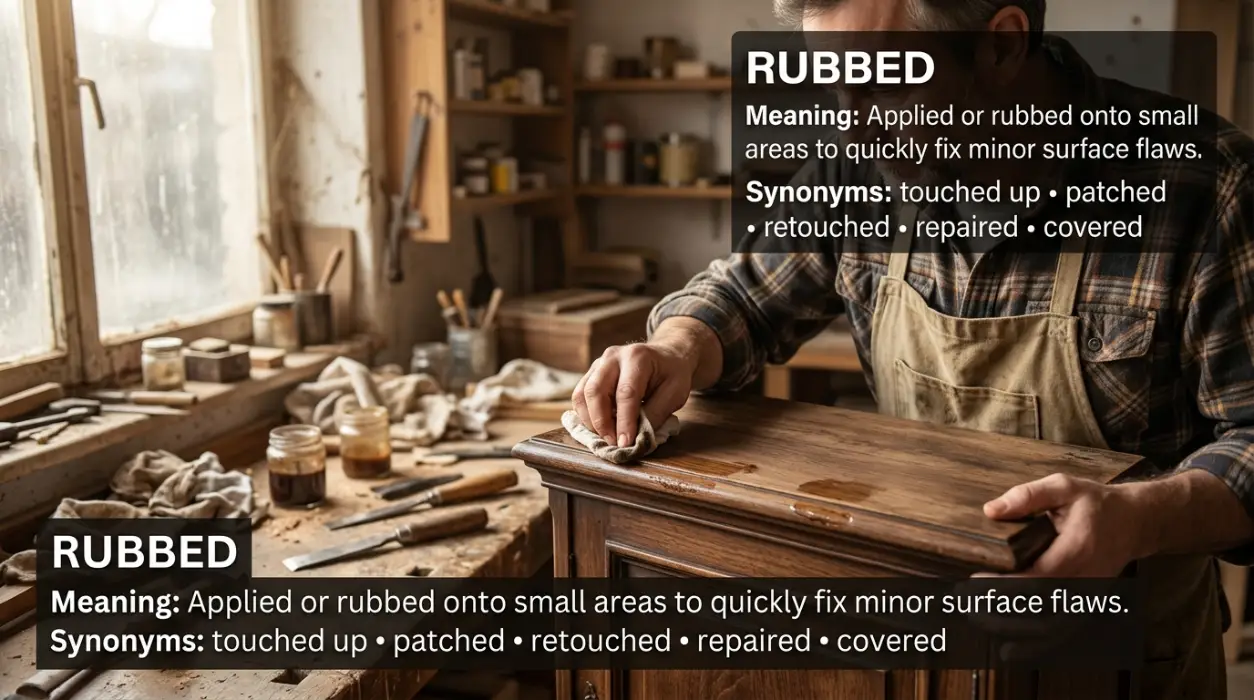
Touched up (Phrasal Verb) — US: /tʌtʃt ʌp/ | UK: /tʌtʃt ʌp/
Meaning: Rubbed or painted small areas to fix minor surface flaws quickly.
Tone/Register: Casual, Repair
Example:
She touched up her makeup before entering dinner.
He touched up the scratched paint on the doors.
Synonyms by Tone
Tone plays an essential role in word selection. Selecting an inappropriate word creates awkward sentences, whereas picking the right tone makes your communication clear and natural.
Positive Tone
These options express comfort, care, affection, and gentle relief:
- Stroked
- Massaged
- Caressed
- Soothed
- Nuzzled
Neutral Tone
These options describe simple physical actions without emotional bias:
- Wiped
- Touched
- Brushed
- Dried
- Worked in
Negative Tone
These words highlight irritation, damage, or harsh physical friction:
- Chafed
- Scraped
- Abraded
- Scratched
- Scuffed
Playful / Informal
These express casual, generous, or lighthearted physical contact:
- Slathered
- Pet
- Smeared
- Smudged
Mini Comparison
Rubbed vs. Massaged vs. Stroked
- Meaning Difference:
- Rubbed describes basic back-and-forth friction on any surface.
- Massaged implies deliberate, therapeutic pressure applied to body muscles.
- Stroked indicates a light, smooth, and gentle movement across skin or fur.
- Tone Difference:
- Rubbed carries a completely neutral and everyday tone.
- Massaged sounds health-focused, deliberate, and relaxing.
- Stroked sounds affectionate, soothing, and soft.
- When to Use Each:
- Use rubbed for daily tasks like warming hands or cleaning counters.
- Use massaged when discussing physical therapy, sore muscles, or relaxation.
- Use stroked when describing affection toward pets, children, or loved ones.
Context-Based Usage
Daily Conversation
In casual chats, native speakers prefer simple terms like wiped, scratched, pet, or rubbed. You might say you “wiped the counter” or “pet the dog.” These verbs sound natural and clear in informal settings.
Writing or Blogging
Bloggers choose expressive terms like stroked, slathered, or soothed to build vivid mental pictures. These descriptive verbs keep online articles engaging and visually appealing for readers.
Professional or Academic Tone
In formal reports, medical articles, or research papers, rely on technical choices like abraded, massaged, cleansed, or applied. These words maintain strong analytical clarity and authority.
Creative or Informal Use
When writing fiction or personal essays, reach for sensory options like caressed, nuzzled, or chafed. These options add rich emotional depth and physical realism to storytelling.
Common Mistakes & Native Usage
Common Mistakes Learners Make
- Misusing prepositions: Learners often confuse “rubbed on” with “rubbed into.” Use “into” when applying creams or lotions so they absorb fully.
- Confusing soft touch with friction: Do not use harsh words like scoured or abraded when describing gentle skin contact.
- Overusing the focus word: Relying on “rubbed” repeatedly makes narrative descriptions dull. Alternate with choices like stroked or wiped for better variety.
Register Notes
- Spoken English: Native speakers frequently use wiped, pet, rubbed, and scratched.
- Written English: Formal contexts favor abraded, massaged, cleansed, and burnished.
- For additional phrasing advice to polish your grammar, explore our detailed writing guides on descriptive verbs.
Real-Life Mini Scenarios
Workplace
When the carpenter noticed minor roughness on the wooden table, he carefully buffed the surface. This quick action restored its smooth, professional finish instantly.
Social Situations
While waiting at a chilly bus stop, she rubbed her hands together quickly. The generated heat kept her fingers warm against the cold wind.
Media / Pop Culture
In a popular sports documentary, the athletic trainer massaged the sprinter’s calf muscles. Consequently, the athlete recovered in time for the championship race.
Writing or Storytelling
In a historical novel, a character caressed an old family photograph. This gentle gesture revealed her deep nostalgic longing for home.
Interactive Practice Quiz
1. Which synonym best describes gently petting an animal?
A) Scoured
B) Stroked
C) Abraded
D) Scraped
2. Which word fits best when cleaning dirty dishes with heavy force?
A) Caressed
B) Nuzzled
C) Scoured
D) Skimmed
3. What is the main difference between “rubbed” and “massaged”?
A) Massaged implies deliberate, therapeutic muscle pressure
B) Rubbed is only used for cleaning glass
C) Massaged means scraping skin roughly
D) Both words share the same physical meaning
4. Which term carries a clear negative tone indicating skin damage from friction?
A) Soothed
B) Chafed
C) Glided
D) Burnished
5. What is an informal term for applying a thick cream generously?
A) Slathered
B) Abraded
C) Anointed
D) Frictioned
6. If you polish leather or metal until it gleams, you have:
A) Frayed it
B) Burnished it
C) Chafed it
D) Scratched it
7. Which choice fits best when a horse nuzzles affectionately against a fence?
A) Scoured
B) Nuzzled
C) Abraded
D) Squeegeed
8. What word describes passing over a surface lightly without touching deeply?
A) Skimmed
B) Kneaded
C) Scoured
D) Lathered
9. In skincare writing, spreading moisturizer until absorbed is called:
A) Working in
B) Scuffing
C) Abrading
D) Fraying
10. Which word best describes wiping water off glass with a rubber tool?
A) Caressed
B) Squeegeed
C) Stroked
D) Nuzzled
Application Task
Write one short, original sentence describing how you warm your hands on a cold day using one of the synonyms above (such as massaged, stroked, or soothed).
Answer Key
1: B | 2: C | 3: A | 4: B | 5: A | 6: B | 7: B | 8: A | 9: A | 10: B
FAQs
1. What is the most common formal synonym for rubbed?
The most common formal synonyms are massaged, cleansed, abraded, and buffed. These options maintain professional clarity and sound natural in medical, technical, or academic writing.
2. Can “stroked” always replace “rubbed”?
No, stroked implies a gentle, soft, and affectionate motion. It works well for touching skin or fur but sounds awkward when describing heavy cleaning or scraping actions.
3. How does “chafed” differ from standard rubbing?
Chafed specifically means that continuous friction has caused skin irritation, discomfort, or material wear. Standard rubbing can be neutral or soothing, whereas chafing always implies physical discomfort.
4. Which synonyms for rubbed work best in creative storytelling?
In fiction, sensory verbs like caressed, nuzzled, slathered, stroked, or chafed work best. These descriptive choices build vivid mental images and emotional depth for readers.
5. What preposition should follow “rubbed” when applying lotion?
Use the preposition “into” when applying lotions or creams to indicate absorption (e.g., “she rubbed the cream into her skin”). Use “on” or “onto” when describing surface contact without absorption.
Conclusion
Understanding rubbed can help you describe an action involving repeated movement or pressure between two surfaces. Learning its synonyms, meaning, and examples can improve your English vocabulary and make your writing more precise.
The word rubbed is commonly used in everyday situations, such as cleaning, drying, polishing, or soothing a particular area. Knowing its related synonyms can help you express similar actions in different ways and make your communication more natural.
By practicing rubbed in sentences and exploring related words, you can strengthen your vocabulary and communication skills. A clear understanding of this word will help you use it confidently and effectively in different English contexts.

Hasnain Ali is an SEO Content Strategist and the founder of wordvora.com, a trusted vocabulary platform that helps writers, students, professionals, and English learners find accurate synonyms, antonyms, word meanings, and real-life usage examples. He specializes in keyword research, on-page SEO, topical authority, and creating search-first content that aligns with Google’s latest Search Quality and E-E-A-T guidelines. His work focuses on producing clear, well-structured, and reader-friendly resources that satisfy search intent while maintaining high editorial standards.
Through extensive hands-on experience with SEO tools such as Google Search Console, Google Analytics, SEMrush, and Ahrefs, Hasnain researches user search behavior and develops content that is both informative and easy to understand. Every article published on wordvora.com is carefully reviewed for accuracy, readability, and contextual relevance before publication. His mission is to build one of the web’s most reliable English vocabulary resources by providing practical language guidance, trustworthy explanations, and content that helps readers improve their writing, communication, and vocabulary with confidence.