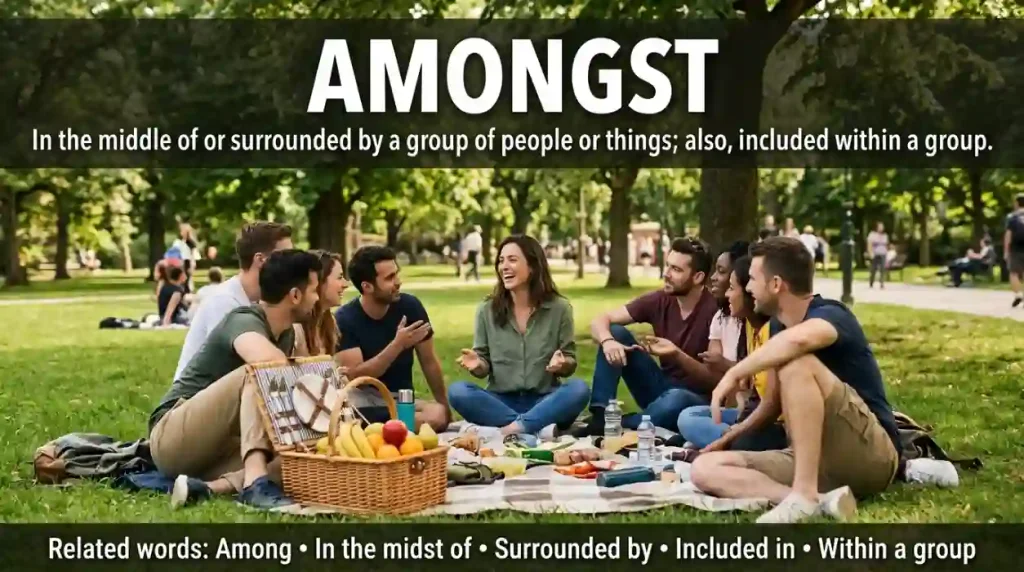
A synonym for amongst is among, amid, surrounded by, in the company of, or in the middle of, depending on the context. These expressions describe something located within a group, environment, or situation. The best alternative depends on the sentence, intended meaning, and level of formality.
Imagine standing amongst your classmates before an important exam. You could also say you are among your classmates or in the company of your classmates. Both alternatives communicate a similar idea.
The word amongst appears in everyday English, books, news articles, and academic writing. It helps describe relationships, locations, and things that exist within a group.
Learning a synonym for amongst can make your English more flexible. Students can improve essays, bloggers can vary their language, and content writers can create clearer sentences without changing their intended meaning.
Whether you speak English daily or use it professionally, understanding these alternatives helps you express ideas naturally. Let’s explore useful options and learn when each one works best.
What Does “Amongst” Really Mean?
Amongst is a preposition that means in, surrounded by, or in the company of members of a group. It connects a person, object, or idea with other people, things, or elements.
For example:
- She felt comfortable amongst her friends.
- A small cottage stood amongst the trees.
- The news spread quickly amongst employees.
Native English speakers generally understand amongst as equivalent to among. Both words can describe something within a group or surrounded by several things.
The main difference concerns style. Among is more common in modern American English, while amongst can sound slightly more traditional, literary, or formal. However, both forms remain correct in contemporary English.
Part of Speech
Preposition: A word that expresses a relationship between a noun or pronoun and other elements in a sentence.
Connotative Meaning
(Connotation means the emotional associations or impressions a word creates beyond its basic dictionary definition.)
- Positive tone: Amongst friends, supporters, or welcoming communities, the word can suggest belonging and connection.
- Negative tone: Amongst enemies, rumors, or confusion, it can suggest tension or uncertainty.
- Neutral tone: Amongst trees, documents, students, or buildings, it simply describes a relationship or position.
The word itself is neutral. The surrounding words determine its emotional effect.
Etymology:
The word amongst developed from older English expressions related to being in a group or mixed with other things. Its history reflects the evolution of English prepositions.
Old English (450–1100)
Old English used forms such as on gemang, meaning approximately “in a crowd” or “among.” The word mang was associated with a mixture or gathering.
Middle English (1100–1500)
During the Middle English period, forms such as among and amonges developed. The ending -st eventually became associated with the variant amongst.
Modern English (1500–Present)
Both among and amongst became established in English. Today, among dominates much everyday American usage, while amongst remains familiar in British English and literary writing.
Pronunciation
- US: /əˈmʌŋst/
- UK: /əˈmʌŋst/
Syllables
a-mongst — one spoken syllable in standard pronunciation.
Affixation Pattern
- Root: among, historically related to older English words for a crowd or mixture.
- Prefix: None.
- Suffix: -st, part of the historical development of the word’s variant form.
The ending is not a productive suffix that English speakers normally add to other words today.
Synonyms List
The following alternatives cover the closest equivalents first, followed by context-dependent expressions. Some are direct synonyms, while others work only in particular sentences. Always choose the expression that preserves your intended meaning.
1. Among (Preposition) — US: /əˈmʌŋ/ | UK: /əˈmʌŋ/
Meaning: In the company of members of a group or surrounded by several things.
Tone/Register: Neutral; suitable for speech and writing.
Examples:
She was popular among her classmates.
The missing photograph was found among the old papers.
2. Amid (Preposition) — US: /əˈmɪd/ | UK: /əˈmɪd/
Meaning: In the middle of an environment, event, or situation.
Tone/Register: Neutral to formal; common in journalism.
Examples:
Amid the celebration, the phone suddenly rang.
The company continued working amid uncertainty.
3. Amidst (Preposition) — US: /əˈmɪdst/ | UK: /əˈmɪdst/
Meaning: Surrounded by or in the middle of something.
Tone/Register: Literary or slightly formal.
Examples:
She found peace amidst the noise.
Amidst the autumn leaves, a bright red flower stood out.
4. Between (Preposition) — US: /bɪˈtwiːn/ | UK: /bɪˈtwiːn/
Meaning: In the space separating people or things, or in a relationship connecting distinct parties.
Tone/Register: Neutral; everyday and academic.
Examples:
The agreement was made between the two departments.
A narrow path runs between the houses.
5. In the Company of (Prepositional Phrase)
Pronunciation: US: /ɪn ðə ˈkʌmpəni əv/ | UK: /ɪn ðə ˈkʌmpəni əv/
Meaning: In the presence of other people.
Tone/Register: Neutral to formal; often social.
Examples:
He relaxed in the company of close friends.
She felt confident in the company of experienced colleagues.
6. Surrounded by (Participial Phrase)
Pronunciation: US: /səˈraʊndɪd baɪ/ | UK: /səˈraʊndɪd baɪ/
Meaning: Having people or things on all sides.
Tone/Register: Neutral; descriptive.
Examples:
The cabin was surrounded by tall pine trees.
I felt surrounded by supportive people.
7. In the Midst of (Prepositional Phrase)
Pronunciation: US: /ɪn ðə mɪdst əv/ | UK: /ɪn ðə mɪdst əv/
Meaning: In the middle of an event, activity, or difficult situation.
Tone/Register: Neutral to formal.
Examples:
We were in the midst of a busy workday.
She stayed calm in the midst of the argument.
8. In the Middle of (Prepositional Phrase)
Pronunciation: US: /ɪn ðə ˈmɪdəl əv/ | UK: /ɪn ðə ˈmɪdəl əv/
Meaning: At a central point in a place, activity, or event.
Tone/Register: Informal to neutral.
Examples:
The café sits in the middle of the town square.
I called while he was in the middle of dinner.
9. Within (Preposition) — US: /wɪˈðɪn/ | UK: /wɪˈðɪn/
Meaning: Inside a place, boundary, group, or defined limit.
Tone/Register: Neutral to formal.
Examples:
Trust must develop within a team.
The answer lies within the text itself.
10. Inside (Preposition) — US: /ɪnˈsaɪd/ | UK: /ɪnˈsaɪd/
Meaning: In the interior of a place, space, or enclosed group.
Tone/Register: Neutral; conversational.
Examples:
Everyone waited inside the building.
A folded note was hidden inside the box.
11. In (Preposition) — US: /ɪn/ | UK: /ɪn/
Meaning: Located within a place, group, or situation.
Tone/Register: Neutral; extremely common.
Examples:
She works in a team of designers.
There is a typo in the final paragraph.
12. Throughout (Preposition) — US: /θruːˈaʊt/ | UK: /θruːˈaʊt/
Meaning: In every part of a place or across the full duration of a period.
Tone/Register: Neutral to formal.
Examples:
Music could be heard throughout the building.
The announcement circulated throughout the organization.
13. Across (Preposition) — US: /əˈkrɔːs/ | UK: /əˈkrɒs/
Meaning: In different parts of an area or among multiple locations or groups.
Tone/Register: Neutral; common in business and journalism.
Examples:
The survey reached families across the region.
Ideas spread quickly across the department.
14. All Around (Adverbial Phrase)
Pronunciation: US: /ɔːl əˈraʊnd/ | UK: /ɔːl əˈraʊnd/
Meaning: On every side or throughout the surrounding area.
Tone/Register: Informal to neutral.
Examples:
Children were playing all around the garden.
I could see smiling faces all around me.
15. In Between (Prepositional or Adverbial Phrase)
Pronunciation: US: /ɪn bɪˈtwiːn/ | UK: /ɪn bɪˈtwiːn/
Meaning: In an intermediate position separating two things or points.
Tone/Register: Neutral; conversational.
Examples:
The small table fits in between the sofas.
We had a quick chat in between meetings.
16. Amid the Ranks of (Prepositional Phrase)
Pronunciation: US: /əˈmɪd ðə ræŋks əv/ | UK: /əˈmɪd ðə ræŋks əv/
Meaning: Within a particular group of people, often members of an organization or profession.
Tone/Register: Formal; institutional or journalistic.
Examples:
She quickly earned respect amid the ranks of senior researchers.
The proposal gained support amid the ranks of local officials.
17. In the Crowd (Prepositional Phrase)
Pronunciation: US: /ɪn ðə kraʊd/ | UK: /ɪn ðə kraʊd/
Meaning: Present within a large gathering of people.
Tone/Register: Neutral; descriptive.
Examples:
I spotted my cousin in the crowd.
A familiar voice called out in the crowd.
18. In a Group (Prepositional Phrase)
Pronunciation: US: /ɪn ə ɡruːp/ | UK: /ɪn ə ɡruːp/
Meaning: As part of a collection of people or things considered together.
Tone/Register: Neutral; educational and conversational.
Examples:
Students worked in a group to solve the puzzle.
He felt more comfortable in a group of familiar faces.
19. In the Company of Others (Prepositional Phrase)
Pronunciation: US: /ɪn ðə ˈkʌmpəni əv ˈʌðərz/ | UK: /ɪn ðə ˈkʌmpəni əv ˈʌðəz/
Meaning: With other people rather than alone.
Tone/Register: Neutral to formal.
Examples:
She enjoys reading in the company of others.
The child became more talkative in the company of other students.
20. Mixed With (Prepositional Phrase)
Pronunciation: US: /mɪkst wɪð/ | UK: /mɪkst wɪð/
Meaning: Combined or blended with other people, substances, or things.
Tone/Register: Neutral; practical and descriptive.
Examples:
The blue paint was mixed with a little white.
Excitement was mixed with nervousness before the performance.

21. Interspersed With (Participial Phrase)
Pronunciation: US: /ˌɪntərˈspɝːst wɪð/ | UK: /ˌɪntəˈspɜːst wɪð/
Meaning: Distributed at intervals among other things.
Tone/Register: Formal; descriptive and academic.
Examples:
The garden was interspersed with stone benches.
Her speech was interspersed with short personal stories.
22. Intermingled With (Participial Phrase)
Pronunciation: US: /ˌɪntərˈmɪŋɡəld wɪð/ | UK: /ˌɪntəˈmɪŋɡəld wɪð/
Meaning: Blended or mixed closely with other elements.
Tone/Register: Formal to literary.
Examples:
The scent of coffee intermingled with the smell of fresh bread.
Her memories were intermingled with feelings of regret.
23. Scattered Among (Participial Phrase)
Pronunciation: US: /ˈskætərd əˈmʌŋ/ | UK: /ˈskætəd əˈmʌŋ/
Meaning: Spread irregularly across members or parts of a group.
Tone/Register: Neutral; descriptive.
Examples:
Several rare editions were scattered among the library shelves.
Bright flowers were scattered among the green plants.
24. Distributed Among (Participial Phrase)
Pronunciation: US: /dɪˈstrɪbjətɪd əˈmʌŋ/ | UK: /dɪˈstrɪbjuːtɪd əˈmʌŋ/
Meaning: Shared or allocated across members of a group.
Tone/Register: Formal; business and academic.
Examples:
The workload was distributed among four employees.
The collected books were distributed among local schools.
25. Divided Among (Participial Phrase)
Pronunciation: US: /dɪˈvaɪdɪd əˈmʌŋ/ | UK: /dɪˈvaɪdɪd əˈmʌŋ/
Meaning: Separated into portions for several people or groups.
Tone/Register: Neutral to formal.
Examples:
The inheritance was divided among the siblings.
Responsibility was divided among the project leaders.
26. Shared Among (Participial Phrase)
Pronunciation: US: /ʃerd əˈmʌŋ/ | UK: /ʃeəd əˈmʌŋ/
Meaning: Held, experienced, or used collectively by members of a group.
Tone/Register: Neutral; positive in cooperative contexts.
Examples:
A strong sense of trust was shared among the volunteers.
The team shared information among its members.
27. Common Among (Adjective + Preposition)
Pronunciation: US: /ˈkɑːmən əˈmʌŋ/ | UK: /ˈkɒmən əˈmʌŋ/
Meaning: Frequently found or experienced within a particular group.
Tone/Register: Neutral; academic and everyday.
Examples:
This expression is common among teenagers.
Seasonal allergies are common among people in the area.
28. Prevalent Among (Adjective + Preposition)
Pronunciation: US: /ˈprɛvələnt əˈmʌŋ/ | UK: /ˈprɛvələnt əˈmʌŋ/
Meaning: Widespread or frequently occurring within a group or population.
Tone/Register: Formal; research and journalism.
Examples:
Remote work is prevalent among technology companies.
The study examined attitudes prevalent among first-year students.
29. Widespread Among (Adjective + Preposition)
Pronunciation: US: /ˈwaɪdspred əˈmʌŋ/ | UK: /ˈwaɪdspred əˈmʌŋ/
Meaning: Existing across a large proportion of a particular group.
Tone/Register: Neutral to formal.
Examples:
Concern was widespread among residents.
The new habit became widespread among young professionals.
30. Popular Among (Adjective + Preposition)
Pronunciation: US: /ˈpɑːpjələr əˈmʌŋ/ | UK: /ˈpɒpjələ əˈmʌŋ/
Meaning: Liked or preferred by many members of a group.
Tone/Register: Neutral; positive.
Examples:
The podcast is popular among university students.
This recipe remains popular among busy parents.
31. Respected Among (Adjective + Preposition)
Pronunciation: US: /rɪˈspɛktɪd əˈmʌŋ/ | UK: /rɪˈspɛktɪd əˈmʌŋ/
Meaning: Regarded with admiration by members of a group.
Tone/Register: Positive; professional.
Examples:
She is respected among her colleagues.
The scientist became respected among fellow researchers.
32. Accepted Among (Adjective + Preposition)
Pronunciation: US: /əkˈsɛptɪd əˈmʌŋ/ | UK: /əkˈsɛptɪd əˈmʌŋ/
Meaning: Recognized or approved within a particular community.
Tone/Register: Neutral to formal.
Examples:
The practice is widely accepted among experienced teachers.
The explanation became accepted among members of the committee.
33. Recognized Among (Verb Phrase) — US: /ˈrɛkəɡnaɪzd əˈmʌŋ/ | UK: /ˈrɛkəɡnaɪzd əˈmʌŋ/
Meaning: Known or acknowledged by members of a group.
Tone/Register: Neutral to formal.
Examples:
The author is recognized among contemporary poets.
Her leadership skills were recognized among department heads.
34. Counted Among (Verb Phrase)
Pronunciation: US: /ˈkaʊntɪd əˈmʌŋ/ | UK: /ˈkaʊntɪd əˈmʌŋ/
Meaning: Considered to belong to a particular category or group.
Tone/Register: Formal; often complimentary.
Examples:
He is counted among the country’s leading historians.
The book is counted among the year’s most influential publications.
35. Numbered Among (Verb Phrase)
Pronunciation: US: /ˈnʌmbərd əˈmʌŋ/ | UK: /ˈnʌmbəd əˈmʌŋ/
Meaning: Included as a member of a specified group.
Tone/Register: Formal; literary or journalistic.
Examples:
The museum is numbered among the city’s major attractions.
She was numbered among the finalists for the award.
36. Included Among (Participial Phrase)
Pronunciation: US: /ɪnˈkluːdɪd əˈmʌŋ/ | UK: /ɪnˈkluːdɪd əˈmʌŋ/
Meaning: Forming part of a larger collection or group.
Tone/Register: Neutral to formal.
Examples:
Your name is included among the guests.
Several useful references were included among the course materials.
37. Listed Among (Participial Phrase)
Pronunciation: US: /ˈlɪstɪd əˈmʌŋ/ | UK: /ˈlɪstɪd əˈmʌŋ/
Meaning: Recorded as one item or member within a list or category.
Tone/Register: Neutral to formal.
Examples:
The restaurant is listed among the neighborhood’s favorites.
Her achievements were listed among the reasons for her promotion.
38. Ranked Among (Participial Phrase)
Pronunciation: US: /ræŋkt əˈmʌŋ/ | UK: /ræŋkt əˈmʌŋ/
Meaning: Placed within a group according to quality, performance, or importance.
Tone/Register: Formal; evaluative.
Examples:
The university is ranked among the region’s best institutions.
His latest novel is ranked among the year’s notable releases.
39. Found Among (Participial Phrase)
Pronunciation: US: /faʊnd əˈmʌŋ/ | UK: /faʊnd əˈmʌŋ/
Meaning: Discovered within a collection or group of things.
Tone/Register: Neutral; descriptive.
Examples:
A handwritten letter was found among her belongings.
The answer can be found among the supporting documents.
40. Hidden Among (Participial Phrase)
Pronunciation: US: /ˈhɪdən əˈmʌŋ/ | UK: /ˈhɪdən əˈmʌŋ/
Meaning: Concealed within a group or surrounding environment.
Tone/Register: Neutral to suspenseful.
Examples:
A tiny key was hidden among the kitchen utensils.
The clue was hidden among the details of the story.

41. Nestled Among (Participial Phrase)
Pronunciation: US: /ˈnɛsəld əˈmʌŋ/ | UK: /ˈnɛsəld əˈmʌŋ/
Meaning: Positioned comfortably or attractively within surrounding objects or places.
Tone/Register: Positive; descriptive and literary.
Examples:
A small village is nestled among rolling hills.
The reading corner is nestled among the tall bookshelves.
42. Embedded Among (Participial Phrase)
Pronunciation: US: /ɪmˈbɛdɪd əˈmʌŋ/ | UK: /ɪmˈbɛdɪd əˈmʌŋ/
Meaning: Firmly fixed or incorporated within a larger group or structure.
Tone/Register: Formal; technical or academic.
Examples:
The message was embedded among the article’s illustrations.
Several new ideas were embedded among the existing guidelines.
43. Positioned Among (Participial Phrase)
Pronunciation: US: /pəˈzɪʃənd əˈmʌŋ/ | UK: /pəˈzɪʃənd əˈmʌŋ/
Meaning: Deliberately placed within a group or surrounding area.
Tone/Register: Neutral to formal.
Examples:
The sculpture was positioned among the garden paths.
A new support desk was positioned among the busiest offices.
44. Placed Among (Participial Phrase)
Pronunciation: US: /pleɪst əˈmʌŋ/ | UK: /pleɪst əˈmʌŋ/
Meaning: Put in a particular position within a collection or group.
Tone/Register: Neutral.
Examples:
The winning entry was placed among the featured designs.
A fresh vase was placed among the decorations.
45. Situated Among (Participial Phrase)
Pronunciation: US: /ˈsɪtʃueɪtɪd əˈmʌŋ/ | UK: /ˈsɪtʃueɪtɪd əˈmʌŋ/
Meaning: Located within or surrounded by other places or objects.
Tone/Register: Formal; geographical and descriptive.
Examples:
The research center is situated among several university buildings.
Their home is situated among peaceful countryside lanes.
46. Living Among (Verb Phrase)
Pronunciation: US: /ˈlɪvɪŋ əˈmʌŋ/ | UK: /ˈlɪvɪŋ əˈmʌŋ/
Meaning: Residing within a community or alongside other people.
Tone/Register: Neutral; social and descriptive.
Examples:
Living among different cultures changed her perspective.
He spent a year living among farming communities.
47. Working Among (Verb Phrase)
Pronunciation: US: /ˈwɜːrkɪŋ əˈmʌŋ/ | UK: /ˈwɜːkɪŋ əˈmʌŋ/
Meaning: Carrying out work within a group or community.
Tone/Register: Neutral to formal; professional.
Examples:
She enjoys working among creative people.
The researchers spent months working among local volunteers.
48. Standing Among (Verb Phrase)
Pronunciation: US: /ˈstændɪŋ əˈmʌŋ/ | UK: /ˈstændɪŋ əˈmʌŋ/
Meaning: Being physically present within a group or collection.
Tone/Register: Neutral; descriptive or literary.
Examples:
A single oak tree was standing among younger saplings.
He paused, standing among the guests before his speech.
49. Gathered Among (Participial Phrase)
Pronunciation: US: /ˈɡæðərd əˈmʌŋ/ | UK: /ˈɡæðəd əˈmʌŋ/
Meaning: Assembled or collected within a larger group or place.
Tone/Register: Neutral to literary.
Examples:
The children gathered among the colorful festival stalls.
Rare artifacts were gathered among the museum’s newest collections.
50. Permeating (Verb, Context-Dependent) — US: /ˈpɝːmieɪtɪŋ/ | UK: /ˈpɜːmieɪtɪŋ/
Meaning: Spreading throughout something rather than simply occupying a position within it.
Tone/Register: Formal; descriptive and analytical.
Examples:
A feeling of excitement was permeating the entire room.
The theme of belonging was permeating the novel.
Important distinction: Permeating is not a direct synonym for amongst. It works when the original sentence describes something spreading throughout a setting. It cannot replace amongst in every context.
Synonyms by Tone
Tone influences how readers understand your message. Choose a synonym that suits the subject and the relationship between the speaker and the audience.
Positive Alternatives
- In the company of: Suggests companionship and connection.
- Shared among: Emphasizes cooperation and collective ownership.
- Respected among: Expresses admiration.
- Popular among: Highlights approval or preference.
- Nestled among: Creates a comfortable, attractive image.
Neutral Alternatives
- Among: The most versatile everyday choice.
- Within: Emphasizes an internal boundary or group.
- In: A simple, general alternative.
- Between: Highlights separation or a relationship between distinct parties.
- Distributed among: Focuses on allocation.
Negative or Tense Contexts
- Amid confusion: Highlights disorder or uncertainty.
- In the midst of an argument: Places someone inside a conflict.
- Surrounded by enemies: Emphasizes threat or hostility.
- Hidden among suspicious objects: Creates a sense of secrecy.
- Intermingled with rumors: Suggests a complicated mixture of information.
These expressions are not inherently negative. Their surrounding words establish the emotional tone.
Playful or Informal Alternatives
- In the middle of: A natural conversational expression.
- All around: Useful for vivid, casual descriptions.
- In the crowd: Works for social gatherings and events.
- In between: Fits everyday explanations.
- Inside: Simple and direct when physical boundaries matter.
“Amongst” vs. Close Alternatives
| Word or phrase | Main meaning | Best use |
|---|---|---|
| Among | Within a group | Everyday speech and general writing |
| Amongst | Within or surrounded by a group | Literary, traditional, or British-style writing |
| Amid | In the middle of a situation or environment | News, descriptions, and abstract situations |
| Between | Separating or connecting distinct things | Relationships, positions, and comparisons |
| Within | Inside a defined boundary or group | Formal, academic, and technical writing |
Consider these examples:
- Among the students: One person belongs to a group of students.
- Amid the celebration: Someone or something exists in the middle of an event.
- Between the students: The focus is on the space or relationship separating particular students.
The distinction matters because a synonym should preserve the original sentence’s meaning, not merely sound different.
How “Amongst” Changes by Context
Daily Conversation
In everyday speech, among usually sounds more natural than amongst in American English. British speakers may use both forms comfortably.
Instead of saying, “I found my bag amongst the coats,” you can say, “I found my bag among the coats.”
Writing and Blogging
Bloggers often benefit from choosing precise alternatives. Among keeps prose simple, while amid can introduce a situation with greater emphasis.
For example, “Amid growing interest, the author released a new chapter” sounds more journalistic than “Among growing interest.”
Professional and Academic Writing
Academic writing favors accuracy over variety for its own sake. Use within for boundaries, prevalent among for patterns in a population, and distributed among for allocation.
Avoid replacing a familiar word with a complicated phrase if the original already communicates the point clearly.
Creative and Informal Writing
Writers can use nestled among, hidden among, or interspersed with to build vivid scenes. These expressions provide additional detail and help readers picture a setting.
For dialogue, simpler expressions often sound more authentic. A character might say, “I was in the middle of everyone,” rather than use an elaborate phrase.
Common Mistakes Learners Make
Using “Between” for Every Group
Between often describes a relationship involving distinct individuals or entities. Among typically presents something as part of a group or collective.
However, the traditional rule that between must only refer to two items is too restrictive. English speakers also use it for distinct relationships involving more than two parties.
Assuming “Amongst” Is Incorrect
Amongst is a valid English word. It is not a spelling error or an outdated form that must always be avoided.
Use among when you want the most broadly familiar modern option, especially in American English.
Confusing “Amid” With “Between”
Amid often refers to an event, atmosphere, or surrounding condition. Between more clearly identifies a relationship or separation involving distinct things.
For example, “amid the noise” sounds natural, while “between the noise” usually requires a more specific spatial meaning.
Replacing Words Without Checking Grammar
Not every expression fits the same sentence structure. “The documents were amongst the files” can become “The documents were among the files.”
However, replacing amongst with distributed among requires a different grammatical construction.
Overusing Fancy Synonyms
Using a different expression in every sentence can make writing feel unnatural. Choose alternatives for clarity, precision, and tone rather than variety alone.
Register Notes
- Formal: Within, prevalent among, distributed among, and situated among.
- Informal: Among, in, and in the middle of.
- Spoken English: Short, familiar expressions usually sound most natural.
- Written English: More descriptive alternatives can help when they add useful meaning.
For more vocabulary practice, consider an internal article about the differences between among, between, and amid.
Real-Life Mini Scenarios
Workplace
A manager might say, “The new policy was discussed among team members.” This emphasizes communication within the group.
Social Situations
Someone attending a reunion could say, “I felt at home amongst old friends.” The alternative “among old friends” carries the same meaning.
Media and Pop Culture
A journalist might write, “Amid online criticism, the actor released a statement.” This highlights the circumstances surrounding the announcement.
Writing and Storytelling
A novelist could describe “a silver key hidden among dusty books.” The phrase helps readers imagine the object within its surroundings.
External Reference for Further Learning
For authoritative definitions, pronunciation, and example sentences, consult the Cambridge Dictionary entry for amongst. Compare it with the entry for among to explore differences in usage and register.
Practice Exercise
1. “She felt comfortable amongst her friends.” Which alternative is most natural?
A. Between her friends
B. Among her friends
C. Across her friends
D. Throughout her friends
2. “The village stood amongst the hills.” Which phrase best describes its physical setting?
A. Divided among the hills
B. Popular among the hills
C. Nestled among the hills
D. Counted among the hills
3. A news report describes a decision made during a crisis. Which word fits best?
A. Amid
B. Between
C. Inside
D. Shared
4. “The workload was shared amongst four employees.” Which alternative emphasizes allocation?
A. Hidden among
B. Distributed among
C. Popular among
D. Standing among
5. Which word is generally the most familiar everyday choice in American English?
A. Amongst
B. Interspersed
C. Among
D. Prevalent
6. “The garden had benches at intervals among the plants.” Which phrase best describes this arrangement?
A. Interspersed with
B. Divided between
C. Counted among
D. Accepted among
7. Which phrase best fits a formal research report about a behavior found in a population?
A. All around
B. Prevalent among
C. In the crowd
D. In between
8. “The key was concealed among the old books.” Which alternative emphasizes secrecy?
A. Popular among
B. Hidden among
C. Distributed among
D. Recognized among
9. Which sentence uses between most naturally?
A. She felt relaxed between the community.
B. The cottage stood between the forest.
C. The agreement was made between the two departments.
D. The news spread between excitement.
Reflection Task
Write one original sentence using a synonym for amongst. Choose a context from your daily life, studies, or workplace. Then explain why your chosen alternative fits better than another option.
Answer key: 1-B, 2-C, 3-A, 4-B, 5-C, 6-A, 7-B, 8-B, 9-C
Conclusion
Choosing a synonym for amongst helps you express relationships, settings, and group connections with greater precision. Small vocabulary changes can make your English sound clearer and more natural.
For students, bloggers, and professional writers, the right alternative improves readability without sacrificing meaning. It also helps you adapt your language to different audiences and situations.
Regular practice makes these choices easier. Try using among, amid, and within in your emails, essays, and everyday conversations to build confidence.
Start with one new expression today. Write a sentence, say it aloud, and notice how the meaning changes with context. Every small step strengthens your vocabulary and communication skills.
FAQs
1. What is the best synonym for amongst in American English?
The best synonym for amongst in American English is usually among. Both words describe something within a group or surrounded by several things. For example, “She felt comfortable amongst her colleagues” can become “She felt comfortable among her colleagues.” The second version sounds more typical in contemporary American English.
2. Is “amongst” grammatically correct in modern English?
Yes, amongst is grammatically correct in modern English. It remains in use in British English, literary writing, and formal contexts. It is not incorrect or obsolete. However, among is generally more common in everyday American English. Choose between the two based on your preferred style, audience, and context.
3. Can I use “amid” instead of “amongst” in academic writing?
Yes, when the context supports it. Amid often describes something happening during an event or within a surrounding atmosphere. For example, “Amid growing uncertainty, researchers continued their work” sounds natural. However, amid does not replace amongst in every sentence. Use among when you mean membership in a group.
4. What is the difference between “amongst” and “amidst”?
Amongst usually describes something within a group or surrounded by several things. Amidst often emphasizes being in the middle of an environment, event, or situation. Both words can overlap in meaning, especially in descriptive writing. For example, “amongst friends” emphasizes a social group, while “amidst the celebration” highlights the surrounding event.
5. What is a good synonym for amongst in formal essays?
Among, within, prevalent among, and distributed among are useful choices for formal essays. The best option depends on your sentence. Use within to describe boundaries, prevalent among to discuss patterns in a population, and distributed among when describing how something is allocated. Avoid complicated alternatives that do not improve precision.

Hasnain Ali is an SEO Content Strategist and the founder of wordvora.com, a trusted vocabulary platform that helps writers, students, professionals, and English learners find accurate synonyms, antonyms, word meanings, and real-life usage examples. He specializes in keyword research, on-page SEO, topical authority, and creating search-first content that aligns with Google’s latest Search Quality and E-E-A-T guidelines. His work focuses on producing clear, well-structured, and reader-friendly resources that satisfy search intent while maintaining high editorial standards.
Through extensive hands-on experience with SEO tools such as Google Search Console, Google Analytics, SEMrush, and Ahrefs, Hasnain researches user search behavior and develops content that is both informative and easy to understand. Every article published on wordvora.com is carefully reviewed for accuracy, readability, and contextual relevance before publication. His mission is to build one of the web’s most reliable English vocabulary resources by providing practical language guidance, trustworthy explanations, and content that helps readers improve their writing, communication, and vocabulary with confidence.