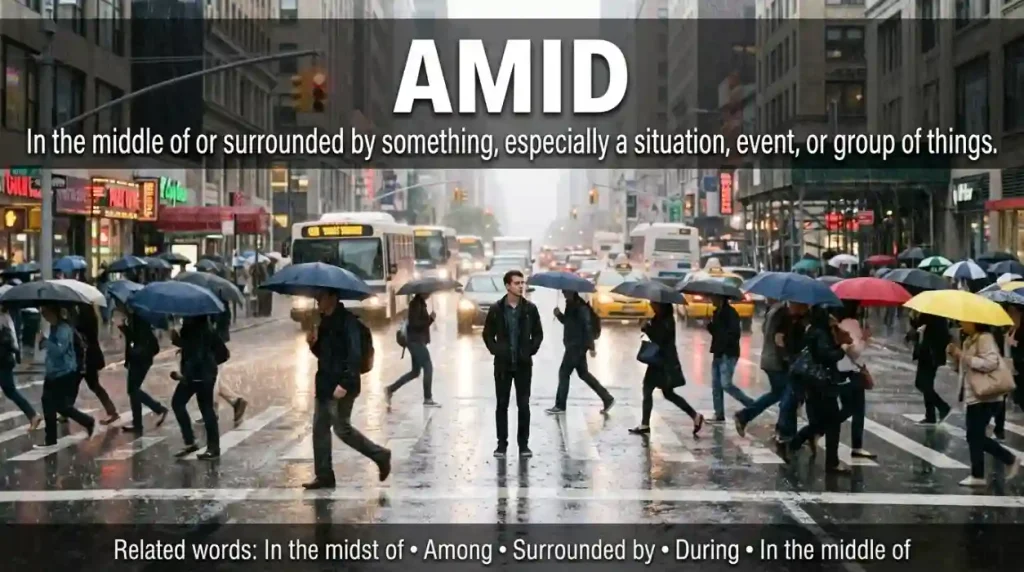
A synonym for amid is a word or phrase that means “in the middle of,” “during,” or “surrounded by,” depending on context. Common alternatives include among, amidst, during, in the midst of, and surrounded by. The best choice depends on whether you describe a situation, a period of time, or a physical setting.
Imagine trying to finish an assignment amid the noise of a busy household. You could say you worked amid the noise or surrounded by distractions. Each version expresses a similar idea with a slightly different emphasis.
The word amid appears frequently in news reports, academic writing, stories, and everyday English. It helps writers describe events that happen while other things are occurring or within a particular environment.
For students, bloggers, and content writers, learning alternatives makes sentences more varied and precise. Daily English users can also choose expressions that sound natural in conversations, messages, and emails.
If you want to describe events, emotions, or surroundings clearly, understanding a synonym for amid will help you express relationships between people, places, and situations with greater confidence.
What Does “Amid” Really Mean?
Amid is a preposition that means “in the middle of,” “during,” or “surrounded by.” It connects a person, event, or condition to the setting or circumstances around it.
Native English speakers commonly use amid to describe busy environments, difficult circumstances, major events, and changing situations. It often sounds slightly more formal than in the middle of.
Examples include:
- A surrounding environment: “The cottage stood amid tall trees.”
- An ongoing event: “She remained calm amid the confusion.”
- A difficult situation: “The company continued operating amid uncertainty.”
- A period of change: “The announcement came amid growing concerns.”
- A crowd: “He moved amid the excited spectators.”
Part of speech: Preposition.
Simple definition: In or during a particular situation, or surrounded by something.
Although amid can describe physical surroundings, it often refers to circumstances rather than a literal location. For example, “amid criticism” means while criticism was happening, not necessarily in a physical space filled with criticism.
🧠 Connotative Meaning
(Connotation is the feeling, attitude, or association a word carries beyond its basic dictionary meaning.)
Positive tone: Amid can introduce a hopeful or joyful setting.
Example: “Amid the celebrations, the family shared a special announcement.”
Negative tone: It often appears with difficult or troubling circumstances.
Example: “Amid mounting pressure, the team struggled to meet its deadline.”
Neutral tone: It can simply describe the setting or circumstances of an event.
Example: “The school opened a new library amid the annual celebrations.”
The word itself is neutral. The nouns around it, such as celebration, uncertainty, or confusion, determine the emotional tone.
📖 Etymology:
Amid developed from older English forms related to the expression on middan, meaning “in the middle.” Its history is connected to the Old English word middel, meaning “middle.”
The modern word describes a position or circumstance within something else. Over time, it became especially useful for expressing both physical surroundings and figurative situations.
A Brief History Through English
- Old English (450–1100): English used forms related to mid and middel to express the idea of being in the middle or together with something.
- Middle English (1100–1500): Forms such as amid and amidde developed and appeared in descriptions of location and surrounding circumstances.
- Modern English (1500–present): Amid became an established preposition. Writers increasingly used it in formal prose, news reporting, literature, and descriptions of events occurring during complex circumstances.

Pronunciation, Syllables, and Affixation
Pronunciation of “amid”
- US IPA: /əˈmɪd/
- UK IPA: /əˈmɪd/
Syllables: a-mid — two syllables.
Affixation pattern
- Root: Historically related to mid, meaning “middle.”
- Prefix: No productive modern prefix is added to the word.
- Suffix: No productive modern suffix is added.
- Word formation: Amid is an established preposition rather than a word formed through a modern prefix-and-suffix pattern.
The stress falls on the second syllable: uh-MID.
📚 Synonyms List
The closest substitute for amid depends on the sentence. Some alternatives describe physical surroundings, while others emphasize timing, involvement, or difficult circumstances. The following list includes direct alternatives and context-specific phrases. They are not all interchangeable.
1. Amidst (preposition) — US / UK: /əˈmɪdst/
Meaning: In the middle of something or surrounded by it.
Tone/Register: Neutral to formal; often literary.
Examples:
The cabin stood amidst the pine trees.
Amidst the celebrations, she quietly thanked her teachers.
2. Among (preposition) — US / UK: /əˈmʌŋ/
Meaning: In the company of, or surrounded by, several people or things.
Tone/Register: Neutral and widely used.
Examples:
He felt comfortable among his classmates.
A rare blue flower grew among the white daisies.
3. In the midst of (prepositional phrase) — US / UK: /ɪn ðə mɪdst əv/
Meaning: In the middle of an event, activity, or situation.
Tone/Register: Neutral to formal.
Examples:
I called her in the midst of a busy workday.
The town was in the midst of major renovations.
4. In the middle of (prepositional phrase) — US / UK: /ɪn ðə ˈmɪd.əl əv/
Meaning: At the center of a place, event, or ongoing activity.
Tone/Register: Neutral and conversational.
Examples:
We stopped in the middle of the crowded square.
He was in the middle of cooking when the doorbell rang.
5. Surrounded by (prepositional phrase) — US / UK: /səˈraʊn.dɪd baɪ/
Meaning: Having people, objects, or conditions all around something or someone.
Tone/Register: Neutral and descriptive.
Examples:
The cottage was surrounded by flowering trees.
She stayed focused, surrounded by noisy colleagues.
6. During (preposition) — US / UK: /ˈdʊr.ɪŋ/ /ˈdjʊə.rɪŋ/
Meaning: At some point within a period or event.
Tone/Register: Neutral, common in speech and writing.
Examples:
Several questions came up during the meeting.
The lights went out during the storm.
7. In (preposition) — US / UK: /ɪn/
Meaning: Within a place, condition, situation, or period.
Tone/Register: Neutral and highly versatile.
Examples:
She found comfort in difficult times.
The decision was made in an atmosphere of uncertainty.
8. Within (preposition) — US / UK: /wɪˈðɪn/
Meaning: Inside the limits of a place, period, group, or situation.
Tone/Register: Neutral to formal.
Examples:
The solution emerged within a complex discussion.
All changes must occur within the agreed period.
9. Throughout (preposition) — US / UK: /θruːˈaʊt/
Meaning: During an entire period or across all parts of an area.
Tone/Register: Neutral and formal.
Examples:
She remained calm throughout the emergency.
Music could be heard throughout the festival grounds.
10. In the presence of (prepositional phrase) — US / UK: /ɪn ðə ˈprez.əns əv/
Meaning: While someone is physically present.
Tone/Register: Formal and neutral.
Examples:
The certificate was presented in the presence of her family.
He felt nervous in the presence of senior managers.
11. In the company of (prepositional phrase) — US / UK: /ɪn ðə ˈkʌm.pə.ni əv/
Meaning: Together with another person or group.
Tone/Register: Neutral, sometimes formal.
Examples:
She enjoyed walking in the company of close friends.
The child felt safe in the company of his grandparents.
12. Amid the midst of (phrase) — US / UK: /əˈmɪd ðə mɪdst əv/
Meaning: This is a nonstandard, redundant combination that speakers should generally avoid; use amid or in the midst of instead.
Tone/Register: Incorrect or awkward in standard usage.
Examples:
Awkward: “Amid the midst of the debate, he left.”
Better: “Amid the debate, he left.”
13. Amidst all (phrase) — US / UK: /əˈmɪdst ɔːl/
Meaning: In the middle of many surrounding events, feelings, or circumstances.
Tone/Register: Literary or expressive.
Examples:
Amidst all the excitement, she remembered to call home.
Amidst all the changes, their friendship remained strong.
14. In the thick of (prepositional phrase) — US / UK: /ɪn ðə θɪk əv/
Meaning: Deeply involved in the busiest or most intense part of an event or situation.
Tone/Register: Conversational and idiomatic.
Examples:
We were in the thick of preparations when the guests arrived.
She stayed composed in the thick of the negotiations.
15. In the heart of (prepositional phrase) — US / UK: /ɪn ðə hɑːrt əv/ /ɪn ðə hɑːt əv/
Meaning: At the central part of a place or the most important part of an activity.
Tone/Register: Descriptive, often literary.
Examples:
Their apartment sits in the heart of the old city.
The debate took place in the heart of the community.
16. In the center of (prepositional phrase) — US / UK: /ɪn ðə ˈsen.tɚ əv/ /ɪn ðə ˈsen.tə əv/
Meaning: At the central point of a physical area or event.
Tone/Register: Neutral and descriptive.
Examples:
A fountain stood in the center of the courtyard.
She found herself in the center of an unexpected argument.
17. Amid ongoing (phrase) — US / UK: /əˈmɪd ˈɑːnˌɡoʊ.ɪŋ/ /əˈmɪd ˈɒnˌɡəʊ.ɪŋ/
Meaning: While something is continuing to happen.
Tone/Register: Formal, especially in news and reports.
Examples:
The school remained open amid ongoing repairs.
The announcement arrived amid ongoing talks.
18. In the course of (prepositional phrase) — US / UK: /ɪn ðə kɔːrs əv/ /ɪn ðə kɔːs əv/
Meaning: At some point while an activity or process is taking place.
Tone/Register: Formal and professional.
Examples:
We discovered the error in the course of our review.
Several new ideas emerged in the course of the workshop.
19. During the course of (prepositional phrase) — US / UK: /ˈdʊr.ɪŋ ðə kɔːrs əv/ /ˈdjʊə.rɪŋ ðə kɔːs əv/
Meaning: At some time while an event or process unfolds.
Tone/Register: Formal, academic, and professional.
Examples:
The researcher gathered new evidence during the course of the study.
The team revised its plan during the course of the project.
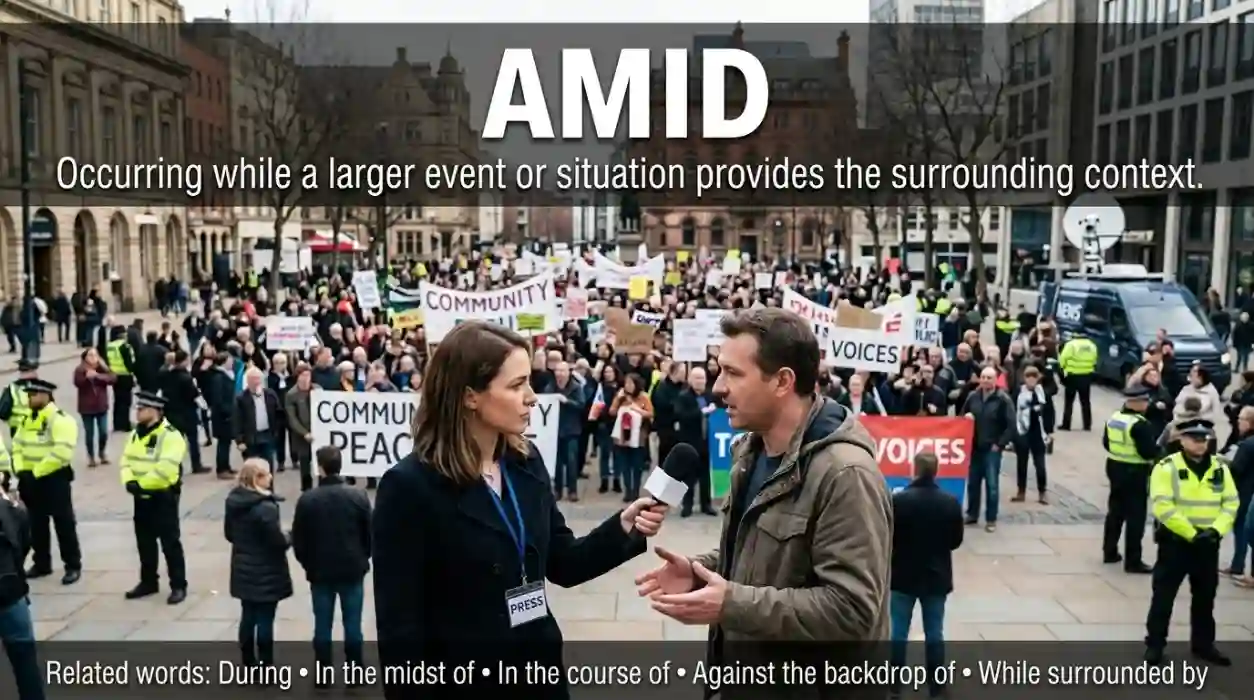
20. Against the backdrop of (prepositional phrase) — US / UK: /əˈɡenst ðə ˈbæk.drɑːp əv/ /əˈɡenst ðə ˈbæk.drɒp əv/
Meaning: Taking place while a larger event or situation provides the background.
Tone/Register: Formal, journalistic, and literary.
Examples:
The election took place against the backdrop of economic uncertainty.
Their love story unfolded against the backdrop of a changing city.
21. In the face of (prepositional phrase) — US / UK: /ɪn ðə feɪs əv/
Meaning: Despite a difficult situation or while confronting a challenge.
Tone/Register: Formal, motivational, and neutral.
Examples:
She remained hopeful in the face of criticism.
The team continued its work in the face of setbacks.
22. Under (preposition) — US / UK: /ˈʌn.dɚ/ /ˈʌn.də/
Meaning: Experiencing or being subject to a condition, pressure, or authority.
Tone/Register: Neutral to formal.
Examples:
The staff worked under considerable pressure.
The agreement was signed under difficult circumstances.
23. Amid growing (phrase) — US / UK: /əˈmɪd ˈɡroʊ.ɪŋ/ /əˈmɪd ˈɡrəʊ.ɪŋ/
Meaning: While a feeling, trend, or problem is increasing.
Tone/Register: Formal and journalistic.
Examples:
The minister resigned amid growing public criticism.
The project continued amid growing interest from researchers.
24. Amid rising (phrase) — US / UK: /əˈmɪd ˈraɪ.zɪŋ/
Meaning: While a number, concern, or condition is increasing.
Tone/Register: Formal and news-oriented.
Examples:
The company changed its policy amid rising costs.
Schools introduced new measures amid rising concerns about safety.
25. Amid mounting (phrase) — US / UK: /əˈmɪd ˈmaʊn.tɪŋ/
Meaning: While pressure, evidence, or concern is steadily accumulating.
Tone/Register: Formal, journalistic.
Examples:
The director stepped down amid mounting pressure.
The proposal faced delays amid mounting objections.
26. In an atmosphere of (prepositional phrase) — US / UK: /ɪn ən ˈæt.məs.fɪr əv/ /ɪn ən ˈæt.məs.fɪə əv/
Meaning: Within an environment characterized by a particular mood or feeling.
Tone/Register: Formal, descriptive, literary.
Examples:
The talks began in an atmosphere of mutual respect.
The staff worked in an atmosphere of uncertainty.
27. In an environment of (prepositional phrase) — US / UK: /ɪn ən ɪnˈvaɪ.rən.mənt əv/
Meaning: Within conditions shaped by a particular set of factors.
Tone/Register: Professional and academic.
Examples:
The team learned to adapt in an environment of rapid change.
Students need support in an environment of constant competition.
28. In a climate of (prepositional phrase) — US / UK: /ɪn ə ˈklaɪ.mət əv/
Meaning: Within a general social, political, or emotional atmosphere.
Tone/Register: Formal, analytical, journalistic.
Examples:
The law was debated in a climate of public concern.
The organization expanded in a climate of growing confidence.
29. In the wake of (prepositional phrase) — US / UK: /ɪn ðə weɪk əv/
Meaning: Following an important event, often one that has caused change or disruption.
Tone/Register: Formal, journalistic.
Examples:
The city rebuilt its roads in the wake of the floods.
Several rules changed in the wake of the investigation.
30. Amid uncertainty (phrase) — US / UK: /əˈmɪd ʌnˈsɝː.tən.ti/ /əˈmɪd ʌnˈsɜː.tən.ti/
Meaning: While outcomes or circumstances remain unclear.
Tone/Register: Formal and neutral.
Examples:
The family made plans amid uncertainty about the move.
Investors waited for further details amid uncertainty.
31. Amid chaos (phrase) — US / UK: /əˈmɪd ˈkeɪ.ɑːs/ /əˈmɪd ˈkeɪ.ɒs/
Meaning: In the middle of extreme confusion or disorder.
Tone/Register: Dramatic, journalistic, descriptive.
Examples:
Amid chaos at the station, a volunteer guided the children outside.
The nurse remained focused amid chaos in the emergency room.
32. Amid turmoil (phrase) — US / UK: /əˈmɪd ˈtɝː.mɔɪl/ /əˈmɪd ˈtɜː.mɔɪl/
Meaning: While experiencing serious disturbance or instability.
Tone/Register: Formal, literary, journalistic.
Examples:
The country held elections amid political turmoil.
Their family business survived amid financial turmoil.
33. Amid controversy (phrase) — US / UK: /əˈmɪd ˈkɑːn.trəˌvɝː.si/ /əˈmɪd ˈkɒn.trəˌvɜː.si/
Meaning: While a subject or decision is being publicly debated or criticized.
Tone/Register: Formal, media-oriented.
Examples:
The museum opened amid controversy over its new exhibit.
The athlete retired amid controversy surrounding the decision.
34. Amid celebrations (phrase) — US / UK: /əˈmɪd ˌsel.əˈbreɪ.ʃənz/
Meaning: While people are celebrating an event or achievement.
Tone/Register: Neutral to positive.
Examples:
The announcement was made amid celebrations in the town square.
Amid celebrations, the graduates thanked their families.
35. Amid applause (phrase) — US / UK: /əˈmɪd əˈplɔːz/
Meaning: While people are clapping to express approval or appreciation.
Tone/Register: Descriptive, often positive.
Examples:
The winner stepped onto the stage amid applause.
She left the auditorium amid warm applause.
36. Amid laughter (phrase) — US / UK: /əˈmɪd ˈlæf.tɚ/ /əˈmɪd ˈlɑːf.tə/
Meaning: While people are laughing.
Tone/Register: Neutral to positive, narrative.
Examples:
Amid laughter, the friends recalled their childhood adventures.
He delivered the punchline amid laughter from the audience.
37. Amid tears (phrase) — US / UK: /əˈmɪd tɪrz/ /əˈmɪd tɪəz/
Meaning: While people are crying or expressing strong emotion.
Tone/Register: Emotional, literary, journalistic.
Examples:
She said goodbye amid tears at the airport.
Amid tears, the family embraced after the long separation.
38. Amid conflict (phrase) — US / UK: /əˈmɪd ˈkɑːn.flɪkt/ /əˈmɪd ˈkɒn.flɪkt/
Meaning: While disagreement, fighting, or opposition is taking place.
Tone/Register: Formal, journalistic.
Examples:
The aid workers continued their efforts amid conflict.
The agreement was reached amid conflict between rival groups.
39. Amid debate (phrase) — US / UK: /əˈmɪd dɪˈbeɪt/
Meaning: While people are discussing and disagreeing about an issue.
Tone/Register: Neutral to formal.
Examples:
The policy changed amid debate among education experts.
The council approved the plan amid debate over its effects.
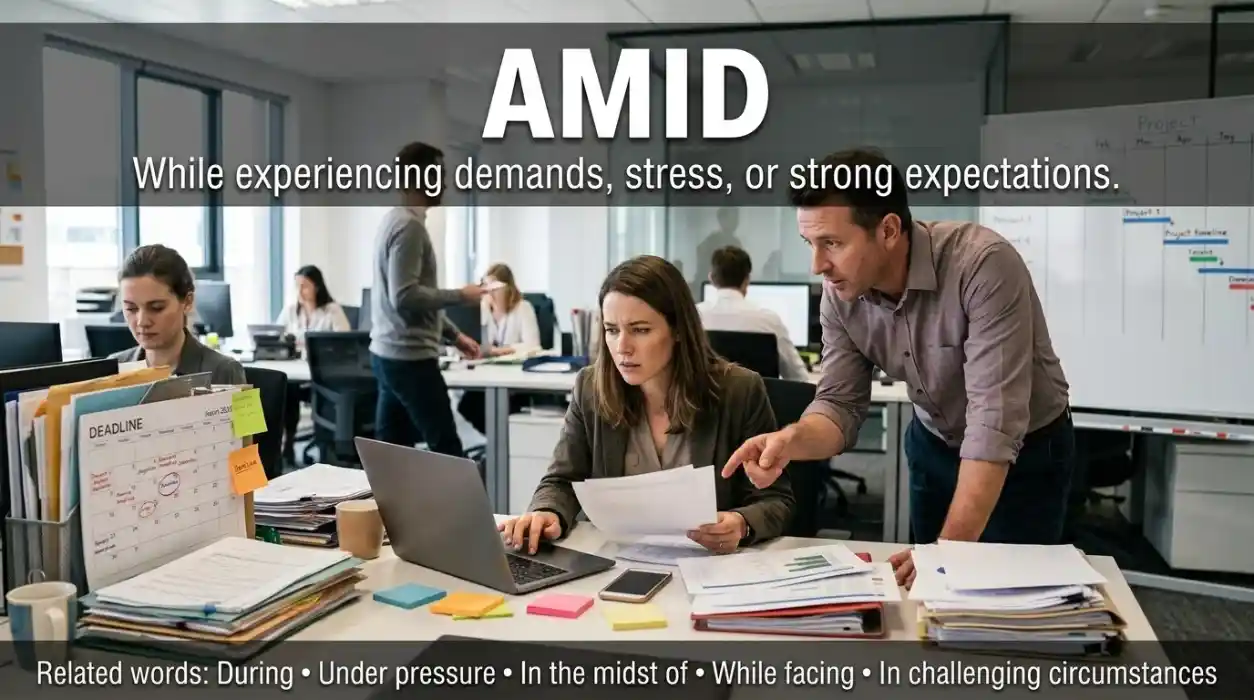
40. Amid pressure (phrase) — US / UK: /əˈmɪd ˈpreʃ.ɚ/ /əˈmɪd ˈpreʃ.ə/
Meaning: While experiencing demands, stress, or strong expectations.
Tone/Register: Neutral, professional, journalistic.
Examples:
The manager resigned amid pressure from the board.
She delivered an excellent presentation amid pressure to succeed.
41. Amid protests (phrase) — US / UK: /əˈmɪd ˈproʊ.tests/ /əˈmɪd ˈprəʊ.tests/
Meaning: While public demonstrations are taking place.
Tone/Register: Formal, news-oriented.
Examples:
The event continued amid protests outside the building.
The policy was withdrawn amid protests from residents.
42. Amid rumors (phrase) — US / UK: /əˈmɪd ˈruː.mɚz/ /əˈmɪd ˈruː.məz/
Meaning: While unconfirmed stories or claims are circulating.
Tone/Register: Neutral, journalistic.
Examples:
The singer released a statement amid rumors about the tour.
The school issued a clarification amid rumors of closure.
43. Amid change (phrase) — US / UK: /əˈmɪd tʃeɪndʒ/
Meaning: While changes are taking place.
Tone/Register: Neutral, reflective, professional.
Examples:
The team maintained its values amid change.
Amid change in the industry, the small studio found new opportunities.
44. Amid transition (phrase) — US / UK: /əˈmɪd trænˈzɪʃ.ən/
Meaning: During the process of moving from one stage, role, or system to another.
Tone/Register: Formal, professional, academic.
Examples:
The department continued serving clients amid transition.
Students received extra guidance amid the transition to online classes.
45. Amid uncertainty and change (phrase) — US / UK: /əˈmɪd ʌnˈsɝː.tən.ti ænd tʃeɪndʒ/
Meaning: While circumstances are unclear and evolving.
Tone/Register: Formal and reflective.
Examples:
The community stayed connected amid uncertainty and change.
Leaders must communicate clearly amid uncertainty and change.
46. In the middle (prepositional phrase) — US / UK: /ɪn ðə ˈmɪd.əl/
Meaning: At a central point or during an ongoing event, when the surrounding context is understood.
Tone/Register: Neutral, conversational.
Examples:
I was in the middle when the argument started.
She arrived in the middle of the performance.
47. In between (preposition/adverb) — US / UK: /ˌɪn bɪˈtwiːn/
Meaning: In the space or interval separating two people, things, or events.
Tone/Register: Neutral, conversational.
Examples:
The small table stood in between the two chairs.
We chatted in between sessions at the conference.
48. Enveloped by (prepositional phrase) — US / UK: /ɪnˈvel.əpt baɪ/
Meaning: Surrounded or covered by something, often physically or emotionally.
Tone/Register: Literary, descriptive.
Examples:
The village was enveloped by thick morning fog.
She felt enveloped by a sense of calm.
49. Immersed in (prepositional phrase) — US / UK: /ɪˈmɝːst ɪn/ /ɪˈmɜːst ɪn/
Meaning: Deeply involved in an activity, experience, or environment.
Tone/Register: Neutral to formal.
Examples:
He was immersed in research for his final project.
The children became immersed in the world of the story.
50. Set against (prepositional phrase) — US / UK: /set əˈɡenst/
Meaning: Presented in relation to a contrasting background, event, or situation.
Tone/Register: Formal, literary, analytical.
Examples:
The novel is set against a backdrop of social change.
Her personal story unfolds against a period of political uncertainty.
Synonyms by Tone
The tone of a substitute depends on the situation and the words around it. Choosing the right expression helps you communicate whether an event is simply happening, surrounded by activity, or taking place under pressure.
Positive or Reassuring Contexts
These phrases work well when the surrounding circumstances feel joyful, supportive, or inspiring.
- Among: emphasizes being part of a group.
- Amidst all: places an event within a busy but often positive setting.
- Amid celebrations: highlights a joyful occasion.
- Amid applause: suggests approval or appreciation.
- In the company of: emphasizes companionship.
- In the presence of: highlights someone’s attendance.
Example: “Amid celebrations, she stood among her friends and thanked everyone who had helped her.”
Neutral Contexts
These expressions describe timing, location, or circumstances without automatically suggesting a positive or negative attitude.
- During: focuses on time.
- Within: focuses on boundaries or limits.
- Throughout: emphasizes an entire period or area.
- In the middle of: provides a straightforward description.
- In the course of: suits formal descriptions of processes.
- In between: describes a position or interval separating two things.
Example: “During the conference, several new ideas emerged within the discussion.”
Negative or High-Pressure Contexts
These expressions often introduce difficult circumstances, disagreement, or uncertainty.
- Amid chaos
- Amid turmoil
- Amid controversy
- Amid pressure
- Amid protests
- In the face of
- Against the backdrop of
- In the wake of
Example: “In the face of criticism, the team continued its work amid growing uncertainty.”
Formal, Literary, and Descriptive Contexts
These phrases can give writing a more polished or vivid tone.
- In the thick of
- In the heart of
- In an atmosphere of
- In a climate of
- Enveloped by
- Immersed in
- Set against
Example: “Set against a backdrop of political change, the novel explores the lives of an ordinary family.”
Tone matters because a substitute should preserve the meaning while fitting the reader, audience, and situation.
“Amid” vs. Close Alternatives
| Word or phrase | Main difference | Best use |
|---|---|---|
| Amid | In the middle of a situation or surrounded by something | Concise, often formal writing |
| Among | In a group or surrounded by multiple people or things | People, objects, and group settings |
| During | At some point within a period or event | Time and events |
| Surrounded by | Emphasizes things or people around someone or something | Physical and figurative surroundings |
| In the midst of | Highlights the middle of an ongoing event or situation | Active situations and processes |
| Against the backdrop of | Describes the larger circumstances behind an event | News, analysis, and storytelling |
Compare the Meaning
- “Amid the crowd, she spotted her brother.” This places her within a crowd.
- “Among the crowd, she spotted her brother.” This is understandable, but in the crowd or amid the crowd sounds more natural in many contexts.
- “During the concert, she spotted her brother.” This emphasizes when she saw him, not where she stood.
- “Surrounded by fans, she waved to her brother.” This emphasizes the people around her.
- “In the midst of the concert, she received a call.” This emphasizes that the concert was already underway.
The key distinction is whether you want to emphasize a setting, a group, a period of time, or a larger situation.
How to Use “Amid” in Different Contexts
Daily Conversation
In casual speech, people often prefer during, among, or in the middle of. These expressions feel direct and natural.
“I lost my keys in the middle of all the confusion.”
Amid also works in conversation, but it can sound more formal or carefully worded.
Writing and Blogging
In articles and blog posts, amid helps connect an event to surrounding developments without making a sentence too long.
“The café introduced a new menu amid growing interest in plant-based food.”
Avoid inserting amid simply to make a sentence sound sophisticated. Choose it when the relationship between the event and its circumstances is clear.
Professional or Academic Writing
In reports, research papers, and business writing, amid often introduces circumstances that affect a decision or result.
“The study was conducted amid considerable uncertainty about future demand.”
For a time-specific statement, during may be clearer. For a description of surrounding conditions, amid may be more effective.
Creative and Informal Writing
In fiction, amid can establish atmosphere quickly. It lets writers show what surrounds a character without lengthy explanation.
“Amid the flickering lights and distant music, Maya noticed a familiar face.”
For a conversational voice, in the middle of may sound less literary and more natural.
Common Mistakes and Native Usage
1. Confusing “Amid” With “During”
Use during when time is the main focus. Use amid when you want to present an event within surrounding circumstances.
- During the meeting, we discussed the budget. This emphasizes when the discussion happened.
- Amid growing concerns, the board reviewed the budget. This emphasizes the circumstances around the review.
2. Using “Amid” With an Inappropriate Structure
Amid is normally followed by a noun phrase or a noun-like construction.
Natural: “Amid growing concern, the school changed its policy.”
Awkward: “Amid people were shouting, she left.”
Better: “Amid the shouting, she left” or “While people were shouting, she left.”
3. Confusing “Amid” and “Among”
Among typically emphasizes membership in or presence within a group. Amid often emphasizes the surrounding environment or situation.
Natural: “She was among the finalists.”
Natural: “She remained calm amid the controversy.”
The words can overlap when describing a crowd, but their emphasis differs.
4. Writing “Amidst the Middle Of”
Avoid combining equivalent expressions unnecessarily.
Awkward: “Amidst the middle of the celebration, he arrived.”
Better: “Amid the celebration, he arrived.”
You can also write, “In the middle of the celebration, he arrived.”
5. Overusing “Amid” in Formal Writing
Repeating amid in every paragraph can make writing feel stiff. Alternate it with during, while, among, or in the midst of when the meaning allows.
Do not replace every occurrence mechanically. Each expression has its own grammatical pattern and emphasis.
Register Notes
- Formal and concise: amid, amidst, in the wake of.
- Neutral and common: during, among, within.
- Conversational: in the middle of, in between.
- Literary and descriptive: enveloped by, in the heart of, against the backdrop of.
- Analytical or professional: in the course of, in an environment of, in a climate of.
For related vocabulary practice, you could explore synonyms for during to strengthen your understanding of time-based expressions.
Real-Life Mini Scenarios
Workplace
A company announces a new policy while employees are worried about restructuring. “The company introduced the policy amid concerns about job security” communicates both the event and the surrounding circumstances.
Social Situations
A student receives good news at a family gathering. “Amid the laughter, she shared her exam results” creates a warm, lively scene. If the focus is simply on timing, “During dinner, she shared her exam results” is more direct.
Media and Pop Culture
News articles often use amid to connect a development with wider circumstances. For example, “The actor announced a new project amid speculation about an upcoming film.” The word does not confirm that the speculation caused the announcement.
Writing and Storytelling
A novelist might write, “Amid the falling snow, the travelers searched for shelter.” The phrase establishes the environment and helps readers picture the scene. “During the snowfall” is also correct, but it places greater emphasis on time.
Practice Quiz:
1. The event happened while the storm was continuing. Which word best emphasizes the time?
A. Among
B. During
C. Surrounded by
D. Enveloped by
2. A cottage has tall trees all around it. Which phrase is most precise?
A. During
B. In the course of
C. Surrounded by
D. In the wake of
3. A manager decided while facing increasing criticism. Which phrase fits?
A. Amid mounting criticism
B. Among criticism
C. Between criticism
D. Throughout criticism
4. A student is deeply involved in a research project. Which expression fits?
A. In between
B. In the wake of
C. During the course of
D. Immersed in
5. A story takes place against a wider background of political change. Which phrase suits it?
A. In the presence of
B. Against the backdrop of
C. In between
D. During
6. Several people are standing in a group. Which preposition best expresses being part of that group?
A. Amidst
B. Throughout
C. Among
D. Under
7. A company is dealing with a serious period of instability. Which phrase fits?
A. Amid turmoil
B. Among turmoil
C. In between turmoil
D. Throughout turmoil
8. A process is being described formally, from beginning to end. Which phrase may fit?
A. In the heart of
B. In the company of
C. Amid applause
D. Throughout
9. Someone receives a phone call while cooking. Which phrase sounds most natural?
A. Against the backdrop of cooking
B. In the middle of cooking
C. Among cooking
D. Enveloped by cooking
Reflection Task
Write two sentences about the same event. Use amid in the first sentence and a suitable alternative in the second. Decide whether your second version emphasizes the time, the setting, or the circumstances.
Answer key: 1-B, 2-C, 3-A, 4-D, 5-B, 6-C, 7-A, 8-D, 9-B
External Source
For verified definitions, pronunciations, and usage examples, consult the Cambridge Dictionary entry for amid. Comparing its examples with entries for among, during, and amidst can help you understand their differences.
Conclusion
Learning synonyms for amid helps you explain when events happen and what surrounds them. Alternatives such as during, among, and in the midst of add precision to your writing.
Students can use these expressions in essays, while bloggers and content writers can create smoother descriptions. In conversation, choosing the right phrase makes your meaning clearer and more natural.
Remember that synonyms are not always interchangeable. Focus on whether you mean time, a group, a physical setting, or wider circumstances before choosing your words.
Practise using three alternatives in an email, essay, or daily conversation this week. Small vocabulary choices can make your English clearer, more confident, and more expressive.
FAQs
1. What is the best synonym for “amid” in formal writing?
In the midst of is a useful alternative when describing an ongoing situation. Against the backdrop of works when a wider social or historical context matters. During is usually best when you mean a specific period of time. Choose the phrase that reflects the relationship you want to communicate rather than selecting the most formal-sounding option.
2. Is “amidst” more correct than “amid”?
No. Both amid and amidst are standard English prepositions, and both can mean “in the middle of” or “surrounded by.” Amid is common in contemporary news and professional writing, while amidst can sound slightly more literary to some readers. The choice is largely stylistic, and both are grammatically acceptable.
3. Can “amid” be used at the beginning of a sentence?
Yes. Starting a sentence with amid is common, especially in formal and journalistic writing. For example, “Amid growing concerns, the school revised its policy.” The phrase establishes the circumstances before introducing the main action. Make sure the noun phrase following amid clearly relates to the event described in the rest of the sentence.
4. What is the difference between “amid” and “within”?
Amid usually emphasizes surrounding circumstances or being in the middle of a situation. Within more often emphasizes boundaries, limits, or an interior space. “Amid uncertainty” describes the conditions surrounding an event, while “within three days” specifies a time limit. The correct choice depends on whether you mean circumstances or boundaries.
5. Is “amid” appropriate for IELTS essays and academic writing?
Yes. Amid can be useful in IELTS essays and academic writing when it accurately introduces surrounding conditions. For example, “Amid rapid technological change, educational institutions face new challenges.” However, it should not replace during in every sentence. Clear grammar, accurate meaning, and appropriate word choice matter more than using advanced vocabulary unnecessarily.

Hasnain Ali is an SEO Content Strategist and the founder of wordvora.com, a trusted vocabulary platform that helps writers, students, professionals, and English learners find accurate synonyms, antonyms, word meanings, and real-life usage examples. He specializes in keyword research, on-page SEO, topical authority, and creating search-first content that aligns with Google’s latest Search Quality and E-E-A-T guidelines. His work focuses on producing clear, well-structured, and reader-friendly resources that satisfy search intent while maintaining high editorial standards.
Through extensive hands-on experience with SEO tools such as Google Search Console, Google Analytics, SEMrush, and Ahrefs, Hasnain researches user search behavior and develops content that is both informative and easy to understand. Every article published on wordvora.com is carefully reviewed for accuracy, readability, and contextual relevance before publication. His mission is to build one of the web’s most reliable English vocabulary resources by providing practical language guidance, trustworthy explanations, and content that helps readers improve their writing, communication, and vocabulary with confidence.