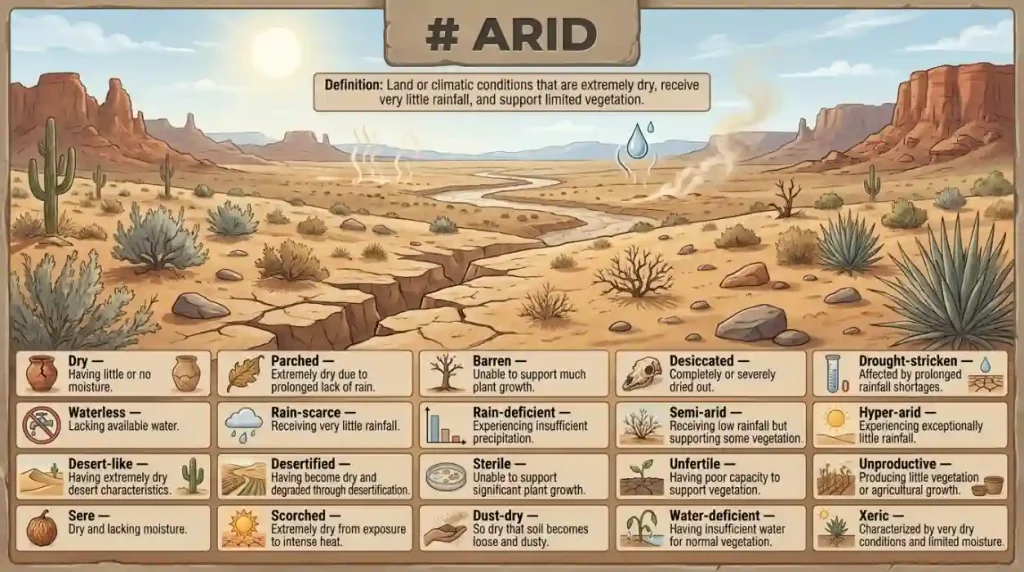
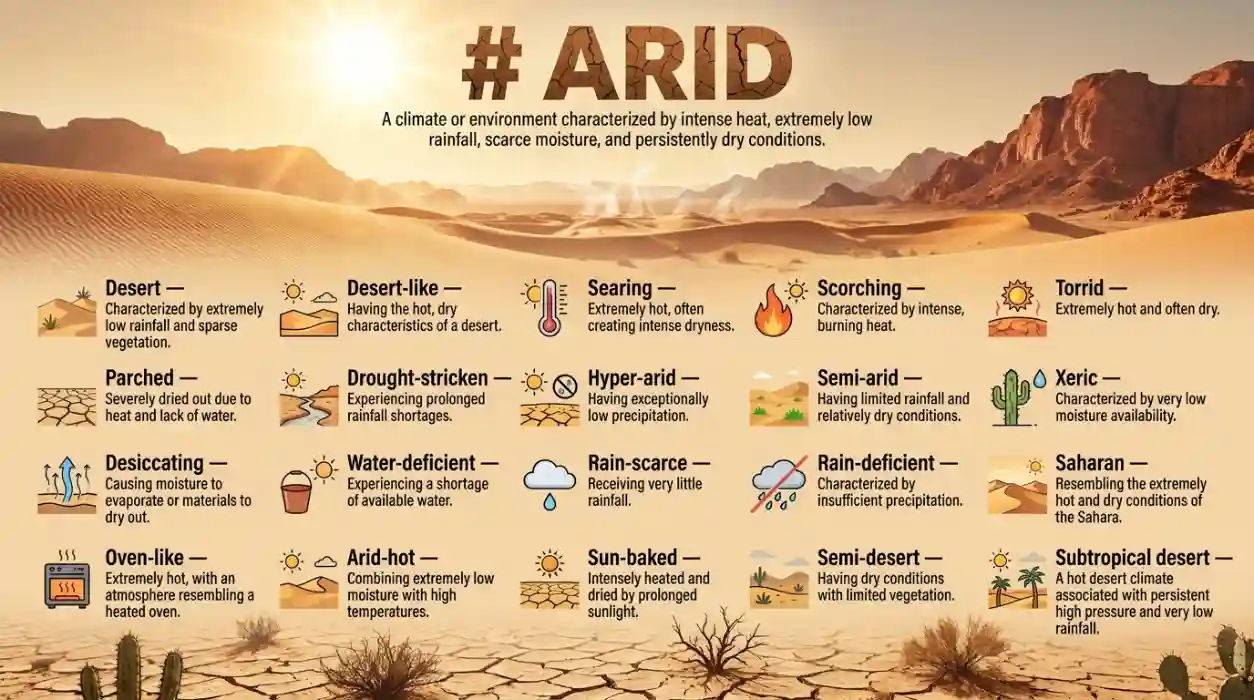
A synonym for arid is dry, parched, waterless, or desiccated. These words describe places, soil, or conditions that lack moisture or receive very little rainfall. The best alternative depends on whether you mean a dry climate, thirsty land, or an extremely dry surface.
Imagine walking across a desert on a hot afternoon. The ground feels dry, the air holds little moisture, and plants struggle to survive. The word arid captures this harsh environment.
You may also see arid in geography books, weather reports, travel writing, and environmental studies. It gives a precise description of places with very low rainfall.
Learning a synonym for arid helps you describe landscapes and weather without repeating the same word. Each alternative adds a slightly different shade of meaning.
Students, bloggers, content writers, and everyday English users can all benefit. The right word makes descriptions clearer, more natural, and more interesting.
What Does “Arid” Really Mean?
Arid means extremely dry or having very little rainfall. It usually describes a region, climate, soil, or environment where water is scarce.
Part of speech: Adjective.
Simple definition: Very dry, especially because little rain falls or very little moisture is available.
Native English speakers commonly use arid when describing deserts, dry regions, climates, and land. It can also describe something lacking interest or imagination, as in an arid discussion.
The word often appears in geography, environmental science, agriculture, climate reports, travel articles, and descriptive writing.
Connotative Meaning
(Connotation means the feeling, association, or emotional suggestion a word carries beyond its basic dictionary meaning.)
- Positive tone: Arid can suggest a striking desert landscape, dramatic scenery, or a unique natural environment.
- Negative tone: It can suggest hardship, drought, poor soil, water shortages, and difficult living conditions.
- Neutral tone: In scientific and geographical writing, it simply describes a climate or region with very little rainfall.
The emotional meaning depends on context. An arid landscape may look beautiful to a traveler but create serious challenges for farmers and residents.
Etymology:
The English word arid comes from Latin aridus, meaning “dry” or “parched.” It is related to the Latin verb arere, meaning “to be dry” or “to become dry.”
The word entered English through French or learned Latin influence. Its central meaning has remained connected with dryness. Today, it commonly describes climates and environments that receive little precipitation.
Old English (450–1100)
The word arid did not form part of ordinary Old English vocabulary. English speakers used native words such as drȳge, the ancestor of modern dry, to describe a lack of moisture.
Middle English (1100–1500)
The word arid was not yet a common part of everyday Middle English. Words related to dry continued to express the same basic idea. Learned Latin and French vocabulary gradually influenced English descriptions of nature and climate.
Modern English (1500–Present)
Arid entered English in the early modern period through learned vocabulary. Its use became especially useful in geographical and scientific descriptions. Today, it refers to very dry climates, landscapes, and conditions. It can also describe something dull or lacking substance in a figurative sense.
Pronunciation (US & UK – IPA)
- US: /ˈær.ɪd/
- UK: /ˈær.ɪd/
The pronunciation is very similar in both varieties of English.
Syllables
ar-id — two syllables.
The stress falls on the first syllable: AR-id.
Affixation Pattern of “Arid”
- Root: arid — the complete adjective comes from Latin aridus.
- Prefix: None.
- Suffix: No productive English suffix is added to form the word.
Related word forms include:
- Aridity (noun): The condition or degree of being dry.
- Aridly (adverb): In a dry or figuratively dull manner.
- Aridness (noun): The state of being arid.
Synonyms List
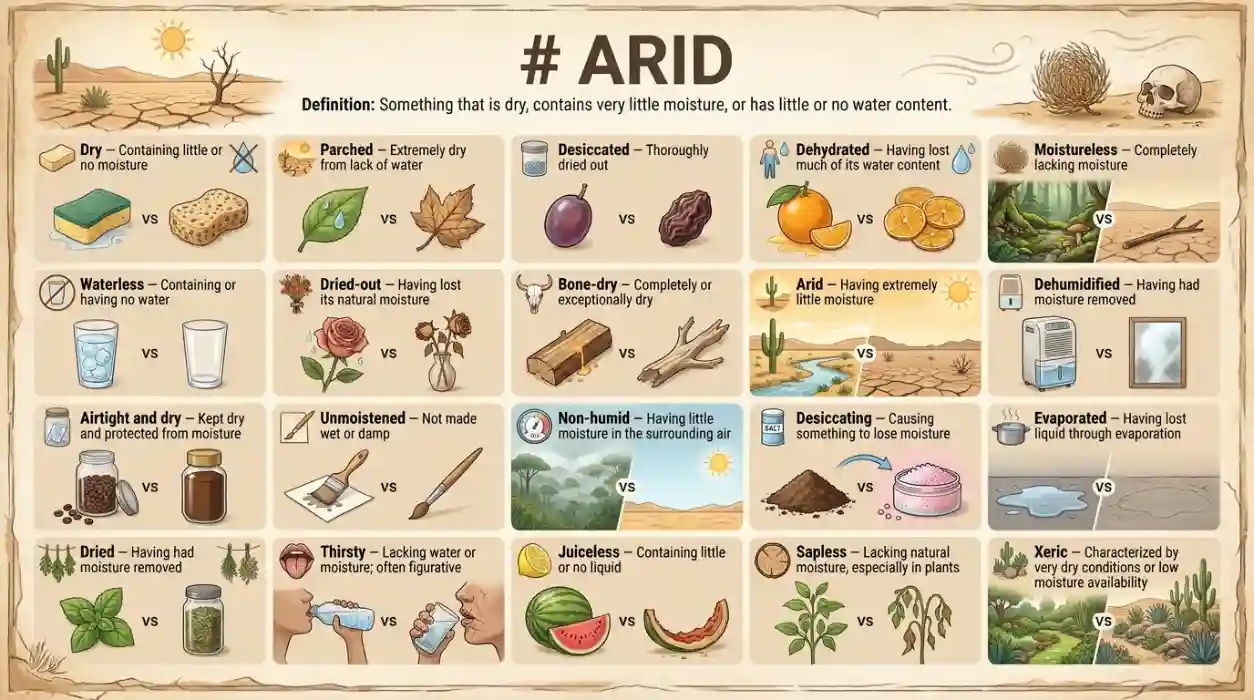
A quick vocabulary note: Dry is the closest everyday synonym for arid. Other alternatives have more specific meanings. Some describe a lack of rain, while others refer to dry soil, intense heat, or a landscape with little vegetation. Choose the word that matches your sentence.
1. Dry (Adjective) — US: /draɪ/ | UK: /draɪ/
Meaning: Having little or no moisture; the simplest and most common alternative to arid.
Tone/Register: Neutral, everyday.
Examples:
The region has a dry climate for most of the year.
Keep the equipment in a dry place.
2. Parched (Adjective) — US: /pɑːrtʃt/ | UK: /pɑːtʃt/
Meaning: Extremely dry, often because of prolonged heat or a lack of rain.
Tone/Register: Descriptive, expressive.
Examples:
The farmers watched their parched fields closely.
We crossed a parched landscape under the afternoon sun.
3. Waterless (Adjective) — US: /ˈwɔː.t̬ɚ.ləs/ | UK: /ˈwɔː.tə.ləs/
Meaning: Having no available water or an extremely limited water supply.
Tone/Register: Neutral, descriptive.
Examples:
The travelers carried extra supplies across the waterless region.
Several waterless settlements depend on distant wells.
4. Desiccated (Adjective) — US: /ˈdes.ɪ.keɪ.t̬ɪd/ | UK: /ˈdes.ɪ.keɪ.tɪd/
Meaning: Completely or almost completely dried out.
Tone/Register: Formal, scientific.
Examples:
The laboratory examined the desiccated plant samples.
Only desiccated vegetation remained after the drought.
5. Rainless (Adjective) — US: /ˈreɪn.ləs/ | UK: /ˈreɪn.ləs/
Meaning: Experiencing little or no rainfall.
Tone/Register: Neutral, descriptive.
Examples:
The region endured several rainless months.
Rainless weather affected the local harvest.
6. Bone-Dry (Adjective) — US: /ˌboʊnˈdraɪ/ | UK: /ˌbəʊnˈdraɪ/
Meaning: Completely dry, with almost no moisture remaining.
Tone/Register: Informal, emphatic.
Examples:
The soil became bone-dry by midsummer.
The old riverbed was bone-dry after weeks without rain.
7. Barren (Adjective) — US: /ˈber.ən/ | UK: /ˈbær.ən/
Meaning: Unable to support much plant growth, often because of poor soil or a lack of water.
Tone/Register: Neutral, descriptive.
Examples:
Few plants survive on the barren hillside.
The expedition crossed a barren stretch of land.
8. Desiccating (Adjective) — US: /ˈdes.ɪ.keɪ.tɪŋ/ | UK: /ˈdes.ɪ.keɪ.tɪŋ/
Meaning: Causing something to lose moisture or become extremely dry.
Tone/Register: Formal, scientific.
Examples:
The desiccating wind damaged the young plants.
Farmers protected their crops from the desiccating heat.
9. Drought-Stricken (Adjective) — US: /ˈdraʊtˌstrɪk.ən/ | UK: /ˈdraʊtˌstrɪk.ən/
Meaning: Seriously affected by a prolonged period of unusually low rainfall.
Tone/Register: Formal, news, environmental.
Examples:
The drought-stricken district needed emergency water supplies.
Aid workers visited several drought-stricken communities.
10. Drought-Ridden (Adjective) — US: /ˈdraʊtˌrɪd.ən/ | UK: /ˈdraʊtˌrɪd.ən/
Meaning: Frequently or severely affected by drought.
Tone/Register: Descriptive, journalistic.
Examples:
The drought-ridden farmland produced very little grain.
Families left the drought-ridden area in search of work.
11. Moistureless (Adjective) — US: /ˈmɔɪs.tʃɚ.ləs/ | UK: /ˈmɔɪs.tʃə.ləs/
Meaning: Completely lacking moisture.
Tone/Register: Technical, descriptive.
Examples:
The moistureless soil could not support the seedlings.
The samples became moistureless during storage.
12. Scorched (Adjective) — US: /skɔːrtʃt/ | UK: /skɔːtʃt/
Meaning: Burned or damaged by intense heat, often leaving land extremely dry.
Tone/Register: Descriptive, dramatic.
Examples:
Scorched grass covered the open field.
The fire left the hillside black and scorched.
13. Sun-Baked (Adjective) — US: /ˈsʌnˌbeɪkt/ | UK: /ˈsʌnˌbeɪkt/
Meaning: Dried or hardened by prolonged exposure to strong sunlight.
Tone/Register: Descriptive, informal.
Examples:
We walked along a sun-baked path.
The village stood among sun-baked hills.
14. Sun-Scorched (Adjective) — US: /ˈsʌnˌskɔːrtʃt/ | UK: /ˈsʌnˌskɔːtʃt/
Meaning: Extremely dry or damaged by intense sunlight.
Tone/Register: Literary, descriptive.
Examples:
Sun-scorched plants lined the roadside.
The hikers rested beneath the only tree on the sun-scorched plain.
15. Sterile (Adjective) — US: /ˈster.əl/ | UK: /ˈster.aɪl/
Meaning: Unable to support plant growth or reproduction; when describing land, it can mean unproductive.
Tone/Register: Formal, scientific.
Examples:
The sterile ground supported almost no vegetation.
Researchers tested the soil before planting crops.
16. Infertile (Adjective) — US: /ɪnˈfɝː.təl/ | UK: /ɪnˈfɜː.taɪl/
Meaning: Not capable of producing healthy crops or supporting plant growth.
Tone/Register: Neutral, agricultural.
Examples:
The infertile soil required careful treatment.
Farmers avoided planting crops in the infertile section.
17. Unproductive (Adjective) — US: /ˌʌn.prəˈdʌk.tɪv/ | UK: /ˌʌn.prəˈdʌk.tɪv/
Meaning: Producing little or no useful growth, often because land lacks water or nutrients.
Tone/Register: Neutral, professional.
Examples:
The unproductive field needed better irrigation.
Several seasons of poor rainfall left the land unproductive.
18. Unwatered (Adjective) — US: /ʌnˈwɔː.t̬ɚd/ | UK: /ʌnˈwɔː.təd/
Meaning: Not supplied with water, especially when describing plants, gardens, or cultivated land.
Tone/Register: Neutral, everyday.
Examples:
The unwatered garden began to wilt.
The unwatered crops struggled during the hot season.
19. Thirsty (Adjective) — US: /ˈθɝː.sti/ | UK: /ˈθɜː.sti/
Meaning: Needing water; often used figuratively for dry soil, plants, or land.
Tone/Register: Informal, expressive.
Examples:
The thirsty earth absorbed the first drops of rain.
These thirsty plants need regular watering.
20. Dusty (Adjective) — US: /ˈdʌs.ti/ | UK: /ˈdʌs.ti/
Meaning: Covered with or containing fine dry particles of dust.
Tone/Register: Neutral, everyday.
Examples:
A dusty road led to the remote village.
The dry season left the fields dusty.

21. Sandy (Adjective) — US: /ˈsæn.di/ | UK: /ˈsæn.di/
Meaning: Containing or covered with sand; sandy ground often drains water quickly.
Tone/Register: Neutral, descriptive.
Examples:
The sandy soil dried quickly after the rain.
Small shrubs grew along the sandy track.
22. Desert-Like (Adjective) — US: /ˈdez.ɚtˌlaɪk/ | UK: /ˈdez.ətˌlaɪk/
Meaning: Resembling a desert because of dryness, sparse vegetation, or limited water.
Tone/Register: Descriptive, neutral.
Examples:
The area has a desert-like climate.
A desert-like landscape surrounded the isolated settlement.
23. Desert (Adjective) — US: /ˈdez.ɚt/ | UK: /ˈdez.ət/
Meaning: Relating to a desert environment, especially one with very low rainfall.
Tone/Register: Neutral, geographical.
Examples:
Desert conditions make farming difficult.
The region supports several desert plant species.
24. Semi-Arid (Adjective) — US: /ˌsem.iˈær.ɪd/ | UK: /ˌsem.iˈær.ɪd/
Meaning: Having low rainfall, but generally receiving more precipitation than a fully arid climate.
Tone/Register: Scientific, geographical.
Examples:
The town lies in a semi-arid region.
Semi-arid grasslands support plants adapted to limited rainfall.
25. Xeric (Adjective) — US: /ˈzɪr.ɪk/ | UK: /ˈzɪə.rɪk/
Meaning: Characterized by very dry conditions or adapted to environments with little available moisture.
Tone/Register: Scientific, specialist.
Examples:
Xeric habitats support plants that conserve water.
The researchers studied a xeric ecosystem.
26. Xerophytic (Adjective) — US: /ˌzɪr.oʊˈfɪt̬.ɪk/ | UK: /ˌzɪə.rəʊˈfɪt.ɪk/
Meaning: Describing plants that have adapted to survive in very dry environments.
Tone/Register: Scientific, botanical.
Examples:
Cacti are common examples of xerophytic plants.
The garden contains several xerophytic species.
27. Low-Rainfall (Adjective) — US: /ˌloʊˈreɪn.fɔːl/ | UK: /ˌləʊˈreɪn.fɔːl/
Meaning: Receiving only a small amount of rain over a given period.
Tone/Register: Neutral, geographical.
Examples:
Low-rainfall areas often depend on careful water management.
The crop grows well in low-rainfall conditions.
28. Dryland (Adjective) — US: /ˈdraɪ.lænd/ | UK: /ˈdraɪ.lænd/
Meaning: Relating to land or farming in regions where rainfall is limited.
Tone/Register: Agricultural, academic.
Examples:
Dryland farming requires crops that tolerate limited water.
The researchers studied dryland agriculture.
29. Moisture-Deficient (Adjective) — US: /ˈmɔɪs.tʃɚ dɪˈfɪʃ.ənt/ | UK: /ˈmɔɪs.tʃə dɪˈfɪʃ.ənt/
Meaning: Lacking the moisture needed for healthy soil, plant growth, or another process.
Tone/Register: Technical, formal.
Examples:
Moisture-deficient soil can limit crop development.
The report identified several moisture-deficient areas.
30. Dried-Out (Adjective) — US: /ˌdraɪdˈaʊt/ | UK: /ˌdraɪdˈaʊt/
Meaning: Having lost most or all of its moisture.
Tone/Register: Informal, neutral.
Examples:
The dried-out pond attracted little wildlife.
We found dried-out plants beside the fence.
31. Parched-Earth (Descriptive Phrase) — US: /ˌpɑːrtʃtˈɝːθ/ | UK: /ˌpɑːtʃtˈɜːθ/
Meaning: A descriptive expression for ground that has become extremely dry.
Tone/Register: Literary, expressive.
Examples:
Cracks spread across the parched earth.
The first rain softened the parched earth.
32. Rain-Starved (Adjective) — US: /ˈreɪnˌstɑːrvd/ | UK: /ˈreɪnˌstɑːvd/
Meaning: Receiving too little rainfall to maintain normal water levels or healthy vegetation.
Tone/Register: Journalistic, descriptive.
Examples:
The rain-starved valley needed a reliable water supply.
Rain-starved crops showed signs of stress.
33. Drought-Affected (Adjective) — US: /ˈdraʊt əˌfek.tɪd/ | UK: /ˈdraʊt əˌfek.tɪd/
Meaning: Experiencing damage or difficulty because of drought.
Tone/Register: Formal, environmental.
Examples:
Drought-affected farms received support from the local authority.
The survey covered several drought-affected villages.
34. Drought-Prone (Adjective) — US: /ˈdraʊtˌproʊn/ | UK: /ˈdraʊtˌprəʊn/
Meaning: Likely to experience drought because of its climate or rainfall patterns.
Tone/Register: Formal, geographical.
Examples:
Farmers in drought-prone regions often store rainwater.
The new plan focuses on drought-prone districts.
35. Water-Scarce (Adjective) — US: /ˈwɔː.t̬ɚˌskers/ | UK: /ˈwɔː.təˌskeəs/
Meaning: Having an insufficient supply of accessible water.
Tone/Register: Formal, environmental.
Examples:
Water-scarce communities need reliable infrastructure.
The project supports agriculture in water-scarce regions.
36. Water-Deprived (Adjective) — US: /ˈwɔː.t̬ɚ dɪˌpraɪvd/ | UK: /ˈwɔː.tə dɪˌpraɪvd/
Meaning: Lacking enough water for normal needs or healthy growth.
Tone/Register: Formal, descriptive.
Examples:
Water-deprived plants often develop slowly.
The water-deprived settlement depends on seasonal supplies.
37. Moisture-Poor (Adjective) — US: /ˈmɔɪs.tʃɚˌpʊr/ | UK: /ˈmɔɪs.tʃəˌpɔː/
Meaning: Containing very little moisture, particularly when describing soil or air.
Tone/Register: Technical, descriptive.
Examples:
Moisture-poor soil needs careful management.
The region’s moisture-poor air dries plants quickly.
38. Dry-Climate (Adjective) — US: /ˌdraɪˈklaɪ.mət/ | UK: /ˌdraɪˈklaɪ.mət/
Meaning: Relating to a climate where rainfall is generally low.
Tone/Register: Neutral, geographical.
Examples:
Dry-climate regions often have specialized vegetation.
The building design suits a dry-climate environment.
39. Arid-Looking (Adjective) — US: /ˈær.ɪdˌlʊk.ɪŋ/ | UK: /ˈær.ɪdˌlʊk.ɪŋ/
Meaning: Appearing extremely dry, whether or not the location has an officially arid climate.
Tone/Register: Informal, descriptive.
Examples:
The rocky valley looked arid from the road.
An arid-looking plain stretched toward the horizon.
40. Desolate (Adjective) — US: /ˈdes.ə.lət/ | UK: /ˈdes.ə.lət/
Meaning: Empty, lonely, or lacking signs of life; it may describe a dry landscape but does not necessarily mean dry.
Tone/Register: Literary, dramatic.
Examples:
The travelers crossed a desolate stretch of desert.
The abandoned settlement looked desolate at sunset.
41. Lifeless (Adjective) — US: /ˈlaɪf.ləs/ | UK: /ˈlaɪf.ləs/
Meaning: Showing little or no visible life or activity, sometimes because the environment is extremely dry.
Tone/Register: Descriptive, expressive.
Examples:
The lifeless ground showed little sign of vegetation.
The pond looked lifeless after the long drought.
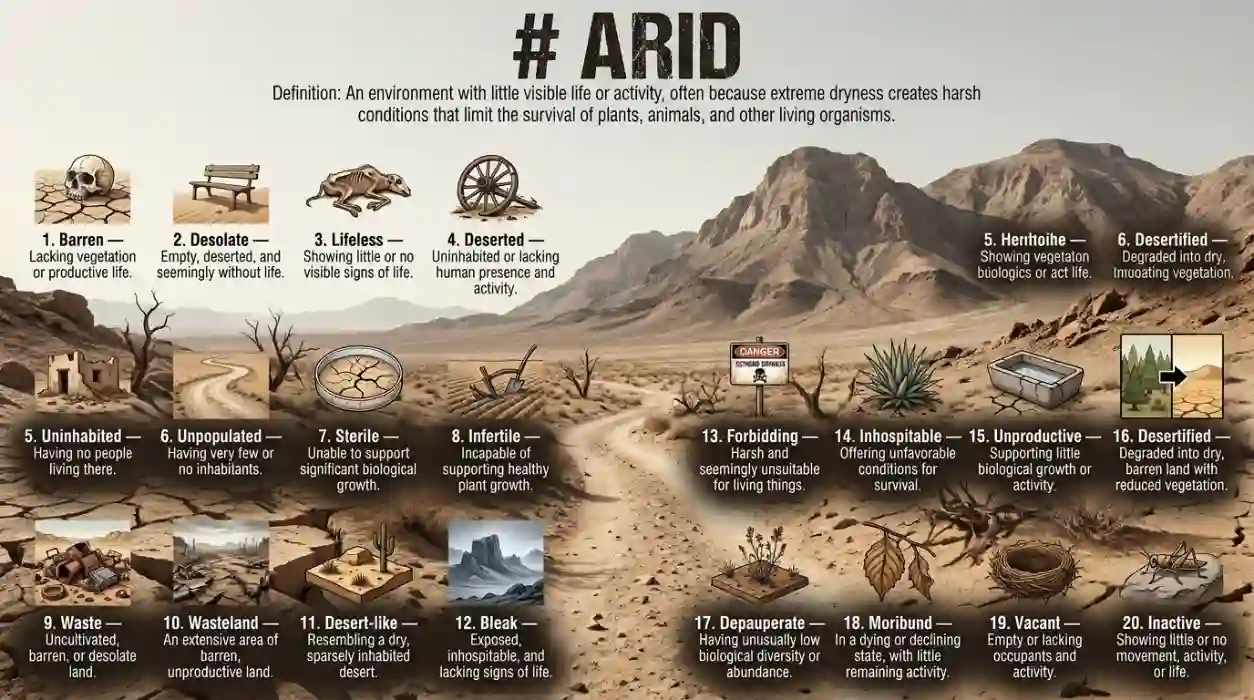
42. Uninhabitable (Adjective) — US: /ˌʌn.ɪnˈhæb.ɪ.t̬ə.bəl/ | UK: /ˌʌn.ɪnˈhæb.ɪ.tə.bəl/
Meaning: Too difficult or unsafe for people to live in; extreme dryness may be one reason.
Tone/Register: Formal, neutral.
Examples:
Severe water shortages made the area nearly uninhabitable.
The report examined conditions in the uninhabitable zone.
43. Heat-Baked (Adjective) — US: /ˈhiːtˌbeɪkt/ | UK: /ˈhiːtˌbeɪkt/
Meaning: Dried or hardened by prolonged exposure to high temperatures.
Tone/Register: Descriptive, literary.
Examples:
Heat-baked soil covered the abandoned farm.
The road crossed a heat-baked plain.
44. Heat-Scorched (Adjective) — US: /ˈhiːtˌskɔːrtʃt/ | UK: /ˈhiːtˌskɔːtʃt/
Meaning: Damaged or dried by intense heat.
Tone/Register: Descriptive, dramatic.
Examples:
Heat-scorched leaves covered the garden floor.
The heat-scorched landscape needed weeks of rain.
45. Sun-Dried (Adjective) — US: /ˈsʌnˌdraɪd/ | UK: /ˈsʌnˌdraɪd/
Meaning: Dried through exposure to sunlight, often used for materials or food rather than climates.
Tone/Register: Neutral, practical.
Examples:
The village used sun-dried bricks for construction.
Sun-dried herbs filled the kitchen with a strong aroma.
46. Dried (Adjective) — US: /draɪd/ | UK: /draɪd/
Meaning: Having had moisture removed, either naturally or through a drying process.
Tone/Register: Neutral, everyday.
Examples:
Dried mud covered the sides of the old road.
The dried plants were collected for the study.
47. Aridified (Adjective) — US: /ˈær.ɪ.də.faɪd/ | UK: /ˈær.ɪ.dɪ.faɪd/
Meaning: Made drier or changed toward more arid conditions.
Tone/Register: Technical, scientific.
Examples:
The research examined an aridified landscape.
The region became increasingly dry over several centuries.
48. Desiccant (Adjective/Noun) — US: /ˈdes.ɪ.kənt/ | UK: /ˈdes.ɪ.kənt/
Meaning: Describing or referring to a substance that absorbs moisture; it is related to dryness but is not a direct synonym for an arid climate.
Tone/Register: Technical, scientific.
Examples:
The package contained a desiccant to protect the equipment.
A desiccant material can help keep stored items dry.
49. Evaporative (Adjective) — US: /ɪˈvæp.əˌreɪ.tɪv/ | UK: /ɪˈvæp.əˌreɪ.tɪv/
Meaning: Relating to evaporation, the process through which liquid changes into vapor; it can describe processes that contribute to dryness.
Tone/Register: Scientific, technical.
Examples:
Evaporative water loss increased during the heatwave.
The researchers measured evaporative cooling in the dry environment.
50. Xerothermic (Adjective) — US: /ˌzɪr.oʊˈθɝː.mɪk/ | UK: /ˌzɪə.rəʊˈθɜː.mɪk/
Meaning: Characterized by both dry and hot conditions.
Tone/Register: Scientific, specialist.
Examples:
The study identified a xerothermic habitat on the rocky slope.
Several species thrive in xerothermic environments.
Synonyms by Tone
Different alternatives create different impressions. A scientific report may need a precise climate term, while a travel article may benefit from vivid descriptive language.
Neutral
These words describe dryness without adding much emotional judgment:
- Dry
- Waterless
- Rainless
- Moistureless
- Sandy
- Dusty
- Dried
- Dried-out
- Low-rainfall
- Dry-climate
Negative
These expressions often emphasize hardship, damage, or poor growing conditions:
- Parched
- Barren
- Drought-stricken
- Drought-ridden
- Scorched
- Sterile
- Infertile
- Unproductive
- Water-deprived
- Desolate
- Lifeless
Positive or Descriptive
These words can help create vivid imagery without necessarily presenting dryness as harmful:
- Sun-baked
- Sun-dried
- Desert-like
- Xeric
- Xerophytic
- Heat-baked
- Xerothermic
Formal or Scientific
These alternatives suit geography, agriculture, environmental studies, and research:
- Semi-arid
- Drought-prone
- Drought-affected
- Moisture-deficient
- Moisture-poor
- Dryland
- Aridified
- Desiccated
- Desiccating
- Water-scarce
Playful or Informal
These expressions are more conversational and emphatic:
- Bone-dry
- Thirsty
- Dried-out
- Arid-looking
Why Tone Matters
A word such as bone-dry sounds conversational and emphatic. Desiccated sounds scientific. Parched creates a stronger image of heat and hardship.
Choose a word that matches your audience. The right choice makes your writing sound natural instead of unnecessarily complicated.
“Arid” vs. Close Alternatives
Some words describe nearly the same condition but are not perfect replacements.
| Word | Meaning difference | Tone | When to use it |
|---|---|---|---|
| Arid | Very dry, especially because rainfall is extremely low | Formal, geographical | Climate descriptions and scientific writing |
| Dry | Having little or no moisture; broader than arid | Neutral, everyday | General conversation and simple descriptions |
| Parched | Extremely dry, often because of heat or a lack of rain | Expressive, vivid | Describing thirsty soil, plants, or landscapes |
| Desiccated | Dried out almost completely | Scientific, formal | Describing specimens, materials, or vegetation |
Examples:
- “The region has an arid climate.” This describes a long-term climate pattern.
- “The ground is dry.” This describes its current condition.
- “The crops look parched.” This suggests that heat or a lack of water has stressed them.
- “The leaves were desiccated.” This emphasizes how thoroughly they had dried out.
How “Arid” Changes by Context
Daily Conversation
In everyday English, dry is usually the easiest alternative. You can say, “The weather has been very dry,” or “The garden looks parched.”
Use arid when you want to describe a region or climate more precisely. It is common in conversations about deserts, travel, and weather.
Writing or Blogging
Travel bloggers often use arid, sun-baked, barren, and desert-like to describe landscapes. Environmental writers may prefer water-scarce, drought-prone, or low-rainfall.
Vary your vocabulary naturally. Do not replace every use of arid with a different word if the meaning becomes less accurate.
Professional or Academic Tone
In geography and climate research, arid has a specific environmental meaning. Researchers may also use terms such as semi-arid, xeric, and moisture-deficient.
Agricultural writing may use infertile, unproductive, or dryland when discussing soil and farming. These terms describe different conditions, so check the context before choosing one.
Creative or Informal Use
Creative writers can use parched, bone-dry, sun-scorched, and heat-baked to create strong mental pictures.
For example, “The sun scorched the barren fields” sounds more vivid than “The fields were arid.” Both can be correct, but they create different effects.
Common Mistakes Learners Make
1. Using “Arid” for Every Dry Object
Arid usually describes climates, regions, land, or conditions. It is not the most natural word for a wet towel that has dried.
Better: Say “The towel is dry,” not “The towel is arid.”
2. Confusing “Arid” With “Semi-Arid”
An arid climate receives extremely little rainfall. A semi-arid climate receives more rainfall, although it remains relatively dry.
Better: Use semi-arid when the climate falls between arid and more humid conditions.
3. Treating “Barren” as an Exact Synonym
A barren landscape lacks much vegetation or productive growth. It may be dry, but barrenness can also result from poor soil, pollution, or other environmental factors.
Better: Use barren when you want to emphasize a lack of plant life.
4. Using “Desiccated” in Casual Conversation
Desiccated is correct, but it sounds formal or scientific. Most people would say dried out in ordinary conversation.
Better: Match the word to your audience and purpose.
5. Confusing “Dry” With “Drought-Stricken”
A dry day does not necessarily mean a drought. Drought describes a prolonged period of unusually low water availability.
Better: Use drought-stricken only when an area has experienced significant drought conditions.
6. Overusing Dramatic Words
Words such as scorched, lifeless, and desolate create strong images. Using them too often can make a description sound exaggerated.
Better: Mix vivid words with neutral terms such as dry and low-rainfall.
Register Notes
- Formal: Arid, desiccated, xeric, semi-arid, and moisture-deficient.
- Informal: Dry, bone-dry, thirsty, and dried-out.
- Spoken English: Dry, parched, and bone-dry sound natural in conversation.
- Written English: Arid, drought-prone, and desiccated can add precision to reports and articles.
For related vocabulary practice, explore a guide to synonyms for humid to understand the opposite end of the moisture spectrum.
Real-Life Mini Scenarios
Workplace
An agricultural consultant prepares a report about a region with very little rainfall. The report uses arid for the climate, water-scarce for the local conditions, and unproductive for fields with poor crop yields.
Social Situations
A traveler tells a friend about a desert trip. They describe the ground as bone-dry and the landscape as sun-baked. These expressions make the story feel natural and vivid.
Media and Pop Culture
A documentary discusses climate change and long periods without rain. Its narrator may use drought-stricken, parched, and semi-arid to explain different environmental conditions.
Writing and Storytelling
A novelist describes a remote village surrounded by dry hills. Words such as barren, desolate, and scorched help establish the atmosphere and make the setting easier to imagine.
Practice Exercise
1. You are describing a region that receives very little rainfall throughout the year. Which word is most accurate?
A. Arid
B. Humid
C. Damp
2. A garden has received no water for weeks, and its soil is extremely dry. Which word fits best?
A. Fertile
B. Parched
C. Moist
3. You are writing a scientific report about plant samples that have lost almost all their moisture. Which term is appropriate?
A. Desiccated
B. Rainy
C. Flooded
4. A region receives little rainfall but more than a desert climate. Which term should you use?
A. Tropical
B. Semi-arid
C. Humid
5. You want an informal expression meaning completely dry. Which one works best?
A. Bone-dry
B. Waterlogged
C. Damp
6. A farming district has suffered a serious, prolonged drought. Which phrase is most suitable?
A. Drought-stricken
B. Moisture-rich
C. Rain-soaked
7. You are describing land that cannot support much plant growth. Which word is most appropriate?
A. Barren
B. Lush
C. Fertile
8. A botanist studies plants adapted to survive with very little water. Which adjective describes these plants?
A. Xerophytic
B. Aquatic
C. Tropical
9. You are chatting with a friend about a dry towel. Which word sounds most natural?
A. Arid
B. Dry
C. Xeric
10. A researcher investigates a region that is likely to experience drought. Which term fits?
A. Drought-prone
B. Rain-rich
C. Waterlogged
Reflection Task
Write two short sentences describing a dry landscape. Use one everyday synonym and one formal or scientific alternative.
Answer Key: 1-A, 2-B, 3-A, 4-B, 5-A, 6-A, 7-A, 8-A, 9-B, 10-A,
External Sources
For accurate definitions, pronunciation, and further reading, consult these established references:
- Oxford Learner’s Dictionaries – Arid
- Cambridge Dictionary – Arid
- Merriam-Webster – Arid
- Online Etymology Dictionary – Arid
Conclusion
Learning a synonym for arid gives you more ways to describe dry weather, thirsty soil, and challenging landscapes. Each alternative adds a useful shade of meaning.
Words such as parched, barren, and desiccated make descriptions more precise. They also help your writing sound varied without losing its meaning.
A stronger vocabulary improves essays, blogs, professional writing, and everyday conversations. It helps you explain what you see and choose words that fit your message.
Start with three new words today. Practise them in emails, essays, and daily conversations, and notice how each one changes the picture in your reader’s mind.
FAQs
1. What is the best synonym for arid in a geography essay?
Dry is the closest simple synonym, but arid is often more precise in geographical writing. It describes regions with very low precipitation. You can also use semi-arid when the area receives somewhat more rainfall. Choose the term that accurately reflects the climate rather than using different words only for variety.
2. What is the opposite of arid?
The most common opposite of arid is humid, which describes air or a climate containing a relatively high amount of moisture. Other opposites include moist, damp, and wet. The best choice depends on the subject. For example, a humid climate is the opposite of an arid climate, while a wet surface is the opposite of a dry surface.
3. What is the noun form of arid?
The most common noun form is aridity. It describes the condition or degree of dryness, especially in a climate or geographical region. For example: “The aridity of the region limits agricultural production.” You may also encounter aridness, but aridity is generally more suitable in formal and scientific writing.
4. Can arid describe a person or a personality?
Not usually in its literal sense. However, arid can describe someone’s speech, writing, or conversation figuratively when it seems dull, lifeless, or lacking imagination. For example, “The lecture felt arid because it contained no interesting examples.” It is not a common direct description of someone’s personality.
5. What is the difference between arid and barren land?
Arid describes a lack of moisture or very low rainfall. Barren describes land that supports little or no vegetation or productive growth. An arid region may contain plants adapted to dry conditions, while barren land may be unproductive for several different reasons. The words overlap but do not have the same meaning.

Hasnain Ali is an SEO Content Strategist and the founder of wordvora.com, a trusted vocabulary platform that helps writers, students, professionals, and English learners find accurate synonyms, antonyms, word meanings, and real-life usage examples. He specializes in keyword research, on-page SEO, topical authority, and creating search-first content that aligns with Google’s latest Search Quality and E-E-A-T guidelines. His work focuses on producing clear, well-structured, and reader-friendly resources that satisfy search intent while maintaining high editorial standards.
Through extensive hands-on experience with SEO tools such as Google Search Console, Google Analytics, SEMrush, and Ahrefs, Hasnain researches user search behavior and develops content that is both informative and easy to understand. Every article published on wordvora.com is carefully reviewed for accuracy, readability, and contextual relevance before publication. His mission is to build one of the web’s most reliable English vocabulary resources by providing practical language guidance, trustworthy explanations, and content that helps readers improve their writing, communication, and vocabulary with confidence.