
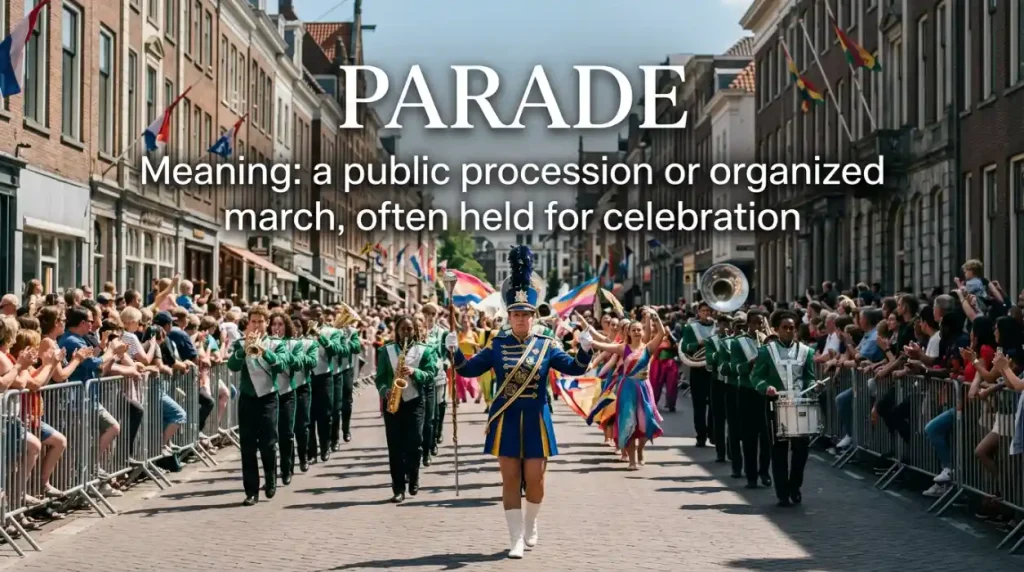
Synonyms for parade can rescue a dull sentence. Imagine a town street filled with music, flags, and marching feet. The word fits, but variety makes writing sparkle.
A student may write, “The parade passed the school.” A richer choice could be “The procession passed the school,” depending on the exact scene.
Synonyms for parade help students, bloggers, content writers, and daily English users choose words with the right meaning, tone, and level of formality.
Because parade is common in everyday speech, news, history, and storytelling, synonyms for parade help you choose clearer, fresher, more precise English.
What Does “Parade” Really Mean?
Parade can be a noun or a verb.
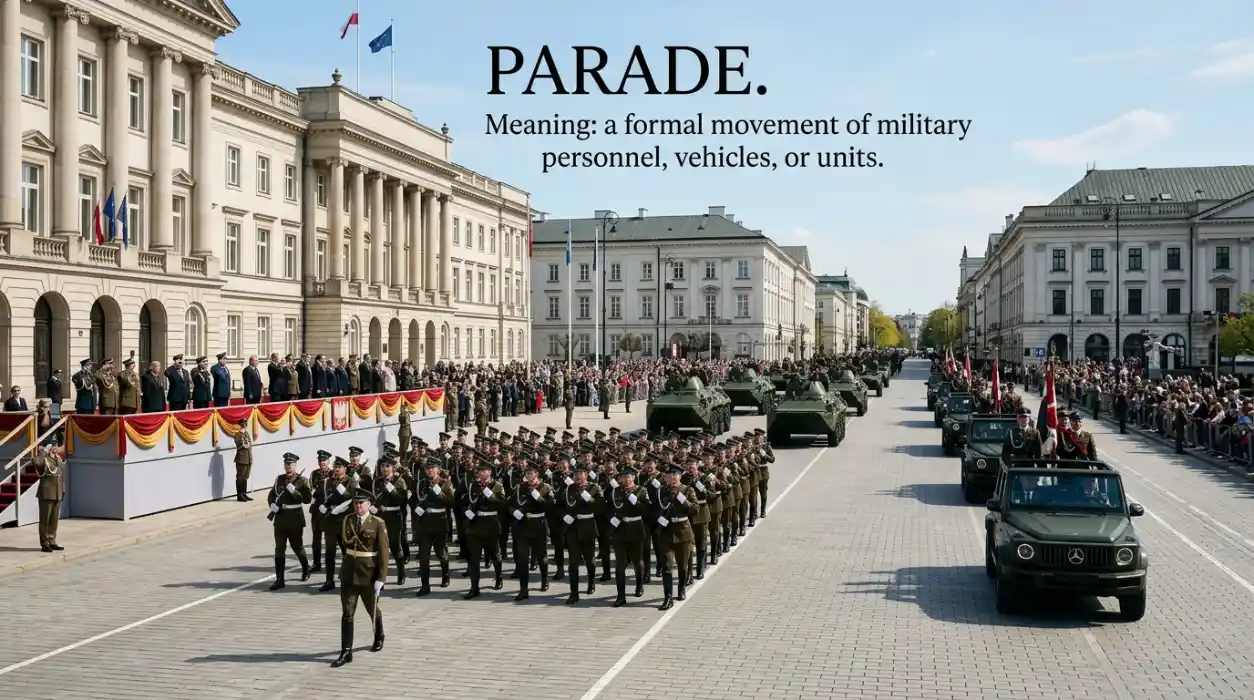
As a noun, a parade is an organized public event in which people, vehicles, performers, military units, or decorated groups move through a place for celebration, ceremony, or display.
Simple definition: A parade is an organized procession presented for people to watch.
For example:
“Thousands of people watched the Independence Day parade.”
As a verb, to parade means to walk, move, or display something publicly, often so that other people can see it.
“The dancers paraded through the main street.”
Native speakers usually associate parade with visibility and movement. It often suggests that something is being presented before an audience.
The word commonly appears in discussions about national celebrations, military ceremonies, festivals, cultural events, sports victories, schools, entertainment, and public demonstrations.
However, parade can also have a figurative meaning. Someone may “parade their achievements” when they show them off proudly or excessively.
Connotative Meaning of “Parade”
Connotation (the feelings or associations a word suggests beyond its basic dictionary meaning) can change how parade feels in a sentence.
Positive Tone
A parade can suggest celebration, pride, unity, tradition, excitement, and community spirit.
For example, a holiday parade may bring families together and create a joyful atmosphere.
Negative Tone
The verb parade can sometimes suggest showing off, boasting, or displaying something unnecessarily.
“He paraded his success in front of everyone.”
Here, the word has a more critical attitude.
Neutral Tone
In a factual sentence, parade can simply describe an organized public procession.
“The annual parade began at noon.”
Therefore, the surrounding words and context determine whether the term sounds joyful, formal, critical, or neutral.
Etymology of “Parade”
The English word parade ultimately traces back to Romance-language roots connected with the idea of preparing, arranging, or presenting something.
It entered English through French, linked to Italian parata, meaning a display or organized presentation. The deeper root is associated with Latin parare, meaning “to prepare” or “to arrange.”
The history is worth noting because parade was not an Old English word.
Old English: 450–1100
Old English had native words for walking, marching, displaying, gathering, and public activity. However, the modern word parade was not part of ordinary Old English vocabulary.
Middle English: 1100–1500
French influence increased greatly after the Norman Conquest. Words connected with public display and organized movement entered English during this broad period.
The modern form parade, however, became established later, around the transition into Early Modern English.
Modern English: 1500–Present
By the Early Modern period, parade had developed its familiar meanings involving public processions, military displays, ceremonies, and demonstrations.
Later, its verb forms expanded into figurative uses. Today, people can parade through a street, parade before an audience, or parade their achievements.
Pronunciation of “Parade”
- US: /pəˈreɪd/
- UK: /pəˈreɪd/
In both varieties, the stress falls on the second syllable.
Syllables
pa-rade
Affixation Pattern of “Parade”
Root: parade
Prefix: none
Suffix: none in the basic word
The noun and verb share the same basic form. Related forms include paraded, parading, and parader.
Synonyms List
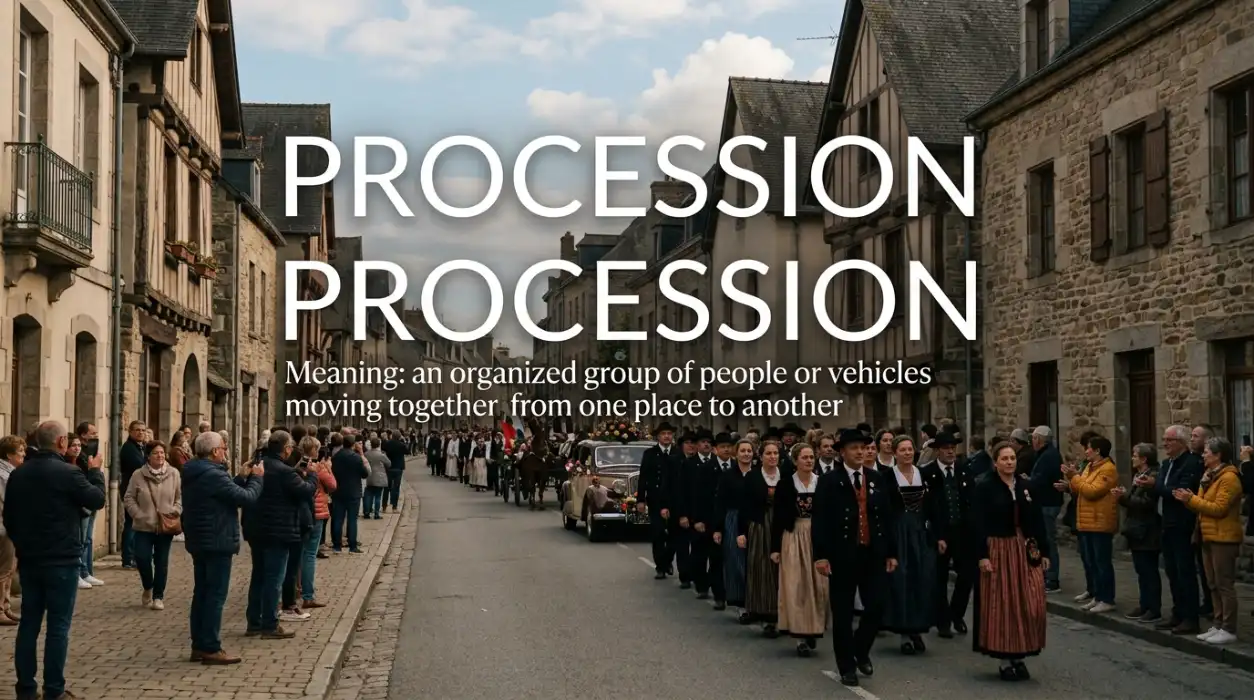
Procession (Noun) — US / UK: /prəˈsɛʃən/ /prəˈsɛʃən/
Meaning: An organized group of people or vehicles moving together from one place to another.
Tone/Register: Neutral to formal.
Example:
The wedding procession moved slowly toward the garden.
A long procession filled the city avenue.
March (Noun) — US / UK: /mɑːrtʃ/ /mɑːtʃ/
Meaning: An organized walk, often involving a group with a shared purpose.
Tone/Register: Neutral; formal in civic contexts.
Example:
The students joined a climate march downtown.
The peaceful march ended before sunset.
Pageant (Noun) — US / UK: /ˈpædʒənt/ /ˈpædʒənt/
Meaning: A public event that presents people, costumes, performances, or historical scenes in an impressive way.
Tone/Register: Formal; literary.
Example:
The town hosted a colorful historical pageant.
Children dressed as famous figures for the school pageant.
Processional (Noun) — US / UK: /prəˈsɛʃənəl/ /prəˈsɛʃənəl/
Meaning: A formal movement of people into or through a place, especially during a ceremony.
Tone/Register: Formal.
Example:
The musicians played during the ceremonial processional.
Guests stood quietly as the processional began.
Cavalcade (Noun) — US / UK: /ˌkævəlˈkeɪd/ /ˌkævəlˈkeɪd/
Meaning: A procession of people, vehicles, or events, often impressive or varied.
Tone/Register: Literary; formal.
Example:
A cavalcade of vintage cars crossed the bridge.
The festival featured a colorful cavalcade of performers.
Motorcade (Noun) — US / UK: /ˈmoʊtərkeɪd/ /ˈməʊtəkəɪd/
Meaning: A group of vehicles traveling together, especially for an important person or official event.
Tone/Register: Formal; journalistic.
Example:
The president’s motorcade arrived at the venue.
Police officers cleared the road for the motorcade.
March-Past (Noun) — US / UK: /ˈmɑːrtʃ ˌpæst/ /ˈmɑːtʃ ˌpɑːst/
Meaning: A formal event in which people pass an official or audience while marching.
Tone/Register: Formal; military.
Example:
The cadets performed a precise march-past.
The ceremony ended with a military march-past.
Review (Noun) — US / UK: /rɪˈvjuː/ /rɪˈvjuː/
Meaning: A formal inspection or presentation of troops, ships, or other organized groups.
Tone/Register: Formal; military.
Example:
The general attended the annual troop review.
The naval review attracted thousands of spectators.
Display (Noun) — US / UK: /dɪˈspleɪ/ /dɪˈspleɪ/
Meaning: A public presentation intended to attract attention or demonstrate something.
Tone/Register: Neutral; formal.
Example:
The festival included a spectacular display of costumes.
The aircraft formed part of the public display.
Spectacle (Noun) — US / UK: /ˈspɛktəkəl/ /ˈspɛktəkəl/
Meaning: An impressive or striking public sight that attracts attention.
Tone/Register: Neutral; literary.
Example:
The opening ceremony was a remarkable spectacle.
Fireworks turned the celebration into a dazzling spectacle.
Show (Noun) — US / UK: /ʃoʊ/ /ʃəʊ/
Meaning: A public presentation designed to entertain, impress, or attract attention.
Tone/Register: Informal to neutral.
Example:
The children put on a lively show for the crowd.
The victory celebration became quite a show.
Exhibition (Noun) — US / UK: /ˌɛksəˈbɪʃən/ /ˌɛksɪˈbɪʃən/
Meaning: A public presentation of objects, activities, or abilities for people to see.
Tone/Register: Formal; academic.
Example:
The event included an exhibition of historic vehicles.
Visitors enjoyed the military exhibition.
Demonstration (Noun) — US / UK: /ˌdɛmənˈstreɪʃən/ /ˌdɛmənˈstreɪʃən/
Meaning: A public gathering or movement that expresses an opinion or supports a cause.
Tone/Register: Neutral; formal.
Example:
Thousands joined the demonstration peacefully.
The demonstration moved toward the central square.
Rally (Noun) — US / UK: /ˈræli/ /ˈræli/
Meaning: A large public gathering organized around a cause, political idea, team, or movement.
Tone/Register: Neutral; political or civic.
Example:
Supporters gathered for a rally before the election.
The rally drew people from several neighborhoods.
Festival Procession (Noun) — US / UK: /ˈfɛstəvəl prəˈsɛʃən/ /ˈfɛstɪvəl prəˈsɛʃən/
Meaning: A ceremonial procession held as part of a cultural or religious festival.
Tone/Register: Formal; cultural.
Example:
The festival procession featured traditional dancers.
Families watched the procession from their balconies.
Cortege (Noun) — US / UK: /kɔːrˈtɛʒ/ /kɔːˈtɛʒ/
Meaning: A group traveling together, especially a funeral procession.
Tone/Register: Formal; solemn.
Example:
The funeral cortege moved quietly through the village.
People stood respectfully as the cortege passed.
Convoy (Noun) — US / UK: /ˈkɑːnvɔɪ/ /ˈkɒnvɔɪ/
Meaning: A group of vehicles or ships traveling together.
Tone/Register: Neutral; formal.
Example:
A convoy of decorated trucks entered the city.
The charity convoy carried supplies across the region.
File (Noun) — US / UK: /faɪl/ /faɪl/
Meaning: A line or succession of people moving one after another.
Tone/Register: Neutral.
Example:
A file of dancers entered the square.
The performers walked in a neat file behind the band.
Train (Noun) — US / UK: /treɪn/ /treɪn/
Meaning: A long line of people, vehicles, or animals moving together.
Tone/Register: Neutral; sometimes literary.
Example:
A train of decorated floats passed the stadium.
The royal train moved through the crowded streets.
Retinue (Noun) — US / UK: /ˈrɛtənˌuː/ /ˈrɛtɪnjuː/
Meaning: A group of attendants or followers accompanying an important person.
Tone/Register: Formal; historical.
Example:
The ambassador arrived with a small retinue.
Her retinue followed her into the ceremony.
Convocation (Noun) — US / UK: /ˌkɑːnvəˈkeɪʃən/ /ˌkɒnvəˈkeɪʃən/
Meaning: A formal gathering of people, especially for an academic or ceremonial purpose.
Tone/Register: Formal; academic.
Example:
Graduates entered the hall for the convocation.
The university held its annual convocation in May.
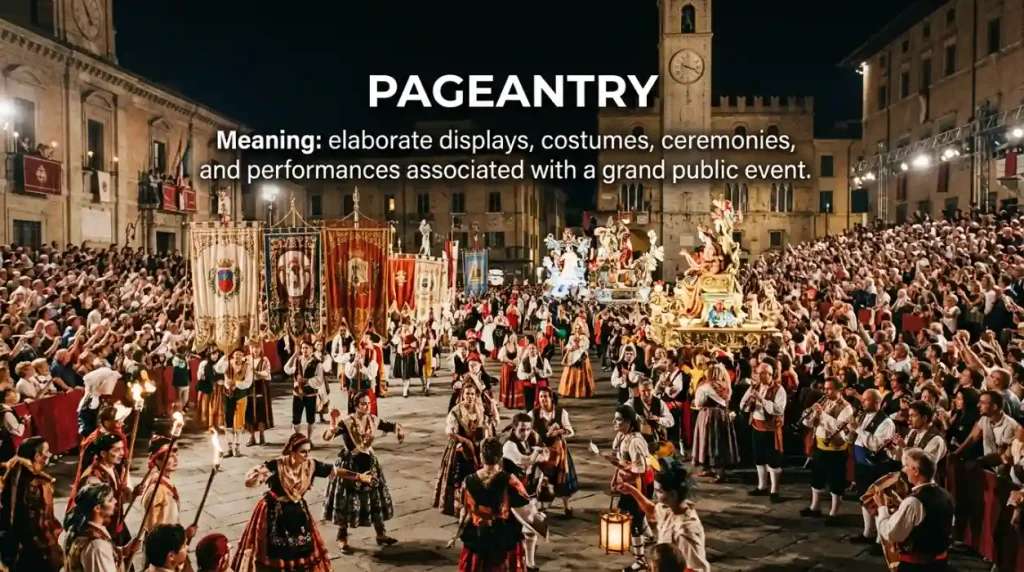
Pageantry (Noun) — US / UK: /ˈpædʒəntri/ /ˈpædʒəntri/
Meaning: Elaborate displays, costumes, ceremonies, and performances associated with a grand public event.
Tone/Register: Formal; literary.
Example:
The ceremony was full of color and pageantry.
Visitors admired the traditional pageantry of the festival.
Process (Verb) — US / UK: /prəˈsɛs/ /prəˈsɛs/
Meaning: To move forward in an organized group, usually formally or ceremonially.
Tone/Register: Formal.
Example:
The graduates processed into the auditorium.
The guests processed toward the main stage.
March (Verb) — US / UK: /mɑːrtʃ/ /mɑːtʃ/
Meaning: To walk in a deliberate, organized way, often with others.
Tone/Register: Neutral.
Example:
The band marched along the boulevard.
The players marched onto the field together.
Walk (Verb) — US / UK: /wɔːk/ /wɔːk/
Meaning: To move on foot, especially when the organized movement matters more than ceremony.
Tone/Register: Neutral; everyday.
Example:
The performers walked through the neighborhood.
The children walked behind the decorated float.
Strut (Verb) — US / UK: /strʌt/ /strʌt/
Meaning: To walk proudly and confidently, sometimes in an exaggerated way.
Tone/Register: Informal.
Example:
The actor strutted down the red carpet.
He strutted across the stage like a champion.
File Past (Verb Phrase) — US / UK: /faɪl pæst/ /faɪl pɑːst/
Meaning: To move past someone or something in an orderly line.
Tone/Register: Formal; descriptive.
Example:
The soldiers filed past the reviewing officer.
Guests filed past the memorial in silence.
Stream (Verb) — US / UK: /striːm/ /striːm/
Meaning: To move continuously in a large group or steady flow.
Tone/Register: Neutral; descriptive.
Example:
Fans streamed through the streets after the victory.
Spectators streamed toward the festival entrance.
Advance (Verb) — US / UK: /ədˈvæns/ /ədˈvæns/
Meaning: To move forward, especially in an organized or purposeful way.
Tone/Register: Formal.
Example:
The ceremonial group advanced toward the platform.
The marching band advanced through the town center.
Proceed (Verb) — US / UK: /prəˈsiːd/ /prəˈsiːd/
Meaning: To move forward or continue in a planned direction.
Tone/Register: Formal.
Example:
The guests proceeded into the main hall.
The performers proceeded along the marked route.
Showcase (Verb) — US / UK: /ˈʃoʊkeɪs/ /ˈʃəʊkeɪs/
Meaning: To present something publicly in a way that emphasizes its best or most impressive qualities.
Tone/Register: Neutral; professional.
Example:
The festival showcased local music and dance.
The event showcased the city’s cultural heritage.
Exhibit (Verb) — US / UK: /ɪɡˈzɪbɪt/ /ɪɡˈzɪbɪt/
Meaning: To display something publicly so that people can see or examine it.
Tone/Register: Formal; academic.
Example:
The museum exhibited several historic uniforms.
The gallery exhibited photographs from the celebration.
Present (Verb) — US / UK: /prɪˈzɛnt/ /prɪˈzɛnt/
Meaning: To put something before an audience for attention, consideration, or appreciation.
Tone/Register: Formal; professional.
Example:
The school presented its annual cultural program.
The performers presented a tribute to local heroes.
Flaunt (Verb) — US / UK: /flɔːnt/ /flɔːnt/
Meaning: To display something proudly and openly, often in a way that seems intended to impress others.
Tone/Register: Informal; usually negative.
Example:
He flaunted his expensive trophy online.
The celebrity flaunted her award during the interview.
Parade (Verb) — US / UK: /pəˈreɪd/ /pəˈreɪd/
Meaning: To display or move something publicly, often in a way that attracts attention.
Tone/Register: Neutral to informal.
Example:
The team paraded the trophy around the stadium.
The children paraded their costumes before the audience.
Promote (Verb) — US / UK: /prəˈmoʊt/ /prəˈməʊt/
Meaning: To publicly support or highlight something so that more people notice it.
Tone/Register: Neutral; professional.
Example:
The event promoted local artists.
The celebration promoted awareness of the city’s history.
Celebrate (Verb) — US / UK: /ˈsɛləbreɪt/ /ˈsɛləbreɪt/
Meaning: To honor or enjoy an important event through public activities or ceremonies.
Tone/Register: Neutral.
Example:
Residents gathered to celebrate the town’s anniversary.
Families celebrated the national holiday together.
Honor (Verb) — US / UK: /ˈɑːnər/ /ˈɒnə/
Meaning: To show public respect or recognition for a person, event, group, or achievement.
Tone/Register: Formal; respectful.
Example:
The ceremony honored fallen firefighters.
The city honored its volunteers during the event.
Commemorate (Verb) — US / UK: /kəˈmɛməreɪt/ /kəˈmɛməreɪt/
Meaning: To remember and mark an important person, event, or historical occasion publicly.
Tone/Register: Formal; academic.
Example:
The ceremony commemorated the historic anniversary.
Residents gathered to commemorate the community’s founders.
Demonstrate (Verb) — US / UK: /ˈdɛmənstreɪt/ /ˈdɛmənstreɪt/
Meaning: To publicly show support, opposition, ability, or a particular quality.
Tone/Register: Formal; neutral.
Example:
Workers demonstrated in support of safer conditions.
The event demonstrated strong community support.
Assemble (Verb) — US / UK: /əˈsɛmbəl/ /əˈsɛmbəl/
Meaning: To gather people or groups together for an organized activity.
Tone/Register: Formal; neutral.
Example:
The performers assembled behind the main stage.
Families assembled near the starting point.
Gather (Verb) — US / UK: /ˈɡæðər/ /ˈɡæðə/
Meaning: To come together in one place, often for a shared public activity.
Tone/Register: Neutral; everyday.
Example:
Residents gathered along the avenue.
Crowds gathered early to watch the performers.
Parade Around (Verb Phrase) — US / UK: /pəˈreɪd əˈraʊnd/ /pəˈreɪd əˈraʊnd/
Meaning: To move around publicly while intentionally showing something to others.
Tone/Register: Informal.
Example:
The children paraded around in their new costumes.
Fans paraded around with team flags after the win.
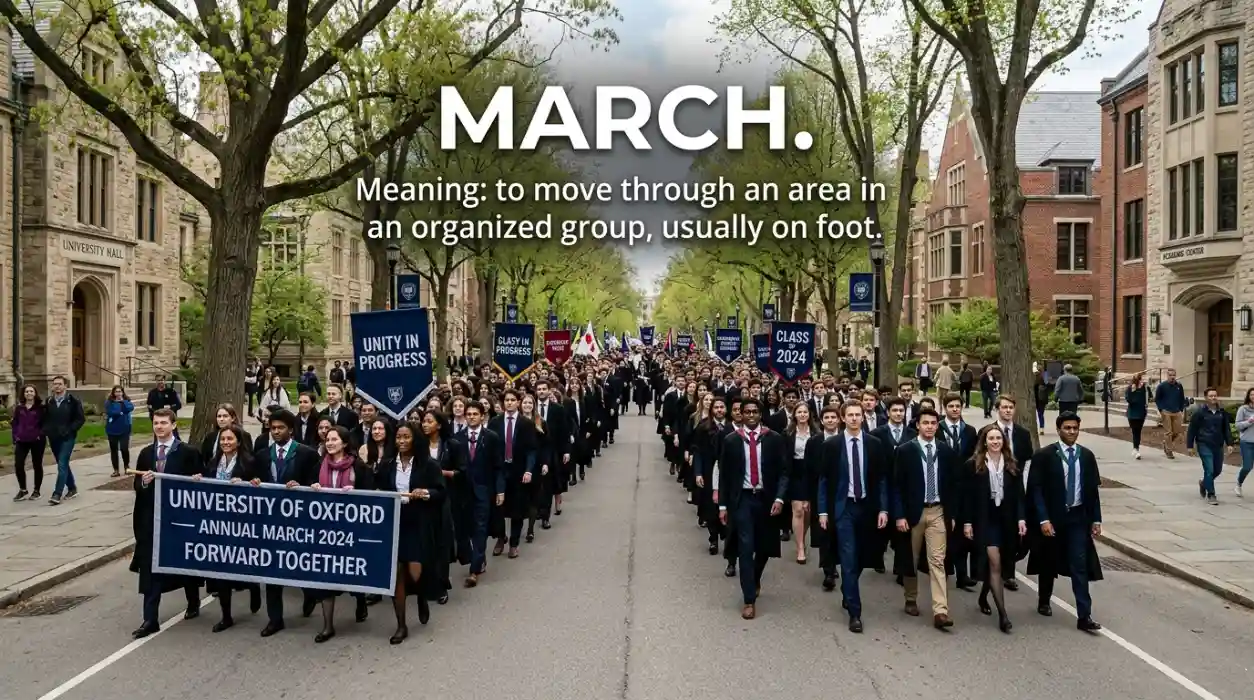
March Through (Verb Phrase) — US / UK: /mɑːrtʃ θruː/ /mɑːtʃ θruː/
Meaning: To move through an area in an organized group, usually on foot.
Tone/Register: Neutral.
Example:
The musicians marched through the old town.
The students marched through the campus courtyard.
Move in Formation (Verb Phrase) — US / UK: /muːv ɪn fɔːrˈmeɪʃən/ /muːv ɪn fɔːˈmeɪʃən/
Meaning: To move together in a planned arrangement or pattern.
Tone/Register: Formal; military.
Example:
The dancers moved in formation across the stage.
The marching group moved in formation toward the square.
Take Part in a Procession (Verb Phrase) — US / UK: /teɪk pɑːrt ɪn ə prəˈsɛʃən/ /teɪk pɑːt ɪn ə prəˈsɛʃən/
Meaning: To participate in an organized ceremonial movement.
Tone/Register: Formal.
Example:
Teachers took part in the school procession.
Local musicians took part in the opening procession.
File Into View (Verb Phrase) — US / UK: /faɪl ˈɪntuː vjuː/ /faɪl ˈɪntuː vjuː/
Meaning: To appear gradually as a group moves into a visible area.
Tone/Register: Descriptive; literary.
Example:
The dancers filed into view as the music began.
A line of performers filed into view from backstage.
Parade Before (Verb Phrase) — US / UK: /pəˈreɪd bɪˈfɔːr/ /pəˈreɪd bɪˈfɔː/
Meaning: To move or display oneself before an audience or important person.
Tone/Register: Formal; literary.
Example:
The cadets paraded before the senior officers.
The finalists paraded before the judging panel.
Show Off (Verb Phrase) — US / UK: /ʃoʊ ɔːf/ /ʃəʊ ɒf/
Meaning: To display something or oneself in an obvious attempt to attract admiration.
Tone/Register: Informal; often negative.
Example:
He showed off his medal to his friends.
She showed off her new costume at the party.
Public Display (Noun Phrase) — US / UK: /ˈpʌblɪk dɪˈspleɪ/ /ˈpʌblɪk dɪˈspleɪ/
Meaning: Something presented openly for a group of people to see.
Tone/Register: Neutral; formal.
Example:
The vehicles formed a public display of local craftsmanship.
The ceremony included a public display of traditional art.
Ceremonial March (Noun Phrase) — US / UK: /ˌsɛrəˈmoʊniəl mɑːrtʃ/ /ˌsɛrəˈməʊniəl mɑːtʃ/
Meaning: A formal march performed as part of a ceremony.
Tone/Register: Formal.
Example:
The soldiers completed a ceremonial march.
Music accompanied the ceremonial march into the square.
Street Procession (Noun Phrase) — US / UK: /striːt prəˈsɛʃən/ /striːt prəˈsɛʃən/
Meaning: An organized group moving along public streets as part of a celebration or ceremony.
Tone/Register: Neutral; descriptive.
Example:
The street procession began after sunset.
Local artists joined the colorful street procession.
Organized March (Noun Phrase) — US / UK: /ˈɔːrɡənaɪzd mɑːrtʃ/ /ˈɔːɡənaɪzd mɑːtʃ/
Meaning: A planned group movement, often connected with a cause, ceremony, or celebration.
Tone/Register: Neutral; formal.
Example:
The organization held an organized march for clean parks.
Students joined the organized march after class.
Grand Display (Noun Phrase) — US / UK: /ɡrænd dɪˈspleɪ/ /ɡrænd dɪˈspleɪ/
Meaning: A large and impressive presentation designed to attract public attention.
Tone/Register: Neutral; expressive.
Example:
The opening featured a grand display of lights.
The stadium hosted a grand display of national symbols.
Public Spectacle (Noun Phrase) — US / UK: /ˈpʌblɪk ˈspɛktəkəl/ /ˈpʌblɪk ˈspɛktəkəl/
Meaning: A highly visible event or scene that attracts a large audience.
Tone/Register: Neutral to literary.
Example:
The launch became a public spectacle.
The colorful ceremony created a memorable public spectacle.
Festival March (Noun Phrase) — US / UK: /ˈfɛstəvəl mɑːrtʃ/ /ˈfɛstɪvəl mɑːtʃ/
Meaning: A group march organized as part of a festival or cultural celebration.
Tone/Register: Neutral.
Example:
The festival march included dancers and musicians.
Children carried handmade banners during the festival march.
Military Procession (Noun Phrase) — US / UK: /ˈmɪləteri prəˈsɛʃən/ /ˈmɪlɪtəri prəˈsɛʃən/
Meaning: A formal movement of military personnel, vehicles, or units.
Tone/Register: Formal.
Example:
The military procession passed the memorial.
Visitors watched the military procession from the plaza.
Synonyms by Tone
Positive
These choices often emphasize celebration, pride, community, or excitement:
- Pageant
- Pageantry
- Festival procession
- Celebration march
- Colorful procession
- Grand display
- Showcase
- Celebrate
- Honor
- Commemorate
They work especially well when the event has cultural, historical, or emotional importance.
Neutral
These terms describe organized movement or public presentation without strongly judging it:
- Procession
- March
- Display
- Show
- Processional
- Motorcade
- Convoy
- Review
- Gather
- Assemble
- Proceed
- Process
- Public display
These are useful in news reports, school writing, essays, and everyday English.
Negative
Some alternatives suggest criticism, unnecessary display, or social tension:
- Flaunt
- Show off
- Parade around
- Demonstration
- Rally
- Public spectacle
Be careful with these choices. Flaunt and show off, for example, usually imply that someone wants admiration.
Playful or Informal
For relaxed conversation, these can sound more natural:
- Show
- Strut
- Show off
- Parade around
- Walk
- March through
- Stream
Tone matters because a technically related word can still change the attitude of your sentence.
“Parade” vs Close Alternatives
| Word | Main Meaning | Tone | Best Use |
|---|---|---|---|
| Parade | Organized public movement or display | Neutral to positive | Celebrations, ceremonies, public events |
| Procession | Organized group moving together | Formal/neutral | Ceremonies, funerals, religious events |
| March | Organized walking movement | Neutral | Causes, military events, civic gatherings |
For example, a parade often creates a lively public image.
Procession sounds more formal and ceremonial.
March focuses more strongly on the act of walking together or expressing a shared purpose.
How “Parade” Changes by Context
Daily Conversation
In casual English, parade is easy and familiar.
“Are you going to the parade?”
You can replace it with procession when the event is formal. However, march may be better when people are walking for a cause.
Writing or Blogging
Writers often use procession, pageant, spectacle, display, or cavalcade to create variety.
However, avoid replacing every instance of parade. Sometimes the original word is the clearest choice.
Professional or Academic Tone
Formal writing benefits from precise terms such as procession, ceremonial march, public display, demonstration, or military review.
For example, a history essay might say:
“The ceremonial procession reflected the political traditions of the period.”
That sounds more precise than using parade repeatedly.
Creative or Informal Use
Creative writing gives you more freedom.
Words such as cavalcade, spectacle, pageantry, strut, and grand display can create a stronger visual image.
For instance:
“A colorful cavalcade rolled through the sleepy village.”
The word cavalcade adds movement and visual richness.
Common Mistakes Learners Make
1. Treating every synonym as interchangeable
A funeral procession is not normally called a funeral pageant.
Likewise, a motorcade specifically involves vehicles.
Always check the central meaning before replacing a word.
2. Confusing “march” with “parade”
A march can be part of a parade, but not every march is a parade.
People may march to protest, while a parade is usually presented as a public event or spectacle.
3. Using “flaunt” positively
Flaunt often carries a negative suggestion.
“She flaunted her wealth.”
This implies that the display may be excessive or boastful.
4. Using “procession” for casual movement
“Procession” sounds organized and often ceremonial.
For ordinary movement, group, line, or stream may sound more natural.
5. Forgetting that “parade” is also a verb
You can say:
“The dancers paraded through the square.”
You can also say:
“He paraded his achievements before the audience.”
The second example has a more critical tone.
6. Overusing synonyms
Good writing is not about avoiding the same word at all costs.
If parade is the most accurate word, keep it. Change it only when another term adds a useful shade of meaning.
Register Notes
In formal English, prefer words such as procession, ceremonial march, military review, commemorate, and public display when they accurately describe the event.
In academic writing, specificity is especially important. Instead of using a broad term like parade, identify whether you mean a political demonstration, military review, cultural procession, or festival march.
For related vocabulary development, an internal guide to words for celebration, movement, and public events can also help expand your word choices.
Real-Life Mini Scenarios Using “Parade”
Workplace
A company may organize a public celebration after reaching an important milestone.
“The city hosted a parade to recognize the championship team.”
Social Situations
Friends might attend a holiday parade together.
“We found a good spot before the parade started.”
Media and Pop Culture
News reports often use parade, motorcade, spectacle, or procession depending on what happened.
“Fans filled the streets for the championship parade.”
Writing and Storytelling
A novelist may choose a more descriptive synonym to create atmosphere.
“A slow procession emerged through the fog.”
Here, procession creates a more solemn mood than parade.
Practice Exercise
1. A group of soldiers passes an officer during a formal ceremony. Which word fits best?
A. Show
B. Review
C. Strut
D. Gather
2. A group of people walks together to support a political cause.
A. Pageant
B. Motorcade
C. March
D. Spectacle
3. A funeral group moves quietly toward a cemetery.
A. Cortege
B. Rally
C. Showcase
D. Festival march
4. A celebrity deliberately displays expensive jewelry to impress people.
A. Process
B. Flaunt
C. Commemorate
D. Assemble
5. A large group of decorated vehicles travels together.
A. Convoy
B. Pageant
C. Processional
D. Pageantry
6. A historical event uses costumes, actors, and dramatic scenes.
A. Pageant
B. Review
C. March
D. File
7. Which word sounds most formal for an organized ceremonial movement?
A. Show
B. Strut
C. Procession
D. Walk
8. A group of performers moves continuously into the city square.
A. Stream
B. Exhibit
C. Flaunt
D. Honor
9. A university formally brings graduates into an auditorium.
A. Convocation
B. Rally
C. Motorcade
D. Show off
10. A city marks an important historical anniversary.
A. Commemorate
B. Strut
C. Flaunt
D. Showcase
11. A public event emphasizes impressive costumes and traditions.
A. Pageantry
B. Convoy
C. File
D. Review
12. Someone walks proudly in an exaggerated way.
A. Process
B. Strut
C. Assemble
D. Proceed
Answer key: 1-B | 2-C | 3-A | 4-B | 5-A | 6-A | 7-C | 8-A | 9-A | 10-A | 11-A | 12-B
Reflection Task
Write one sentence about a real or imagined public event. Use procession, pageant, march, spectacle, or another synonym instead of parade. Then ask yourself: Did the new word change the tone?
Conclusion
Learning synonyms for parade gives your English more color and precision. You can describe a civic march, a grand pageant, or a public display without sounding repetitive.
Good word choice also builds confidence. Students write better essays, bloggers create smoother posts, and speakers sound more natural when each term fits its context.
Even small changes can sharpen communication. Try a different synonym in an email, essay, caption, or daily conversation, then notice how the tone changes.
Keep practicing gently. Choose one new word today, make your own sentence, and use it naturally this week. That simple habit can make your vocabulary stronger.
FAQs
1. What is the best synonym for parade in formal English?
Procession is often the best formal synonym for parade when you mean an organized group moving together, especially during a ceremony. However, the exact choice depends on context. Military review suits an inspection of troops, while ceremonial march emphasizes formal walking. For academic writing, choose the most specific term rather than automatically replacing every use of parade.
2. What is a good synonym for parade in a sentence about a festival?
For a festival, procession, pageant, festival march, colorful procession, and pageantry can work well. The best choice depends on the event. Use procession for organized movement, pageant for a staged presentation, and pageantry when focusing on elaborate costumes, traditions, ceremony, and visual beauty.
3. Is procession the same as parade?
No. Procession and parade overlap, but they are not identical. A parade usually emphasizes public entertainment, celebration, or display. A procession can be more solemn or ceremonial. Religious events, funerals, weddings, and formal ceremonies commonly use procession. Therefore, procession is often a more formal and specific alternative.
4. What is the difference between a parade and a march?
A parade is usually a public event involving organized movement and display. A march focuses more on people walking together, often for a purpose or cause. A march may be part of a parade, but it can also be a protest or political event without the celebratory atmosphere normally associated with a parade.
5. Which synonym for parade is best for a military event?
The best term depends on the military activity. Military procession describes organized movement, while march-past describes troops passing an official or reviewing officer. Military review emphasizes formal inspection. Therefore, these terms can be more precise than parade when writing about military ceremonies, especially in formal or historical contexts.

Hasnain Ali is an SEO Content Strategist and the founder of wordvora.com, a trusted vocabulary platform that helps writers, students, professionals, and English learners find accurate synonyms, antonyms, word meanings, and real-life usage examples. He specializes in keyword research, on-page SEO, topical authority, and creating search-first content that aligns with Google’s latest Search Quality and E-E-A-T guidelines. His work focuses on producing clear, well-structured, and reader-friendly resources that satisfy search intent while maintaining high editorial standards.
Through extensive hands-on experience with SEO tools such as Google Search Console, Google Analytics, SEMrush, and Ahrefs, Hasnain researches user search behavior and develops content that is both informative and easy to understand. Every article published on wordvora.com is carefully reviewed for accuracy, readability, and contextual relevance before publication. His mission is to build one of the web’s most reliable English vocabulary resources by providing practical language guidance, trustworthy explanations, and content that helps readers improve their writing, communication, and vocabulary with confidence.