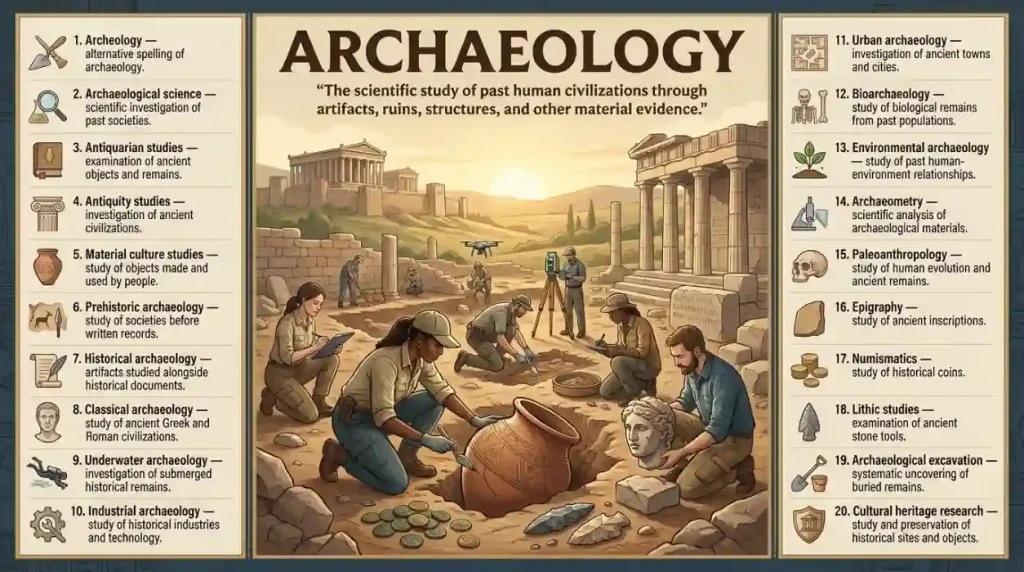
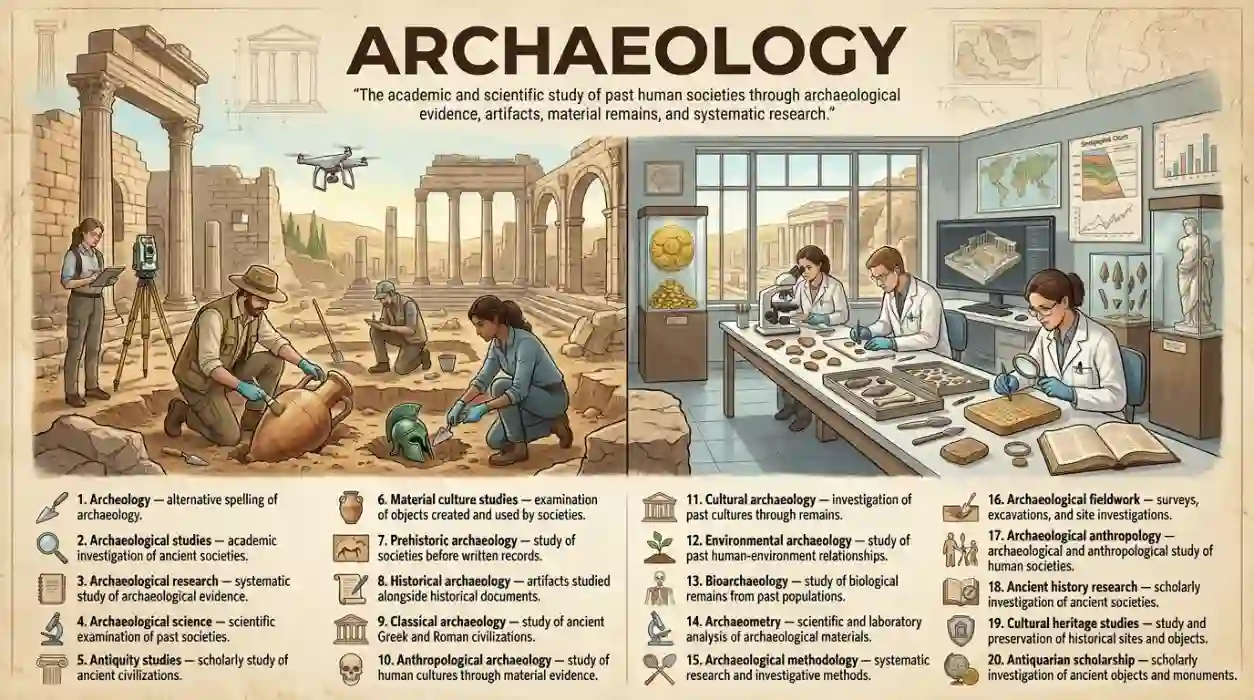
A synonym for archeology is archaeology, the standard alternative spelling. Other close expressions include archaeological research, the study of the past, and material culture studies. These describe related aspects of the discipline rather than exact synonyms.
Imagine finding an old coin while walking through a field. You might wonder who used it, how old it is, and what it reveals about the past. That curiosity leads straight to archeology.
The word appears in books, documentaries, museums, classrooms, and history articles. Knowing its alternatives helps you describe the subject more accurately and avoid repeating the same expression.
Students can use related terms in essays and research projects. Bloggers and content writers can make articles more varied, while everyday English users can explain discoveries in simple language.
This guide explores useful alternatives and related expressions. It also explains their meanings, pronunciation, tone, and best contexts, so you can choose the right term with confidence.
What Does “Archeology” Really Mean?
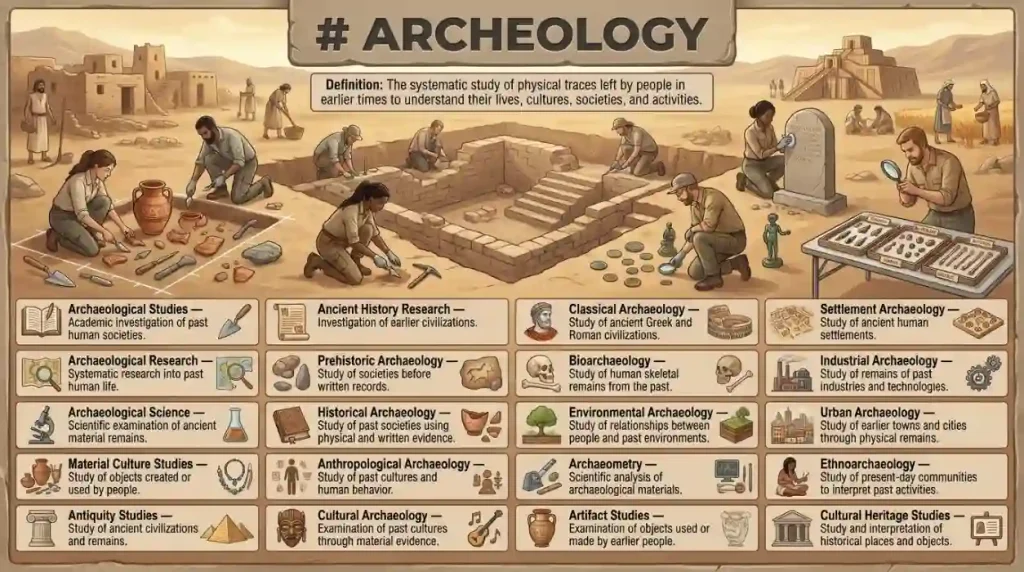
Archeology is the study of past human life through the objects, buildings, tools, bones, landscapes, and other physical remains people left behind. Researchers examine this evidence to understand how earlier communities lived, worked, traded, travelled, and thought.
The standard British and internationally common spelling is archaeology. Archeology is an accepted variant, especially in American English. Both spellings refer to the same academic discipline. Oxford Learner’s Dictionaries+2
Part of speech: Noun. It is generally an uncountable noun.
Simple definition: The study of past people and societies through the physical evidence they left behind.
Native speakers understand archeology as a field of research, not simply the act of digging. Excavation is one method used by archaeologists, but the discipline also involves recording, dating, comparing, and interpreting evidence.
Common contexts include university courses, museum exhibitions, historical documentaries, heritage protection, academic research, and news reports about discoveries.
Connotative Meaning
(Connotation means the feeling, association, or emotional suggestion that a word carries beyond its basic dictionary definition.)
- Positive tone: Discovery, curiosity, knowledge, cultural understanding, and connection with human history.
- Negative tone: The word itself is not negative. A particular project may raise concerns about looting, colonial collecting, or damage to heritage sites.
- Neutral tone: In academic and everyday contexts, archeology is usually a neutral term for a field of study.
Etymology:
The word comes through French archéologie and Latin archaeologia, ultimately from Ancient Greek arkhaiologia. The Greek term referred to ancient history, ancient stories, or the study of ancient things. It combines elements associated with what is ancient and with speaking or studying.
Old English (450–1100)
The English word archeology was not in ordinary use during the Old English period. People could discuss old objects, ancient places, and earlier peoples, but the modern academic term had not yet entered English.
Middle English (1100–1500)
The word was still not established in Middle English. Scholars and writers used other expressions to discuss antiquities, history, and old monuments. The English term developed later through learned European vocabulary.
Modern English (1500–Present)
The word entered English around the beginning of the seventeenth century, initially with a meaning close to “ancient history.” Its modern sense—the systematic study of past societies through material remains—developed during the nineteenth century.
Pronunciation (US & UK – IPA)
- US: /ˌɑːr.kiˈɑː.lə.dʒi/
- UK: /ˌɑː.kiˈɒl.ə.dʒi/
These are standard broad transcriptions. The first syllable and the stressed vowel can sound different between American and British accents.
Syllables
ar-chae-ol-o-gy — commonly divided into five spoken syllables: ar-chae-ol-o-gy.
Affixation Pattern of “Archeology”
- Root or combining element: archaeo- — relating to ancient things or the distant past.
- Prefix: No ordinary English prefix is added to the complete word.
- Suffix: -logy — a word-forming element used in the names of fields of study.
The word is historically borrowed from Greek rather than formed by simply attaching an English prefix and suffix. The parts above describe its modern structure for vocabulary learning.
Synonyms List
A useful accuracy note: English does not have exact synonyms for archeology. The word names a specific academic discipline. Its only straightforward spelling alternative is archaeology. The 50 entries below therefore include the exact spelling variant, close descriptive alternatives, established branches, research methods, and related fields. They are not all interchangeable.
For the multiword expressions, pronunciation is approximate and may vary by accent.
1. Archaeology (Noun) — US / UK: /ˌɑːr.kiˈɑː.lə.dʒi/ · /ˌɑː.kiˈɒl.ə.dʒi/
Meaning: The standard alternative spelling of archeology, especially common in British English and international academic writing.
Tone/Register: Neutral, academic.
Examples:
She is studying archaeology at university.
The museum has a new archaeology exhibition.
2. Archaeological Studies (Noun Phrase) — US / UK: /ˌɑːr.ki.əˈlɑː.dʒɪ.kəl ˈstʌd.iz/ · /ˌɑː.ki.əˈlɒdʒ.ɪ.kəl ˈstʌd.iz/
Meaning: Academic study of past societies using archaeological evidence and research methods.
Tone/Register: Formal, academic.
Examples:
His degree focuses on archaeological studies.
The department recently expanded its archaeological studies program.
3. Archaeological Research (Noun Phrase) — US / UK: /ˌɑːr.ki.əˈlɑː.dʒɪ.kəl rɪˈsɝːtʃ/ · /ˌɑː.ki.əˈlɒdʒ.ɪ.kəl rɪˈsɜːtʃ/
Meaning: Systematic investigation of past human activity through objects, sites, and other material evidence.
Tone/Register: Formal, academic.
Examples:
Archaeological research changed how historians understand the settlement.
The team published its research last spring.
4. Study of Antiquities (Noun Phrase) — US / UK: /ˈstʌd.i əv ænˈtɪk.wə.tiz/
Meaning: The examination of ancient objects, monuments, and historical remains.
Tone/Register: Formal, traditional.
Examples:
The course includes the study of antiquities.
She became interested in ancient pottery through this subject.
5. Study of the Past (Noun Phrase) — US / UK: /ˈstʌd.i əv ðə pæst/
Meaning: A broad expression for investigating earlier times, including but not limited to archaeology.
Tone/Register: Neutral, accessible.
Examples:
The study of the past can reveal how communities changed.
He enjoys the study of the past more than modern politics.
6. Material Culture Studies (Noun Phrase) — US / UK: /məˈtɪr.i.əl ˈkʌl.tʃɚ ˈstʌd.iz/ · /məˈtɪə.ri.əl ˈkʌl.tʃə ˈstʌd.iz/
Meaning: The study of objects people make and use to understand their social lives and cultural values.
Tone/Register: Academic, specialist.
Examples:
Material culture studies helped explain the meaning of the decorated bowls.
Her research examines clothing through material culture studies.
7. Antiquarianism (Noun) — US / UK: /ˌæn.tɪˈkwɛr.i.əˌnɪ.zəm/
Meaning: The interest in collecting, studying, and documenting old objects and historical remains.
Tone/Register: Formal, historical.
Examples:
Antiquarianism influenced early interest in ancient monuments.
The exhibition explores the history of antiquarianism.
8. Antiquarian Studies (Noun Phrase) — US / UK: /ˌæn.tɪˈkwɛr.i.ən ˈstʌd.iz/
Meaning: Research into historical objects, documents, monuments, and traditions, often with an emphasis on antiquities.
Tone/Register: Formal, historical.
Examples:
The library offers resources for antiquarian studies.
Her paper considers the role of antiquarian studies in heritage research.
9. Prehistoric Studies (Noun Phrase) — US / UK: /ˌpriː.hɪˈstɔːr.ɪk ˈstʌd.iz/
Meaning: The investigation of human periods before written historical records, often using archaeological evidence.
Tone/Register: Academic, neutral.
Examples:
Prehistoric studies help researchers understand early human communities.
He chose prehistoric studies for his final research project.
10. Historical Archaeology (Noun Phrase) — US / UK: /hɪˈstɔːr.ɪ.kəl ˌɑːr.kiˈɑː.lə.dʒi/ · /hɪˈstɒr.ɪ.kəl ˌɑː.kiˈɒl.ə.dʒi/
Meaning: A branch of archaeology that studies periods supported by written records as well as physical evidence.
Tone/Register: Academic, specialist.
Examples:
Historical archaeology examines the remains of colonial settlements.
The team used letters and household objects in its study.
11. Prehistoric Archaeology (Noun Phrase) — US / UK: /ˌpriː.hɪˈstɔːr.ɪ.kəl ˌɑːr.kiˈɑː.lə.dʒi/ · /ˌpriː.hɪˈstɒr.ɪ.kəl ˌɑː.kiˈɒl.ə.dʒi/
Meaning: The study of human communities from before the development of written records.
Tone/Register: Academic.
Examples:
Prehistoric archaeology examines stone tools and early settlements.
She presented a paper on prehistoric archaeology.
12. Classical Archaeology (Noun Phrase) — US / UK: /ˈklæs.ɪ.kəl ˌɑːr.kiˈɑː.lə.dʒi/ · /ˈklæs.ɪ.kəl ˌɑː.kiˈɒl.ə.dʒi/
Meaning: The study of the material remains of ancient Greek and Roman societies.
Tone/Register: Academic, specialist.
Examples:
Classical archaeology explores ancient Greek temples.
His research focuses on Roman homes and public spaces.
13. Industrial Archaeology (Noun Phrase) — US / UK: /ɪnˈdʌs.tri.əl ˌɑːr.kiˈɑː.lə.dʒi/ · /ɪnˈdʌs.tri.əl ˌɑː.kiˈɒl.ə.dʒi/
Meaning: The study of physical remains from industry, manufacturing, transport, and technology.
Tone/Register: Academic, professional.
Examples:
Industrial archaeology documents old factories and railways.
The town preserved its historic mill as part of an industrial archaeology project.
14. Maritime Archaeology (Noun Phrase) — US / UK: /ˈmær.ɪ.taɪm ˌɑːr.kiˈɑː.lə.dʒi/ · /ˈmær.ɪ.taɪm ˌɑː.kiˈɒl.ə.dʒi/
Meaning: The study of human interaction with seas and waterways through shipwrecks, ports, and underwater remains.
Tone/Register: Academic, specialist.
Examples:
Maritime archaeology revealed details about the sunken vessel.
She joined a maritime archaeology survey near the coast.
15. Underwater Archaeology (Noun Phrase) — US / UK: /ˌʌn.dɚˈwɑː.t̬ɚ ˌɑːr.kiˈɑː.lə.dʒi/ · /ˌʌn.dəˈwɔː.tə ˌɑː.kiˈɒl.ə.dʒi/
Meaning: Archaeological investigation of submerged sites and objects beneath water.
Tone/Register: Academic, specialist.
Examples:
Underwater archaeology can uncover ancient trading routes.
The documentary follows an underwater archaeology team.
16. Environmental Archaeology (Noun Phrase) — US / UK: /ɪnˌvaɪ.rənˈmen.təl ˌɑːr.kiˈɑː.lə.dʒi/ · /ɪnˌvaɪ.rənˈmen.təl ˌɑː.kiˈɒl.ə.dʒi/
Meaning: The study of past environments and human relationships with them using archaeological evidence.
Tone/Register: Academic, scientific.
Examples:
Environmental archaeology can reveal ancient farming practices.
The project examines climate and settlement patterns.
17. Bioarchaeology (Noun) — US / UK: /ˌbaɪ.oʊˌɑːr.kiˈɑː.lə.dʒi/ · /ˌbaɪ.əʊˌɑː.kiˈɒl.ə.dʒi/
Meaning: The study of human remains from archaeological contexts to understand health, diet, activity, and past populations.
Tone/Register: Academic, scientific.
Examples:
Bioarchaeology provided clues about the community’s diet.
The researcher studies ancient skeletons through bioarchaeology.
18. Zooarchaeology (Noun) — US / UK: /ˌzuː.oʊˌɑːr.kiˈɑː.lə.dʒi/ · /ˌzuː.əʊˌɑː.kiˈɒl.ə.dʒi/
Meaning: The study of animal remains from archaeological sites to understand past human-animal relationships.
Tone/Register: Academic, specialist.
Examples:
Zooarchaeology helped identify the animals raised by the settlement.
Her research uses animal bones to study ancient diets.
19. Archaeological Fieldwork (Noun Phrase) — US / UK: /ˌɑːr.ki.əˈlɑː.dʒɪ.kəl ˈfiːld.wɝːk/ · /ˌɑː.ki.əˈlɒdʒ.ɪ.kəl ˈfiːld.wɜːk/
Meaning: Practical archaeological work carried out at sites, including surveying, recording, and excavation.
Tone/Register: Professional, academic.
Examples:
Archaeological fieldwork begins after the site survey.
Students gained experience through summer fieldwork.
20. Archaeological Excavation (Noun Phrase) — US / UK: /ˌɑːr.ki.əˈlɑː.dʒɪ.kəl ˌek.skəˈveɪ.ʃən/ · /ˌɑː.ki.əˈlɒdʒ.ɪ.kəl ˌek.skəˈveɪ.ʃən/
Meaning: The controlled removal and recording of soil to investigate buried archaeological remains.
Tone/Register: Technical, academic.
Examples:
The archaeological excavation uncovered a stone foundation.
Every object was recorded during the excavation.
21. Excavation (Noun) — US / UK: /ˌek.skəˈveɪ.ʃən/
Meaning: The process of carefully digging into the ground to expose buried material or structures.
Tone/Register: Neutral, technical.
Examples:
The excavation continued for three months.
Researchers found pottery during the excavation.
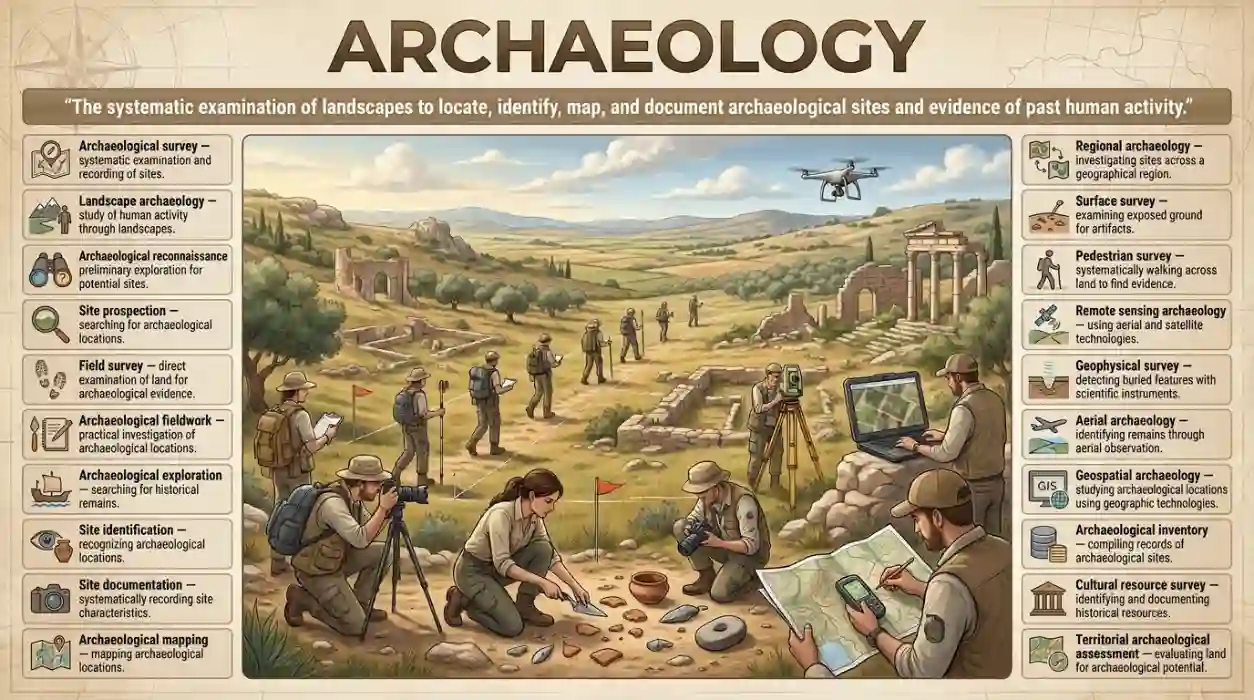
22. Archaeological Survey (Noun Phrase) — US / UK: /ˌɑːr.ki.əˈlɑː.dʒɪ.kəl ˈsɝː.veɪ/ · /ˌɑː.ki.əˈlɒdʒ.ɪ.kəl ˈsɜː.veɪ/
Meaning: The systematic examination of a landscape to locate and document archaeological sites.
Tone/Register: Professional, academic.
Examples:
The archaeological survey identified several ancient structures.
Researchers mapped the area before beginning any excavation.
23. Site Investigation (Noun Phrase) — US / UK: /saɪt ɪnˌves. tɪˈɡeɪ.ʃən/
Meaning: A detailed examination of a particular location to assess its archaeological or historical evidence.
Tone/Register: Professional, technical.
Examples:
The site investigation revealed traces of an earlier settlement.
A specialist team completed the assessment before construction began.
24. Artifact Studies (Noun Phrase) — US / UK: /ˈɑːr.t̬ə.fækt ˈstʌd.iz/ · /ˈɑː.tɪ.fækt ˈstʌd.iz/
Meaning: The examination of human-made objects to understand their purpose, production, use, and cultural meaning.
Tone/Register: Academic, specialist.
Examples:
Artifact studies helped date the collection.
The course includes pottery and metalwork analysis.
25. Antiquities Research (Noun Phrase) — US / UK: /ænˈtɪk.wə.tiz rɪˈsɝːtʃ/ · /ænˈtɪk.wə.tiz rɪˈsɜːtʃ/
Meaning: Research into ancient objects, monuments, and cultural remains.
Tone/Register: Formal, historical.
Examples:
Antiquities research brought new attention to the temple site.
The scholar published a study of regional antiquities.
26. Ancient History (Noun Phrase) — US / UK: /ˈeɪn.ʃənt ˈhɪs.t̬ɚ.i/ · /ˈeɪn.ʃənt ˈhɪs.tər.i/
Meaning: The study of early human societies and civilizations, often using written sources alongside archaeological evidence.
Tone/Register: Academic, neutral.
Examples:
Ancient history was her favorite subject at school.
The lecture connected ancient history with recent discoveries.
27. Cultural Heritage Studies (Noun Phrase) — US / UK: /ˈkʌl.tʃɚ.əl ˈher.ɪ.t̬ɪdʒ ˈstʌd.iz/ · /ˈkʌl.tʃər.əl ˈher.ɪ.tɪdʒ ˈstʌd.iz/
Meaning: The study of how societies preserve, interpret, and value cultural places, objects, and traditions.
Tone/Register: Academic, professional.
Examples:
Cultural heritage studies examine how communities protect historic places.
She works in cultural heritage research.
28. Heritage Research (Noun Phrase) — US / UK: /ˈher.ɪ.t̬ɪdʒ rɪˈsɝːtʃ/ · /ˈher.ɪ.tɪdʒ rɪˈsɜːtʃ/
Meaning: Investigation of places, objects, practices, and traditions considered important to a community’s history.
Tone/Register: Professional, neutral.
Examples:
Heritage research guided the restoration plan.
The report includes new findings about the old town.
29. Historical Research (Noun Phrase) — US / UK: /hɪˈstɔːr.ɪ.kəl rɪˈsɝːtʃ/ · /hɪˈstɒr.ɪ.kəl rɪˈsɜːtʃ/
Meaning: The investigation of past events and societies using documents, objects, testimony, and other evidence.
Tone/Register: Academic, professional.
Examples:
Historical research helped establish when the building was constructed.
She combined archival records with physical evidence.
30. Anthropological Archaeology (Noun Phrase) — US / UK: /ˌæn.θrə.pəˈlɑː.dʒɪ.kəl ˌɑːr.kiˈɑː.lə.dʒi/ · /ˌæn.θrə.pəˈlɒdʒ.ɪ.kəl ˌɑː.kiˈɒl.ə.dʒi/
Meaning: An approach to archaeology that uses anthropological questions to understand human societies and cultural change.
Tone/Register: Academic, specialist.
Examples:
Anthropological archaeology explores how communities organize daily life.
The researcher studies migration through this approach.
31. Ethnoarchaeology (Noun) — US / UK: /ˌeθ.noʊˌɑːr.kiˈɑː.lə.dʒi/ · /ˌeθ.nəʊˌɑː.kiˈɒl.ə.dʒi/
Meaning: The study of living communities and their material practices to help interpret archaeological evidence.
Tone/Register: Academic, specialist.
Examples:
Ethnoarchaeology can help explain how tools were used.
The team compared modern pottery methods with ancient examples.
32. Experimental Archaeology (Noun Phrase) — US / UK: /ɪkˌsper.əˈmen.t̬əl ˌɑːr.kiˈɑː.lə.dʒi/ · /ɪkˌsper.ɪˈmen.təl ˌɑː.kiˈɒl.ə.dʒi/
Meaning: The testing of ideas about the past by recreating tools, techniques, buildings, or activities.
Tone/Register: Academic, practical.
Examples:
Experimental archaeology tested how ancient ovens worked.
Students recreated a traditional tool as part of the project.
33. Landscape Archaeology (Noun Phrase) — US / UK: /ˈlænd.skeɪp ˌɑːr.kiˈɑː.lə.dʒi/ · /ˈlænd.skeɪp ˌɑː.kiˈɒl.ə.dʒi/
Meaning: The study of how people shaped, used, and experienced landscapes over time.
Tone/Register: Academic, specialist.
Examples:
Landscape archaeology revealed an old network of pathways.
The project examines how farming changed the region.
34. Urban Archaeology (Noun Phrase) — US / UK: /ˈɝː.bən ˌɑːr.kiˈɑː.lə.dʒi/ · /ˈɜː.bən ˌɑː.kiˈɒl.ə.dʒi/
Meaning: The study of past human activity in towns and cities through buried and standing remains.
Tone/Register: Academic, professional.
Examples:
Urban archaeology uncovered an older street beneath the city center.
The museum displays finds from recent urban excavations.
35. Industrial Heritage Research (Noun Phrase) — US / UK: /ɪnˈdʌs.tri.əl ˈher.ɪ.t̬ɪdʒ rɪˈsɝːtʃ/ · /ɪnˈdʌs.tri.əl ˈher.ɪ.tɪdʒ rɪˈsɜːtʃ/
Meaning: Research into the historical importance of factories, machinery, transport systems, and industrial sites.
Tone/Register: Professional, academic.
Examples:
Industrial heritage research documented the area’s mining history.
The council used the findings to protect the former railway depot.
36. Numismatics (Noun) — US / UK: /nuːˈmɪz.mæt̬.ɪks/ · /njuːˈmɪz.mæt.ɪks/
Meaning: The study and collection of coins, currency, and related monetary objects, including those found at archaeological sites.
Tone/Register: Specialist, academic.
Examples:
Numismatics helped identify the age of the coins.
She specializes in ancient currency.
37. Epigraphy (Noun) — US / UK: /ɪˈpɪɡ.rə.fi/
Meaning: The study and interpretation of inscriptions carved or written on durable materials.
Tone/Register: Academic, specialist.
Examples:
Epigraphy helped researchers read the inscription on the stone.
The project compares writing styles across ancient monuments.
38. Palaeography (Noun) — US / UK: /ˌpeɪ.liˈɑː.ɡrə.fi/ · /ˌpæl.iˈɒɡ.rə.fi/
Meaning: The study of historical handwriting and writing systems, often used alongside archaeological research.
Tone/Register: Academic, specialist.
Examples:
Palaeography helped date the handwritten document.
The scholar examined changes in letter forms.
39. Archaeometry (Noun) — US / UK: /ˌɑːr.kiˈɑː.mə.tri/ · /ˌɑː.kiˈɒm.ə.tri/
Meaning: The application of scientific and quantitative techniques to archaeological materials and questions.
Tone/Register: Scientific, academic.
Examples:
Archaeometry helped determine the source of the pottery clay.
The laboratory used chemical analysis to study the sample.
40. Archaeological Science (Noun Phrase) — US / UK: /ˌɑːr.ki.əˈlɑː.dʒɪ.kəl ˈsaɪ.əns/ · /ˌɑː.ki.əˈlɒdʒ.ɪ.kəl ˈsaɪ.əns/
Meaning: The use of scientific methods to investigate archaeological materials, dates, environments, and past activities.
Tone/Register: Scientific, academic.
Examples:
Archaeological science can reveal where ancient metals originated.
The university introduced a new archaeological science course.
41. Archaeological Interpretation (Noun Phrase) — US / UK: /ˌɑːr.ki.əˈlɑː.dʒɪ.kəl ɪnˌtɝː.prəˈteɪ.ʃən/ · /ˌɑː.ki.əˈlɒdʒ.ɪ.kəl ɪnˌtɜː.prɪˈteɪ.ʃən/
Meaning: The process of explaining what archaeological evidence may reveal about past people and activities.
Tone/Register: Academic, professional.
Examples:
Archaeological interpretation requires careful attention to context.
The report offers a new interpretation of the burial site.
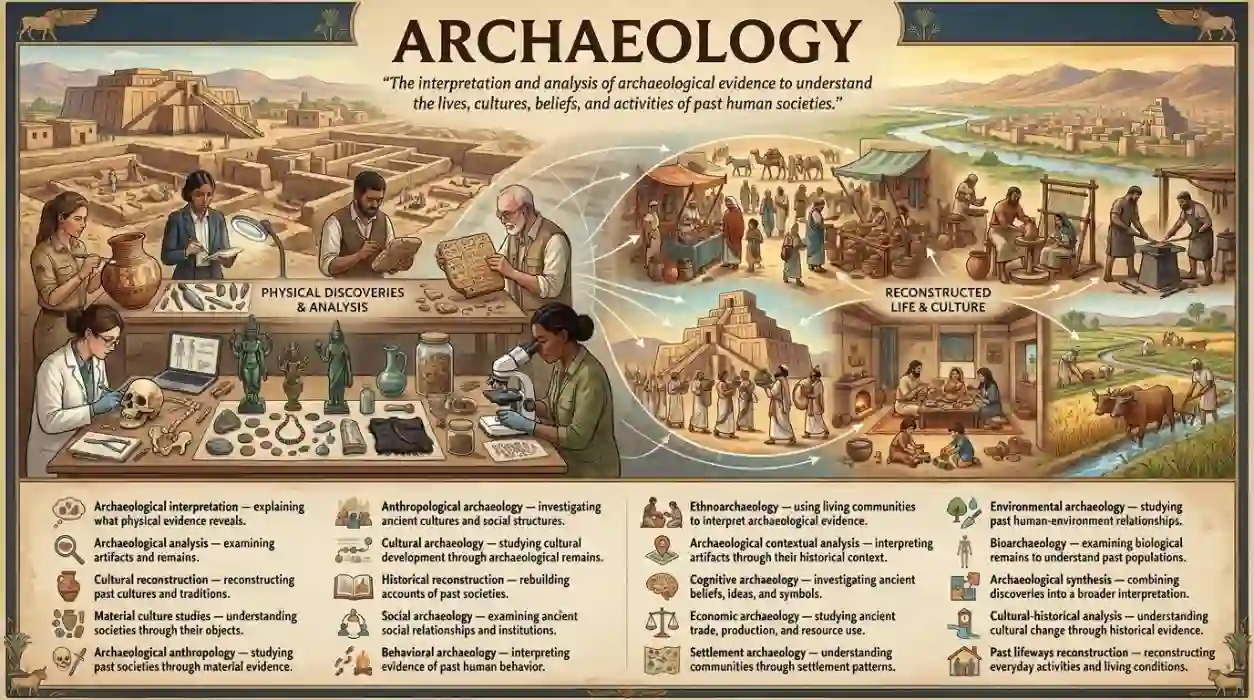
42. Archaeological Analysis (Noun Phrase) — US / UK: /ˌɑːr.ki.əˈlɑː.dʒɪ.kəl əˈnæl.ə.sɪs/ · /ˌɑː.ki.əˈlɒdʒ.ɪ.kəl əˈnæl.ə.sɪs/
Meaning: The detailed examination of archaeological evidence to identify patterns, dates, materials, or functions.
Tone/Register: Academic, technical.
Examples:
Archaeological analysis revealed several stages of construction.
The pottery underwent detailed analysis in the laboratory.
43. Archaeological Investigation (Noun Phrase) — US / UK: /ˌɑːr.ki.əˈlɑː.dʒɪ.kəl ɪnˌves.tɪˈɡeɪ.ʃən/ · /ˌɑː.ki.əˈlɒdʒ.ɪ.kəl ɪnˌves.tɪˈɡeɪ.ʃən/
Meaning: A planned inquiry into a site, object, or historical question using archaeological methods.
Tone/Register: Formal, professional.
Examples:
The archaeological investigation began with a detailed site map.
Its findings changed the proposed restoration work.
44. Archaeological Heritage (Noun Phrase) — US / UK: /ˌɑːr.ki.əˈlɑː.dʒɪ.kəl ˈher.ɪ.t̬ɪdʒ/ · /ˌɑː.ki.əˈlɒdʒ.ɪ.kəl ˈher.ɪ.tɪdʒ/
Meaning: Physical remains and sites from the past that have historical or cultural significance.
Tone/Register: Formal, heritage-related.
Examples:
The region is known for its rich archaeological heritage.
Local groups work to protect archaeological heritage.
45. Archaeological Record (Noun Phrase) — US / UK: /ˌɑːr.ki.əˈlɑː.dʒɪ.kəl ˈrek.ɚd/ · /ˌɑː.ki.əˈlɒdʒ.ɪ.kəl ˈrek.ɔːd/
Meaning: The surviving material evidence of past human activity available for archaeological study.
Tone/Register: Academic, technical.
Examples:
The archaeological record contains evidence of early trade.
Some materials survive better than others in the archaeological record.
46. Material Remains (Noun Phrase) — US / UK: /məˈtɪr.i.əl rɪˈmeɪnz/ · /məˈtɪə.ri.əl rɪˈmeɪnz/
Meaning: Physical objects and structures left by earlier people, such as tools, buildings, pottery, and bones.
Tone/Register: Neutral, academic.
Examples:
Material remains offer clues about everyday life.
The researchers carefully documented the material remains.
47. Ancient Civilizations Research (Noun Phrase) — US / UK: /ˈeɪn.ʃənt ˌsɪv.əl.əˈzeɪ.ʃənz rɪˈsɝːtʃ/ · /ˈeɪn.ʃənt ˌsɪv.əl.aɪˈzeɪ.ʃənz rɪˈsɜːtʃ/
Meaning: Research into the societies, institutions, and cultures of ancient civilizations, sometimes using archaeological evidence.
Tone/Register: Academic, accessible.
Examples:
Ancient civilizations research explores the growth of early cities.
Her article discusses trade across the ancient world.
48. Human Past Studies (Noun Phrase) — US / UK: /ˈhjuː.mən pæst ˈstʌd.iz/
Meaning: A broad descriptive phrase for research into earlier human societies and experiences.
Tone/Register: Neutral, accessible.
Examples:
Human past studies bring together evidence from several disciplines.
The course explores migration and early communities.
49. Study of Material Remains (Noun Phrase) — US / UK: /ˈstʌd.i əv məˈtɪr.i.əl rɪˈmeɪnz/ · /ˈstʌd.i əv məˈtɪə.ri.əl rɪˈmeɪnz/
Meaning: A plain-language description of examining physical traces left by people in earlier times.
Tone/Register: Neutral, explanatory.
Examples:
The study of material remains can reveal how people prepared food.
This approach connects objects with everyday activities.
50. Study of Ancient Cultures (Noun Phrase) — US / UK: /ˈstʌd.i əv ˈeɪn.ʃənt ˈkʌl.tʃɚz/ · /ˈstʌd.i əv ˈeɪn.ʃənt ˈkʌl.tʃəz/
Meaning: A broad expression for investigating the beliefs, customs, practices, and material life of ancient societies.
Tone/Register: Neutral, educational.
Examples:
The study of ancient cultures can challenge familiar historical assumptions.
She enjoys learning about ancient cultures through museum visits.
Synonyms by Tone
The best alternative depends on what you want to communicate. Some expressions name a formal academic field, while others explain the subject in everyday language.
Positive or Engaging
These expressions can make the subject sound exciting, discovery-focused, or connected to cultural understanding:
- Study of the past — accessible and inviting.
- Material culture studies — emphasizes how objects reveal human experience.
- Cultural heritage studies — highlights preservation and cultural value.
- Study of ancient cultures — clear and educational.
- Ancient civilizations research — suggests exploration of early societies.
Neutral
These are suitable for general explanations, articles, and classroom writing:
- Archaeology
- Archaeological studies
- Archaeological research
- Historical archaeology
- Prehistoric archaeology
- Archaeological fieldwork
- Archaeological survey
- Study of material remains
- Historical research
Formal or Academic
Use these in essays, research papers, museum publications, and professional discussions:
- Antiquarian studies
- Prehistoric studies
- Classical archaeology
- Environmental archaeology
- Bioarchaeology
- Zooarchaeology
- Ethnoarchaeology
- Archaeometry
- Archaeological science
- Archaeological interpretation
Technical or Method-Focused
These expressions refer to particular activities or specialisms rather than the entire discipline:
- Archaeological excavation
- Excavation
- Site investigation
- Artifact studies
- Epigraphy
- Palaeography
- Numismatics
- Underwater archaeology
- Landscape archaeology
- Urban archaeology
Why Tone Matters in Word Choice
A university essay may need the precise term archaeological investigation. A friendly blog post may work better with the study of the past. Choosing the right expression helps readers understand whether you mean the whole discipline, a research method, or a related subject.
“Archeology” vs. Close Alternatives
Some expressions look interchangeable but have different meanings. These three comparisons are especially useful.
| Word or phrase | Main difference | Best use |
|---|---|---|
| Archeology / Archaeology | Two accepted spellings of the same discipline | Use archaeology in most international or British English writing; archeology is common in US usage |
| Antiquarianism | Focuses on interest in and study of old objects and historical remains; it is not identical to modern archaeology | Historical discussions about collectors, antiquities, and early research |
| Ancient history | Covers past societies and events, often using written sources as well as physical evidence | Essays or discussions about ancient civilizations and historical periods |
Which should you choose?
Use archaeology when you mean the academic discipline. Choose ancient history when discussing a period or its events more broadly. Use antiquarianism when the subject is the historical interest in old objects and monuments.
How “Archeology” Changes by Context
Daily Conversation
In everyday speech, simple phrases are usually easier to understand than technical terminology. You might say, “I enjoy learning about ancient cultures,” or “I watched a documentary about archaeology.”
If someone asks what archeology involves, explain that it studies the past through objects, buildings, and other physical evidence.
Writing or Blogging
Writers can alternate between archaeology, archaeological research, ancient cultures, and the study of material remains. Each expression adds a slightly different focus.
Avoid replacing the main keyword every time it appears. Repeating archaeology where it is the clearest term is better than using an inaccurate alternative simply to vary the wording.
Professional or Academic Writing
Academic writing benefits from precise terminology. A paper about ancient coins might use numismatics. A study of inscriptions might refer to epigraphy. A project involving buried structures might describe its work as an archaeological excavation.
These terms make a sentence more specific. They do not all mean archaeology itself.
Creative or Informal Use
In a story, travel article, or social media caption, phrases such as uncovering the past, exploring ancient remains, and discovering lost worlds can create a sense of curiosity.
These are descriptive expressions, not formal synonyms. They work well when you want a lively tone rather than a technical definition.
Common Mistakes Learners Make
1. Treating Every Related Term as an Exact Synonym
Excavation is not another name for the entire discipline. It is one method used in archaeological work. Similarly, epigraphy focuses on inscriptions, while numismatics focuses on coins and currency.
Better approach: Use the name of the specific method or field only when that is what you mean.
2. Confusing Archeology With Ancient History
The subjects overlap, but they are not identical. Ancient history often examines written records and historical events. Archaeology investigates physical remains and the contexts in which they are found.
Better approach: Use archaeology when material evidence is central to your point.
3. Assuming Archeology Only Means Digging
Excavation is highly visible, so people sometimes assume that all archaeologists spend their time digging. In reality, the work can also involve laboratory analysis, mapping, conservation, dating, and interpretation.
Better approach: Use archaeological research when referring to the wider process.
4. Mixing Up the Two Spellings
Both archeology and archaeology are accepted. However, spelling conventions differ between publications and regions.
Better approach: Follow the spelling used by your school, publisher, or chosen style guide. Be consistent throughout the same article.
5. Using Technical Vocabulary Without Explaining It
A specialist term can confuse readers who are new to the subject. For example, zooarchaeology may be unfamiliar to a general audience.
Better approach: Introduce the term and explain it briefly: “Zooarchaeology, the study of animal remains from archaeological sites, can reveal ancient diets.”
Register Notes
- Formal: Archaeological research, archaeological investigation, and archaeometry suit academic and professional writing.
- Informal: The study of the past and learning about ancient cultures are friendly and accessible.
- Spoken English: Short expressions are often easier to follow in conversation.
- Written English: Specific branch names help make essays and reports more precise.
For more vocabulary guidance, you can also explore related topics such as synonyms for historical or ancient in a wider English vocabulary guide.
Real-Life Examples
Workplace Scenario
A museum employee is preparing a public exhibition. Instead of describing every section as “archeology,” the employee uses archaeological research for the findings and cultural heritage studies for the preservation work.
Social Scenario
A friend visits an old settlement and shares photographs. They might say, “I love learning about ancient cultures,” rather than using a technical term in casual conversation.
Media and Pop Culture Scenario
A documentary explores a shipwreck. Its subject could be described as maritime archaeology or underwater archaeology, depending on the focus of the programme.
Writing and Storytelling Scenario
A travel blogger writes about a historic city. The article uses archaeological remains for the physical discoveries and ancient history for the wider story of the civilization.
Practice Exercise:
1. You are writing a university paper about the scientific study of ancient objects. Which term is most appropriate?
- A. Archaeological research
- B. Ancient entertainment
- C. Modern fashion
2. A researcher studies coins found at a Roman site. Which specialist subject is relevant?
- A. Epigraphy
- B. Numismatics
- C. Palaeography
3. You want a simple phrase for a general audience. Which sounds most accessible?
- A. The study of the past
- B. Archaeometry
- C. Zooarchaeology
4. A team investigates a sunken ship. Which branch is most relevant?
- A. Urban archaeology
- B. Maritime archaeology
- C. Industrial archaeology
5. A researcher examines animal bones from an ancient settlement. Which term fits?
- A. Zooarchaeology
- B. Numismatics
- C. Antiquarianism
6. You are discussing the study of ancient Greek and Roman remains. Which phrase is most precise?
- A. Classical archaeology
- B. Landscape archaeology
- C. Industrial heritage research
7. A scientist uses chemical analysis to investigate ancient pottery. Which term may describe this approach?
- A. Archaeometry
- B. Ancient history
- C. Antiquarianism
8. A researcher examines inscriptions carved into a monument. Which subject is relevant?
- A. Epigraphy
- B. Bioarchaeology
- C. Maritime archaeology
9. You are writing a friendly blog post for readers with no specialist knowledge. Which phrase is easiest to understand?
- A. The study of ancient cultures
- B. Archaeological interpretation
- C. Archaeological science
10. A team surveys a landscape to locate possible ancient sites. What is this activity called?
- A. Archaeological survey
- B. Palaeography
- C. Numismatics
Reflection Task
Write one sentence about a historical discovery. Use one expression from the list, such as archaeological research, material culture studies, or the study of ancient cultures.
Answer Key: 1-A, 2-B, 3-A, 4-B, 5-A, 6-A, 7-A, 8-A, 9-A, 10-A
External Sources
For further reading and reliable definitions, consult:
- Oxford Learner’s Dictionaries – Archeology
- Cambridge Dictionary – Archaeology
- Online Etymology Dictionary – Archaeology
Conclusion
Learning a synonym for archeology helps you explain the study of the past with greater precision. The right alternative makes your writing clearer and more engaging.
Related terms also help you understand different areas of research, from ancient coins and inscriptions to underwater discoveries and cultural heritage.
Practise these expressions in emails, essays, blog posts, and everyday conversations. Choose one new term today and write a sentence with it.
Frequently Asked Questions
1. Is archeology the same as archaeology?
Yes. Archeology and archaeology are spelling variants of the same noun. The spelling archaeology is widely used in British and international English, while archeology is common in American English. Both refer to the study of past societies through physical evidence, including buildings, tools, pottery, and other remains.
2. What is a simple word for someone who studies archeology?
An archaeologist is a person who studies the human past through material evidence. Archaeologists may specialize in ancient buildings, human remains, shipwrecks, landscapes, or artifacts. The related spelling archeologist is also used, particularly in American English. The plural is archaeologists or archeologists.
3. What is the difference between an archaeologist and a historian?
An archaeologist mainly investigates physical evidence, such as objects, buildings, graves, and settlement remains. A historian often studies written records, letters, official documents, and other historical sources. Their work can overlap. Combining material evidence with written records can provide a fuller understanding of the past.
4. What is the adjective form of archeology?
The adjective is archaeological. It describes something connected with archaeology, such as archaeological evidence, archaeological sites, or archaeological discoveries. The American spelling archeological is also accepted. For example: “The team found archaeological evidence near the river.”
5. What is the difference between archaeology and paleontology?
Archaeology focuses mainly on past human societies and the physical traces of human activity. Paleontology studies ancient life through fossils, including extinct animals and plants. The fields can overlap when researchers investigate human evolution or the environments in which early humans lived, but their central questions are different.

Hasnain Ali is an SEO Content Strategist and the founder of wordvora.com, a trusted vocabulary platform that helps writers, students, professionals, and English learners find accurate synonyms, antonyms, word meanings, and real-life usage examples. He specializes in keyword research, on-page SEO, topical authority, and creating search-first content that aligns with Google’s latest Search Quality and E-E-A-T guidelines. His work focuses on producing clear, well-structured, and reader-friendly resources that satisfy search intent while maintaining high editorial standards.
Through extensive hands-on experience with SEO tools such as Google Search Console, Google Analytics, SEMrush, and Ahrefs, Hasnain researches user search behavior and develops content that is both informative and easy to understand. Every article published on wordvora.com is carefully reviewed for accuracy, readability, and contextual relevance before publication. His mission is to build one of the web’s most reliable English vocabulary resources by providing practical language guidance, trustworthy explanations, and content that helps readers improve their writing, communication, and vocabulary with confidence.