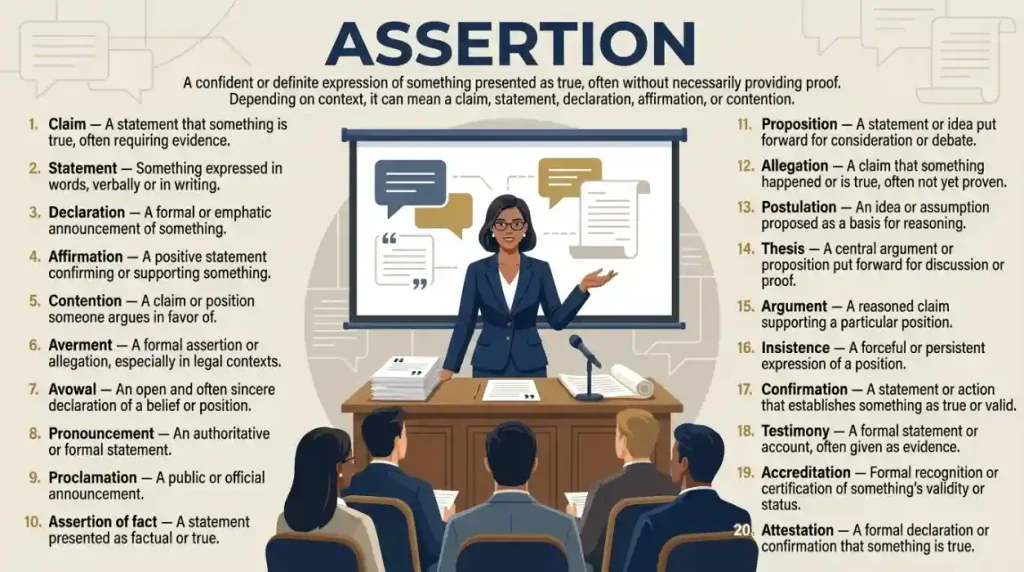
A synonym for assertion is a word or phrase that expresses a statement, claim, or confident expression of an idea. Common alternatives include claim, statement, declaration, affirmation, contention, and avowal. The best choice depends on the speaker’s confidence, purpose, and context.
Imagine writing an essay and using the word assertion several times. Your sentences may start to sound repetitive. Choosing a more precise alternative can make your writing clearer and more engaging.
For example, “She made an assertion about the results” could become “She made a claim about the results.” Both sentences communicate an idea, but the second sounds more natural in everyday English.
Learning a synonym for assertion helps you express ideas with greater accuracy. Students can improve essays, while bloggers and content writers can create more varied, readable articles.
The word assertion appears in academic discussions, workplace conversations, news reports, and everyday debates. Understanding its alternatives helps daily English users communicate with confidence.
What Does “Assertion” Really Mean?
An assertion is a statement that someone presents as true. It often expresses a belief, opinion, or position with confidence.
In simple English, an assertion is something a person says or writes as a fact or something they strongly believe.
For example:
- “His assertion was supported by the research.”
- “The manager made an assertion about the team’s progress.”
An assertion does not automatically mean that something is true. It describes how a person presents an idea, not whether the idea has been proven.
Part of Speech
Assertion is a noun.
It refers to the act of stating something confidently or to the statement itself.
Related forms include:
- Assert (verb): To state something confidently.
- Assertive (adjective): Confident and direct in expressing opinions or needs.
- Assertively (adverb): Confidently and directly.
- Assertiveness (noun): The quality of expressing yourself confidently.
Connotative Meaning of Assertion
(Connotation means the emotional feeling or association a word creates beyond its basic dictionary meaning.)
The word assertion is generally neutral. However, its emotional effect can change with the situation.
Positive tone: It can suggest confidence, clarity, determination, or strong communication.
Example: “Her assertion of independence inspired the team.”
Negative tone: It can suggest stubbornness, arrogance, or an unsupported claim.
Example: “His assertion sounded convincing, but he offered no evidence.”
Neutral tone: It can simply describe a statement or position.
Example: “The report examines the assertion made by the researcher.”
Etymology:
The word assertion comes through French from Latin assertio, meaning a declaration or act of asserting. It is connected to the Latin verb asserere, meaning to claim, affirm, or maintain.
Its history reflects the modern meaning: presenting an idea or position as true.
Old English (450–1100)
The word assertion was not part of Old English vocabulary. English speakers used other words and expressions to communicate statements, claims, and declarations.
Middle English (1100–1500)
The word entered English through French and Latin-influenced vocabulary. Its use developed around the expression of claims, declarations, and positions.
Modern English (1500–Present)
Over time, assertion became established in formal, philosophical, legal, and academic English. Today, it appears in essays, research, debates, business communication, and everyday discussions.

Pronunciation of Assertion
- US: /əˈsɝː.ʃən/
- UK: /əˈsɜː.ʃən/
Syllables
as-ser-tion
The word has three syllables. The main stress falls on the second syllable: SER.
Affixation Pattern of Assertion
- Root: Latin asserere (to claim or affirm), through the related noun assertio.
- Prefix: No productive English prefix.
- Suffix: -ion, forming a noun associated with an action, process, or result.
Synonyms List
The alternatives below cover the central meaning of assertion and closely related uses. Some are direct substitutes, while others suit particular situations, such as formal writing, debate, research, or reporting.
1. Claim (Noun) — US / UK: /kleɪm/ / /kleɪm/
Meaning: A statement that someone says is true, although it may still need proof.
Tone/Register: Neutral; everyday, academic, and professional.
Examples:
The journalist questioned the claim about rising employment.
Her claim attracted attention during the meeting.
2. Statement (Noun) — US / UK: /ˈsteɪt.mənt/ / /ˈsteɪt.mənt/
Meaning: Something expressed in speech or writing as information, an opinion, or a position.
Tone/Register: Neutral; widely used in speech and writing.
Examples:
The director released a statement after the announcement.
His statement explained the situation clearly.
3. Declaration (Noun) — US / UK: /ˌdek.ləˈreɪ.ʃən/ / /ˌdek.ləˈreɪ.ʃən/
Meaning: A clear and often formal announcement of an intention, belief, or position.
Tone/Register: Formal; official, legal, and public communication.
Examples:
The organization issued a declaration of support.
Her declaration ended the uncertainty.
4. Affirmation (Noun) — US / UK: /ˌæf.ɚˈmeɪ.ʃən/ / /ˌæf.əˈmeɪ.ʃən/
Meaning: A positive statement that confirms or strongly supports an idea.
Tone/Register: Positive; formal and personal development contexts.
Examples:
His affirmation of the team’s abilities boosted morale.
The letter served as an affirmation of their commitment.
5. Assertion (Noun) — US / UK: /əˈsɝː.ʃən/ / /əˈsɜː.ʃən/
Meaning: A confident statement that presents an idea as true.
Tone/Register: Neutral to formal; academic and professional.
Examples:
The professor challenged the central assertion.
Her assertion reflected years of experience.
6. Contention (Noun) — US / UK: /kənˈten.ʃən/ / /kənˈten.ʃən/
Meaning: An opinion or argument that someone maintains, especially in a disagreement.
Tone/Register: Formal; academic, legal, and argumentative.
Examples:
The author’s main contention concerns educational access.
I disagree with the contention that success depends only on luck.
7. Avowal (Noun) — US / UK: /əˈvaʊ.əl/ / /əˈvaʊ.əl/
Meaning: An open and sincere statement of a belief, feeling, or commitment.
Tone/Register: Formal; personal and literary.
Examples:
Her avowal of loyalty surprised everyone.
The speech included an honest avowal of regret.
8. Pronouncement (Noun) — US / UK: /prəˈnaʊns.mənt/ / /prəˈnaʊns.mənt/
Meaning: An official or authoritative statement about a subject.
Tone/Register: Formal; public, official, and sometimes authoritative.
Examples:
The judge’s pronouncement brought the hearing to a close.
The minister made a pronouncement about the new policy.
9. Proposition (Noun) — US / UK: /ˌprɑː.pəˈzɪʃ.ən/ / /ˌprɒp.əˈzɪʃ.ən/
Meaning: An idea or statement put forward for consideration, discussion, or acceptance.
Tone/Register: Formal; academic, logical, and professional.
Examples:
The researcher tested a proposition about human behavior.
Her proposition started a lively discussion.
10. Postulate (Noun) — US / UK: /ˈpɑː.stʃə.lət/ / /ˈpɒs.tjə.lət/
Meaning: An idea or principle presented as a basis for reasoning, often without initial proof.
Tone/Register: Academic; scientific and philosophical.
Examples:
The theory begins with a simple postulate.
Students examined the postulate during the seminar.
11. Allegation (Noun) — US / UK: /ˌæl.əˈɡeɪ.ʃən/ / /ˌæl.əˈɡeɪ.ʃən/
Meaning: A claim that someone has done something wrong, especially one that has not yet been proven.
Tone/Register: Serious; legal and journalistic.
Examples:
The company denied the allegation of misconduct.
The newspaper investigated the allegation carefully.
12. Accusation (Noun) — US / UK: /ˌæk.jəˈzeɪ.ʃən/ / /ˌæk.jʊˈzeɪ.ʃən/
Meaning: A statement that someone is responsible for a mistake, offense, or wrongdoing.
Tone/Register: Negative; personal, legal, and conversational.
Examples:
He rejected the accusation of dishonesty.
The accusation created tension between the colleagues.
13. Insistence (Noun) — US / UK: /ɪnˈsɪs.təns/ / /ɪnˈsɪs.təns/
Meaning: A firm statement or repeated demand that something is true or should happen.
Tone/Register: Neutral to forceful; everyday and professional.
Examples:
Her insistence that the figures were correct surprised the auditor.
Despite the delay, his insistence remained unchanged.
14. Conviction (Noun) — US / UK: /kənˈvɪk.ʃən/ / /kənˈvɪk.ʃən/
Meaning: A firmly held belief that someone expresses with confidence.
Tone/Register: Strong; personal, formal, and persuasive.
Examples:
She spoke with conviction about equal education.
His conviction gave the presentation greater impact.
15. Belief (Noun) — US / UK: /bɪˈliːf/ / /bɪˈliːf/
Meaning: An idea that someone accepts as true.
Tone/Register: Neutral; everyday, personal, and academic.
Examples:
Her belief in teamwork shaped her leadership style.
That belief influenced his final decision.
16. Opinion (Noun) — US / UK: /əˈpɪn.jən/ / /əˈpɪn.jən/
Meaning: A personal judgment or view about a subject.
Tone/Register: Neutral; conversational and professional.
Examples:
His opinion differed from the majority view.
I respect your opinion, even when we disagree.
17. Viewpoint (Noun) — US / UK: /ˈvjuː.pɔɪnt/ / /ˈvjuː.pɔɪnt/
Meaning: A particular way of thinking about or understanding an issue.
Tone/Register: Neutral; academic, conversational, and professional.
Examples:
The article presents a fresh viewpoint on remote work.
Her viewpoint helped us understand the problem.
18. Position (Noun) — US / UK: /pəˈzɪʃ.ən/ / /pəˈzɪʃ.ən/
Meaning: A person’s stated opinion or attitude toward a particular issue.
Tone/Register: Neutral to formal; business, politics, and debate.
Examples:
The company clarified its position on data privacy.
His position remained consistent throughout the discussion.
19. Stance (Noun) — US / UK: /stæns/ / /stæns/
Meaning: A clearly held attitude or position on a subject.
Tone/Register: Neutral to firm; public debate and professional writing.
Examples:
The candidate explained her stance on education.
His stance against discrimination was clear.
20. Thesis (Noun) — US / UK: /ˈθiː.sɪs/ / /ˈθiː.sɪs/
Meaning: A central idea or argument that a writer or speaker develops and supports.
Tone/Register: Academic; essays, research, and formal argument.
Examples:
The essay’s thesis challenges a common assumption.
She supported her thesis with reliable evidence.

21. Premise (Noun) — US / UK: /ˈprem.ɪs/ / /ˈprem.ɪs/
Meaning: A statement or assumption used as the starting point for an argument or explanation.
Tone/Register: Formal; logical and academic.
Examples:
The argument depends on a questionable premise.
We should examine the premise before accepting the conclusion.
22. Argument (Noun) — US / UK: /ˈɑːrɡ.jə.mənt/ / /ˈɑːɡ.jʊ.mənt/
Meaning: A reasoned statement or set of reasons supporting a particular position.
Tone/Register: Neutral to formal; debate and academic writing.
Examples:
Her argument was supported by recent studies.
The article presents a convincing argument for reform.
23. Assertion of Fact (Noun Phrase) — US / UK: /əˈsɝː.ʃən əv fækt/ / /əˈsɜː.ʃən əv fækt/
Meaning: A statement presented as objectively true rather than merely a personal opinion.
Tone/Register: Formal; legal, academic, and analytical.
Examples:
The witness made an assertion of fact during the hearing.
The report separates assertions of fact from personal judgments.
24. Claim of Truth (Noun Phrase) — US / UK: /kleɪm əv truːθ/ / /kleɪm əv truːθ/
Meaning: A statement that presents a particular idea as true.
Tone/Register: Neutral to formal; analytical and academic.
Examples:
The researcher questioned the claim of truth in the article.
Every claim of truth should be examined carefully.
25. Pronouncement of Belief (Noun Phrase) — US / UK: /prəˈnaʊns.mənt əv bɪˈliːf/ / /prəˈnaʊns.mənt əv bɪˈliːf/
Meaning: A clear statement expressing a person’s firmly held belief.
Tone/Register: Formal; public speaking and literary writing.
Examples:
His pronouncement of belief attracted public attention.
The speech included a powerful pronouncement of belief.
26. Confirmation (Noun) — US / UK: /ˌkɑːn.fɚˈmeɪ.ʃən/ / /ˌkɒn.fəˈmeɪ.ʃən/
Meaning: A statement or action that establishes that something is true or correct.
Tone/Register: Neutral; business and everyday communication.
Examples:
We received confirmation of the revised schedule.
Her response provided confirmation of the original statement.
27. Verification (Noun) — US / UK: /ˌver.ə.fəˈkeɪ.ʃən/ / /ˌver.ɪ.fɪˈkeɪ.ʃən/
Meaning: The process of checking whether a statement or claim is accurate.
Tone/Register: Formal; research, technical, and professional.
Examples:
The figures require independent verification.
The editor requested verification before publishing the claim.
28. Testimony (Noun) — US / UK: /ˈtes.tə.moʊ.ni/ / /ˈtes.tɪ.mə.ni/
Meaning: A formal statement given as evidence, especially in a legal setting.
Tone/Register: Formal; legal and official.
Examples:
Her testimony supported the timeline.
The court reviewed the witness’s testimony.
29. Deposition (Noun) — US / UK: /ˌdep.əˈzɪʃ.ən/ / /ˌdep.əˈzɪʃ.ən/
Meaning: A formal statement made under oath, usually outside court, for use in legal proceedings.
Tone/Register: Highly formal; legal.
Examples:
The lawyer reviewed the deposition before the trial.
His deposition clarified several details.
30. Attestation (Noun) — US / UK: /ˌæt.esˈteɪ.ʃən/ / /ˌæt.esˈteɪ.ʃən/
Meaning: A formal declaration or confirmation that something is true or genuine.
Tone/Register: Formal; legal, administrative, and official.
Examples:
The document included an attestation of authenticity.
Her attestation confirmed the identity of the applicant.
31. Testimonial (Noun) — US / UK: /ˌtes.təˈmoʊ.ni.əl/ / /ˌtes.tɪˈməʊ.ni.əl/
Meaning: A statement that describes or supports a person’s experience, character, or qualities.
Tone/Register: Neutral to positive; professional and personal.
Examples:
The client provided a testimonial about the service.
His testimonial highlighted the team’s dedication.
32. Endorsement (Noun) — US / UK: /ɪnˈdɔːrs.mənt/ / /ɪnˈdɔːs.mənt/
Meaning: A public statement of support or approval for a person, idea, or proposal.
Tone/Register: Positive; business, politics, and public communication.
Examples:
The proposal received an endorsement from local leaders.
Her endorsement strengthened the campaign.
33. Ratification (Noun) — US / UK: /ˌræt.ə.fəˈkeɪ.ʃən/ / /ˌræt.ɪ.fɪˈkeɪ.ʃən/
Meaning: Formal approval that makes an agreement or decision officially valid.
Tone/Register: Highly formal; legal, political, and institutional.
Examples:
The treaty required ratification by parliament.
The agreement became effective after ratification.
34. Confirmation of a Position (Noun Phrase) — US / UK: /ˌkɑːn.fɚˈmeɪ.ʃən əv ə pəˈzɪʃ.ən/ / /ˌkɒn.fəˈmeɪ.ʃən əv ə pəˈzɪʃ.ən/
Meaning: A statement that reinforces or repeats an already established opinion or stance.
Tone/Register: Neutral to formal; professional and diplomatic.
Examples:
The spokesperson issued a confirmation of the organization’s position.
Her email served as a confirmation of her earlier stance.
35. Proclamation (Noun) — US / UK: /ˌproʊ.kləˈmeɪ.ʃən/ / /ˌprɒk.ləˈmeɪ.ʃən/
Meaning: A public or official announcement that declares something.
Tone/Register: Formal; official, ceremonial, and historical.
Examples:
The mayor proclaimed public safety.
The proclamation announced a day of celebration.
36. Manifesto (Noun) — US / UK: /ˌmæn.əˈfes.toʊ/ / /ˌmæn.ɪˈfes.təʊ/
Meaning: A public statement explaining a person’s or group’s principles, aims, or plans.
Tone/Register: Formal; political, artistic, and organizational.
Examples:
The group published a manifesto outlining its goals.
Her manifesto called for meaningful educational change.
37. Dictum (Noun) — US / UK: /ˈdɪk.təm/ / /ˈdɪk.təm/
Meaning: A short, authoritative statement expressing a principle or general truth.
Tone/Register: Formal; literary, philosophical, and legal.
Examples:
The professor often repeated the dictum that evidence matters.
His famous dictum shaped the debate.
38. Maxim (Noun) — US / UK: /ˈmæk.sɪm/ / /ˈmæk.sɪm/
Meaning: A brief statement expressing a general rule, principle, or truth.
Tone/Register: Formal; philosophical and literary.
Examples:
The book opens with a familiar maxim about patience.
She followed the maxim that actions speak louder than words.
39. Axiom (Noun) — US / UK: /ˈæk.si.əm/ / /ˈæk.si.əm/
Meaning: A principle accepted as true or used as a foundation for reasoning.
Tone/Register: Academic; mathematics, logic, and philosophy.
Examples:
The proof begins with a basic axiom.
The lecturer questioned whether the axiom still applied.
40. Edict (Noun) — US / UK: /ˈiː.dɪkt/ / /ˈiː.dɪkt/
Meaning: An official order or command issued by someone with authority.
Tone/Register: Formal and authoritative; historical, political, and legal.
Examples:
The ruler issued an edict restricting public gatherings.
The new edict changed local regulations.

41. Decree (Noun) — US / UK: /dɪˈkriː/ / /dɪˈkriː/
Meaning: An official order or decision made by an authority.
Tone/Register: Formal; legal and governmental.
Examples:
The court issued a decree concerning the property.
The decree established new administrative rules.
42. Finding (Noun) — US / UK: /ˈfaɪn.dɪŋ/ / /ˈfaɪn.dɪŋ/
Meaning: A conclusion reached after examining evidence or conducting an investigation.
Tone/Register: Neutral to formal; academic, legal, and professional.
Examples:
The investigation produced an important finding.
The report’s findings challenged the original claim.
43. Conclusion (Noun) — US / UK: /kənˈkluː.ʒən/ / /kənˈkluː.ʒən/
Meaning: A judgment or decision reached after considering information or evidence.
Tone/Register: Neutral; academic, professional, and everyday.
Examples:
The evidence led us to a different conclusion.
Her conclusion was clear and well supported.
44. Observation (Noun) — US / UK: /ˌɑːb.zɚˈveɪ.ʃən/ / /ˌɒb.zəˈveɪ.ʃən/
Meaning: A comment or remark based on something someone has noticed.
Tone/Register: Neutral; academic and conversational.
Examples:
His observation about the results was helpful.
The teacher made an interesting observation during the lesson.
45. Remark (Noun) — US / UK: /rɪˈmɑːrk/ / /rɪˈmɑːk/
Meaning: A spoken or written comment about a person, event, or subject.
Tone/Register: Neutral; everyday and professional.
Examples:
Her remark started a thoughtful conversation.
I found his final remark especially useful.
46. Assertion of Authority (Noun Phrase) — US / UK: /əˈsɝː.ʃən əv əˈθɔːr.ə.ti/ / /əˈsɜː.ʃən əv ɔːˈθɒr.ə.ti/
Meaning: A statement or action that demonstrates someone’s authority or right to make decisions.
Tone/Register: Formal; leadership, institutional, and political.
Examples:
The announcement was an assertion of authority.
Her decision represented an assertion of authority within the department.
47. Affirmation of Fact (Noun Phrase) — US / UK: /ˌæf.ɚˈmeɪ.ʃən əv fækt/ / /ˌæf.əˈmeɪ.ʃən əv fækt/
Meaning: A statement that positively confirms something as factual.
Tone/Register: Formal; legal and analytical.
Examples:
The document contained an affirmation of fact.
The witness gave an affirmation of the key details.
48. Representation (Noun) — US / UK: /ˌrep.rɪ.zenˈteɪ.ʃən/ / /ˌrep.rɪ.zenˈteɪ.ʃən/
Meaning: A statement or account that describes something in a particular way.
Tone/Register: Formal; business, legal, and professional.
Examples:
The advertisement made a misleading representation of the product.
Her representation of the events differed from his account.
49. Assertion of Principle (Noun Phrase) — US / UK: /əˈsɝː.ʃən əv ˈprɪn.sə.pəl/ / /əˈsɜː.ʃən əv ˈprɪn.sə.pəl/
Meaning: A firm statement expressing commitment to a particular value or guiding belief.
Tone/Register: Formal; ethical, political, and public communication.
Examples:
The speech was an assertion of principle.
Their refusal became an assertion of principle rather than a personal dispute.
50. Declaration of Intent (Noun Phrase) — US / UK: /ˌdek.ləˈreɪ.ʃən əv ɪnˈtent/ / /ˌdek.ləˈreɪ.ʃən əv ɪnˈtent/
Meaning: A clear statement explaining what a person or organization plans or intends to do.
Tone/Register: Formal; business, legal, and personal communication.
Examples:
The proposal included a declaration of intent.
Her announcement served as a declaration of intent to lead the project.
Synonyms by Tone
The tone of a synonym affects how readers interpret your message. A neutral word can sound objective, while a forceful alternative may suggest confidence or disagreement.
Positive Synonyms
These words can communicate support, confidence, or commitment:
- Affirmation
- Avowal
- Conviction
- Endorsement
- Testimonial
- Confirmation
- Affirmation of fact
Example: “Her affirmation of the team’s abilities encouraged everyone.”
Neutral Synonyms
These alternatives describe a statement, opinion, or position without adding strong emotional judgment:
- Claim
- Statement
- Proposition
- Belief
- Opinion
- Viewpoint
- Position
- Remark
- Observation
- Representation
Example: “The report examines the claim in detail.”
Negative or Forceful Synonyms
These words can suggest disagreement, an unproven accusation, or an authoritative demand:
- Allegation
- Accusation
- Insistence
- Edict
- Decree
- Dictum
- Pronouncement
Example: “The allegation created concern among employees.”
Playful or Informal Alternatives
There is no widely accepted playful one-word synonym for assertion. In casual English, people often choose simpler expressions:
- Claim
- Opinion
- Point
- View
- Remark
Example: “That’s quite a claim. What makes you think so?”
Why Does Tone Matter?
A synonym may communicate more than the basic meaning of a word. For example, claim can sound neutral, while allegation suggests possible wrongdoing.
Choose a word that matches your intention. This makes your writing more accurate and helps readers understand your attitude.
“Assertion” vs. Close Alternatives
Some synonyms have similar meanings but are not interchangeable in every sentence.
| Word | Main difference | Best use |
|---|---|---|
| Assertion | A confident statement presented as true | Formal discussion and analysis |
| Claim | A statement presented as true, sometimes awaiting proof | Everyday and academic writing |
| Statement | A general expression of information or opinion | Broad, neutral communication |
| Declaration | A clear, often formal announcement | Official decisions and commitments |
Compare these examples:
- Assertion: “She asserted that the policy needed reform.” This emphasizes a confidently expressed position.
- Claim: “She claimed that the policy needed reform.” This can sound more open to questioning or verification.
- Statement: “Her statement explained why the policy needed reform.” This simply reports what she said.
- Declaration: “Her declaration announced support for policy reform.” This suggests a formal or deliberate announcement.
How Assertion Changes by Context
Daily Conversation
In everyday speech, claim, statement, and opinion often sound more natural than assertion.
For example, “That’s an interesting claim” is conversational. “That’s an interesting assertion” sounds more formal and analytical.
Writing and Blogging
Writers can use claim, contention, viewpoint, and argument to make their articles more varied.
Use claim when introducing an idea that needs support. Choose contention when discussing a position in a debate.
Professional or Academic Writing
Formal alternatives include proposition, thesis, premise, attestation, and affirmation.
Select the term that accurately describes the role of the statement. A thesis is a central argument, while a premise is a starting assumption.
Creative or Informal Use
In storytelling, words such as remark, avowal, pronouncement, and declaration can help establish a character’s personality.
A character who makes a quiet avowal may sound sincere. Someone who delivers a dramatic pronouncement may sound authoritative.
Common Mistakes Learners Make
1. Treating Every Claim as a Proven Fact
An assertion is not automatically true. It is a statement presented as true.
Incorrect assumption: “An assertion must be supported by evidence.”
Better understanding: An assertion may be supported, unsupported, or later disproved.
2. Using Allegation When You Mean Opinion
An allegation usually concerns an accusation of wrongdoing. It is not a general substitute for every opinion.
Less suitable: “My allegation is that this movie is interesting.”
Better: “My opinion is that this movie is interesting.”
3. Confusing a Statement With a Declaration
A statement can communicate almost any information. A declaration is usually more deliberate, formal, or significant.
Use a statement for general communication and a declaration for a clear announcement of a position or intention.
4. Using Formal Words in Casual Conversation
Words such as attestation, postulate, and proposition can sound unnatural in relaxed conversation.
Choose simple alternatives such as claim, point, or opinion when speaking with friends.
5. Repeating Assertion Too Often
Repeating one word can make an essay or article feel monotonous.
However, replacing every occurrence with a different synonym is not the solution. Repeat the original word when it is the clearest choice.
Register Notes: Formal vs. Informal English
Formal English: Use contention, proposition, attestation, thesis, or declaration when the situation requires precision or an academic tone.
Informal English: Use claim, opinion, point, or remark in everyday conversations.
Spoken English: Short, familiar words are usually easier to understand.
Written English: More specific alternatives can help explain the exact purpose of a statement.
For more vocabulary practice, explore related topics such as synonyms for opinion, claim, and statement.
Real-Life Examples
Workplace Scenario
A manager says, “Our customer service has improved this year.” This is an assertion. A colleague may ask for performance figures to support the claim.
Social Situation
A friend says, “I believe honesty is more important than popularity.” This is an expression of belief and personal conviction.
Media and News
A news report describes an allegation made against a public official. The journalist should distinguish the allegation from verified facts.
Writing and Storytelling
A novelist writes, “I will never abandon my principles.” The character’s declaration reveals determination and personal values.

Practice Exercise:
1. A student presents a central argument in an academic essay. Which word fits best?
A. Remark
B. Thesis
C. Edict
D. Accusation
2. A company publicly announces its support for a new policy. Which word is most suitable?
A. Endorsement
B. Allegation
C. Premise
D. Deposition
3. A journalist reports an unproven claim that someone committed misconduct. Which word should be used?
A. Maxim
B. Viewpoint
C. Allegation
D. Testimonial
4. A friend shares a personal judgment about a film. Which word sounds most natural?
A. Decree
B. Opinion
C. Attestation
D. Ratification
5. A witness gives a formal statement in court. Which term fits best?
A. Testimony
B. Remark
C. Maxim
D. Manifesto
6. A researcher starts an argument with an assumption. Which word describes that starting point?
A. Endorsement
B. Premise
C. Accusation
D. Proclamation
7. A government authority issues an official order. Which word is most accurate?
A. Viewpoint
B. Avowal
C. Edict
D. Observation
8. Someone firmly expresses a personal commitment. Which word is most suitable?
A. Avowal
B. Allegation
C. Finding
D. Deposition
9. A report gives a conclusion based on an investigation. Which word fits best?
A. Remark
B. Finding
C. Opinion
D. Insistence
10. A speaker publicly announces an intention to lead a project. Which phrase works best?
A. Claim of truth
B. Declaration of intent
C. Personal remark
D. Legal deposition
Reflection task:
Write one original sentence using contention, affirmation, or viewpoint. Then rewrite it using a different synonym without changing its main meaning.
Answer key: 1-B | 2-A | 3-C | 4-B | 5-A | 6-B | 7-C | 8-A | 9-B | 10-B
External Learning Sources
For further study of word meanings, pronunciation, and usage, consult these established references:
- Merriam-Webster Dictionary: https://www.merriam-webster.com/
- Cambridge Dictionary: https://dictionary.cambridge.org/
- Oxford Learner’s Dictionaries: https://www.oxfordlearnersdictionaries.com/
- Etymonline: https://www.etymonline.com/
These references can help readers check definitions, pronunciation, word history, and examples in context.
Conclusion:
Learning a synonym for assertion helps you express ideas clearly. Words such as claim, statement, and affirmation add variety while preserving your intended meaning.
A strong vocabulary also makes essays, blogs, and professional messages easier to read. The right word helps your audience understand your position without unnecessary repetition.
You do not need to memorize all alternatives at once. Start with a few familiar choices and notice how native speakers use them in real conversations.
Practice these words in emails, essays, and daily conversations. Write your own examples, compare their meanings, and keep exploring new vocabulary to communicate with confidence.
FAQs
1. What is the closest synonym for assertion in formal English?
The closest formal alternatives are claim, contention, affirmation, and declaration. The right choice depends on the sentence. Use contention for a position in an argument, affirmation for a positive confirmation, and declaration for a formal announcement.
2. What is a synonym for assertion in academic writing?
In academic writing, useful alternatives include claim, proposition, thesis, contention, and premise. Each has a different function. A thesis presents the central argument, while a premise provides a starting point for reasoning. Choose the word that describes your idea accurately.
3. What is the difference between an assertion and an assumption?
An assertion is a statement presented as true. An assumption is something accepted as true without necessarily having proof. For example, saying “The results have improved” is an assertion. Believing that the results will improve without evidence is an assumption.
4. Is an assertion always a fact?
No. An assertion is not automatically a verified fact. It is a statement that someone presents as true. It may be accurate, inaccurate, supported by evidence, or unsupported. In research and journalism, it is important to distinguish an assertion from an established finding.
5. What is the opposite of assertion?
There is no single perfect antonym for assertion in every context. Depending on the meaning, possible opposites include denial, retraction, withdrawal, and disavowal. For example, a denial rejects a claim, while a retraction withdraws a previously published statement.

Hasnain Ali is an SEO Content Strategist and the founder of wordvora.com, a trusted vocabulary platform that helps writers, students, professionals, and English learners find accurate synonyms, antonyms, word meanings, and real-life usage examples. He specializes in keyword research, on-page SEO, topical authority, and creating search-first content that aligns with Google’s latest Search Quality and E-E-A-T guidelines. His work focuses on producing clear, well-structured, and reader-friendly resources that satisfy search intent while maintaining high editorial standards.
Through extensive hands-on experience with SEO tools such as Google Search Console, Google Analytics, SEMrush, and Ahrefs, Hasnain researches user search behavior and develops content that is both informative and easy to understand. Every article published on wordvora.com is carefully reviewed for accuracy, readability, and contextual relevance before publication. His mission is to build one of the web’s most reliable English vocabulary resources by providing practical language guidance, trustworthy explanations, and content that helps readers improve their writing, communication, and vocabulary with confidence.