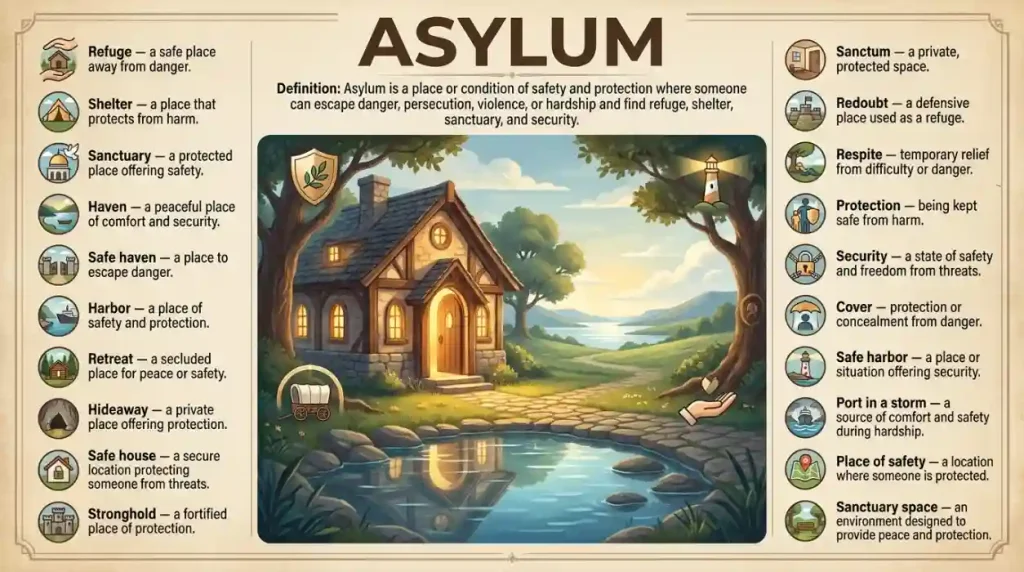
A synonym for asylum depends on the context. Common alternatives include refuge, sanctuary, shelter, haven, and safe haven. In legal contexts, protection or political protection may fit. For a historical psychiatric institution, different terms such as mental hospital apply.
Imagine someone escaping danger and searching for a safe place. You might describe that place as a refuge, sanctuary, or haven. Each word communicates safety, but each carries a slightly different meaning.
The word asylum commonly appears in discussions about immigration, human rights, safety, and history. Understanding its different meanings helps you choose an accurate alternative.
Learning a synonym for asylum can improve essays, articles, and everyday conversations. Students, bloggers, content writers, and English learners can all benefit from a wider vocabulary.
What Does “Asylum” Really Mean?
Asylum is a noun with two important meanings. First, it refers to protection or safety given to someone escaping danger, persecution, or serious harm. Second, it historically refers to an institution for people receiving psychiatric care.
In modern English, the word most often appears in discussions about refugees, immigration, and human rights.
For example:
- “The family sought asylum in another country.” This means they requested protection from danger or persecution.
- “The old asylum closed several decades ago.” In this historical context, the word refers to a psychiatric institution.
Native English speakers usually understand the intended meaning from the surrounding sentence. The topic helps them distinguish legal protection from a medical institution.
Part of Speech
Asylum is a noun.
It refers to protection from danger or persecution, or to an institution that historically provided care for people with mental health conditions.
Common related forms and expressions include:
- Seek asylum: Request protection in another country.
- Grant asylum: Officially provide protection to someone.
- Asylum seeker: A person who has requested protection and is waiting for a decision.
- Political asylum: Protection requested because of political persecution.
- Asylum system: The legal process used to assess protection claims.
Connotative Meaning of Asylum
(Connotation means the emotional feeling or association a word creates beyond its basic dictionary meaning.)
The emotional tone of asylum depends on its context. In modern discussions, it often connects with safety, human rights, displacement, and the need for protection.
Positive tone: It can suggest hope, safety, compassion, and a fresh start.
Example: “The country offered asylum to families escaping persecution.”
Negative tone: In historical contexts, it may bring associations with confinement, neglect, or poor treatment in institutions.
Example: “The abandoned asylum had a troubling history.”
Neutral tone: It can describe a legal protection process or a historical institution without expressing approval or criticism.
Example: “The report explains how the asylum system works.”
Etymology:
The word asylum comes from Latin asylum, which came from the ancient Greek word asylon. The Greek term referred to a place that could not be seized or violated. It was associated with a protected or inviolable sanctuary.
The original idea of safety remains central to the modern meaning. Over time, the word developed a connection with protection for people escaping persecution.
Old English (450–1100)
The word asylum was not part of established Old English vocabulary. English speakers used other words and expressions for safety, refuge, and places of protection.
Middle English (1100–1500)
The word entered English during the late Middle English period through Latin and French influence. Its early use referred to a place of refuge or sanctuary.
Modern English (1500–Present)
The word became established in English with meanings connected to sanctuary and protection. Later, it also became associated with institutions providing care for people with mental health conditions.
Today, asylum is especially important in immigration law and international discussions about the protection of displaced people.

Pronunciation of Asylum
- US: /əˈsaɪ.ləm/
- UK: /əˈsaɪ.ləm/
Syllables
a-sy-lum
The word has three syllables. The main stress falls on the second syllable: SY.
Affixation Pattern of Asylum
- Root: Greek asylon, meaning a place of refuge or sanctuary.
- Prefix: No productive English prefix.
- Suffix: No productive English suffix.
The word entered English as a complete noun. Its modern forms include asylum seeker and asylum-seeking, which are formed by combining it with other words.
Synonyms List
The following list covers the main meanings of asylum: a place of safety, legal protection from persecution, and a psychiatric institution in historical or specialized contexts.
Some entries are direct synonyms. Others are related expressions that fit only particular situations. This distinction matters because legal asylum, ordinary shelter, and psychiatric care are not exactly the same thing.
1. Refuge (Noun) — US / UK: /ˈref.juːdʒ/ / /ˈref.juːdʒ/
Meaning: A safe place or condition that protects someone from danger, harm, or difficulty.
Tone/Register: Neutral; everyday, literary, and formal.
Examples:
The family found refuge in a neighboring country.
The library became a quiet refuge from the busy city.
2. Sanctuary (Noun) — US / UK: /ˈsæŋk.tʃu.er.i/ / /ˈsæŋk.tʃu.ə.ri/
Meaning: A protected place where someone can find safety or peace.
Tone/Register: Positive; formal, spiritual, and literary.
Examples:
The shelter offered sanctuary to people fleeing violence.
She considered the garden her personal sanctuary.
3. Shelter (Noun) — US / UK: /ˈʃel.tɚ/ / /ˈʃel.tə/
Meaning: A place that provides protection from danger, weather, or difficult conditions.
Tone/Register: Neutral; everyday and humanitarian.
Examples:
The volunteers opened a shelter for displaced families.
They searched for shelter before the storm arrived.
4. Haven (Noun) — US / UK: /ˈheɪ.vən/ / /ˈheɪ.vən/
Meaning: A peaceful or secure place where someone feels protected.
Tone/Register: Positive; descriptive and literary.
Examples:
The small village became a haven for the travelers.
Her home was a haven during a stressful period.
5. Safe Haven (Noun Phrase) — US / UK: /ˌseɪf ˈheɪ.vən/ / /ˌseɪf ˈheɪ.vən/
Meaning: A place where people can escape danger and feel secure.
Tone/Register: Positive; humanitarian, journalistic, and everyday.
Examples:
The center provided a safe haven for vulnerable children.
The country became a safe haven for families escaping conflict.
6. Place of Refuge (Noun Phrase) — US / UK: /ˌpleɪs əv ˈref.juːdʒ/ / /ˌpleɪs əv ˈref.juːdʒ/
Meaning: A location where someone can find protection from danger or persecution.
Tone/Register: Formal; legal and humanitarian.
Examples:
The island served as a place of refuge for sailors.
The organization searched for a place of refuge for the family.
7. Place of Safety (Noun Phrase) — US / UK: /ˌpleɪs əv ˈseɪf.ti/ / /ˌpleɪs əv ˈseɪf.ti/
Meaning: A location where someone is protected from immediate harm.
Tone/Register: Neutral to formal; emergency and humanitarian contexts.
Examples:
Rescue workers brought the passengers to a place of safety.
The children needed a place of safety after the evacuation.
8. Protection (Noun) — US / UK: /prəˈtek.ʃən/ / /prəˈtek.ʃən/
Meaning: The act or condition of keeping someone safe from harm or persecution.
Tone/Register: Neutral; legal, professional, and everyday.
Examples:
The family requested protection from the authorities.
The law provides protection for vulnerable individuals.
9. Safe Shelter (Noun Phrase) — US / UK: /ˌseɪf ˈʃel.tɚ/ / /ˌseɪf ˈʃel.tə/
Meaning: Accommodation that protects people from danger or threatening conditions.
Tone/Register: Neutral; humanitarian and everyday.
Examples:
The community arranged safe shelter for the visitors.
Every family deserves access to safe shelter.
10. Retreat (Noun) — US / UK: /rɪˈtriːt/ / /rɪˈtriːt/
Meaning: A quiet or protected place where someone can withdraw from pressure or danger.
Tone/Register: Neutral to positive; everyday and literary.
Examples:
The mountain cabin became a peaceful retreat.
He viewed the countryside as a retreat from city life.
11. Hideaway (Noun) — US / UK: /ˈhaɪd.ə.weɪ/ / /ˈhaɪd.ə.weɪ/
Meaning: A secluded place where someone can stay away from attention or danger.
Tone/Register: Informal; conversational and literary.
Examples:
They discovered a quiet hideaway near the coast.
The character escaped to a remote hideaway.
12. Hiding Place (Noun Phrase) — US / UK: /ˈhaɪ.dɪŋ ˌpleɪs/ / /ˈhaɪ.dɪŋ ˌpleɪs/
Meaning: A concealed location where someone can remain safe from people searching for them.
Tone/Register: Neutral; everyday and narrative.
Examples:
The family found a hiding place during the attack.
The detective discovered the criminal’s hiding place.
13. Safe House (Noun) — US / UK: /ˈseɪf ˌhaʊs/ / /ˈseɪf ˌhaʊs/
Meaning: A secure location used to protect people whose safety may be at risk.
Tone/Register: Neutral; security, humanitarian, and crime-related contexts.
Examples:
The organization arranged a safe house for the witness.
The journalist stayed in a safe house during the investigation.
14. Sanctuary City (Noun Phrase) — US / UK: /ˈsæŋk.tʃu.er.i ˌsɪt.i/ / /ˈsæŋk.tʃu.ə.ri ˌsɪt.i/
Meaning: A city that adopts policies intended to limit certain forms of cooperation with immigration enforcement and support immigrant communities.
Tone/Register: Political and legal; contemporary public discussion.
Examples:
The article examined the policies of a sanctuary city.
Residents debated how the city should support immigrant families.
15. Haven of Safety (Noun Phrase) — US / UK: /ˈheɪ.vən əv ˈseɪf.ti/ / /ˈheɪ.vən əv ˈseɪf.ti/
Meaning: A place that offers protection, security, and relief from danger.
Tone/Register: Positive; literary and descriptive.
Examples:
The center became a haven of safety for the children.
The peaceful settlement offered a haven of safety to newcomers.
16. Sanctuary Place (Noun Phrase) — US / UK: /ˈsæŋk.tʃu.er.i ˌpleɪs/ / /ˈsæŋk.tʃu.ə.ri ˌpleɪs/
Meaning: A location regarded as protected, peaceful, or free from outside threats.
Tone/Register: Descriptive; literary and informal.
Examples:
The old chapel remained a sanctuary place for local residents.
They hoped to create a sanctuary place for injured animals.
17. Protection Status (Noun Phrase) — US / UK: /prəˈtek.ʃən ˌsteɪ.təs/ / /prəˈtek.ʃən ˌsteɪ.təs/
Meaning: An official legal status that allows an eligible person to receive protection in a country.
Tone/Register: Formal; immigration and legal contexts.
Examples:
She applied for protection status after leaving her homeland.
The authorities reviewed his protection status.
18. International Protection (Noun Phrase) — US / UK: /ˌɪn.tɚˈnæʃ.ən.əl prəˈtek.ʃən/ / /ˌɪn.təˈnæʃ.ən.əl prəˈtek.ʃən/
Meaning: Protection provided under international or national legal frameworks to people who cannot safely return home.
Tone/Register: Formal; humanitarian and legal.
Examples:
The organization helps displaced people seek international protection.
The report explains the principles of international protection.
19. Humanitarian Protection (Noun Phrase) — US / UK: /hjuːˌmæn.əˈter.i.ən prəˈtek.ʃən/ / /hjuːˌmæn.ɪˈteə.ri.ən prəˈtek.ʃən/
Meaning: Protection granted on humanitarian grounds when returning someone to their home country could expose them to serious harm.
Tone/Register: Formal; immigration and human rights.
Examples:
The family received humanitarian protection.
The case raised questions about humanitarian protection policies.
20. Political Protection (Noun Phrase) — US / UK: /pəˈlɪt̬.ɪ.kəl prəˈtek.ʃən/ / /pəˈlɪt.ɪ.kəl prəˈtek.ʃən/
Meaning: Safety provided to someone facing danger because of their political beliefs or activities.
Tone/Register: Formal; political and legal.
Examples:
The activist requested political protection abroad.
The government discussed options for political protection.

21. Refuge Status (Noun Phrase) — US / UK: /ˈref.juːdʒ ˌsteɪ.təs/ / /ˈref.juːdʒ ˌsteɪ.təs/
Meaning: A recognized status as a person who has fled serious danger and qualifies for refugee protection.
Tone/Register: Formal; legal and humanitarian.
Examples:
The applicant waited for a decision on refugee status.
Her refugee status allowed her to access certain services.
22. Asylum Status (Noun Phrase) — US / UK: /əˈsaɪ.ləm ˌsteɪ.təs/ / /əˈsaɪ.ləm ˌsteɪ.təs/
Meaning: An official legal status granted to a person who qualifies for asylum protection.
Tone/Register: Formal; immigration and legal.
Examples:
He received asylum status after a lengthy review.
The lawyer explained the rights connected with asylum status.
23. Right of Sanctuary (Noun Phrase) — US / UK: /ˌraɪt əv ˈsæŋk.tʃu.er.i/ / /ˌraɪt əv ˈsæŋk.tʃu.ə.ri/
Meaning: A recognized right or tradition allowing someone to seek safety in a protected place.
Tone/Register: Formal; historical and legal.
Examples:
The historian studied the medieval right of sanctuary.
The discussion explored the origins of sanctuary rights.
24. Protection from Persecution (Noun Phrase) — US / UK: /prəˈtek.ʃən frəm ˌpɝː.sɪˈkjuː.ʃən/ / /prəˈtek.ʃən frəm ˌpɜː.sɪˈkjuː.ʃən/
Meaning: Safety from serious harm or unfair treatment because of a person’s identity, beliefs, or membership in a particular group.
Tone/Register: Formal; human rights and legal writing.
Examples:
The applicant sought protection from persecution.
The law recognizes the need for protection from persecution in qualifying cases.
25. Political Asylum (Noun Phrase) — US / UK: /pəˈlɪt̬.ɪ.kəl əˈsaɪ.ləm/ / /pəˈlɪt.ɪ.kəl əˈsaɪ.ləm/
Meaning: Asylum sought by someone who fears persecution because of political opinions or activities.
Tone/Register: Formal; immigration and political discussion.
Examples:
The journalist applied for political asylum overseas.
The documentary explored the history of political asylum.
26. Sanctuary State (Noun Phrase) — US / UK: /ˈsæŋk.tʃu.er.i steɪt/ / /ˈsæŋk.tʃu.ə.ri steɪt/
Meaning: A state that adopts policies intended to limit certain cooperation with federal immigration enforcement.
Tone/Register: Political and legal; mainly used in the United States.
Examples:
The debate focused on the role of a sanctuary state.
The policy was discussed during the state election.
27. Protection Mechanism (Noun Phrase) — US / UK: /prəˈtek.ʃən ˌmek.əˌnɪz.əm/ / /prəˈtek.ʃən ˌmek.əˌnɪz.əm/
Meaning: A legal or practical system designed to keep vulnerable people safe.
Tone/Register: Formal; policy and humanitarian contexts.
Examples:
The agency developed a protection mechanism for vulnerable families.
The report evaluated the existing protection mechanisms.
28. Safe Passage (Noun Phrase) — US / UK: /ˌseɪf ˈpæs.ɪdʒ/ / /ˌseɪf ˈpæs.ɪdʒ/
Meaning: Permission or an arrangement allowing someone to travel through a dangerous area without being harmed.
Tone/Register: Neutral to formal; diplomatic and humanitarian.
Examples:
The families requested safe passage across the border.
The agreement provided safe passage for civilians.
29. Place of Sanctuary (Noun Phrase) — US / UK: /ˌpleɪs əv ˈsæŋk.tʃu.er.i/ / /ˌpleɪs əv ˈsæŋk.tʃu.ə.ri/
Meaning: A protected location where people can escape danger or find peace.
Tone/Register: Positive; formal and literary.
Examples:
The monastery became a place of sanctuary.
The community hoped to build a place of sanctuary for displaced people.
30. Asylum Protection (Noun Phrase) — US / UK: /əˈsaɪ.ləm prəˈtek.ʃən/ / /əˈsaɪ.ləm prəˈtek.ʃən/
Meaning: Legal protection offered to someone who qualifies for asylum.
Tone/Register: Formal; legal and humanitarian.
Examples:
The application explained why the family needed asylum protection.
The decision confirmed the applicant’s eligibility for asylum protection.
31. Psychiatric Hospital (Noun) — US / UK: /ˌsaɪ.kiˈæt.rɪk ˈhɑː.spɪ.t̬əl/ / /ˌsaɪ.kiˈæt.rɪk ˈhɒs.pɪ.təl/
Meaning: A hospital that provides specialized assessment and treatment for mental health conditions.
Tone/Register: Neutral; medical and professional.
Examples:
The patient received treatment at a psychiatric hospital.
The city plans to expand its psychiatric hospital services.
32. Mental Hospital (Noun) — US / UK: /ˈmen.t̬əl ˌhɑː.spɪ.t̬əl/ / /ˈmen.təl ˌhɒs.pɪ.təl/
Meaning: A hospital providing care for people with mental health conditions; the term can sound dated in some contexts.
Tone/Register: Neutral to dated; medical and historical.
Examples:
The documentary examined the history of the mental hospital.
The institution was later replaced by modern community services.
33. Psychiatric Institution (Noun Phrase) — US / UK: /ˌsaɪ.kiˈæt.rɪk ˌɪn.stəˈtuː.ʃən/ / /ˌsaɪ.kiˈæt.rɪk ˌɪn.stɪˈtjuː.ʃən/
Meaning: An organization or facility that provides specialized psychiatric care.
Tone/Register: Formal; medical, academic, and historical.
Examples:
The researcher studied the development of psychiatric institutions.
The psychiatric institution introduced a new treatment program.
34. Mental Health Facility (Noun Phrase) — US / UK: /ˈmen.t̬əl helθ fəˌsɪl.ə.t̬i/ / /ˈmen.təl helθ fəˌsɪl.ɪ.ti/
Meaning: A facility that provides assessment, treatment, or support for people experiencing mental health difficulties.
Tone/Register: Neutral; modern medical and professional.
Examples:
The patient was referred to a mental health facility.
The new mental health facility offers several forms of support.
35. Treatment Center (Noun) — US / UK: /ˈtriːt.mənt ˌsen.t̬ɚ/ / /ˈtriːt.mənt ˌsen.tə/
Meaning: A place where people receive professional care for a medical or psychological condition.
Tone/Register: Neutral; medical and professional.
Examples:
She received specialist care at a treatment center.
The treatment center offers support for people in crisis.
36. Residential Treatment Facility (Noun Phrase) — US / UK: /ˌrez.əˈden.ʃəl ˈtriːt.mənt fəˌsɪl.ə.t̬i/ / /ˌrez.ɪˈden.ʃəl ˈtriːt.mənt fəˌsɪl.ɪ.ti/
Meaning: A facility where people live temporarily while receiving structured medical or psychological treatment.
Tone/Register: Formal; medical and professional.
Examples:
The patient entered a residential treatment facility for additional support.
The facility provides structured care in a residential setting.
37. Psychiatric Care Facility (Noun Phrase) — US / UK: /ˌsaɪ.kiˈæt.rɪk ˈker fəˌsɪl.ə.t̬i/ / /ˌsaɪ.kiˈæt.rɪk ˈkeə fəˌsɪl.ɪ.ti/
Meaning: A location that provides professional care for people with psychiatric conditions.
Tone/Register: Formal; healthcare and institutional writing.
Examples:
The patient was transferred to a psychiatric care facility.
The region needs more psychiatric care facilities.
38. Mental Institution (Noun Phrase) — US / UK: /ˈmen.t̬əl ˌɪn.stəˈtuː.ʃən/ / /ˈmen.təl ˌɪn.stɪˈtjuː.ʃən/
Meaning: An institution historically or formally associated with long-term care for people with mental health conditions.
Tone/Register: Historical or dated; formal discussion.
Examples:
The novel describes life inside a mental institution.
The old mental institution closed after major reforms.
39. Psychiatric Clinic (Noun Phrase) — US / UK: /ˌsaɪ.kiˈæt.rɪk ˈklɪn.ɪk/ / /ˌsaɪ.kiˈæt.rɪk ˈklɪn.ɪk/
Meaning: A medical facility where people receive psychiatric assessment, treatment, or follow-up care.
Tone/Register: Neutral; medical and professional.
Examples:
He arranged an appointment at a psychiatric clinic.
The psychiatric clinic provides outpatient services.
40. Mental Health Institution (Noun Phrase) — US / UK: /ˈmen.t̬əl helθ ˌɪn.stəˈtuː.ʃən/ / /ˈmen.təl helθ ˌɪn.stɪˈtjuː.ʃən/
Meaning: An organization or facility dedicated to providing mental health services and care.
Tone/Register: Formal; healthcare and academic.
Examples:
The study examined the role of mental health institutions.
The institution introduced new standards of patient care.

41. Infirmary (Noun) — US / UK: /ɪnˈfɝː.mer.i/ / /ɪnˈfɜː.mə.ri/
Meaning: A place providing medical care, especially in an institution, school, or military setting.
Tone/Register: Formal or historical; medical and institutional.
Examples:
The historic building once housed an infirmary.
The injured worker was taken to the factory infirmary.
42. Hospital (Noun) — US / UK: /ˈhɑː.spɪ. təl///ˈhɒs.pɪ.təl/t̬əl/ / /ˈhɒs.pɪ.təl/
Meaning: A medical institution where people receive diagnosis, treatment, and care.
Tone/Register: Neutral; everyday and medical.
Examples:
The patient was admitted to the hospital overnight.
The hospital opened a new specialist department.
43. Care Institution (Noun Phrase) — US / UK: /ˈker ˌɪn.stəˈtuː.ʃən/ / /ˈkeə ˌɪn.stɪˈtjuː.ʃən/
Meaning: An organization that provides ongoing care and support to people who need assistance.
Tone/Register: Formal; social care and institutional contexts.
Examples:
The report reviewed the standards at the care institution.
The care institution supports residents with complex needs.
44. Residential Care Facility (Noun Phrase) — US / UK: /ˌrez.əˈden.ʃəl ˈker fəˌsɪl.ə.t̬i/ / /ˌrez.ɪˈden.ʃəl ˈkeə fəˌsɪl.ɪ.ti/
Meaning: A place where people live while receiving ongoing personal, social, or medical support.
Tone/Register: Neutral to formal; healthcare and social care.
Examples:
Her grandfather moved into a residential care facility.
The facility provides daily assistance to its residents.
45. Sanatorium (Noun) — US / UK: /ˌsæn.əˈtɔːr.i.əm/ / /ˌsæn.əˈtɔː.ri.əm/
Meaning: A medical institution historically used for people needing long-term treatment, especially for tuberculosis.
Tone/Register: Historical; medical and literary.
Examples:
The abandoned sanatorium stood on the hillside.
The novel is set in a remote sanatorium.
46. Clinic (Noun) — US / UK: /ˈklɪn.ɪk/ / /ˈklɪn.ɪk/
Meaning: A medical center where people receive examination, treatment, or professional health advice.
Tone/Register: Neutral; everyday and medical.
Examples:
The patient visited a clinic for an assessment.
The clinic offers specialist mental health appointments.
47. Institution (Noun) — US / UK: /ˌɪn.stəˈtuː.ʃən/ / /ˌɪn.stɪˈtjuː.ʃən/
Meaning: An established organization or facility that provides a particular service, including residential care.
Tone/Register: Formal; academic and institutional.
Examples:
The historic institution closed after years of public debate.
The researcher studied how the institution treated its residents.
48. Residential Psychiatric Center (Noun Phrase) — US / UK: /ˌrez.əˈden.ʃəl ˌsaɪ.kiˈæt.rɪk ˈsen.t̬ɚ/ / /ˌrez.ɪˈden.ʃəl ˌsaɪ.kiˈæt.rɪk ˈsen.tə/
Meaning: A residential facility providing specialized psychiatric assessment and treatment.
Tone/Register: Formal; healthcare and professional writing.
Examples:
The family discussed the residential psychiatric center with the care team.
The center provides structured support for its residents.
49. Startling Asylum (Noun Phrase) — US / UK: /ˈluː.nə.tɪk əˈsaɪ.ləm/ / /ˈluː.nə.tɪk əˈsaɪ.ləm/
Meaning: A historical term for an institution that housed people with mental health conditions.
Tone/Register: Historical and offensive or stigmatizing in modern use.
Examples:
The museum displayed records from a nineteenth-century asylum.
The historian explained why the term is now considered outdated.
50. Madhouse (Noun) — US / UK: /ˈmæd.haʊs/ / /ˈmæd.haʊs/
Meaning: An informal and often offensive historical term for a psychiatric institution; it can also describe a chaotic place figuratively.
Tone/Register: Informal, dated, and potentially offensive.
Examples:
The old novel describes a character being sent to a madhouse.
The office felt like a madhouse during the final deadline.
Synonyms by Tone
The best alternative depends on the meaning you want to communicate. A word that works in a humanitarian report may sound unsuitable in a casual conversation.
Positive Synonyms
These words emphasize safety, relief, and protection:
- Refuge
- Sanctuary
- Haven
- Safe haven
- Place of refuge
- Place of safety
- Safe shelter
- Haven of safety
- Place of sanctuary
- Retreat
Example: “The community center became a safe haven for displaced families.”
Neutral Synonyms
These terms describe legal protection or a place that provides care:
- Shelter
- Protection
- Safe house
- Protection status
- International protection
- Humanitarian protection
- Refuge status
- Asylum status
- Psychiatric hospital
- Mental health facility
- Treatment center
- Psychiatric clinic
Example: “The applicant requested international protection.”
Negative or Historically Sensitive Alternatives
These words may suggest confinement, outdated treatment, or stigma:
- Mental institution
- Mental hospital
- Madhouse
Use historical terms only when the context requires them. Some expressions are now considered offensive because they reduce people to a diagnosis or reinforce harmful stereotypes.
Playful or Informal Alternatives
For ordinary conversation, words such as hideaway, retreat, and hideout may describe a private place to escape from stress.
Example: “That little cabin is my weekend hideaway.”
These words do not mean legal asylum. They simply describe a place where someone can relax or stay away from attention.
Why Does Tone Matter?
Words carry social and emotional meaning. Sanctuary sounds welcoming, while madhouse can sound insulting. Psychiatric hospital is generally more respectful and accurate than outdated institutional labels.
Choose alternatives that suit the subject and respect the people being described.
“Asylum” vs. Close Alternatives
Some words have overlapping meanings but differ in legal or emotional significance.
| Word | Meaning difference | Tone | When to use it |
|---|---|---|---|
| Asylum | Legal protection for someone who qualifies under relevant rules | Formal and legal | Immigration and human rights |
| Refuge | A place or condition offering safety | Neutral | General safety and escape |
| Sanctuary | A protected place associated with safety or peace | Positive | Humanitarian, religious, and literary contexts |
| Shelter | A place that protects people from immediate danger or exposure | Neutral | Emergency accommodation |
| Haven | A secure or peaceful place | Positive | Descriptive and everyday writing |
Compare these examples:
- Asylum: “The family applied for asylum.” This refers to a legal request for protection.
- Refuge: “The family found refuge across the border.” This emphasizes reaching safety.
- Sanctuary: “The community offered sanctuary to the family.” This emphasizes a protected place or welcome.
- Shelter: “The family stayed in a temporary shelter.” This emphasizes accommodation and immediate safety.
Remember that receiving shelter or finding refuge does not automatically mean someone has been granted legal asylum.
How “Asylum” Changes by Context
Daily Conversation
In everyday English, refuge, shelter, haven, and safe place are usually easier to understand than asylum.
For example, “My home is a haven after a busy day” uses the word figuratively. It describes comfort rather than legal protection.
Writing and Blogging
In articles and blog posts, choose sanctuary, refuge, or safe haven when discussing a place of protection.
Use asylum seeker, international protection, or asylum status when discussing immigration. These expressions carry specific meanings and should not be replaced carelessly.
Professional or Academic Tone
Formal writing may use humanitarian protection, psychiatric institution, mental health facility, or protection status.
For legal topics, check the exact terminology used by the relevant country. Immigration laws and definitions can differ between jurisdictions.
Creative or Informal Use
In fiction, haven, hideaway, sanctuary, and retreat can create a particular atmosphere.
A character might escape to a secluded haven or find sanctuary in an old building. These choices can make a scene feel peaceful, mysterious, or emotionally powerful.
Common Mistakes Learners Make
1. Treating Refuge and Asylum as Identical
Both words relate to safety, but they do not always mean the same thing.
Refuge can describe any safe place. Asylum often refers to a formal request for protection from persecution.
2. Using Shelter as a Legal Synonym
A shelter provides a place to stay. It does not automatically provide immigration protection or legal status.
Less accurate: “The family received asylum when they entered a shelter.”
Better: “The family received temporary shelter while their asylum application was reviewed.”
3. Confusing an Asylum Seeker With a Refugee
An asylum seeker has requested protection and is awaiting a decision. A refugee is someone who meets the applicable refugee definition.
The terms are related, but they are not interchangeable in every legal context.
4. Using Historical Psychiatric Terms in Modern Writing
Words such as startling, asylum, and madhouse may appear in historical documents or fiction. They can sound offensive when used to describe modern mental health services.
Prefer psychiatric hospital or mental health facility when discussing present-day care.
5. Assuming Every Safe Place Is a Sanctuary
A sanctuary often suggests special protection or a place of peace. A shelter may simply provide temporary accommodation.
Choose the word that reflects the actual purpose of the place.
Register Notes: Formal vs. Informal English
Formal English: Use international protection, humanitarian protection, refuge, or psychiatric institution in legal, academic, and professional writing.
Informal English: Use safe place, haven, hideaway, or shelter in ordinary conversations.
Spoken English: Simple expressions such as “a safe place” are often clearer than technical legal terms.
Written English: More specific terms help distinguish legal protection, emergency accommodation, and medical care.
For additional vocabulary practice, explore related topics such as synonyms for refuge, sanctuary, and shelter.
Real-Life Examples
Workplace Scenario
An employee escaping a serious threat in their home country asks about legal protection. A human resources officer directs them to an appropriate immigration support organization. The relevant term is asylum, not simply shelter.
Social Situation
A family leaves an unsafe area and stays with relatives. Their relatives provide a haven or safe place while they decide what to do next.
Media and News
A news report explains that a person has applied for asylum. The journalist should distinguish the application from an official decision granting protection.
Writing and Storytelling
A novelist describes an old building as a sanctuary where a character finds peace. The word creates a sense of safety and emotional relief.

Practice Exercise
1. A family escapes persecution and requests legal protection in another country. Which term is most accurate?
A. Retreat
B. Asylum
C. Hideaway
D. Infirmary
2. A quiet garden gives someone relief from a stressful routine. Which word fits best?
A. Decree
B. Sanctuary
C. Institution
D. Allegation
3. People need temporary accommodation after a flood. Which word is most suitable?
A. Shelter
B. Axiom
C. Clinic
D. Proclamation
4. A journalist describes a country as a secure place for people escaping conflict. Which phrase works best?
A. Safe haven
B. Mental hospital
C. Madhouse
D. Infirmary
5. A person has requested asylum but is still waiting for an official decision. What are they called?
A. A hospital patient
B. An asylum seeker
C. A sanctuary worker
D. A resident
6. A medical facility provides specialist psychiatric treatment. Which term is most accurate?
A. Safe house
B. Psychiatric hospital
C. Hideaway
D. Retreat
7. A historical document refers to an institution using an outdated term for people with mental health conditions. Which expression might appear?
A. Safe haven
B. Startling, asylum
C. International protection
D. Refuge status
8. A person wants a peaceful place to escape the noise of the city. Which word sounds natural?
A. Haven
B. Allegation
C. Decree
D. Testimony
9. A government grants a person legal protection after reviewing their case. Which phrase is appropriate?
A. Protection status
B. Hiding place
C. Weekend retreat
D. Safe passage
Reflection task:
Write two original sentences using refuge, sanctuary, or protection. Make one sentence about a physical safe place and the other about legal protection. Explain how the meanings differ.
Answer key: 1-B | 2-B | 3-A | 4-A | 5-B | 6-B | 7-B | 8-A | 9-A
External Learning Sources
Use these established references to check definitions, pronunciation, legal terminology, and word history:
- Merriam-Webster Dictionary: https://www.merriam-webster.com/
- Cambridge Dictionary: https://dictionary.cambridge.org/
- Oxford Learner’s Dictionaries: https://www.oxfordlearnersdictionaries.com/
- UNHCR – The UN Refugee Agency: https://www.unhcr.org/
- Etymonline: https://www.etymonline.com/
These sources help readers understand the difference between everyday synonyms and the precise language used in immigration, human rights, and mental health contexts.
Conclusion
Learning a synonym for asylum helps you describe safety, protection, and peaceful places with greater accuracy. Words such as refuge, sanctuary, and haven offer useful alternatives.
A stronger vocabulary makes essays, blogs, and conversations clearer. It also helps you discuss sensitive topics with care and respect for the people involved.
You do not need to memorize all alternatives at once. Start with the most common words and learn how their meanings change with context.
Practice using refuge, sanctuary, and protection in your own sentences. Try them in emails, essays, and everyday conversations to build confidence.
FAQs
1. What is the closest one-word synonym for asylum?
The closest one-word synonym is usually refuge or sanctuary when asylum means protection from danger. However, neither word always carries the same legal meaning as asylum. In immigration writing, protection may be suitable, but the exact term depends on the legal context.
2. What is another word for asylum seeker?
There is no perfect one-word replacement for asylum seeker. Depending on the situation, you may use protection applicant or person seeking international protection. However, official legal documents often use the established term asylum seeker, so it is usually best to retain it.
3. What is the difference between asylum and refugee status?
Asylum is a form of protection requested from a country by someone who fears persecution or serious harm. Refugee status describes recognition under the applicable refugee definition. The legal relationship between these terms varies by country, so they should not automatically be treated as identical.
4. What is a synonym for asylum in a sentence about safety?
Use refuge, sanctuary, haven, or safe haven when describing a place that offers safety. For example, “The village became a refuge for displaced families.” These alternatives work well in everyday writing, but they do not necessarily describe formal immigration protection.
5. What is the modern term for an old asylum?
The appropriate modern term depends on the institution’s purpose. Use psychiatric hospital for a hospital providing specialist mental health care, or mental health facility for a broader care setting. Historical expressions such as ” startling ” and ” asylum ” should generally remain in historical discussions or direct quotations.

Hasnain Ali is an SEO Content Strategist and the founder of wordvora.com, a trusted vocabulary platform that helps writers, students, professionals, and English learners find accurate synonyms, antonyms, word meanings, and real-life usage examples. He specializes in keyword research, on-page SEO, topical authority, and creating search-first content that aligns with Google’s latest Search Quality and E-E-A-T guidelines. His work focuses on producing clear, well-structured, and reader-friendly resources that satisfy search intent while maintaining high editorial standards.
Through extensive hands-on experience with SEO tools such as Google Search Console, Google Analytics, SEMrush, and Ahrefs, Hasnain researches user search behavior and develops content that is both informative and easy to understand. Every article published on wordvora.com is carefully reviewed for accuracy, readability, and contextual relevance before publication. His mission is to build one of the web’s most reliable English vocabulary resources by providing practical language guidance, trustworthy explanations, and content that helps readers improve their writing, communication, and vocabulary with confidence.