
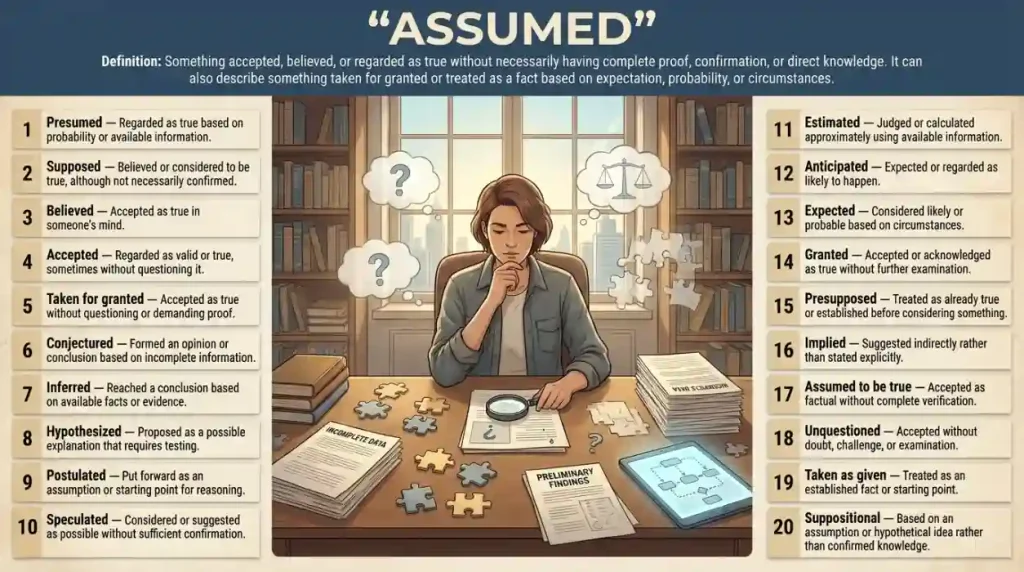
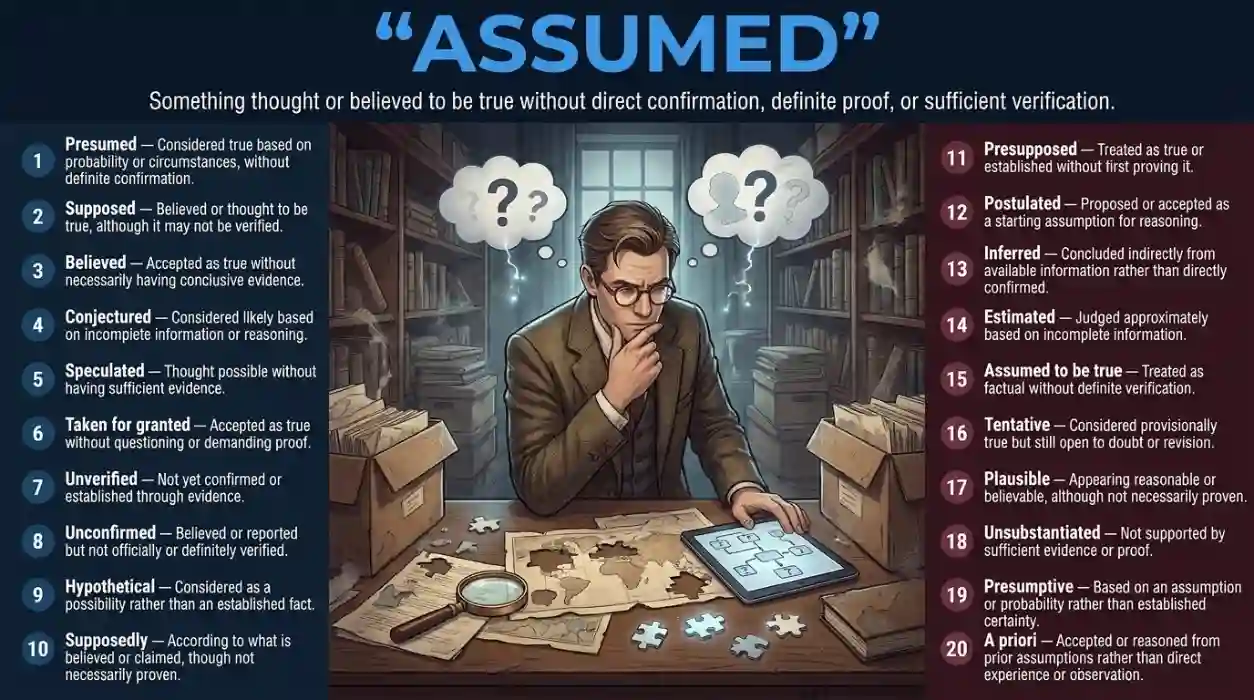
The best synonym for assumed depends on how you use the word. Common alternatives include presumed, supposed, believed, accepted, inferred, taken for granted, and undertaken. Some describe an unproven belief, while others refer to accepting responsibility or taking on a role.
Imagine a colleague says, “I assumed you had sent the email.” The sentence sounds natural, but you could also say, “I presumed you had sent the email.” The second version has a slightly more formal tone.
The word assumed appears in everyday conversations, academic writing, workplace messages, and storytelling. Its meaning changes with context, so choosing the right alternative matters.
Learning a synonym for assumed helps you avoid repetition and express your ideas more precisely. Students, bloggers, content writers, and everyday English users can all benefit from understanding its different meanings.
What Does “Assumed” Really Mean?
Assumed generally means accepted as true without complete proof, but it can also mean taking on a responsibility, role, quality, or appearance.
In simple English, when you assume something, you believe it is true without checking every detail. When you assume a role, you begin performing its duties.
Consider these examples:
- “I assumed the shop was closed.” Here, assumed means believed without confirmation.
- “She assumed responsibility for the project.” Here, it means accepted responsibility.
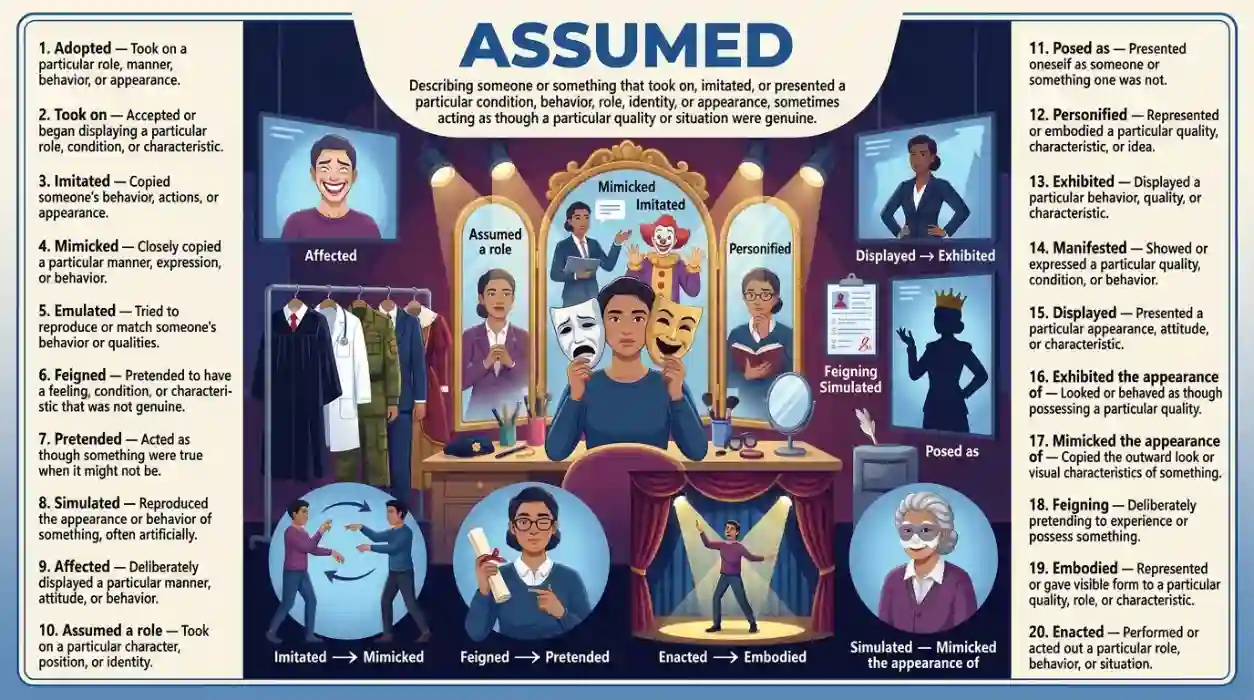
- “He assumed a confident expression.” Here, it means adopted or took on an appearance.
Native English speakers understand the word through its surrounding sentence. The context tells them whether it refers to a belief, an obligation, or an adopted quality.
Part of Speech
Assumed is primarily the past tense and past participle of the verb assume. It can also function as an adjective.
- Assume (verb): To accept something as true, take responsibility, or adopt a role.
- Assumed (past tense): Describes something someone accepted, took on, or adopted in the past.
- Assumed (past participle): Used in perfect and passive verb constructions.
- Assumed (adjective): Describes something accepted or treated as true without proof.
Connotative Meaning of Assumed
(Connotation means the emotional feeling or association a word creates beyond its basic dictionary meaning.)
The word assumed is usually neutral. However, it can suggest confidence, uncertainty, responsibility, or even an incorrect judgment.
Positive tone: It can suggest initiative or willingness when someone takes responsibility or adopts a role.
Example: “She assumed leadership during the difficult period.”
Negative tone: It can suggest carelessness when someone believes something without checking the facts.
Example: “He made an assumed judgment without listening to both sides.”
Neutral tone: It can simply describe an idea accepted as true or a role taken on.
Example: “The figures were assumed to be accurate.”
Etymology:
The word assumed comes from the Latin verb assumere, meaning “to take up,” “to take upon oneself,” or “to adopt.” It entered English through Old French and developed several related meanings.
Its modern uses still reflect this history. People can assume a belief, responsibility, position, or appearance.
Old English (450–1100)
The modern word” assume ” was not established in Old English. English speakers used other expressions to communicate ideas such as believing, accepting, and taking responsibility.
Middle English (1100–1500)
The word assume entered English through French and Latin influence during the Middle English period. Its meaning developed around taking something up or accepting it.
Modern English (1500–Present)
The word gained wider use in formal and everyday English. Today, it can describe an unverified belief, an accepted duty, an adopted identity, or a quality someone displays.
Pronunciation of Assumed
- US: /əˈsuːmd/
- UK: /əˈsjuːmd/
Syllables
as-sumed
The word has two syllables. The main stress falls on the second syllable: SUMED.
Affixation Pattern of Assumed
- Root: Sume, from Latin sumere, meaning to take.
- Prefix: Ad-, which changed to as- through assimilation in the development of assume.
- Suffix: -ed, marking the past tense and past participle.
The base verb is assume. Adding -ed creates assumed.
Synonyms List
The following alternatives cover the main meanings of assumed. The first group focuses on believing something without complete proof. Later entries include alternatives for taking responsibility, adopting a role, or displaying a quality.
Not every word can replace assumed in every sentence. Always check the context before choosing a substitute.
1. Presumed (Verb/Adjective) — US / UK: /prɪˈzuːmd/ / /prɪˈzjuːmd/
Meaning: Believed something was true based on available information, although it was not confirmed.
Tone/Register: Neutral to formal; everyday and professional.
Examples:
I presumed the meeting had been postponed.
The presumed cause of the delay was a technical issue.
2. Supposed (Verb/Adjective) — US / UK: /səˈpoʊzd/ / /səˈpəʊzd/
Meaning: Thought or believed something to be true, often without direct confirmation.
Tone/Register: Neutral; conversational and informal.
Examples:
I supposed you already knew about the change.
The supposed winner had not received official confirmation.
3. Believed (Verb/Adjective) — US / UK: /bɪˈliːvd/ / /bɪˈliːvd/
Meaning: Accepted an idea as true based on personal judgment or available information.
Tone/Register: Neutral; everyday and academic.
Examples:
She believed the package would arrive today.
The believed explanation later proved incorrect.
4. Thought (Verb) — US / UK: /θɔːt/ / /θɔːt/
Meaning: Held an idea or opinion about something without necessarily knowing it was correct.
Tone/Register: Informal to neutral; very common in conversation.
Examples:
I thought you were working from home.
He thought the instructions were optional.
5. Inferred (Verb) — US / UK: /ɪnˈfɝːd/ / /ɪnˈfɜːd/
Meaning: Concluded from evidence, clues, or information rather than direct confirmation.
Tone/Register: Formal; academic and analytical.
Examples:
The researcher inferred the result from the available data.
We inferred that the customer was unhappy from her response.
6. Concluded (Verb) — US / UK: /kənˈkluːdɪd/ / /kənˈkluːdɪd/
Meaning: Reached a decision or judgment after considering information.
Tone/Register: Neutral to formal; academic and professional.
Examples:
The team concluded that the plan was too expensive.
I concluded that he needed more time.
7. Presupposed (Verb/Adjective) — US / UK: /ˌpriː.səˈpoʊzd/ / /ˌpriː.səˈpəʊzd/
Meaning: Accepted something as true in advance without establishing it through proof.
Tone/Register: Formal; academic, philosophical, and analytical.
Examples:
The argument presupposed that everyone had equal access.
The discussion rested on a presupposed condition.
8. Taken for Granted (Verb Phrase) — US / UK: /ˈteɪ.kən fər ˈɡræn.tɪd/ / /ˈteɪ.kən fə ˈɡrɑːn.tɪd/
Meaning: Accepted something as true or certain without questioning it.
Tone/Register: Neutral; conversational and written English.
Examples:
We took it for granted that the service would continue.
She had taken his support for granted.
9. Accepted (Verb/Adjective) — US / UK: /əkˈsep.tɪd/ / /əkˈsep.tɪd/
Meaning: Treated something as true, valid, or satisfactory.
Tone/Register: Neutral to formal; everyday and professional.
Examples:
They accepted the explanation without further questions.
The accepted version of the story changed later.
10. Believed to Be (Verb Phrase) — US / UK: /bɪˈliːvd tə biː/ / /bɪˈliːvd tə biː/
Meaning: Thought to have a particular quality or identity without complete confirmation.
Tone/Register: Neutral to formal; reporting and academic writing.
Examples:
The painting is believed to be more than a century old.
The missing document was believed to be in the archive.
11. Considered (Verb/Adjective) — US / UK: /kənˈsɪd.ɚd/ / /kənˈsɪd.əd/
Meaning: Regarded or judged something as having a particular quality or status.
Tone/Register: Neutral to formal; academic and professional.
Examples:
The proposal was considered practical by the committee.
She considered the invitation a valuable opportunity.
12. Regarded (Verb) — US / UK: /rɪˈɡɑːr.dɪd/ / /rɪˈɡɑː.dɪd/
Meaning: Viewed or thought of someone or something in a particular way.
Tone/Register: Formal; professional and academic.
Examples:
He was regarded as an expert in his field.
The method was regarded as reliable.
13. Estimated (Verb/Adjective) — US / UK: /ˈes.tə.meɪ.tɪd/ / /ˈes.tɪ.meɪ.tɪd/
Meaning: Judged an amount, value, or possibility approximately rather than knowing it exactly.
Tone/Register: Neutral to formal; business and technical writing.
Examples:
We estimated the journey would take two hours.
The estimated attendance was higher than expected.
14. Guessed (Verb) — US / UK: /ɡest/ / /ɡest/
Meaning: Formed an opinion or answer without having enough information to know for certain.
Tone/Register: Informal; everyday conversation.
Examples:
I guessed that she was still at work.
He guessed the answer before checking the facts.
15. Speculated (Verb) — US / UK: /ˈspek.jə.leɪ.tɪd/ / /ˈspek.jə.leɪ.tɪd/
Meaning: Formed or discussed a possible explanation without having definite evidence.
Tone/Register: Neutral to formal; journalism and academic discussion.
Examples:
Reporters speculated that the event might be cancelled.
We speculated about the reason for his sudden departure.
16. Hypothesized (Verb) — US / UK: /haɪˈpɑː.θə.saɪzd/ / /haɪˈpɒθ.ə.saɪzd/
Meaning: Proposed an explanation or idea that can be tested.
Tone/Register: Academic; scientific and research writing.
Examples:
The scientist hypothesized that temperature affected the results.
Researchers hypothesized a link between sleep and memory.
17. Postulated (Verb) — US / UK: /ˈpɑː.stʃə.leɪ.tɪd/ / /ˈpɒs.tjə.leɪ.tɪd/
Meaning: Put forward an idea or principle as a basis for reasoning.
Tone/Register: Formal; philosophical and scientific.
Examples:
The theory postulated a new explanation for the behavior.
The author postulated that culture influenced the decision.
18. Inferred to Be (Verb Phrase) — US / UK: /ɪnˈfɝːd tə biː/ / /ɪnˈfɜːd tə biː/
Meaning: Concluded that something had a particular identity or quality based on available evidence.
Tone/Register: Formal; academic and analytical.
Examples:
The substance was inferred to be harmless from the initial tests.
His silence was inferred to be a sign of disagreement.
19. Assessed (Verb) — US / UK: /əˈsest/ / /əˈsest/
Meaning: Evaluated a situation or person and formed a judgment about it.
Tone/Register: Neutral to formal; professional and academic.
Examples:
The manager assessed the situation before responding.
We assessed the risks as relatively low.
20. Judged (Verb) — US / UK: /dʒʌdʒd/ / /dʒʌdʒd/
Meaning: Formed an opinion or conclusion about something after considering the available information.
Tone/Register: Neutral; everyday and professional.
Examples:
I judged the road safe enough to cross.
She judged the proposal on its practical value.
21. Deemed (Verb) — US / UK: /diːmd/ / /diːmd/
Meaning: Considered or officially decided that someone or something had a particular status or quality.
Tone/Register: Formal; legal, business, and administrative.
Examples:
The application was deemed incomplete.
The committee deemed the change necessary.
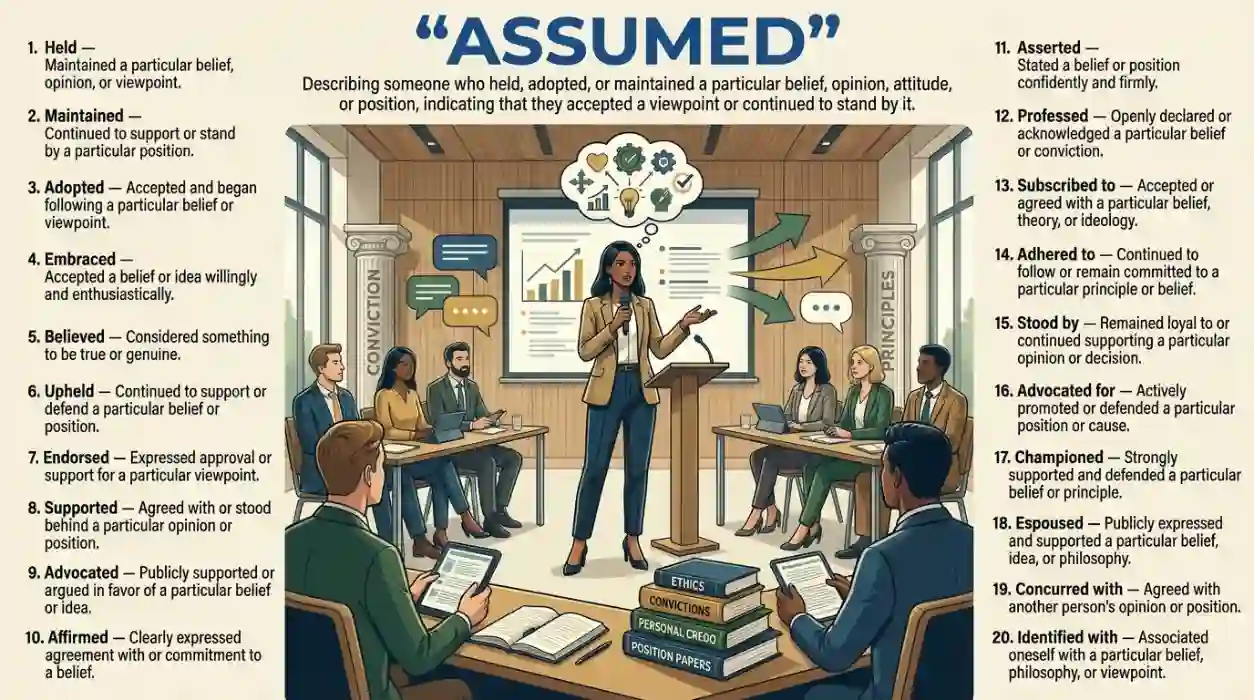
22. Held (Verb) — US / UK: /held/ / /held/
Meaning: Maintained a particular belief, opinion, or position.
Tone/Register: Neutral to formal; academic and professional.
Examples:
She held the view that education should be accessible.
The organization held a different position on the issue.
23. Presumed to Be (Verb Phrase) — US / UK: /prɪˈzuːmd tə biː/ / /prɪˈzjuːmd tə biː/
Meaning: Thought to have a particular identity or quality without complete proof.
Tone/Register: Neutral to formal; legal and everyday writing.
Examples:
The parcel was presumed to be lost.
The building was presumed to be empty.
24. Supposed to Be (Verb Phrase) — US / UK: /səˈpoʊzd tə biː/ / /səˈpəʊzd tə biː/
Meaning: Expected or believed to have a particular identity, purpose, or quality.
Tone/Register: Informal to neutral; conversational.
Examples:
The new office is supposed to be quieter.
He was supposed to be the most experienced candidate.
25. Assumed to Be (Verb Phrase) — US / UK: /əˈsuːmd tə biː/ / /əˈsjuːmd tə biː/
Meaning: Treated as having a particular identity or quality without confirmation.
Tone/Register: Neutral; everyday, academic, and professional.
Examples:
The figures were assumed to be accurate.
The room was assumed to be available.
26. Undertook (Verb) — US / UK: /ˌʌn.dɚˈtʊk/ / /ˌʌn.dəˈtʊk/
Meaning: Accepted responsibility for a task, project, or duty.
Tone/Register: Formal; professional and written English.
Examples:
She undertook the responsibility of training new staff.
The team undertook a major research project.
27. Took On (Phrasal Verb) — US / UK: /tʊk ɑːn/ / /tʊk ɒn/
Meaning: Accepted a task, duty, challenge, or responsibility.
Tone/Register: Neutral; conversational and professional.
Examples:
He took on extra work during the busy season.
She took on the challenge with confidence.
28. Accepted Responsibility (Verb Phrase) — US / UK: /əkˈsep.tɪd rɪˌspɑːn.səˈbɪl.ə.ti/ / /əkˈsep.tɪd rɪˌspɒn.sɪˈbɪl.ə.ti/
Meaning: Agreed to be accountable for a task, action, or outcome.
Tone/Register: Neutral to formal; workplace and personal communication.
Examples:
The supervisor accepted responsibility for the mistake.
She accepted responsibility for organizing the event.
29. Took Charge (Verb Phrase) — US / UK: /tʊk tʃɑːrdʒ/ / /tʊk tʃɑːdʒ/
Meaning: Began controlling or managing a situation, task, or group.
Tone/Register: Neutral to positive; conversational and professional.
Examples:
Maya took charge when the manager was away.
He took charge of the emergency response.
30. Undertaken (Verb) — US / UK: /ˌʌn.dɚˈteɪ.kən/ / /ˌʌn.dəˈteɪ.kən/
Meaning: Accepted or started a responsibility, task, or project.
Tone/Register: Formal; professional and academic.
Examples:
The research was undertaken by a university team.
Several improvements have been undertaken this year.
31. Adopted (Verb/Adjective) — US / UK: /əˈdɑːp.tɪd/ / /əˈdɒp.tɪd/
Meaning: Took up a particular method, position, attitude, or identity.
Tone/Register: Neutral to formal; business and everyday writing.
Examples:
The company adopted a more flexible approach.
He adopted a calm attitude during the discussion.
32. Assumed the Role (Verb Phrase) — US / UK: /əˈsuːmd ðə roʊl/ / /əˈsjuːmd ðə rəʊl/
Meaning: Began performing the duties or responsibilities of a particular position.
Tone/Register: Formal to neutral; workplace and storytelling.
Examples:
She assumed the role of team leader last month.
He assumed the role after the director retired.
33. Took Up (Phrasal Verb) — US / UK: /tʊk ʌp/ / /tʊk ʌp/
Meaning: Began a task, activity, position, or responsibility.
Tone/Register: Neutral; everyday and professional.
Examples:
He took up the position in early spring.
She took up the challenge without hesitation.
34. Inhabited (Verb) — US / UK: /ɪnˈhæb.ɪ.tɪd/ / /ɪnˈhæb.ɪ.tɪd/
Meaning: Occupied or lived in a particular place, or figuratively entered a character’s perspective or role.
Tone/Register: Formal; literary and descriptive.
Examples:
The actor inhabited the character with remarkable skill.
The family inhabited the house for many years.
35. Embodied (Verb) — US / UK: /ɪmˈbɑː.did/ / /ɪmˈbɒd.id/
Meaning: Represented or expressed a particular quality, idea, or principle.
Tone/Register: Formal; literary and professional.
Examples:
Her actions embodied the values of the organization.
The design embodied simplicity and elegance.
36. Displayed (Verb) — US / UK: /dɪˈspleɪd/ / /dɪˈspleɪd/
Meaning: Showed a particular quality, feeling, or behavior.
Tone/Register: Neutral; everyday and professional.
Examples:
He displayed confidence during the interview.
The team displayed impressive patience.
37. Exhibited (Verb) — US / UK: /ɪɡˈzɪb.ɪ.tɪd/ / /ɪɡˈzɪb.ɪ.tɪd/
Meaning: Showed or demonstrated a particular quality or behavior.
Tone/Register: Formal; academic and professional.
Examples:
The student exhibited excellent problem-solving skills.
The material exhibited signs of damage.
38. Projected (Verb) — US / UK: /prəˈdʒek.tɪd/ / /prəˈdʒek.tɪd/
Meaning: Presented a particular image, attitude, or impression to other people.
Tone/Register: Neutral to formal; business and social contexts.
Examples:
She projected confidence during the presentation.
His response projected a sense of calm.
39. Feigned (Verb) — US / UK: /feɪnd/ / /feɪnd/
Meaning: Pretended to have a feeling, condition, or quality that was not genuine.
Tone/Register: Negative; formal and literary.
Examples:
He feigned surprise when he heard the news.
She feigned confidence to hide her nervousness.
40. Pretended (Verb) — US / UK: /prɪˈten.dɪd/ / /prɪˈten.dɪd/
Meaning: Acted as though something were true when it was not.
Tone/Register: Neutral to negative; everyday and informal.
Examples:
He pretended to understand the instructions.
The child pretended to be a superhero.
41. Affected (Verb) — US / UK: /əˈfek.tɪd/ / /əˈfek.tɪd/
Meaning: Deliberately adopted a particular manner, accent, or attitude, often in an artificial way.
Tone/Register: Neutral to negative; literary and conversational.
Examples:
He affected a serious expression during the interview.
She affected a formal accent for the performance.
42. Simulated (Verb) — US / UK: /ˈsɪm.jə.leɪ.tɪd/ / /ˈsɪm.jə.leɪ.tɪd/
Meaning: Imitated a particular condition, behavior, or appearance.
Tone/Register: Neutral to formal; technical and descriptive.
Examples:
The training exercise simulated a real emergency.
The model simulated the effects of heavy rainfall.
43. Feigned to Be (Verb Phrase) — US / UK: /feɪnd tə biː/ / /feɪnd tə biː/
Meaning: Pretended to have a particular identity, condition, or quality.
Tone/Register: Formal; literary and descriptive.
Examples:
He feigned being unaware of the disagreement.
The character feigned being an ordinary traveler.
44. Posed As (Phrasal Verb) — US / UK: /poʊzd æz/ / /pəʊzd æz/
Meaning: Presented oneself as someone or something different from one’s real identity.
Tone/Register: Neutral to negative; storytelling and reporting.
Examples:
The stranger posed as a delivery worker.
The actor posed as a journalist for the scene.
45. Took the Form of (Verb Phrase) — US / UK: /tʊk ðə fɔːrm əv/ / /tʊk ðə fɔːm əv/
Meaning: Appeared or developed in a particular shape, style, or expression.
Tone/Register: Neutral to formal; descriptive and academic.
Examples:
The protest took the form of a peaceful march.
Her support took the form of practical assistance.
46. Adopted the Appearance of (Verb Phrase) — US / UK: /əˈdɑːp.tɪd ði əˈpɪr.əns əv/ / /əˈdɒp.tɪd ði əˈpɪə.rəns əv/
Meaning: Took on a particular outward look or visual impression.
Tone/Register: Formal; descriptive and literary.
Examples:
The building adopted the appearance of a traditional cottage.
The character adopted the appearance of a wealthy traveler.
47. Took the Position of (Verb Phrase) — US / UK: /tʊk ðə pəˈzɪʃ.ən əv/ / /tʊk ðə pəˈzɪʃ.ən əv/
Meaning: Began occupying a particular role or expressing a particular stance.
Tone/Register: Neutral to formal; professional and academic.
Examples:
She took the position of project coordinator.
He took the position that the decision was unfair.
48. Undertook the Duties of (Verb Phrase) — US / UK: /ˌʌn.dɚˈtʊk ðə ˈduː.tiz əv/ / /ˌʌn.dəˈtʊk ðə ˈdjuː.tiz əv/
Meaning: Accepted and performed the responsibilities associated with a role.
Tone/Register: Formal; workplace and administrative.
Examples:
The deputy undertook the duties of the director.
She undertook the duties of the absent supervisor.
49. Entered Upon (Verb Phrase) — US / UK: /ˈen.tɚd əˈpɑːn/ / /ˈen.təd əˈpɒn/
Meaning: Began a particular task, position, or course of action.
Tone/Register: Formal; legal, literary, and traditional writing.
Examples:
The new officer entered upon her duties in June.
He entered upon a period of intensive study.
50. Assumed Control (Verb Phrase) — US / UK: /əˈsuːmd kənˈtroʊl/ / /əˈsjuːmd kənˈtrəʊl/
Meaning: Took authority over a situation, organization, or process.
Tone/Register: Neutral to formal; business, government, and reporting.
Examples:
The emergency team assumed control of the site.
A new director assumed control of the department.
Synonyms by Tone
The emotional tone of a word affects how readers interpret your message. A suitable synonym can make your writing sound more natural, respectful, or precise.
Positive Synonyms
These alternatives can suggest thoughtful judgment, responsibility, or initiative:
- Accepted
- Undertook
- Took on
- Adopted
- Assumed the role
- Embodied
- Displayed
- Exhibited
- Took charge
Example: “She took on the responsibility with confidence.”
Neutral Synonyms
These words communicate a belief or conclusion without strong emotional judgment:
- Presumed
- Supposed
- Believed
- Thought
- Inferred
- Concluded
- Considered
- Regarded
- Estimated
- Judged
- Deemed
- Held
Example: “I presumed the office was closed.”
Negative or Critical Synonyms
These words can suggest weak evidence, artificial behavior, or an incorrect belief:
- Guessed
- Speculated
- Taken for granted
- Feigned
- Pretended
- Affected
- Posed as
Example: “He pretended to understand the instructions.”
Playful or Informal Alternatives
In casual conversation, simpler expressions often sound more natural:
- Thought
- Guessed
- Figured
- Took on
- Supposed
- Pretended
Example: “I figured you were already on your way.”
Why Does Tone Matter?
A word can change the impression a sentence creates. Presumed sounds more formal than guessed. Feigned suggests deliberate deception, while displayed describes a visible quality.
Think about your audience before choosing a replacement. The best synonym is the one that preserves your intended meaning and tone.
“Assumed” vs. Close Alternatives
Several words have similar meanings, but they are not always interchangeable.
| Word | Meaning difference | Tone | Best use |
|---|---|---|---|
| Assumed | Accepted something as true without confirmation | Neutral | Everyday beliefs and formal writing |
| Presumed | Formed a belief based on probability or available information | Neutral to formal | Professional and legal contexts |
| Supposed | Thought something was true or expected | Informal to neutral | Everyday conversation |
| Inferred | Concluded evidence or clues | Formal | Research and analytical writing |
Compare these examples:
- Assumed: “I assumed the train was delayed.” This suggests a belief without confirmation.
- Presumed: “I presumed the train was delayed.” This sounds slightly more formal and may suggest a reasonable expectation.
- Supposed: “I supposed the train was delayed.” This sounds conversational and can suggest uncertainty.
- Inferred: “I inferred that the train was delayed from the announcement.” This specifically highlights the evidence used to conclude.
How “Assumed” Changes by Context
Daily Conversation
In everyday speech, thought, guessed, figured, and supposed are common alternatives.
For example, “I thought you were busy” sounds relaxed and natural. “I presumed you were busy” sounds more formal.
Writing and Blogging
In articles, essays, and blog posts, alternatives such as presumed, inferred, considered, and believed can improve clarity.
Use inferred when a conclusion comes from evidence. Choose believed when describing someone’s personal understanding.
Professional or Academic Tone
Formal writing often uses deemed, presupposed, undertaken, and regarded.
For example, “The application was deemed incomplete” sounds appropriate in an official report. “The team undertook the research” describes accepted work.
Creative or Informal Use
In fiction, feigned, pretended, adopted, and embodied can describe a character’s behavior or appearance.
For example, “She feigned confidence” suggests that the character was hiding her true feelings.
Common Mistakes Learners Make
1. Confusing Assumed With Proven
An assumption is not necessarily a fact.
Incorrect: “The result was assumed, so it must be correct.”
Better: “The result was assumed to be correct, but it still needed verification.”
2. Using Presumed and Inferred Interchangeably
These words have different shades of meaning.
Presumed describes a belief based on probability or expectation. Inferred describes a conclusion drawn from evidence or clues.
3. Using Assumed When You Mean Accepted Responsibility
Consider the sentence:
“She assumed responsibility for the mistake.”
Here, assumed means accepted or took on. Replacing it with presumed would change the meaning.
4. Confusing Assumed With Pretended
Assumed can mean adopted a role or appearance. Pretended specifically suggests acting as though something were true when it was not.
For example, “He assumed a leadership role” means he took the position. It does not mean he was pretending to be a leader.
5. Overusing Formal Synonyms
Words such as presupposed, deemed, and postulated are useful in the right context. However, they may sound unnatural in casual messages.
Choose thought, believed, or figured when the situation is informal.
Register Notes: Formal vs. Informal English
Formal English: Use presumed, inferred, presupposed, deemed, or undertaken in reports, academic writing, and professional communication.
Informal English: Use thought, guessed, figured, or supposed when speaking with friends or family.
Spoken English: Short expressions such as “I thought” and “I figured” sound natural in everyday conversation.
Written English: More precise alternatives can explain whether someone formed a belief, concluded, or accepted a responsibility.
For further vocabulary practice, explore related topics such as synonyms for believed, presumed, and considered.
Real-Life Examples
Workplace Scenario
A manager says, “I assumed the report was finished.” The employee explains that one section still needs review. Here, assumed describes a belief without confirmation.
Social Situation
A friend says, “I thought you were coming to dinner.” The sentence communicates an expectation that turned out to be incorrect.
Media and Pop Culture
A news report describes a person as the presumed winner before the final results are confirmed. The word signals that the outcome is not yet official.
Writing and Storytelling
A character assumes the identity of a traveler to enter a restricted area. In this context, assumes means adopts or takes on an identity.

Practice Quiz:
1. You believed the office was closed, but you had not checked. Which word fits best?
A. Undertook
B. Presumed
C. Displayed
D. Embodied
2. A scientist draws several clues. Which word is most accurate?
A. Inferred
B. Pretended
C. Adopted
D. Took charge
3. You casually thought your friend was at home. Which alternative sounds most natural?
A. Deemed
B. Postulated
C. Thought
D. Undertaken
4. A manager accepts responsibility for a difficult project. Which phrase fits best?
A. Taken for granted
B. Took on
C. Speculated
D. Feigned
5. A researcher proposes an explanation that can be tested. Which verb is appropriate?
A. Hypothesized
B. Pretended
C. Displayed
D. Posed as
6. A person deliberately acts as though they are confident. Which word best describes this behavior?
A. Concluded
B. Estimated
C. Feigned
D. Regarded
7. An official committee considers an application incomplete. Which word sounds most suitable?
A. Guessed
B. Deemed
C. Thought
D. Supposed
8. A new employee begins performing the duties of a team leader. Which phrase is correct?
A. Assumed the role
B. Taken for granted
C. Speculated about
D. Believed to be
9. You formed an approximate idea of the journey time. Which word fits best?
A. Embodied
B. Estimated
C. Feigned
D. Undertook
10. A person adopts a particular attitude for a performance. Which word is suitable?
A. Affected
B. Inferred
C. Concluded
D. Presumed
Reflection task:
Write one original sentence using presumed, inferred, or undertook. Then rewrite it using another suitable synonym. Explain how the meaning or tone changes.
Answer key: 1-B | 2-A | 3-C | 4-B | 5-A | 6-C | 7-B | 8-A | 9-B | 10-A
External Learning Sources
Use these established references to check definitions, pronunciation, word forms, and usage examples:
- Merriam-Webster Dictionary: https://www.merriam-webster.com/
- Cambridge Dictionary: https://dictionary.cambridge.org/
- Oxford Learner’s Dictionaries: https://www.oxfordlearnersdictionaries.com/
- Etymonline: https://www.etymonline.com/
These sources provide additional support for understanding how assumed and its alternatives work in different contexts.
Conclusion:
Learning alternatives to assumed helps you explain beliefs, judgments, responsibilities, and roles more accurately. Words such as presumed and inferred add useful shades of meaning.
A varied vocabulary makes essays, blogs, emails, and conversations clearer. It also helps you choose words that match your audience and communicate your ideas naturally.
You do not need to memorize all alternatives immediately. Start with a few common words and practice using them in different situations.
Try writing sentences with presumed, thought, and undertook today. Use them in emails, essays, and daily conversations to build confidence and fluency.
FAQs
1. What is the best synonym for assumed in a sentence?
The best synonym depends on what assumed means in your sentence. Use presumed when someone believes something is likely to be true. Choose inferred when the belief comes from evidence. Use undertook or took on when the sentence describes accepting responsibility.
2. What is a synonym for assumed in academic writing?
Useful academic alternatives include presupposed, inferred, hypothesized, postulated, presumed, and considered. These words express different kinds of reasoning. For instance, researchers use hypothesized when proposing a testable explanation and inferred when concluding from evidence.
3. What is the opposite of assumed?
Possible opposites include verified, confirmed, questioned, rejected, and disproved, depending on the context. If someone assumed a fact without checking it, verified or confirmed may describe the opposite process. If someone assumed responsibility, relinquished or gave up may be more appropriate.
4. What is the difference between assumed and presumed?
Both words can describe accepting something as true without complete proof. However, presumed often suggests that a belief is reasonable based on available information or probability. Assumed is broader and can also mean accepting responsibility, adopting a role, or taking on an appearance.
5. Can assumed be used as an adjective?
Yes. Assumed can describe something accepted as true or adopted rather than confirmed or genuine. For example, “The report used an assumed value for the calculation.” It can also describe an adopted identity, as in “He performed under an assumed name.”

Hasnain Ali is an SEO Content Strategist and the founder of wordvora.com, a trusted vocabulary platform that helps writers, students, professionals, and English learners find accurate synonyms, antonyms, word meanings, and real-life usage examples. He specializes in keyword research, on-page SEO, topical authority, and creating search-first content that aligns with Google’s latest Search Quality and E-E-A-T guidelines. His work focuses on producing clear, well-structured, and reader-friendly resources that satisfy search intent while maintaining high editorial standards.
Through extensive hands-on experience with SEO tools such as Google Search Console, Google Analytics, SEMrush, and Ahrefs, Hasnain researches user search behavior and develops content that is both informative and easy to understand. Every article published on wordvora.com is carefully reviewed for accuracy, readability, and contextual relevance before publication. His mission is to build one of the web’s most reliable English vocabulary resources by providing practical language guidance, trustworthy explanations, and content that helps readers improve their writing, communication, and vocabulary with confidence.