
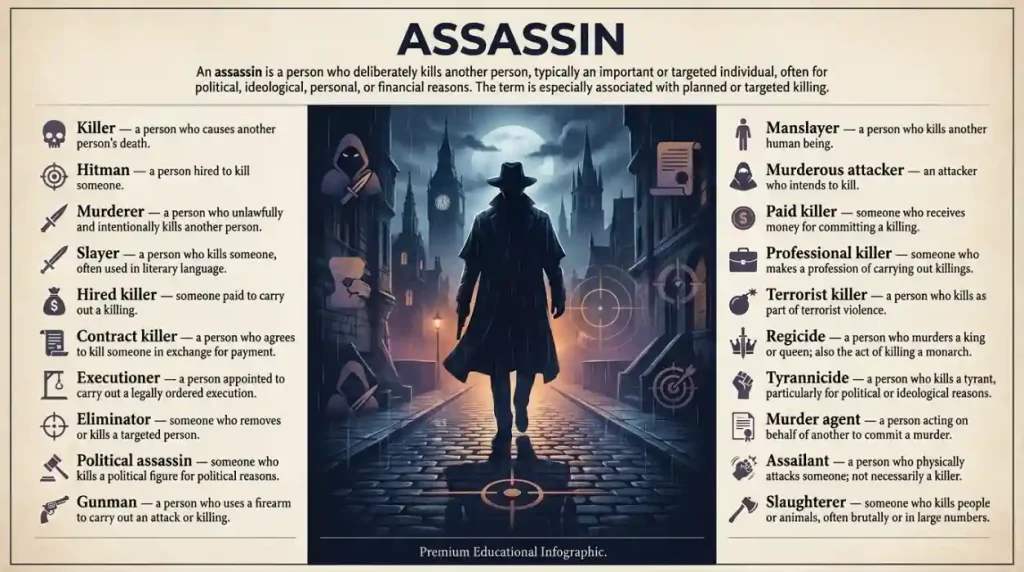
A synonym for assassin is killer, murderer, or, more specifically, contract killer. An assassin is a person who deliberately murders someone, often an important public figure, for political, ideological, or financial reasons. The best alternative depends on the context.
Imagine reading a news report about a planned attack on a political leader. The writer calls the attacker an assassin. Another writer might choose hired killer or political murderer. Each expression creates a slightly different impression.
Learning a synonym for assassin helps you describe criminal acts with greater precision. It also makes your writing clearer and less repetitive.
The word assassin appears in news reports, history books, crime stories, films, and political discussions. Its meaning is usually serious and negative.
Students, bloggers, content writers, and everyday English users can benefit from knowing its alternatives. The right word makes descriptions more accurate and natural.
What Does “Assassin” Really Mean?
Assassin is a noun. It describes a person who deliberately kills another person, usually an important or prominent individual, for a political, ideological, religious, or financial purpose.
In everyday English, people often use assassin for someone who carries out a planned murder. The word commonly appears in discussions of political violence, historical events, organized crime, and fictional thrillers.
An assassin is not simply anyone who causes a death. The word usually suggests a deliberate killing with a particular target or motive.
For example:
- A person hired to murder a business leader may be called an assassin.
- Someone who deliberately kills a political figure may be described as a political assassin.
The exact label depends on the person’s motive, role, and circumstances.
Connotative Meaning
(Connotation means the emotional or cultural associations a word carries beyond its basic dictionary definition.)
- Positive tone: The word assassin does not normally have a positive meaning. In fiction, however, a character may be portrayed as skilled or heroic despite committing murder.
- Negative tone: It strongly suggests violence, deliberate killing, and criminal behavior.
- Neutral tone: In historical or academic writing, it can function as a factual label without expressing the writer’s personal feelings.
The word itself carries a serious negative association. The surrounding context determines whether the writer uses it as a factual description or a dramatic label.
Etymology and History
The English word assassin entered the language through French and Italian forms. Its deeper history is connected to Arabic ḥashīshiyyīn, a term historically associated with the Nizari Ismailis.
The precise origin and historical use of the Arabic term remain debated. Popular explanations often connect it with hashish, but that explanation should not be treated as a settled historical fact.
Old English (450–1100)
The word assassin did not belong to Old English vocabulary. English speakers used other words and expressions to describe people who committed deliberate killings.
Middle English (1100–1500)
The term entered English near the end of the Middle English period, influenced by forms used in European languages. It became associated with accounts of targeted political killings.
Modern English (1500–Present)
The word developed into a general term for someone who deliberately murders a selected person, especially a prominent figure. Today, it appears in journalism, historical writing, crime fiction, and everyday conversation.

Pronunciation, Syllables, and Word Structure
US pronunciation: /əˈsæs.ɪn/
UK pronunciation: /əˈsæs.ɪn/
Syllables: as-sas-in (three syllables)
Stress: The second syllable receives the main stress: uh-SASS-in.
Affixation Pattern
- Root: assassin
- Prefix: None
- Suffix: None in the basic noun form
- Word formation: The word is a borrowed lexical item rather than a transparent combination of a modern English root and affixes.
Related forms include assassinate (verb), assassination (noun), and assassin-like (adjective).
Synonyms List
The English language has fewer exact synonyms for assassin. Many alternatives describe a broader type of killer or a particular role. The following list includes close synonyms, established expressions, and context-specific alternatives.
Use the explanations carefully. A murderer is not automatically an assassin, and a sniper is not necessarily one.
1. Killer (Noun) — US / UK: /ˈkɪl.ɚ/ / /ˈkɪl.ə/
Meaning: A person who causes another person’s death, deliberately or otherwise.
Tone/Register: Neutral; common in everyday and journalistic English.
Examples:
The police searched for the killer.
The novel follows a mysterious killer.
2. Murderer (Noun) — US / UK: /ˈmɝː.dɚ.ɚ/ / /ˈmɜː.dər.ər/
Meaning: A person who unlawfully and intentionally kills another person.
Tone/Register: Formal, legal, and strongly negative.
Examples:
The murderer was convicted in court.
The detective spent years investigating the case.
3. Hitman (Noun) — US / UK: /ˈhɪt.mæn/ / /ˈhɪt.mæn/
Meaning: A person paid to kill someone, usually as part of a criminal arrangement.
Tone/Register: Informal; common in crime fiction and media.
Examples:
The film features a retired hitman.
Police suspected that the victim had been targeted by a hitman.
4. Contract Killer (Noun) — US / UK: /ˈkɑːn.trækt ˈkɪl.ɚ/ / /ˈkɒn.trækt ˈkɪl.ə/
Meaning: A person who commits murder in exchange for payment under an agreement.
Tone/Register: Formal or journalistic.
Examples:
The investigation uncovered a contract killer.
The documentary examines the world of contract killing.
5. Hired Killer (Noun) — US / UK: /ˌhaɪɚd ˈkɪl. ɚ///ˌhaɪəd ˈkɪl.ə/ɚ/ / /ˌhaɪəd ˈkɪl.ə/
Meaning: A person employed or paid to murder a particular target.
Tone/Register: Neutral to formal.
Examples:
The report described him as a hired killer.
The story centers on a hired killer seeking redemption.
6. Political Assassin (Noun) — US / UK: /pəˈlɪt̬.ɪ.kəl əˈsæs.ɪn/ / /pəˈlɪt.ɪ.kəl əˈsæs.ɪn/
Meaning: An assassin whose target is selected for political reasons.
Tone/Register: Formal, historical, and journalistic.
Examples:
The political assassin targeted a government official.
Historians continue to debate the motive behind the attack.
7. Professional Killer (Noun) — US / UK: /prəˈfeʃ.ən.əl ˈkɪl.ɚ/ / /prəˈfeʃ.ən.əl ˈkɪl.ə/
Meaning: A person who kills as an organized or paid occupation.
Tone/Register: Formal or descriptive.
Examples:
The novel introduces a professional killer.
The journalist investigated the criminal network.
8. Hired Gun (Noun) — US / UK: /ˌhaɪɚd ˈɡʌn/ / /ˌhaɪəd ˈɡʌn/
Meaning: An informal expression for someone hired to use violence or perform a task for another person.
Tone/Register: Informal; sometimes figurative.
Examples:
The screenplay portrays him as a hired gun.
In business, the phrase can also describe an outside expert hired for a difficult job.
9. Slayer (Noun) — US / UK: /ˈsleɪ.ɚ/ / /ˈsleɪ.ə/
Meaning: A person who kills someone or something, often used in dramatic or literary language.
Tone/Register: Literary, dramatic, or informal.
Examples:
The legend tells of a dragon slayer.
The fantasy novel introduces a feared slayer.
10. Executioner (Noun) — US / UK: /ˌek.səˈkjuː.ʃən.ɚ/ / /ˌek.sɪˈkjuː.ʃən.ə/
Meaning: A person officially appointed to carry out a legally ordered execution.
Tone/Register: Formal and historical.
Examples:
The historical drama features a royal executioner.
The executioner carried out the sentence under the law.
11. Murder-for-Hire Operator (Noun) — US / UK: /ˈmɝː.dɚ fər ˈhaɪɚ ˈɑː.pəˌreɪ.t̬ɚ/ / /ˈmɜː.də fə ˈhaɪə ˈɒp.əˌreɪ.tə/
Meaning: A person involved in arranging or carrying out a murder for payment.
Tone/Register: Formal, legal, and journalistic.
Examples:
Investigators examined whether a murder-for-hire operator was involved.
The court heard evidence about the alleged arrangement.
12. Murderous Assailant (Noun) — US / UK: /ˈmɝː.dɚ.əs əˈseɪ.lənt/ / /ˈmɜː.dər.əs əˈseɪ.lənt/
Meaning: An attacker who commits a fatal assault.
Tone/Register: Formal and descriptive.
Examples:
The report described the attacker as a murderous assailant.
Witnesses provided details about the incident.
13. Slaughterer (Noun) — US / UK: /ˈslɔː.t̬ɚ.ɚ/ / /ˈslɔː.tər.ər/
Meaning: A person who kills people or animals, often in large numbers or with extreme brutality.
Tone/Register: Strongly negative and dramatic.
Examples:
The historical account called him a ruthless slaughterer.
The word emphasizes brutality rather than a specific motive.
14. Butcher (Noun) — US / UK: /ˈbʊtʃ.ɚ/ / /ˈbʊtʃ.ə/
Meaning: A person who kills people brutally; it can also refer to someone whose work involves preparing meat.
Tone/Register: Highly negative when used for a violent person.
Examples:
The writer portrayed the warlord as a butcher.
In its ordinary occupational sense, the word refers to a meat seller or preparer.
15. Homicide Perpetrator (Noun) — US / UK: /ˈhɑː.mə.saɪd pɚˈpɛt.reɪ.t̬ɚ/ / /ˈhɒm.ɪ.saɪd ˈpɜː.pɪˌtreɪ.tə/
Meaning: A person responsible for an act of homicide.
Tone/Register: Formal, legal, and academic.
Examples:
The report examined the background of the homicide perpetrator.
Investigators gathered evidence before identifying a suspect.
16. Assassinator (Noun) — US / UK: /əˈsæs.əˌneɪ.t̬ɚ/ / /əˈsæs.ɪˌneɪ.tə/
Meaning: A rare word for someone who assassinates another person.
Tone/Register: Rare and formal; assassin is much more natural.
Examples:
The old text referred to the attacker as an assassin.
Modern writers usually choose a simpler term.
17. Political Killer (Noun) — US / UK: /pəˈlɪt̬.ɪ.kəl ˈkɪl.ɚ/ / /pəˈlɪt.ɪ.kəl ˈkɪl.ə/
Meaning: A person who kills someone for a political purpose.
Tone/Register: Neutral to formal.
Examples:
The article examined the motives of the political killer.
The phrase highlights the motive rather than the person’s method.
18. Targeted Killer (Noun) — US / UK: /ˈtɑːr.ɡɪ.t̬ɪd ˈkɪl.ɚ/ / /ˈtɑː.ɡɪ.tɪd ˈkɪl.ə/
Meaning: A person who deliberately kills a selected individual.
Tone/Register: Descriptive and journalistic.
Examples:
The investigation treated the death as a targeted killing.
The phrase does not necessarily establish a political motive.
19. Serial Killer (Noun) — US / UK: /ˈsɪr.i.əl ˈkɪl.ɚ/ / /ˈsɪə.ri.əl ˈkɪl.ə/
Meaning: A person who murders multiple victims in separate events over time.
Tone/Register: Neutral, criminological, and journalistic.
Examples:
The documentary explores the psychology of a serial killer.
The detective connected several separate cases.
20. Mass Murderer (Noun) — US / UK: /ˌmæs ˈmɝː.dɚ.ɚ/ / /ˌmæs ˈmɜː.dər.ər/
Meaning: A person who kills several people in one event or a closely connected series of events.
Tone/Register: Formal and strongly negative.
Examples:
The report described the attacker as a mass murderer.
The term refers to the scale of the crime, not necessarily an assassination.

21. Political Murderer (Noun) — US / UK: /pəˈlɪt̬.ɪ.kəl ˈmɝː.dɚ.ɚ/ / /pəˈlɪt.ɪ.kəl ˈmɜː.dər.ər/
Meaning: A person who commits murder for political reasons.
Tone/Register: Formal and analytical.
Examples:
The historian described the suspect as a political murderer.
The phrase emphasizes the motive behind the crime.
22. Homicide Offender (Noun) — US / UK: /ˈhɑː.mə.saɪd əˈfɛn.dɚ/ / /ˈhɒm.ɪ.saɪd əˈfɛn.də/
Meaning: A person who has committed an act of homicide.
Tone/Register: Legal and criminological.
Examples:
The study examined the backgrounds of homicide offenders.
The term is broader than assassin.
23. Murder Suspect (Noun) — US / UK: /ˈmɝː.dɚ ˈsʌs.pɛkt/ / /ˈmɜː.də ˈsʌs.pekt/
Meaning: A person believed by authorities to be involved in a murder, but not necessarily convicted.
Tone/Register: Neutral and journalistic.
Examples:
Police questioned a murder suspect.
The newspaper avoided naming the person before formal charges.
24. Murderer-for-Hire (Noun) — US / UK: /ˈmɝː.dɚ fər ˈhaɪɚ/ / /ˈmɜː.də fə ˈhaɪə/
Meaning: A person who accepts payment to commit murder.
Tone/Register: Descriptive and journalistic.
Examples:
The thriller follows a murderer-for-hire.
The phrase makes the financial motive clear.
25. Contract Murderer (Noun) — US / UK: /ˈkɑːn.trækt ˈmɝː.dɚ.ɚ/ / /ˈkɒn.trækt ˈmɜː.dər.ər/
Meaning: A person who murders someone under a paid agreement.
Tone/Register: Formal and descriptive.
Examples:
The novel introduces a contract murderer.
The investigation focused on the alleged payment.
26. Assassin-for-Hire (Noun) — US / UK: /əˈsæs.ɪn fər ˈhaɪɚ/ / /əˈsæs.ɪn fə ˈhaɪə/
Meaning: An assassin who accepts payment to kill a selected target.
Tone/Register: Descriptive; common in fiction and media.
Examples:
The series follows an assassin-for-hire.
The character struggles with the consequences of his past.
27. Political Executioner (Noun) — US / UK: /pəˈlɪt̬.ɪ.kəl ˌek.səˈkjuː.ʃən.ɚ/ / /pəˈlɪt.ɪ.kəl ˌek.sɪˈkjuː.ʃən.ə/
Meaning: A person who carries out killings for a political authority or cause.
Tone/Register: Historical, formal, and context-dependent.
Examples:
The novel depicts him as a political executioner.
The term may suggest state violence rather than a private assassination.
28. State Assassin (Noun) — US / UK: /ˈsteɪt əˈsæs.ɪn/ / /ˈsteɪt əˈsæs.ɪn/
Meaning: An assassin acting on behalf of a state or government.
Tone/Register: Political and analytical.
Examples:
The book investigates allegations of a state assassin.
The author distinguishes documented facts from speculation.
29. Secret Agent (Noun) — US / UK: /ˈsiː.krət ˈeɪ.dʒənt/ / /ˈsiː.krət ˈeɪ.dʒənt/
Meaning: A person working covertly for an intelligence organization or government.
Tone/Register: Neutral; common in fiction and journalism.
Examples:
The story follows a secret agent behind enemy lines.
A secret agent is not necessarily an assassin.
30. Sniper (Noun) — US / UK: /ˈsnaɪ.pɚ/ / /ˈsnaɪ.pə/
Meaning: A person trained to shoot accurately from a concealed or distant position.
Tone/Register: Military, journalistic, and neutral.
Examples:
The historical account mentions a military sniper.
A sniper becomes an assassin only when the circumstances fit that meaning.
31. Gunman (Noun) — US / UK: /ˈɡʌn.mæn/ / /ˈɡʌn.mæn/
Meaning: A person who carries or uses a gun, especially during a violent crime.
Tone/Register: Journalistic and neutral to negative.
Examples:
Witnesses reported seeing a gunman near the building.
The report did not establish the attacker’s motive.
32. Armed Assailant (Noun) — US / UK: /ˌɑːrmd əˈseɪ.lənt/ / /ˌɑːmd əˈseɪ.lənt/
Meaning: A person who attacks another individual while carrying a weapon.
Tone/Register: Formal and journalistic.
Examples:
The statement referred to an armed assailant.
Investigators were still establishing the circumstances.
33. Attacker (Noun) — US / UK: /əˈtæk.ɚ/ / /əˈtæk.ə/
Meaning: A person who uses physical force or violence against another person or target.
Tone/Register: Neutral and widely used.
Examples:
The attacker fled the scene.
The report did not yet identify the motive.
34. Assailant (Noun) — US / UK: /əˈseɪ.lənt/ / /əˈseɪ.lənt/
Meaning: A person who physically attacks someone.
Tone/Register: Formal and journalistic.
Examples:
The victim identified the assailant.
The word does not automatically mean that a murder occurred.
35. Perpetrator (Noun) — US / UK: /ˈpɝː.pəˌtreɪ.t̬ɚ/ / /ˈpɜː.pɪˌtreɪ.tə/
Meaning: A person who carries out a crime or harmful act.
Tone/Register: Formal, legal, and academic.
Examples:
Investigators worked to identify the perpetrator.
The term can describe many kinds of wrongdoing.
36. Culprit (Noun) — US / UK: /ˈkʌl.prɪt/ / /ˈkʌl.prɪt/
Meaning: A person responsible for a crime, mistake, or problem.
Tone/Register: Neutral; common in conversation and writing.
Examples:
The police eventually found the culprit.
The word is broader and less specific than assassin.
37. Criminal (Noun) — US / UK: /ˈkrɪm.ə.nəl/ / /ˈkrɪm.ɪ.nəl/
Meaning: A person who commits a crime.
Tone/Register: Neutral to negative.
Examples:
The novel explores the life of a criminal.
Not every criminal is a murderer or assassin.
38. Person (Noun) — US / UK: /ˈfel.ən/ / /ˈfel.ən/
Meaning: A person convicted of a serious crime classified as a felony, particularly in US law.
Tone/Register: Legal and formal.
Examples:
The court record identified him as a convicted person.
The word describes legal status, not a particular kind of killer.
39. Murderous Conspirator (Noun) — US / UK: /ˈmɝː.dɚ.əs kənˈspɪr.ə.t̬ɚ/ / /ˈmɜː.dər.əs kənˈspɪr.ə.tə/
Meaning: A person involved in a secret plan to commit murder.
Tone/Register: Formal and descriptive.
Examples:
The investigation uncovered a group of murderous conspirators.
The term may describe someone who plans a killing without personally carrying it out.
40. Covert Operative (Noun) — US / UK: /ˈkoʊ.vɚt ˈɑː.pəˌreɪ.t̬ɪv/ / /ˈkəʊ.vɜːt ˈɒp.ər.ə.tɪv/
Meaning: A person who carries out secret activities for an organization or authority.
Tone/Register: Professional, political, and intelligence-related.
Examples:
The novel introduces a covert operative.
The term does not imply that the person commits murder.

41. Political Extremist (Noun) — US / UK: /pəˈlɪt̬.ɪ.kəl ɪkˈstriː.mɪst/ / /pəˈlɪt.ɪ.kəl ɪkˈstriː.mɪst/
Meaning: A person who supports extreme political beliefs or methods.
Tone/Register: Political and analytical.
Examples:
The report examined the group’s extremist ideology.
An extremist is not automatically an assassin.
42. Terrorist (Noun) — US / UK: /ˈter.ɚ.ɪst/ / /ˈter.ər.ɪst/
Meaning: A person who uses or threatens violence to advance political, ideological, or religious aims, often by intimidating a wider population.
Tone/Register: Political, legal, and journalistic.
Examples:
The article discussed the threat of terrorist violence.
The term is not interchangeable with assassin because terrorism can involve many kinds of acts.
43. Insurgent (Noun) — US / UK: /ɪnˈsɝː.dʒənt/ / /ɪnˈsɜː.dʒənt/
Meaning: A person who takes part in an armed rebellion against an established authority.
Tone/Register: Political, military, and formal.
Examples:
The report described the conflict between government forces and insurgents.
An insurgent may use violence without being an assassin.
44. Militant (Noun) — US / UK: /ˈmɪl.ə.tənt/ / /ˈmɪl.ɪ.tənt/
Meaning: A person who supports or participates in aggressive action for a political or ideological cause.
Tone/Register: Political and journalistic.
Examples:
The article examined the group’s militant activities.
The word does not necessarily describe someone who commits murder.
45. Mercenary (Noun) — US / UK: /ˈmɝː.səˌner.i/ / /ˈmɜː.sə.nər.i/
Meaning: A person who works as a soldier for financial reward rather than primarily from loyalty to a country or cause.
Tone/Register: Military, historical, and formal.
Examples:
The historical novel features a mercenary.
A mercenary is not necessarily a contract killer.
46. Death Squad Member (Noun) — US / UK: /ˈdeθ ˌskwɑːd ˈmem.bɚ/ / /ˈdeθ ˌskwɒd ˈmem.bə/
Meaning: A person belonging to an organized group responsible for unlawful killings.
Tone/Register: Political, historical, and journalistic.
Examples:
The investigation examined the role of each death squad member.
The phrase describes group membership rather than a single assassination.
47. Political Hitman (Noun) — US / UK: /pəˈlɪt̬.ɪ.kəl ˈhɪt.mæn/ / /pəˈlɪt.ɪ.kəl ˈhɪt.mæn/
Meaning: An informal expression for someone hired or directed to kill a person for political reasons.
Tone/Register: Informal, journalistic, and dramatic.
Examples:
The screenplay portrays the character as a political hitman.
The newspaper used the expression to describe an alleged plot.
48. Cold-Blooded Killer (Noun) — US / UK: /ˌkoʊld ˈblʌd.ɪd ˈkɪl.ɚ/ / /ˌkəʊld ˈblʌd.ɪd ˈkɪl.ə/
Meaning: A person who kills without showing compassion or remorse.
Tone/Register: Strongly negative and emotional.
Examples:
The witness described the attacker as a cold-blooded killer.
The expression emphasizes cruelty, not the reason for the killing.
49. Ruthless Murderer (Noun) — US / UK: /ˈruːθ.ləs ˈmɝː.dɚ.ɚ/ / /ˈruːθ.ləs ˈmɜː.dər.ər/
Meaning: A person who commits murder without concern for other people’s lives or suffering.
Tone/Register: Strongly negative and descriptive.
Examples:
The biography portrays the dictator as a ruthless murderer.
The phrase highlights a person’s cruelty.
50. Targeted Assailant (Noun) — US / UK: /ˈtɑːr.ɡɪ.t̬ɪd əˈseɪ.lənt/ / /ˈtɑː.ɡɪ.tɪd əˈseɪ.lənt/
Meaning: An attacker who deliberately selects a particular person as a target.
Tone/Register: Formal and descriptive.
Examples:
Investigators believed the victim faced a targeted assailant.
The expression describes the selection of a victim but does not prove that a murder occurred.
Synonyms by Tone
Word choice affects how readers understand a person, crime, or event. A neutral expression may suit a factual report, while a dramatic one may work better in fiction.
Positive or Admiring in Fiction
There is no genuinely positive synonym for a person who commits murder. However, fictional stories sometimes portray such characters as skilled or impressive.
- Professional killer
- Covert operative
- Secret agent
These expressions can sound less openly judgmental, but they do not make murder positive or lawful.
Neutral or Descriptive
These words describe a person’s actions or role without necessarily adding dramatic emphasis.
- Killer
- Homicide offender
- Perpetrator
- Assailant
- Attacker
- Gunman
- Targeted killer
Negative or Strongly Critical
These expressions emphasize cruelty, criminal behavior, or the seriousness of the act.
- Murderer
- Slaughterer
- Butcher
- Cold-blooded killer
- Ruthless murderer
- Mass murderer
Informal or Dramatic
These expressions often appear in conversation, entertainment, and crime fiction.
- Hitman
- Hired gun
- Political hitman
- Slayer
- Assassin-for-hire
Why does tone matter? A writer who uses murder suspect communicates something different from a writer who uses murderer. The first describes suspicion; the second suggests established responsibility. Choose words that match the evidence and the intended meaning.
“Assassin” vs. Close Alternatives
| Word | Main meaning | Important difference |
|---|---|---|
| Assassin | A person who deliberately kills a selected target, often for political or financial reasons | Suggests a targeted killing |
| Hitman | A person paid to kill someone | Emphasizes payment or employment |
| Murderer | A person who unlawfully and intentionally kills another person | Broader; payment or political motive is not required |
| Killer | A person who causes someone’s death | Broadest term; intent may vary |
Which word should you choose?
- Use assassin when the killing involves a selected target and the context supports that description.
- Use hitman when payment is central to the story.
- Use murderer when you want to emphasize unlawful intentional killing.
- Use killer when the circumstances or motive are not yet clear.
How “Assassin” Changes by Context
Daily Conversation
In everyday speech, killer and murderer are more common than technical or elaborate expressions. Use assassin when you mean a person who carries out a targeted killing.
For example: “The film is about an assassin who wants to leave his past behind.”
Writing and Blogging
Writers should choose alternatives based on the facts. A crime article might use suspect, attacker, or alleged killer when responsibility has not been established.
Avoid using assassin simply to make a headline sound dramatic.
Professional or Academic Writing
Academic and legal writing requires careful distinctions. Terms such as homicide offender, perpetrator, and political assassin may be appropriate when their definitions fit the evidence.
Do not use a legal label without checking its meaning in the relevant jurisdiction.
Creative and Informal Use
Crime novels, films, and games often use hitman, slayer, and assassin-for-hire. These expressions help establish a character’s role or create a particular atmosphere.
A fantasy story may use slayer, while a modern crime thriller may use hitman.
Common Mistakes Learners Make
1. Treating Every Killer as an Assassin
A person may cause a death without being an assassin. The word usually suggests deliberate, targeted killing.
2. Confusing an Assassin with a Hitman
A hitman is generally paid to kill. An assassin may act for financial, political, ideological, or other reasons.
3. Using “Murder Suspect” and “Murderer” Interchangeably
A suspect has not necessarily been proven guilty. A murderer is a person who committed murder. Responsible reporting respects this distinction.
4. Assuming a Sniper Is Always an Assassin
A sniper is defined by a shooting role or skill. The word assassin describes the nature and purpose of a killing. The terms can overlap, but they are not identical.
5. Overusing Dramatic Expressions
Words such as butcher and cold-blooded killer carry strong emotional associations. They may sound exaggerated in academic or factual writing.
Register Notes
- Formal: murderer, homicide offender, perpetrator, political assassin.
- Informal: hitman, hired gun.
- Spoken English: killer, attacker, gunman.
- Written English: assassin, contract killer, political murderer.
One useful internal vocabulary link to explore is the difference between murder, homicide, and manslaughter. These terms are related, but they do not have identical legal meanings.
Real-Life Mini Scenarios
Workplace
A journalist is writing about an alleged plot against a public official. Until the facts are established, suspect or alleged attacker may be safer than assassin.
Social Situations
A friend discusses a crime thriller. They might say, “The main character is a hitman,” because the fictional character accepts payment to kill.
Media and Pop Culture
A historical documentary discusses the murder of a political leader. The narrator uses “assassin” because the victim was deliberately targeted.
Writing and Storytelling
A novelist introduces a character who kills for political reasons. The term “political assassin” immediately communicates the character’s role and motive.

Practice Quiz:
1. A person is paid to murder a business leader. Which word fits best?
A. Secret agent
B. Hitman
C. Mercenary
D. Sniper
2. A newspaper reports that police are investigating someone who may have committed murder. Which expression is safest?
A. Murder suspect
B. Convicted murderer
C. Executioner
D. Slayer
3. A person unlawfully and intentionally kills another person. Which broad term describes this person?
A. Insurgent
B. Secret agent
C. Murderer
D. Mercenary
4. A person secretly works for an intelligence organization. Which term describes their general role?
A. Butcher
B. Slaughterer
C. Homicide offender
D. Secret agent
5. A person kills a selected public figure for political reasons. Which phrase is most precise?
A. Political assassin
B. Serial killer
C. Gunman
D. Executioner
6. A person causes someone’s death, but the circumstances are not yet known. Which word is broadest?
A. Assassin
B. Killer
C. Hitman
D. Contract murderer
7. A person commits several separate murders over time. Which term is appropriate?
A. Hired gun
B. Political killer
C. Serial killer
D. Executioner
8. A writer wants a formal term for someone who carries out a crime. Which word fits?
A. Hired gun
B. Slayer
C. Hitman
D. Perpetrator
9. A trained military shooter fires accurately from a concealed position. What is the correct role?
A. Sniper
B. Murder suspect
C. Butcher
D. Mercenary
Answer Key: 1-B | 2-A | 3-C | 4-D | 5-A | 6-B | 7-C | 8-D | 9-A
Reflection Task
Write two short sentences about a fictional crime story. Use assassin in one sentence and a different synonym or related alternative in the other. Explain why you chose each word.
External Sources
For further research and reliable definitions, consult:
- Oxford English Dictionary: Historical meanings, word origins, and usage examples for assassin and related words.
- Merriam-Webster Dictionary: Modern definitions, pronunciation, and example sentences.
- Cambridge Dictionary: Learner-friendly explanations and UK/US pronunciation.
- Encyclopaedia Britannica: Historical background on the origins and use of the term Assassin.
These sources can help verify historical details, pronunciation, and the distinctions between related vocabulary.
Conclusion
Learning a synonym for assassin helps you express ideas with accuracy. Words such as killer, hitman, and murderer have different meanings and should not be exchanged carelessly.
A strong vocabulary improves essays, blog posts, storytelling, and everyday conversations. It also helps readers understand the facts without confusing suspicion, motive, and responsibility.
Practice these alternatives in short sentences, emails, and writing exercises. Notice how each word changes the meaning and tone of your message.
Keep exploring new vocabulary and testing it in context. Careful word choice is one of the simplest ways to become a clearer, more confident English communicator.
Frequently Asked Questions
1. What is the difference between an assassin and an assassinator?
Assassin is the standard, widely accepted English word for a person who carries out an assassination. Assassinator is a rare alternative that appears occasionally in older or specialized writing. Modern speakers and writers almost always prefer assassin. If you want natural, clear English, choose assassin rather than assassinator.
2. What is the verb form of the noun assassin?
The verb is assassinate. It means to murder a selected person, usually someone prominent, for political, ideological, or financial reasons. For example, a history book might say, “The plot was intended to assassinate the leader.” The related noun assassination describes the act or event itself.
3. What is the difference between assassination and murder?
Murder is a broad term for unlawful, intentional killing. Assassination usually refers to the targeted killing of a prominent or important person, often for political or ideological reasons. An assassination is generally a form of murder, but not every murder is an assassination. Legal definitions can vary by jurisdiction.
4. Can the word assassin be used for a woman?
Yes. Assassin is a gender-neutral noun in modern English. It can describe a man, woman, or person of any gender who carries out an assassination. You do not need to create a separate feminine form. For example, “The novel’s assassin is a woman working undercover.”
5. Is hitman a more informal synonym for assassin?
Often, yes. Hitman is an informal word that usually describes someone paid to kill a selected person. Assassin is broader and can describe a targeted killer whose motive is political, ideological, or financial. Use hitman when the paid nature of the killing matters to the context.

Hasnain Ali is an SEO Content Strategist and the founder of wordvora.com, a trusted vocabulary platform that helps writers, students, professionals, and English learners find accurate synonyms, antonyms, word meanings, and real-life usage examples. He specializes in keyword research, on-page SEO, topical authority, and creating search-first content that aligns with Google’s latest Search Quality and E-E-A-T guidelines. His work focuses on producing clear, well-structured, and reader-friendly resources that satisfy search intent while maintaining high editorial standards.
Through extensive hands-on experience with SEO tools such as Google Search Console, Google Analytics, SEMrush, and Ahrefs, Hasnain researches user search behavior and develops content that is both informative and easy to understand. Every article published on wordvora.com is carefully reviewed for accuracy, readability, and contextual relevance before publication. His mission is to build one of the web’s most reliable English vocabulary resources by providing practical language guidance, trustworthy explanations, and content that helps readers improve their writing, communication, and vocabulary with confidence.