Synonyms for beat down can help when “beat down” feels too repetitive. After a stressful week, you may want a clearer word for feeling tired, discouraged, or defeated.
Imagine a student failing the same test twice. They might say, “I feel beat down.” A synonym can show whether they feel tired, hopeless, or simply discouraged.
The phrase is common because it describes physical force, emotional pressure, or repeated hardship. However, each alternative adds a slightly different shade of meaning.
For students, bloggers, content writers, and everyday speakers, a synonym for beat down makes communication more precise. It also helps your writing sound natural rather than repetitive.
What Does “Synonym for Beat Down” Really Mean?
The phrase beat down has several meanings, so context matters.
When used about a person, beat down often means to make someone feel weakened, discouraged, exhausted, or emotionally defeated after continued difficulty.
In simple English:
Beat down means weakened or discouraged by pressure, hardship, criticism, failure, or repeated difficulties.
For example:
The constant criticism really beat him down.
This means the criticism gradually damaged his confidence or emotional strength.
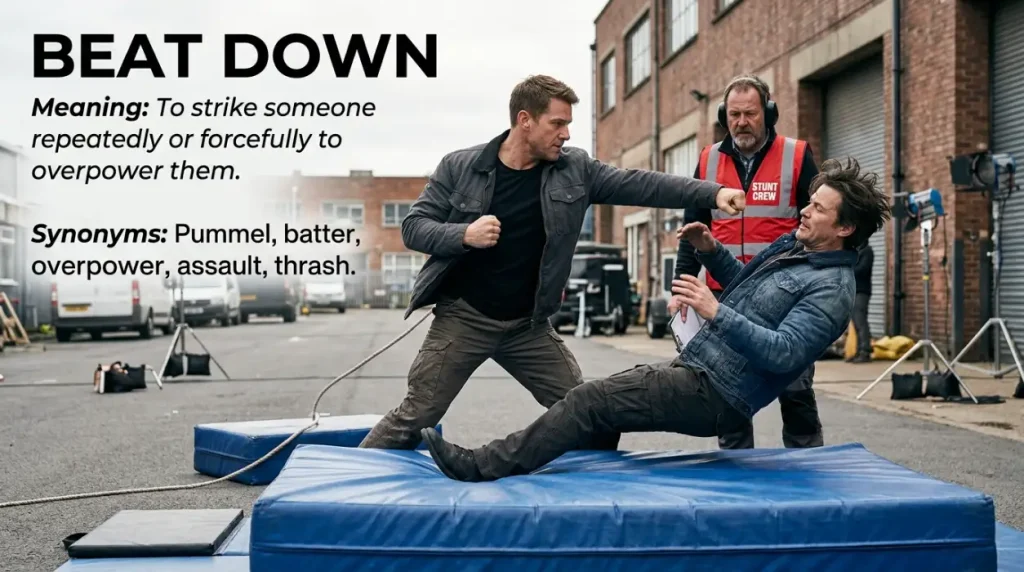
However, beat down can also describe physical action or natural forces.
The hot sun beat down on the empty road.
Here, the phrase does not describe sadness. It means the sunlight was shining intensely from above.
Part of Speech
Beat down is primarily a phrasal verb.
Its forms include:
- Present: beat down
- Past: beat down
- Past participle: beaten down
- -ing form: beating down
When describing a person’s condition, English commonly uses beaten down:
She felt beaten down by months of stress.
Therefore, when someone searches for a synonym for beat down, they may actually be looking for an alternative to either beat down or beaten down.
Emotional Tone
When the phrase describes a person, it usually carries a negative emotional tone.
It suggests that something has gradually reduced a person’s energy, confidence, hope, or resistance.
Native speakers often understand it as stronger than simply tired.
Someone can be tired after a busy day. Someone who feels beaten down has usually experienced ongoing pressure or hardship.
Common Contexts
You may hear or read beat down in:
- Everyday conversation
- Personal stories
- Workplace discussions
- Academic writing
- News and commentary
- Fiction
- Sports discussions
- Discussions of stress
- Descriptions of difficult life experiences
Connotative Meaning of “Beat Down”
Connotation (the emotional feeling or association that a word carries beyond its basic dictionary meaning) matters when selecting a synonym.
Positive Tone
Beat down is not normally positive. However, a sentence can create a positive sense of resilience.
She was beaten down by failure, but she kept trying.
The phrase describes hardship, while the larger sentence emphasizes strength and recovery.
Negative Tone
The negative sense is the most common when describing a person.
It can suggest emotional pain, discouragement, exhaustion, helplessness, or defeat.
Years of rejection left him beaten down.
Neutral Tone
A more neutral alternative may focus on the specific effect rather than the emotional image.
For example, fatigued emphasizes tiredness, while discouraged emphasizes reduced confidence.
Choosing a neutral word can make professional or academic writing more precise.
Etymology of “Beat Down”
The phrase comes from two Old English elements: beat and down.
Origin of “Beat”
The verb beat comes from Old English bēatan, meaning “to strike,” “to beat,” or “to pound.” It belongs to the wider Germanic language family.
Over time, its meaning expanded beyond physical striking.
Old English: 450–1100
In Old English, bēatan primarily referred to striking or hitting.
The word dūn, the ancestor of modern down, referred to a hill or elevated land. The directional sense developed naturally from the idea of moving from a higher position toward a lower one.
Middle English: 1100–1500
During Middle English, forms related to beat and down continued to develop.
English increasingly used verb-plus-particle combinations. These combinations could create meanings that were more figurative than the individual words suggested.
Modern English: 1500–Present
Modern English developed many figurative uses of beat down.
The expression can now describe physical force, intense weather, financial pressure, emotional hardship, and the gradual weakening of someone’s confidence.
The emotional meaning is especially common in phrases such as:
“The constant pressure beat him down.”
Pronunciation: US & UK IPA
Beat
- US: /biːt/
- UK: /biːt/
Down
- US: /daʊn/
- UK: /daʊn/
Full Phrase
- US: /ˌbiːt ˈdaʊn/
- UK: /ˌbiːt ˈdaʊn/
“Beaten Down”
- US: /ˌbiːtən ˈdaʊn/
- UK: /ˌbiːtən ˈdaʊn/
Syllables
beat-down
The phrase has two syllables.
beaten-down has three syllables:
beat-en-down
Affixation Pattern of “Beat Down”
Root: beat
Prefix: none
Suffix: none in the base form
Particle: down
The word beaten is an irregular past participle of beat. It does not follow a regular “-ed” pattern.
Synonyms List
Discouraged (Adjective) — US / UK: /dɪˈskɜːrɪdʒd/ /dɪˈskʌrɪdʒd/
Meaning: Having less confidence or hope after a setback.
Tone/Register: Neutral, everyday.
Example:
I felt discouraged after missing the deadline.
My teacher helped me make a better plan.
Demoralized (Adjective) — US / UK: /dɪˈmɔːrəlaɪzd/ /dɪˈmɒrəlaɪzd/
Meaning: Having lost confidence or motivation because of repeated problems.
Tone/Register: Formal, professional.
Example:
The workers became demoralized after months of criticism.
The manager introduced regular feedback sessions.
Disheartened (Adjective) — US / UK: /dɪsˈhɑːrtənd/ /dɪsˈhɑːtənd/
Meaning: Having lost hope or enthusiasm after disappointment.
Tone/Register: Neutral, literary.
Example:
She felt disheartened by the rejection.
A new opportunity restored her confidence.
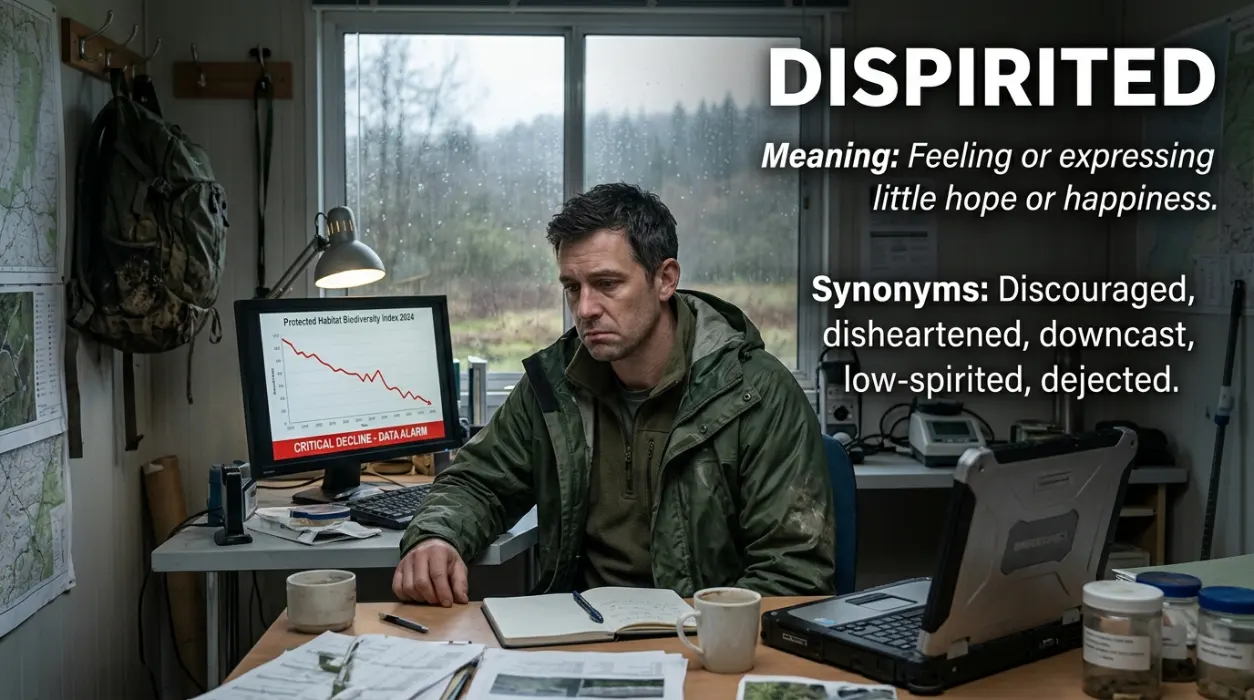
Dispirited (Adjective) — US / UK: /dɪˈspɪrɪtɪd/ /dɪˈspɪrɪtɪd/
Meaning: Lacking energy, enthusiasm, or hope.
Tone/Register: Formal, literary.
Example:
The students looked dispirited after the difficult exam.
Their tutor encouraged them to keep practicing.
Defeated (Adjective) — US / UK: /dɪˈfiːtɪd/ /dɪˈfiːtɪd/
Meaning: Feeling that you have lost and cannot continue successfully.
Tone/Register: Emotional, everyday.
Example:
He felt defeated after another unsuccessful interview.
Still, he sent out a new application.
Crushed (Adjective) — US / UK: /krʌʃt/ /krʌʃt/
Meaning: Extremely disappointed or emotionally overwhelmed.
Tone/Register: Strong, conversational.
Example:
She was crushed when her project was rejected.
Her friends reminded her of how far she had come.
Shattered (Adjective) — US / UK: /ˈʃætərd/ /ˈʃætəd/
Meaning: Extremely distressed or emotionally devastated.
Tone/Register: Very strong, emotional.
Example:
He was shattered by the sudden loss.
His family stayed close during the following weeks.
Broken (Adjective) — US / UK: /ˈbroʊkən/ /ˈbrəʊkən/
Meaning: Deeply damaged emotionally by severe hardship.
Tone/Register: Strong, informal, literary.
Example:
The experience left her feeling broken.
Gradually, she began rebuilding her confidence.
Worn Out (Adjective) — US / UK: /ˌwɔːrn ˈaʊt/ /ˌwɔːn ˈaʊt/
Meaning: Extremely tired after prolonged effort.
Tone/Register: Informal, everyday.
Example:
I’m worn out after moving all weekend.
Tonight, I just want to rest.
Exhausted (Adjective) — US / UK: /ɪɡˈzɔːstɪd/ /ɪɡˈzɔːstɪd/
Meaning: Extremely tired physically or mentally.
Tone/Register: Neutral, widely used.
Example:
The nurses were exhausted after the overnight shift.
They finally had time to sit down.
Drained (Adjective) — US / UK: /dreɪnd/ /dreɪnd/
Meaning: Having very little energy remaining.
Tone/Register: Neutral, conversational.
Example:
That argument left me drained.
I needed a quiet evening afterward.
Weary (Adjective) — US / UK: /ˈwɪri/ /ˈwɪəri/
Meaning: Very tired, especially after prolonged difficulty.
Tone/Register: Formal, literary.
Example:
After years of travel, the workers grew weary.
They wanted a calmer routine.
Fatigued (Adjective) — US / UK: /fəˈtiːɡd/ /fəˈtiːɡd/
Meaning: Physically or mentally tired after sustained effort.
Tone/Register: Formal, professional.
Example:
The pilot reported feeling fatigued.
The crew arranged an appropriate rest period.
Tired Out (Adjective) — US / UK: /ˌtaɪərd ˈaʊt/ /ˌtaɪəd ˈaʊt/
Meaning: Very tired after demanding activity.
Tone/Register: Informal, spoken.
Example:
The children were tired out after the picnic.
They fell asleep on the drive home.
Weakened (Adjective) — US / UK: /ˈwiːkənd/ /ˈwiːkənd/
Meaning: Having lost strength or resilience.
Tone/Register: Neutral, formal.
Example:
Months of stress had weakened his confidence.
He began working on smaller goals.
Overwhelmed (Adjective) — US / UK: /ˌoʊvərˈwelmd/ /ˌəʊvəˈwelmd/
Meaning: Feeling unable to cope with excessive demands or emotions.
Tone/Register: Neutral, common.
Example:
I felt overwhelmed by the amount of paperwork.
My colleague helped me organize it.
Burdened (Adjective) — US / UK: /ˈbɜːrdənd/ /ˈbɜːdəned/
Meaning: Carrying a heavy emotional or practical responsibility.
Tone/Register: Formal, serious.
Example:
She felt burdened by family responsibilities.
Her brother offered to share the work.
Downtrodden (Adjective) — US / UK: /ˈdaʊntrɑːdən/ /ˈdaʊntrɒdən/
Meaning: Persistently oppressed, mistreated, or disadvantaged.
Tone/Register: Formal, literary, social commentary.
Example:
The novel portrays downtrodden factory workers.
Its characters search for dignity and hope.
Oppressed (Adjective) — US / UK: /əˈprest/ /əˈprest/
Meaning: Subjected to prolonged unfair control or treatment.
Tone/Register: Formal, academic.
Example:
The documentary examines the lives of oppressed communities.
It focuses on their struggle for basic rights.
Subdued (Adjective) — US / UK: /səbˈduːd/ /səbˈdjuːd/
Meaning: Quieter, less energetic, or less confident than usual.
Tone/Register: Neutral, formal.
Example:
He seemed subdued during the meeting.
Usually, he speaks with much more energy.
Somber (Adjective) — US / UK: /ˈsɑːmbər/ /ˈsɒmbə/
Meaning: Serious and gloomy in mood.
Tone/Register: Formal, written.
Example:
The room became somber after the announcement.
Nobody spoke for several minutes.
Gloomy (Adjective) — US / UK: /ˈɡluːmi/ /ˈɡluːmi/
Meaning: Feeling or expressing little hope or happiness.
Tone/Register: Neutral, everyday.
Example:
He sounded gloomy on the phone.
We decided to meet for lunch.
Downcast (Adjective) — US / UK: /ˈdaʊnkæst/ /ˈdaʊnkɑːst/
Meaning: Looking sad or discouraged.
Tone/Register: Neutral, slightly literary.
Example:
The players looked downcast after the match.
Their coach praised their effort.
Low (Adjective) — US / UK: /loʊ/ /ləʊ/
Meaning: Feeling unhappy or emotionally discouraged.
Tone/Register: Informal, conversational.
Example:
I’ve been feeling low this week.
A walk outside helped clear my head.
Blue (Adjective) — US / UK: /bluː/ /bluː/
Meaning: Feeling sad or unhappy.
Tone/Register: Informal.
Example:
She felt blue after her travel plans changed.
Her friends invited her to dinner.
Melancholy (Adjective) — US / UK: /ˈmelənkɑːli/ /ˈmelənkɒli/
Meaning: Gently or deeply sad in a reflective way.
Tone/Register: Literary, artistic.
Example:
The old photograph gave him a melancholy feeling.
It reminded him of his childhood.
Sorrowful (Adjective) — US / UK: /ˈsɑːroʊfəl/ /ˈsɒrəʊfəl/
Meaning: Experiencing or expressing deep sadness.
Tone/Register: Formal, literary.
Example:
Her voice sounded sorrowful during the interview.
She spoke quietly about the loss.
Aggrieved (Adjective) — US / UK: /əˈɡriːvd/ /əˈɡriːvd/
Meaning: Feeling wronged or treated unfairly.
Tone/Register: Formal.
Example:
The employee felt aggrieved by the decision.
He asked for the matter to be reviewed.
Resigned (Adjective) — US / UK: /rɪˈzaɪnd/ /rɪˈzaɪnd/
Meaning: Accepting an unpleasant situation because change seems unlikely.
Tone/Register: Neutral, formal.
Example:
She sounded resigned to another delay.
She continued working without complaining.
Hopeless (Adjective) — US / UK: /ˈhoʊpləs/ /ˈhəʊpləs/
Meaning: Feeling that improvement is unlikely.
Tone/Register: Strong, negative.
Example:
The situation seemed hopeless at first.
A practical solution soon appeared.
Powerless (Adjective) — US / UK: /ˈpaʊərləs/ /ˈpaʊələs/
Meaning: Feeling unable to control or change a situation.
Tone/Register: Neutral, serious.
Example:
He felt powerless during the dispute.
Later, he found someone who could intervene.
Deflated (Adjective) — US / UK: /dɪˈfleɪtɪd/ /dɪˈfleɪtɪd/
Meaning: Suddenly less confident or enthusiastic after disappointment.
Tone/Register: Informal, everyday.
Example:
I felt deflated after reading the rejection email.
Then I revised my application.
Disappointed (Adjective) — US / UK: /ˌdɪsəˈpɔɪntɪd/ /ˌdɪsəˈpɔɪntɪd/
Meaning: Unhappy because an expected result did not happen.
Tone/Register: Neutral.
Example:
He was disappointed by the final score.
He still congratulated the other team.
Frustrated (Adjective) — US / UK: /ˈfrʌstreɪtɪd/ /ˈfrʌstreɪtɪd/
Meaning: Annoyed or discouraged because progress is blocked.
Tone/Register: Neutral, everyday, professional.
Example:
She became frustrated with the slow process.
She asked for clearer instructions.
Demoralizing (Adjective) — US / UK: /dɪˈmɔːrəlaɪzɪŋ/ /dɪˈmɒrəlaɪzɪŋ/
Meaning: Causing someone to lose confidence or motivation.
Tone/Register: Formal, professional.
Example:
Repeated public criticism can be demoralizing.
Private feedback may create a better learning environment.
Discouraging (Adjective) — US / UK: /dɪˈskɜːrɪdʒɪŋ/ /dɪˈskʌrɪdʒɪŋ/
Meaning: Making someone less hopeful or confident.
Tone/Register: Neutral.
Example:
The first result was discouraging.
The researchers continued the experiment.
Crushing (Adjective) — US / UK: /ˈkrʌʃɪŋ/ /ˈkrʌʃɪŋ/
Meaning: Extremely disappointing or emotionally overwhelming.
Tone/Register: Strong, emotional.
Example:
Missing the final opportunity was crushing.
She needed some time before trying again.
Battle-Weary (Adjective) — US / UK: /ˈbætəl ˌwɪri/ /ˈbætəl ˌwɪəri/
Meaning: Extremely tired after prolonged struggle or conflict.
Tone/Register: Literary, journalistic.
Example:
The battle-weary community wanted stability.
Residents began rebuilding damaged homes.
Hard-Pressed (Adjective) — US / UK: /ˌhɑːrd ˈprest/ /ˌhɑːd ˈprest/
Meaning: Under considerable pressure or difficulty.
Tone/Register: Formal, journalistic.
Example:
The small team was hard-pressed to meet demand.
Management brought in additional support.
Strained (Adjective) — US / UK: /streɪnd/ /streɪnd/
Meaning: Under pressure and showing signs of stress or difficulty.
Tone/Register: Neutral, professional.
Example:
Their friendship became strained after the disagreement.
They eventually talked honestly.
Stressed-Out (Adjective) — US / UK: /ˌstrest ˈaʊt/ /ˌstrest ˈaʊt/
Meaning: Extremely worried, tense, or mentally tired.
Tone/Register: Informal, spoken.
Example:
I’m stressed-out about tomorrow’s presentation.
I’m going to prepare tonight.
Burned-Out (Adjective) — US / UK: /ˌbɜːrnd ˈaʊt/ /ˌbɜːnd ˈaʊt/
Meaning: Emotionally and physically exhausted after prolonged stress or overwork.
Tone/Register: Informal, workplace.
Example:
She felt burned out after months of overtime.
She reduced her workload.
Run-Down (Adjective) — US / UK: /ˌrʌn ˈdaʊn/ /ˌrʌn ˈdaʊn/
Meaning: Feeling tired, weak, or lacking energy.
Tone/Register: Informal, everyday.
Example:
I’ve been feeling run-down lately.
I decided to get more sleep.

Spent (Adjective) — US / UK: /spent/ /spent/
Meaning: Having no energy left after intense effort.
Tone/Register: Neutral, concise.
Example:
After the long hike, we were spent.
We ordered dinner and rested.
Depleted (Adjective) — US / UK: /dɪˈpliːtɪd/ /dɪˈpliːtɪd/
Meaning: Having greatly reduced physical, mental, or emotional resources.
Tone/Register: Formal, professional.
Example:
The demanding project left the team emotionally depleted.
The company introduced more reasonable schedules.
Haggard (Adjective) — US / UK: /ˈhæɡərd/ /ˈhæɡəd/
Meaning: Looking exhausted because of stress, worry, or hardship.
Tone/Register: Literary, descriptive.
Example:
He looked haggard after several sleepless nights.
His friends urged him to rest.
Frazzled (Adjective) — US / UK: /ˈfræzəld/ /ˈfræzəld/
Meaning: Extremely tired, worried, or mentally disorganized.
Tone/Register: Informal.
Example:
I was completely frazzled before the event.
A quiet afternoon helped me recover.
Jaded (Adjective) — US / UK: /ˈdʒeɪdɪd/ /ˈdʒeɪdɪd/
Meaning: Less enthusiastic because of repeated experience or disappointment.
Tone/Register: Neutral, literary.
Example:
Years of complaints made him jaded.
He eventually moved to another department.
Wearied (Adjective) — US / UK: /ˈwɪərid/ /ˈwɪərid/
Meaning: Made tired by prolonged difficulty or effort.
Tone/Register: Formal, literary.
Example:
The negotiations left both sides wearied.
They agreed to continue the next day.
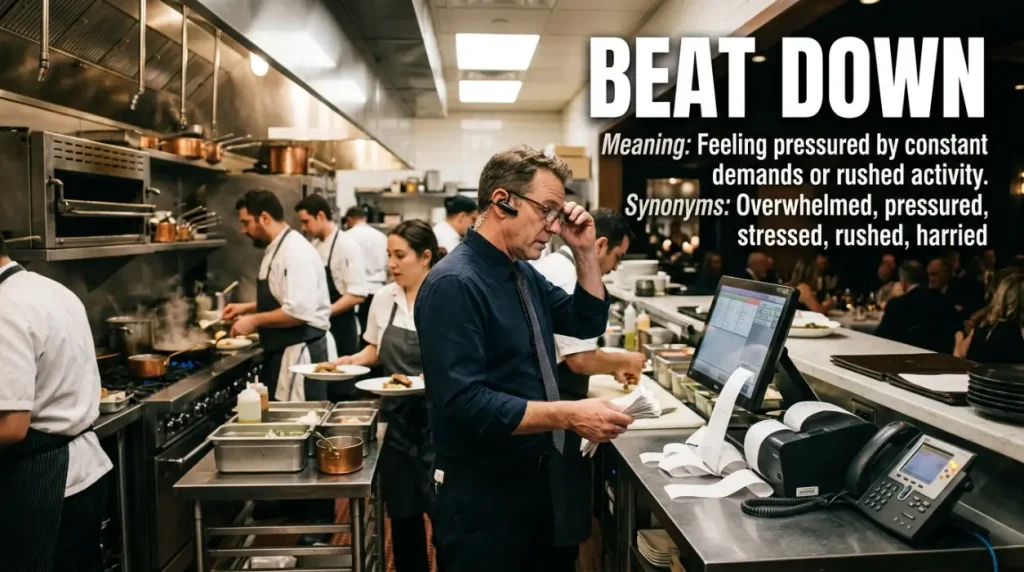
Harried (Adjective) — US / UK: /ˈhærid/ /ˈhærid/
Meaning: Feeling pressured because of constant demands or rushed activity.
Tone/Register: Formal, written.
Example:
The harried manager answered messages between meetings.
By evening, he needed some quiet time.
Synonyms by Tone
Positive or Recovery-Oriented
These choices can describe hardship without making the person sound permanently defeated:
- Discouraged
- Disappointed
- Deflated
- Weary
- Weakened
They work well when the person may recover or continue.
Neutral
For everyday or professional communication, consider:
- Drained
- Exhausted
- Fatigued
- Overwhelmed
- Strained
- Spent
- Run-down
- Mentally exhausted
- Emotionally drained
These terms usually describe the condition more directly.
Negative or Strongly Emotional
Use stronger words when the situation genuinely supports them:
- Crushed
- Shattered
- Broken
- Defeated
- Hopeless
- Powerless
- Demoralized
- Sorrowful
These words can make a sentence feel much more intense.
Informal or Playful
Casual conversations may use:
- Worn out
- Tired out
- Stressed-out
- Frazzled
- Blue
- Beat-up
- Beaten-up
These expressions may sound too casual for formal writing.
Why Tone Matters
Word choice changes how readers understand a situation.
Compare:
“She was tired.”
with:
“She was shattered.”
The first is mild. The second suggests severe emotional distress.
Therefore, do not choose a synonym simply because a dictionary lists it. Choose the word that matches the intensity, context, and intended meaning.
“Beat Down” vs Close Alternatives
Discouraged vs. Beat Down
Beat down suggests that repeated pressure has gradually weakened someone.
Discouraged focuses mainly on reduced hope or confidence.
Use beat down for a more vivid, conversational description. Use discouraged when you want a cleaner and more neutral expression.
Beat Down vs Exhausted
Exhausted focuses on extreme tiredness.
Beat down can include tiredness, but it often adds emotional defeat or prolonged hardship.
“The long hike left me exhausted.”
“Years of criticism left him beaten down.”
The first is mainly physical. The second is mainly emotional.
Beat Down vs Demoralized
Demoralized specifically emphasizes reduced morale, motivation, or confidence.
It is especially useful in professional and academic contexts.
“The repeated failures demoralized the team.”
This sounds more formal than:
“The repeated failures beat the team down.”
How “Beat Down” Changes by Context
Daily Conversation
In casual speech, beat down is natural when discussing stress or difficult experiences.
“I’ve been feeling beat down lately.”
You can soften the statement with drained or tired.
You can strengthen it with crushed, defeated, or shattered, depending on the situation.
Writing and Blogging
Bloggers often use beat down because it creates a strong emotional image.
However, repeating it too often can make content sound predictable.
For variety, use:
- Discouraged
- Overwhelmed
- Worn down
- Emotionally drained
- Weary
A specific synonym can also improve semantic clarity.
Professional or Academic English
Formal writing usually benefits from precise vocabulary.
Instead of:
“The employees felt beat down.”
you could write:
“The employees reported feeling demoralized.”
Or:
“The prolonged workload left staff emotionally depleted.”
These versions identify the specific effect more clearly.
Creative or Informal Use
Creative writing allows stronger emotional language.
A character might be haggard after sleepless nights.
Another character might feel crestfallen after rejection.
A tragic character might be shattered by loss.
The right synonym helps readers experience the scene rather than simply understand it.
Common Mistakes Learners Make
Mistake 1: Confusing “Beat Down” and “Beaten Down”
The base phrasal verb is beat down.
When describing someone’s condition, beaten down is often the natural form.
“The criticism beat him down.”
“He felt beaten down by the criticism.”
Mistake 2: Using “Exhausted” for Every Situation
Exhaustion is about energy.
Beaten down can involve emotional defeat.
Someone can be exhausted after exercising without feeling discouraged at all.
Mistake 3: Overusing Strong Emotional Words
Words such as broken, shattered, and hopeless are powerful.
Using them for minor inconveniences can make your English sound exaggerated.
Mistake 4: Confusing “Beat-Up” With “Beaten Down”
Beat-up often describes physical appearance or damage.
“The beat-up car still runs.”
Beaten down commonly describes emotional or psychological effects.
“The constant pressure left her beaten down.”
Mistake 5: Ignoring Register
Frazzled is natural in casual speech.
Demoralized is more appropriate in formal workplace writing.
Crestfallen is more literary.
Register matters because native speakers choose vocabulary based on audience and situation.
Register Notes
Informal and Spoken
Use:
- Worn out
- Tired out
- Drained
- Frazzled
- Stressed-out
- Beat-up
Neutral
Use:
- Discouraged
- Exhausted
- Overwhelmed
- Disappointed
- Frustrated
- Weakened
Formal
Use:
- Demoralized
- Depleted
- Fatigued
- Burdened
- Aggrieved
- Downtrodden
Literary
Use:
- Melancholy
- Haggard
- Weary
- Crestfallen
- Battle-weary
- Sorrowful
Real-Life Mini Scenarios
Workplace
After several months of unrealistic deadlines, an employee might say:
“I feel beaten down by the workload.”
A formal report might instead say:
“Staff members reported feeling emotionally depleted.”
Social Situation
After repeated criticism from a friend, someone might say:
“Those comments really discouraged me.”
That sounds less dramatic than shattered and more specific than simply saying sad.
Media and Pop Culture
A sports commentator might describe a team as demoralized after repeated defeats.
A movie review might describe a character as crestfallen after a major disappointment.
A documentary may use downtrodden when discussing prolonged social hardship.
Writing and Storytelling
A novelist can use weary to show long-term struggle without suggesting complete defeat.
For example:
“She looked weary, but her eyes still showed determination.”
That sentence creates a more complex character than simply calling her broken.
Practice Exercise
1. After working three long shifts, Sara has almost no energy left. Which word fits best?
A. Crestfallen
B. Exhausted
C. Downtrodden
D. Aggrieved
2. A student has lost confidence after failing several tests.
A. Demoralized
B. Energetic
C. Playful
D. Relaxed
3. Someone says, “There is too much work, and I don’t know where to start.”
A. Overwhelmed
B. Melancholy
C. Beat-up
D. Sorrowful
4. Which word works best in a formal workplace report?
A. Blue
B. Frazzled
C. Demoralized
D. Tired out
5. A worker is emotionally exhausted after months of excessive overtime.
A. Burned-out
B. Curious
C. Cheerful
D. Proud
6. Which alternative is relatively mild?
A. Shattered
B. Discouraged
C. Broken
D. Hopeless
7. A character looks exhausted after several sleepless nights.
A. Haggard
B. Blue
C. Deflated
D. Frustrated
8. Which expression commonly describes a damaged old object?
A. Beat-up
B. Disheartened
C. Demoralized
D. Burdened
9. Someone accepts an unpleasant situation because they no longer expect change.
A. Resigned
B. Crushing
C. Energetic
D. Excited
10. A person feels unable to change a difficult situation.
A. Powerless
B. Weary
C. Melancholy
D. Spent
Answer Key: 1-B | 2-A | 3-A | 4-C | 5-A | 6-B | 7-A | 8-A | 9-A | 10-A
Reflection Task
Write one sentence using beat down to describe a difficult situation. Then rewrite it using discouraged, drained, or weary. Notice how the emotional shade changes.
Conclusion
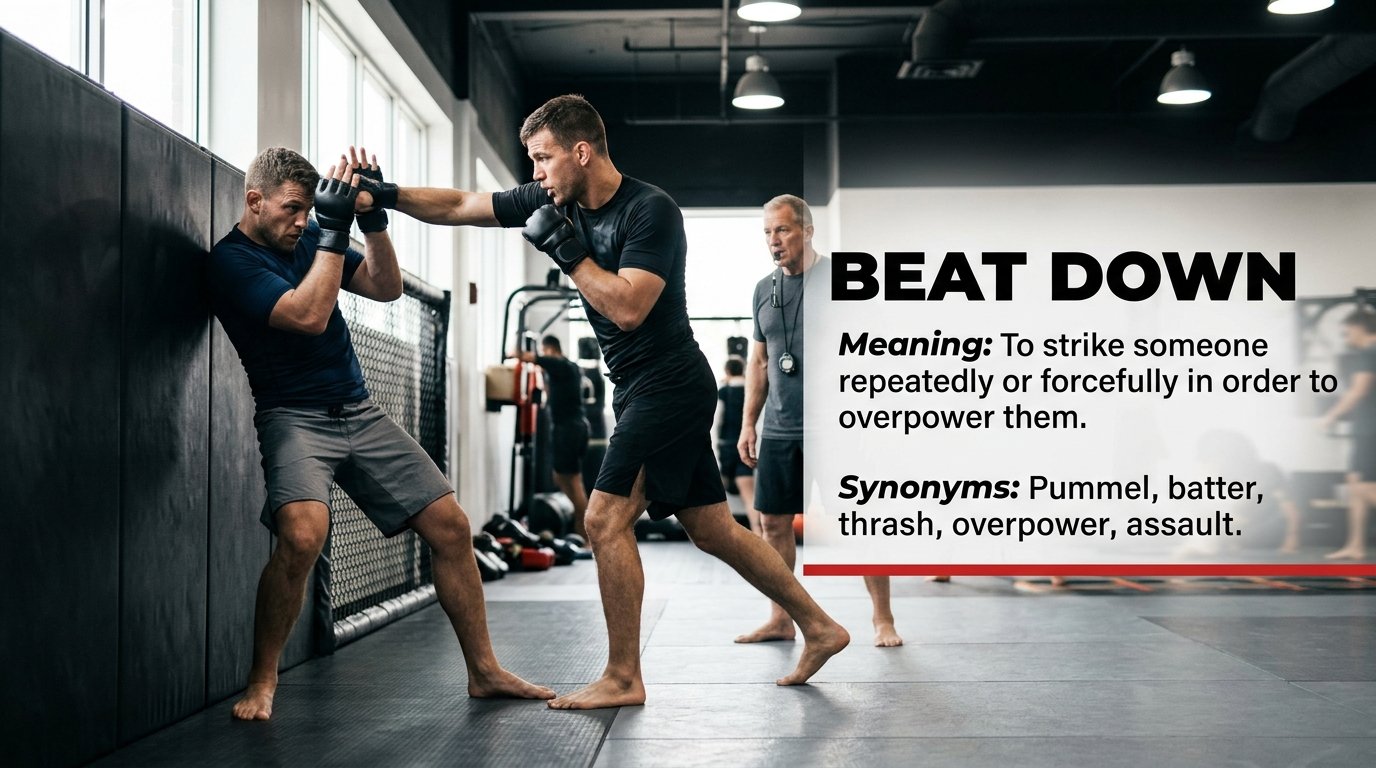
Understanding beat down can help you describe the act of striking someone repeatedly, defeating someone, or making someone feel exhausted or discouraged. It can also describe reducing or weakening something through repeated force or pressure.
The phrase beat down is commonly used in everyday conversations, physical descriptions, and figurative expressions. Knowing its related synonyms can help you express ideas such as defeat, overpower, exhaust, weaken, or wear down in different contexts.
By practicing beat down in sentences and exploring related expressions, you can strengthen your vocabulary and writing skills. A clear understanding of this phrase will help you use it naturally, accurately, and confidently in different English contexts.
FAQs
1. What is a good synonym for “beat down” when talking about emotions?
A good emotional alternative depends on the exact feeling. Discouraged works for reduced confidence, demoralized suggests lost motivation, and drained emphasizes low emotional energy. If the situation involves severe disappointment, crushed or shattered may fit better. The most accurate synonym is the one that identifies the specific emotional effect.
2. What is a professional synonym for “beat down”?
In professional writing, demoralized, emotionally depleted, fatigued, overwhelmed, or weakened can work well. “Demoralized” is especially useful when workplace conditions have reduced employee motivation or confidence. “Emotionally depleted” is more descriptive and measured. Choose the term that identifies the specific effect rather than replacing the phrase automatically.
3. Is “beat down” the same as “worn down”?
They are closely related, but they emphasize slightly different ideas. Worn down usually suggests gradual weakening caused by continuous effort, stress, or difficulty. Beat down can also suggest discouragement or emotional defeat. Therefore, “worn down” often sounds more gradual and neutral, while “beat down” can carry a stronger emotional image.
4. What is the difference between “beat down” and “beat up”?
Beat down can describe emotional weakening or the physical action of striking downward. Beat up commonly describes physical violence or something that looks damaged and worn. For example, “The pressure beat him down” describes emotional hardship, while “The beat-up car needs repairs” describes physical condition.
5. What is a softer way to say “I feel beat down”?
Try “I feel discouraged,” “I feel drained,” “I feel worn out,” or “I feel overwhelmed.” These expressions usually sound less dramatic than “I feel beaten down.” Your choice depends on the cause. Use “drained” for low energy, “discouraged” for lost confidence, and “overwhelmed” when demands feel difficult to manage.

Hasnain Ali is an SEO Content Strategist and the founder of wordvora.com, a trusted vocabulary platform that helps writers, students, professionals, and English learners find accurate synonyms, antonyms, word meanings, and real-life usage examples. He specializes in keyword research, on-page SEO, topical authority, and creating search-first content that aligns with Google’s latest Search Quality and E-E-A-T guidelines. His work focuses on producing clear, well-structured, and reader-friendly resources that satisfy search intent while maintaining high editorial standards.
Through extensive hands-on experience with SEO tools such as Google Search Console, Google Analytics, SEMrush, and Ahrefs, Hasnain researches user search behavior and develops content that is both informative and easy to understand. Every article published on wordvora.com is carefully reviewed for accuracy, readability, and contextual relevance before publication. His mission is to build one of the web’s most reliable English vocabulary resources by providing practical language guidance, trustworthy explanations, and content that helps readers improve their writing, communication, and vocabulary with confidence.