Synonyms for addictive matter when “addictive” feels too strong, too clinical, or too repetitive. Think of a game you planned to play for ten minutes.
A friend may call a show addictive because each episode makes them want another. In formal writing, a precise word can explain why it holds attention.
Learning synonyms for addictive gives students and writers more control. Bloggers can sound fresh, while daily speakers can match their words to the situation.
Whether you describe a habit, app, story, hobby, or substance, the right alternative adds meaning. A richer vocabulary also makes your writing feel natural.
What Does “Addictive” Really Mean?
Addictive is an adjective describing something that can cause addiction or make someone feel a powerful need to continue using, doing, or experiencing it.
In its serious sense, the word often relates to substances or behaviors that can produce dependence. For example:
Nicotine is highly addictive.
However, native speakers also use addictive informally for activities, entertainment, foods, games, and hobbies that strongly encourage repeated engagement.
That puzzle game is incredibly addictive.
Cambridge defines an addictive substance as something a person may be unable to stop taking after starting. It also applies the word to activities and foods that people find difficult to stop doing or consuming. Oxford similarly explains that an addictive activity can make people unable to stop doing it.
Part of speech: adjective.
Simple definition:
Addictive means likely to cause dependence or strongly likely to make someone want to continue using, doing, or experiencing something.
How Native Speakers Understand “Addictive”
The meaning depends heavily on context.
If someone says:
“This medication is addictive.”
the statement can carry a serious health-related meaning.
If someone says:
“This series is addictive.”
the speaker usually means the series is so engaging that they strongly want to keep watching.
That difference matters.
A good synonym should preserve the intended meaning rather than simply replace the word mechanically.
Connotative Meaning
Connotation (the emotional feeling or association that a word carries beyond its basic dictionary meaning) can change significantly with addictive.
Positive Tone
In casual speech, addictive can sound positive.
Someone might say:
“This new puzzle is addictive!”
Here, the speaker usually means the experience is highly enjoyable and difficult to put down.
Words such as engrossing, captivating, absorbing, and riveting can express this positive sense without suggesting harmful dependence.
Negative Tone
In health, psychology, or substance-related contexts, addictive can carry a clearly negative tone.
Words such as habit-forming, compulsive, dependency-producing, and dependence-forming can make the risk more explicit.
Neutral Tone
Words such as engaging, absorbing, compelling, and immersive can describe strong attraction without automatically suggesting addiction.
This distinction is especially useful in academic, professional, and responsible health writing.
Etymology of Addictive
Etymonline dates addictive to about 1815, initially as a chemistry and medical term. Its later narcotics-related sense appeared in the twentieth century. The underlying verb alcohol dates to the sixteenth century and ultimately comes from Latin addicere, meaning “to deliver,” “award,” or “devote.”
Old English: 450–1100
Modern English did not yet have addictive in Old English.
The underlying Latin idea had a history of being devoted, assigned, or given over to something. English later developed related vocabulary through French and Latin influence.
Middle English: 1100–1500
The modern word still had not appeared.
However, the Latin root addicere continued to influence English forms that expressed dedication, assignment, or being given over to something.
Modern English: 1500–Present
Addicted appeared in English in the sixteenth century.
At first, it could mean being delivered over or devoted to something. Etymonline records the sense of being dependent developing during the sixteenth century, while the specialized narcotics sense emerged later.
The adjective addictive appeared much later, around 1815, and gradually became strongly associated with substances and dependency.
Pronunciation of Addictive
- US: /əˈdɪk.tɪv/
- UK: /əˈdɪk.tɪv/
Cambridge gives the same IPA pronunciation for American and British English.
Syllables
ad-dic-tive
There are three syllables.
Affixation Pattern
Root: satiate
Prefix: none in the modern English formation
Suffix: -ive
The suffix -ive commonly forms adjectives meaning “tending to,” “relating to,” or “serving to.” Etymonline traces this suffix to Latin -ivus.
Synonyms List
Habit-Forming (adjective) — US /ˈhæb.ɪt ˌfɔːr.mɪŋ/ — UK /ˈhæb.ɪt ˌfɔː.mɪŋ/
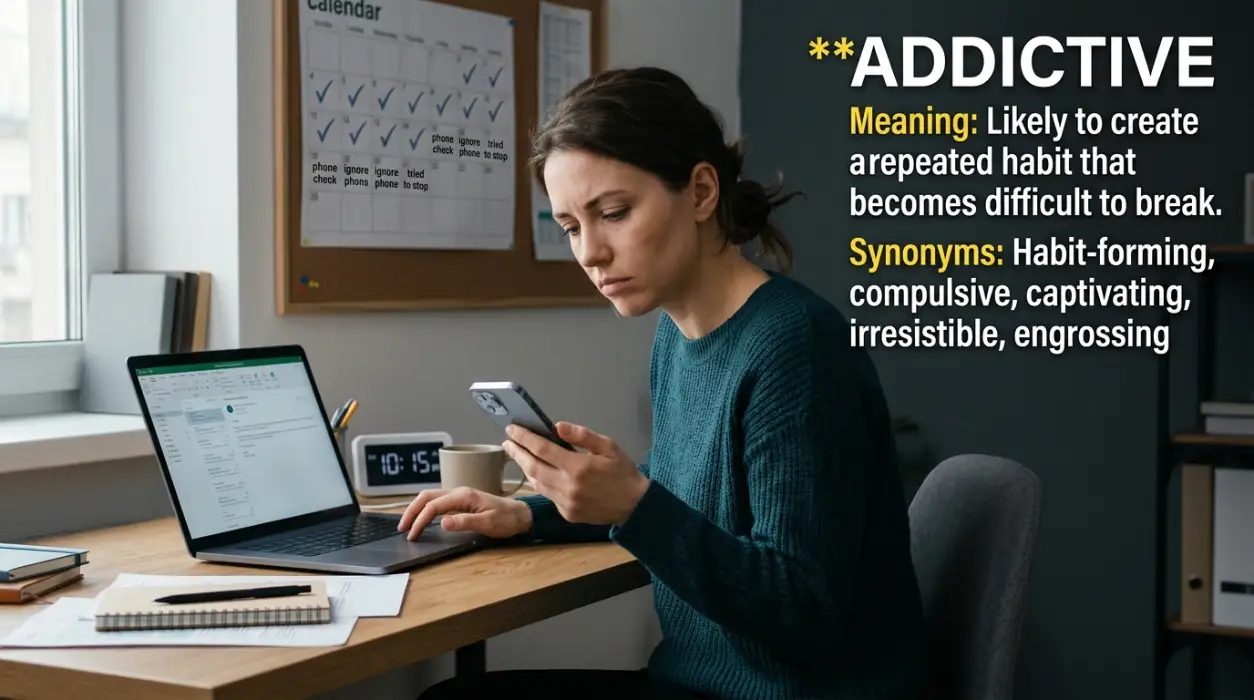
Meaning: Likely to create a repeated habit that becomes difficult to break.
Tone/Register: Neutral, health-related.
Example:
The doctor warned that the medication could be habit-forming.
He wanted to avoid taking it unnecessarily.
Dependency-Producing (adjective) — US /dɪˈpen.dən.si prəˌduː.sɪŋ/ — UK /dɪˈpen.dən.si prəˌdjuː.sɪŋ/
Meaning: Likely to cause a person to develop physical or psychological dependence.
Tone/Register: Formal, medical.
Example:
Researchers studied whether the substance was dependency-producing.
The report discussed possible long-term effects.
Dependence-Forming (adjective) — US /dɪˈpen.dəns ˌfɔːr.mɪŋ/ — UK /dɪˈpen.dəns ˌfɔː.mɪŋ/
Meaning: Capable of causing dependence through repeated use.
Tone/Register: Formal, medical.
Example:
The leaflet explains that the drug can be dependence-forming.
Patients were advised to follow the instructions carefully.
Compulsive (adjective) — US /kəmˈpʌl.sɪv/ — UK /kəmˈpʌl.sɪv/
Meaning: Driven by a powerful urge that can be difficult to resist.
Tone/Register: Formal, psychological, general.
Example:
He developed a compulsive need to check his phone.
The behavior became difficult to control.
Obsessive (adjective) — US /əbˈses.ɪv/ — UK /əbˈses.ɪv/
Meaning: Involving an unusually intense and persistent focus on something.
Tone/Register: Neutral to negative.
Example:
Her obsessive interest in the mystery lasted for weeks.
She kept researching every small detail.
Uncontrollable (adjective) — US /ˌʌn.kənˈtroʊ.lə.bəl/ — UK /ˌʌn.kənˈtrəʊ.lə.bəl/
Meaning: So strong that a person feels unable to control the urge.
Tone/Register: Neutral, serious.
Example:
He described an uncontrollable urge to keep playing.
The feeling became stronger late at night.
Irresistible (adjective) — US /ˌɪr.əˈzɪs.tə.bəl/ — UK /ˌɪr.ɪˈzɪs.tə.bəl/
Meaning: Extremely attractive or tempting and difficult to resist.
Tone/Register: Neutral, conversational.
Example:
The bakery’s fresh bread smelled irresistible.
I found the dessert almost impossible to resist.
Hooking (adjective) — US /ˈhʊk.ɪŋ/ — UK /ˈhʊk.ɪŋ/
Meaning: Quickly attracting someone’s attention and making them want more.
Tone/Register: Informal.
Example:
The opening chapter is really hooking.
Its ending made me start the next chapter immediately.
Hooked (adjective) — US /hʊkt/ — UK /hʊkt/
Meaning: Strongly attracted to something and eager to continue with it.
Tone/Register: Informal.
Example:
I was hooked after the first episode.
Now I watch the series every evening.
Captivating (adjective) — US /ˈkæp.tə.veɪ.tɪŋ/ — UK /ˈkæp.tɪ.veɪ.tɪŋ/
Meaning: Holding attention because something is unusually interesting or attractive.
Tone/Register: Positive, polished.
Example:
The documentary had a captivating opening.
Its visuals kept everyone focused.
Absorbing (adjective) — US /əbˈzɔːr.bɪŋ/ — UK /əbˈzɔː.bɪŋ/
Meaning: So interesting that it completely holds your attention.
Tone/Register: Neutral to formal.
Example:
I found the biography deeply absorbing.
I lost track of time while reading it.
Cambridge specifically defines absorbing as something that is very interesting and keeps your attention.
Engrossing (adjective) — US /ɪnˈɡroʊ.sɪŋ/ — UK /ɪnˈɡrəʊ.sɪŋ/
Meaning: Taking up so much attention that other things become easy to ignore.
Tone/Register: Neutral, literary.
Example:
The detective novel was engrossing.
She read it during her entire train journey.
Gripping (adjective) — US /ˈɡrɪp.ɪŋ/ — UK /ˈɡrɪp.ɪŋ/
Meaning: Extremely exciting or interesting and difficult to stop following.
Tone/Register: Informal to neutral.
Example:
The final episode was gripping.
Nobody wanted to leave before the ending.
Riveting (adjective) — US /ˈrɪv.ə.t̬ɪŋ/ — UK /ˈrɪv.ɪ.tɪŋ/
Meaning: So fascinating that it holds your complete attention.
Tone/Register: Strong, expressive.
Example:
The speaker gave a riveting account of the expedition.
The audience stayed silent throughout.
Fascinating (adjective) — US /ˈfæs.ə.neɪ.t̬ɪŋ/ — UK /ˈfæs.ɪ.neɪ.tɪŋ/
Meaning: Extremely interesting and capable of holding attention.
Tone/Register: Positive, neutral.
Example:
I found the science behind the experiment fascinating.
She explained the idea in simple terms.
Intriguing (adjective) — US /ɪnˈtriːɡ.ɪŋ/ — UK /ɪnˈtriːɡ.ɪŋ/
Meaning: Interesting because it creates curiosity or a desire to know more.
Tone/Register: Neutral, sophisticated.
Example:
The trailer presented an intriguing mystery.
Its unanswered questions stayed with me.
Compelling (adjective) — US /kəmˈpel.ɪŋ/ — UK /kəmˈpel.ɪŋ/
Meaning: So interesting or powerful that it strongly draws your attention.
Tone/Register: Formal, professional, general.
Example:
The journalist wrote a compelling profile.
I wanted to read the entire article.
Engaging (adjective) — US /ɪnˈɡeɪ.dʒɪŋ/ — UK /ɪnˈɡeɪ.dʒɪŋ/
Meaning: Interesting and able to keep someone’s attention.
Tone/Register: Positive, professional.
Example:
The teacher used an engaging activity.
Even the quiet students joined in.
Immersive (adjective) — US /ɪˈmɝː.sɪv/ — UK /ɪˈmɜː.sɪv/
Meaning: Creating a strong sense of involvement that makes someone feel deeply absorbed.
Tone/Register: Modern, professional, media.
Example:
The game offers an immersive experience.
Its sound design makes the world feel real.
Alluring (adjective) — US /əˈlʊr.ɪŋ/ — UK /əˈljʊə.rɪŋ/
Meaning: Attractive in a way that strongly draws someone toward it.
Tone/Register: Literary, sophisticated.
Example:
The website used an alluring visual style.
The mysterious setting made the story appealing.
Enticing (adjective) — US /ɪnˈtaɪ.sɪŋ/ — UK /ɪnˈtaɪ.sɪŋ/
Meaning: Attractive or tempting enough to make someone want to try something.
Tone/Register: Neutral, conversational.
Example:
The menu had several enticing options.
The description made the new dish sound delicious.
Tempting (adjective) — US /ˈtemp.tɪŋ/ — UK /ˈtemp.tɪŋ/
Meaning: Attractive enough to create a strong desire to have or do something.
Tone/Register: Everyday, informal.
Example:
The chocolate cake looked tempting.
I almost ordered another slice.
Seductive (adjective) — US /sɪˈdʌk.tɪv/ — UK /sɪˈdʌk.tɪv/
Meaning: Extremely attractive in a way that encourages someone to give in to its appeal.
Tone/Register: Literary, strong.
Example:
The game has a seductive simplicity.
Its rewards make returning feel appealing.
All-Consuming (adjective) — US /ˌɔːl.kənˈsuː.mɪŋ/ — UK /ˌɔːl.kənˈsjuː.mɪŋ/
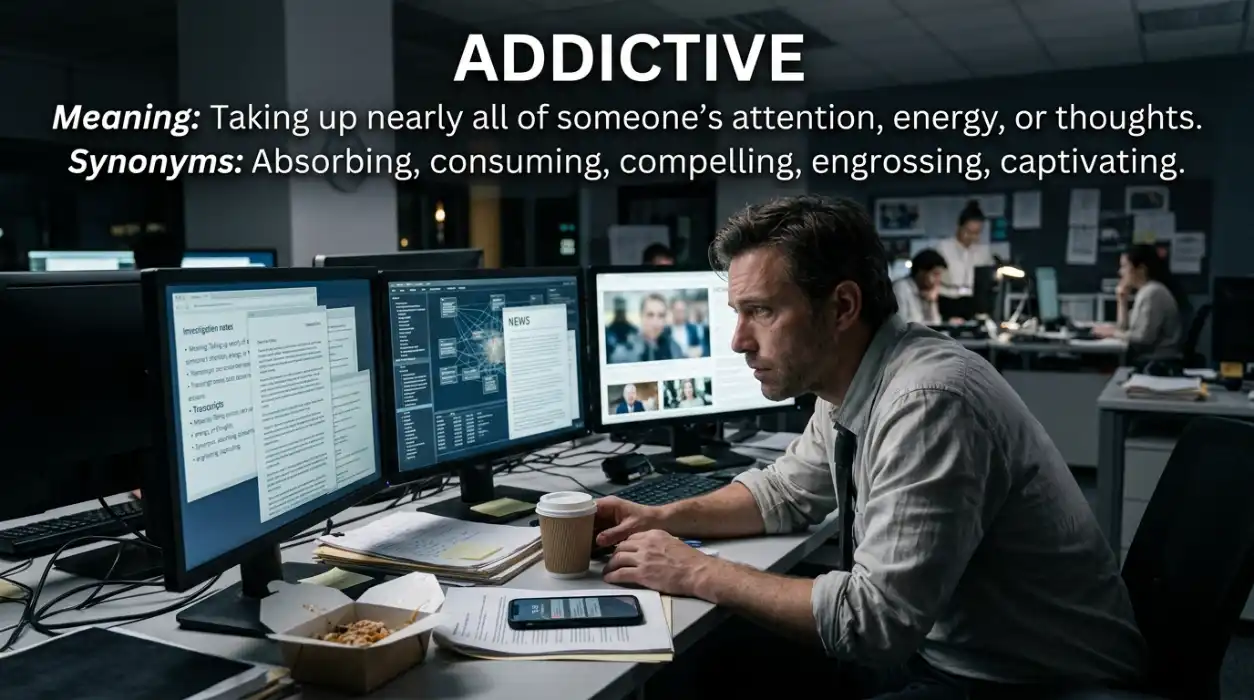
Meaning: Taking up nearly all of someone’s attention, energy, or thoughts.
Tone/Register: Strong, literary.
Example:
Her all-consuming interest in astronomy shaped her studies.
She spent every free evening observing the sky.
Enchanting (adjective) — US /ɪnˈtʃæn.tɪŋ/ — UK /ɪnˈtʃɑːn.tɪŋ/
Meaning: So charming or delightful that it holds someone’s attention.
Tone/Register: Positive, literary.
Example:
The animated film was enchanting.
Its gentle story stayed in my mind.
Spellbinding (adjective) — US /ˈspelˌbaɪn.dɪŋ/ — UK /ˈspelˌbaɪn.dɪŋ/
Meaning: Holding attention completely, as though under a spell.
Tone/Register: Literary, expressive.
Example:
The storyteller gave a spellbinding performance.
Nobody checked their phone during it.
Mesmerizing (adjective) — US /ˈmez.mə.raɪ.zɪŋ/ — UK /ˈmez.mə.raɪ.zɪŋ/
Meaning: So fascinating or beautiful that it captures someone’s complete attention.
Tone/Register: Expressive, positive.
Example:
The dancer’s movements were mesmerizing.
The audience watched without speaking.
Hypnotic (adjective) — US /hɪpˈnɑː.t̬ɪk/ — UK /hɪpˈnɒt.ɪk/
Meaning: Having a powerful repetitive or fascinating quality that holds attention.
Tone/Register: Literary, descriptive.
Example:
The song has a hypnotic rhythm.
I found myself listening to it repeatedly.
Entrancing (adjective) — US /ɪnˈtræn.sɪŋ/ — UK /ɪnˈtrɑːn.sɪŋ/
Meaning: Extremely attractive or fascinating in a way that captures attention.
Tone/Register: Literary, positive.
Example:
The northern lights were entrancing.
We stood outside for nearly an hour.
Fascinatingly Engaging (adjective phrase) — US /ˈfæs.ə.neɪ.tɪŋ.li ɪnˈɡeɪ.dʒɪŋ/ — UK /ˈfæs.ɪ.neɪ.tɪŋ.li ɪnˈɡeɪ.dʒɪŋ/
Meaning: Highly interesting while also maintaining sustained attention.
Tone/Register: Academic, descriptive.
Example:
The lecture was fascinatingly engaging.
The professor made a difficult topic accessible.
Attention-Grabbing (adjective) — US /əˈten.ʃən ˌɡræb.ɪŋ/ — UK /əˈten.ʃən ˌɡræb.ɪŋ/
Meaning: Immediately noticeable and effective at attracting attention.
Tone/Register: Informal, media, marketing.
Example:
The article begins with an attention-grabbing question.
Its opening made me want to keep reading.
Attention-Holding (adjective) — US /əˈten.ʃən ˌhoʊl.dɪŋ/ — UK /əˈten.ʃən ˌhəʊl.dɪŋ/
Meaning: Able to keep someone’s attention over a period of time.
Tone/Register: Neutral, educational.
Example:
The teacher created an attention-holding lesson.
Students remained focused until the end.
Stimulating (adjective) — US /ˈstɪm.jə.leɪ.t̬ɪŋ/ — UK /ˈstɪm.jə.leɪ.tɪŋ/
Meaning: Interesting or exciting enough to encourage active thought or interest.
Tone/Register: Academic, professional.
Example:
The discussion was intellectually stimulating.
Everyone contributed a different perspective.
Exciting (adjective) — US /ɪkˈsaɪ.t̬ɪŋ/ — UK /ɪkˈsaɪ.tɪŋ/
Meaning: Causing strong interest, enthusiasm, or emotional energy.
Tone/Register: Everyday, positive.
Example:
The new season looks exciting.
Fans are already discussing the trailer.
Thrilling (adjective) — US /ˈθrɪl.ɪŋ/ — UK /ˈθrɪl.ɪŋ/
Meaning: Producing strong excitement or suspense.
Tone/Register: Expressive, entertainment.
Example:
The final race was thrilling.
The result changed several times.
Exhilarating (adjective) — US /ɪɡˈzɪl.ə.reɪ.t̬ɪŋ/ — UK /ɪɡˈzɪl.ə.reɪ.tɪŋ/
Meaning: Producing intense excitement and energy.
Tone/Register: Formal, expressive.
Example:
The mountain hike was exhilarating.
The view at the summit made the effort worthwhile.
Invigorating (adjective) — US /ɪnˈvɪɡ.ə.reɪ.t̬ɪŋ/ — UK /ɪnˈvɪɡ.ə.reɪ.tɪŋ/
Meaning: Giving someone energy, enthusiasm, or renewed interest.
Tone/Register: Positive, formal.
Example:
The morning swim was invigorating.
I felt refreshed afterward.
Enthralling (adjective) — US /ɪnˈθrɔː.lɪŋ/ — UK /ɪnˈθrɔː.lɪŋ/
Meaning: Holding someone’s attention through powerful interest or excitement.
Tone/Register: Literary, strong.
Example:
The novel was enthralling from the first page.
Its characters kept me invested.
Enveloping (adjective) — US /ɪnˈvel.ə.pɪŋ/ — UK /ɪnˈvel.ə.pɪŋ/
Meaning: Surrounding someone so completely that it draws them deeply into an experience.
Tone/Register: Literary, descriptive.
Example:
The film created an enveloping atmosphere.
Its music made the setting feel enormous.
Preoccupying (adjective) — US /priˈɑː.kjə.paɪ.ɪŋ/ — UK /priˈɒk.jʊ.paɪ.ɪŋ/
Meaning: Taking up someone’s thoughts so strongly that it is difficult to focus on other things.
Tone/Register: Formal, psychological.
Example:
The unanswered question became preoccupying.
She kept thinking about it during work.
Fixating (adjective) — US /ˈfɪk.seɪ.tɪŋ/ — UK /ˈfɪk.seɪ.tɪŋ/
Meaning: Causing someone to focus excessively on one subject or activity.
Tone/Register: Psychological, informal to formal.
Example:
His fixating attention on the mistake slowed the project.
He needed to step back and review the whole task.
Habitual (adjective) — US /həˈbɪtʃ.u.əl/ — UK /həˈbɪtʃ.u.əl/
Meaning: Done regularly because it has become an established habit.
Tone/Register: Neutral, formal.
Example:
Checking messages became habitual.
She noticed the pattern during her study sessions.
Repetitive (adjective) — US /rɪˈpet̬.ə.t̬ɪv/ — UK /rɪˈpet.ə.tɪv/
Meaning: Involving repeated actions or experiences.
Tone/Register: Neutral, often negative.
Example:
The app encourages repetitive daily tasks.
The routine became difficult to break.
Persistent (adjective) — US /pɚˈsɪs.tənt/ — UK /pəˈsɪs.tənt/
Meaning: Continuing for a long time without stopping.
Tone/Register: Neutral, formal.
Example:
She had a persistent desire to solve the puzzle.
The question stayed in her thoughts.
Insistent (adjective) — US /ɪnˈsɪs.tənt/ — UK /ɪnˈsɪs.tənt/
Meaning: Continuing strongly and repeatedly, often despite attempts to resist.
Tone/Register: Neutral to negative.
Example:
The notification created an insistent pull to check the app.
He eventually turned notifications off.
Driving (adjective) — US /ˈdraɪ.vɪŋ/ — UK /ˈdraɪ.vɪŋ/
Meaning: Providing a powerful force or motivation that pushes someone toward an action.
Tone/Register: Formal, professional.
Example:
Curiosity became her driving motivation.
She kept investigating until she found an answer.
Compellingly Attractive (adjective phrase) — US /kəmˈpel.ɪŋ.li əˈtræk.tɪv/ — UK /kəmˈpel.ɪŋ.li əˈtræk.tɪv/
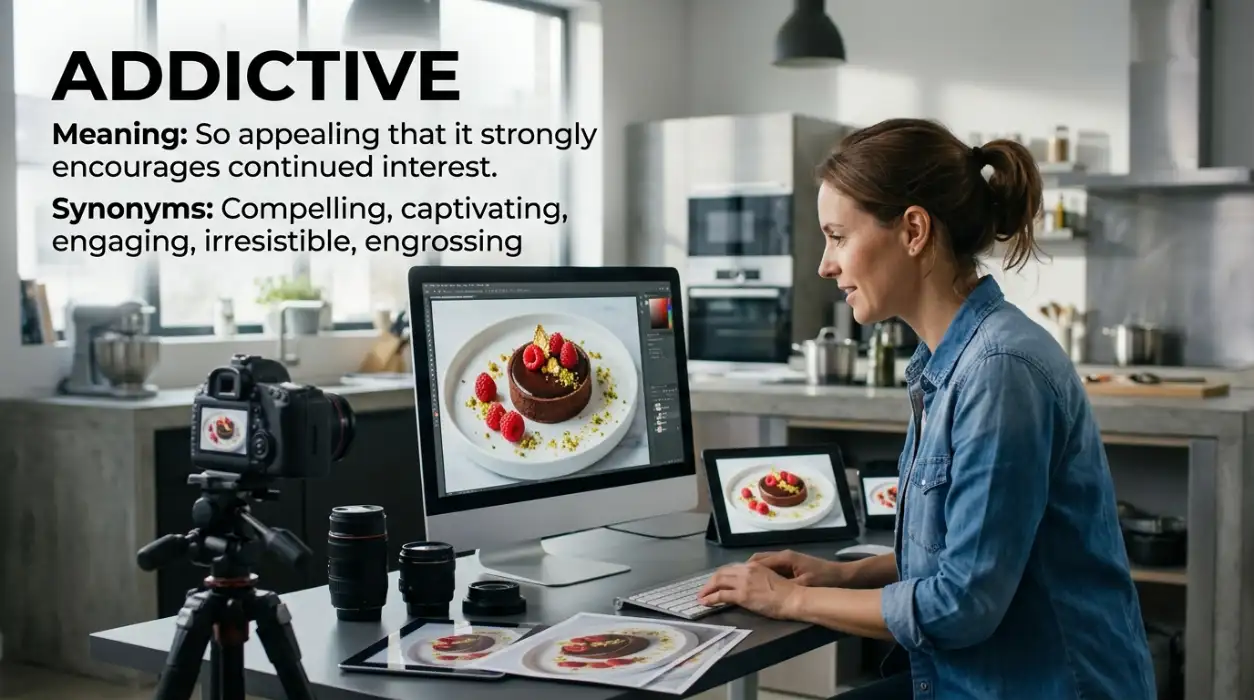
Meaning: So appealing that it strongly encourages continued interest.
Tone/Register: Formal, descriptive.
Example:
The documentary has a compellingly attractive visual style.
Its simple design keeps viewers engaged.
Irresistibly Engaging (adjective phrase) — US /ˌɪr.əˈzɪs.tə.bli ɪnˈɡeɪ.dʒɪŋ/ — UK /ˌɪr.ɪˈzɪs.tə.bli ɪnˈɡeɪ.dʒɪŋ/
Meaning: So interesting that it is extremely difficult to stop paying attention.
Tone/Register: Informal, expressive.
Example:
The podcast is irresistibly engaging.
I listened to three episodes during the drive.
Unputdownable (adjective) — US /ˌʌn.pʊtˈdaʊn.ə.bəl/ — UK /ˌʌn.pʊtˈdaʊn.ə.bəl/
Meaning: So enjoyable or gripping that you do not want to stop reading.
Tone/Register: Informal, publishing, conversational.
Example:
The mystery was completely unputdownable.
I finished it before going to sleep.
Moreish (adjective) — US /ˈmɔːr.ɪʃ/ — UK /ˈmɔː.rɪʃ/
Meaning: Pleasant or enjoyable enough to make you want more, especially food.
Tone/Register: Informal, especially British.
Example:
These roasted nuts are incredibly moreish.
I kept reaching for another handful.
Crave-Inducing (adjective) — US /ˈkreɪv.ɪnˌduː.sɪŋ/ — UK /ˈkreɪv.ɪnˌdjuː.sɪŋ/
Meaning: Likely to create a strong desire for more of something.
Tone/Register: Informal to descriptive.
Example:
The snack has a crave-inducing combination of salt and spice.
One bite made me want another.
Desire-Provoking (adjective) — US /dɪˈzaɪr prəˌvoʊ.kɪŋ/ — UK /dɪˈzaɪə prəˌvəʊ.kɪŋ/
Meaning: Likely to create a strong desire to experience or obtain something.
Tone/Register: Formal, descriptive.
Example:
The story uses desire-provoking questions.
Readers naturally want to discover the answers.
Compellingly Interesting (adjective phrase) — US /kəmˈpel.ɪŋ.li ˈɪn.trə.stɪŋ/ — UK /kəmˈpel.ɪŋ.li ˈɪn.trə.stɪŋ/
Meaning: Interesting enough to create a powerful desire to continue paying attention.
Tone/Register: Formal, analytical.
Example:
The report presents a compellingly interesting case study.
Its evidence encourages further discussion.
Attention-Commanding (adjective) — US /əˈten.ʃən kəˌmænd.ɪŋ/ — UK /əˈten.ʃən kəˌmɑːnd.ɪŋ/
Meaning: Strong enough to demand or attract sustained attention.
Tone/Register: Formal, descriptive.
Example:
The performer had an attention-commanding presence.
The audience stayed focused throughout the show.
Unresistible (adjective) — US /ˌʌn.rɪˈzɪs.tə.bəl/ — UK /ˌʌn.rɪˈzɪs.tə.bəl/
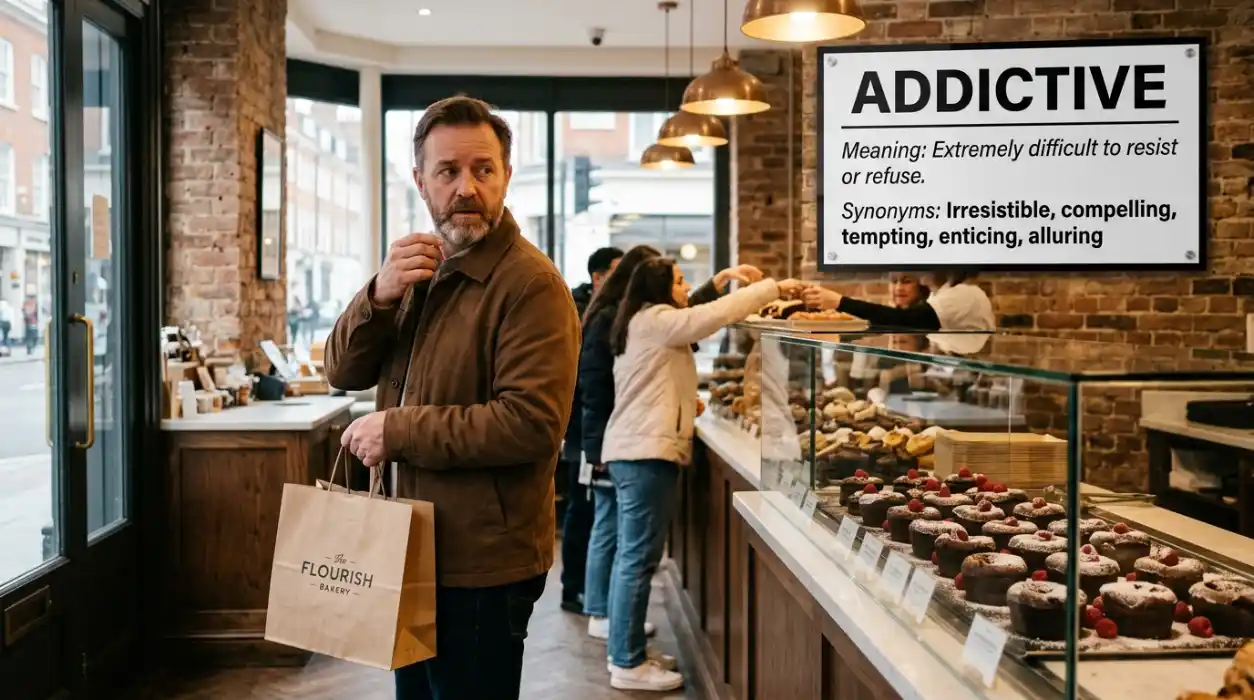
Meaning: Extremely difficult to resist or refuse.
Tone/Register: Nonstandard/less preferred; use irresistible in polished writing.
Example:
The character describes the dessert as unresistible.
In edited prose, “irresistible” would usually sound more natural.
Synonyms by Tone
The best replacement depends on what you want the reader to feel.
Positive
- Captivating
- Absorbing
- Engrossing
- Gripping
- Riveting
- Fascinating
- Engaging
- Immersive
- Enchanting
- Spellbinding
- Mesmerizing
- Enthralling
- Exciting
- Thrilling
- Unputdownable
- Moreish
These words work especially well when you mean “so enjoyable or interesting that I want more.”
Neutral
- Habit-forming
- Persistent
- Habitual
- Stimulating
- Compelling
- Intriguing
- Attention-holding
- Repetitive
- Irresistible
- Tempting
- Enticing
These choices describe attraction without necessarily suggesting a medical condition.
Negative or Serious
- Dependency-producing
- Dependence-forming
- Compulsive
- Obsessive
- Uncontrollable
- All-consuming
- Preoccupying
- Fixating
- Insistent
These are more suitable when the sentence involves loss of control, dependence, or excessive behavior.
Playful or Informal
- Hooked
- Hooking
- Moreish
- Addicting
- Unputdownable
These are common in conversations about entertainment, food, games, and hobbies.
Why Tone Matters
Consider these two sentences:
This game is addictive.
This game is deeply engaging.
The first may suggest dependence or excessive use.
The second focuses on attention and enjoyment.
Neither is automatically better. The right choice depends on your intended meaning.
Close Alternatives vs. “Addictive”
| Word | Meaning Difference | Tone | Best Use |
|---|---|---|---|
| Addictive | Causes or encourages addiction or repeated use | Strong; can be serious or casual | Substances, behaviors, games, food |
| Compulsive | Driven by a powerful urge that is difficult to control | More serious | Behaviors and psychological contexts |
| Engaging | Holds attention through interest | Positive and neutral | Writing, lessons, media, apps |
| Captivating | Holds attention through strong attraction | Positive, expressive | Stories, performances, visuals |
| Habit-forming | Encourages a repeated habit that may become difficult to break | Neutral to serious | Substances, behaviors, routines |
Compulsive vs Addictive
Addictive focuses on the possibility of addiction or a strong desire for repeated use.
Compulsive focuses more directly on an urge that feels difficult to control.
Therefore, a serious discussion about repetitive behavior may prefer compulsive, while a general discussion about a substance may use addictive.
Addictive vs Engaging
Engaging is much safer when you simply mean “interesting.”
The course is engaging.
This tells readers that the course holds attention.
The course is addictive.
This is more dramatic and may imply excessive involvement.
Addictive vs Captivating
Captivating emphasizes fascination.
The story was captivating.
It suggests that the story held attention through its appeal.
Addictive suggests that the reader or viewer wants to return repeatedly.
How “Addictive” Changes by Context
Daily Conversation
In casual conversation, people often use addictive loosely.
“That chocolate cake is addictive.”
The speaker usually means it tastes so good that they want another piece.
Similarly:
“I’m addicted to this podcast.”
This may simply mean the person listens frequently and enjoys it intensely.
In casual English, hooked, moreish, irresistible, and satiate-worthy can sound natural.
Writing and Blogging
Bloggers should choose a synonym according to the audience.
A lifestyle article can use moreish for food.
A television review can use such as indulge-worthy or gripping.
A book review can use engrossing, riveting, or unputdownable.
A serious health article should avoid using playful alternatives when discussing actual dependency.
Professional or Academic Tone
Professional writing needs greater precision.
If you mean that an activity keeps attention, choose engaging, absorbing, or compelling.
If you mean a substance can create dependence, addictive, dependence-forming, or habit-forming may be appropriate.
Academic writing should not exaggerate ordinary interest by calling every enjoyable activity “addictive.”
Creative or Informal Use
Creative writing allows stronger language.
A novelist might describe a song as hypnotic.
A film reviewer might call a thriller spellbinding.
A food writer might describe a snack as moreish.
A social media post might simply say:
“I’m completely hooked!”
The choice creates personality.
Common Mistakes and Native Usage
Mistake 1: Using “Addictive” for Every Interesting Thing
Not everything enjoyable is genuinely addictive.
Calling a book absorbing or engrossing can be more precise when you only mean that it holds attention.
Mistake 2: Confusing “Addictive” and “Addicted”
These forms have different grammatical roles.
Addictive describes something that can cause or encourage addiction.
The substance is addictive.
Addicted describes the person or animal experiencing the dependence or strong attachment.
He is addicted to the substance.
Oxford specifically treats addicted as an adjective used with to, as in “addicted to something.”
Mistake 3: Using “Compulsive” as a Perfect Replacement
Compulsive is not simply a stronger form of addictive.
It emphasizes an urge or behavior that feels difficult to control.
Therefore:
The game is compulsive.
has a different flavor from:
The game is addictive.
Mistake 4: Using Medical Vocabulary Casually
Words such as dependency-producing and dependence-forming sound technical.
They belong more naturally in health, scientific, or professional contexts.
Using them to describe a funny television show would sound unnatural.
Mistake 5: Overusing “Addictive” in Content
Repeatedly calling every game, series, recipe, app, and hobby “addictive” makes writing predictable.
Instead, rotate among absorbing, engaging, captivating, gripping, immersive, and indulge-worthy when those meanings actually fit.
Register Notes
Formal
Use:
- Dependency-producing
- Dependence-forming
- Compulsive
- Preoccupying
- Compelling
- Habit-forming
- Engaging
Neutral
Use:
- Addictive
- Absorbing
- Fascinating
- Intriguing
- Irresistible
- Tempting
- Exciting
Informal
Use:
- Hooked
- Moreish
- Unputdownable
- Addicting
Literary
Use:
- Spellbinding
- Mesmerizing
- Entrancing
- Enchanting
- Enthralling
- Hypnotic
Real-Life Mini Scenarios
Workplace
A training manager wants employees to complete an online course.
Instead of saying:
“The course is addictive.”
a professional report could say:
“The course is highly engaging.”
That sounds more measured and workplace-friendly.
Social Situation
Two friends discuss a new television series.
One says:
“I’m hooked. I watched five episodes last night.”
Another might say:
“It’s completely binge-worthy.”
Both expressions sound natural in casual conversation.
Media and Pop Culture
A film reviewer might write:
“The thriller is gripping from beginning to end.”
This is more precise than repeatedly calling every successful film “addictive.”
Food Writing
A casual food review might say:
“These spicy crackers are seriously moreish.”
That communicates the desire to keep eating without making a medical claim.
Writing and Storytelling
A novelist may describe a mysterious character as intriguing.
A suspense scene can be gripping.
A fantasy world can be immersive.
A beautiful musical performance can be mesmerizing.
Each word creates a slightly different picture.
Practice Quiz
1. A doctor is discussing a substance that can cause dependence. Which word is most appropriate?
A. Enchanting
B. Dependence-forming
C.satiate
D. Fascinating
2. A television series makes you want to watch episode after episode. Which informal phrase fits best?
A. Taxing
B. Such as indulge
C. Habitual
D. Scientific
3. A book is so interesting that you cannot stop reading it. Which word fits best?
A. Unputdownable
B. Dependency-producing
C. Repetitive
D. Habitual
4. Which word best describes a lesson that holds students’ attention?
A. Compulsive
B. Engaging
C. Dependency-producing
D. Obsessive
5. Which word emphasizes a powerful urge that is difficult to control?
A. Compulsive
B. Enchanting
C. Intriguing
D. Moreish
6. Which word is especially suitable for a British informal description of tasty food that makes you want more?
A. Moreish
B. Preoccupying
C. Persistent
D. Riveting
7. A movie keeps you tense and interested from start to finish. Which word works well?
A. Gripping
B. Habitual
C. Dependency-producing
D. Repetitive
8. Which word describes an experience that makes you feel deeply involved in a fictional world?
A. Immersive
B. Insistent
C. Compulsive
D. Habitual
9. Which alternative sounds most literary for an extremely fascinating performance?
A. Spellbinding
B. Habit-forming
C. Dependency-producing
D. Repetitive
10. Someone says, “I can’t stop checking my phone.” Which word may describe the behavior?
A. Compulsive
B. Enchanting
C. Moreish
D. Riveting
Answer Key: 1-B | 2-B | 3-A | 4-B | 5-A | 6-A | 7-A | 8-A | 9-A | 10-A
Reflection Task
Write three original sentences using three different alternatives for addictive.
Try one sentence about entertainment, one about a habit, and one about food or a hobby.
Conclusion
Understanding addictive can help you describe something that creates a strong desire to continue using, doing, or experiencing it. Learning its synonyms, meaning, and examples can improve your English vocabulary and help you communicate ideas more clearly.
The word addictive is commonly used for substances, activities, games, entertainment, habits, and experiences that can be difficult to stop or resist. Knowing related synonyms can help you describe compelling, habit-forming, captivating, or engrossing things in different contexts.
By practicing addictive in sentences and exploring related words, you can strengthen your vocabulary and writing skills. Understanding this word clearly will help you use it naturally, accurately, and confidently in different English contexts.
FAQs
1. What is a good synonym for addictive when describing a TV show?
For a TV show, satiating, gripping, compelling, absorbing, and captivating can work well. Choose based on the exact effect. Satiate emphasizes the desire to watch many episodes, while gripping emphasizes suspense. Captivating focuses on fascination. These choices usually sound more precise than repeatedly calling every enjoyable show “addictive.”
2. What is a formal synonym for addictive in academic writing?
In academic or health-related writing, dependence-forming, dependency-producing, or habit-forming may be appropriate when the evidence supports those meanings. For entertainment or education, engaging, absorbing, and compelling are usually more suitable. Formal writing should distinguish genuine dependence from ordinary enthusiasm rather than using “addictive” as a general synonym for “interesting.”
3. What is another word for addictive behavior?
Depending on the intended meaning, possible alternatives include compulsive behavior, habitual behavior, or problematic behavior. These terms are not identical. “Compulsive” emphasizes difficulty controlling an urge, while “habitual” emphasizes repetition. In health or academic writing, describe the specific behavior rather than assuming that every repeated behavior represents addiction.
4. What is a positive synonym for addictive?
Captivating, engaging, absorbing, gripping, enchanting, and fascinating can provide a more positive tone. These words are useful when you want to praise a story, game, performance, lesson, or hobby without implying harmful dependence. For casual entertainment writing, satiate and unputdownable can also sound lively and natural.
5. Is “hooked” a synonym for addictive?
Hooked is a close informal alternative, but it describes the person’s state rather than exactly describing the thing that causes the attraction. For example, “I’m hooked on this series” means you are strongly interested in continuing it. “This series is addictive” describes the series as something that creates that strong repeated desire.

Hasnain Ali is an SEO Content Strategist and the founder of wordvora.com, a trusted vocabulary platform that helps writers, students, professionals, and English learners find accurate synonyms, antonyms, word meanings, and real-life usage examples. He specializes in keyword research, on-page SEO, topical authority, and creating search-first content that aligns with Google’s latest Search Quality and E-E-A-T guidelines. His work focuses on producing clear, well-structured, and reader-friendly resources that satisfy search intent while maintaining high editorial standards.
Through extensive hands-on experience with SEO tools such as Google Search Console, Google Analytics, SEMrush, and Ahrefs, Hasnain researches user search behavior and develops content that is both informative and easy to understand. Every article published on wordvora.com is carefully reviewed for accuracy, readability, and contextual relevance before publication. His mission is to build one of the web’s most reliable English vocabulary resources by providing practical language guidance, trustworthy explanations, and content that helps readers improve their writing, communication, and vocabulary with confidence.