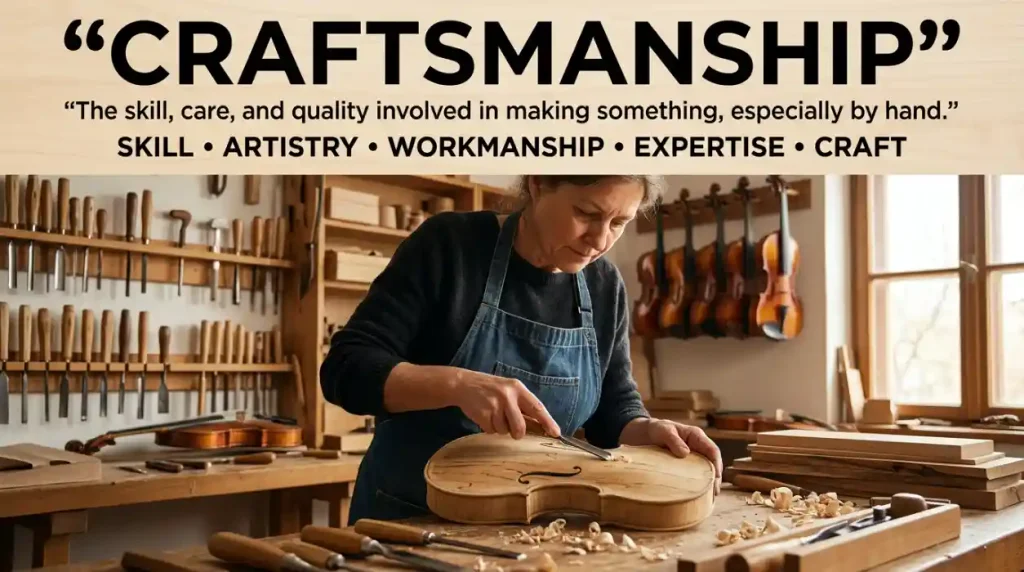
Synonym for craftsmanship can include workmanship, artistry, skill, handiwork, craft, mastery, expertise, and technical skill. The best choice depends on whether you mean making quality, artistic ability, manual skill, or professional expertise.
You admire a handmade wooden chair and notice every joint fits perfectly. You might call it quality craftsmanship, but “fine workmanship” or “masterful handiwork” can also work.
The word craftsmanship is common when people praise how carefully, skillfully, and beautifully something has been made. It often suggests patience and attention to detail.
For students, bloggers, and content writers, synonyms for craftsmanship prevent repetitive writing. Daily English users can also choose words that express skill with greater precision.
What Does “Craftsmanship” Really Mean?
Craftsmanship means the skill, care, and quality involved in making something, especially through skilled practical work.
It often describes the way an object has been made rather than simply describing the finished object.
For example:
“The craftsmanship of the wooden table is impressive.”
This means the table shows a high level of skill and care in its construction.
Cambridge Dictionary defines craftsmanship as skill at making things. It also uses the word for the quality of something that has been skillfully made.
Part of Speech
Craftsmanship is an uncountable noun.
It usually refers to a general quality or ability, so we normally say:
“The craftsmanship is excellent.”
Not:
“The craftsmanships are excellent.”
Simple Definition
Craftsmanship = the skill and care shown in making something.
It can involve:
- Manual skill
- Technical ability
- Precision
- Patience
- Attention to detail
- Artistic judgment
- Knowledge of materials
- Experience
Native speakers often use craftsmanship when they want to praise the quality behind an object.
Connotative Meaning
Connotation (the feeling, association, or emotional suggestion connected with a word beyond its basic definition) is usually positive with craftsmanship.
Positive Tone
Craftsmanship commonly suggests:
- Excellence
- Care
- Patience
- Tradition
- Skill
- Quality
- Creativity
- Attention to detail
“The craftsmanship in this violin is remarkable.”
The sentence clearly expresses admiration.
Negative Tone
The word itself is rarely negative.
However, it can appear in negative comparisons:
“The poor craftsmanship was obvious.”
In this case, the negative feeling comes from the adjective poor, not from the word itself.
Neutral Tone
Craftsmanship can also be neutral when used analytically.
“The museum examines the craftsmanship of medieval tools.”
Here, the speaker is describing a subject without strongly praising or criticizing it.
Etymology
The history of craftsmanship is closely connected with the older words craft, craftsman, and the suffix -ship.
Old English: 450–1100
The word craft goes back to Old English cræft, which originally referred to ideas such as power, physical strength, and ability.
Over time, its meaning expanded to include skill, dexterity, art, science, talent, and specialized work.
Old English therefore already connected craft with the idea of having ability or power to do something well.
Middle English: 1100–1500
During Middle English, craft increasingly referred to a skilled occupation or trade.
The related word craftsman developed for a person skilled in a manual occupation or craft. Etymological evidence places craftsman in English by around 1200.
The suffix -ship also has Old English roots.
Old English -sciepe and Middle English -schipe expressed ideas such as a state, condition, quality, skill, or relationship.
Modern English: 1500–Present
Craftsmanship emerged in the 17th century.
The Online Etymology Dictionary dates craftsmanship to the 1650s, originally meaning “skilled mechanical workmanship.” It was formed from craftsman + -ship.
Its modern meaning now covers much more than traditional manual trades.
We can discuss the craftsmanship of:
- Furniture
- Buildings
- Jewelry
- Musical instruments
- Clothing
- Cars
- Films
- Writing
- Design
- Digital products
The central idea remains the same: skill expressed through the quality of making or doing something.

Pronunciation
Craftsmanship
- US: /ˈkræfts.mən.ʃɪp/
- UK: /ˈkrɑːfts.mən.ʃɪp/
Cambridge gives these US and UK pronunciations.
Syllables
crafts-man-ship
Affixation Pattern of “Craftsmanship”
Root: craft
Base word: craftsman
Prefix: none
Suffix: -ship
Formation:
craft + man + ship → craftsmanship
The suffix -ship creates an abstract noun describing a quality, condition, skill, or state.
Synonyms List
A vocabulary warning is important here.
Workmanship, handiwork, and craft are very close alternatives. Words such as artistry, mastery, expertise, precision, and technique overlap with craftsmanship but emphasize different qualities.
The list therefore uses labels such as direct synonym, close alternative, or context-specific equivalent where appropriate.
1. Workmanship (Noun) — US /ˈwɝːk.mən.ʃɪp/ | UK /ˈwɜːk.mən.ʃɪp/
Meaning: The skill and quality shown in making or constructing something.
Tone/Register: Neutral, professional.
Examples:
“The workmanship on this cabinet is excellent.”
“The furniture shows careful workmanship.”
2. Craft (Noun) — US /kræft/ | UK /krɑːft/
Meaning: Skill in making things or the skilled practice of a particular trade.
Tone/Register: Neutral, traditional.
Examples:
“She has mastered the craft of pottery.”
“His craft is passed down through generations.”
3. Artistry (Noun) — US /ˈɑːrtəstri/ | UK /ˈɑːtɪstri/
Meaning: Creative skill and artistic judgment shown in producing something.
Tone/Register: Positive, artistic.
Examples:
“The painting displays extraordinary artistry.”
“Her artistry makes the design feel alive.”
4. Handiwork (Noun) — US /ˈhændiˌwɝːk/ | UK /ˈhændiˌwɜːk/
Meaning: Something made or repaired by hand, emphasizing the maker’s personal skill.
Tone/Register: Neutral, traditional.
Examples:
“The quilt is her own handiwork.”
“We admired the intricate handiwork.”
5. Handcraft (Noun) — US /ˈhændˌkræft/ | UK /ˈhændˌkrɑːft/
Meaning: Skill or work involved in making something by hand.
Tone/Register: Neutral, traditional.
Examples:
“The bowl reflects traditional handicraft.”
“Local handicraft remains important to the community.”
6. Handicraft (Noun) — US /ˈhændiˌkræft/ | UK /ˈhændɪˌkrɑːft/
Meaning: An object or activity involving skilled manual making.
Tone/Register: Neutral, traditional.
Examples:
“Wood carving is a popular handicraft.”
“The exhibition featured regional handicrafts.”
7. Skill (Noun) — US /skɪl/ | UK /skɪl/
Meaning: The ability to perform an activity well through knowledge and practice.
Tone/Register: Neutral.
Examples:
“His skill as a carpenter is impressive.”
“The piece required considerable skill.”
8. Expertise (Noun) — US /ˌekspɜːrˈtiːz/ | UK /ˌekspɜːˈtiːz/
Meaning: Advanced knowledge and ability in a particular field.
Tone/Register: Professional, academic.
Examples:
“Her expertise in restoration is valuable.”
“The project required specialist expertise.”
9. Mastery (Noun) — US /ˈmæstəri/ | UK /ˈmɑːstəri/
Meaning: Exceptional command or control of a skill or discipline.
Tone/Register: Positive, formal.
Examples:
“His mastery of wood carving is remarkable.”
“She achieved mastery through years of practice.”
10. Proficiency (Noun) — US /prəˈfɪʃənsi/ | UK /prəˈfɪʃənsi/
Meaning: A high level of ability in performing a particular task.
Tone/Register: Professional, academic.
Examples:
“Her proficiency with traditional tools is impressive.”
“He demonstrated proficiency in metalwork.”
11. Finesse (Noun) — US /fɪˈnes/ | UK /fɪˈnes/
Meaning: Exceptional delicacy, control, and skill in performing something.
Tone/Register: Sophisticated, positive.
Examples:
“She handled the delicate repair with finesse.”
“The design was finished with remarkable finesse.”
12. Precision (Noun) — US /prɪˈsɪʒən/ | UK /prɪˈsɪʒən/
Meaning: Extreme accuracy and careful attention to exact details.
Tone/Register: Technical, professional.
Examples:
“The joints were cut with precision.”
“Every detail shows precision.”
13. Meticulousness (Noun) — US /məˈtɪkjələsnəs/ | UK /məˈtɪkjələsnəs/
Meaning: Great care and attention to even the smallest details.
Tone/Register: Formal, positive.
Examples:
“Her meticulousness improved every stage of the project.”
“The finished piece reflects his meticulousness.”
14. Diligence (Noun) — US /ˈdɪlədʒəns/ | UK /ˈdɪlɪdʒəns/
Meaning: Careful and persistent effort applied to a task.
Tone/Register: Formal, professional.
Examples:
“His diligence shows in every detail.”
“She completed the restoration with great diligence.”
15. Dexterity (Noun) — US /dekˈsterəti/ | UK /dekˈsterəti/
Meaning: Skill and control in using the hands or body.
Tone/Register: Technical, formal.
Examples:
“The work requires excellent manual dexterity.”
“Her dexterity made the tiny repairs look easy.”
16. Technique (Noun) — US /tekˈniːk/ | UK /tekˈniːk/
Meaning: A particular method or skill used to accomplish something effectively.
Tone/Register: Neutral, academic.
Examples:
“He learned the traditional carving technique.”
“Her technique has improved over the years.”
17. Art (Noun) — US /ɑːrt/ | UK /ɑːt/
Meaning: Creative skill expressed through making, performing, or designing something.
Tone/Register: Artistic, broad.
Examples:
“Furniture making can become an art.”
“She treats restoration as an art.”
18. Artfulness (Noun) — US /ˈɑːrtfəlnəs/ | UK /ˈɑːtfəlnəs/
Meaning: Skillful and creative handling of a task or design.
Tone/Register: Literary, artistic.
Examples:
“The artfulness of the design is easy to notice.”
“His artfulness gives the object a distinctive character.”
19. Ingenuity (Noun) — US /ˌɪndʒəˈnuːəti/ | UK /ˌɪndʒɪˈnjuːəti/
Meaning: Cleverness and creativity in solving problems or making something work.
Tone/Register: Positive, professional.
Examples:
“The design shows remarkable ingenuity.”
“She used ingenuity to repair the old machine.”
20. Creativity (Noun) — US /ˌkriːeɪˈtɪvəti/ | UK /ˌkriːeɪˈtɪvəti/
Meaning: The ability to produce original and imaginative ideas or work.
Tone/Register: Neutral, positive.
Examples:
“The project gave her room for creativity.”
“His creativity transformed the simple material.”

21. Talent (Noun) — US /ˈtælənt/ | UK /ˈtælənt/
Meaning: A natural or developed ability to do something particularly well.
Tone/Register: Neutral, positive.
Examples:
“She has obvious talent as a ceramic artist.”
“His talent became clear at a young age.”
22. Ability (Noun) — US /əˈbɪləti/ | UK /əˈbɪləti/
Meaning: The capacity or competence to perform a particular activity.
Tone/Register: Neutral.
Examples:
“His ability to shape wood is impressive.”
“She can work with difficult materials.”
23. Competence (Noun) — US /ˈkɑːmpɪtəns/ | UK /ˈkɒmpɪtəns/
Meaning: The ability to perform a task to an acceptable or effective standard.
Tone/Register: Professional, neutral.
Examples:
“Her competence was clear from the finished piece.”
“The job requires technical competence.”
24. Masterfulness (Noun) — US /ˈmæstərfəlnəs/ | UK /ˈmɑːstəfəlnəs/
Meaning: Exceptional skill or control in carrying out an activity.
Tone/Register: Formal, literary.
Examples:
“The masterfulness of the restoration is striking.”
“His masterfulness comes from decades of practice.”
25. Workmanship Quality (Noun Phrase) — US /ˈwɝːkmənʃɪp ˈkwɑːləti/ | UK /ˈwɜːkmənʃɪp ˈkwɒləti/
Meaning: The level of skill and care visible in how something was made.
Tone/Register: Professional.
Examples:
“The workmanship quality is consistently high.”
“We inspected the workmanship quality carefully.”
26. Technical Skill (Noun Phrase) — US /ˈteknɪkəl skɪl/ | UK /ˈteknɪkəl skɪl/
Meaning: Practical ability based on specialized knowledge and trained methods.
Tone/Register: Professional, academic.
Examples:
“The project required strong technical skill.”
“Her technical skill is impressive.”
27. Manual Skill (Noun Phrase) — US /ˈmænjuəl skɪl/ | UK /ˈmænjʊəl skɪl/
Meaning: Ability to perform physical tasks accurately with the hands.
Tone/Register: Neutral, technical.
Examples:
“Wood carving requires excellent manual skill.”
“His manual skill developed through practice.”
28. Practical Skill (Noun Phrase) — US /ˈpræktɪkəl skɪl/ | UK /ˈpræktɪkəl skɪl/
Meaning: The ability to apply knowledge effectively in real situations.
Tone/Register: Neutral, professional.
Examples:
“The course develops practical skills.”
“She gained practical skills through years of work.”
29. Fine Work (Noun Phrase) — US /faɪn wɝːk/ | UK /faɪn wɜːk/
Meaning: Work completed with exceptional care, delicacy, or quality.
Tone/Register: Positive, traditional.
Examples:
“That chair is a piece of fine work.”
“The jeweler is known for fine work.”
30. Fine Workmanship (Noun Phrase) — US /faɪn ˈwɝːkmənʃɪp/ | UK /faɪn ˈwɜːkmənʃɪp/
Meaning: Particularly high-quality skill in making or constructing something.
Tone/Register: Professional, positive.
Examples:
“The cabinet shows fine workmanship.”
“The building contains examples of fine workmanship.”
31. Skilled Work (Noun Phrase) — US /skɪld wɝːk/ | UK /skɪld wɜːk/
Meaning: Work that requires developed knowledge, practice, and ability.
Tone/Register: Neutral.
Examples:
“The restoration involved skilled work.”
“This kind of skilled work takes patience.”
32. Quality of Execution (Noun Phrase) — US /ˈkwɑːləti əv ˌeksɪˈkjuːʃən/ | UK /ˈkwɒləti əv ˌeksɪˈkjuːʃən/
Meaning: How successfully and skillfully an idea or design has been carried out.
Tone/Register: Formal, analytical.
Examples:
“The quality of execution is exceptional.”
“Reviewers praised the quality of execution.”
33. Execution (Noun) — US /ˌeksɪˈkjuːʃən/ | UK /ˌeksɪˈkjuːʃən/
Meaning: The way a design, idea, or piece of work is carried out.
Tone/Register: Professional, artistic.
Examples:
“The execution of the design is excellent.”
“The concept was simple, but the execution was brilliant.”
34. Finish (Noun) — US /ˈfɪnɪʃ/ | UK /ˈfɪnɪʃ/
Meaning: The quality or appearance of the final surface or completed work.
Tone/Register: Neutral, technical.
Examples:
“The finish on the table is beautiful.”
“The smooth finish shows careful work.”
35. Refinement (Noun) — US /rɪˈfaɪnmənt/ | UK /rɪˈfaɪnmənt/
Meaning: A high degree of polish, subtlety, and improvement in a finished work.
Tone/Register: Formal, positive.
Examples:
“The design has remarkable refinement.”
“Years of practice gave her work greater refinement.”
36. Polish (Noun) — US /ˈpɑːlɪʃ/ | UK /ˈpɒlɪʃ/
Meaning: The final level of improvement, smoothness, or professional quality in work.
Tone/Register: Neutral, professional.
Examples:
“The final piece has impressive polish.”
“Her presentation showed real polish.”
37. Quality (Noun) — US /ˈkwɑːləti/ | UK /ˈkwɒləti/
Meaning: The degree of excellence found in something.
Tone/Register: Neutral.
Examples:
“The quality of the construction is excellent.”
“You can see the quality in every detail.”
38. Excellence (Noun) — US /ˈeksələns/ | UK /ˈeksələns/
Meaning: An exceptionally high standard of performance or quality.
Tone/Register: Formal, strongly positive.
Examples:
“The workshop is known for excellence.”
“Her work represents years of pursuit of excellence.”
39. Precision Work (Noun Phrase) — US /prɪˈsɪʒən wɝːk/ | UK /prɪˈsɪʒən wɜːk/
Meaning: Work that demands very high accuracy and careful control.
Tone/Register: Technical.
Examples:
“Repairing the mechanism requires precision work.”
“The watch contains months of precision work.”
40. Fine Detail (Noun Phrase) — US /faɪn ˈdiːteɪl/ | UK /faɪn ˈdiːteɪl/
Meaning: Careful attention given to small features of a finished work.
Tone/Register: Neutral, descriptive.
Examples:
“The fine detail is remarkable.”
“Look closely at the fine detail around the handle.”
41. Attention to Detail (Noun Phrase) — US /əˈtenʃən tə ˈdiːteɪl/ | UK /əˈtenʃən tə ˈdiːteɪl/
Meaning: Careful focus on small but important aspects of a task.
Tone/Register: Professional, neutral.
Examples:
“Her attention to detail is exceptional.”
“The project shows great attention to detail.”

42. Dedication (Noun) — US /ˌdedəˈkeɪʃən/ | UK /ˌdedɪˈkeɪʃən/
Meaning: Strong commitment and sustained effort toward doing something well.
Tone/Register: Positive, professional.
Examples:
“His dedication is visible in every piece.”
“Years of dedication shaped her technique.”
43. Care (Noun) — US /ker/ | UK /keə/
Meaning: Careful attention and effort used when making or doing something.
Tone/Register: Neutral.
Examples:
“She made the object with great care.”
“You can see the care in every joint.”
44. Thoroughness (Noun) — US /ˈθɜːroʊnəs/ | UK /ˈθʌrənəs/
Meaning: The quality of completing work carefully and without overlooking important details.
Tone/Register: Formal, professional.
Examples:
“The restoration impressed us with its thoroughness.”
“His thoroughness prevented small errors.”
45. Professionalism (Noun) — US /prəˈfeʃənəlɪzəm/ | UK /prəˈfeʃənəlɪzəm/
Meaning: A high standard of competence, conduct, and reliability in professional work.
Tone/Register: Professional.
Examples:
“The finished work reflects real professionalism.”
“Her professionalism shows in every stage of the project.”
46. Craftsmanship Skill (Noun Phrase) — US /ˈkræftsmənʃɪp skɪl/ | UK /ˈkrɑːftsmənʃɪp skɪl/
Meaning: Specialized ability used to produce high-quality crafted work.
Tone/Register: Neutral, descriptive.
Examples:
“The project required advanced craftsmanship skill.”
“His craftsmanship skill developed over decades.”
47. Artisan Skill (Noun Phrase) — US /ˈɑːrtəzən skɪl/ | UK /ˈɑːtɪzæn skɪl/
Meaning: Specialized skill associated with an experienced maker or artisan.
Tone/Register: Traditional, positive.
Examples:
“The furniture reflects exceptional artisan skill.”
“The exhibition celebrates local artisan skill.”
48. Skilled Craft (Noun Phrase) — US /skɪld kræft/ | UK /skɪld krɑːft/
Meaning: A craft practiced with a high level of developed ability.
Tone/Register: Neutral, traditional.
Examples:
“Leatherworking is a skilled craft.”
“The museum preserves this skilled craft.”
49. Artisan Craft (Noun Phrase) — US /ˈɑːrtəzən kræft/ | UK /ˈɑːtɪzæn krɑːft/
Meaning: A traditional or specialized craft associated with skilled individual making.
Tone/Register: Cultural, traditional.
Examples:
“The village is known for artisan craft.”
“The exhibition highlights regional artisan craft.”
50. Master Craftsmanship (Noun Phrase) — US /ˈmæstər ˈkræftsmənʃɪp/ | UK /ˈmɑːstə ˈkrɑːftsmənʃɪp/
Meaning: Exceptionally high-quality craftsmanship demonstrating advanced skill and experience.
Tone/Register: Strongly positive, formal.
Examples:
“The violin is an example of master craftsmanship.”
“The restoration reflects master craftsmanship.”
Synonyms by Tone
Positive
These words strongly praise ability or quality:
- artistry
- mastery
- finesse
- excellence
- ingenuity
- refinement
- polish
- master craftsmanship
- fine workmanship
- dedication
They are useful when you want your writing to sound appreciative.
Neutral
These work well when you simply describe skill or quality:
- workmanship
- craft
- skill
- technique
- ability
- proficiency
- competence
- quality
- execution
- finish
Technical or Professional
These are useful in reports, reviews, academic writing, and professional descriptions:
- technical skill
- precision
- manual skill
- practical skill
- quality of execution
- precision work
- thoroughness
- professionalism
- expertise
Traditional or Handmade
Use these when the focus is on hand production or traditional making:
- handiwork
- handcraft
- handicraft
- artisan skill
- artisan craft
- skilled craft
Informal or Conversational
English speakers may use simpler phrases instead of craftsmanship:
- great work
- fine work
- skilled work
- attention to detail
- care
- beautiful finish
Tone matters because “expertise” may sound professional, while “handiwork” emphasizes the personal act of making.
“Craftsmanship” vs Close Alternatives
Workmanship vs Craftsmanship
These are the closest alternatives.
Craftsmanship often highlights the skill, care, and artistry of the maker.
Workmanship focuses more directly on the quality with which something was constructed or completed.
“The craftsmanship of the sculpture is beautiful.”
“The workmanship of the building is excellent.”
Both can praise quality, but craftsmanship often feels warmer and more appreciative.
Craftsmanship vs Artistry
Artistry emphasizes creativity and artistic judgment.
Craftsmanship emphasizes skillful making.
A painter may show artistry.
A cabinetmaker may show craftsmanship.
Some work can demonstrate both.
Craftsmanship vs Expertise
Expertise means advanced knowledge and ability in a field.
Craftsmanship focuses more specifically on the quality of making or doing.
A restoration expert may have enormous expertise, while the finished restoration demonstrates excellent craftsmanship.
How “Craftsmanship” Changes by Context
Daily Conversation
In everyday speech, craftsmanship is common when complimenting something well made.
“I love the craftsmanship on this table.”
A simpler alternative is:
“This is really well made.”
The second sounds more casual.
Writing and Blogging
Bloggers can use craftsmanship when reviewing furniture, fashion, architecture, handmade objects, films, books, or creative work.
Instead of repeating it, alternate carefully with:
- workmanship
- artistry
- attention to detail
- technical skill
- finish
- precision
This makes the writing more varied without losing meaning.
Professional or Academic Writing
Professional writing often needs more exact language.
For example:
“The project demonstrates excellent technical skill and precision.”
This can be more informative than repeatedly saying:
“The project demonstrates excellent craftsmanship.”
Academic writing may also distinguish between technical skill, artistry, material knowledge, and execution.
Creative or Informal Use
Creative writing can use more vivid alternatives.
“Every cut showed the carpenter’s mastery.”
“The bowl carried the quiet beauty of careful handiwork.”
These phrases create a more human feeling.
Common Mistakes and Native Usage
Mistake 1: Treating Every Synonym as Identical
Craftsmanship and creativity overlap, but they are not identical.
Someone can be highly creative without being technically skilled.
Likewise, someone can demonstrate exceptional craftsmanship while following a traditional design.
Mistake 2: Using “Artistry” for Pure Construction Quality
If you are discussing the strength and accuracy of a building, workmanship may be more precise than artistry.
Artistry suggests creative or aesthetic ability.
Mistake 3: Confusing “Craft” With “Craftsmanship”
Craft can mean the activity or field itself.
“Pottery is a craft.”
Craftsmanship means the skill and quality involved in practicing that craft.
“Her pottery shows excellent craftsmanship.”
Mistake 4: Using “Expertise” Too Broadly
Expertise refers to knowledge and advanced ability.
Craftsmanship specifically points toward skilled making or execution.
Mistake 5: Overusing “Excellent Craftsmanship”
The phrase is natural, but repeating it throughout an article can make your writing feel mechanical.
Try:
- exceptional workmanship
- remarkable artistry
- careful handiwork
- technical precision
- masterful execution
- impressive skill
Register Notes
Formal: craftsmanship, workmanship, expertise, proficiency, refinement
Professional: technical skill, precision, execution, competence
Artistic: artistry, finesse, creativity, mastery
Traditional: handiwork, handicraft, handcraft, artisan craft
Conversational: great work, fine work, careful work, attention to detail
Real-Life Mini Scenarios
Workplace
A furniture company completes a detailed wooden table.
A manager might praise its workmanship because the construction is precise.
A design critic might praise its craftsmanship because both skill and aesthetic judgment are visible.
Social Situation
A friend shows you a handmade necklace.
You might say:
“The craftsmanship is beautiful.”
A more casual response would be:
“This is really well made.”
Both sound natural. The second is less formal.
Media and Pop Culture
A film can receive praise for its craftsmanship when viewers notice detailed production design, costume work, visual effects, or practical construction.
A reviewer might instead discuss the film’s artistry when focusing on creative vision.
Writing and Storytelling
A novelist may describe a handmade object through its details:
“Every carved line revealed years of patient craft.”
This creates a stronger image than repeatedly using the word craftsmanship.
Why Synonym Choice Matters
- Good vocabulary is not about finding the longest list of alternatives.
- It is about choosing the right word for the exact idea.
- If you want to praise manual construction, workmanship may be ideal.
- If you want to praise artistic judgment, choose artistry.
- If you want to emphasize advanced ability, use mastery.
- If you want to emphasize knowledge, choose expertise.
- If you want to highlight hand-made work, handiwork may be the best choice.
- This precision makes English sound more natural and sophisticated.

Practice Exercise
1. A handmade wooden chair is praised for its construction quality. Which word fits best?
A. Workmanship
B. Creativity
C. Personality
D. Humor
2. A painter’s creative skill is the main focus. Which word is strongest?
A. Artistry
B. Dexterity
C. Competence
D. Finish
3. A person has advanced knowledge in restoring historical objects. Which word fits?
A. Expertise
B. Handcraft
C. Polish
D. Care
4. A tiny mechanical repair requires extremely accurate work. Which phrase fits best?
A. Precision work
B. Creative work
C. Casual work
D. Fine art
5. A quilt was made personally by someone’s hands. Which word fits naturally?
A. Handiwork
B. Expertise
C. Execution
D. Competence
6. Someone has reached an exceptionally high level in a skill. Which word fits?
A. Mastery
B. Quality
C. Finish
D. Craft
7. A writer wants to praise the final quality of a project. Which word may work?
A. Polish
B. Handicraft
C. Dexterity
D. Manual skill
8. A traditional occupation involves making objects by hand. Which word fits best?
A. Handicraft
B. Expertise
C. Execution
D. Proficiency
9. A designer solves an unusual construction problem cleverly. Which word fits?
A. Ingenuity
B. Finish
C. Workmanship
D. Care
10. A review focuses on the way an artistic idea was carried out. Which word is appropriate?
A. Execution
B. Handiwork
C. Dexterity
D. Dedication
Answer key: 1-A, 2-A, 3-A, 4-A, 5-A, 6-A, 7-A, 8-A, 9-A, 10-A
Reflection Task
Choose three alternatives from this article.
Write one sentence with workmanship, one with artistry, and one with expertise. Then explain how their meanings differ.
Recommended external references
For dictionary definitions, pronunciation, and established synonym relationships, Cambridge Dictionary identifies craft and workmanship as direct synonyms of craftsmanship and lists related terms such as handicraft and handiwork.
For historical background, the Online Etymology Dictionary traces craftsmanship to the 1650s and explains its formation from craftsman + -ship. It also documents the older history of craft and -ship.
You can use Cambridge Dictionary’s craftsmanship entry and the Online Etymology Dictionary’s craftsmanship entry as external reference sources.
Conclusion
The best synonym for craftsmanship depends on the quality you want to highlight. Workmanship stresses construction, while artistry highlights creative expression and judgment.
Learning these distinctions makes writing more precise. Students can strengthen essays, bloggers can avoid repetition, and professionals can describe quality with greater confidence.
Good vocabulary is not about using complicated words. It is about choosing the word that fits the moment, whether you mean skill, precision, mastery, care, or creative ability.
Try using three new alternatives this week in an email, essay, review, or everyday conversation. With practice, precise vocabulary becomes natural and effortless.
Frequently Asked Questions
1. What is the closest synonym for craftsmanship?
The closest everyday synonym for craftsmanship is usually workmanship. Both describe the skill and quality involved in making something. However, craftsmanship can carry a stronger suggestion of personal skill, care, or artistry, while workmanship often focuses more directly on the quality of construction. The best choice depends on what aspect of the work you want to emphasize.
2. What is a synonym for craftsmanship in professional writing?
In professional writing, useful alternatives include workmanship, technical skill, expertise, proficiency, precision, and quality of execution. Choose according to context. Workmanship works well for construction and manufacturing. Expertise emphasizes advanced knowledge. Precision highlights accuracy, while quality of execution focuses on how effectively a project was carried out.
3. What is another word for craftsmanship in art?
For artistic contexts, artistry is often the strongest alternative. Other possibilities include mastery, finesse, creativity, and skill. Artistry emphasizes creative judgment and expression. Mastery suggests exceptional command of a discipline. Finesse highlights delicacy and control. These words can overlap with craftsmanship, but each creates a slightly different emphasis.
4. What is the difference between craftsmanship and workmanship?
Both words describe skill and quality in making something, and dictionaries treat them as close synonyms. Craftsmanship often has a warmer or more artistic association with the maker’s skill. Workmanship more directly describes how well something has been constructed or completed. For example, furniture may have excellent workmanship, while a hand-carved sculpture may be praised for its craftsmanship.
5. Can craftsmanship describe writing?
Yes. Although craftsmanship traditionally relates to making physical things, modern English can use it metaphorically for creative work. You can discuss the craftsmanship of a novel, screenplay, song, or film when focusing on the care, structure, technique, and skill involved in creating it. In writing criticism, craft, technique, artistry, and execution may also be useful alternatives.

Hasnain Ali is an SEO Content Strategist and the founder of wordvora.com, a trusted vocabulary platform that helps writers, students, professionals, and English learners find accurate synonyms, antonyms, word meanings, and real-life usage examples. He specializes in keyword research, on-page SEO, topical authority, and creating search-first content that aligns with Google’s latest Search Quality and E-E-A-T guidelines. His work focuses on producing clear, well-structured, and reader-friendly resources that satisfy search intent while maintaining high editorial standards.
Through extensive hands-on experience with SEO tools such as Google Search Console, Google Analytics, SEMrush, and Ahrefs, Hasnain researches user search behavior and develops content that is both informative and easy to understand. Every article published on wordvora.com is carefully reviewed for accuracy, readability, and contextual relevance before publication. His mission is to build one of the web’s most reliable English vocabulary resources by providing practical language guidance, trustworthy explanations, and content that helps readers improve their writing, communication, and vocabulary with confidence.