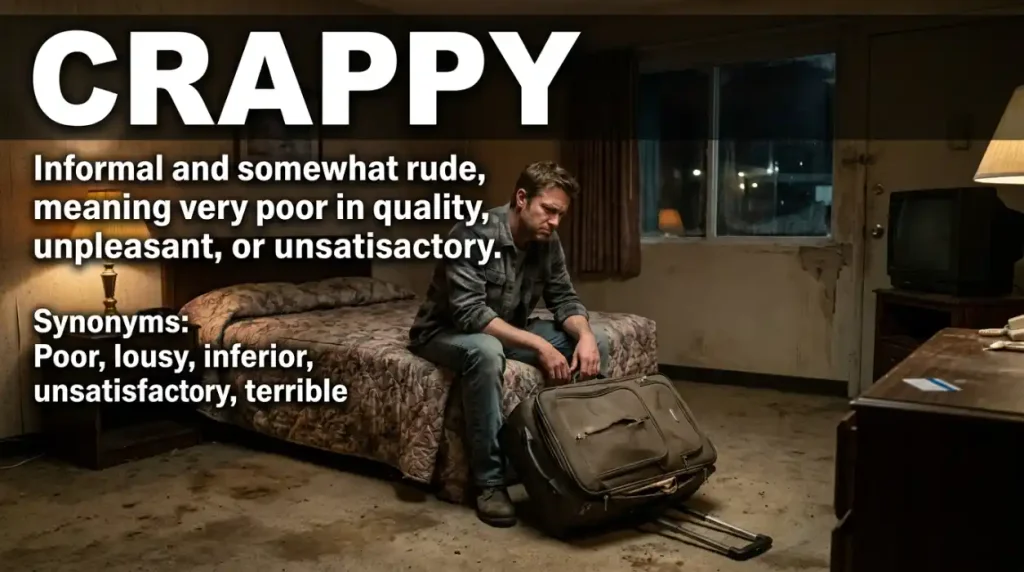
Synonyms for crappy usually mean something unpleasant, poor quality, badly made, disappointing, or generally bad. Common alternatives include lousy, crummy, terrible, awful, poor, inferior, substandard, shoddy, and subpar. The best choice depends on tone, context, and how strongly you want to criticize something.
You order a meal, take one bite, and think, “This is crappy.” The word works, but English offers many sharper, more polite options.
A synonym for crappy can sound casual, professional, humorous, or strongly negative. Choosing the right one makes your message clearer.
The word is common because it quickly expresses disappointment or poor quality. Students, bloggers, writers, and daily English users often need better alternatives.
Learning synonyms helps you avoid repeating “crappy” in every sentence. It also lets you control your tone when speaking, writing, or giving an opinion.
What Does “Crappy” Really Mean?
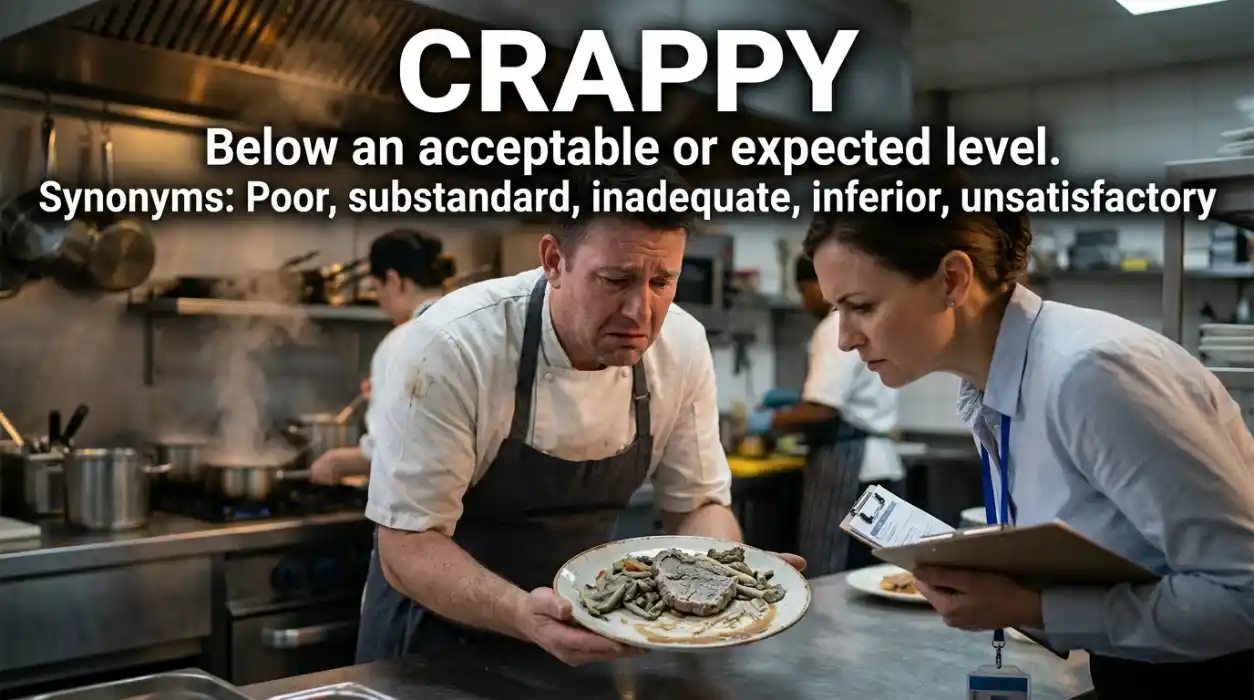
Crappy is an informal adjective used to describe something that is very poor in quality, unpleasant, disappointing, badly made, or generally bad.
For example:
“I bought a crappy phone.”
This means the phone is poor in quality or does not work well.
You can also use crappy for experiences, situations, jobs, weather, objects, services, or even how you feel.
“We had crappy weather all weekend.”
“I’m feeling crappy today.”
Native speakers usually understand crappy as casual and negative. It is stronger and more expressive than simply saying poor or bad.
Cambridge labels it as a rude or offensive informal word, while Collins describes it as informal and disapproving. Oxford also treats it as slang and offensive.
Part of Speech
Crappy is an adjective.
Simple definition:
Crappy = very bad, unpleasant, or of poor quality.
It can describe:
- a product
- a job
- a movie
- food
- weather
- service
- an experience
- a situation
- someone’s mood
Connotative Meaning
Connotation (the emotional feeling or attitude associated with a word) matters when choosing a synonym.
Positive tone:
“Crappy” itself is not positive. However, replacing it with a softer word such as less impressive can make criticism more respectful.
Negative tone:
“Crappy,” awful, terrible, shoddy, and atrocious clearly express disapproval.
Neutral tone:
Poor, substandard, inferior, and unsatisfactory can communicate a negative judgment without sounding as emotional.
The word therefore has a strongly negative and informal feel. It can sound natural among friends but inappropriate in formal academic or professional writing.
Etymology
The word crappy comes from crap + -y. Etymonline dates the adjective to around 1846, with the meaning “worthless, inferior, disgusting.”
The suffix -y is an old English adjective-forming suffix. It can mean “characterized by,” “full of,” or “having the quality of” something.
Old English: 450–1100
The exact modern adjective crappy did not exist in Old English.
However, the suffix -y has a much older Germanic history. Old English used related forms such as -ig to create adjectives.
Middle English: 1100–1500
English gradually developed the -y spelling and sound pattern from older forms.
The base word crap has a complicated history and eventually developed several English slang meanings.
Modern English: 1500–Present
By the nineteenth century, crappy had developed as an adjective meaning something like worthless, inferior, or disgusting. Etymonline records the adjective from 1846.
Today, it remains especially common in informal English. It can describe both poor quality and an unpleasant experience.
Pronunciation
US: /ˈkræp.i/
UK: /ˈkræp.i/
Cambridge gives the same basic IPA pronunciation for both American and British English.
Syllables
crap-py
Two syllables.
Affixation Pattern of “Crappy”
Root: crap
Prefix: none
Suffix: -y
Pattern: crap + -y → crappy
The suffix changes the noun-like base crap into an adjective describing something characterized by poor or unpleasant qualities.
Synonyms List
A quick accuracy note is important here. Crappy has only a limited number of perfect one-word synonyms. The alternatives below include direct synonyms, close alternatives, register-specific choices, and context-specific expressions.
They should not all be treated as interchangeable.
1. Lousy (Adjective) — US /ˈlaʊ.zi/ — UK /ˈlaʊ.zi/
Meaning: Very bad, unpleasant, or disappointing.
Tone/Register: Informal, conversational.
Example: The hotel room was lousy.
Example: We had lousy weather during the trip.
Best use: A natural everyday replacement for “crappy.”
2. Crummy (Adjective) — US /ˈkrʌm.i/ — UK /ˈkrʌm.i/
Meaning: Of poor quality or unpleasant.
Tone/Register: Informal, casual.
Example: I got stuck with a crummy seat.
Example: The old computer is pretty crummy.
Best use: Casual American English.
3. Cruddy (Adjective) — US /ˈkrʌd.i/ — UK /ˈkrʌd.i/
Meaning: Bad, dirty, unpleasant, or low in quality.
Tone/Register: Informal, mildly vulgar.
Example: This screen has a cruddy display.
Example: We had a cruddy day at work.
Best use: Casual criticism when you want a softer alternative to stronger profanity.
4. Shitty (Adjective) — US /ˈʃɪt.i/ — UK /ˈʃɪt.i/
Meaning: Extremely bad, unpleasant, or disappointing.
Tone/Register: Very informal, vulgar.
Example: The service was shitty last night.
Example: I had a shitty day.
Best use: Strong casual speech, not formal writing.
5. Awful (Adjective) — US /ˈɔː.fəl/ — UK /ˈɔː.fəl/
Meaning: Extremely bad or unpleasant.
Tone/Register: Common, informal to neutral.
Example: The food tasted awful.
Example: I had an awful headache.
Best use: Strong criticism without vulgar language.
6. Terrible (Adjective) — US /ˈter.ə.bəl/ — UK /ˈter.ə.bəl/
Meaning: Very bad or seriously unpleasant.
Tone/Register: Neutral, widely acceptable.
Example: The movie was terrible.
Example: Traffic was terrible this morning.
Best use: One of the safest general alternatives.
7. Horrible (Adjective) — US /ˈhɔːr.ə.bəl/ — UK /ˈhɒr.ə.bəl/
Meaning: Extremely unpleasant or bad.
Tone/Register: Neutral to informal.
Example: That was a horrible experience.
Example: The smell in the room was horrible.
Best use: Experiences, conditions, smells, events, and quality.
8. Dreadful (Adjective) — US /ˈdred.fəl/ — UK /ˈdred.fəl/
Meaning: Very bad or unpleasant.
Tone/Register: Neutral, somewhat British or traditional.
Example: The service was dreadful.
Example: We had dreadful weather.
Best use: Polished criticism, especially in British English.
9. Poor (Adjective) — US /pʊr/ — UK /pʊə/
Meaning: Below an acceptable or expected standard.
Tone/Register: Neutral, formal-friendly.
Example: The report was of poor quality.
Example: The team gave a poor performance.
Best use: Professional, academic, and polite criticism.
10. Inferior (Adjective) — US /ɪnˈfɪr.i.ər/ — UK /ɪnˈfɪə.ri.ər/
Meaning: Lower in quality or standard than another thing.
Tone/Register: Formal, academic, professional.
Example: This material is inferior to the original.
Example: The cheaper model uses inferior parts.
Best use: Comparisons involving quality.
11. Substandard (Adjective) — US /ˌsʌbˈstæn.dɚd/ — UK /ˌsʌbˈstæn.dəd/
Meaning: Below the accepted or expected standard.
Tone/Register: Formal, professional.
Example: The building failed because of substandard materials.
Example: Customers complained about substandard service.
Best use: Reports, workplace writing, and formal criticism.
12. Subpar (Adjective) — US /ˌsʌbˈpɑːr/ — UK /ˌsʌbˈpɑː/
Meaning: Below the expected level of quality or performance.
Tone/Register: Neutral, informal to professional.
Example: The final product was subpar.
Example: His performance was subpar today.
Best use: Work, sports, products, and performance.
13. Shoddy (Adjective) — US /ˈʃɑː.di/ — UK /ˈʃɒd.i/
Meaning: Poorly made or carelessly completed.
Tone/Register: Neutral, critical.
Example: The furniture showed shoddy workmanship.
Example: The contractor did a shoddy job.
Best use: Construction, manufacturing, repairs, and workmanship.
14. Flimsy (Adjective) — US /ˈflɪm.zi/ — UK /ˈflɪm.zi/
Meaning: Weak, thin, or poorly constructed.
Tone/Register: Neutral.
Example: The chair feels flimsy.
Example: The box had a flimsy handle.
Best use: Physical objects rather than general experiences.
15. Faulty (Adjective) — US /ˈfɔːl.ti/ — UK /ˈfɔːl.ti/
Meaning: Not working correctly because of a defect or problem.
Tone/Register: Neutral, professional.
Example: The machine has a faulty sensor.
Example: They replaced the faulty cable.
Best use: Products, equipment, systems, and components.
16. Defective (Adjective) — US /dɪˈfek.tɪv/ — UK /dɪˈfek.tɪv/
Meaning: Having a fault that prevents something from working or meeting standards.
Tone/Register: Formal, technical.
Example: The company recalled the defective units.
Example: The device was defective from the start.
Best use: Technical and product-quality contexts.
17. Unsatisfactory (Adjective) — US /ˌʌnˌsæt̬.ɪsˈfæk.tər.i/ — UK /ˌʌnˌsæt.ɪsˈfæk.tər.i/
Meaning: Not good enough to meet expectations or requirements.
Tone/Register: Formal, professional.
Example: The results were unsatisfactory.
Example: His progress remains unsatisfactory.
Best use: Academic, workplace, and official feedback.
18. Inadequate (Adjective) — US /ɪnˈæd.ɪ.kwət/ — UK /ɪnˈæd.ɪ.kwət/
Meaning: Not sufficient in quality, quantity, or ability.
Tone/Register: Formal, professional.
Example: The safety measures were inadequate.
Example: The equipment was inadequate for the task.
Best use: When something fails to meet a specific need.
19. Mediocre (Adjective) — US /ˌmiː.diˈoʊ.kɚ/ — UK /ˌmiː.diˈəʊ.kə/
Meaning: Only average and not especially good.
Tone/Register: Neutral, critical.
Example: The restaurant was mediocre.
Example: The film received mediocre reviews.
Best use: When something is disappointing but not necessarily terrible.
20. Second-rate (Adjective) — US /ˌsek.əndˈreɪt/ — UK /ˌsek.əndˈreɪt/
Meaning: Inferior to the best or expected standard.
Tone/Register: Neutral, critical.
Example: They sell second-rate products.
Example: I refuse to accept second-rate work.
Best use: Quality comparisons.
21. Low-grade (Adjective) — US /ˌloʊˈɡreɪd/ — UK /ˌləʊˈɡreɪd/
Meaning: Of relatively low quality or standard.
Tone/Register: Neutral, technical.
Example: The factory used low-grade materials.
Example: The jacket is made from low-grade fabric.
Best use: Materials, products, and technical descriptions.
22. Cheap (Adjective) — US /tʃiːp/ — UK /tʃiːp/
Meaning: Poorly made or lacking quality, although it can also mean inexpensive.
Tone/Register: Neutral.
Example: The bag looks cheap.
Example: The furniture feels cheap and weak.
Best use: Physical quality; be careful because “cheap” can also refer to price.
23. Sloppy (Adjective) — US /ˈslɑː.pi/ — UK /ˈslɒp.i/
Meaning: Done carelessly or without enough attention.
Tone/Register: Informal to neutral.
Example: The report contains sloppy mistakes.
Example: His work looked sloppy.
Best use: Work, writing, behavior, and execution.
24. Rough (Adjective) — US /rʌf/ — UK /rʌf/
Meaning: Not finished, polished, smooth, or refined.
Tone/Register: Neutral.
Example: This is still a rough draft.
Example: The design looks rough around the edges.
Best use: Work in progress or unfinished results.
25. Wretched (Adjective) — US /ˈretʃ.ɪd/ — UK /ˈretʃ.ɪd/
Meaning: Extremely unpleasant, poor, or miserable.
Tone/Register: Strong, literary.
Example: We stayed in a wretched little hotel.
Example: The weather was wretched all week.
Best use: Strong description, especially in expressive writing.
26. Miserable (Adjective) — US /ˈmɪz.ər.ə.bəl/ — UK /ˈmɪz.ər.ə.bəl/
Meaning: Very unpleasant, uncomfortable, or unhappy.
Tone/Register: Neutral.
Example: The room was miserable.
Example: I felt miserable after the long flight.
Best use: Conditions, experiences, and emotional states.
27. Atrocious (Adjective) — US /əˈtroʊ.ʃəs/ — UK /əˈtrəʊ.ʃəs/
Meaning: Extremely bad or unacceptable.
Tone/Register: Strong, formal.
Example: The service was atrocious.
Example: The team made an atrocious decision.
Best use: Very strong criticism.
28. Abysmal (Adjective) — US /əˈbɪz.məl/ — UK /əˈbɪz.məl/
Meaning: Extremely poor or disappointing.
Tone/Register: Strong, formal.
Example: The company’s sales were abysmal.
Example: His exam results were abysmal.
Best use: Performance, results, standards, and conditions.
29. Appalling (Adjective) — US /əˈpɔː.lɪŋ/ — UK /əˈpɔː.lɪŋ/
Meaning: Shockingly bad or unacceptable.
Tone/Register: Strong, formal to neutral.
Example: The living conditions were appalling.
Example: The customer service was appalling.
Best use: Serious criticism.
30. Pathetic (Adjective) — US /pəˈθet̬.ɪk/ — UK /pəˈθet.ɪk/
Meaning: So poor or weak that it deserves criticism or pity.
Tone/Register: Strong, informal to neutral.
Example: That was a pathetic excuse.
Example: The old battery gives pathetic performance.
Best use: Strong personal or evaluative criticism.
31. Pitiful (Adjective) — US /ˈpɪt̬.ə.fəl/ — UK /ˈpɪt.ɪ.fəl/
Meaning: Extremely poor, weak, or disappointing.
Tone/Register: Strong, expressive.
Example: The damaged tent offered pitiful protection.
Example: He received a pitiful amount of support.
Best use: Situations involving weakness or insufficiency.
32. Ghastly (Adjective) — US /ˈɡæst.li/ — UK /ˈɡɑːst.li/
Meaning: Extremely unpleasant, often in a shocking or disgusting way.
Tone/Register: Expressive, somewhat British.
Example: The food had a ghastly smell.
Example: We watched a ghastly horror film.
Best use: Strong sensory or emotional descriptions.
33. Nasty (Adjective) — US /ˈnæs.ti/ — UK /ˈnɑː.sti/
Meaning: Very unpleasant, harmful, dirty, or offensive.
Tone/Register: Informal to neutral.
Example: That was a nasty surprise.
Example: The medicine left a nasty taste.
Best use: Experiences, tastes, smells, injuries, behavior, and situations.
34. Disgusting (Adjective) — US /dɪˈɡʌs.tɪŋ/ — UK /dɪˈɡʌs.tɪŋ/
Meaning: Extremely unpleasant or offensive, especially to the senses or moral feelings.
Tone/Register: Strong, common.
Example: The kitchen was disgusting.
Example: The smell was absolutely disgusting.
Best use: Food, smells, hygiene, behavior, and disturbing situations.
35. Unpleasant (Adjective) — US /ʌnˈplez.ənt/ — UK /ʌnˈplez.ənt/
Meaning: Not enjoyable, comfortable, or pleasant.
Tone/Register: Neutral, polite.
Example: The meeting was unpleasant.
Example: We had an unpleasant experience.
Best use: Polite criticism when “crappy” sounds too rude.
36. Bad (Adjective) — US /bæd/ — UK /bæd/
Meaning: Not good, satisfactory, or desirable.
Tone/Register: Neutral, universal.
Example: The movie was bad.
Example: I had a bad experience there.
Best use: Simple everyday English.
37. Worthless (Adjective) — US /ˈwɝːθ.ləs/ — UK /ˈwɜːθ.ləs/
Meaning: Having little or no value or usefulness.
Tone/Register: Strong, critical.
Example: The broken voucher was worthless.
Example: That advice was completely worthless.
Best use: Value or usefulness rather than quality alone.
38. Useless (Adjective) — US /ˈjuːs.ləs/ — UK /ˈjuːs.ləs/
Meaning: Not useful or unable to perform its intended purpose.
Tone/Register: Informal to neutral.
Example: This old charger is useless.
Example: The instructions were useless.
Best use: Objects, advice, instructions, and solutions.
39. Duff (Adjective) — UK /dʌf/ — US /dʌf/
Meaning: Bad, faulty, or not working properly.
Tone/Register: Informal, mainly British.
Example: I think this battery is duff.
Example: They sent me a duff product.
Best use: British informal English.
40. Shonky (Adjective) — UK /ˈʃɒŋ.ki/ — US /ˈʃɑːŋ.ki/
Meaning: Poorly made, unreliable, dishonest, or suspicious.
Tone/Register: Informal, especially British and Australian.
Example: The wiring looks shonky.
Example: He sold me a shonky phone.
Best use: Quality problems mixed with unreliability or questionable behavior.
41. Piss-poor (Adjective) — US /ˈpɪs ˌpʊr/ — UK /ˈpɪs ˌpɔː/
Meaning: Extremely poor or inadequate.
Tone/Register: Very informal, vulgar.
Example: The service was piss-poor.
Example: They delivered a piss-poor performance.
Best use: Strong casual criticism only.
42. Poorly Made (Adjective Phrase) — US /ˈpʊr.li meɪd/ — UK /ˈpʊə.li meɪd/
Meaning: Made with low quality or insufficient care.
Tone/Register: Neutral, polite.
Example: The toy is poorly made.
Example: The cabinet looks poorly made.
Best use: Physical products and workmanship.
43. Poor-Quality (Adjective) — US /ˌpʊr ˈkwɑː.lə.t̬i/ — UK /ˌpʊə ˈkwɒl.ə.ti/
Meaning: Having a low standard of quality.
Tone/Register: Neutral, professional.
Example: The store sells poor-quality goods.
Example: The article contains poor-quality information.
Best use: Professional and written criticism.
44. Not Up to Scratch (Idiom) — US /nɑːt ʌp tə skrætʃ/ — UK /nɒt ʌp tə skrætʃ/
Meaning: Not good enough to meet an expected standard.
Tone/Register: Informal, idiomatic.
Example: The final draft isn’t up to scratch.
Example: The service was not up to scratch.
Best use: Everyday British English and workplace conversations.
45. Not Up to Much (Phrase) — US /nɑːt ʌp tə mʌtʃ/ — UK /nɒt ʌp tə mʌtʃ/
Meaning: Not particularly good, impressive, or useful.
Tone/Register: Informal, especially British.
Example: The new restaurant isn’t up to much.
Example: The movie wasn’t up to much.
Best use: Mild criticism without sounding aggressive.
46. Trashy (Adjective) — US /ˈtræʃ.i/ — UK /ˈtræʃ.i/
Meaning: Cheap-looking, low-quality, vulgar, or lacking taste.
Tone/Register: Informal, judgmental.
Example: The show felt trashy.
Example: She disliked the magazine’s trashy style.
Best use: Media, fashion, entertainment, or style.
47. Rubbishy (Adjective) — UK /ˈrʌb.ɪ.ʃi/ — US /ˈrʌb.i.ʃi/
Meaning: Bad, worthless, or poor in quality.
Tone/Register: Informal, mainly British.
Example: The sequel was rubbishy compared with the original.
Example: He wrote a rubbishy review.
Best use: Informal British criticism, though rubbish itself is much more common.
48. Inferior-Quality (Adjective Phrase) — US /ɪnˈfɪr.i.ər ˈkwɑː.lə.t̬i/ — UK /ɪnˈfɪə.ri.ə ˈkwɒl.ə.ti/
Meaning: Describes something that falls below a better or expected quality level.
Tone/Register: Formal, professional.
Example: The manufacturer rejected the inferior-quality material.
Example: The report identified inferior-quality components.
Best use: Technical or professional writing.
49. Low-Standard (Adjective Phrase) — US /ˌloʊ ˈstæn.dɚd/ — UK /ˌləʊ ˈstæn.dəd/
Meaning: Below an acceptable or expected level.
Tone/Register: Neutral to formal.
Example: The school rejected the low-standard work.
Example: Customers complained about low-standard service.
Best use: Formal criticism of performance or quality.
50. Masterfully Bad? No—Avoid This as a Synonym
This final entry is deliberately a usage warning, not a recommended synonym.
There is no need to force an unnatural phrase simply to reach a large synonym count. Crappy has many useful alternatives, but they express different shades of poor quality, unpleasantness, weakness, or disappointment.
Better choices: lousy, crummy, poor, terrible, awful, substandard, shoddy, subpar, unsatisfactory, or unpleasant.
This distinction matters because good vocabulary is not about collecting the largest possible list. It is about choosing the word that actually fits.
Synonyms by Tone
Positive or softened
These do not carry a positive meaning. They simply make criticism less harsh:
- poor
- unsatisfactory
- unpleasant
- not up to much
- not up to scratch
They are useful when you want to criticize without sounding rude.
Neutral
These work well in everyday or professional English:
- bad
- poor
- inferior
- substandard
- subpar
- inadequate
- faulty
- defective
- mediocre
- low-grade
Strongly Negative
These express stronger disapproval:
- awful
- terrible
- horrible
- atrocious
- abysmal
- appalling
- wretched
- disgusting
- pathetic
Playful or Informal
These are more conversational:
- lousy
- crummy
- cruddy
- duff
- shonky
- not up to much
Vulgar or Very Casual
Use these carefully:
- crappy
- shitty
- piss-poor
Tone matters because the same criticism can sound friendly, professional, sarcastic, or offensive depending on the word you choose.
“Crappy” vs. Close Alternatives
| Word | Main Meaning | Tone | Best Context |
|---|---|---|---|
| Crappy | Very bad or unpleasant | Informal, rude | Casual conversation |
| Poor | Below an expected standard | Neutral | Work, school, general writing |
| Lousy | Very bad or disappointing | Informal | Everyday speech |
| Shoddy | Poorly made or carelessly done | Critical | Products and workmanship |
| Substandard | Below an accepted standard | Formal | Professional writing |
| Awful | Very bad or unpleasant | Strong but common | General conversation |
| Subpar | Below the expected level | Neutral | Performance and quality |
The easiest rule is simple:
Use “crappy” with friends. Use “poor,” “substandard,” or “unsatisfactory” in formal settings.
How “Crappy” Changes by Context
Daily Conversation
In casual speech, crappy is natural when you want to express frustration.
“This coffee is crappy.”
A softer option is:
“This coffee is pretty poor.”
A stronger option is:
“This coffee is awful.”
Writing or Blogging
Blog writing often benefits from more precise language.
Instead of:
“The product is crappy.”
You might write:
“The product feels poorly made and unreliable.”
This tells readers exactly what the problem is.
Professional or Academic Tone
Avoid crappy in formal reports, essays, academic assignments, and official emails.
Use:
- poor
- inadequate
- substandard
- unsatisfactory
- inferior
- defective
For example:
“The original method produced unsatisfactory results.”
That sounds much more professional than:
“The original method was crappy.”
Creative or Informal Use
Stories, dialogue, comedy, social posts, and personal writing can use crappy naturally.
“What a crappy way to start Monday.”
The informal word can make dialogue sound authentic.
Common Mistakes Learners Make
Mistake 1: Using “crappy” in formal writing
“Crappy” is informal and can be offensive. It is usually unsuitable for academic essays and professional reports.
Use poor, substandard, or unsatisfactory instead.
Mistake 2: Treating every synonym as identical
Shoddy usually suggests poor workmanship.
Faulty suggests something has a defect.
Mediocre means average or disappointing, not necessarily terrible.
Awful expresses strong negative emotion.
Mistake 3: Using “cheap” when you mean “bad”
Cheap can mean inexpensive.
“This shirt was cheap.”
That does not automatically mean it was poor quality.
But:
“This shirt looks cheap.”
can suggest poor quality or appearance.
Mistake 4: Using vulgar synonyms everywhere
Words such as shitty and piss-poor are much stronger and more vulgar than crappy.
They belong mainly in casual speech, dialogue, or strongly informal writing.
Native Usage Tip
Native speakers often choose a synonym based on what exactly is wrong.
If it fails to meet a standard, say substandard.
If it is simply disappointing, say lousy or mediocre.
That is more natural than replacing “crappy” randomly.
Real-Life Mini Scenarios
Workplace
A manager may say:
“The report is not up to scratch.”
A close friend might say:
“That report is pretty crappy.”
The first sounds professional. The second sounds casual.
Social Situation
Someone might complain:
“The restaurant was lousy.”
Another person might say:
“The food was awful.”
Both communicate disappointment, but awful sounds stronger.
Media and Pop Culture
A viewer might say:
“The new season was mediocre.”
A casual viewer might say:
“The new season was crappy.”
The first sounds more measured. The second sounds more emotional.
Writing and Storytelling
A character can naturally say:
“This is a crappy situation.”
That can reveal the character’s personality and frustration.
In narration, however, a writer might prefer:
“It was an unpleasant situation.”
The choice depends on voice and audience.
Why Synonyms Improve Your English
Knowing synonyms is not about replacing one word with another every time.
It is about understanding shades of meaning.
Compare:
“The laptop is bad.”
with:
“The laptop is faulty.”
The first gives a general opinion.
The second suggests a technical problem.
Now compare:
“The laptop is crappy.”
This sounds casual and emotional.
And:
“The laptop is substandard.”
This sounds formal and objective.
The meaning changes slightly even though all four expressions communicate dissatisfaction.
Practice Quiz
1. You are writing a university essay and want to describe weak research.
A. crappy
B. substandard
C. shitty
D. piss-poor
2. Your friend asks about a terrible movie.
A. lousy
B. adequate
C. satisfactory
D. refined
3. A machine has a technical defect.
A. mediocre
B. faulty
C. dreadful
D. trashy
4. A restaurant meal is very bad, and you are speaking casually.
A. crappy
B. adequate
C. superior
D. satisfactory
5. A contractor used poor materials and careless workmanship.
A. shoddy
B. pleasant
C. excellent
D. polished
6. You want to criticize something politely.
A. shitty
B. piss-poor
C. unsatisfactory
D. crappy
7. Something is below the expected standard.
A. subpar
B. wonderful
C. excellent
D. delightful
8. A product is inexpensive and also looks poorly made.
A. cheap
B. masterful
C. adequate
D. impressive
9. You are speaking informal British English about something unimpressive.
A. not up to much
B. outstanding
C. exceptional
D. magnificent
10. You want to describe an extremely bad performance.
A. abysmal
B. acceptable
C. adequate
D. average
Answer Key: 1-B | 2-A | 3-B | 4-A | 5-A | 6-C | 7-A | 8-A | 9-A | 10-A
Reflection Task
Choose one synonym from the list and write a sentence about something you experienced recently.
Try to explain why that synonym fits better than simply saying “crappy.”
Suggested External Sources
For pronunciation, definition, usage, and word-history verification, useful reference sources include Cambridge Dictionary, Oxford Learner’s Dictionaries, Collins Dictionary, and Etymonline. Cambridge confirms the informal/rude sense and pronunciation, while Etymonline provides the historical formation from crap + -y.
Conclusion
“Crappy” is useful casual English, but the right synonym can make your meaning sharper, kinder, or more professional.
Words such as “poor,” “substandard,” and “unsatisfactory” work well in formal writing, while “lousy” and “crummy” feel more conversational.
Strong words such as “atrocious” or “abysmal” show serious criticism. Softer choices help you sound thoughtful without losing your message.
Practice these alternatives in emails, essays, conversations, and everyday descriptions. The more you use them, the more naturally your vocabulary will grow.
FAQs
1. What is the best synonym for crappy in professional English?
Poor, substandard, and unsatisfactory are among the safest professional alternatives. The best choice depends on the situation. Use poor for general low quality, substandard when something falls below an accepted standard, and unsatisfactory when a result fails to meet expectations. These words communicate criticism without the rude or slang-heavy tone associated with “crappy.”
2. Is “crappy” considered a rude word in English?
Yes. Crappy is informal and is commonly treated as rude or mildly offensive because it comes from the vulgar word “crap.” It is common in casual conversation, especially when expressing frustration. However, it is usually better to avoid it in formal emails, academic essays, business reports, interviews, and other situations where polished language is expected.
3. What is a polite way to say something is crappy?
You can say poor, unsatisfactory, substandard, unpleasant, or not up to standard. Your choice should match the problem. For example, “The service was unsatisfactory” sounds professional, while “The experience was unpleasant” sounds polite and less confrontational. These expressions are useful when you want to criticize something without sounding rude.
4. Is “lousy” stronger than “crappy”?
Usually, lousy and crappy are similar in strength, but their style differs. Both are informal ways to describe something bad or disappointing. “Crappy” can sound more vulgar because of its origin, while “lousy” is generally safer in casual conversation. For example, “a lousy meal” and “a crappy meal” both express disappointment, but the second sounds rougher.
5. What is the difference between crappy, shoddy, and substandard?
Crappy is broad, informal, and emotional. Shoddy specifically suggests poor workmanship, careless construction, or low-quality execution. Substandard is more formal and means below an accepted standard. You might call a bad chair “crappy,” describe its careless construction as “shoddy,” and state in a report that its materials are “substandard.”
6. Can I use “crappy” in an academic essay?
Generally, no. Academic writing normally requires precise and formal vocabulary. Instead of saying “crappy results,” write poor results, unsatisfactory results, or disappointing results, depending on your meaning. Using more precise vocabulary also makes your argument sound more objective and credible. Save “crappy” for informal dialogue, personal writing, or situations where conversational language is appropriate.

Hasnain Ali is an SEO Content Strategist and the founder of wordvora.com, a trusted vocabulary platform that helps writers, students, professionals, and English learners find accurate synonyms, antonyms, word meanings, and real-life usage examples. He specializes in keyword research, on-page SEO, topical authority, and creating search-first content that aligns with Google’s latest Search Quality and E-E-A-T guidelines. His work focuses on producing clear, well-structured, and reader-friendly resources that satisfy search intent while maintaining high editorial standards.
Through extensive hands-on experience with SEO tools such as Google Search Console, Google Analytics, SEMrush, and Ahrefs, Hasnain researches user search behavior and develops content that is both informative and easy to understand. Every article published on wordvora.com is carefully reviewed for accuracy, readability, and contextual relevance before publication. His mission is to build one of the web’s most reliable English vocabulary resources by providing practical language guidance, trustworthy explanations, and content that helps readers improve their writing, communication, and vocabulary with confidence.