
synonym for warfare can be war, armed conflict, hostilities, fighting, combat, military action, or military operations, depending on context. More specific terms such as battle, campaign, insurgency, or war of attrition describe particular forms or aspects of warfare rather than replacing it everywhere.
You read a history article and see the word “warfare” repeated several times. A few precise alternatives can make the writing smoother and help you describe the exact kind of conflict.
For example, “The region experienced years of warfare” can become “The region experienced years of armed conflict.” Both are natural, but the second feels more neutral.
The word is common in history, politics, military studies, journalism, fiction, and academic writing. Its meaning often depends on the method or setting of conflict.
For students, bloggers, content writers, and daily English users, knowing alternatives to warfare improves precision. You can choose a word that matches the scale, method, and tone.
What Does “Warfare” Really Mean?
Warfare is a noun meaning the activity, practice, or methods involved in fighting a war.
Cambridge describes it as the activity of fighting a war, often including the weapons and methods used. Examples include guerrilla, naval, nuclear, trench, psychological, and economic warfare.
A useful distinction is this:
War often refers to the conflict itself.
Warfare often emphasizes how the conflict is fought.
For example:
The two countries were at war.
This describes the overall state of conflict.
The armies used trench warfare.
This focuses on the method of fighting.
Part of Speech
Warfare is a noun.
It is normally an uncountable noun.
You usually say:
Warfare has changed dramatically.
Not:
A warfare has changed dramatically.
Instead, use a countable expression such as:
A form of warfare
A type of warfare
A method of warfare
Simple Definition
Warfare means the activity, methods, or practice of fighting a war.
How Native Speakers Understand It
Native speakers often associate warfare with more than physical fighting.
It can refer to:
- weapons
- military tactics
- combat methods
- technology
- organized fighting
- strategies
- psychological pressure
- economic pressure
- cyber operations
That is why expressions such as cyber warfare, psychological warfare, and economic warfare are possible.
The word can therefore be broader than simply battle.
Connotative Meaning
Connotation (the emotional feeling or association connected with a word beyond its basic definition) is important with warfare.
Positive Tone
Warfare rarely has a genuinely positive emotional tone because it is associated with organized conflict and human suffering.
However, in historical or academic writing, it can be neutral when describing military development.
The study examines medieval warfare.
The sentence is descriptive rather than approving.
Negative Tone
The word often carries a serious or negative association because warfare involves violence, destruction, fear, displacement, or loss.
Modern warfare can affect civilians far from the battlefield.
Here, the word has a clearly serious tone.
Neutral Tone
In academic, historical, and technical contexts, warfare can be neutral.
The book examines changes in naval warfare.
The writer is describing a subject rather than expressing approval or disapproval.
Etymology
The word warfare is a compound formed from war + fare.
Etymonline dates the noun to the mid-15th century, with the historical sense “a going to war,” “a military expedition,” or “the action of engaging in war.” Its figurative use appeared in the 1540s.
The second element, fare, has a much older history. Old English fær meant “journey,” “road,” “passage,” or “expedition.” It was related to faran, meaning “to journey.”
Old English: 450–1100
The modern compound warfare did not yet exist in Old English.
Old English had several words connected with war and fighting, including wig, guð, heaðo, and hild. The ordinary word war itself developed from a different Germanic and French-influenced history.
The older word fare referred to a journey or expedition.
Middle English: 1100–1500
During Middle English, English vocabulary absorbed many French influences following the Norman Conquest.
War had developed from forms related to Old French werre/guerre, while fare continued its Germanic history.
By the middle of the 15th century, these elements had combined into warfare, referring to the activity or practice of going to war.
Modern English: 1500–Present
The meaning gradually expanded beyond simply “going to war.”
Today, warfare can describe the techniques, technologies, strategies, and systems used in military conflict.
This explains modern expressions such as:
- cyber warfare
- psychological warfare
- nuclear warfare
- guerrilla warfare
- naval warfare
- trench warfare
- economic warfare
Pronunciation
US: /ˈwɔːr.fer/
UK: /ˈwɔː.feər/
Cambridge gives these standard US and UK pronunciations.
Syllables
war-fare
Two syllables.
Affixation Pattern of “Warfare”
Root: war + fare
Prefix: None.
Suffix: None.
The word is best understood as a compound noun, not as a word created through a modern prefix or suffix.
Synonyms List
A quick accuracy note matters here.
Not all 50 terms below are perfect one-for-one synonyms. Some are close synonyms, while others describe a particular type, scale, method, or aspect of warfare.
That distinction is useful because replacing warfare mechanically can make a sentence inaccurate.
1. War (noun) — US /wɔːr/ — UK /wɔː/
Meaning: War is organized armed conflict between countries, groups, or other opposing sides.
Tone/Register: Neutral; universal and very common.
Examples:
The country had been at war for several years.
The documentary explores the causes of the war.
2. Armed conflict (noun phrase) — US /ɑːrmd ˈkɑːnflɪkt/ — UK /ɑːmd ˈkɒnflɪkt/
Meaning: Armed conflict is a neutral term for fighting involving weapons between organized groups.
Tone/Register: Formal; academic, legal, and journalistic.
Examples:
Thousands of people were displaced by the armed conflict.
The report examines the causes of the conflict.
3. Hostilities (noun) — US /hɑːˈstɪlətiz/ — UK /hɒˈstɪlətiz/
Meaning: Hostilities refer to acts of fighting or military opposition between sides.
Tone/Register: Formal; diplomatic and legal.
Examples:
The two sides agreed to suspend hostilities.
Hostilities resumed after several weeks.
4. Fighting (noun) — US /ˈfaɪtɪŋ/ — UK /ˈfaɪtɪŋ/
Meaning: Fighting means physical or armed combat between opposing sides.
Tone/Register: Neutral and common.
Examples:
The fighting continued throughout the night.
Civilians fled the area because of the fighting.
5. Combat (noun) — US /ˈkɑːmbæt/ — UK /ˈkɒmbæt/
Meaning: Combat means direct fighting between opposing forces.
Tone/Register: Military, formal, and technical.
Examples:
The soldiers received extensive combat training.
The aircraft was designed for combat.
6. Battle (noun) — US /ˈbætəl/ — UK /ˈbætəl/
Meaning: A battle is a particular period or instance of fighting between opposing forces.
Tone/Register: Neutral; historical and military.
Examples:
The battle lasted three days.
Historians still debate what happened during the battle.
7. Conflict (noun) — US /ˈkɑːnflɪkt/ — UK /ˈkɒnflɪkt/
Meaning: Conflict is a state of serious disagreement or armed opposition between people, groups, or states.
Tone/Register: Neutral to formal.
Examples:
The conflict displaced thousands of families.
Diplomats are trying to reduce the conflict.
8. Military action (noun phrase) — US /ˈmɪləteri ˈækʃən/ — UK /ˈmɪlɪtəri ˈækʃən/
Meaning: Military action refers to deliberate activity by armed forces.
Tone/Register: Formal and journalistic.
Examples:
The government announced military action.
The decision followed weeks of rising tensions.
9. Military operations (noun phrase) — US /ˈmɪləteri ˌɑːpəˈreɪʃənz/ — UK /ˈmɪlɪtəri ˌɒpəˈreɪʃənz/
Meaning: Military operations are organized activities carried out by armed forces.
Tone/Register: Professional and military.
Examples:
The report discusses military operations in the region.
The forces suspended operations during the negotiations.
10. Military campaign (noun phrase) — US /ˈmɪləteri kæmˈpeɪn/ — UK /ˈmɪlɪtəri kæmˈpeɪn/
Meaning: A military campaign is a planned series of operations pursuing a strategic objective.
Tone/Register: Formal and historical.
Examples:
The campaign lasted several months.
Historians studied the military campaign in detail.
11. Armed struggle (noun phrase) — US /ɑːrmd ˈstrʌɡəl/ — UK /ɑːmd ˈstrʌɡəl/
Meaning: Armed struggle describes organized fighting undertaken by a group pursuing political or strategic goals.
Tone/Register: Political and historical.
Examples:
The movement described its history as an armed struggle.
The book examines the group’s armed struggle.
12. Armed confrontation (noun phrase) — US /ɑːrmd ˌkɑːnfrənˈteɪʃən/ — UK /ɑːmd ˌkɒnfrənˈteɪʃən/
Meaning: Armed confrontation emphasizes a direct encounter between opposing armed sides.
Tone/Register: Formal and analytical.
Examples:
The border dispute led to an armed confrontation.
Officials are trying to prevent another confrontation.
13. State of war (noun phrase) — US /steɪt əv wɔːr/ — UK /steɪt əv wɔː/
Meaning: State of war describes the condition in which opposing sides are formally or actively at war.
Tone/Register: Formal and legal.
Examples:
The nations remained in a state of war.
The agreement formally ended the state of war.
14. Military engagement (noun phrase) — US /ˈmɪləteri ɪnˈɡeɪdʒmənt/ — UK /ˈmɪlɪtəri ɪnˈɡeɪdʒmənt/
Meaning: A military engagement is a specific encounter between opposing military forces.
Tone/Register: Formal and military.
Examples:
The troops were involved in a brief engagement.
The engagement ended before nightfall.
15. Clash of arms (noun phrase) — US /klæʃ əv ɑːrmz/ — UK /klæʃ əv ɑːmz/
Meaning: Clash of arms is a formal or literary expression for armed fighting.
Tone/Register: Literary and historical.
Examples:
The novel describes a dramatic clash of arms.
The museum exhibit recalls an earlier clash of arms.
16. Armed hostilities (noun phrase) — US /ɑːrmd hɑːˈstɪlətiz/ — UK /ɑːmd hɒˈstɪlətiz/
Meaning: Armed hostilities refers to active military fighting between opposing sides.
Tone/Register: Formal and diplomatic.
Examples:
The agreement called for an end to armed hostilities.
New hostilities were reported near the border.
17. Combat operations (noun phrase) — US /ˈkɑːmbæt ˌɑːpəˈreɪʃənz/ — UK /ˈkɒmbæt ˌɒpəˈreɪʃənz/
Meaning: Combat operations are organized military activities involving direct or potential fighting.
Tone/Register: Technical and military.
Examples:
The unit was withdrawn from combat operations.
The report covers several combat operations.
18. War-making (noun) — US /ˈwɔːrˌmeɪkɪŋ/ — UK /ˈwɔːˌmeɪkɪŋ/
Meaning: War-making refers to the activity or process of initiating and conducting war.
Tone/Register: Academic and political.
Examples:
The essay examines the politics of war-making.
The book questions traditional ideas about war-making.
19. Warfighting (noun) — US /ˈwɔːrˌfaɪtɪŋ/ — UK /ˈwɔːˌfaɪtɪŋ/
Meaning: Warfighting emphasizes the practical conduct of military fighting.
Tone/Register: Military and technical.
Examples:
The course examines modern warfighting.
Technology has changed military warfighting.
20. Belligerency (noun) — US /bəˈlɪdʒərənsi/ — UK /bəˈlɪdʒərənsi/
Meaning: Belligerency describes the condition or status of being actively engaged in war or hostile conflict.
Tone/Register: Formal and legal.
Examples:
The treaty addressed the status of belligerency.
The declaration changed the legal understanding of belligerency.
21. Military conflict (noun phrase) — US /ˈmɪləteri ˈkɑːnflɪkt/ — UK /ˈmɪlɪtəri ˈkɒnflɪkt/
Meaning: Military conflict refers specifically to conflict involving armed forces.
Tone/Register: Formal and academic.
Examples:
The study focuses on military conflict.
The region has experienced prolonged military conflict.
22. Armed violence (noun phrase) — US /ɑːrmd ˈvaɪələns/ — UK /ɑːmd ˈvaɪələns/
Meaning: Armed violence emphasizes violent acts carried out with weapons.
Tone/Register: Academic and humanitarian.
Examples:
The report examines patterns of armed violence.
Children were affected by years of armed violence.
23. Organized violence (noun phrase) — US /ˈɔːrɡənaɪzd ˈvaɪələns/ — UK /ˈɔːɡənaɪzd ˈvaɪələns/
Meaning: Organized violence refers to systematic violence carried out by organized groups.
Tone/Register: Academic and sociological.
Examples:
The researcher studies organized violence.
The history of the region includes periods of organized violence.
24. Interstate conflict (noun phrase) — US /ˌɪntərˈsteɪt ˈkɑːnflɪkt/ — UK /ˌɪntəˈsteɪt ˈkɒnflɪkt/
Meaning: Interstate conflict is conflict occurring between sovereign states.
Tone/Register: Academic and political.
Examples:
The paper examines interstate conflict.
Diplomacy can sometimes prevent interstate conflict.
25. Civil conflict (noun phrase) — US /ˈsɪvəl ˈkɑːnflɪkt/ — UK /ˈsɪvəl ˈkɒnflɪkt/
Meaning: Civil conflict describes serious armed or political conflict within a society or state.
Tone/Register: Academic and journalistic.
Examples:
The region suffered years of civil conflict.
The documentary explores the effects of civil conflict.
26. Civil war (noun phrase) — US /ˈsɪvəl wɔːr/ — UK /ˈsɪvəl wɔː/
Meaning: Civil war is an organized armed conflict between groups within the same country or political community.
Tone/Register: Historical and formal.
Examples:
The country experienced a long civil war.
The novel is set during a civil war.
27. Insurgency (noun) — US /ɪnˈsɝːdʒənsi/ — UK /ɪnˈsɜːdʒənsi/
Meaning: Insurgency is an organized attempt to challenge or overthrow established authority, often through armed resistance.
Tone/Register: Political, military, and academic.
Examples:
The government struggled to contain the insurgency.
The study examines the causes of the insurgency.
28. Rebellion (noun) — US /rɪˈbeljən/ — UK /rɪˈbeljən/
Meaning: Rebellion is organized resistance against an authority or government.
Tone/Register: Neutral to historical.
Examples:
The rebellion spread across several provinces.
Historians disagree about the rebellion’s origins.
29. Revolt (noun) — US /rɪˈvoʊlt/ — UK /rɪˈvəʊlt/
Meaning: A revolt is an organized attempt to resist or overthrow authority.
Tone/Register: Neutral; historical and journalistic.
Examples:
The revolt began in the capital.
The museum tells the story of the revolt.
30. Uprising (noun) — US /ˈʌpˌraɪzɪŋ/ — UK /ˈʌpˌraɪzɪŋ/
Meaning: An uprising is a collective act of resistance against authority.
Tone/Register: Journalistic and historical.
Examples:
The uprising spread rapidly.
The documentary examines the causes of the uprising.
31. Resistance (noun) — US /rɪˈzɪstəns/ — UK /rɪˈzɪstəns/
Meaning: Resistance is organized opposition to an occupying, governing, or opposing force.
Tone/Register: Neutral to formal.
Examples:
The resistance operated underground.
The history course covers the local resistance.
32. Guerrilla warfare (noun phrase) — US /ɡəˈrɪlə ˈwɔːrfer/ — UK /ɡəˈrɪlə ˈwɔːfeə/
Meaning: Guerrilla warfare involves irregular fighters using small-scale tactics against stronger forces.
Tone/Register: Military and academic.
Examples:
The conflict included years of guerrilla warfare.
The book examines guerrilla warfare tactics.
33. Conventional warfare (noun phrase) — US /kənˈvenʃənəl ˈwɔːrfer/ — UK /kənˈvenʃənəl ˈwɔːfeə/
Meaning: Conventional warfare generally refers to warfare using traditional military forces and weapons rather than nuclear or other unconventional methods.
Tone/Register: Technical and academic.
Examples:
The course compares conventional warfare with newer forms of conflict.
Conventional warfare remains an important historical subject.
34. Asymmetric warfare (noun phrase) — US /ˌeɪsəˈmetrɪk ˈwɔːrfer/ — UK /ˌeɪsɪˈmetrɪk ˈwɔːfeə/
Meaning: Asymmetric warfare involves opponents with significantly different military capabilities, resources, or strategies.
Tone/Register: Academic and military.
Examples:
The article examines asymmetric warfare.
The conflict demonstrated the challenges of asymmetric warfare.
35. Hybrid warfare (noun phrase) — US /ˈhaɪbrɪd ˈwɔːrfer/ — UK /ˈhaɪbrɪd ˈwɔːfeə/
Meaning: Hybrid warfare refers to a combination of conventional and unconventional methods used in a conflict.
Tone/Register: Contemporary, academic, and political.
Examples:
The seminar examines the concept of hybrid warfare.
Experts debated how hybrid warfare changes security planning.
36. Cyber warfare (noun phrase) — US /ˈsaɪbər ˈwɔːrfer/ — UK /ˈsaɪbə ˈwɔːfeə/
Meaning: Cyber warfare refers to hostile operations conducted through computer systems and digital networks.
Tone/Register: Technical and contemporary.
Examples:
The report discusses the risks of cyber warfare.
Cyber warfare has become an important research topic.
37. Naval warfare (noun phrase) — US /ˈneɪvəl ˈwɔːrfer/ — UK /ˈneɪvəl ˈwɔːfeə/
Meaning: Naval warfare refers to military conflict conducted at sea or involving naval forces.
Tone/Register: Military and historical.
Examples:
The museum has an exhibit on naval warfare.
The book explores changes in naval warfare.
38. Air warfare (noun phrase) — US /er ˈwɔːrfer/ — UK /eə ˈwɔːfeə/
Meaning: Air warfare refers to military operations conducted using aircraft.
Tone/Register: Technical and historical.
Examples:
The documentary examines the development of air warfare.
Air warfare transformed military strategy.
39. Trench warfare (noun phrase) — US /trɛntʃ ˈwɔːrfer/ — UK /trentʃ ˈwɔːfeə/
Meaning: Trench warfare is fighting conducted from fortified trenches and defensive positions.
Tone/Register: Historical and military.
Examples:
The lesson covers trench warfare during World War I.
The photographs show the harsh conditions of trench warfare.
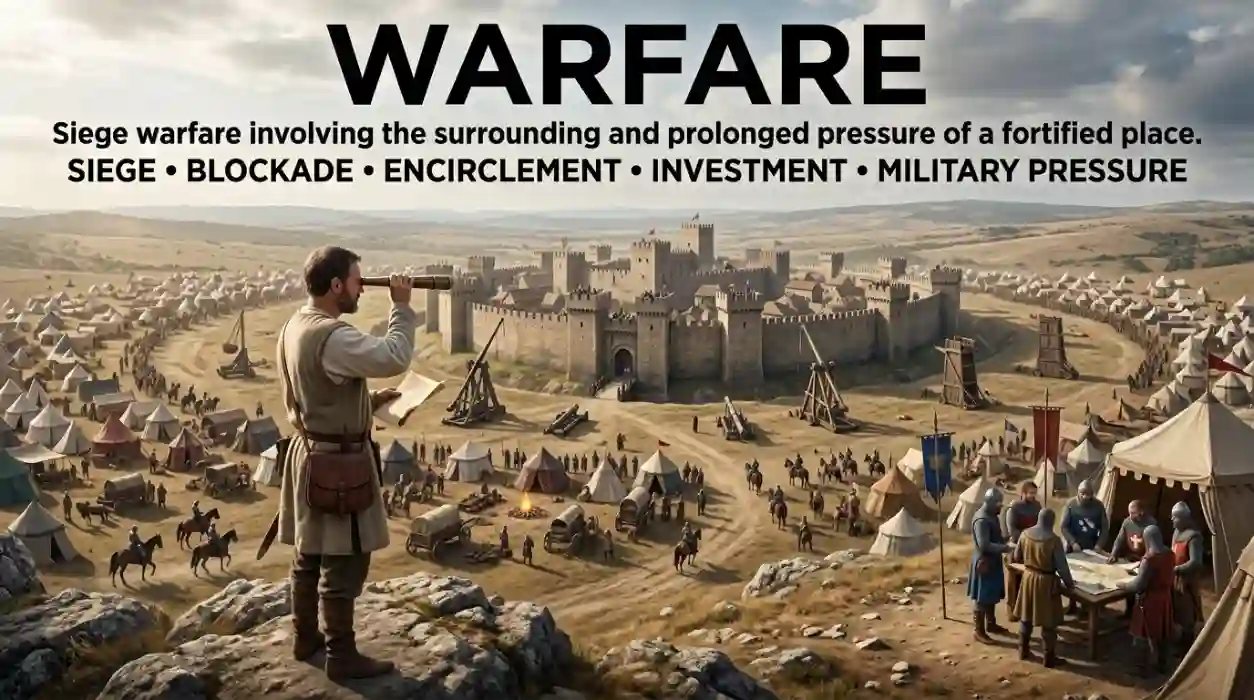
40. Siege warfare (noun phrase) — US /siːdʒ ˈwɔːrfer/ — UK /siːdʒ ˈwɔːfeə/
Meaning: Siege warfare involves surrounding and pressuring a fortified place over an extended period.
Tone/Register: Historical and military.
Examples:
The castle was designed to withstand siege warfare.
The book describes medieval siege warfare.
41. Jungle warfare (noun phrase) — US /ˈdʒʌŋɡəl ˈwɔːrfer/ — UK /ˈdʒʌŋɡəl ˈwɔːfeə/
Meaning: Jungle warfare refers to military fighting conducted in dense tropical environments.
Tone/Register: Military and historical.
Examples:
The documentary discusses jungle warfare.
The soldiers trained for difficult jungle conditions.
42. Urban warfare (noun phrase) — US /ˈɝːbən ˈwɔːrfer/ — UK /ˈɜːbən ˈwɔːfeə/
Meaning: Urban warfare refers to armed conflict conducted in towns and cities.
Tone/Register: Military, academic, and journalistic.
Examples:
The report examines the effects of urban warfare.
Urban warfare can create serious risks for civilians.
43. Psychological warfare (noun phrase) — US /ˌsaɪkəˈlɑːdʒɪkəl ˈwɔːrfer/ — UK /ˌsaɪkəˈlɒdʒɪkəl ˈwɔːfeə/
Meaning: Psychological warfare uses communication, fear, persuasion, or other psychological methods to influence an opponent.
Tone/Register: Military and academic.
Examples:
The study examines psychological warfare.
Propaganda can play a role in psychological warfare.
44. Economic warfare (noun phrase) — US /ˌiːkəˈnɑːmɪk ˈwɔːrfer/ — UK /ˌiːkəˈnɒmɪk ˈwɔːfeə/
Meaning: Economic warfare involves using economic pressure or restrictions to weaken an opposing state or group.
Tone/Register: Political and economic.
Examples:
The article discusses economic warfare.
The sanctions were analyzed as a form of economic pressure.
45. Information warfare (noun phrase) — US /ˌɪnfərˈmeɪʃən ˈwɔːrfer/ — UK /ˌɪnfəˈmeɪʃən ˈwɔːfeə/
Meaning: Information warfare involves using information and communication to influence, deceive, disrupt, or weaken an opponent.
Tone/Register: Academic and contemporary.
Examples:
The conference explored information warfare.
Social media can become part of an information conflict.
46. Total war (noun phrase) — US /ˈtoʊtəl wɔːr/ — UK /ˈtəʊtəl wɔː/
Meaning: Total war describes a conflict in which a society’s resources and institutions are extensively mobilized for the war effort.
Tone/Register: Historical and academic.
Examples:
The historian examines the concept of total war.
The country mobilized its economy during total war.
47. Limited war (noun phrase) — US /ˈlɪmətɪd wɔːr/ — UK /ˈlɪmɪtɪd wɔː/
Meaning: Limited war describes a conflict in which the objectives, participants, geography, or methods are deliberately restricted.
Tone/Register: Academic and strategic.
Examples:
The course examines the theory of limited war.
The conflict was described as a limited war.
48. War of attrition (noun phrase) — US /wɔːr əv əˈtrɪʃən/ — UK /wɔːr əv əˈtrɪʃən/
Meaning: A war of attrition aims to wear down an opponent through sustained losses and pressure.
Tone/Register: Military and academic.
Examples:
The conflict became a prolonged war of attrition.
Neither side wanted another war of attrition.
49. Military campaign (noun phrase) — US /ˈmɪləteri kæmˈpeɪn/ — UK /ˈmɪlɪtəri kæmˈpeɪn/
Meaning: A military campaign is a coordinated series of operations directed toward a strategic objective.
Tone/Register: Formal and historical.
Examples:
The campaign changed the course of the conflict.
Students studied the military campaign in class.
50. Armed struggle (noun phrase) — US /ɑːrmd ˈstrʌɡəl/ — UK /ɑːmd ˈstrʌɡəl/
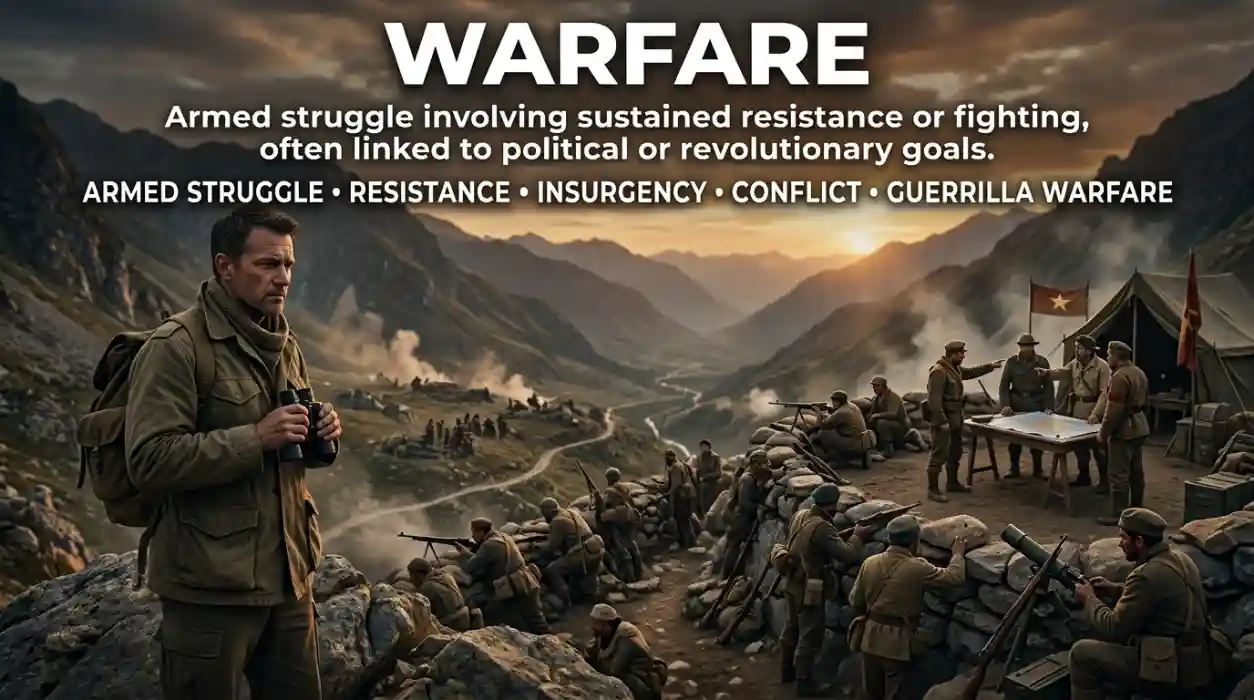
Meaning: Armed struggle describes sustained armed resistance or fighting, often connected to political or revolutionary goals.
Tone/Register: Political, historical, and academic.
Examples:
The memoir describes years of armed struggle.
The historian analyzes the movement’s armed struggle.
Synonyms by Tone
Positive or Constructive Academic Tone
Because warfare itself is generally serious or harmful, “positive” here means neutral or constructive framing, not approval of violence.
Useful choices include:
- military operations
- military campaign
- military engagement
- military action
- resistance
- conflict
These can sound measured and analytical.
Neutral Tone
For straightforward informational writing, use:
- war
- armed conflict
- hostilities
- fighting
- combat
- conflict
- military conflict
- military operations
- military action
- military campaign
These are especially useful in essays and reports.
Negative or Serious Tone
These emphasize violence, danger, or human suffering:
- armed violence
- organized violence
- hostilities
- fighting
- bloodshed
- civil conflict
- war of attrition
Be careful with emotionally loaded words. They can change the reader’s perception.
Playful or Informal Tone
There are relatively few genuinely playful synonyms for warfare because the subject is serious.
In figurative writing, however, English sometimes uses:
- battle
- clash
- struggle
- fight
- war
For example:
The two companies are locked in a fierce price war.
Here, war is metaphorical rather than literal military warfare.
Why Tone Matters
Compare these sentences:
The region experienced warfare.
The region experienced armed conflict.
The region experienced armed violence.
All three can describe serious conflict, but the emotional effect changes.
Warfare emphasizes the practice or methods of fighting.
Armed conflict sounds neutral and analytical.
Armed violence emphasizes harm and human impact.
Good vocabulary does not simply replace words. It changes emphasis.
“Warfare” vs Close Alternatives
Warfare vs War
War is the broader and more common word.
It can refer to the overall state of conflict.
The countries went to war.
Warfare often emphasizes the activity, techniques, or methods of fighting.
The book examines medieval warfare.
Use war for the event or state.
Use warfare when discussing how war is conducted.
Warfare vs Armed Conflict
Armed conflict is often more neutral and formal.
It is common in academic, diplomatic, humanitarian, and legal writing.
The region has experienced armed conflict.
Warfare may sound more focused on military practice.
The study examines modern warfare.
Warfare vs Combat
Combat usually refers to direct fighting between opposing forces.
The soldiers entered combat.
Warfare is broader.
Technology has transformed modern warfare.
You can think of combat as one activity within the broader concept of warfare.
How “Warfare” Changes by Context
Daily Conversation
In ordinary conversation, people usually say war or fighting rather than warfare.
For example:
There has been fighting near the border.
sounds more conversational than:
There has been warfare near the border.
Warfare sounds more analytical.
Writing and Blogging
Bloggers can use warfare when discussing history, technology, strategy, literature, or politics.
However, repeating it in every paragraph can make an article sound stiff.
You can alternate carefully with:
- conflict
- armed conflict
- fighting
- military action
- combat
- hostilities
Only change the word when the meaning remains accurate.
Professional and Academic Tone
Academic writing often favors precise expressions.
For example:
The study examines changes in modern warfare.
is appropriate.
You might then specify:
It focuses on cyber warfare and information warfare.
Specific terms improve precision.
Creative and Informal Use
Creative writing may use battle, fight, clash, or struggle to create stronger imagery.
Their battle for survival had only begun.
This can feel more immediate than:
Their warfare for survival had only begun.
The best word depends on whether you want an analytical or emotional effect.
Common Mistakes & Native Usage
Mistake 1: Treating “Warfare” as Countable
Avoid:
A warfare occurred.
Better:
Warfare occurred.
Or:
A war occurred.
Or:
A form of warfare developed.
Mistake 2: Assuming “Battle” Equals “Warfare”
A battle is usually one particular encounter.
Warfare can include many battles, strategies, weapons, operations, and methods.
The battle lasted two days.
The warfare continued for years.
Mistake 3: Using “Conflict” as a Perfect Replacement
Conflict is broader than warfare.
A conflict can be:
- political
- personal
- social
- economic
- military
So:
The two managers had a conflict.
does not mean they were engaged in warfare.
Mistake 4: Confusing Warfare With Militarism
Militarism refers to a strong emphasis on military power or military values.
It does not simply mean warfare.
The essay examines militarism.
means something different from:
The essay examines warfare.
Mistake 5: Using a Specific Type as a General Synonym
Do not replace warfare with cyber warfare unless the context actually concerns cyber activity.
Likewise, trench warfare should only be used when trenches are relevant.
Register Notes
Formal: armed conflict, hostilities, military operations, military engagement, belligerency.
Neutral: war, fighting, combat, conflict, battle.
Academic: asymmetric warfare, hybrid warfare, interstate conflict, organized violence.
Historical: trench warfare, siege warfare, guerrilla warfare, military campaign.
Journalistic: fighting, hostilities, military action, armed conflict.
Real-Life Mini Scenarios
Workplace
A business article might use warfare metaphorically:
The companies entered a price war.
Here, war is not literal military conflict.
A more formal article might say:
The companies entered an intense competitive struggle.
The context determines whether the language is literal or figurative.
Social Situation
If two people strongly disagree, you would normally say:
They had a conflict.
You would not normally call their disagreement warfare unless you were deliberately using dramatic metaphor.
Media and Pop Culture
A documentary might discuss psychological warfare when describing attempts to influence an opponent’s morale.
A news report might simply refer to military operations.
A historical drama might use battle or combat for a specific scene.
Writing and Storytelling
An author may write:
The kingdom had endured years of warfare.
That gives the story a broad historical feeling.
For one event:
The final battle began at dawn.
The second sentence is more specific.
Practice Exercise
1. Which word best describes the general activity and methods of fighting a war?
A. Battle
B. Warfare
C. Disagreement
D. Debate
2. Which term is usually more neutral and formal than “war”?
A. Armed conflict
B. Fight
C. Clash
D. Struggle
3. A single major military encounter is usually called a:
A. Warfare
B. Battle
C. Militarism
D. Hostility
4. Which term refers specifically to direct fighting?
A. Combat
B. Diplomacy
C. Campaign
D. Resistance
5. Which phrase describes fighting between groups within one country?
A. Naval warfare
B. Civil war
C. Air warfare
D. Economic warfare
6. Which term best fits fighting conducted at sea?
A. Urban warfare
B. Naval warfare
C. Trench warfare
D. Cyber warfare
7. Which phrase refers to conflict involving digital systems?
A. Siege warfare
B. Cyber warfare
C. Jungle warfare
D. Conventional warfare
8. Which expression is most suitable for diplomatic writing?
A. Armed conflict
B. Huge fight
C. Big battle
D. Serious clash
9. Which term emphasizes organized resistance against an authority?
A. Insurgency
B. Campaign
C. Combat
D. Warfare
10. Which phrase describes fighting from trenches?
A. Urban warfare
B. Trench warfare
C. Naval warfare
D. Hybrid warfare
Answer key: 1-B | 2-A | 3-B | 4-A | 5-B | 6-B | 7-B | 8-A | 9-A | 10-B
Reflection Task
Write one sentence using warfare.
Then rewrite it with one precise alternative, such as armed conflict, combat, hostilities, military operations, battle, or campaign.
External references:
Cambridge Dictionary — warfare · Cambridge Thesaurus — warfare · Etymonline — warfare
Conclusion
Learning a strong synonym for warfare helps you write about conflict with more precision. Small word choices can distinguish a whole war from one battle or military operation.
For students and bloggers, varied vocabulary prevents repetition. For content writers, it creates clearer explanations and helps readers understand scale, method, and context.
Use war for the broader conflict, combat for direct fighting, and armed conflict for neutral formal writing. Choose specific terms when the method matters.
Practice one alternative today in an email, essay, article, or conversation. Compare it with “warfare” and notice the difference; that simple habit can sharpen your vocabulary.
FAQs
1. What is the best synonym for warfare in academic writing?
Armed conflict is often a strong choice when you need a neutral academic expression. Military conflict, hostilities, and military operations can also work, depending on the exact meaning. If your subject is the methods used to fight, warfare may actually be the most precise word. Academic writing should prioritize accuracy over simply finding a more complicated synonym.
2. What is a simple synonym for warfare?
The simplest and most common alternative is war. Other accessible choices include fighting, combat, and conflict, although each has a slightly different meaning. “War” describes the overall armed conflict, while “combat” usually focuses on direct fighting. “Conflict” is broader and can refer to nonmilitary disagreements too.
3. Is “war” the same as “warfare”?
Not exactly. War usually refers to the armed conflict itself or the state of being at war. Warfare often focuses on the methods, practices, strategies, and technologies used in fighting. For example, “The countries were at war” describes the conflict, while “The book examines modern warfare” focuses on how war is conducted.
4. What is a formal synonym for warfare?
Formal alternatives include armed conflict, hostilities, military operations, military action, military engagement, and military conflict. The most appropriate choice depends on context. “Hostilities” is useful in diplomatic writing, while “military operations” emphasizes organized activities by armed forces. “Armed conflict” is especially useful when a neutral, analytical tone is needed.
5. What is the difference between warfare and combat?
Combat generally means direct fighting between opposing forces. Warfare is broader and can include combat, strategy, weapons, technology, logistics, psychological methods, and other ways of conducting war. Therefore, combat can be considered one part of warfare. “The soldiers entered combat” focuses on fighting, while “technology changed modern warfare” covers a much wider subject.

Hasnain Ali is an SEO Content Strategist and the founder of wordvora.com, a trusted vocabulary platform that helps writers, students, professionals, and English learners find accurate synonyms, antonyms, word meanings, and real-life usage examples. He specializes in keyword research, on-page SEO, topical authority, and creating search-first content that aligns with Google’s latest Search Quality and E-E-A-T guidelines. His work focuses on producing clear, well-structured, and reader-friendly resources that satisfy search intent while maintaining high editorial standards.
Through extensive hands-on experience with SEO tools such as Google Search Console, Google Analytics, SEMrush, and Ahrefs, Hasnain researches user search behavior and develops content that is both informative and easy to understand. Every article published on wordvora.com is carefully reviewed for accuracy, readability, and contextual relevance before publication. His mission is to build one of the web’s most reliable English vocabulary resources by providing practical language guidance, trustworthy explanations, and content that helps readers improve their writing, communication, and vocabulary with confidence.