
A useful synonym for to the point is direct, but the best choice depends on the exact meaning. Other alternatives include concise, succinct, focused, relevant, precise, clear, straightforward, pertinent, pointed, pithy, brief, and forthright. Some emphasize brevity, while others highlight relevance, clarity, accuracy, or directness.
The synonym “to the point” is useful when you want to describe communication that avoids unnecessary detail. Imagine asking a colleague a simple question and receiving a long explanation before the answer.
You might say, “Please keep your response to the point.” A student might instead write, “Please give a concise answer.”
The phrase is widely used because clear communication saves time. Its alternatives help students, bloggers, content writers, and professionals express subtle differences.
For daily English users, knowing a synonym for to the point also makes speech more flexible. You can sound direct, polite, formal, or conversational without repeating one phrase.
What Does “To the Point” Really Mean?
To the point is an idiomatic expression meaning directly relevant, focused on the main subject, and free from unnecessary information.
For example:
“Her answer was short and to the point.”
This means that her answer addressed the important issue without adding irrelevant details.
The expression can also describe writing, questions, comments, presentations, reports, emails, speeches, and conversations.
Native speakers generally understand it as a positive or neutral description of efficient communication.
However, context matters.
A person who is “to the point” may be admired for being efficient. In another situation, excessive directness may be perceived as cold or impatient.
Part of Speech
To the point is an idiomatic phrase. In sentences such as “Her answer was to the point,” it functions as a complement describing the answer.
The related adjective phrase to-the-point can also appear before a noun:
“He gave a to-the-point response.”
Simple Definition
To the point means focused on the main idea and without unnecessary words or details.
Connotative Meaning of “To the Point”
Connotation (the feeling or association connected with a word beyond its literal meaning) can influence how this phrase is understood.
Positive Tone
“To the point” can suggest clarity, confidence, efficiency, intelligence, and professionalism.
A concise answer may be appreciated during a busy meeting.
Negative Tone
In some situations, excessive directness may sound blunt, impatient, dismissive, or insensitive.
“Get to the point” can therefore sound much harsher than “Could you summarize the main idea?”
Neutral Tone
In academic, technical, and informational contexts, the expression can simply describe communication that stays focused.
No strong emotional judgment is required.
Etymology
The expression contains the common words to and point.
The noun point entered English through Old French point, which came from Latin punctum, meaning a point, mark, or small puncture. It is related to Latin pungere, meaning “to prick.”
Over time, point developed many abstract meanings. It came to refer not only to a physical mark but also to an idea, argument, purpose, detail, or central issue.
The expression to the point developed from this figurative sense of point as the central matter being discussed.
Old English: 450–1100
The exact expression to the point was not part of Old English.
Old English had native words for subjects such as purpose, matter, meaning, and relevance. The modern word point entered English later through French influence.
Middle English: 1100–1500
During the Middle English period, French vocabulary strongly influenced English.
Words related to point entered the language through Old French. The word could refer to a physical point as well as a particular matter or detail.
Modern English: 1500–Present
The abstract meanings of point became increasingly established in Modern English.
The word could refer to the central idea of an argument or discussion. From this meaning, it developed as an expression of relevant, focused communication.
Today, it is widely used in conversation, education, journalism, business, essays, presentations, and digital communication.
Pronunciation
US: /tə ðə pɔɪnt/
UK: /tə ðə pɔɪnt/
In natural speech, to and the are usually unstressed.
Syllables
to-the-point
Affixation Pattern
Root: point
Prefix: none
Suffix: none
The expression is an idiomatic phrase rather than a word formed through prefixation or suffixation.
Synonyms List
Some emphasize brevity, some relevance, some clarity, and others directness. A few are context-specific rather than strict dictionary synonyms.
That distinction matters because natural English depends on meaning, register, and tone.
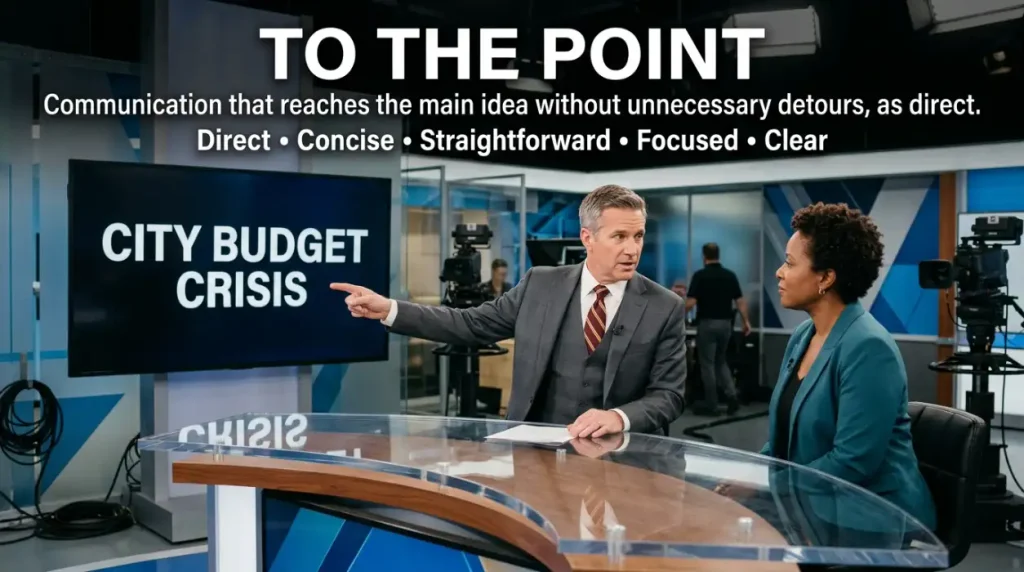
Direct (Adjective) — US /dəˈrekt/ — UK /daɪˈrekt/
Meaning: Direct describes communication that reaches the main idea without unnecessary detours.
Tone/Register: Neutral, professional, and very common.
Examples:
Her answer was direct and easy to understand.
He gave a direct response instead of avoiding the question.
Concise (Adjective) — US /kənˈsaɪs/ — UK /kənˈsaɪs/
Meaning: Concise means expressing the essential information in few words.
Tone/Register: Formal, academic, and professional.
Examples:
Please keep the introduction concise.
The concise summary saved everyone time.
Succinct (Adjective) — US /səkˈsɪŋkt/ — UK /səkˈsɪŋkt/
Meaning: Succinct means brief while still communicating the necessary information.
Tone/Register: Formal and polished.
Examples:
She gave a succinct summary of the meeting.
His response was succinct but complete.
Focused (Adjective) — US /ˈfoʊkəst/ — UK /ˈfəʊkəst/
Meaning: Focused describes communication that stays centered on one main subject.
Tone/Register: Neutral and professional.
Examples:
The presentation was focused and easy to follow.
Try to keep your answer focused on the question.
Relevant (Adjective) — US /ˈreləvənt/ — UK /ˈreləvənt/
Meaning: Relevant means directly connected with the subject being discussed.
Tone/Register: Neutral, academic, and professional.
Examples:
Please include only relevant information.
Her comment was relevant to the discussion.
Pertinent (Adjective) — US /ˈpɝːtənənt/ — UK /ˈpɜːtɪnənt/
Meaning: Pertinent means closely and directly related to the matter under consideration.
Tone/Register: Formal.
Examples:
The lawyer asked several pertinent questions.
Only pertinent details were included in the report.
Precise (Adjective) — US /prɪˈsaɪs/ — UK /prɪˈsaɪs/
Meaning: Precise means exact, specific, and free from unnecessary ambiguity.
Tone/Register: Neutral to formal.
Examples:
Her explanation was precise and easy to verify.
Please give me a precise answer.
Clear (Adjective) — US /klɪr/ — UK /klɪə/
Meaning: Clear describes communication that is easy to understand.
Tone/Register: Neutral and universal.
Examples:
His instructions were clear and practical.
She gave a clear answer to the question.
Straightforward (Adjective) — US /ˌstreɪtˈfɔːrwərd/ — UK /ˌstreɪtˈfɔːwəd/
Meaning: Straightforward describes something simple, direct, and easy to understand.
Tone/Register: Neutral and conversational.
Examples:
The instructions were straightforward.
She gave me a straightforward explanation.
Pithy (Adjective) — US /ˈpɪθi/ — UK /ˈpɪθi/
Meaning: Pithy describes a short statement that contains substantial meaning.
Tone/Register: Literary, journalistic, and polished.
Examples:
His pithy comment ended the debate.
The article contains several pithy observations.
Pointed (Adjective) — US /ˈpɔɪntɪd/ — UK /ˈpɔɪntɪd/
Meaning: Pointed describes language that is deliberately direct and sometimes sharply critical.
Tone/Register: Neutral to formal; potentially sharp.
Examples:
She asked a pointed question about the delay.
His pointed remark made everyone pause.
Brief (Adjective) — US /briːf/ — UK /briːf/
Meaning: Brief means containing only a small amount of information or lasting for a short time.
Tone/Register: Neutral and very common.
Examples:
Please give me a summary.
We had a brief conversation before the meeting.
Crisp (Adjective) — US /krɪsp/ — UK /krɪsp/
Meaning: Crisp describes communication that is clean, concise, and easy to grasp.
Tone/Register: Professional and informal.
Examples:
The report needs a crisp introduction.
Her answer was crisp and confident.
Explicit (Adjective) — US /ɪkˈsplɪsɪt/ — UK /ɪkˈsplɪsɪt/
Meaning: Explicit means stated clearly rather than being left implied.
Tone/Register: Formal and academic.
Examples:
The instructions were explicit.
The contract contains explicit requirements.
Unambiguous (Adjective) — US /ˌʌnæmˈbɪɡjuəs/ — UK /ˌʌnæmˈbɪɡjuəs/
Meaning: Unambiguous means clear enough to allow only one reasonable interpretation.
Tone/Register: Formal and technical.
Examples:
Her instructions were unambiguous.
The message was unambiguous.
Coherent (Adjective) — US /koʊˈhɪrənt/ — UK /kəʊˈhɪərənt/
Meaning: Coherent describes ideas that are logically connected and easy to follow.
Tone/Register: Academic and professional.
Examples:
He presented a coherent argument.
The final report was coherent and well organized.
Cogent (Adjective) — US /ˈkoʊdʒənt/ — UK /ˈkəʊdʒənt/
Meaning: Cogent describes an argument that is clear, logical, and convincing.
Tone/Register: Formal and academic.
Examples:
She made a cogent argument for changing the policy.
His explanation was short but cogent.
On-Topic (Adjective) — US /ˌɑːnˈtɑːpɪk/ — UK /ˌɒnˈtɒpɪk/
Meaning: On-topic means directly related to the subject under discussion.
Tone/Register: Informal and conversational.
Examples:
Please keep your comments on-topic.
Her answer stayed completely on-topic.
Germane (Adjective) — US /dʒɝːˈmeɪn/ — UK /ˈdʒɜːmeɪn/
Meaning: Germane means closely relevant to a particular matter.
Tone/Register: Formal.
Examples:
The evidence was germane to the case.
Only germane issues were discussed.
Apropos (Adjective/Adverb) — US /ˌæprəˈpoʊ/ — UK /ˌæprəˈpəʊ/
Meaning: Apropos means relevant or appropriately connected to the subject.
Tone/Register: Formal and literary.
Examples:
Her comment was apropos of the discussion.
The question was entirely apropos.

Matter-of-Fact (Adjective) — US /ˌmætər əv ˈfækt/ — UK /ˌmætər əv ˈfækt/
Meaning: Matter-of-fact describes communication that is direct and unemotional.
Tone/Register: Neutral.
Examples:
He gave a matter-of-fact explanation.
Her matter-of-fact tone kept the discussion calm.
Forthright (Adjective) — US /ˈfɔːrθraɪt/ — UK /ˈfɔːθraɪt/
Meaning: Forthright means openly direct and honest.
Tone/Register: Professional and formal.
Examples:
She was forthright about the project’s problems.
His forthright answer surprised the committee.
Frank (Adjective) — US /fræŋk/ — UK /fræŋk/
Meaning: Frank means honest and direct, especially about something difficult.
Tone/Register: Neutral to informal.
Examples:
To be frank, the proposal needs more work.
She gave me a frank assessment of the situation.
Blunt (Adjective) — US /blʌnt/ — UK /blʌnt/
Meaning: Blunt describes very direct language that may sound insensitive.
Tone/Register: Informal to neutral; potentially negative.
Examples:
His blunt response surprised the team.
She was blunt about what needed to change.
Plainspoken (Adjective) — US /ˈpleɪnˌspoʊkən/ — UK /ˈpleɪnˌspəʊkən/
Meaning: Plainspoken describes someone who communicates simply and honestly.
Tone/Register: Informal to neutral.
Examples:
Her plainspoken advice was easy to understand.
He is known for his plainspoken style.
No-Nonsense (Adjective) — US /ˌnoʊˈnɑːns/ — UK /ˌnəʊˈnɒns/
Meaning: No-nonsense describes a practical approach that avoids unnecessary discussion.
Tone/Register: Informal and professional.
Examples:
She has a no-nonsense approach to meetings.
His no-nonsense answer settled the issue.
Streamlined (Adjective) — US /ˈstriːmlaɪnd/ — UK /ˈstriːmlaɪnd/
Meaning: Streamlined describes something simplified by removing unnecessary parts.
Tone/Register: Professional and business-oriented.
Examples:
The revised report is much more streamlined.
The new process keeps communication streamlined.
Digestible (Adjective) — US /dɪˈdʒestəbəl/ — UK /daɪˈdʒestəbəl/
Meaning: Digestible describes information presented in an easily understood form.
Tone/Register: Informal to professional.
Examples:
The writer turned a complex topic into a digestible summary.
The key findings were presented in a digestible format.
Economical (Adjective) — US /ˌiːkəˈnɑːmɪkəl/ — UK /ˌiːkəˈnɒmɪkəl/
Meaning: Economical language communicates an idea without unnecessary words.
Tone/Register: Formal and literary.
Examples:
The author uses economical language throughout the essay.
Her economical writing makes every sentence count.
Unvarnished (Adjective) — US /ʌnˈvɑːrnɪʃt/ — UK /ʌnˈvɑːnɪʃt/
Meaning: Unvarnished describes information given plainly without softening or decoration.
Tone/Register: Formal to neutral.
Examples:
The report offered an unvarnished account of the problem.
She gave us her unvarnished opinion.
Candid (Adjective) — US /ˈkændɪd/ — UK /ˈkændɪd/
Meaning: Candid describes honest and open communication without deliberate concealment.
Tone/Register: Neutral to professional.
Examples:
He gave a candid assessment of the project.
The interview produced several candid answers.
Unembellished (Adjective) — US /ˌʌnɪmˈbelɪʃt/ — UK /ˌʌnɪmˈbelɪʃt/
Meaning: Unembellished describes language presented simply without extra decoration or elaboration.
Tone/Register: Formal and literary.
Examples:
She gave an unembellished account of what happened.
The facts were presented in an unembellished style.
Succinctly (Adverb) — US /səkˈsɪŋktli/ — UK /səkˈsɪŋktli/
Meaning: Succinctly means expressing something briefly and clearly.
Tone/Register: Formal and academic.
Examples:
He explained the problem succinctly.
The issue can be summarized succinctly.
Directly (Adverb) — US /dəˈrektli/ — UK /daɪˈrektli/
Meaning: Directly means without an indirect route or unnecessary intermediary explanation.
Tone/Register: Neutral and extremely common.
Examples:
Please answer the question directly.
She spoke directly about the problem.
Clearly (Adverb) — US /ˈklɪrli/ — UK /ˈklɪəli/
Meaning: Clearly means in a way that is easy to understand or interpret.
Tone/Register: Neutral.
Examples:
Please explain your position clearly.
He stated his concerns clearly.
Precisely (Adverb) — US /prɪˈsaɪsli/ — UK /prɪˈsaɪsli/
Meaning: Precisely means accurately and with exact wording.
Tone/Register: Formal to neutral.
Examples:
Tell me precisely what happened.
She explained precisely why the plan failed.
Plainly (Adverb) — US /ˈpleɪnli/ — UK /ˈpleɪnli/
Meaning: Plainly means in a simple, direct, and easily understood way.
Tone/Register: Neutral and somewhat formal.
Examples:
He plainly stated what he wanted.
The evidence plainly supports the conclusion.
Unambiguously (Adverb) — US /ˌʌnæmˈbɪɡjuəsli/ — UK /ˌʌnæmˈbɪɡjuəsli/
Meaning: Unambiguously means in a way that leaves no reasonable uncertainty about the meaning.
Tone/Register: Formal and technical.
Examples:
The policy states the requirement unambiguously.
Her position was expressed unambiguously.
To the Core (Phrase) — US /tə ðə kɔːr/ — UK /tə ðə kɔː/
Meaning: To the core means reaching the essential or central part of an issue.
Tone/Register: Neutral to expressive.
Examples:
Her criticism went to the core of the problem.
The article gets to the core of the issue quickly.
Straight to the Point (Phrase) — US /streɪt tə ðə pɔɪnt/ — UK /streɪt tə ðə pɔɪnt/
Meaning: Straight to the point emphasizes immediate movement toward the main idea.
Tone/Register: Conversational and professional.
Examples:
Let’s get straight to the point.
He went straight to the point in his opening statement.

Get to the Heart of It (Phrase) — US /ɡet tə ðə hɑːrt əv ɪt/ — UK /ɡet tə ðə hɑːt əv ɪt/
Meaning: This phrase means addressing the central issue rather than peripheral details.
Tone/Register: Conversational and expressive.
Examples:
Her question gets to the heart of the issue.
The documentary gets to the heart of the story.
Cut to the Chase (Idiom) — US /kʌt tə ðə tʃeɪs/ — UK /kʌt tə ðə tʃeɪs/
Meaning: Cut to the chase means stop unnecessary discussion and address the main matter.
Tone/Register: Informal.
Examples:
Let’s cut to the chase and discuss the real problem.
He cut to the chase during the meeting.
Say It Plainly (Phrase) — US /seɪ ɪt ˈpleɪnli/ — UK /seɪ ɪt ˈpleɪnli/
Meaning: Say it plainly means express the idea simply and directly.
Tone/Register: Conversational.
Examples:
Just say it plainly if you disagree.
She said it plainly and avoided confusion.
Keep It Brief (Phrase) — US /kiːp ɪt briːf/ — UK /kiːp ɪt briːf/
Meaning: Keep it brief means communicate using only the necessary amount of information.
Tone/Register: Informal to professional.
Examples:
We have five minutes, so keep it brief.
The editor asked the writer to keep it brief.
Get Straight to the Matter (Phrase) — US /ɡet streɪt tə ðə ˈmætər/ — UK /ɡet streɪt tə ðə ˈmætə/
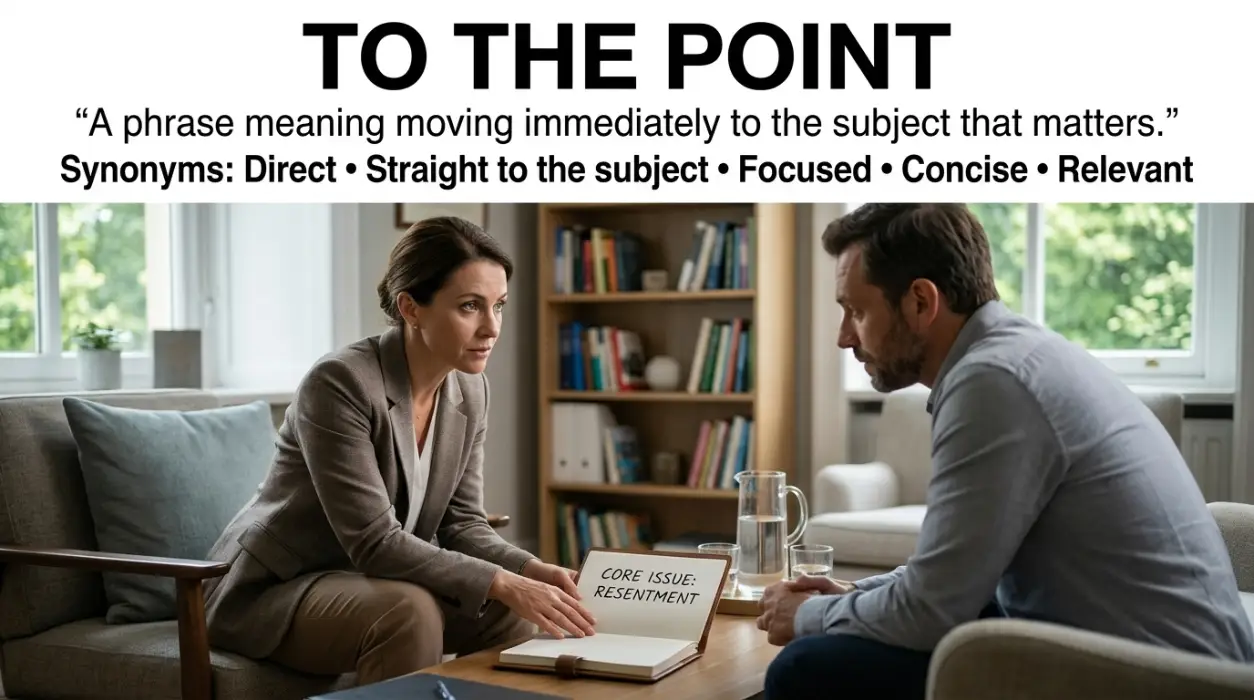
Meaning: This phrase means move immediately to the subject that matters.
Tone/Register: Neutral to formal.
ExampleS:
She got straight to the matter during the interview.
The chair asked everyone to get straight to the matter.
Synonyms by Tone
Positive
Concise, succinct, focused, precise, clear, straightforward, pithy, crisp, coherent, cogent, and digestible often sound positive.
They suggest effective communication.
Neutral
Direct, relevant, pertinent, brief, explicit, unambiguous, on-topic, germane, candid, and matter-of-fact are generally neutral.
They describe communication without strongly judging it.
Potentially Negative
Blunt, pointed, unvarnished, and sometimes frank can sound critical depending on context.
They may imply that someone has been unusually direct.
Playful or Informal
No-nonsense, cut to the chase, say it plainly, and straight to the point are more conversational.
These expressions work well in everyday speech but may be less suitable for formal academic writing.
“To the Point” vs Close Alternatives
| Expression | Main emphasis | Tone | Best use |
|---|---|---|---|
| To the point | Relevance and focus | Neutral-positive | General communication |
| Direct | Straightforward delivery | Neutral | Conversation and work |
| Concise | Few words | Positive | Writing and reports |
| Relevant | Connection to the subject | Neutral | Academic writing |
| Blunt | Very direct delivery | Potentially negative | Sensitive opinions |
Direct vs. To the Point
To the point emphasizes staying focused on the main matter.
Direct emphasizes the manner in which something is communicated.
A person can be direct but give far more information than necessary.
To the Point vs Concise
Concise focuses on brevity.
To the point focuses on relevance.
A concise answer is not necessarily useful if it fails to address the question.
To the Point vs Relevant
Relevant means connected to the subject.
To the point normally suggests relevance plus focus.
This is why “relevant” can replace the phrase in some contexts but not all.
How “To the Point” Changes by Context
Daily Conversation
In casual conversation, direct, clear, straightforward, brief, and straight to the point are natural.
For example:
“Can you give me a straightforward answer?”
This sounds conversational and easy to understand.
Writing and Blogging
For blogs and articles, concise, focused, digestible, precise, relevant, and streamlined are useful.
A reader usually wants the main information quickly.
Short, purposeful paragraphs can make online content easier to scan.
Professional and Academic Writing
Professional writing often benefits from being concise, succinct, pertinent, precise, coherent, cogent, and unambiguous.
For example:
“Please provide a concise summary of the findings.”
That sounds more polished than simply telling someone not to write too much.
Creative and Informal Use
Creative writing allows more expressive alternatives.
Pithy, pointed, candid, plainspoken, blunt, and matter-of-fact can describe a character’s speaking style.
The choice can reveal personality as well as meaning.
Common Mistakes and Native Usage
Mistake 1: Assuming “to the point” only means short
A short answer is not automatically to the point.
The answer must also address the important issue.
Mistake 2: Treating “blunt” as a perfect synonym
Blunt is stronger.
It can suggest that someone communicates without enough sensitivity.
Use direct when you want a safer, neutral tone.
Mistake 3: Confusing “concise” with “relevant”
Concise describes length.
Relevant describes connection to the topic.
Good professional communication should often be both.
Mistake 4: Overusing “direct”
“Direct” is extremely useful, but repeated use can make your writing predictable.
Try focused, precise, succinct, pertinent, or clear when those meanings fit.
Mistake 5: Using formal words in casual conversation
Words such as germane, cogent, pertinent, and unambiguous are correct but may sound overly formal in ordinary conversation.
Native speakers often choose simpler alternatives such as clear, direct, brief, or straightforward.
Register Notes
Everyday speech: direct, clear, brief, straightforward, frank.
Professional writing: concise, precise, focused, relevant, streamlined.
Academic writing: succinct, pertinent, cogent, coherent, germane.
Creative writing: pithy, pointed, candid, plainspoken, unvarnished.
Informal speech: cut to the chase, no-nonsense, straight to the point.
For broader vocabulary development, related articles on synonyms and precise English can be used as internal learning resources.
Real-Life Mini Scenarios
Workplace
A manager needs a short update before a meeting.
“Please give me a concise summary of the project.”
Here, concise is more precise than simply saying “to the point.”
Social Situation
A friend asks whether you enjoyed a restaurant.
“Yes. The food was excellent, but the service was slow.”
The answer is direct and to the point without being unnecessarily blunt.
Media and Pop Culture
A journalist may describe an interview as candid when a guest answers difficult questions openly.
A review might call a memorable quote pithy because it expresses a strong idea in very few words.
Writing and Storytelling
A novelist might give a character pointed dialogue to create tension.
A fast-paced scene may use economical prose so the story moves quickly.
These distinctions help writers communicate both meaning and attitude.
Practice Exercise
1. Your manager wants a summary containing only essential information. Which word fits best?
A. Concise
B. Chaotic
C. Blunt
D. Decorative
2. A friend answers your question honestly without avoiding it. Which word fits best?
A. Direct
B. Vague
C. Indirect
D. Confusing
3. An essay contains information closely connected to its main topic. Which word fits?
A. Relevant
B. Whimsical
C. Blunt
D. Accidental
4. A short statement contains a surprisingly powerful idea. Which word fits?
A. Pithy
B. Lengthy
C. Confused
D. Irrelevant
5. Someone gives an extremely direct answer that sounds slightly insensitive. Which word fits?
A. Blunt
B. Digestible
C. Concise
D. Coherent
6. A scientific report needs exact wording. Which word is most suitable?
A. Precise
B. Playful
C. Casual
D. Whimsical
7. A presentation stays centered on one main topic. Which word fits?
A. Focused
B. Random
C. Blunt
D. Accidental
8. A lawyer asks questions closely connected to the case. Which word fits?
A. Pertinent
B. Playful
C. Decorative
D. Casual
9. A report has been simplified by removing unnecessary information. Which word fits?
A. Streamlined
B. Blunt
C. Irrelevant
D. Confusing
10. A person gives an honest and open opinion about a difficult issue. Which word fits?
A. Forthright
B. Vague
C. Indirect
D. Unclear
Reflection Task
Write one sentence describing an answer, email, or conversation you experienced recently. Rewrite it using one synonym for to the point and notice how the tone changes.
Answer key: 1-A | 2-A | 3-A | 4-A | 5-A | 6-A | 7-A | 8-A | 9-A | 10-A
Conclusion
A good synonym for to the point can make your writing more precise. Words such as direct, concise, and focused help you describe clear communication without unnecessary repetition.
For essays, blogs, emails, and reports, alternatives such as succinct, relevant, precise, and pertinent can make your language stronger. For conversation, direct often feels more natural.
Vocabulary becomes useful when you understand its shades. Blunt can sound harsh, pithy can sound polished, and forthright can emphasize honesty rather than brevity.
Choose three new alternatives and practice them today. Use them in an email, essay, story, or conversation, and notice how each word changes your message.
External reference sources
For definitions, pronunciation, usage examples, and additional vocabulary research:
Merriam-Webster
Oxford Learner’s Dictionaries
This revised version deliberately distinguishes true synonyms from context-specific semantic alternatives, which helps prevent unnatural word substitution while still covering the broad search intent behind “synonym for to the point.”
FAQs
What is the best synonym for “to the point” in professional English?
Concise, direct, focused, and precise are strong professional choices. Use concise when brevity matters, direct when the delivery is straightforward, focused when the message stays on one issue, and precise when exact wording matters. The best choice depends on the specific quality you want to describe.
What is a polite way to say “get to the point”?
Instead of “Get to the point,” which can sound impatient, say “Could you summarize the main point?, “Could you keep your answer concise?”, or “Could you focus on the key issue?” These alternatives communicate the same request more politely and work well in professional, academic, and everyday situations.
Is “concise” the same as “to the point”?
No. Concise mainly means brief while retaining important information. To the point emphasizes relevance and focus. A response may be concise but still fail to answer the question. Ideally, effective communication is both concise and to the point: it is short enough to be efficient and relevant enough to be useful.
What is a stronger synonym for “to the point”?
The answer depends on the intended tone. Blunt is stronger because it suggests unusually direct language and can sound insensitive. Pointed suggests sharp or deliberate criticism. Forthright emphasizes honesty. If you want a professional alternative without a negative implication, precise or direct is usually safer.
What is a formal synonym for “to the point”?
Formal alternatives include succinct, pertinent, germane, cogent, precise, and concise. Succinct emphasizes brevity, pertinent emphasizes relevance, and cogent describes an argument that is clear and convincing. In academic writing, choose the word that expresses the exact quality of the communication rather than simply choosing the most sophisticated term.

Hasnain Ali is an SEO Content Strategist and the founder of wordvora.com, a trusted vocabulary platform that helps writers, students, professionals, and English learners find accurate synonyms, antonyms, word meanings, and real-life usage examples. He specializes in keyword research, on-page SEO, topical authority, and creating search-first content that aligns with Google’s latest Search Quality and E-E-A-T guidelines. His work focuses on producing clear, well-structured, and reader-friendly resources that satisfy search intent while maintaining high editorial standards.
Through extensive hands-on experience with SEO tools such as Google Search Console, Google Analytics, SEMrush, and Ahrefs, Hasnain researches user search behavior and develops content that is both informative and easy to understand. Every article published on wordvora.com is carefully reviewed for accuracy, readability, and contextual relevance before publication. His mission is to build one of the web’s most reliable English vocabulary resources by providing practical language guidance, trustworthy explanations, and content that helps readers improve their writing, communication, and vocabulary with confidence.