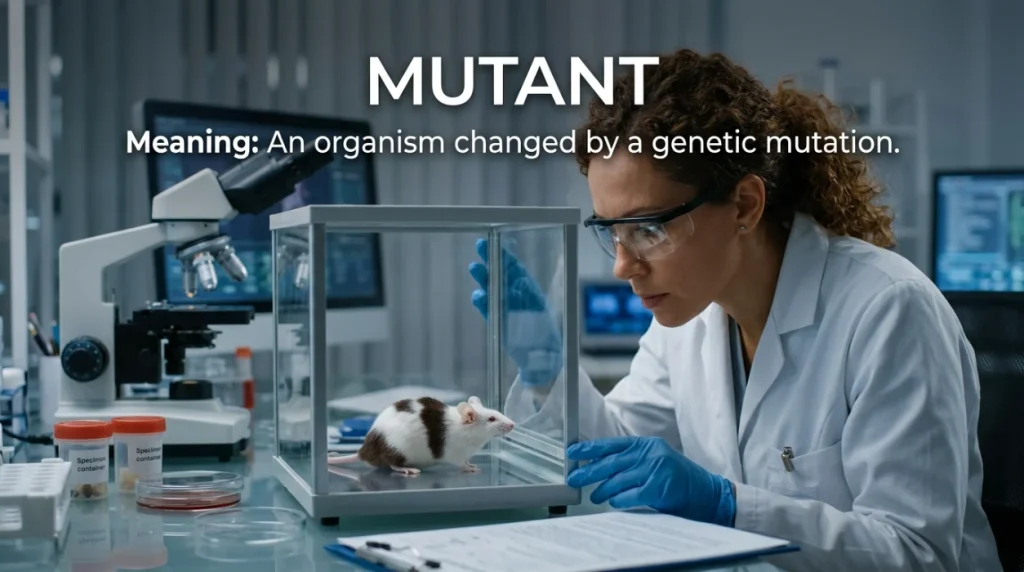
Synonyms for mutant become useful when one word feels too scientific, dramatic, or negative. A science student, for example, may need a precise alternative.
In biology, a mutant can mean an organism with a genetic change. In fiction, however, it may describe a dramatically altered person or creature.
That is why synonyms for mutant need careful word choice. Terms such as variant, altered, and aberrant can carry very different meanings.
For students, bloggers, content writers, and daily English users, learning synonyms for mutant makes descriptions clearer, more accurate, and easier to understand.
What Does “Mutant” Really Mean?
Mutant is primarily a noun and can also function as an adjective.
In biology, a mutant is an organism, cell, or genetic form that contains a mutation. A mutation is a change in genetic material.
For example:
Scientists studied a mutant strain of bacteria.
Here, mutant is a technical biological term.
In fiction and popular culture, however, mutant often has a broader meaning. It may describe a person, animal, or creature whose characteristics have changed because of mutation.
For example:
The novel features a mutant creature living underground.
Native speakers therefore understand mutant according to context. In scientific writing, it can be neutral. In everyday speech and fiction, it can sound unusual, dramatic, frightening, or even insulting.
Simple Definition
Mutant: a living organism, cell, or genetic form that has undergone a mutation or has characteristics resulting from genetic change.
Part of Speech
Noun:
The mutant survived the experiment.
Adjective:
Researchers examined the mutant gene.
Connotative Meaning of “Mutant”
Connotation (the emotional feeling or association that a word can suggest beyond its basic dictionary meaning) is especially important with mutant.
Positive Tone
In scientific contexts, mutant can be neutral rather than negative. In fiction, a mutant character may also be heroic, powerful, intelligent, or admirable.
The mutant character protects the city.
Here, the word does not necessarily express criticism.
Negative Tone
In casual language, mutant can suggest something abnormal, frightening, unnatural, or defective.
The creature looked like a mutant.
This can sound harsh when applied to a person.
Neutral Tone
Scientific writing often uses mutant objectively.
The researchers isolated a mutant strain.
In this context, the word describes genetic difference rather than judging it.

Etymology of “Mutant”
The English word mutant ultimately comes from Latin mutare, meaning “to change.”
The related Latin form mutans, meaning “changing,” helped give rise to the scientific term.
Unlike many basic English words, mutant does not originate as an Old English word. It entered English much later through scientific and biological vocabulary.
Old English: 450–1100
The modern word mutant was not part of Old English.
Old English had other words expressing ideas such as change, alteration, transformation, and difference, but the modern scientific term had not yet developed.
Middle English: 1100–1500
During Middle English, English absorbed many French and Latin-derived words.
The linguistic family connected with Latin mutare continued developing across European languages, although mutant itself was not yet the established modern English biological noun.
Modern English: 1500–Present
The rise of modern science created a need for precise terminology concerning heredity and biological change.
Mutant became established in scientific English, particularly as genetics developed during the nineteenth and twentieth centuries.
Today, it appears in biology, genetics, medicine, science communication, speculative fiction, comics, films, games, and popular culture.
Pronunciation
US: /ˈmjuːtənt/
UK: /ˈmjuːtənt/
Syllables
mu-tant
Affixation Pattern of “Mutant”
Root: Latin mutare — “to change”
Prefix: none in the modern English word
Suffix: -ant
The -ant ending can form nouns or adjectives associated with an action, state, or agent.
Synonyms List
Variation (Noun) — US: /ˌvɛriˈeɪʃən/ — UK: /ˌveəriˈeɪʃn/
- Meaning: A change or difference in condition, amount, or level.
- Tone/Register: Scientific, neutral.
- Example: Genetic variation allows species to adapt to environments.
- Example: Researchers noted a slight variation in cell structures.
Variant (Noun) — US: /ˈvɛriənt/ — UK: /ˈveəriənt/
- Meaning: A form or version of something that differs slightly from other forms.
- Tone/Register: Formal, technical.
- Example: Scientists tracked a new viral variant in the lab.
- Example: The manuscript had an unusual linguistic variant.
Abnormality (Noun) — US: /ˌæbnɔːrˈmælɪti/ — UK: /ˌæbnɔːˈmæləti/
- Meaning: Something that is abnormal, typically in an unwelcome way.
- Tone/Register: Medical, formal.
- Example: Doctors checked scans for any physical abnormality.
- Example: A chromosomal abnormality can alter cellular development.
Anomaly (Noun) — US: /əˈnɒməli/ — UK: /əˈnɒməli/
- Meaning: Something that deviates from what is standard, normal, or expected.
- Tone/Register: Academic, formal.
- Example: The strange reading on the chart was a clear anomaly.
- Example: Researchers investigated the genetic anomaly closely.
Alteration (Noun) — US: /ˌɔːltəˈreɪʃən/ — UK: /ˌɒltəˈreɪʃn/
- Meaning: The action or process of changing or being altered.
- Tone/Register: Formal, technical.
- Example: DNA alteration can lead to new physical traits.
- Example: Structural alteration improved the tool’s durability.
Modification (Noun) — US: /ˌmɒdɪfɪˈkeɪʃən/ — UK: /ˌmɒdɪfɪˈkeɪʃn/
- Meaning: The action of modifying something or a change made.
- Tone/Register: Professional, technical.
- Example: Gene modification helps crops resist harsh weather.
- Example: Engineers made a minor modification to the engine.
Mutation (Noun) — US: /mjuːˈteɪʃən/ — UK: /mjuːˈteɪʃn/
- Meaning: The changing of the structure of a gene.
- Tone/Register: Scientific, formal.
- Example: A rare gene mutation caused the unique flower color.
- Example: Scientists studied cellular mutation rates in plants.
Sport (Noun) — US: /spɔːrt/ — UK: /spɔːt/
- Meaning: An animal or plant that shows abnormal structural deviation.
- Tone/Register: Botanical, historical.
- Example: Gardeners propagated the unusual plant sport successfully.
- Example: The rose bush grew a rare botanical sport.
Freak (Noun) — US: /friːk/ — UK: /friːk/
- Meaning: A person, animal, or plant with a physical abnormality.
- Tone/Register: Informal, colloquial.
- Example: Storms caused a freak accident on the highway.
- Example: Old carnivals unfortunately displayed biological freaks.
Monster (Noun) — US: /ˈmɑːnstər/ — UK: /ˈmɒnstə/
- Meaning: A mythical creature or an unnatural, terrifying living thing.
- Tone/Register: Literary, informal.
- Example: Folklore tales featured a terrifying swamp monster.
- Example: The storm created monster waves offshore.
Hybrid (Noun) — US: /ˈhaɪbrɪd/ — UK: /ˈhaɪbrɪd/
- Meaning: The offspring of two plants or animals of different species.
- Tone/Register: Scientific, common.
- Example: Farmers grew a productive hybrid corn variety.
- Example: The vehicle used an efficient hybrid engine.
Chimera (Noun) — US: /kaɪˈmɪərə/ — UK: /kaɪˈmɪərə/
- Meaning: An organism containing tissues of two distinct genetic constitutions.
- Tone/Register: Scientific, mythological.
- Example: Geneticists identified a natural mammalian chimera.
- Example: The ancient beast was described as a fire-breathing chimera.
Monstrosity (Noun) — US: /mɑːnˈstrɒsɪti/ — UK: /mɒnˈstrɒsəti/
- Meaning: Something that is very large and unsightly or morally wrong.
- Tone/Register: Literary, formal.
- Example: The abandoned concrete building looked like an urban monstrosity.
- Example: Writers described the creature as a genetic monstrosity.
Curio (Noun) — US: /ˈkjʊəriəs/ — UK: /ˈkjʊəriəʊ/
- Meaning: A rare, unusual, or intriguing object.
- Tone/Register: Literary, casual.
- Example: The antique shop was filled with fascinating curios.
- Example: She collected odd seashells as nautical curios.
Oddity (Noun) — US: /ˈɒdɪti/ — UK: /ˈɒdəti/
- Meaning: A strange or peculiar person, thing, or trait.
- Tone/Register: Common, descriptive.
- Example: The weather pattern was considered a seasonal oddity.
- Example: He was known for his quirky behavioral oddities.
Quirk (Noun) — US: /kwɜːrk/ — UK: /kwɜːk/
- Meaning: A peculiar behavioural habit or unusual trait.
- Tone/Register: Casual, common.
- Example: Smiling when nervous was one of her quirky habits.
- Example: Language translation software has a few funny quirks.
Aberration (Noun) — US: /ˌæbəˈreɪʃən/ — UK: /ˌæbəˈreɪʃn/
- Meaning: A departure from what is normal, usual, or expected.
- Tone/Register: Formal, academic.
- Example: The sudden drop in temperature was an autumn aberration.
- Example: Financial audits revealed a strange data aberration.
Deviant (Noun) — US: /ˈdiːviənt/ — UK: /ˈdiːviənt/
- Meaning: A person who differs significantly from accepted norms.
- Tone/Register: Formal, psychological.
- Example: Sociologists studied behavioral patterns of social deviants.
- Example: The algorithm flagged the transaction as a market deviant.
Outlier (Noun) — US: /ˈaʊtˌlaɪər/ — UK: /ˈaʊtˌlaɪə/
- Meaning: A person or thing differing from all other members of a group.
- Tone/Register: Statistical, professional.
- Example: The test score was an outlier compared to class averages.
- Example: Researchers removed statistical outliers before analyzing data.
Irregularity (Noun) — US: /ɪˌrɛɡjʊˈlærɪti/ — UK: /ɪˌreɡjʊˈlæləti/
- Meaning: The state or quality of being irregular.
- Tone/Register: Formal, technical.
- Example: Inspectors checked machinery for surface irregularity.
- Example: Bank accountants investigated a cash flow irregularity.
Exception (Noun) — US: /ɪkˈsɛpʃən/ — UK: /ɪkˈsepʃn/
- Meaning: A person or thing that is excluded from a general statement.
- Tone/Register: Common, formal.
- Example: This rule has no exception under any circumstance.
- Example: She was a rare exception to the attendance policy.
Specialization (Noun) — US: /ˌspɛʃəlɪˈzeɪʃən/ — UK: /ˌspeʃəlaɪˈzeɪʃn/
- Meaning: The process of concentrating on a particular subject or skill.
- Tone/Register: Professional, academic.
- Example: Medical specialization improves patient recovery rates.
- Example: Cellular specialization creates distinct body tissues.

Mutation Product (Noun phrase) — US: /mjuːˈteɪʃən ˈprɒdʌkt/ — UK: /mjuːˈteɪʃn ˈprɒdʌkt/
- Meaning: The resulting organism or trait from genetic mutation.
- Tone/Register: Scientific, technical.
- Example: Lab reports detailed each mutation product observed.
- Example: Botanists cultivated a unique mutation product.
Genetically Modified Organism (Phrase) — US: /dʒəˈnɛtɪkli ˈmɒdɪfaɪd ˈɔːrɡənɪzəm/ — UK: /dʒəˈnetɪkli ˈmɒdɪfaɪd ˈɔːɡənɪzəm/
- Meaning: An organism whose genetic material has been altered.
- Tone/Register: Scientific, formal.
- Example: Agricultural regulations govern genetically modified organisms.
- Example: Scientists tested genetically modified organisms for safety.
GMO (Acronym) — US: /ˌdʒiː.ɛmˈoʊ/ — UK: /ˌdʒiː.emˈəʊ/
- Meaning: Common abbreviation for genetically modified organism.
- Tone/Register: Common, commercial.
- Example: Grocery shoppers often look for non-GMO food labels.
- Example: Supermarkets sell various certified GMO products.
Transgenic Organism (Phrase) — US: /trænzˈdʒɛnɪk ˈɔːrɡənɪzəm/ — UK: /trænzˈdʒenɪk ˈɔːɡənɪzəm/
- Meaning: An organism containing foreign genetic material.
- Tone/Register: Scientific, academic.
- Example: Researchers created a transgenic organism for study.
- Example: Transgenic organism research requires strict containment protocols.
Recombinant (Noun) — US: /riːˈkɒmbɪnənt/ — UK: /riːˈkɒmbɪnənt/
- Meaning: An organism or cell formed by genetic recombination.
- Tone/Register: Technical, scientific.
- Example: Geneticists analyzed DNA sequences of bacterial recombinants.
- Example: Laboratory tests produced stable cellular recombinants.
Altered Lifeform (Phrase) — US: /ˈɔːltərd ˈlaɪfˌfɔːrm/ — UK: /ˈɒltəd ˈlaɪfˌfɔːm/
- Meaning: A living entity modified by science or nature.
- Tone/Register: Sci-fi, descriptive.
- Example: Sci-fi novels often feature mysterious altered lifeforms.
- Example: The probe searched alien planets for altered lifeforms.
Bioengineered Specimen (Phrase) — US: /ˈbaɪoʊˌɛndʒɪˈnɪərd ˈspɛsɪmən/ — UK: /ˈbaɪəʊˌendʒɪˈnɪəd ˈspesɪmən/
- Meaning: A sample created through biological engineering.
- Tone/Register: Professional, scientific.
- Example: The laboratory cataloged every bioengineered specimen.
- Example: Biologists examined the delicate bioengineered specimen.
Mutated Specimen (Phrase) — US: /ˈmjuːteɪtɪd ˈspɛsɪmən/ — UK: /mjuːˈteɪtɪd ˈspesɪmən/
- Meaning: A sample showing signs of mutation.
- Tone/Register: Scientific, formal.
- Example: Researchers safely stored the mutated specimen.
- Example: The mutated specimen displayed unusual cell growth.
Altered Specimen (Phrase) — US: /ˈɔːltərd ˈspɛsɪmən/ — UK: /ˈɒltəd ˈspesɪmən/
- Meaning: A biological sample that has changed.
- Tone/Register: Scientific, technical.
- Example: Technicians scanned the altered specimen under microscopes.
- Example: The altered specimen reacted poorly to reagents.
Reconstructed Organism (Phrase) — US: /,riːkənˈstrʌktɪd ˈɔːrɡənɪzəm/ — UK: /,riːkənˈstrʌktɪd ˈɔːɡənɪzəm/
- Meaning: An organism rebuilt or reassembled scientifically.
- Tone/Register: Academic, technical.
- Example: Paleontologists studied a reconstructed organism model.
- Example: Geneticists built a reconstructed organism from fragments.
Engineered Mutant (Phrase) — US: /ˌɛndʒɪˈnɪərd ˈmjuːtənt/ — UK: /ˌendʒɪˈnɪəd ˈmjuːtənt/
- Meaning: A mutant creature created intentionally by technology.
- Tone/Register: Sci-fi, technical.
- Example: Video games frequently star an engineered mutant hero.
- Example: Laboratory logs described the properties of the engineered mutant.
Synthetic Organism (Phrase) — US: /sɪnˈθɛtɪk ˈɔːrɡənɪzəm/ — UK: /sinˈθetɪk ˈɔːɡənɪzəm/
- Meaning: An organism created artificially in a lab.
- Tone/Register: Advanced science, formal.
- Example: Synthetic biology aims to build a functional synthetic organism.
- Example: Ethics committees reviewed synthetic organism patents.
Designed Creature (Phrase) — US: /dɪˈzaɪnd ˈkriːtʃər/ — UK: /dɪˈzaɪnd ˈkriːtʃə/
- Meaning: An animal created or bred with specific targeted traits.
- Tone/Register: Descriptive, modern.
- Example: Futuristic tales depicted a custom-designed creature.
- Example: Breeders worked to produce a perfectly designed creature.
Lab-Grown Entity (Phrase) — US: /læb ɡroʊn ˈɛntɪti/ — UK: /læb ɡrəʊn ˈentəti/
- Meaning: An entity cultivated entirely within laboratory conditions.
- Tone/Register: Modern, scientific.
- Example: Biologists fed nutrients to the lab-grown entity.
- Example: The experiment monitored growth phases of the lab-grown entity.
Evolutionary Offshoot (Phrase) — US: /ˌiːvəˈluːʃənəri ˈɔːfˌʃʊt/ — UK: /ˌiːvəˈluːʃənəri ˈɔːfˌʃʊt/
- Meaning: A branch or variety that developed separately from a main species line.
- Tone/Register: Scientific, academic.
- Example: Neanderthals represent a fascinating evolutionary offshoot.
- Example: The isolated island species was an evolutionary offshoot.
Derivative (Noun) — US: /dɪˈrɪvətɪv/ — UK: /dɪˈrɪvətɪv/
- Meaning: Something that is based on another source.
- Tone/Register: Formal, academic.
- Example: The new chemical compound was a petroleum derivative.
- Example: Modern dialects are often linguistic derivatives.
Offshoot (Noun) — US: /ˈɔːfˌʃʊt/ — UK: /ˈɔːfˌʃʊt/
- Meaning: A side branch or something that originates from something else.
- Tone/Register: Common, descriptive.
- Example: The startup became a successful corporate offshoot.
- Example: Botanical offshoots grew from the main tree trunk.
Branch (Noun) — US: /bræntʃ/ — UK: /brɑːntʃ/
- Meaning: A local division of an organization or a biological limb.
- Tone/Register: Common, versatile.
- Example: Oak trees spread green leafy branches outward.
- Example: The bank opened a new downtown branch office.
Offspring (Noun) — US: /ˈɔːfˌsprɪŋ/ — UK: /ˈɔːfˌsprɪŋ/
- Meaning: A person’s child or children, or animal young.
- Tone/Register: Common, biological.
- Example: Animal mothers fiercely protect their newborn offspring.
- Example: Parents supported their adult offspring through college.
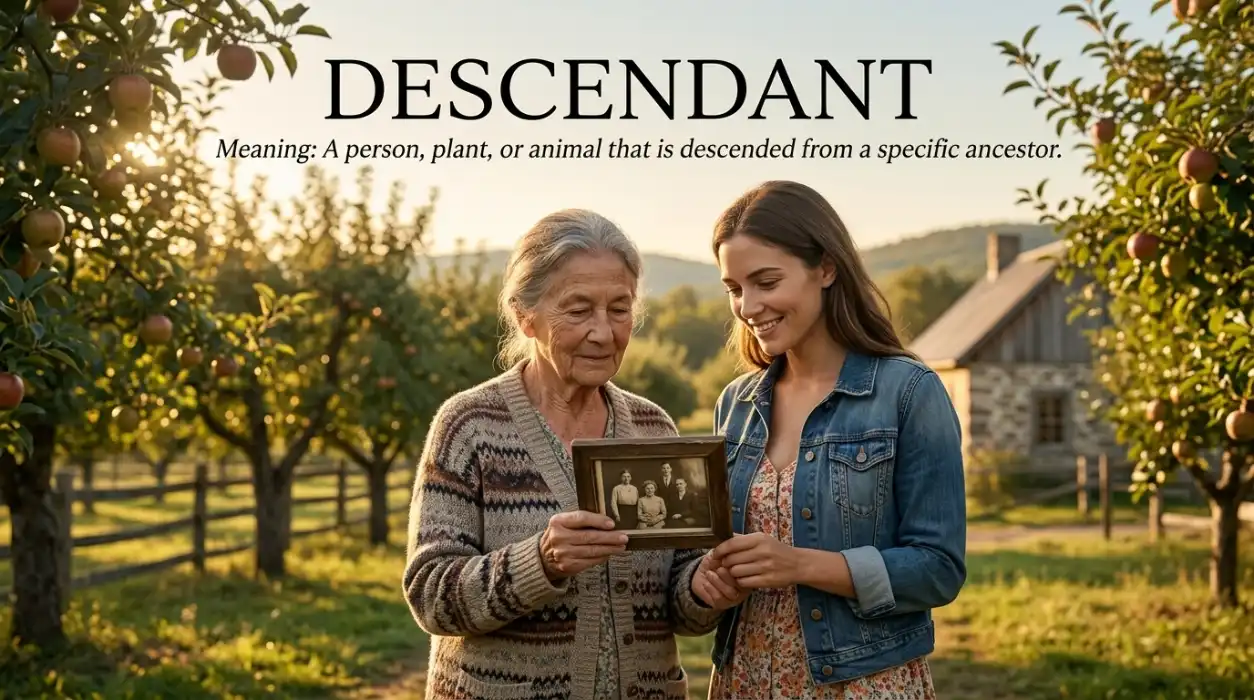
Descendant (Noun) — US: /dɪˈsɛndənt/ — UK: /dɪˈsendənt/
- Meaning: A person, plant, or animal that is descended from a specific ancestor.
- Tone/Register: Formal, common.
- Example: Historians traced royal family descendants across centuries.
- Example: Modern birds are direct descendants of dinosaurs.
Progeny (Noun) — US: /ˈprɒdʒəni/ — UK: /ˈprɒdʒəni/
- Meaning: A descendant or the descendants of a person, animal, or plant.
- Tone/Register: Formal, literary.
- Example: The prize stallion sired numerous athletic progeny.
- Example: Writers explored the fate of royal progeny in exile.
Scion (Noun) — US: /ˈsaɪən/ — UK: /ˈsaɪən/
- Meaning: A descendant of a notable family, or a plant twig for grafting.
- Tone/Register: Literary, formal.
- Example: The wealthy corporate scion inherited the estate.
- Example: Gardeners grafted a healthy apple tree scion.
Spawn (Noun) — US: /spɔːn/ — UK: /spɔːn/
- Meaning: The eggs of fish, amphibians, or crustaceans.
- Tone/Register: Descriptive, biological.
- Example: Frogs laid gelatinous clusters of spawn in ponds.
- Example: Salmon swam upstream to release fresh spawn.
Strain (Noun) — US: /streɪn/ — UK: /streɪn/
- Meaning: A breed or variety of a plant, animal, or micro-organism.
- Tone/Register: Scientific, agricultural.
- Example: Farmers cultivated a drought-resistant wheat strain.
- Example: Pharmacists studied a new bacterial strain in samples.
Breed (Noun) — US: /briːd/ — UK: /briːd/
- Meaning: A particular kind of animal or plant produced by breeding.
- Tone/Register: Common, agricultural.
- Example: Herding dogs are an intelligent working breed.
- Example: Cat owners adored the fluffy Persian breed.
Variety (Noun) — US: /vəˈraɪəti/ — UK: /vəˈraɪəti/
- Meaning: The quality or state of being different or diverse.
- Tone/Register: Common, versatile.
- Example: Supermarkets offered a wide variety of fresh fruit.
- Example: Life needs variety to stay interesting and vibrant.
Type (Noun) — US: /taɪp/ — UK: /taɪp/
- Meaning: A category of people or things having common characteristics.
- Tone/Register: Common, general.
- Example: What type of music do you enjoy listening to?
- Example: Engineers designed a new type of electric vehicle.
Sort (Noun) — US: /sɔːrt/ — UK: /sɔːt/
- Meaning: A category of things or people with similar features.
- Tone/Register: Common, casual.
- Example: She organized books by subject and sort.
- Example: What sort of trouble did they run into?
Kind (Noun) — US: /kaɪnd/ — UK: /kaɪnd/
- Meaning: A group of people or things having similar characteristics.
- Tone/Register: Common, friendly.
- Example: Be kind to everyone you meet along your path.
- Example: What kind of pet do you want to adopt?
Category (Noun) — US: /ˈkætəɡɔːri/ — UK: /ˈkætəɡəri/
- Meaning: A class or division of people or things regarded as having shared traits.
- Tone/Register: Professional, formal.
- Example: Library books are sorted into specific topical categories.
- Example: Expense reports required detailed category breakdowns.
Classification (Noun) — US: /ˌklæsɪfɪˈkeɪʃən/ — UK: /ˌklæsɪfɪˈkeɪʃn/
- Meaning: The action or process of classifying something.
- Tone/Register: Academic, formal.
- Example: Biological classification groups living species scientifically.
- Example: Security clearance requires strict file classification.
Group (Noun) — US: /ɡruːp/ — UK: /ɡruːp/
- Meaning: Several people or things located together or classed together.
- Tone/Register: Common, versatile.
- Example: A group of hikers climbed the mountain trail.
- Example: Students formed a study group for final exams.
Class (Noun) — US: /klæs/ — UK: /klɑːs/
- Meaning: A set of students meeting regularly or a taxonomic rank.
- Tone/Register: Common, formal.
- Example: Biology class dissected plant specimens in the lab.
- Example: First-class passengers enjoyed luxury lounge amenities.
Synonyms by Tone
Tone matters because mutant can be neutral in science but dramatic in fiction.
Positive or Neutral Alternatives
- Variant
- Genetic variant
- Biological variant
- Novel variant
- Distinct variant
- Hybrid
- Recombinant
- Engineered organism
- Modified organism
- Altered organism
- Outlier
- Exception
These choices usually avoid strong emotional judgment.
Formal and Scientific Alternatives
- Genetic alteration
- Genetic change
- Mutational variant
- Mutational
- Morphological variant
- Phenotypic variant
- Genetic anomaly
- Biological anomaly
- Aberrant
- Atypical
- Anomalous
- Divergent
- Experimental variant
These are particularly useful in scientific or academic contexts.
Negative Alternatives
- Deviant
- Genetic deviant
- Aberration
- Freak
- Misfit
- Outcast
- Abomination
- Monstrosity
- Monster
These words should be selected carefully because several carry judgment, fear, or hostility.
Playful or Informal Alternatives
- Freak
- Oddity
- Misfit
- Morph
- Monster
- Creature
These are more common in fiction, entertainment, casual descriptions, or character dialogue.
“Mutant” vs Close Alternatives
Variant vs Mutant
Mutant emphasizes a mutation or an organism associated with genetic change.
Variant is broader and more neutral.
Use mutant when genetic mutation is central. Use variant when you simply need to identify a differing form.
Mutant vs Hybrid
A hybrid usually results from combining genetic material or characteristics from different parents or populations.
A mutant results from mutation.
Therefore, a hybrid is not automatically a mutant.
Mutant vs Aberration
Mutant identifies a changed biological form.
Aberration emphasizes departure from an expected pattern.
Consequently, aberration often sounds more evaluative or formal.
How “Mutant” Changes by Context
Daily Conversation
In everyday speech, mutant is uncommon unless someone is discussing science, movies, games, comics, or fictional creatures.
For a real biological difference, variant, genetic change, or unusual form may sound more natural.
Writing and Blogging
Bloggers should consider audience and subject.
A science article might use genetic variant or mutated form.
A pop-culture article may deliberately use mutant, creature, or monster because those words create stronger imagery.
Professional and Academic Writing
Precision is essential.
Instead of calling something a mutant when the exact issue is a genetic difference, genetic variant may be more appropriate.
Likewise, phenotypic variant works when the emphasis is on observable characteristics.
However, terminology should always follow the scientific context.
Creative and Informal Use
Fiction allows much greater freedom.
A writer may use monster, misfit, outcast, creature, or abomination to reveal how other characters perceive a changed being.
This makes word choice part of characterization.
Common Mistakes Learners Make
Mistake 1: Using “Mutant” and “Mutation” Interchangeably
They are related but different.
A mutation is a genetic change.
A mutant is an organism, cell, or biological form associated with such a change.
Mistake 2: Assuming Every Variant Is a Mutant
The word variant is broader.
A variant may differ genetically without the writer needing to label it a mutant.
Therefore, variant is often safer in neutral scientific communication.
Mistake 3: Using “Monster” in Scientific Writing
Monster is strongly associated with fiction and emotional judgment.
It should not replace mutant in serious scientific prose.
Mistake 4: Calling Someone a “Freak”
Although freak can appear in fictional dialogue, it can be insulting when used about a real person.
Use it only when the context clearly supports the intended tone.
Mistake 5: Confusing “Hybrid” With “Mutant”
A hybrid comes from different biological sources.
A mutant involves mutation.
The mechanisms are not the same.
Native Usage and Register Notes
For scientific English, variant, genetic variant, mutated, genetic alteration, phenotypic variant, and anomalous can provide greater precision.
For general English, unusual, altered, different, or variant may sound more accessible.
Meanwhile, words such as abomination and monstrosity are highly charged. They often reveal a character’s fear or prejudice rather than objectively describing a biological condition.
A useful internal vocabulary link would be a guide to synonyms for abnormal, because the two vocabulary groups overlap in scientific and descriptive writing.
Real-Life Mini Scenarios
Workplace or Research
A scientist is presenting laboratory findings.
The researchers discovered a genetic variant.
This is usually more precise than using mutant without explanation.
Social Situation
A person discusses a science-fiction film.
The story follows a mutant who struggles to fit into society.
Here, mutant works naturally because the context is fictional.
Media and Pop Culture
A reviewer wants to describe a fictional character.
The mutant hero has unusual abilities.
The word is familiar and immediately establishes the character’s role.
Writing and Storytelling
A novelist wants to show social rejection.
The creature was treated as an outcast.
Here, outcast focuses on social exclusion rather than genetics.

Interactive Practice Quiz
1. A biology paper discusses a DNA difference without using emotional language. Which term fits best?
A. Monster
B. Genetic variant
C. Freak
D. Abomination
2. A fictional creature is rejected by its community. Which word emphasizes social exclusion?
A. Outcast
B. Variant
C. Recombinant
D. Mutation
3. Two different plant varieties are combined through breeding. Which term is most appropriate?
A. Hybrid
B. Aberration
C. Monster
D. Mutant
4. A laboratory organism has deliberately altered genetic material. Which term fits?
A. Engineered organism
B. Misfit
C. Oddity
D. Outcast
5. A scientific result does not fit the expected pattern. Which adjective works well?
A. Bubbly
B. Anomalous
C. Playful
D. Stylish
6. A fictional villain calls a changed creature an extremely unnatural horror. Which dramatic word fits?
A. Variant
B. Abomination
C. Outlier
D. Hybrid
7. A dataset contains one individual far outside the usual range. Which term is most precise?
A. Outlier
B. Monster
C. Mutant
D. Creature
8. A scientist describes observable differences in an organism’s physical traits. Which phrase fits best?
A. Phenotypic variant
B. Social misfit
C. Monster
D. Freak
9. A writer wants to describe someone who does not fit into a social group.
A. Misfit
B. Recombinant
C. Genetic alteration
D. Variant
10. A science-fiction story features a person whose abilities resulted from mutation.
A. Mutant
B. Exception
C. Irregularity
D. Hybrid
Answer key: 1-B | 2-A | 3-A | 4-A | 5-B | 6-B | 7-A | 8-A | 9-A | 10-A
Reflection Task
Write one sentence using mutant in a scientific or fictional context.
Then rewrite it using a more precise alternative such as variant, outlier, altered organism, misfit, or creature.
Conclusion
Learning synonyms for mutant helps you separate scientific accuracy from dramatic language. A genetic variant, fictional monster, and social outcast may describe different aspects of the same character.
Moreover, precise alternatives make your writing clearer. Variant sounds neutral, aberrant sounds technical, and outcast focuses on social rejection.
This vocabulary range improves essays, blogs, stories, scientific explanations, and everyday communication. It also helps speakers avoid words that accidentally sound judgmental.
Frequently Asked Questions
1. What is the best scientific synonym for mutant?
The best scientific alternative is often genetic variant, although the correct term depends on the research context. Variant is broader and generally more neutral, while mutant specifically connects the organism or cell with a mutation. Other possibilities include altered organism, mutational variant, and phenotypic variant when those descriptions accurately reflect the scientific situation.
2. What is a neutral word instead of mutant?
Variant is usually one of the safest neutral alternatives. It describes something that differs from another form without automatically suggesting that the difference is harmful, strange, or unnatural. Depending on context, altered form, genetic variant, atypical, and outlier can also work, but each emphasizes a slightly different type of difference.
3. Is variant the same as mutant?
No. Variant is a broader term than mutant. A variant is simply a form that differs from another recognized form, while mutant generally refers to an organism, cell, or genetic form associated with mutation. Therefore, replacing mutant with variant can make scientific or general writing sound more neutral, but it may also remove useful biological specificity.
4. What is a good synonym for mutant in fiction?
The best fictional alternative depends on the character’s role. Creature is relatively neutral, while monster emphasizes fear. Misfit highlights social difference, and outcast emphasizes rejection. Abomination expresses strong condemnation. Therefore, fiction writers should choose the word that reflects the narrator’s attitude rather than simply replacing mutant mechanically.
5. What is the difference between mutant and hybrid?
A mutant is associated with a mutation, meaning a change in genetic material. A hybrid, by contrast, usually results from combining genetic material from different parents, varieties, or populations. These processes are different. An organism can be a hybrid without being described as a mutant, so the two terms should not normally be treated as exact synonyms.

Hasnain Ali is an SEO Content Strategist and the founder of wordvora.com, a trusted vocabulary platform that helps writers, students, professionals, and English learners find accurate synonyms, antonyms, word meanings, and real-life usage examples. He specializes in keyword research, on-page SEO, topical authority, and creating search-first content that aligns with Google’s latest Search Quality and E-E-A-T guidelines. His work focuses on producing clear, well-structured, and reader-friendly resources that satisfy search intent while maintaining high editorial standards.
Through extensive hands-on experience with SEO tools such as Google Search Console, Google Analytics, SEMrush, and Ahrefs, Hasnain researches user search behavior and develops content that is both informative and easy to understand. Every article published on wordvora.com is carefully reviewed for accuracy, readability, and contextual relevance before publication. His mission is to build one of the web’s most reliable English vocabulary resources by providing practical language guidance, trustworthy explanations, and content that helps readers improve their writing, communication, and vocabulary with confidence.