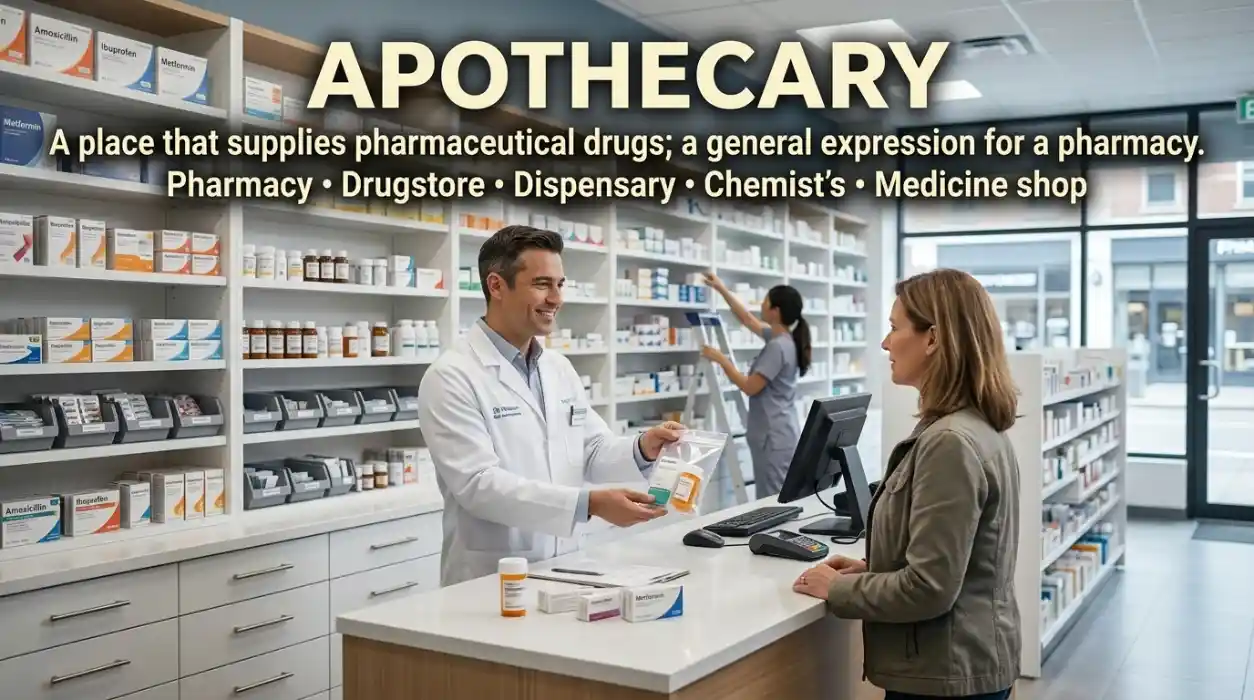
Synonyms for apothecary include pharmacist, druggist, chemist, dispensary, and pharmacy, depending on whether you mean the person who prepares medicines or the place where medicines are sold. The word is usually historical or literary today.
Synonyms for apothecary can help when an old-fashioned word appears in a novel, history lesson, or fantasy story. Knowing the closest modern term makes the meaning much easier to understand.
Imagine reading, “She visited the village apothecary for a remedy.” Today, you might naturally say, “She visited the pharmacist at the pharmacy.”
Learning synonyms for apothecary also strengthens vocabulary. Students, bloggers, content writers, and daily English users can choose words that match their audience and context.
The word is commonly used because it has a strong historical connection with medicine. It also creates a traditional, literary feeling that modern words such as pharmacist do not always provide.
What Does “Apothecary” Really Mean?
Apothecary is a noun.
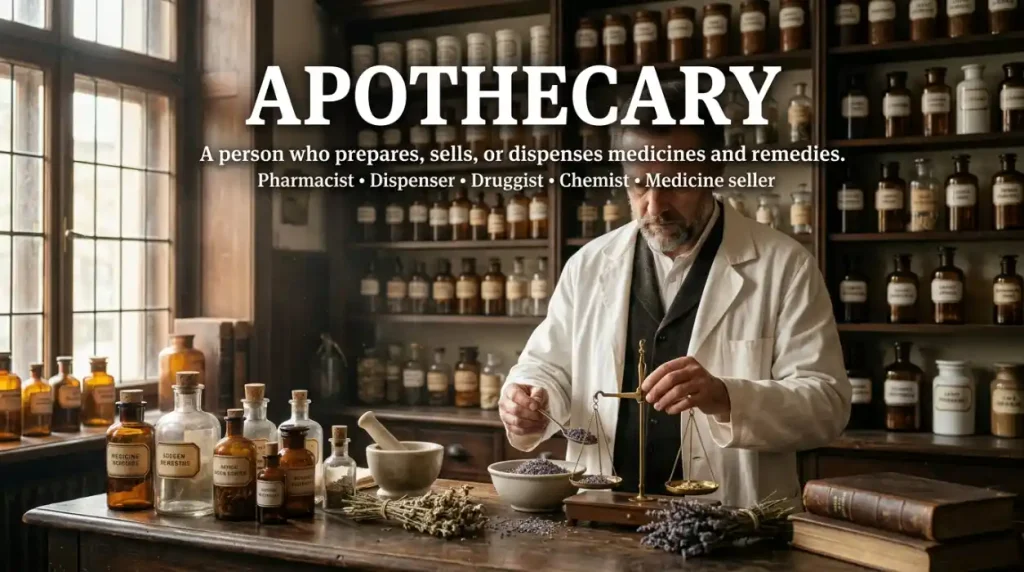
In simple English, an apothecary was historically a person who prepared, compounded, and sold medicines. In older usage, the word could also be connected with the shop where medicines were kept or sold.
Cambridge defines apothecary as a person who historically made and sold medicines. It lists chemist, druggist, and pharmacist as synonyms.
Today, apothecary is uncommon in ordinary conversation. It appears more often in historical writing, literature, fantasy, period dramas, branding language, and descriptions of traditional medicine.
A native English speaker may hear apothecary and immediately imagine an old-fashioned medicine shop, glass bottles, herbs, handwritten labels, and someone preparing remedies.
Part of Speech
Apothecary — noun
Simple definition: A person who historically prepared and sold medicines.
Example:
“The village apothecary prepared a herbal remedy.”
The word can sound formal, historical, literary, or deliberately old-fashioned.
Connotative Meaning
Connotation (the feeling or association a word carries beyond its basic dictionary meaning) matters when choosing a synonym.
Positive Tone
Apothecary can suggest tradition, craftsmanship, knowledge, and old-world expertise.
In creative writing, it may create a warm and mysterious atmosphere.
Negative Tone
In some historical or literary contexts, the word may suggest outdated medical practices or questionable remedies.
This depends heavily on the surrounding context.
Neutral Tone
In historical writing, apothecary can simply identify a profession from an earlier period.
The safest modern equivalent is often pharmacist when you mean the person.
Etymology of Apothecary
The history of apothecary is unusually interesting.
The word entered English in the Middle English period, from Old French apotecaire. Old French received it from Late Latin apothecarius, meaning a storekeeper. The Latin word came from apotheca, meaning a storehouse, which ultimately comes from Greek apothēkē.
The Greek word literally referred to a place where things were put away or stored. Over time, the meaning became associated with people who stored, prepared, and sold medicines.
Old English: 450–1100
There was no established English word for apothecary in Old English.
The concept of medicine sellers existed, but the specific word entered English later through French and Latin.
Middle English: 1100–1500
The word appeared in forms such as apotecarie, ypoticarie, and potecarie.
By the middle of the 14th century, it could refer to a shopkeeper, especially someone who stored, compounded, and sold medicines.
Modern English: 1500–Present
The modern spelling became established around the early modern period.
By the 17th century, its meaning had narrowed toward druggist or medicine seller. Historical developments in the apothecary profession helped strengthen this meaning.

Pronunciation
US: /əˈpɑː.θəˌker.i/
UK: /əˈpɒθ.ə.kər.i/
Syllables
a-poth-e-car-y
Affixation Pattern of Apothecary
Root: apothec-
Prefix: None in the English word as it is normally analyzed today
Suffix: -ary
Historically, however, the word was borrowed through several languages. The deeper Greek structure contains apo-, meaning “away,” and a form related to thēkē, meaning a receptacle or place for storing things.
Synonyms List
The strongest direct modern equivalents are pharmacist, druggist, chemist, and, in historical contexts, chemist and druggist. Other entries are context-based equivalents for the person, profession, or medicine shop.
Pharmacist (noun) — US /ˈfɑːr.mə.sɪst/ | UK /ˈfɑː.mə.sɪst/
Meaning: A trained professional who prepares, handles, and dispenses medicines.
Tone/Register: Neutral, professional, modern.
Examples:
“Ask the pharmacist if this medicine should be taken with food.”
“The pharmacist explained the prescription clearly.”
Druggist (noun) — US /ˈdrʌɡ.ɪst/ | UK /ˈdrʌɡ.ɪst/
Meaning: A person who prepares or sells medicines, especially in older or American usage.
Tone/Register: Traditional, historical, American.
Examples:
“Her grandfather worked as a druggist.”
“The old druggist knew the town well.”
Chemist (noun) — US /ˈkemɪst/ | UK /ˈkemɪst/
Meaning: In British English, a chemist can mean a pharmacist or a person working in a pharmacy.
Tone/Register: Neutral, British.
Examples:
“I picked up the medicine from the chemist.”
“The chemist recommended speaking with a doctor.”
Chemist’s (noun) — US /ˈkemɪsts/ | UK /ˈkemɪsts/
Meaning: A British expression for a pharmacy or shop where medicines are sold.
Tone/Register: Neutral, British.
Examples:
“I need to stop at the chemist’s.”
“She bought the cream from the chemist’s.”
Pharmacy (noun) — US /ˈfɑːr.mə.si/ | UK /ˈfɑː.mə.si/
Meaning: A place where medicines are prepared and sold.
Tone/Register: Neutral, standard.
Examples:
“The prescription is ready at the pharmacy.”
“He walked to the pharmacy after work.”
Cambridge uses pharmacy for a shop or part of a shop where medicines are prepared and sold.
Drugstore (noun) — US /ˈdrʌɡ.stɔːr/ | UK /ˈdrʌɡ.stɔːr/
Meaning: An American term for a store that sells medicines and often other everyday products.
Tone/Register: Neutral, American.
Examples:
“I stopped at the drugstore for cold medicine.”
“The drugstore was open late.”
Dispensary (noun) — US /dɪˈspen.sə.ri/ | UK /dɪˈspen.sər.i/
Meaning: A place where medicines are prepared or supplied.
Tone/Register: Formal, medical, historical.
Examples:
“The village had a small dispensary.”
“Patients collected their medicines there.”
Medicine Shop (noun phrase) — US /ˈmed.ɪ.sən ʃɑːp/ | UK /ˈmed.ɪ.sɪn ʃɒp/
Meaning: A simple expression for a shop that sells medicines.
Tone/Register: Neutral, descriptive.
Examples:
“The traveler found a medicine shop near the inn.”
“The medicine shop opened before sunrise.”
Medicine Store (noun phrase) — US /ˈmed.ɪ.sən stɔːr/ | UK /ˈmed.ɪ.sɪn stɔːr/
Meaning: A store that supplies medicines and related health products.
Tone/Register: Neutral, descriptive.
Examples:
“She went to the medicine store for supplies.”
“The medicine store serves several nearby villages.”
Drug Shop (noun phrase) — US /ˈdrʌɡ ʃɑːp/ | UK /ˈdrʌɡ ʃɒp/
Meaning: A shop selling medicines or pharmaceutical products.
Tone/Register: Neutral, regional.
Examples:
“There was a small drug shop beside the market.”
“He asked the drug shop for basic medicine.”
Drug Store (noun phrase) — US /ˈdrʌɡ stɔːr/ | UK /ˈdrʌɡ stɔː/
Meaning: A store selling medicines, especially in American English.
Tone/Register: Neutral, American.
Examples:
“She bought the tablets at the drug store.”
“The local drug store also sells toiletries.”
Medicine Dispensary (noun phrase) — US /ˈmed.ɪ.sən dɪˈspen.sə.ri/ | UK /ˈmed.ɪ.sɪn dɪˈspen.sər.i/
Meaning: A place specifically associated with supplying medicines.
Tone/Register: Formal, medical.
Examples:
“The clinic operates a medicine dispensary.”
“Patients collected their prescriptions there.”
Dispensing Chemist (noun phrase) — US /dɪˈspen.sɪŋ ˈkem.ɪst/ | UK /dɪˈspen.sɪŋ ˈkem.ɪst/
Meaning: A chemist who prepares and supplies medicines.
Tone/Register: Formal, British.
Examples:
“The dispensing chemist prepared the prescription.”
“She spoke with the dispensing chemist.”
Dispensing Pharmacist (noun phrase) — US /dɪˈspen.sɪŋ ˈfɑːr.mə.sɪst/ | UK /dɪˈspen.sɪŋ ˈfɑː.mə.sɪst/
Meaning: A pharmacist whose work includes supplying prescribed medicines.
Tone/Register: Professional, medical.
Examples:
“The dispensing pharmacist checked the label.”
“He asked the dispensing pharmacist for guidance.”
Community Pharmacist (noun phrase) — US /kəˈmjuː.nə.ti ˈfɑːr.mə.sɪst/ | UK /kəˈmjuː.nə.ti ˈfɑː.mə.sɪst/
Meaning: A pharmacist who works in a community pharmacy and serves local patients.
Tone/Register: Professional, modern.
Examples:
“The community pharmacist answered her question.”
“He works as a community pharmacist.”
Retail Pharmacist (noun phrase) — US /ˈriː.teɪl ˈfɑːr.mə.sɪst/ | UK /ˈriː.teɪl ˈfɑː.mə.sɪst/
Meaning: A pharmacist who works in a retail pharmacy setting.
Tone/Register: Professional, business.
Examples:
“The retail pharmacist reviewed the prescription.”
“She began her career as a retail pharmacist.”
Pharmaceutical Dispenser (noun phrase) — US /ˌfɑːr.məˈsuː.tɪ.kəl dɪˈspen.sər/ | UK /ˌfɑː.məˈsjuː.tɪ.kəl dɪˈspen.sə/
Meaning: A person who dispenses pharmaceutical medicines.
Tone/Register: Formal, technical.
Examples:
“The pharmaceutical dispenser checked the medicine.”
“The dispenser prepared the order carefully.”
Medicine Dispenser (noun phrase) — US /ˈmed.ɪ.sən dɪˈspen.sər/ | UK /ˈmed.ɪ.sɪn dɪˈspen.sə/
Meaning: A person who supplies medicines to patients.
Tone/Register: Neutral, descriptive.
Examples:
“The medicine dispenser explained the instructions.”
“Patients spoke with the dispenser first.”
Drug Dispenser (noun phrase) — US /ˈdrʌɡ dɪˈspen.sər/ | UK /ˈdrʌɡ dɪˈspen.sə/
Meaning: A person or role involved in supplying medicines.
Tone/Register: Technical, formal.
Examples:
“The drug dispenser checked the prescription.”
“The role involves careful medicine handling.”
Dispenser (noun) — US /dɪˈspen.sər/ | UK /dɪˈspen.sə/
Meaning: A person who supplies or gives out medicines when the medical context is clear.
Tone/Register: Neutral, professional.
Examples:
“The dispenser handed over the prescription.”
“She spoke with the dispenser at the clinic.”
Compounder (noun) — US /kəmˈpaʊn.dər/ | UK /kəmˈpaʊn.də/
Meaning: A person who prepares medicines by combining ingredients.
Tone/Register: Technical, historical.
Examples:
“The compounder prepared the mixture by hand.”
“The old record describes him as a skilled compounder.”
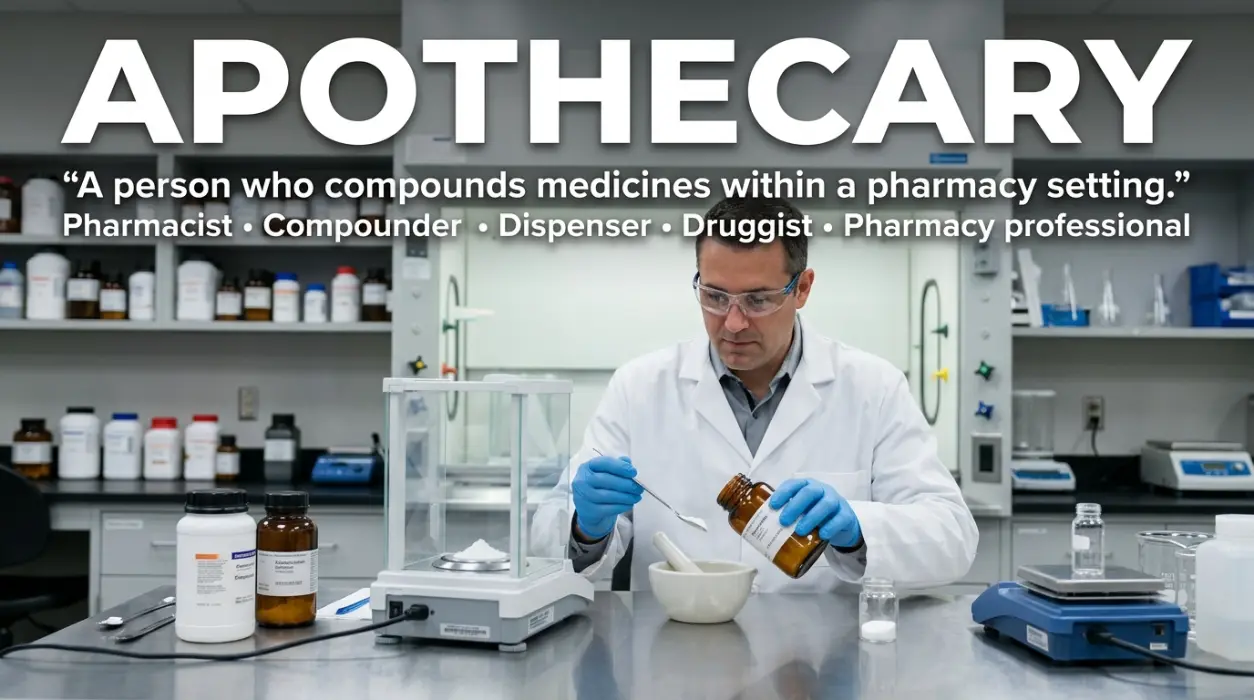
Pharmacy Compounder (noun phrase) — US /ˈfɑːr.mə.si kəmˈpaʊn.dər/ | UK /ˈfɑː.mə.si kəmˈpaʊn.də/
Meaning: A person who compounds medicines within a pharmacy setting.
Tone/Register: Technical, professional.
Examples:
“The pharmacy compounder prepared the formulation.”
“She trained as a pharmacy compounder.”
Medicine Compounder (noun phrase) — US /ˈmed.ɪ.sən kəmˈpaʊn.dər/ | UK /ˈmed.ɪ.sɪn kəmˈpaʊn.də/
Meaning: A person who combines ingredients to prepare medicines.
Tone/Register: Technical, historical.
Examples:
“The medicine compounder measured each ingredient.”
“The story describes a careful medicine compounder.”
Pharmaceutical Compounder (noun phrase) — US /ˌfɑːr.məˈsuː.tɪ.kəl kəmˈpaʊn.dər/ | UK /ˌfɑː.məˈsjuː.tɪ.kəl kəmˈpaʊn.də/
Meaning: A person who prepares pharmaceutical formulations by combining ingredients.
Tone/Register: Technical, professional.
Examples:
“The pharmaceutical compounder followed the formula.”
“The laboratory employed an experienced compounder.”
Medicine Seller (noun phrase) — US /ˈmed.ɪ.sən ˈsel.ər/ | UK /ˈmed.ɪ.sɪn ˈsel.ə/
Meaning: A person who sells medicines, especially in historical or descriptive writing.
Tone/Register: Neutral, historical.
Examples:
“The medicine seller traveled between villages.”
“People gathered around the medicine seller.”
Drug Seller (noun phrase) — US /ˈdrʌɡ ˈsel.ər/ | UK /ˈdrʌɡ ˈsel.ə/
Meaning: A person who sells drugs; in historical contexts, it can describe a medicine seller.
Tone/Register: Context-dependent.
Examples:
“The historical account mentions a local drug seller.”
“The term can sound ambiguous in modern English.”
Medicine Retailer (noun phrase) — US /ˈmed.ɪ.sən ˈriː.teɪ.lər/ | UK /ˈmed.ɪ.sɪn ˈriː.teɪ.lə/
Meaning: A person or business that sells medicines directly to consumers.
Tone/Register: Business, neutral.
Examples:
“The medicine retailer served several rural communities.”
“The report discusses local medicine retailers.”
Drug Retailer (noun phrase) — US /ˈdrʌɡ ˈriː.teɪ.lər/ | UK /ˈdrʌɡ ˈriː.teɪ.lə/
Meaning: A retailer that supplies pharmaceutical drugs.
Tone/Register: Business, formal.
Examples:
“The drug retailer followed strict procedures.”
“The study examined local drug retailers.”
Pharmaceutical Retailer (noun phrase) — US /ˌfɑːr.məˈsuː.tɪ.kəl ˈriː.teɪ.lər/ | UK /ˌfɑː.məˈsjuː.tɪ.kəl ˈriː.teɪ.lə/
Meaning: A business or professional involved in retailing pharmaceutical products.
Tone/Register: Formal, business.
Examples:
“The pharmaceutical retailer supplied approved medicines.”
“The article examines pharmaceutical retailers.”
Pharmaceutical Seller (noun phrase) — US /ˌfɑːr.məˈsuː.tɪ.kəl ˈsel.ər/ | UK /ˌfɑː.məˈsjuː.tɪ.kəl ˈsel.ə/
Meaning: A person or business that sells pharmaceutical products.
Tone/Register: Formal, commercial.
Examples:
“The pharmaceutical seller supplied the clinic.”
“The term appears in formal industry writing.”
Chemist and Druggist (noun phrase) — US /ˈkem.ɪst ænd ˈdrʌɡ.ɪst/ | UK /ˈkem.ɪst ənd ˈdrʌɡ.ɪst/
Meaning: A historical British expression for a professional who prepared and sold medicines.
Tone/Register: Historical, British.
Examples:
“The document identifies him as a chemist and druggist.”
“The profession was common in older British records.”
Chemist-Druggist (noun) — US /ˈkem.ɪst ˈdrʌɡ.ɪst/ | UK /ˈkem.ɪst ˈdrʌɡ.ɪst/
Meaning: A historical term for a person working with and selling medicines.
Tone/Register: Historical, British.
Examples:
“The novel introduces a village chemist-druggist.”
“The archive lists several chemist-druggists.”
Pharmacist-Druggist (noun phrase) — US /ˈfɑːr.mə.sɪst ˈdrʌɡ.ɪst/ | UK /ˈfɑː.mə.sɪst ˈdrʌɡ.ɪst/
Meaning: A descriptive combination referring to a pharmacist or druggist.
Tone/Register: Historical, descriptive.
Examples:
“The character works as a pharmacist-druggist.”
“The phrase emphasizes both professional and retail duties.”
Pharmacy Professional (noun phrase) — US /ˈfɑːr.mə.si prəˈfeʃ.ən.əl/ | UK /ˈfɑː.mə.si prəˈfeʃ.ən.əl/
Meaning: A broad modern expression for a trained professional working in pharmacy.
Tone/Register: Professional, modern.
Examples:
“Speak with a pharmacy professional about the prescription.”
“The pharmacy professional explained the instructions.”
Pharmaceutical Professional (noun phrase) — US /ˌfɑːr.məˈsuː.tɪ.kəl prəˈfeʃ.ən.əl/ | UK /ˌfɑː.məˈsjuː.tɪ.kəl prəˈfeʃ.ən.əl/
Meaning: A broad term for a professional working in the pharmaceutical field.
Tone/Register: Formal, professional.
Examples:
“She interviewed a pharmaceutical professional.”
“The article describes the professional’s role.”
Medicine Provider (noun phrase) — US /ˈmed.ɪ.sən prəˈvaɪ.dər/ | UK /ˈmed.ɪ.sɪn prəˈvaɪ.də/
Meaning: A broad expression for someone or an organization that provides medicines.
Tone/Register: Neutral, descriptive.
Examples:
“The medicine provider supplied the clinic.”
“The phrase is broader than pharmacist.”
Medication Dispenser (noun phrase) — US /ˌmed.ɪˈkeɪ.ʃən dɪˈspen.sər/ | UK /ˌmed.ɪˈkeɪ.ʃən dɪˈspen.sə/
Meaning: A person responsible for supplying medication.
Tone/Register: Professional, medical.
Examples:
“The medication dispenser checked the label.”
“The dispenser confirmed the patient’s details.”
Prescription Dispenser (noun phrase) — US /prɪˈskrɪp.ʃən dɪˈspen.sər/ | UK /prɪˈskrɪp.ʃən dɪˈspen.sə/
Meaning: A person who supplies prescribed medicines.
Tone/Register: Formal, medical.
Examples:
“The prescription dispenser verified the order.”
“She spoke to the dispenser before leaving.”
Apothecary Shop (noun phrase) — US /əˈpɑː.θəˌker.i ʃɑːp/ | UK /əˈpɒθ.ə.kər.i ʃɒp/
Meaning: A historical or literary expression for a shop associated with an apothecary.
Tone/Register: Historical, literary.
Examples:
“The hero entered the apothecary shop.”
“Her novel features a mysterious apothecary shop.”
Medicine House (noun phrase) — US /ˈmed.ɪ.sən haʊs/ | UK /ˈmed.ɪ.sɪn haʊs/
Meaning: A descriptive or literary term for a place associated with medicines.
Tone/Register: Literary, historical.
Examples:
“The medicine house stood beside the old square.”
“Villagers visited the medicine house for remedies.”
Drug House (noun phrase) — US /ˈdrʌɡ haʊs/ | UK /ˈdrʌɡ haʊs/
Meaning: A historical or descriptive expression for a business dealing in drugs or medicines.
Tone/Register: Historical, context-dependent.
Examples:
“The records mention a local drug house.”
“The phrase can sound ambiguous today.”
Medicinal Shop (noun phrase) — US /məˈdɪs.ən.əl ʃɑːp/ | UK /məˈdɪs.ɪ.nəl ʃɒp/
Meaning: A descriptive term for a shop associated with medicinal products.
Tone/Register: Descriptive, literary.
Examples:
“The traveler found a small medicinal shop.”
“Her story opens outside the medicinal shop.”
Pharmacy Shop (noun phrase) — US /ˈfɑːr.mə.si ʃɑːp/ | UK /ˈfɑː.mə.si ʃɒp/
Meaning: A descriptive phrase referring to a shop where medicines are sold.
Tone/Register: Neutral, descriptive.
Examples:
“The pharmacy shop was near the station.”
“He walked into the pharmacy shop after lunch.”
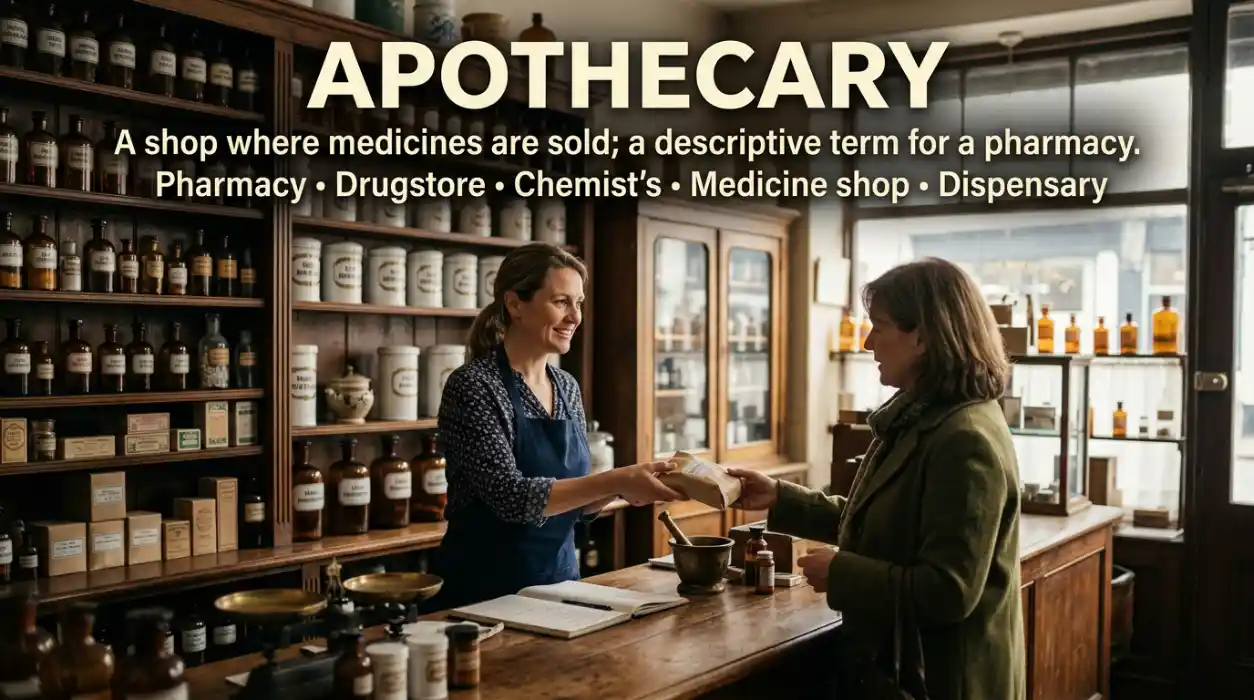
Druggist Shop (noun phrase) — US /ˈdrʌɡ.ɪst ʃɑːp/ | UK /ˈdrʌɡ.ɪst ʃɒp/
Meaning: A historical or descriptive term for a shop operated by a druggist.
Tone/Register: Historical, American.
Examples:
“The town once had a small druggist shop.”
“The museum recreated the old druggist shop.”
Pharmacist’s Shop (noun phrase) — US /ˈfɑːr.mə.sɪsts ʃɑːp/ | UK /ˈfɑː.mə.sɪsts ʃɒp/
Meaning: A descriptive phrase for a shop operated by a pharmacist.
Tone/Register: Neutral, descriptive.
Examples:
“The story begins at the pharmacist’s shop.”
“She waited outside the pharmacist’s shop.”
Dispensing Shop (noun phrase) — US /dɪˈspen.sɪŋ ʃɑːp/ | UK /dɪˈspen.sɪŋ ʃɒp/
Meaning: A shop or workplace where medicines are dispensed.
Tone/Register: Formal, descriptive.
Examples:
“The dispensing shop served the surrounding farms.”
“Patients collected medicine from the dispensing shop.”
Medicine Outlet (noun phrase) — US /ˈmed.ɪ.sən ˈaʊt.let/ | UK /ˈmed.ɪ.sɪn ˈaʊt.let/
Meaning: A general term for a place where medicines are supplied or sold.
Tone/Register: Neutral, business.
Examples:
“The village has one medicine outlet.”
“The medicine outlet serves several nearby communities.”
Pharmacy Outlet (noun phrase) — US /ˈfɑːr.mə.si ˈaʊt.let/ | UK /ˈfɑː.mə.si ˈaʊt.let/
Meaning: A general expression for a physical location where pharmacy services or medicines are provided.
Tone/Register: Business, neutral.
Examples:
“The pharmacy outlet is inside the medical center.”
“Patients can visit the nearest pharmacy outlet.”
Drug Outlet (noun phrase) — US /ˈdrʌɡ ˈaʊt.let/ | UK /ˈdrʌɡ ˈaʊt.let/
Meaning: A general expression for a place supplying pharmaceutical drugs.
Tone/Register: Formal, technical.
Examples:
“The report identifies the licensed drug outlet.”
“The drug outlet supplies approved medicines.”
The Most Useful Synonyms at a Glance
If you need a modern word for the person, choose:
- Pharmacist — safest modern choice.
- Druggist — traditional, especially American.
- Chemist — common in British English.
- Dispensing pharmacist — more specific and professional.
- Compounder — emphasizes preparation of medicines.
If you need a modern word for the place, choose:
- Pharmacy — standard and widely understood.
- Drugstore — especially American English.
- Chemist’s — especially British English.
- Dispensary — more formal or institutional.
- Medicine shop — simple and descriptive.
Synonyms by Tone
Positive
Apothecary, pharmacist, medicine maker, and compounder can create associations with knowledge, care, craftsmanship, and traditional expertise.
In a fantasy story, apothecary may sound charming and mysterious.
Neutral
Pharmacist, chemist, pharmacy, dispensary, and drugstore are usually practical choices.
They communicate the basic meaning without adding much emotional color.
Negative or Ambiguous
Druggist can sound old-fashioned. Drug seller may also sound ambiguous because drug has multiple meanings in modern English.
Choose such terms carefully.
Playful or Informal
Apothecary itself can become playful when used deliberately in modern creative writing.
For example, a writer might describe a fictional character as “the neighborhood apothecary” to create a whimsical old-world mood.
Why Tone Matters in Word Choice
Two words can point to the same general idea but create different impressions.
Compare:
“I asked the pharmacist for advice.”
This sounds modern and ordinary.
“I visited the apothecary for a remedy.”
This sounds historical, literary, or fictional.
That difference is important for students, bloggers, novelists, and content writers. The right synonym does more than replace a word. It shapes the reader’s impression.
Apothecary vs Close Alternatives
Apothecary vs Pharmacist
Meaning: Both can describe someone associated with preparing and supplying medicines.
Tone: Apothecary sounds historical or literary. Pharmacist is modern and professional.
Use: Choose pharmacist for modern healthcare contexts. Choose apothecary for historical or creative contexts.
Apothecary vs Druggist
Meaning: Both can refer to someone who prepares or sells medicines.
Tone: Druggist is traditional and can sound dated. Apothecary is even more strongly historical or literary.
Use: Use druggist when the historical or regional context supports it.
Apothecary vs Chemist
Meaning: In British English, chemist can mean a pharmacist or pharmacy.
Tone: Chemist is normal modern British English. Apothecary is old-fashioned.
Use: Use chemist for contemporary British settings and apothecary for historical storytelling.
How “Apothecary” Changes by Context
Daily Conversation
Most speakers today would normally say pharmacist, pharmacy, or drugstore.
For example:
“I need to ask the pharmacist.”
This sounds natural in modern English.
“I need to ask the apothecary.”
This sounds intentionally historical or unusual.
Writing and Blogging
Writers may use apothecary when discussing history, traditional medicine, literature, fantasy, or word origins.
A blog about historical vocabulary can use the word naturally because the historical tone is part of the subject.
Professional or Academic Tone
In modern professional writing, pharmacist is usually clearer when referring to a contemporary healthcare professional.
In historical research, however, apothecary may be the most accurate term because it identifies a particular historical role.
Creative or Informal Use
Creative writers often choose apothecary because it creates atmosphere.
A sentence such as “The old apothecary guarded a cabinet of mysterious bottles” immediately feels different from “The pharmacist worked behind the counter.”
Common Mistakes Learners Make
Mistake 1: Using Apothecary for Every Modern Pharmacist
Not every modern pharmacist should be called an apothecary.
The word carries historical and stylistic associations.
Mistake 2: Treating Pharmacy and Pharmacist as the Same POS
A pharmacist is a person.
A pharmacy is a place or the field of preparing and dispensing medicines.
So this is correct:
“She spoke with the pharmacist.”
This is also correct:
“She went to the pharmacy.”
Mistake 3: Assuming Chemist Always Means Scientist
In British English, chemist can mean pharmacist.
In American English, chemist usually means a scientist who works with chemistry.
Context matters.
Mistake 4: Using Druggist Without Checking Context
Druggist is understandable, but it can sound old-fashioned.
For a modern international audience, pharmacist is usually clearer.
Mistake 5: Overusing Apothecary
Using the word repeatedly can make modern writing sound artificially historical.
Use it when its tone adds something useful.
Register Notes
Formal: pharmacist, pharmaceutical professional, dispensing pharmacist
Neutral: pharmacy, pharmacist, chemist, dispensary
Historical: apothecary, druggist, chemist and druggist, compounder
Literary: apothecary, medicine house, apothecary shop
American: druggist, drugstore
British: chemist, chemist’s
For related vocabulary, an internal article about pharmacy vocabulary and medical English can help readers build a wider semantic field.
Real-Life Mini Scenarios
Workplace
A health writer might use pharmacist in a modern article:
“The pharmacist explained how the prescription should be used.”
An author writing historical fiction might write:
“The apothecary closed his shop at sunset.”
Social Situations
A British speaker might say:
“I’ll ask the chemist.”
An American speaker might say:
“I’ll stop by the drugstore.”
Media and Pop Culture
Historical dramas often use apothecary to establish a period setting.
Fantasy stories may use the word to describe someone who prepares herbs, potions, and traditional remedies.
Writing and Storytelling
A novelist can choose apothecary when atmosphere matters.
A nonfiction writer discussing modern healthcare will usually prefer pharmacist.
How to Choose the Right Synonym
Ask one simple question:
Am I describing a person, a place, or a historical atmosphere?
If it is a historical or literary setting, apothecary may be the strongest choice.
If you are writing for a global audience, pharmacist and pharmacy are often the clearest options.
Practice Exercise
1. You are writing about a modern healthcare professional in the United States.
A. Apothecary
B. Pharmacist
C. Medicine house
D. Chemist-druggist
2. You are writing a historical novel about a village in medieval Europe.
A. Apothecary
B. Retail pharmacist
C. Pharmacy professional
D. Drug outlet
3. A British speaker wants to buy medicine today.
A. Apothecary
B. Chemist
C. Compounder
D. Medicine house
4. An American asks where to buy cold medicine.
A. Drugstore
B. Apothecary
C. Chemist’s
D. Medicine house
5. Which word focuses on preparing medicines by combining ingredients?
A. Compounder
B. Pharmacy
C. Drugstore
D. Chemist’s
6. Which word usually refers to a place rather than a person?
A. Pharmacist
B. Druggist
C. Pharmacy
D. Compounder
7. Which term has the strongest historical or literary feeling?
A. Pharmacist
B. Apothecary
C. Pharmacy
D. Retail pharmacist
8. Which expression is strongly associated with British English?
A. Drugstore
B. Chemist’s
C. Druggist shop
D. Medicine outlet
9. Which word is most appropriate for a modern professional medical article?
A. Apothecary
B. Pharmacist
C. Medicine house
D. Apothecary shop
10. A fantasy writer wants an old-world atmosphere.
A. Apothecary
B. Retail pharmacist
C. Pharmaceutical professional
D. Pharmacy outlet
Answer key: 1-B | 2-A | 3-B | 4-A | 5-A | 6-C | 7-B | 8-B | 9-B | 10-A
Reflection Task
Write one sentence using apothecary, pharmacist, druggist, or chemist.
Then rewrite your sentence with a different synonym and notice how the tone changes.
Frequently Asked Questions
1. What is the closest modern synonym for apothecary?
The closest modern synonym for apothecary is usually pharmacist when referring to a person. A pharmacist is a trained professional who prepares, handles, and supplies medicines. The main difference is tone: apothecary often sounds historical or literary, while pharmacist is standard modern English.
2. Is apothecary the same as pharmacist?
They overlap in meaning, but they are not identical in modern usage. Apothecary traditionally referred to someone who prepared and sold medicines, especially in historical settings. Pharmacist is the normal modern term for a trained healthcare professional who works with medicines in a pharmacy or healthcare setting.
3. What is the British English synonym for apothecary?
In modern British English, chemist is a common equivalent when referring to a pharmacist or pharmacy. Chemist’s can refer to the shop. Apothecary is much more historical or literary, so it is not normally the first choice for an everyday modern conversation in Britain.
4. What is the American English synonym for apothecary?
In American English, pharmacist is the clearest modern term for the person. Druggist is an older or traditional alternative. For the shop, drugstore is a common American term, while pharmacy is also widely used.
5. Why does apothecary sound old-fashioned?
The word has a long history connected with earlier forms of medicine and commerce. English adopted it in the Middle English period, and its meaning became closely associated with historical medicine sellers. Modern English generally uses pharmacist and pharmacy, which makes apothecary feel literary or historical.
External Sources for Further Reading
For dictionary definitions and pronunciation, consult the Cambridge Dictionary entry for apothecary. Cambridge Dictionary — Apothecary
For historical development and etymology, see the Etymonline entry for apothecary. Etymonline — Apothecary Etymology
Conclusion
Learning synonyms for apothecary is more than memorizing replacement words. It helps you understand historical texts, recognize tone, and choose vocabulary that fits your audience.
For everyday English, words such as pharmacist, pharmacy, chemist, and drugstore are usually clearer. Apothecary works especially well in historical and creative contexts.
Strong synonym knowledge also improves essays, blogs, storytelling, emails, and everyday conversations. The right word can make your writing feel natural, precise, or beautifully atmospheric.
Keep practicing by replacing apothecary with different alternatives in your own sentences. Try one in an essay, one in a conversation, and one in a short story.

Hasnain Ali is an SEO Content Strategist and the founder of wordvora.com, a trusted vocabulary platform that helps writers, students, professionals, and English learners find accurate synonyms, antonyms, word meanings, and real-life usage examples. He specializes in keyword research, on-page SEO, topical authority, and creating search-first content that aligns with Google’s latest Search Quality and E-E-A-T guidelines. His work focuses on producing clear, well-structured, and reader-friendly resources that satisfy search intent while maintaining high editorial standards.
Through extensive hands-on experience with SEO tools such as Google Search Console, Google Analytics, SEMrush, and Ahrefs, Hasnain researches user search behavior and develops content that is both informative and easy to understand. Every article published on wordvora.com is carefully reviewed for accuracy, readability, and contextual relevance before publication. His mission is to build one of the web’s most reliable English vocabulary resources by providing practical language guidance, trustworthy explanations, and content that helps readers improve their writing, communication, and vocabulary with confidence.