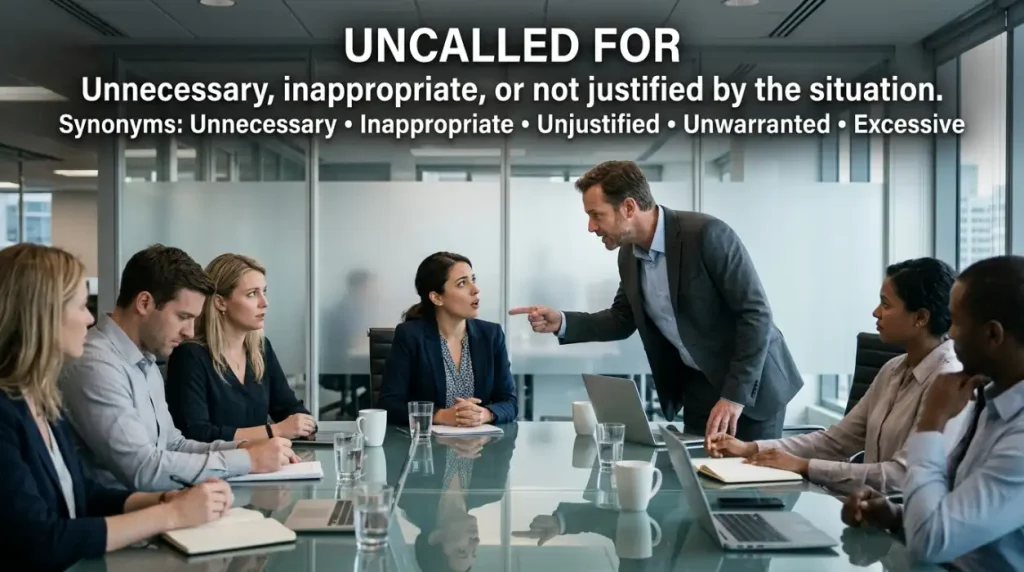
Synonym for uncalled for usually means a word or phrase that describes something inappropriate, unnecessary, unjustified, or not deserved. Common alternatives include unwarranted, inappropriate, unjustified, unnecessary, excessive, and out of line.
You send a polite message, but someone replies with a rude comment. Calling that response uncalled for sounds natural and clear.
Knowing a synonym for uncalled for helps you express the exact shade of meaning. You can sound softer, firmer, more formal, or more professional.
The phrase is common in everyday English because it quickly shows that an action, remark, or reaction was not appropriate.
For students, bloggers, content writers, and daily English users, these alternatives make writing and speaking more precise.
What Does “Uncalled For” Really Mean?
Uncalled for describes something that was not necessary, appropriate, reasonable, or justified in a particular situation.
It is usually used when someone believes that a person’s words, behavior, criticism, reaction, or action went beyond what the situation required.
For example:
“That comment was uncalled for.”
This means the comment was inappropriate or unnecessarily hurtful.
Native speakers commonly use uncalled for in conversations about arguments, criticism, rude remarks, emotional reactions, workplace behavior, and social situations.
Part of Speech
Uncalled for is an adjectival phrase.
Simple Definition
Uncalled for: not necessary, appropriate, justified, or deserved in a particular situation.
Emotional Tone
The phrase often carries a negative judgment. It can sound mildly critical or strongly disapproving, depending on context.
Compare:
“That was unnecessary.”
with:
“That was completely uncalled for.”
The second sentence sounds more emotionally charged.
Connotative Meaning
Connotation (the emotional feeling or association connected with a word beyond its basic dictionary meaning) matters when choosing a synonym.
Positive Tone
There is rarely a genuinely positive meaning for uncalled for, because the phrase normally criticizes an action or comment.
However, a softer alternative can reduce the harshness of the criticism.
Example:
“That response was perhaps unnecessary.”
Negative Tone
This is the normal use of uncalled for.
It can suggest that something was rude, unfair, excessive, inappropriate, or emotionally hurtful.
Example:
“His personal attack was completely uncalled for.”
Neutral Tone
In neutral or professional writing, alternatives such as unwarranted, unjustified, or inappropriate may sound more objective.
Example:
“The criticism appears unwarranted based on the available evidence.”
Etymology
The phrase uncalled for is built from the adjective uncalled and the preposition for.
The word call comes from Old Norse kalla, meaning “to call, summon, or cry out,” and became established in English through Middle English usage.
Old English: 450–1100
The exact modern phrase uncalled for did not exist in Old English. English already had related ideas involving calling, summoning, requesting, and demanding.
Middle English: 1100–1500
The verb call developed broader uses connected with summoning, naming, requesting, and demanding something.
Modern English: 1500–Present
The expression uncalled for developed into its modern sense of something being unnecessary, inappropriate, or not justified by the circumstances.
Today, it is especially common in spoken English and informal writing.
Pronunciation
Uncalled
US: /ˌʌnˈkɔːld/
UK: /ˌʌnˈkɔːld/
For
US: /fɔːr/
UK: /fɔː/
Syllables
un-called-for
Affixation Pattern
Root: call
Prefix: un-
Suffix: none in the phrase
Additional element: for
The prefix un- contributes the idea of something being absent, reversed, or not applicable.
Synonyms List
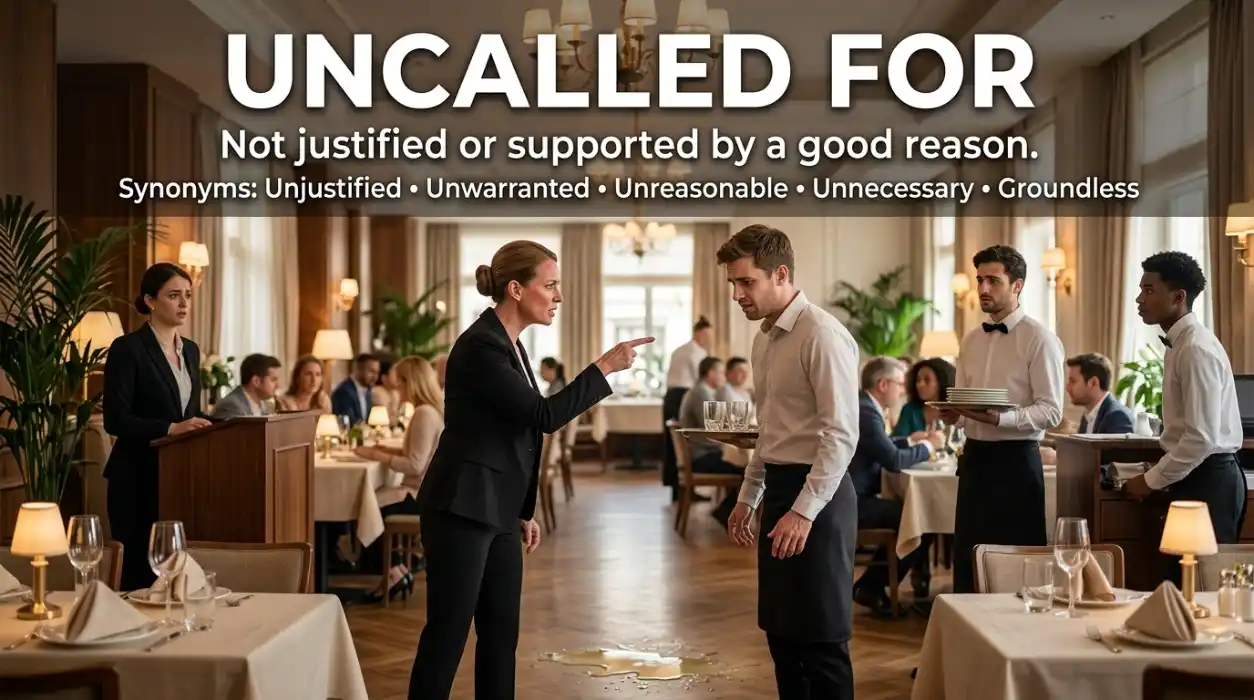
Unwarranted (Adjective) — US / UK: /ʌnˈwɔːrəntɪd/ / /ʌnˈwɒrəntɪd/
Meaning: Not justified or supported by a good reason.
Tone/Register: Formal, neutral, professional.
Examples:
The manager said the criticism was unwarranted.
The article made several unwarranted assumptions.
Unjustified (Adjective) — US / UK: /ʌnˈdʒʌstəˌfaɪd/ / /ʌnˈdʒʌstɪfaɪd/
Meaning: Not supported by an acceptable reason or explanation.
Tone/Register: Neutral, formal.
Examples:
Her angry response seemed unjustified.
The accusation was completely unjustified.
Inappropriate (Adjective) — US / UK: /ˌɪnəˈproʊpriət/ / /ˌɪnəˈprəʊpriət/
Meaning: Not suitable for the situation or setting.
Tone/Register: Neutral, professional.
Examples:
That joke was inappropriate for the classroom.
His comment was inappropriate during the meeting.
Unnecessary (Adjective) — US / UK: /ʌnˈnesəˌseri/ / /ʌnˈnesəsəri/
Meaning: Not needed or required.
Tone/Register: Neutral.
Examples:
The argument was unnecessary.
There was no need for that unnecessary criticism.
Unwarrantable (Adjective) — US / UK: /ʌnˈwɔːrəntəbəl/ / /ʌnˈwɒrəntəbəl/
Meaning: Not capable of being reasonably justified.
Tone/Register: Formal, academic.
Examples:
The decision was considered unwarrantable.
His reaction appeared unwarrantable given the facts.
Improper (Adjective) — US / UK: /ɪmˈprɑːpər/ / /ɪmˈprəʊpə/
Meaning: Not correct, suitable, or acceptable in the circumstances.
Tone/Register: Formal, professional.
Examples:
The employee reported improper conduct.
The question was considered improper.
Unjust (Adjective) — US / UK: /ʌnˈdʒʌst/ / /ʌnˈdʒʌst/
Meaning: Not fair or morally right.
Tone/Register: Neutral, formal.
Examples:
The punishment seemed unjust.
She believed the accusation was unjust.
Unfair (Adjective) — US / UK: /ʌnˈfer/ / /ʌnˈfeə/
Meaning: Not reasonable or equitable.
Tone/Register: Neutral, everyday.
Examples:
That criticism was unfair.
It was unfair to blame him for the mistake.
Unreasonable (Adjective) — US / UK: /ʌnˈriːzənəbəl/ / /ʌnˈriːzənəbəl/
Meaning: Not sensible, fair, or justified.
Tone/Register: Neutral.
Examples:
Her demand seemed unreasonable.
That was an unreasonable response.
Unjustifiable (Adjective) — US / UK: /ʌnˈdʒʌstəˌfaɪəbəl/ / /ʌnˈdʒʌstɪˌfaɪəbəl/
Meaning: Impossible or extremely difficult to defend with a good reason.
Tone/Register: Formal, strong.
Examples:
The personal attack was unjustifiable.
His behavior was unjustifiable.
Needless (Adjective) — US / UK: /ˈniːdləs/ / /ˈniːdləs/
Meaning: Not necessary.
Tone/Register: Neutral, written.
Examples:
The argument caused needless stress.
Her remark created needless tension.
Gratuitous (Adjective) — US / UK: /ɡrəˈtuːətəs/ / /ɡrəˈtjuːɪtəs/
Meaning: Given or made without a useful reason, often in an offensive way.
Tone/Register: Formal, advanced.
Examples:
The article contained a gratuitous insult.
His gratuitous criticism changed the mood.
Unprovoked (Adjective) — US / UK: /ˌʌnprəˈvoʊkt/ / /ˌʌnprəˈvəʊkt/
Meaning: Happening without another person’s action giving a clear reason for it.
Tone/Register: Neutral, strong.
Examples:
The attack appeared unprovoked.
She received an unprovoked insult.
Unwelcome (Adjective) — US / UK: /ʌnˈwelkəm/ / /ʌnˈwelkəm/
Meaning: Not wanted or appreciated.
Tone/Register: Neutral, polite.
Examples:
His advice was unwelcome.
The interruption was deeply unwelcome.
Uninvited (Adjective) — US / UK: /ˌʌnɪnˈvaɪtɪd/ / /ˌʌnɪnˈvaɪtɪd/
Meaning: Not requested, invited, or wanted.
Tone/Register: Neutral.
Examples:
She offered an uninvited opinion.
His uninvited advice annoyed everyone.
Intrusive (Adjective) — US / UK: /ɪnˈtruːsɪv/ / /ɪnˈtruːsɪv/
Meaning: Entering someone’s privacy or personal space without welcome.
Tone/Register: Neutral, professional.
Examples
The question felt intrusive.
That personal comment was intrusive.
Out of Line (Phrase) — US / UK: /aʊt əv laɪn/ / /aʊt əv laɪn/
Meaning: Beyond what is acceptable or appropriate.
Tone/Register: Informal, conversational.
Examples:
That joke was out of line.
You were out of line when you mentioned her private life.
Out of Place (Phrase) — US / UK: /aʊt əv pleɪs/ / /aʊt əv pleɪs/
Meaning: Unsuitable for a particular situation.
Tone/Register: Neutral.
Examples
His comment felt out of place.
The joke was out of place at the ceremony.
Inexcusable (Adjective) — US / UK: /ˌɪnɪkˈskjuːzəbəl/ / /ˌɪnɪkˈskjuːzəbəl/
Meaning: Too bad or wrong to be accepted as reasonable.
Tone/Register: Strong, formal.
Examples:
The insult was inexcusable.
Her behavior was considered inexcusable.
Indefensible (Adjective) — US / UK: /ˌɪndɪˈfensəbəl/ / /ˌɪndɪˈfensəbəl/
Meaning: Impossible to defend as reasonable or acceptable.
Tone/Register: Formal, strong.
Examples
The accusation was indefensible.
His public remarks were indefensible.
Offensive (Adjective) — US / UK: /əˈfensɪv/ / /əˈfensɪv/
Meaning: Causing anger, hurt, or insult.
Tone/Register: Neutral, strong.
Examples:
Some readers found the comment offensive.
That joke was offensive to several people.
Insulting (Adjective) — US / UK: /ɪnˈsʌltɪŋ/ / /ɪnˈsʌltɪŋ/
Meaning: Showing disrespect or deliberately hurting someone’s dignity.
Tone/Register: Neutral, strong.
Examples:
His reply sounded insulting.
The message contained an insulting remark.
Disrespectful (Adjective) — US / UK: /ˌdɪsrɪˈspektfəl/ / /ˌdɪsrɪˈspektfəl/
Meaning: Showing a lack of respect.
Tone/Register: Neutral.
Examples:
That tone was disrespectful.
His comment sounded disrespectful toward the staff.
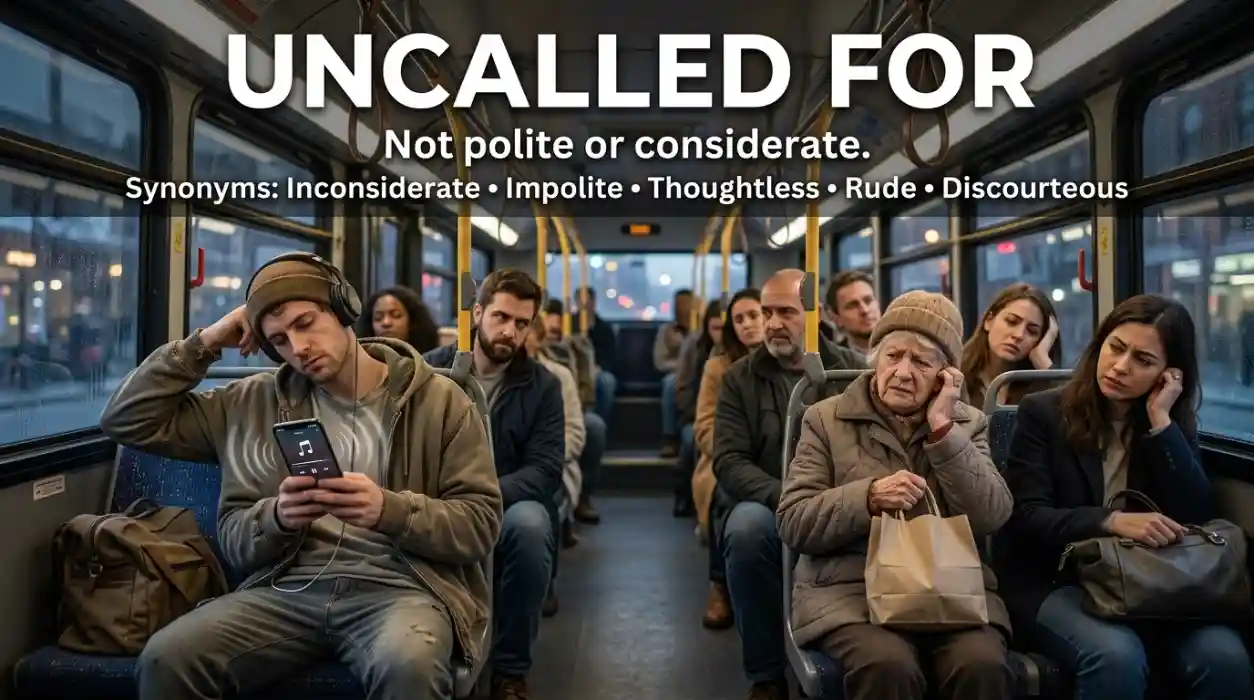
Rude (Adjective) — US / UK: /ruːd/ / /ruːd/
Meaning: Not polite or considerate.
Tone/Register: Informal, everyday.
Examples
That was a rude comment.
It was rude to criticize her in public.
Impolite (Adjective) — US / UK: /ˌɪmpəˈlaɪt/ / /ˌɪmpəˈlaɪt/
Meaning: Not showing ordinary politeness.
Tone/Register: Neutral, polite.
Examples:
His question sounded impolite.
It is impolite to interrupt someone repeatedly.
Discourteous (Adjective) — US / UK: /dɪsˈkɜːrtiəs/ / /dɪsˈkɜːtiəs/
Meaning: Lacking courtesy or good manners.
Tone/Register: Formal.
Examples:
The customer complained about discourteous treatment.
His response was discourteous.
Tactless (Adjective) — US / UK: /ˈtæktləs/ / /ˈtæktləs/
Meaning: Showing poor judgment about what is polite or sensitive.
Tone/Register: Neutral.
Examples:
That question was tactless.
Her tactless remark upset the team.
Insensitive (Adjective) — US / UK: /ɪnˈsensətɪv/ / /ɪnˈsensətɪv/
Meaning: Failing to consider another person’s feelings.
Tone/Register: Neutral, strong.
Examples:
His comment was insensitive.
The joke seemed insensitive after the news.
Inconsiderate (Adjective) — US / UK: /ˌɪnkənˈsɪdərət/ / /ˌɪnkənˈsɪdərət/
Meaning: Failing to think about how an action affects others.
Tone/Register: Neutral.
Examples:
Leaving without telling anyone was inconsiderate.
That was an inconsiderate thing to say.
Thoughtless (Adjective) — US / UK: /ˈθɔːtləs/ / /ˈθɔːtləs/
Meaning: Showing little concern for other people’s feelings.
Tone/Register: Neutral.
Examples:
His remark was thoughtless.
It was a thoughtless response to a serious problem.
Inconsiderate (Adjective) — US / UK: /ˌɪnkənˈsɪdərət/ / /ˌɪnkənˈsɪdərət/
Meaning: Showing insufficient care for other people’s needs or feelings.
Tone/Register: Neutral.
Examples:
Her interruption was inconsiderate.
That comment felt inconsiderate.
Presumptuous (Adjective) — US / UK: /prɪˈzʌmptʃuəs/ / /prɪˈzʌmptʃuəs/
Meaning: Too confident about having the right to say or do something.
Tone/Register: Formal.
Examples:
His question was presumptuous.
It was presumptuous to judge her decision.
Impertinent (Adjective) — US / UK: /ɪmˈpɜːrtɪnənt/ / /ɪmˈpɜːtɪnənt/
Meaning: Rudely disrespectful or overly personal.
Tone/Register: Formal, somewhat old-fashioned.
Examples:
The interviewer asked an impertinent question.
His reply sounded impertinent.
Meddlesome (Adjective) — US / UK: /ˈmedəlsəm/ / /ˈmedəlsəm/
Meaning: Too interested in other people’s private affairs.
Tone/Register: Informal, descriptive.
Examples:
Her meddlesome advice was unwanted.
His meddlesome questions became annoying.
Overstepping (Adjective/Participle) — US / UK: /ˌoʊvərˈstepɪŋ/ / /ˌəʊvəˈstepɪŋ/
Meaning: Going beyond an acceptable boundary or responsibility.
Tone/Register: Neutral, professional.
Examples:
His question was overstepping.
She apologized for overstepping the boundary.
Excessive (Adjective) — US / UK: /ɪkˈsesɪv/ / /ɪkˈsesɪv/
Meaning: Greater than what is reasonable or necessary.
Tone/Register: Formal, neutral.
Examples:
The punishment seemed excessive.
His reaction was excessive.
Extraneous (Adjective) — US / UK: /ɪkˈstreɪniəs/ / /ɪkˈstreɪniəs/
Meaning: Not relevant or necessary to the matter being discussed.
Tone/Register: Academic, formal.
Examples:
The report removed extraneous details.
Her comment was extraneous to the discussion.
Irrelevant (Adjective) — US / UK: /ɪˈreləvənt/ / /ɪˈreləvənt/
Meaning: Not connected with the subject or situation.
Tone/Register: Neutral, academic.
Examples:
That criticism was irrelevant.
His personal opinion was irrelevant to the decision.
Superfluous (Adjective) — US / UK: /suːˈpɜːrf luəs/ / /suːˈpɜːrfluəs/
Meaning: More than necessary or useful.
Tone/Register: Formal.
Examples:
The extra comment was superfluous.
Several sentences were superfluous.
Redundant (Adjective) — US / UK: /rɪˈdʌndənt/ / /rɪˈdʌndənt/
Meaning: Unnecessary because something similar already exists or has been said.
Tone/Register: Formal, professional.
Examples:
That explanation was redundant.
The final paragraph felt redundant.
Needless (Adjective) — US / UK: /ˈniːdləs/ / /ˈniːdləs/
Meaning: Not needed and therefore avoidable.
Tone/Register: Neutral.
Examples:
The dispute caused needless tension.
His criticism added needless pressure.
Avoidable (Adjective) — US / UK: /əˈvɔɪdəbəl/ / /əˈvɔɪdəbəl/
Meaning: Able to be prevented or avoided.
Tone/Register: Neutral.
Examples:
The argument was avoidable.
The misunderstanding led to avoidable conflict.
Unneeded (Adjective) — US / UK: /ʌnˈniːdɪd/ / /ʌnˈniːdɪd/
Meaning: Not required or necessary.
Tone/Register: Neutral.
Examples:
His advice was unneeded.
The extra criticism was unneeded.
Unsuitable (Adjective) — US / UK: /ʌnˈsuːtəbəl/ / /ʌnˈsuːtəbəl/
Meaning: Not appropriate for a particular purpose or situation.
Tone/Register: Neutral, formal.
Examples:
That language was unsuitable for children.
His remark was unsuitable for the occasion.
Amiss (Adjective) — US / UK: /əˈmɪs/ / /əˈmɪs/
Meaning: Wrong, inappropriate, or out of order.
Tone/Register: Formal, somewhat literary.
Examples:
Something seemed amiss with his response.
The remark was clearly amiss.
Unseemly (Adjective) — US / UK: /ʌnˈsiːmli/ / /ʌnˈsiːmli/
Meaning: Not socially acceptable or appropriate.
Tone/Register: Formal, literary.
Examples:
The public argument was unseemly.
His behavior was considered unseemly.
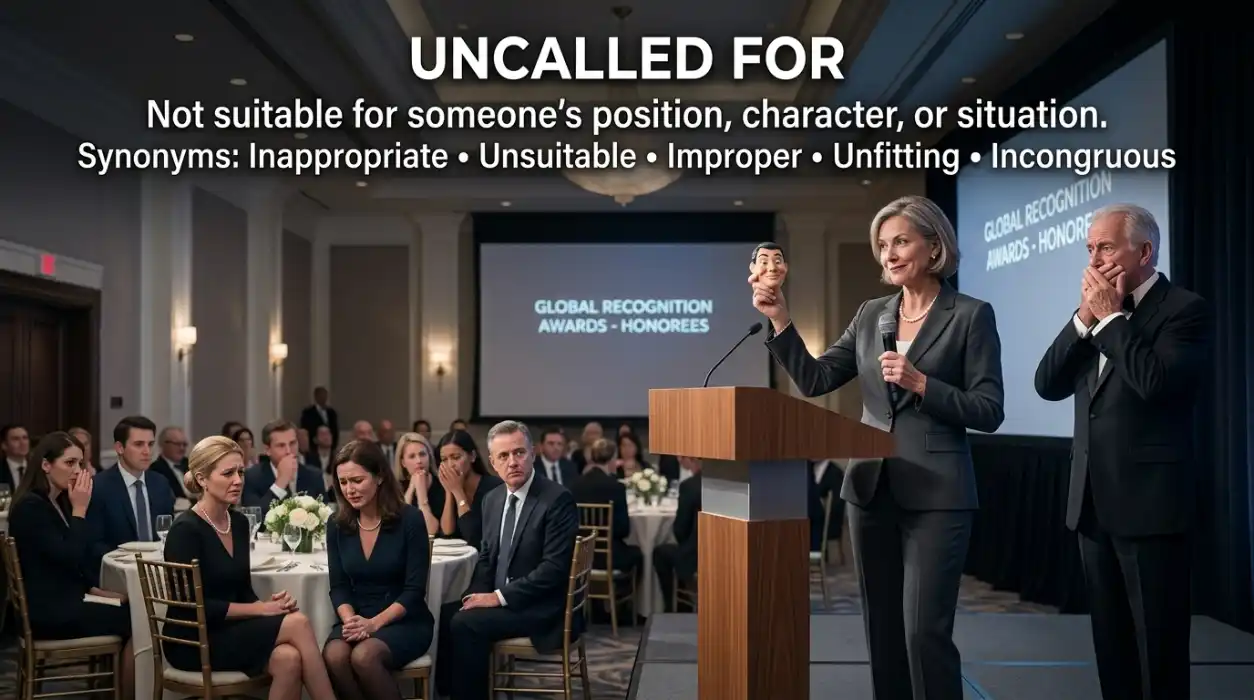
Unbecoming (Adjective) — US / UK: /ˌʌnbɪˈkʌmɪŋ/ / /ˌʌnbɪˈkʌmɪŋ/
Meaning: Not suitable for someone’s position, character, or situation.
Tone/Register: Formal.
Examples:
Such behavior was unbecoming of a leader.
Her response seemed unbecoming.
Objectionable (Adjective) — US / UK: /əbˈdʒekʃənəbəl/ / /əbˈdʒektʃənəbəl/
Meaning: Likely to cause disapproval or opposition.
Tone/Register: Formal.
Examples:
The wording was objectionable.
Several readers found the remark objectionable.
Disproportionate (Adjective) — US / UK: /ˌdɪsprəˈpɔːrʃənət/ / /ˌdɪsprəˈpɔːʃənət/
Meaning: Too large or severe compared with what caused it.
Tone/Register: Formal, analytical.
Examples:
His reaction was disproportionate.
The penalty seemed disproportionate to the mistake.
Needlessly Harsh (Phrase) — US / UK: /ˈniːdləsli hɑːrʃ/ / /ˈniːdləsli hɑːʃ/
Meaning: More severe or critical than the situation requires.
Tone/Register: Neutral.
Examples:
Her feedback was needlessly harsh.
The review sounded needlessly harsh.
Too Much (Phrase) — US / UK: /tuː mʌtʃ/ / /tuː mʌtʃ/
Meaning: More intense, severe, or extreme than appropriate.
Tone/Register: Informal.
Examples:
That reaction was too much.
The personal comments were a bit too much.
Harsh (Adjective) — US / UK: /hɑːrʃ/ / /hɑːʃ/
Meaning: Critically severe or unkind.
Tone/Register: Neutral.
Examples:
His words were harsh.
The criticism sounded unnecessarily harsh.
Cutting (Adjective) — US / UK: /ˈkʌtɪŋ/ / /ˈkʌtɪŋ/
Meaning: Deliberately sharp or hurtful in speech.
Tone/Register: Neutral, expressive.
Examples:
Her cutting remark ended the conversation.
He made a cutting comment about the proposal.
Barbed (Adjective) — US / UK: /bɑːrbd/ / /bɑːbd/
Meaning: Containing an indirect criticism or insult.
Tone/Register: Literary, journalistic.
Examples:
He made a barbed remark about her decision.
The interview included several barbed comments.
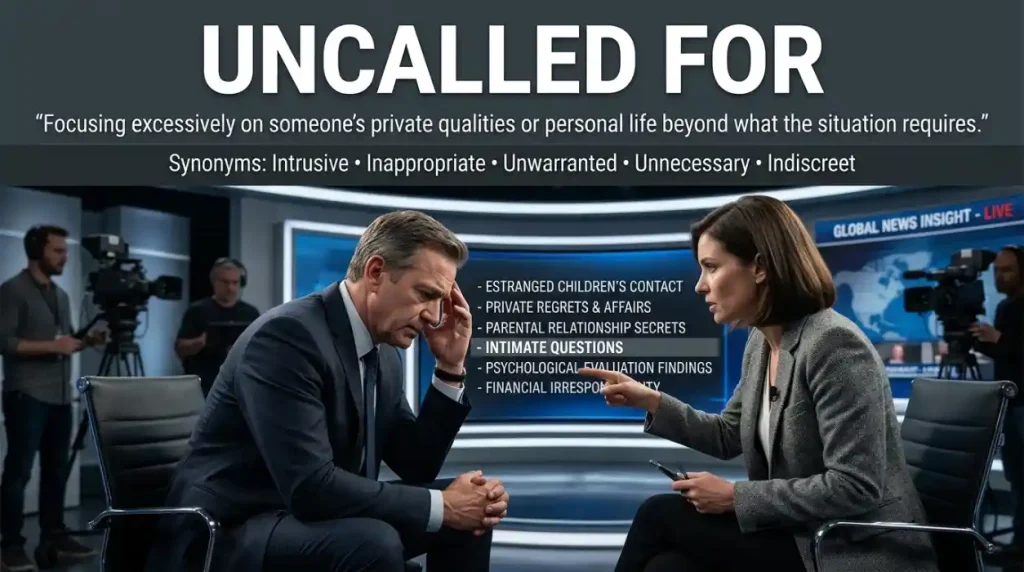
Needlessly Personal (Phrase) — US / UK: /ˈniːdləsli ˈpɜːrsənəl/ / /ˈniːdləsli ˈpɜːsənəl/
Meaning: More focused on someone’s private qualities or life than the situation requires.
Tone/Register: Neutral.
Examples:
The debate became needlessly personal.
His response was needlessly personal.
Why Tone Matters When Choosing a Synonym
A synonym is not always interchangeable with uncalled for.
For example, unnecessary focuses on lack of need. Inappropriate focuses on suitability. Rude focuses on manners. Unwarranted focuses on justification.
That distinction is important in essays, emails, articles, and everyday conversations.
A student might write:
“The criticism was unjustified.”
A friend might say:
“That was out of line.”
A professional report might use:
“The response was unwarranted.”
All three communicate disapproval, but they create different impressions.
Synonyms by Tone
Positive or Constructive
There are few genuinely positive synonyms because uncalled for itself expresses criticism. However, softer alternatives can make feedback more constructive.
Useful choices include:
- Unnecessary
- Avoidable
- Unneeded
- Inappropriate
These focus on the action rather than attacking the person.
Neutral
Good neutral choices include:
- Unjustified
- Unwarranted
- Unreasonable
- Improper
- Unsuitable
- Irrelevant
- Unwelcome
These work well when you want to sound measured.
Negative or Strong
Use stronger vocabulary when the behavior clearly crosses a serious boundary:
- Offensive
- Insulting
- Disrespectful
- Inexcusable
- Indefensible
- Unprovoked
- Mean-spirited
These words make the criticism more direct.
Playful or Informal
In casual speech, people may use:
- Out of line
- Too much
- Uncalled for
- That was rude
These sound natural in conversation but may be too informal for academic writing.
“Uncalled For” vs Close Alternatives
Uncalled For vs Unnecessary
Unnecessary means something was not needed.
Uncalled for often goes further. It suggests that the action was unnecessary and inappropriate, unfair, rude, or unjustified.
Use unnecessary when focusing on need. Use uncalled for when criticizing someone’s behavior or remarks.
Uncalled For vs Inappropriate
Inappropriate means unsuitable for the context.
Uncalled for often suggests that the behavior was not only unsuitable but also unnecessary or unjustified.
For example, a joke can be inappropriate because of the setting. A personal insult may be called uncalled for because there was no reason to make it.
Uncalled For vs Unwarranted
Unwarranted emphasizes lack of justification.
Uncalled for is more conversational and often carries a social or emotional judgment.
Use unwarranted in formal writing when discussing criticism, assumptions, claims, or actions.
How “Uncalled For” Changes by Context
Daily Conversation
In everyday English, uncalled for is often used after someone says something rude.
“That was uncalled for.”
The phrase can express disappointment without explaining every detail.
It is common in arguments, family conversations, friendships, and workplace discussions.
Writing and Blogging
Bloggers can use alternatives to avoid repetition.
Instead of repeatedly writing “uncalled for,” try unnecessary, inappropriate, unwarranted, excessive, or unjustified.
The best choice depends on exactly what you want to criticize.
Professional or Academic English
Formal writing often benefits from precise words.
Instead of:
“The comment was uncalled for.”
You might write:
“The criticism was unwarranted.”
Or:
“The response was inappropriate in the context of the discussion.”
These versions sound more analytical.
Creative or Informal English
Creative writing gives you more freedom.
Words such as cutting, barbed, mean-spirited, rude, and out of line can reveal character and emotion.
They can make dialogue feel more natural.
Common Mistakes Learners Make
Mistake 1: Treating Every Synonym as Identical
Unnecessary and rude are not exact replacements.
Something can be unnecessary without being rude.
Mistake 2: Using Formal Words in Casual Speech
Words such as unwarrantable and superfluous may sound overly formal in ordinary conversation.
“That’s out of line” often sounds more natural with friends.
Mistake 3: Confusing “Uncalled For” With “Uninvited”
An uninvited person was not asked to attend.
An uncalled-for remark was unnecessary or inappropriate.
The words overlap only in some contexts.
Mistake 4: Overusing Strong Synonyms
Calling every disagreement “offensive” or “inexcusable” can make your language sound exaggerated.
Choose the mildest word that accurately communicates your meaning.
Register Notes
Uncalled for is common in spoken English and informal-to-neutral writing.
Unwarranted, unjustified, unjustifiable, superfluous, and unseemly are more suitable for formal or academic contexts.
For additional vocabulary practice, an internal guide on synonyms and tone in English writing can help you compare similar words by register.
Real-Life Mini Scenarios
Workplace
A manager criticizes an employee’s personal life during a performance review.
A natural response is:
“That personal comment was uncalled for.”
A more formal report might say:
“The personal criticism was inappropriate.”
Social Situation
Two friends disagree about a movie.
One suddenly insults the other’s appearance.
The other might say:
“That was completely uncalled for.”
The phrase works because the insult was unrelated to the disagreement.
Media and Pop Culture
A reviewer attacks a celebrity personally instead of discussing their work.
A writer might describe the comment as:
“A gratuitous personal attack.”
This is stronger and more formal than simply saying it was uncalled for.
Writing and Storytelling
A character suddenly makes a cruel remark.
The narrator could write:
“His barbed comment silenced the room.”
Here, barbed adds detail about how the comment sounded.
Practice Exercise
1. Your friend insults you during a small disagreement. Which phrase sounds most natural?
A. Extraneous
B. Out of line
C. Superfluous
D. Unwarrantable
2. A research paper includes criticism that has no supporting evidence. Which word fits best?
A. Unwarranted
B. Playful
C. Invited
D. Polite
3. A joke is unsuitable for a formal ceremony. Which word fits?
A. Inappropriate
B. Unprovoked
C. Barbed
D. Needless
4. Someone attacks another person without being provoked. Which word is strongest?
A. Unnecessary
B. Unprovoked
C. Redundant
D. Irrelevant
5. A report contains details unrelated to its main topic. Which word fits best?
A. Extraneous
B. Rude
C. Offensive
D. Tactless
6. Someone asks a very personal question at work. Which word could describe the question?
A. Intrusive
B. Redundant
C. Superfluous
D. Avoidable
7. A person makes a deliberately hurtful joke about someone. Which phrase fits?
A. Mean-spirited
B. Unneeded
C. Irrelevant
D. Suitable
8. A punishment is much harsher than the mistake deserves. Which word fits?
A. Disproportionate
B. Uninvited
C. Tactless
D. Extraneous
9. Which alternative sounds most formal?
A. Too much
B. Out of line
C. Unwarranted
D. Rude
10. Someone gives advice that nobody requested. Which word fits best?
A. Uninvited
B. Relevant
C. Necessary
D. Appropriate
Reflection Task
Write one sentence using unwarranted, inappropriate, out of line, insensitive, or another synonym from this article. Then ask yourself: Why is this word better than “uncalled for” in my sentence?
Answer key: 1-B | 2-A | 3-A | 4-B | 5-A | 6-A | 7-A | 8-A | 9-C | 10-A
External Reference
For pronunciation, learner-friendly definitions, and examples, consult the Cambridge English Dictionary entry for “uncalled-for”. It distinguishes the UK and US pronunciations and explains the phrase’s disapproving meaning.
Conclusion
Learning a synonym for uncalled for gives you more than extra vocabulary. It helps you express whether something was unnecessary, rude, unfair, excessive, or simply unsuitable.
The right synonym can make an email sound calmer, an essay sound more precise, and a conversation sound more natural. Small word choices can change the tone.
Students, bloggers, writers, and everyday English users can all benefit from this vocabulary. The goal is not to use difficult words, but to choose accurate ones.
Start practicing these alternatives in emails, essays, stories, and daily conversations. Write one new sentence today and notice how the tone changes.
FAQs
1. What is the best synonym for uncalled for in formal English?
Unwarranted or unjustified is often a strong choice in formal English. Both emphasize that something lacks sufficient reason or support. However, inappropriate may be better when the main issue is suitability, while unjustifiable is stronger when the action cannot reasonably be defended.
2. What is a polite synonym for uncalled for?
Inappropriate is usually a useful polite alternative. It communicates disapproval without directly calling someone rude or offensive. Unnecessary can be even softer when you simply want to say that an action or comment was not needed.
3. Is “out of line” the same as “uncalled for”?
They can have similar meanings, especially when describing rude or inappropriate behavior. However, out of line is more informal and often suggests that someone crossed a social boundary. Uncalled for can focus more strongly on the idea that the remark or action was unnecessary or unjustified.
4. What is a synonym for uncalled for when describing a rude comment?
For a rude comment, insulting, offensive, disrespectful, tactless, insensitive, or inappropriate may work. The best word depends on the exact problem. Use insulting for a direct insult, insensitive for hurtful lack of awareness, and tactless for poor judgment about social sensitivity.
5. Can “unnecessary” replace “uncalled for” in every sentence?
No. Unnecessary only tells the reader that something was not needed. Uncalled for often carries an additional sense of unfairness, rudeness, or inappropriate behavior. For example, an unnecessary sentence may simply be extra, while an uncalled-for remark may also be hurtful or unjustified.

Hasnain Ali is an SEO Content Strategist and the founder of wordvora.com, a trusted vocabulary platform that helps writers, students, professionals, and English learners find accurate synonyms, antonyms, word meanings, and real-life usage examples. He specializes in keyword research, on-page SEO, topical authority, and creating search-first content that aligns with Google’s latest Search Quality and E-E-A-T guidelines. His work focuses on producing clear, well-structured, and reader-friendly resources that satisfy search intent while maintaining high editorial standards.
Through extensive hands-on experience with SEO tools such as Google Search Console, Google Analytics, SEMrush, and Ahrefs, Hasnain researches user search behavior and develops content that is both informative and easy to understand. Every article published on wordvora.com is carefully reviewed for accuracy, readability, and contextual relevance before publication. His mission is to build one of the web’s most reliable English vocabulary resources by providing practical language guidance, trustworthy explanations, and content that helps readers improve their writing, communication, and vocabulary with confidence.