synonym for tree can mean a direct alternative or a more specific word for a woody plant. Common choices include woody plant, timber tree, shade tree, sapling, evergreen, deciduous tree, and forest tree, depending on context.
Picture a child drawing a tree with a thick trunk and green leaves. In everyday English, “tree” is perfect, but a writer may need a more precise term.
The word tree is common because it names a familiar part of nature. Synonyms help writers describe size, age, purpose, habitat, and appearance.
For students, bloggers, and content writers, learning a synonym for tree adds variety and precision. It can make descriptions more vivid without making them complicated.
Daily English users can also benefit from these alternatives. Knowing the difference between a sapling, evergreen, and shade tree makes communication clearer and more natural.
What Does “Tree” Really Mean?
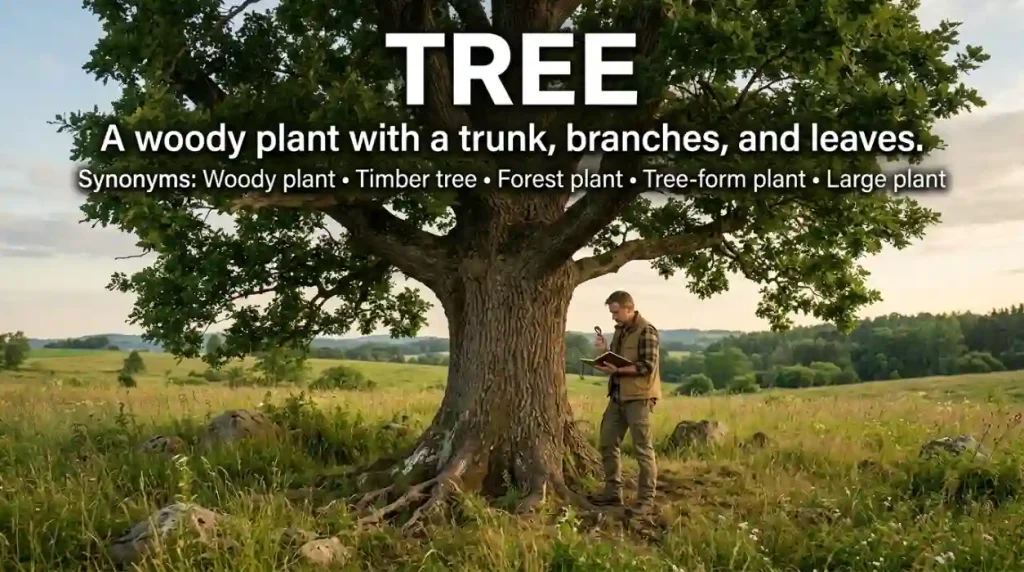
A tree is a large plant with a woody stem or trunk that normally grows upward and develops branches.
Trees are generally larger and more structurally developed than shrubs and many other plants.
For example:
There is a tall tree outside my window.
This sentence gives a general description.
If you know more about it, you can be more specific:
There is an old oak tree outside my window.
Here, oak identifies the type of tree.
The word can also be used metaphorically. A family tree shows relationships between generations. A decision tree is a diagram used to organize choices.
Part of Speech
Tree is primarily a countable noun.
It can also appear in compound nouns, such as:
- treehouse
- tree trunk
- tree branch
- family tree
- fruit tree
- shade tree
Simple definition: A large woody plant with a trunk, branches, and leaves or needles.
How Native Speakers Understand “Tree”
Native speakers usually understand tree as a broad, everyday word.
It does not automatically tell us the species, age, size, habitat, or purpose of the plant.
That is why context-specific alternatives are useful.
Compare:
The tree was beautiful.
with:
The ancient oak was beautiful.
The second sentence gives the reader much more information.
Connotative Meaning
Connotation (the feeling or association connected with a word beyond its basic dictionary meaning) can influence how a tree-related word sounds.
Positive Tone
Words such as majestic tree, heritage tree, flowering tree, and ornamental tree can create positive associations.
They may suggest beauty, age, nature, shelter, or cultural importance.
Negative Tone
Some tree-related expressions can become negative depending on context.
For example, dead tree, diseased tree, or fallen tree may suggest damage, loss, danger, or decay.
The negative feeling comes from the description rather than from the word tree itself.
Neutral Tone
Tree, woody plant, forest tree, sapling, evergreen, and deciduous tree can all be neutral when used accurately.
These terms are useful in factual, educational, and scientific writing.
Etymology
The word tree has one of the oldest histories in English.
It comes from Old English trēow, which meant “tree” and was also connected with the idea of wood. The word belongs to a wider Germanic family of related forms.
Old English: 450–1100
Old English used trēow for a tree. Interestingly, the same word was also connected with wood or timber.
Old English spelling and pronunciation were different from modern English, but the basic connection with a woody plant was already established.
Middle English: 1100–1500
During the Middle English period, the word gradually developed toward the spelling and pronunciation that became familiar in later English.
Forms such as tre and related spellings appeared in medieval texts.
Modern English: 1500–Present
By the Modern English period, tree had become the standard form.
Its basic meaning remained stable, while many compound and metaphorical meanings developed.
Today, tree can describe a physical plant, a wooden material in certain contexts, a branching diagram, or a structure that resembles branches.
Pronunciation
US: /triː/
UK: /triː/
Syllables
tree
It is a one-syllable word.
Affixation Pattern of “Tree”
Root: tree
Prefix: none
Suffix: none
Tree is a simple root word rather than a word formed by adding a common English prefix or suffix.
Synonyms List
Words such as plant are broader, while sapling and evergreen describe particular kinds or stages of trees.
The list below therefore gives accurate semantic alternatives and tree-related terms that can replace or clarify tree in appropriate contexts. This is more useful than forcing rare words that native speakers would not normally use.
Woody Plant (Noun) — US /ˈwʊdi plænt/ — UK /ˈwʊdi plɑːnt/
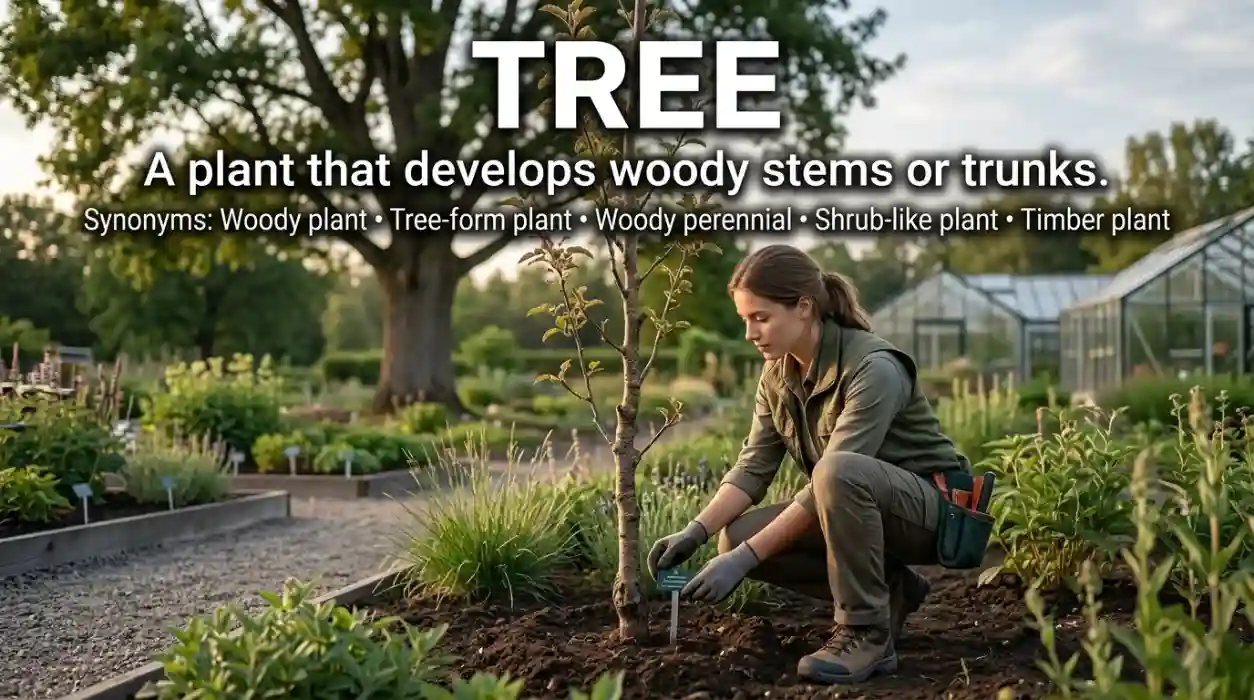
Meaning: A plant that develops woody stems or trunks.
Tone/Register: Scientific, educational.
Examples:
An oak is a common woody plant.
Many woody plants survive for decades.
Arboreal Plant (Noun) — US /ɑːrˈbɔːriəl plænt/ — UK /ɑːˈbɔːriəl plɑːnt/
Meaning: A plant associated with trees or tree-like growth.
Tone/Register: Scientific, formal.
Examples:
The study examines several arboreal plants.
The forest contains many arboreal species.
Timber Tree (Noun) — US /ˈtɪmbɚ triː/ — UK /ˈtɪmbə triː/
Meaning: A tree grown or valued for its wood.
Tone/Register: Forestry, professional.
Examples:
The plantation contains several timber trees.
The species is widely grown as a timber tree.
Forest Tree (Noun) — US /ˈfɔːrəst triː/ — UK /ˈfɒrɪst triː/
Meaning: A tree that grows naturally or is cultivated in a forest environment.
Tone/Register: Neutral, ecological.
Examples:
The researchers studied native forest trees.
This forest tree can survive cold winters.
Woodland Tree (Noun) — US /ˈwʊdlænd triː/ — UK /ˈwʊdlænd triː/
Meaning: A tree growing in woodland.
Tone/Register: Descriptive, ecological.
Examples:
The woodland tree provided shelter for birds.
Several woodland trees grow beside the path.
Shade Tree (Noun) — US /ˈʃeɪd triː/ — UK /ˈʃeɪd triː/
Meaning: A tree planted or valued for the shade it provides.
Tone/Register: Everyday, gardening.
Examples:
We sat beneath the shade tree.
The homeowners planted a shade tree near the patio.
Fruit Tree (Noun) — US /ˈfruːt triː/ — UK /ˈfruːt triː/
Meaning: A tree that produces edible fruit.
Tone/Register: Everyday, agricultural.
Examples:
The garden has three fruit trees.
She planted a fruit tree last spring.
Ornamental Tree (Noun) — US /ˌɔːrnəˈmɛntl triː/ — UK /ˌɔːnəˈmɛntl triː/
Meaning: A tree grown mainly for decorative or aesthetic value.
Tone/Register: Gardening, formal.
Examples:
The city planted ornamental trees along the avenue.
This ornamental tree has colorful flowers.
Native Tree (Noun) — US /ˈneɪtɪv triː/ — UK /ˈneɪtɪv triː/
Meaning: A tree that naturally belongs to a particular region.
Tone/Register: Environmental, educational.
Examples:
The park protects several native trees.
Native trees often support local wildlife.
Heritage Tree (Noun) — US /ˈherɪtɪdʒ triː/ — UK /ˈherɪtɪdʒ triː/
Meaning: A tree recognized for its historical, cultural, ecological, or community importance.
Tone/Register: Formal, cultural.
Examples:
The old oak is considered a heritage tree.
Residents worked together to protect the heritage tree.
Specimen Tree (Noun) — US /ˈspɛsəmən triː/ — UK /ˈspesɪmən triː/
Meaning: A tree selected or displayed because of its notable appearance or characteristics.
Tone/Register: Gardening, formal.
Examples:
The garden features a striking specimen tree.
The specimen tree stands alone near the entrance.
Feature Tree (Noun) — US /ˈfiːtʃɚ triː/ — UK /ˈfiːtʃə triː/
Meaning: A tree deliberately used as a prominent visual feature.
Tone/Register: Gardening, landscape design.
Examples:
The designer placed a feature tree in the courtyard.
The feature tree gives the garden a strong focal point.
Shade-Giving Tree (Noun) — US /ˈʃeɪd ˌɡɪvɪŋ triː/ — UK /ˈʃeɪd ˌɡɪvɪŋ triː/
Meaning: A tree valued because its branches and leaves provide shade.
Tone/Register: Descriptive, everyday.
Examples:
We rested beneath a shade-giving tree.
The school planted several shade-giving trees.
Evergreen (Noun) — US /ˈɛvɚˌɡriːn/ — UK /ˈevəɡriːn/
Meaning: A plant, often a tree, that retains green foliage throughout much of the year.
Tone/Register: Neutral, botanical.
Examples:
A tall evergreen stood beside the house.
The garden has several evergreens.
Conifer (Noun) — US /ˈkɑːnəfɚ/ — UK /ˈkɒnɪfə/
Meaning: A cone-bearing tree or shrub, usually with needle-like or scale-like leaves.
Tone/Register: Scientific, educational.
Examples:
The forest is dominated by conifers.
A young conifer grew near the trail.
Deciduous Tree (Noun) — US /dɪˈsɪdʒuəs triː/ — UK /dɪˈsɪdʒuəs triː/
Meaning: A tree that normally loses its leaves during part of the year.
Tone/Register: Scientific, educational.
Examples:
Maples are deciduous trees.
The deciduous trees turned gold in autumn.
Broadleaf Tree (Noun) — US /ˈbrɔːdˌliːf triː/ — UK /ˈbrɔːdˌliːf triː/
Meaning: A tree with broad, relatively flat leaves rather than needles.
Tone/Register: Botanical, forestry.
Examples:
Broadleaf trees dominate this section of the forest.
The park contains several native broadleaf trees.
Hardwood Tree (Noun) — US /ˈhɑːrdˌwʊd triː/ — UK /ˈhɑːdˌwʊd triː/
Meaning: A tree belonging to a group generally associated with hardwood timber.
Tone/Register: Forestry, technical.
Examples:
The forest contains many hardwood trees.
Oak is a well-known hardwood tree.
Softwood Tree (Noun) — US /ˈsɔːftˌwʊd triː/ — UK /ˈsɒftˌwʊd triː/
Meaning: A tree from a group generally associated with softwood timber, commonly conifers.
Tone/Register: Forestry, technical.
Examples:
Pine is a common softwood tree.
The region has large stands of softwood trees.
Sapling (Noun) — US /ˈsæplɪŋ/ — UK /ˈsæplɪŋ/
Meaning: A young tree that is larger and more established than a seedling.
Tone/Register: Neutral, gardening.
Examples:
The children planted a young sapling.
The sapling needs protection from strong winds.
Seedling (Noun) — US /ˈsiːdlɪŋ/ — UK /ˈsiːdlɪŋ/
Meaning: A very young plant grown from a seed, including a young tree.
Tone/Register: Botanical, everyday.
Examples:
The seedling emerged after several weeks.
She carefully moved the tree seedling outdoors.
Young Tree (Noun) — US /jʌŋ triː/ — UK /jʌŋ triː/
Meaning: A tree that has not yet reached maturity.
Tone/Register: Neutral.
Examples:
A young tree grew beside the fence.
The park protects every young tree.
Mature Tree (Noun) — US /məˈtʃʊr triː/ — UK /məˈtjʊə triː/
Meaning: A fully developed tree that has reached maturity.
Tone/Register: Neutral, professional.
Examples:
The property has several mature trees.
A mature tree can provide extensive shade.
Ancient Tree (Noun) — US /ˈeɪnʃənt triː/ — UK /ˈeɪnʃənt triː/
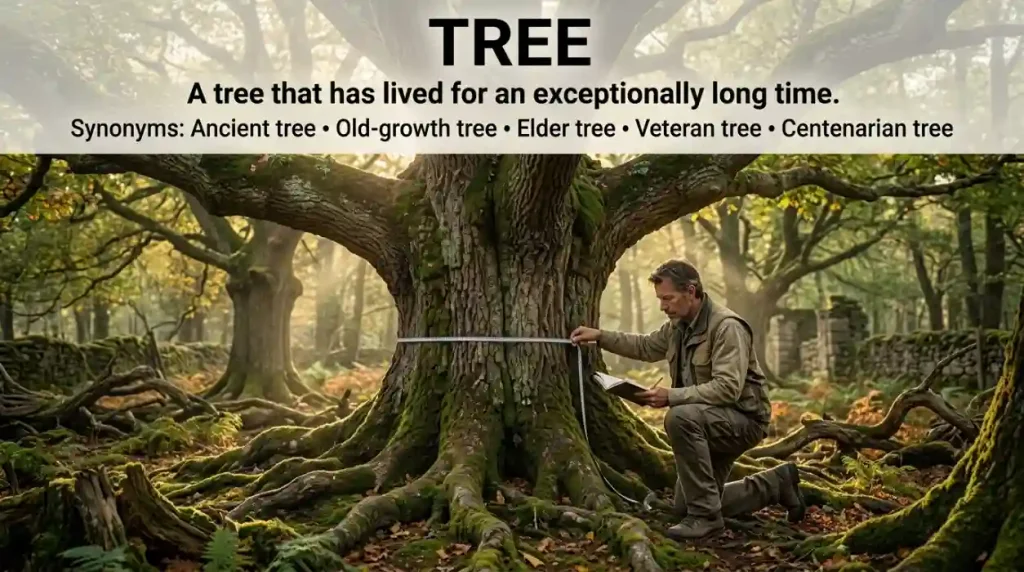
Meaning: A tree that has lived for an exceptionally long time.
Tone/Register: Descriptive, environmental.
Examples:
Visitors gathered around the ancient tree.
The ancient tree has survived for centuries.
Old-Growth Tree (Noun) — US /ˈoʊld ɡroʊθ triː/ — UK /ˈəʊld ɡrəʊθ triː/
Meaning: A tree associated with a mature or minimally disturbed forest ecosystem.
Tone/Register: Environmental, forestry.
Examples:
The reserve protects old-growth trees.
An old-growth tree stood above the younger plants.
Giant Tree (Noun) — US /ˈdʒaɪənt triː/ — UK /ˈdʒaɪənt triː/
Meaning: A very large tree.
Tone/Register: Informal, descriptive.
Examples:
A giant tree towered above the road.
We stopped to photograph the giant tree.
Towering Tree (Noun) — US /ˈtaʊərɪŋ triː/ — UK /ˈtaʊərɪŋ triː/
Meaning: A very tall tree that rises prominently above its surroundings.
Tone/Register: Literary, descriptive.
Examples:
A towering tree blocked the afternoon sun.
Birds nested in the towering tree.
Stately Tree (Noun) — US /ˈsteɪtli triː/ — UK /ˈsteɪtli triː/
Meaning: A large or impressive tree with an elegant appearance.
Tone/Register: Literary, positive.
Examples:
A stately tree stood beside the old house.
The avenue was lined with stately trees.
Majestic Tree (Noun) — US /məˈdʒɛstɪk triː/ — UK /məˈdʒestɪk triː/
Meaning: A tree that appears especially grand, beautiful, or impressive.
Tone/Register: Positive, literary.
Examples:
A majestic tree dominated the landscape.
They rested beneath the majestic tree.
Flowering Tree (Noun) — US /ˈflaʊərɪŋ triː/ — UK /ˈflaʊərɪŋ triː/
Meaning: A tree that produces noticeable flowers.
Tone/Register: Gardening, descriptive.
Examples:
The flowering tree brightened the garden.
A flowering tree stood near the entrance.
Blooming Tree (Noun) — US /ˈbluːmɪŋ triː/ — UK /ˈbluːmɪŋ triː/
Meaning: A tree that is currently producing flowers.
Tone/Register: Informal, descriptive.
Examples:
The blooming tree attracted bees.
We photographed the blooming trees in spring.
Fruit-Bearing Tree (Noun) — US /ˈfruːt ˌberɪŋ triː/ — UK /ˈfruːt ˌbeərɪŋ triː/
Meaning: A tree that produces fruit.
Tone/Register: Agricultural, descriptive.
Examples:
The farm contains many fruit-bearing trees.
The fruit-bearing tree produced a large harvest.
Canopy Tree (Noun) — US /ˈkænəpi triː/ — UK /ˈkænəpi triː/
Meaning: A tree whose crown contributes to the upper layer of a forest.
Tone/Register: Ecological, scientific.
Examples:
Canopy trees provide shelter for many species.
The canopy tree received strong sunlight.
Understory Tree (Noun) — US /ˈʌndərˌstɔːri triː/ — UK /ˈʌndəˌstɔːri triː/
Meaning: A smaller tree that grows beneath the main forest canopy.
Tone/Register: Ecological, scientific.
Examples:
The understory tree receives less direct sunlight.
Several understory trees grow beneath the canopy.
Forest Giant (Noun) — US /ˈfɔːrəst ˌdʒaɪənt/ — UK /ˈfɒrɪst ˌdʒaɪənt/
Meaning: An exceptionally large tree within a forest.
Tone/Register: Informal, descriptive.
Examples:
The hikers stopped beneath a forest giant.
The forest giant could be seen from far away.
Woodland Giant (Noun) — US /ˈwʊdlænd ˌdʒaɪənt/ — UK /ˈwʊdlænd ˌdʒaɪənt/
Meaning: A very large or striking tree in a woodland setting.
Tone/Register: Literary, descriptive.
Examples:
A woodland giant stood beside the trail.
The woodland giant became a local landmark.
Trunked Plant (Noun) — US /trʌŋkt plænt/ — UK /trʌŋkt plɑːnt/
Meaning: A plant characterized by a prominent woody trunk.
Tone/Register: Descriptive, botanical.
Examples:
The landscape contains several trunked plants.
The young trunked plant will grow taller over time.
Woody Perennial (Noun) — US /ˈwʊdi pəˈreniəl/ — UK /ˈwʊdi pəˈreniəl/
Meaning: A long-lived plant that develops woody structures and persists for multiple years.
Tone/Register: Botanical, technical.
Examples:
Many trees are woody perennials.
The garden contains several woody perennials.
Perennial Woody Plant (Noun) — US /pəˈreniəl ˈwʊdi plænt/ — UK /pəˈreniəl ˈwʊdi plɑːnt/
Meaning: A perennial plant with woody stems that remain from year to year.
Tone/Register: Academic, botanical.
Examples:
The tree is a large perennial woody plant.
Perennial woody plants can live for many years.
Tree Form (Noun) — US /ˈtriː fɔːrm/ — UK /ˈtriː fɔːm/
Meaning: A plant growth form characterized by a distinct trunk and elevated crown.
Tone/Register: Botanical, technical.
Examples:
The species can grow in tree form.
The gardener trained the plant into a tree form.
Tree Specimen (Noun) — US /ˈtriː ˌspɛsəmən/ — UK /ˈtriː ˌspesɪmən/
Meaning: An individual tree considered as a particular example or specimen.
Tone/Register: Scientific, horticultural.
Examples:
The garden contains an unusual tree specimen.
Researchers examined the tree specimen closely.
Tree Individual (Noun) — US /ˈtriː ˌɪndəˈvɪdʒuəl/ — UK /ˈtriː ˌɪndɪˈvɪdʒuəl/
Meaning: A single tree considered separately from a population.
Tone/Register: Scientific, ecological.
Examples:
Each tree individual was recorded separately.
Researchers measured every tree individual in the plot.
Woody Growth (Noun) — US /ˈwʊdi ɡroʊθ/ — UK /ˈwʊdi ɡrəʊθ/
Meaning: Vegetation characterized by woody stems or structures.
Tone/Register: Ecological, descriptive.
Example:
The area contains dense woody growth.
Woody growth covered the edge of the field.
Stand (Noun) — US /stænd/ — UK /stænd/
Meaning: A group of trees growing together in a particular area.
Tone/Register: Forestry, ecological.
Examples:
The forest contains a dense stand of pine.
The researchers surveyed the tree stand.
Grove (Noun) — US /ɡroʊv/ — UK /ɡrəʊv/
Meaning: A small group of trees growing together.
Tone/Register: Neutral, descriptive.
Examples:
We walked through a quiet olive grove.
A small grove shaded the edge of the field.
Copse (Noun) — US /kɑːps/ — UK /kɒps/
Meaning: A small group of trees, especially in British English.
Tone/Register: Literary, British.
Examples:
A narrow path led to a small copse.
Birds gathered near the copse at sunset.
Thicket (Noun) — US /ˈθɪkɪt/ — UK /ˈθɪkɪt/
Meaning: A dense area of shrubs, bushes, and sometimes small trees.
Tone/Register: Descriptive.
Examples:
The fox disappeared into the thicket.
Dense trees surrounded the thicket.
Forest (Noun) — US /ˈfɔːrəst/ — UK /ˈfɒrɪst/
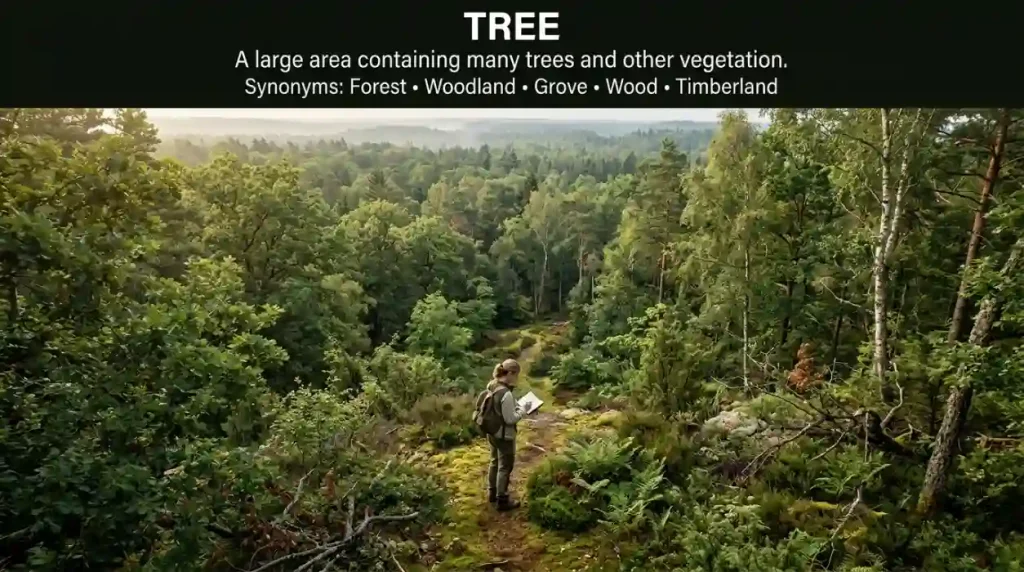
Meaning: A large area containing many trees and other vegetation.
Tone/Register: Neutral.
Examples:
We walked through the forest.
The forest was quiet after the rain.
Woodland (Noun) — US /ˈwʊdlænd/ — UK /ˈwʊdlænd/
Meaning: Land covered partly or mainly by trees.
Tone/Register: Neutral, British-friendly.
Examples:
The path winds through woodland.
Wild animals live in the surrounding woodland.
Timber (Noun) — US /ˈtɪmbɚ/ — UK /ˈtɪmbə/
Meaning: Wood prepared for use, especially as a building or structural material, rather than a living tree.
Tone/Register: Forestry, construction.
Examples:
The company processes timber from managed forests.
The timber was prepared for construction.
Synonyms by Tone
Positive
These terms can create beauty, admiration, or emotional warmth:
- majestic tree
- stately tree
- flowering tree
- heritage tree
- living landmark
- forest giant
- woodland giant
They work particularly well in descriptive writing and storytelling.
Neutral
These are useful for ordinary or factual communication:
- tree
- woody plant
- forest tree
- woodland tree
- shade tree
- fruit tree
- native tree
- sapling
- mature tree
- evergreen
- deciduous tree
Formal or Academic
Use these in scientific, environmental, forestry, or educational contexts:
- woody perennial
- perennial woody plant
- canopy tree
- understory tree
- broadleaf tree
- conifer
- hardwood tree
- softwood tree
- tree cover
- tree form
- tree specimen
Playful or Informal
Creative descriptions can include:
- green giant
- nature giant
- forest giant
- woodland giant
These are not dictionary synonyms for tree. They are expressive descriptions.
That distinction matters. In formal writing, tree or a scientifically accurate term is usually better than an imaginative phrase.
“Tree” vs Close Alternatives
| Word | Meaning | Tone | Best Use |
|---|---|---|---|
| Tree | General term for a large woody plant | Neutral | Everyday English |
| Woody plant | Broader botanical description | Scientific | Educational writing |
| Sapling | Young tree | Neutral | Gardening and ecology |
| Evergreen | Plant that keeps foliage for much of the year | Botanical | Plant descriptions |
| Forest tree | Tree associated with a forest environment | Ecological | Nature writing |
Woody Plant vs Tree
Tree is an everyday word.
Woody plant is broader and more technical. Some woody plants are shrubs rather than trees.
So you should not automatically replace tree with woody plant.
Tree vs Sapling
A sapling is specifically a young tree.
The tree was beside the house.
The sapling was beside the house.
The second sentence tells us that the tree is young.
Tree vs Evergreen
An evergreen is not necessarily a direct synonym for tree. It describes a plant that retains its foliage for much of the year.
Many evergreens are trees, but the category is not limited to trees.
Tree vs Forest
A forest is an area containing many trees.
It is not a synonym for one tree.
This is an important distinction for English learners.
How “Tree” Changes by Context
Daily Conversation
In everyday English, tree is usually the best word.
Native speakers do not normally replace a simple word merely to sound sophisticated.
There is a tree in our garden.
This sounds natural.
If the exact type matters, add a specific word:
There is an apple tree in our garden.
Writing and Blogging
Bloggers often need more descriptive vocabulary.
Instead of repeatedly writing:
The tree was beautiful. The tree was very old. The tree gave us shade.
You can write:
The ancient tree stood quietly beside the path. Its wide canopy gave us welcome shade.
This creates variety while preserving the meaning.
Professional or Academic Writing
Scientific writing benefits from precise terminology.
A researcher may write deciduous tree, canopy tree, native tree, or woody perennial depending on the subject.
Do not use technical vocabulary unless it adds accuracy.
Creative or Informal Writing
Creative writing gives you more freedom.
Expressions such as towering tree, majestic tree, and forest giant can create stronger imagery.
For example:
A towering tree rose above the mist.
This is more vivid than:
A tree was very tall.
Common Mistakes Learners Make
Mistake 1: Treating “Plant” as an Exact Synonym
Every tree is a plant, but not every plant is a tree.
Plant is a broader category.
Use plant when the exact type does not matter.
Mistake 2: Calling Every Young Tree a Seedling
A seedling is a very young plant that has developed from a seed.
A larger young tree is usually called a sapling.
The distinction is useful in gardening and environmental writing.
Mistake 3: Confusing “Forest” With “Tree”
A forest contains many trees.
We walked through the forest.
This does not mean:
We walked through the tree.
The two words refer to different things.
Mistake 4: Using “Evergreen” for Every Tree
Evergreen describes a foliage pattern.
Many trees are deciduous, meaning they lose their leaves seasonally.
Mistake 5: Using “Timber” for a Living Tree
Timber normally refers to wood prepared for use.
A living tree is not normally called timber.
Mistake 6: Overusing Fancy Descriptions
Writing majestic tree in every paragraph can sound artificial.
Use vivid descriptions when they add information or atmosphere.
Register Notes
Tree is neutral and universal.
Sapling is neutral and specific.
Grove is descriptive and common.
Copse is more literary and particularly familiar in British English.
Conifer and deciduous tree are scientific or educational.
Forest giant and living landmark are creative descriptions rather than exact dictionary synonyms.
For additional vocabulary practice, an internal article about synonyms for forest can help readers distinguish individual trees from groups of trees and larger habitats.
Real-Life Mini Scenarios
Workplace
An office manager wants to describe landscaping around a building.
The company planted several shade trees around the entrance.
Here, shade tree explains the purpose of the planting.
Social Situation
A friend describes a memorable childhood place.
We used to meet under the giant tree near the playground.
The phrase giant tree is natural and conversational.
Media and Pop Culture
A nature documentary may use specialized language.
The camera moves through the forest canopy.
Here, canopy refers to the upper layer created by tree branches and leaves.
Writing and Storytelling
A novelist may want to create atmosphere.
An ancient tree stood alone on the hill.
The adjective ancient adds age and mystery.
A more dramatic version might say:
A towering tree rose above the fog.
The second version focuses on visual impact.
Gardening
A gardener may need to distinguish between ages and types.
We planted a sapling beside the mature tree.
The two terms immediately show the age difference.
Environmental Writing
A conservation writer may describe a regional species.
The project protects native trees and restores damaged woodland.
Here, native trees give ecological information that the general word trees does not provide.

Practice Exercise
1. You are talking about a large woody plant in your garden.
A. Tree
B. Forest
C. Timber
D. Canopy
2. A very young tree has recently begun growing.
A. Sapling
B. Forest
C. Timber
D. Grove
3. A tree keeps its green foliage throughout much of the year.
A. Evergreen
B. Deciduous tree
C. Sapling
D. Timber tree
4. A tree loses its leaves seasonally.
A. Evergreen
B. Deciduous tree
C. Canopy
D. Grove
5. A tree is planted mainly to provide shade.
A. Shade tree
B. Timber tree
C. Copse
D. Seedling
6. A tree is grown mainly for its fruit.
A. Fruit tree
B. Canopy tree
C. Hardwood tree
D. Woodland tree
7. A tree is valued mainly for its decorative appearance.
A. Ornamental tree
B. Forest giant
C. Softwood tree
D. Understory tree
8. You are writing a scientific report about the upper layer of a forest.
A. Canopy
B. Grove
C. Sapling
D. Timber
9. You need a word for a small group of trees.
A. Grove
B. Timber
C. Seedling
D. Canopy
10. You are describing a large group of trees growing together in forestry.
A. Stand
B. Sapling
C. Fruit tree
D. Specimen tree
Answer key: 1-A | 2-A | 3-A | 4-B | 5-A | 6-A | 7-A | 8-A | 9-A | 10-A
Reflection Task
Write one sentence using tree.
Then rewrite it using a more precise term such as sapling, evergreen, shade tree, fruit tree, native tree, or ancient tree.
External sources
For dictionary definitions and usage, consult Cambridge Dictionary — tree and Merriam-Webster — tree. For etymology, see Online Etymology Dictionary — tree.
Conclusion
A good synonym for tree should add meaning, not simply replace a familiar word. Terms such as sapling, evergreen, and shade tree tell readers something specific about the plant.
For creative writing, words like majestic, towering, and ancient can create stronger images. For academic work, precise botanical terms can make descriptions clearer and more useful.
Learning tree-related vocabulary improves writing, blogging, speaking, and everyday communication. It also helps students describe nature with greater confidence and accuracy.
Try these words in your next email, essay, conversation, or story. Practice choosing the term that gives your reader exactly the picture you want.
Frequently Asked Questions
1. What is another word for tree in English?
There is no single perfect synonym that works in every context. Woody plant is a broader botanical expression, while sapling, evergreen, forest tree, shade tree, and fruit tree describe particular types or uses. In ordinary conversation, however, tree remains the most natural general word.
2. What is a more poetic word for tree?
English does not have a common poetic noun that directly replaces tree. Writers usually create imagery with phrases such as towering tree, majestic tree, ancient tree, forest giant, or living landmark. These expressions add atmosphere or emotion rather than functioning as exact dictionary synonyms.
3. What is the difference between a tree and a sapling?
A tree is the general term for the plant, while a sapling specifically refers to a young tree. A sapling has developed beyond the earliest seedling stage but has not reached full maturity. Therefore, every sapling can be described as a tree, but not every tree is a sapling.
4. What is another word for a group of trees?
Several words can describe groups of trees. Grove usually means a small group, while copse often refers to a small group or area of trees. Stand is common in forestry for a group of trees occupying a particular area. Forest and woodland refer to larger areas rather than just a small group.
5. What word describes a tree that provides shade?
The most natural term is shade tree. It describes a tree that is planted or valued because its branches and foliage provide shade. The expression is common in gardening, landscaping, and everyday English. You can also say shade-giving tree when you want a more descriptive phrase.

Hasnain Ali is an SEO Content Strategist and the founder of wordvora.com, a trusted vocabulary platform that helps writers, students, professionals, and English learners find accurate synonyms, antonyms, word meanings, and real-life usage examples. He specializes in keyword research, on-page SEO, topical authority, and creating search-first content that aligns with Google’s latest Search Quality and E-E-A-T guidelines. His work focuses on producing clear, well-structured, and reader-friendly resources that satisfy search intent while maintaining high editorial standards.
Through extensive hands-on experience with SEO tools such as Google Search Console, Google Analytics, SEMrush, and Ahrefs, Hasnain researches user search behavior and develops content that is both informative and easy to understand. Every article published on wordvora.com is carefully reviewed for accuracy, readability, and contextual relevance before publication. His mission is to build one of the web’s most reliable English vocabulary resources by providing practical language guidance, trustworthy explanations, and content that helps readers improve their writing, communication, and vocabulary with confidence.