
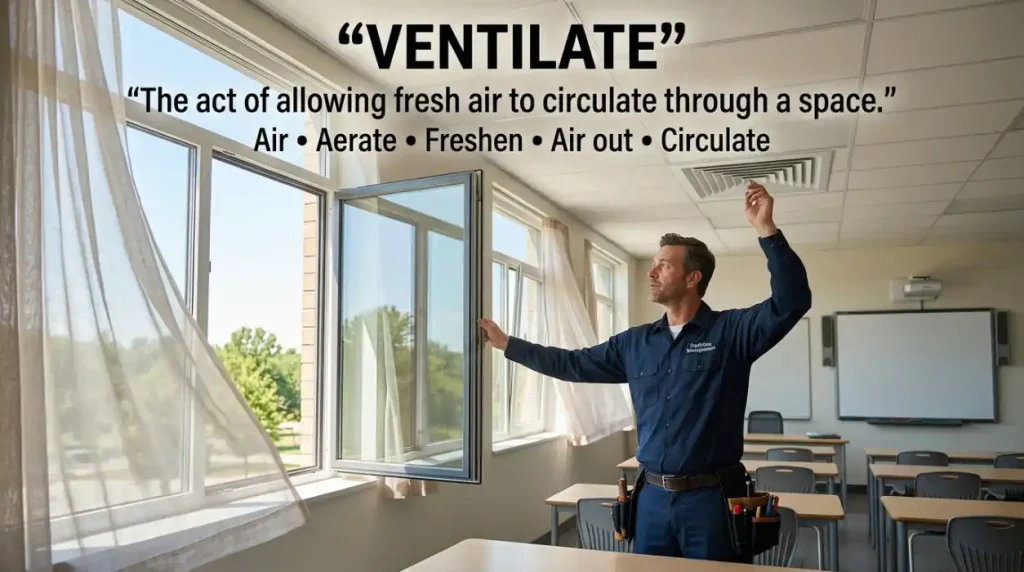
Synonyms for ventilate can include air, aerate, circulate air, air out, freshen, exhaust, vent, or provide airflow, depending on context. In medical English, ventilate can mean to move air into and out of the lungs. In formal writing, it can also mean to express an opinion or grievance.
Synonym for ventilate becomes useful when you want to describe fresh air entering a room. A simple phrase like “open the windows to air out the room” can sound more natural in conversation.
Imagine opening every window after cooking a spicy meal. You are helping to ventilate the kitchen by allowing fresh air to circulate and stale air to leave.
The word is common in home care, construction, workplaces, medicine, engineering, and everyday English. Its exact synonym depends on the situation.
For students, bloggers, content writers, and daily English users, learning these alternatives improves precision. It also helps avoid repeating ventilate in descriptions and explanations.
What Does “Ventilate” Really Mean?
Ventilate is primarily a verb. In simple English, it means to allow fresh air to enter and move through an enclosed space while stale air leaves.
Cambridge Dictionary defines the word as causing fresh air to enter and move around a closed space. It also records specialized medical and formal meanings.
For example:
Please ventilate the bedroom before painting.
This means to bring fresh air into the room and allow air to move through it.
Another common example is:
Open the windows to ventilate the kitchen.
Here, the purpose is better airflow.
Medical Meaning
In medicine, ventilate can mean to force air in and out of a person’s lungs with a machine when they cannot breathe adequately on their own. This is a specialized use.
The patient was mechanically ventilated.
Formal Figurative Meaning
In formal English, ventilate can also mean to express an opinion, complaint, grievance, or issue so that other people can discuss it.
She used the meeting to ventilate her concerns.
This meaning is much less common in everyday conversation.
Part of Speech
Ventilate is a verb.
Related forms include:
- ventilated — past tense and past participle
- ventilating — present participle
- ventilation — noun
- ventilator — noun
- vent — noun and verb
The word is normally transitive when referring to providing air to a space.
They ventilated the room.
It can also appear in passive constructions.
The room was well ventilated.
Cambridge lists ventilated as an adjective for a space that has fresh air entering and moving around it.
How Native Speakers Understand “Ventilate”
Native speakers usually understand ventilate according to the surrounding context.
In medical contexts, it refers to artificial movement of air into and out of the lungs.
In formal discussions, it can mean expressing a grievance or opinion.
That makes the word especially interesting for English learners. One spelling can represent several related meanings.
Connotative Meaning of “Ventilate”
Connotation (the emotional or implied meaning associated with a word beyond its basic dictionary definition) varies according to context.
Positive Tone
When used for rooms or buildings, ventilate can suggest freshness, comfort, cleanliness, and healthy airflow.
We ventilated the room after lunch.
The action sounds practical and beneficial.
Negative Tone
The word can acquire a negative tone when connected with stale air, pollution, fumes, smoke, or unpleasant conditions.
The workshop needs better ventilation.
The word itself remains neutral. The surrounding situation creates the negative impression.
Neutral Tone
In technical, scientific, architectural, and medical writing, ventilate is generally neutral.
The system is designed to ventilate the building.
Here, it simply describes a function.
Etymology
The history of ventilate is surprisingly connected to wind and the ancient process of separating grain.
Etymological sources trace the word to early fifteenth-century ventilaten, meaning “to scatter” or “disperse” as wind does. It came through Latin ventilare, associated with tossing, fanning, agitating, and winnowing. Latin ventulus meant “a breeze,” from ventus, meaning “wind.”
The original idea involved throwing grain into the air so that wind could separate the lighter chaff from the grain. Later, the meaning developed toward supplying fresh air to enclosed spaces. The room-related sense is recorded from the eighteenth century. The medical sense of supplying air artificially to the lungs developed in the twentieth century.
Old English: 450–1100
The modern word ventilate did not exist in Old English.
However, Old English had vocabulary associated with wind, air, breathing, and movement. These ideas form part of the broader conceptual background of the modern word.
Middle English: 1100–1500
The direct ancestor ventilaten entered English around the early fifteenth century.
Its earliest sense involved scattering or dispersing material, reflecting the movement of wind.
Modern English: 1500–Present
The meaning gradually expanded from movement and winnowing toward air circulation.
By the eighteenth century, ventilate could refer to replacing stale or undesirable air with fresh air. By the twentieth century, the word had acquired its specialized medical sense.
Pronunciation
US: /ˈven.t̬ə.leɪt/
UK: /ˈven.tɪ.leɪt/
Syllables
ven-ti-late
Affixation Pattern
Root: vent
Prefix: none in the modern English formation
Suffix: -ate
The -ate ending appears in many English verbs derived from Latin forms.
The related noun ventilation uses the suffix -ation.
Synonyms List
A key point is necessary before the list: ventilate has three major modern uses. No single English word can replace it naturally in all three.
The alternatives below therefore cover its main senses: providing fresh air, allowing air to escape or circulate, medical ventilation, and formally expressing concerns or grievances. The examples show where each alternative fits naturally.
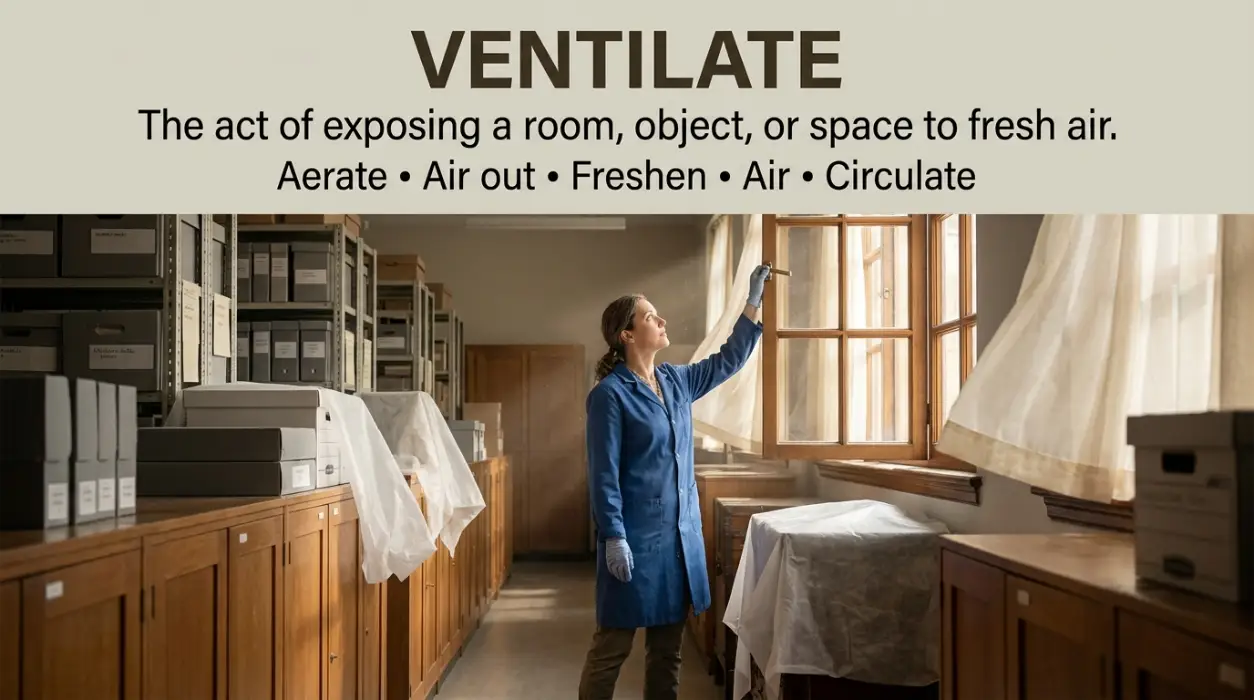
1. Air (Verb) — US / UK: /er/ /eə/
Meaning: To expose a room, object, or space to fresh air.
Tone/Register: Everyday, informal.
Examples:
Open the windows to air the bedroom.
We aired the room after cooking.
2. Aerate (Verb) — US / UK: /ˈer.i.eɪt/ /ˈeə.ri.eɪt/
Meaning: To introduce air into something, especially soil, water, or a controlled environment.
Tone/Register: Technical, scientific.
Examples:
The gardener aerated the soil.
The system aerates the water efficiently.
3. Air Out (Phrasal Verb) — US / UK: /er aʊt/ /eə aʊt/
Meaning: To allow fresh air into a room or enclosed area.
Tone/Register: Informal, conversational.
Examples:
Let’s air out the bedroom.
She opened the windows to air out the kitchen.
4. Freshen (Verb) — US / UK: /ˈfreʃən/ /ˈfreʃən/
Meaning: To make the air in a place fresher and more pleasant.
Tone/Register: Everyday.
Examples:
Open the door to freshen the room.
A little fresh air will freshen the office.
5. Circulate (Verb) — US / UK: /ˈsɝːkjəleɪt/ /ˈsɜːkjəleɪt/
Meaning: To cause air to move continuously through a space.
Tone/Register: Neutral, technical.
Examples:
The fan circulates air around the room.
Ceiling fans help circulate cool air.
6. Vent (Verb) — US / UK: /vent/ /vent/
Meaning: To allow air, gas, heat, or fumes to escape through an opening.
Tone/Register: Technical, everyday.
Examples:
The roof vents hot air.
The cabinet needs a way to vent moisture.
7. Air-Condition (Verb) — US / UK: /ˈer kənˌdɪʃən/ /ˈeə kənˌdɪʃən/
Meaning: To control the temperature and condition of air in an enclosed space.
Tone/Register: Technical, everyday.
Examples:
The building is air-conditioned.
The system air-conditions several offices.
8. Exhaust (Verb) — US / UK: /ɪɡˈzɔːst/ /ɪɡˈzɔːst/
Meaning: To remove air, fumes, heat, or gases from a space.
Tone/Register: Technical, professional.
Examples:
The hood exhausts cooking fumes.
Fans exhaust hot air from the attic.
9. Disperse (Verb) — US / UK: /dɪˈspɝːs/ /dɪˈspɜːs/
Meaning: To spread something out or cause it to move away.
Tone/Register: Formal, technical.
Examples:
The fan dispersed the smoke.
The airflow dispersed the fumes.
10. Dilute (Verb) — US / UK: /daɪˈluːt/ /daɪˈluːt/
Meaning: To reduce the concentration of a substance by adding air or another medium.
Tone/Register: Scientific, technical.
Examples:
Fresh air can dilute indoor pollutants.
The system dilutes contaminated air.
11. Purify (Verb) — US / UK: /ˈpjʊrɪfaɪ/ /ˈpjʊərɪfaɪ/
Meaning: To remove unwanted substances from air or another material.
Tone/Register: Neutral, technical.
Examples:
The filter helps purify indoor air.
Plants can contribute to a fresher indoor environment.
12. Refresh (Verb) — US / UK: /rɪˈfreʃ/ /rɪˈfreʃ/
Meaning: To make air feel fresher or less stale.
Tone/Register: Everyday.
Examples:
Open a window to refresh the room.
The breeze refreshed the stuffy office.
13. Open Up (Phrasal Verb) — US / UK: /ˈoʊpən ʌp/ /ˈəʊpən ʌp/
Meaning: To open windows, doors, or other openings to allow air to enter.
Tone/Register: Informal.
Examples:
Let’s open up the windows.
They opened up the house after the rain.
14. Let Air In (Phrase) — US / UK: /let er ɪn/ /let eə ɪn/
Meaning: To allow fresh air to enter an enclosed place.
Tone/Register: Everyday.
Examples:
Please let some air in.
She opened the window to let air in.
15. Allow Airflow (Verb Phrase) — US / UK: /əˈlaʊ ˈerfloʊ/ /əˈlaʊ ˈeəfləʊ/
Meaning: To permit air to move through a space.
Tone/Register: Technical, professional.
Examples:
The design allows airflow through the attic.
Keep the vents clear to allow airflow.
16. Provide Airflow (Verb Phrase) — US / UK: /prəˈvaɪd ˈerfloʊ/ /prəˈvaɪd ˈeəfləʊ/
Meaning: To supply or create movement of air.
Tone/Register: Technical, professional.
Examples:
The fans provide airflow throughout the room.
The vents provide airflow behind the equipment.
17. Improve Airflow (Verb Phrase) — US / UK: /ɪmˈpruːv ˈerfloʊ/ /ɪmˈpruːv ˈeəfləʊ/
Meaning: To make air movement through a space more effective.
Tone/Register: Neutral, technical.
Examples:
We moved the furniture to improve airflow.
The new vents improve airflow upstairs.
18. Exchange Air (Verb Phrase) — US / UK: /ɪksˈtʃeɪndʒ er/ /ɪksˈtʃeɪndʒ eə/
Meaning: To replace indoor air with outdoor air.
Tone/Register: Technical, scientific.
Examples:
The system exchanges air throughout the building.
Good design helps exchange indoor and outdoor air.
19. Replace Stale Air (Verb Phrase) — US / UK: /rɪˈpleɪs steɪl er/ /rɪˈpleɪs steɪl eə/
Meaning: To remove old indoor air and introduce fresher air.
Tone/Register: Neutral, descriptive.
Examples:
Opening the windows replaces stale air.
The system replaces stale air automatically.
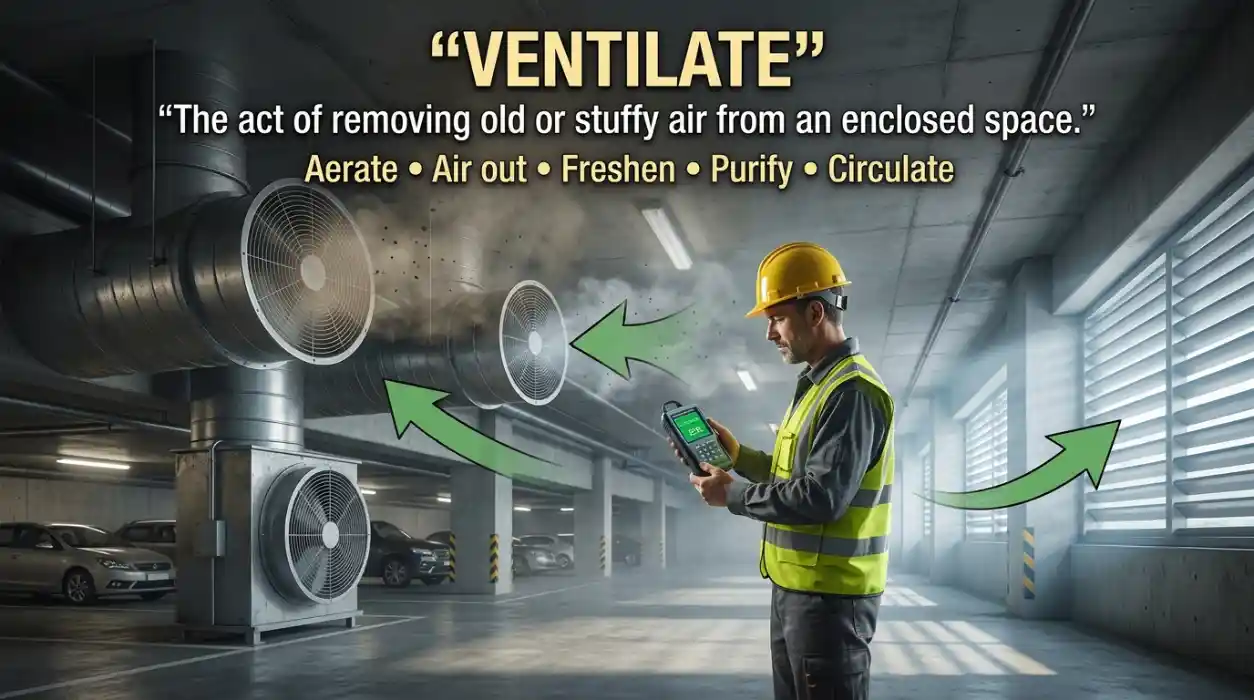
20. Remove Stale Air (Verb Phrase) — US / UK: /rɪˈmuːv steɪl er/ /rɪˈmuːv steɪl eə/
Meaning: To take old or stuffy air out of an enclosed space.
Tone/Register: Everyday, neutral.
Examples:
The fan removes stale air quickly.
Open the door to remove stale air.
21. Extract (Verb) — US / UK: /ɪkˈstrækt/ /ɪkˈstrækt/
Meaning: To remove air, fumes, moisture, or other unwanted material.
Tone/Register: Technical, professional.
Examples:
The extractor removes moisture from the bathroom.
Fans extract cooking fumes.
22. Draw Out (Phrasal Verb) — US / UK: /drɔː aʊt/ /drɔː aʊt/
Meaning: To pull air, fumes, or another substance away from an area.
Tone/Register: Technical, conversational.
Examples:
The hood draws out smoke.
The fan draws out warm air.
23. Blow Through (Phrasal Verb) — US / UK: /bloʊ θruː/ /bləʊ θruː/
Meaning: To move air through an area.
Tone/Register: Informal, descriptive.
Examples:
A cool breeze blew through the house.
Fresh air blew through the open windows.
24. Flow Through (Phrasal Verb) — US / UK: /floʊ θruː/ /fləʊ θruː/
Meaning: To move continuously through an enclosed or defined space.
Tone/Register: Neutral.
Examples:
Air flows through the vents.
Fresh air flowed through the open doorway.
25. Ventilate With Fresh Air (Verb Phrase) — US / UK: /ˈven.tə.leɪt wɪð freʃ er/ /ˈven.tɪ.leɪt wɪð freʃ eə/
Meaning: To use fresh outdoor air to improve conditions inside a space.
Tone/Register: Technical, descriptive.
Examples:
The room was ventilated with fresh air.
They ventilated the greenhouse with outdoor air.
26. Oxygenate (Verb) — US / UK: /ˈɑːksɪdʒəneɪt/ /ˈɒksɪdʒəneɪt/
Meaning: To add or supply oxygen to something.
Tone/Register: Scientific, medical.
Examples:
The treatment helps oxygenate the blood.
Aquatic systems can oxygenate water.
Usage note: This is not a general replacement for ventilate. It fits situations specifically involving oxygen.
27. Respire (Verb) — US / UK: /rɪˈspaɪr/ /rɪˈspaɪə/
Meaning: To breathe or carry out respiration.
Tone/Register: Scientific, formal.
Examples:
The organism respires through specialized structures.
Plants respire throughout their life cycle.
Usage note: Respire describes breathing itself, not ordinary room ventilation.
28. Mechanically Ventilate (Verb Phrase) — US / UK: /məˈkænɪkli ˈven.tə.leɪt/ /məˈkænɪkli ˈven.tɪ.leɪt/
Meaning: To move air using mechanical equipment.
Tone/Register: Engineering, technical.
Examples:
The warehouse is mechanically ventilated.
The system mechanically ventilates the underground area.
29. Assist Breathing (Verb Phrase) — US / UK: /əˈsɪst ˈbriːðɪŋ/ /əˈsɪst ˈbriːðɪŋ/
Meaning: To help a person breathe when natural breathing is inadequate.
Tone/Register: Medical.
Examples:
The machine assists breathing during surgery.
The device can assist breathing in critical situations.
30. Support Respiration (Verb Phrase) — US / UK: /səˈpɔːrt ˌrespəˈreɪʃən/ /səˈpɔːt ˌrespəˈreɪʃən/
Meaning: To help maintain the breathing process.
Tone/Register: Medical, scientific.
Examples:
The machine supports respiration.
The treatment was used to support respiration.
31. Express (Verb) — US / UK: /ɪkˈspres/ /ɪkˈspres/
Meaning: To communicate an opinion, feeling, or concern.
Tone/Register: Neutral, very common.
Examples:
She expressed her concerns during the meeting.
He expressed his frustration calmly.
32. Voice (Verb) — US / UK: /vɔɪs/ /vɔɪs/
Meaning: To express an opinion, concern, or objection openly.
Tone/Register: Neutral, professional.
Examples:
Employees voiced their concerns.
She voiced strong objections to the proposal.
33. Air (Verb, Figurative) — US / UK: /er/ /eə/
Meaning: To express a complaint, grievance, or feeling openly.
Tone/Register: Informal, figurative.
Examples:
He aired his frustrations after the meeting.
She aired her concerns with the manager.
34. Voice Concerns (Verb Phrase) — US / UK: /vɔɪs kənˈsɝːnz/ /vɔɪs kənˈsɜːnz/
Meaning: To communicate worries or objections clearly.
Tone/Register: Professional, neutral.
Examples:
Several workers voiced safety concerns.
She voiced her concerns respectfully.
35. Raise (Verb) — US / UK: /reɪz/ /reɪz/
Meaning: To bring an issue or concern to someone’s attention.
Tone/Register: Neutral, professional.
Examples:
He raised the issue during the meeting.
She raised concerns about the schedule.
36. Present (Verb) — US / UK: /prɪˈzent/ /prɪˈzent/
Meaning: To put forward an issue, argument, or opinion for consideration.
Tone/Register: Formal, academic.
Examples:
The committee presented several concerns.
She presented her argument clearly.
37. State (Verb) — US / UK: /steɪt/ /steɪt/
Meaning: To express an idea or position clearly in words.
Tone/Register: Neutral, formal.
Examples:
He stated his objections clearly.
The report states the main concerns.
38. Articulate (Verb) — US / UK: /ɑːrˈtɪkjəleɪt/ /ɑːˈtɪkjəleɪt/
Meaning: To express an idea, concern, or argument clearly and effectively.
Tone/Register: Formal, academic.
Examples:
She articulated her concerns during the discussion.
The essay articulates a clear position.
39. Communicate (Verb) — US / UK: /kəˈmjuːnəkeɪt/ /kəˈmjuːnɪkeɪt/
Meaning: To share information, opinions, or feelings with others.
Tone/Register: Neutral, professional.
Examples:
He communicated his concerns politely.
The team communicated the problem quickly.
40. Disclose (Verb) — US / UK: /dɪˈskloʊz/ /dɪˈskləʊz/
Meaning: To make information or concerns known, especially information that was previously private.
Tone/Register: Formal, legal, professional.
Examples:
The report disclosed several problems.
She disclosed her concerns to the board.

41. Reveal (Verb) — US / UK: /rɪˈviːl/ /rɪˈviːl/
Meaning: To make something previously hidden or unknown known.
Tone/Register: Neutral.
Examples:
The interview revealed serious concerns.
He revealed his doubts during the discussion.
42. Declare (Verb) — US / UK: /dɪˈkler/ /dɪˈkler/
Meaning: To state something publicly or officially.
Tone/Register: Formal.
Examples:
The organization declared its position.
She declared her opposition to the proposal.
43. Proclaim (Verb) — US / UK: /proʊˈkleɪm/ /prəˈkleɪm/
Meaning: To express something publicly and emphatically.
Tone/Register: Formal, rhetorical.
Examples:
The leader proclaimed support for the reform.
He proclaimed his commitment publicly.
44. Make Known (Verb Phrase) — US / UK: /meɪk noʊn/ /meɪk nəʊn/
Meaning: To communicate information, feelings, or concerns to others.
Tone/Register: Neutral, formal.
Examples:
She made her concerns known.
The workers made their objections known.
45. Put Forward (Phrasal Verb) — US / UK: /pʊt ˈfɔːrwərd/ /pʊt ˈfɔːwəd/
Meaning: To present an idea, argument, concern, or proposal for consideration.
Tone/Register: Professional, academic.
Examples:
He put forward a different explanation.
She put forward several concerns.
46. Bring Up (Phrasal Verb) — US / UK: /brɪŋ ʌp/ /brɪŋ ʌp/
Meaning: To introduce a topic, problem, or concern into a conversation.
Tone/Register: Informal, everyday.
Examples:
I want to bring up one concern.
She brought up the problem during lunch.
47. Discuss (Verb) — US / UK: /dɪˈskʌs/ /dɪˈskʌs/
Meaning: To talk about a subject, issue, or concern with others.
Tone/Register: Neutral, academic, professional.
Examples:
The team discussed the safety issue.
We discussed her concerns privately.
48. Debate (Verb) — US / UK: /dɪˈbeɪt/ /dɪˈbeɪt/
Meaning: To discuss opposing views or arguments in a structured way.
Tone/Register: Academic, formal.
Examples:
The students debated the proposal.
The committee debated several possible solutions.
49. Air Grievances (Verb Phrase) — US / UK: /er ˈɡriːvənsɪz/ /eə ˈɡriːvənsɪz/
Meaning: To openly express complaints or dissatisfaction.
Tone/Register: Formal, figurative.
Examples:
Employees aired their grievances at the meeting.
He used the forum to air his grievances.
50. Vent One’s Feelings (Verb Phrase) — US / UK: /vent wʌnz ˈfiːlɪŋz/ /vent wʌnz ˈfiːlɪŋz/
Meaning: To express strong emotions, frustration, or anger openly.
Tone/Register: Informal, conversational.
Examples:
She needed a friend to vent her feelings to.
He called his brother to vent his frustration.
Synonyms by Tone
Because ventilate has multiple senses, tone depends heavily on what you are describing.
Positive or Neutral
For fresh air and comfortable spaces, these alternatives are generally neutral or positive:
- air
- air out
- freshen
- refresh
- circulate
- provide airflow
- improve airflow
- exchange air
They work well in everyday descriptions.
Technical or Professional
For construction, engineering, science, and medicine, choose:
- aerate
- circulate
- exhaust
- extract
- disperse
- dilute
- exchange air
- mechanically ventilate
- assist breathing
- support respiration
These terms communicate a more specific process.
Formal or Figurative
When ventilate means expressing an issue, alternatives include:
- articulate
- disclose
- declare
- present
- state
- communicate
- voice
- raise
- put forward
- make known
Informal
In everyday speech, the most natural choices are often:
- air out
- air
- open up
- let air in
- bring up
- vent
- freshen
Tone matters because “aerate” sounds technical, while “air out” sounds natural and conversational.
“Ventilate” vs. Close Alternatives
Air Out vs. Ventilate
These are very close when discussing rooms.
Ventilate sounds more technical and can describe a deliberate system or process.
Air out sounds more casual.
We need to ventilate the laboratory.
Let’s air out the bedroom.
Both communicate improved airflow, but the second sounds more natural in casual conversation.
Ventilate vs. Aerate
Aerate usually means introducing air into something such as soil, water, or a liquid.
Ventilate usually refers to moving fresh air through an enclosed space or, in medicine, moving air through the lungs.
We ventilated the office.
We aerated the soil.
Replacing one with the other can change the meaning.
Ventilate vs. Exhaust
Ventilate is broader.
Exhaust emphasizes removing air, fumes, heat, or gases from a particular area.
The building is ventilated naturally.
The fan exhausts hot air.
A ventilation system may use exhaust as one part of the overall airflow process.
How “Ventilate” Changes by Context
Daily Conversation
In ordinary conversation, people often prefer to air out, open the windows, let some air in, or freshen the room.
It’s stuffy in here. Let’s open a window.
This sounds more natural than using the technical verb in every casual situation.
Writing and Blogging
Bloggers can use ventilate when explaining homes, offices, kitchens, greenhouses, cars, or indoor environments.
However, alternatives can make writing more varied.
Open the windows to air out the room.
Fans help circulate fresh air.
Exhaust vents remove warm air.
Each sentence provides a slightly different image.
Professional or Academic English
In engineering, architecture, environmental science, and medicine, ventilate is highly useful.
Technical writing may distinguish between:
- ventilation
- air exchange
- exhaust
- airflow
- extraction
- mechanical ventilation
Precision matters more than simply finding a synonym.
Creative or Informal Use
Creative writing can use sensory language.
A cold breeze moved through the room.
Instead of saying:
The room was ventilated.
The first sentence creates a stronger image.
Common Mistakes Learners Make
Mistake 1: Using “Vent” and “Ventilate” as Identical Words
They are related but grammatically different.
Vent can be a noun:
The kitchen has a small vent.
It can also be a verb:
The pipe vents steam.
Ventilate usually describes the broader process of creating or maintaining airflow.
Mistake 2: Confusing “Ventilate” With “Vent”
A vent is often an opening or device.
Ventilate is the action or process.
The building has several vents.
The vents help ventilate the building.
Mistake 3: Using “Aerate” for Every Airflow Situation
Aerate is more specific.
You can aerate soil, water, or certain materials.
You would normally say:
Ventilate the room.
rather than:
Aerate the room.
Mistake 4: Confusing “Ventilate” With “Exhaust”
Exhaust focuses on removing air or fumes.
Ventilation can involve both introducing fresh air and removing stale air.
Mistake 5: Forgetting the Figurative Meaning
In formal English, ventilate can mean to express a grievance or issue for discussion.
However, this use is less common in modern everyday conversation.
A learner may encounter it in formal writing and mistakenly assume it refers only to airflow.
Mistake 6: Saying “Ventilate Air”
Usually, the object is a room, building, area, or space, not simply “air.”
Natural:
Ventilate the room.
Less natural:
Ventilate the air.
Native Usage Notes
Native speakers commonly use ventilate in technical and practical contexts.
In casual speech, air out is often more natural.
Compare:
We need to ventilate the room.
We need to air out the room.
Both are correct. The second sounds more conversational.
For medical writing, ventilate has a specialized meaning and should not casually be replaced with “breathe.”
For formal discussions, ventilate a grievance is grammatical but somewhat formal. Everyday speakers are more likely to say raise a concern, voice a complaint, or express frustration.
For related vocabulary practice, an internal article about synonyms for “circulate” would complement this topic naturally.
Real-Life Mini Scenarios
Workplace
A meeting room feels stuffy after several hours.
The manager opened the windows to ventilate the room.
A casual alternative:
The manager opened the windows to air out the room.
Home
After frying food, the kitchen smells strongly.
We turned on the extractor to remove the fumes.
Or:
We opened the windows to freshen the kitchen.
Medical Setting
A patient cannot breathe adequately without mechanical assistance.
The patient was mechanically ventilated.
Here, ordinary alternatives such as “air out” would obviously be inappropriate.
Greenhouse
Plants need adequate air movement.
Fans help circulate air through the greenhouse.
Here, circulate describes the movement rather than the entire ventilation process.
Workplace Discussion
An employee wants to discuss a problem.
She raised her concerns during the meeting.
In formal prose, you might encounter:
She ventilated her grievances during the meeting.
The second sentence is grammatical but considerably more formal.
Quick Word-Choice Guide
- Choose air when you mean exposing something to fresh air.
- Choose air out for casual conversations about rooms.
- Choose aerate for adding air to soil, water, or another material.
- Choose circulate when the focus is air movement.
- Choose exhaust when the focus is removing fumes, heat, or stale air.
- Choose extract when air or moisture is being mechanically removed.
- Choose freshen when the goal is making a room feel or smell fresher.
- Choose vent when referring to an opening or a way for air or gas to escape.
- Choose raise, voice, or express when ventilate means discussing a concern.
- Choose mechanically ventilate or assist breathing for the specialized medical sense.

Practice Exercise
1. Your bedroom feels stuffy, so you open the windows.
A. Air out
B. Debate
C. Declare
D. Proclaim
2. A gardener adds air to compacted soil.
A. Aerate
B. Exhaust
C. Vent
D. Disclose
3. A fan moves cool air around an office.
A. Circulate
B. Declare
C. Raise
D. Reveal
4. A kitchen fan removes cooking fumes.
A. Exhaust
B. Articulate
C. Discuss
D. Present
5. A patient needs machine-assisted breathing.
A. Mechanically ventilate
B. Air out
C. Freshen
D. Open up
6. An employee brings a safety concern to management.
A. Raise
B. Aerate
C. Refresh
D. Dilute
7. Someone expresses frustration to a close friend.
A. Vent
B. Extract
C. Circulate
D. Oxygenate
8. A building system replaces indoor air with outdoor air.
A. Exchange air
B. Debate
C. Proclaim
D. State
9. A bathroom fan removes moisture.
A. Extract
B. Articulate
C. Present
D. Voice
10. A writer clearly expresses a complicated argument.
A. Articulate
B. Air out
C. Vent
D. Exhaust
11. You want a casual way to say “ventilate the room.”
A. Air out the room
B. Declare the room
C. Debate the room
D. Disclose the room
12. A company formally communicates its concerns.
A. Voice its concerns
B. Freshen its concerns
C. Aerate its concerns
D. Circulate its concerns
Reflection Task
Write one sentence using ventilate. Then rewrite it using the most natural synonym you can find. Ask yourself whether your new word sounds more casual, technical, or formal.
Answer key: 1-A, 2-A, 3-A, 4-A, 5-A, 6-A, 7-A, 8-A, 9-A, 10-A, 11-A, 12-A
External reference sources
- Cambridge Dictionary — ventilate — definitions, pronunciation, medical usage, and figurative usage.
- Cambridge Dictionary — ventilated — usage for spaces and medical contexts.
- Cambridge Dictionary — ventilation — related noun and technical meaning.
- Etymonline — ventilate and its history — etymology and historical development.
- Etymonline — hyperventilate — related medical terminology and word formation.
Conclusion
The best synonym for ventilate depends on your meaning. Use air out for casual speech, circulate for moving air, and exhaust when removing fumes or heat.
For technical writing, words such as aerate, extract, exchange air, and mechanically ventilate offer useful precision. For complaints, voice, raise, or express sound more natural.
Learning these distinctions strengthens vocabulary without making your English sound forced. Precise synonyms improve essays, blogs, workplace writing, and everyday communication.
Practice by rewriting a few sentences with different alternatives. Try them in an email, essay, or conversation and notice how each word changes the tone.
FAQs
1. What is the best synonym for ventilate a room?
The most natural alternatives are air out, air, freshen, circulate air, and improve airflow. For casual conversation, “air out the room” is especially natural. In technical writing, “ventilate the room” or “provide adequate airflow” may be more precise.
2. What is another word for ventilate in construction?
In construction and building science, useful alternatives include provide airflow, exchange air, circulate air, exhaust, extract, and mechanically ventilate. The correct term depends on the process. “Exhaust” emphasizes removing air, while “ventilate” describes the broader management of indoor airflow.
3. Is air out a synonym for ventilate?
Yes, when discussing rooms or enclosed spaces. Air out is an informal phrasal verb meaning to allow fresh air into a space. It is especially natural in everyday conversation. “Ventilate” sounds more technical and is common in construction, engineering, safety instructions, and formal writing.
4. What is the difference between ventilate and aerate?
Ventilate usually refers to moving fresh air through an enclosed space or, in medicine, supporting breathing. Aerate means introducing air into something such as soil, water, or another material. Therefore, you normally ventilate a room but aerate soil.
5. What is a synonym for ventilate when discussing complaints?
When ventilate means expressing complaints or concerns, alternatives include voice, raise, express, air, articulate, disclose, discuss, and make known. For example, “She voiced her concerns” sounds natural and professional. “She ventilated her grievances” is grammatical but more formal and less common in everyday speech.

Hasnain Ali is an SEO Content Strategist and the founder of wordvora.com, a trusted vocabulary platform that helps writers, students, professionals, and English learners find accurate synonyms, antonyms, word meanings, and real-life usage examples. He specializes in keyword research, on-page SEO, topical authority, and creating search-first content that aligns with Google’s latest Search Quality and E-E-A-T guidelines. His work focuses on producing clear, well-structured, and reader-friendly resources that satisfy search intent while maintaining high editorial standards.
Through extensive hands-on experience with SEO tools such as Google Search Console, Google Analytics, SEMrush, and Ahrefs, Hasnain researches user search behavior and develops content that is both informative and easy to understand. Every article published on wordvora.com is carefully reviewed for accuracy, readability, and contextual relevance before publication. His mission is to build one of the web’s most reliable English vocabulary resources by providing practical language guidance, trustworthy explanations, and content that helps readers improve their writing, communication, and vocabulary with confidence.