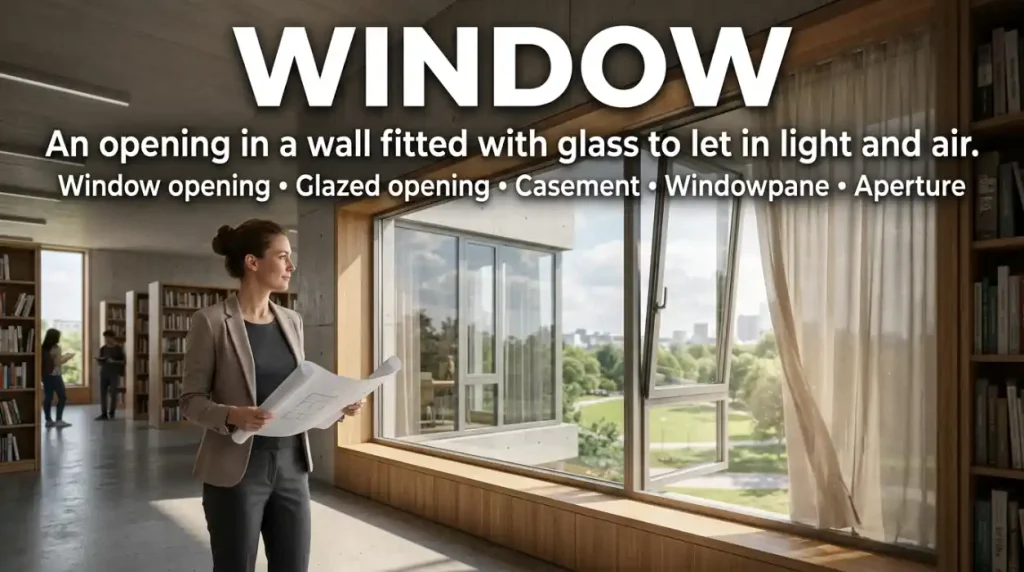
Synonym for window can include opening, aperture, pane, windowpane, casement, glazing, skylight, viewport, or portal, depending on context. Figuratively, alternatives include opportunity, opening, interval, and timeframe.
You look through a bedroom window and suddenly notice the first rain of the season. The word “window” works perfectly, but another term can make your description more precise.
Synonym for window searches are common because “window” has several meanings. It can refer to glass, an opening, a computer screen, or a limited period of time.
Learning alternatives helps students avoid repetition and gives bloggers and content writers more precise vocabulary. Daily speakers also gain confidence when choosing the right word.
A strong synonym for window depends on context. “Pane” suits glass, “aperture” sounds technical, and “opportunity” works when “window” means a brief chance.
What Does “Window” Really Mean?
A window is usually an opening in a wall, roof, vehicle, or other structure that allows light or air to enter and lets people see through it.
The word also has broader meanings.
In computing, a window is an area on a screen where a program, document, or information appears. Oxford also records figurative uses in which a window means a way of seeing or learning about something, or a limited period when an opportunity exists.
Simple Definition
Window: an opening, usually covered with glass, that lets in light and allows people to see through it.
Part of Speech
The main part of speech is a noun.
Examples:
- “Please open the window.”
- “The window is broken.”
- “A new browser window appeared.”
- “We have a short window to finish the work.”
The related adjective is windowed, while compounds include windowpane, window frame, window seat, shop window, and window display.
How Native Speakers Understand “Window”
Native speakers usually understand “window” from context.
In technology, it usually means an area displayed on a computer screen.
In expressions such as “a window of opportunity,” it means a limited period when something can happen.
That flexibility makes “window” a particularly useful English word.
Connotative Meaning
Connotation (the feeling, association, or implied meaning connected with a word beyond its basic dictionary definition) depends heavily on context.
Positive Tone
A window can suggest light, freedom, openness, beauty, possibility, and connection.
“The large window filled the room with morning light.”
The image feels bright and welcoming.
Negative Tone
A window can also suggest exposure, vulnerability, limitation, or separation.
“The broken window left the room exposed.”
The emotional effect comes from the situation rather than from the word itself.
Neutral Tone
Most uses are neutral.
“The office has three windows.”
Here, “window” simply identifies a physical feature.
Etymology
The history of window is particularly interesting because the modern word did not originate from Old English.
The word comes from Old Norse vindauga, literally meaning “wind eye.” It combines vindr, meaning “wind,” with auga, meaning “eye.” Etymonline dates the English noun to around 1200.
Old English: 450–1100
Old English did not use the modern word “window.”
Instead, expressions such as eagþyrl, literally “eye-hole,” and eagduru, literally “eye-door,” referred to openings that admitted light or air.
These terms show an early conceptual connection between an opening and an eye.
Middle English: 1100–1500
Around 1200, forms related to Old Norse vindauga entered English.
The word essentially described an “eye for the wind.” At first, a window could simply be an opening rather than the glass-filled structure familiar today.
Modern English: 1500–Present
Over time, window became the standard English word for an opening fitted with a frame and, increasingly, glass.
The word later developed figurative meanings and technical uses. The computing sense of a window as a display area emerged in the twentieth century.

Pronunciation
US: /ˈwɪn.doʊ/
UK: /ˈwɪn.dəʊ/
Cambridge gives these pronunciations for American and British English.
Syllables
win-dow
The word has two syllables.
Affixation Pattern of “Window”
Root: Historically from Old Norse vindauga
Prefix: None in modern English
Suffix: None in modern English
“Window” is a historical compound rather than a modern English word formed with a productive prefix or suffix.
Synonyms List
The following list deliberately distinguishes between true alternatives and context-specific terms. For example, “pane” means the glass portion of a window, while “aperture” means an opening and may not contain glass.
1. Opening (Noun) — US /ˈoʊ.pən.ɪŋ/ | UK /ˈəʊ.pən.ɪŋ/
Meaning: A space or hole in a wall, roof, or structure that may serve the function of a window.
Tone/Register: Neutral, everyday.
Examples:
“Light entered through a small opening in the wall.”
“The builder enlarged the opening.”
2. Aperture (Noun) — US /ˈæp.ɚ.tʃɚ/ | UK /ˈæp.ə.tʃə/
Meaning: A technical term for an opening through which light or another substance can pass.
Tone/Register: Formal, technical, academic.
Examples:
“The camera has a wide aperture.”
“The architect designed a narrow wall aperture.”
3. Fenestra (Noun) — US /fəˈnes.trə/ | UK /fəˈnes.trə/
Meaning: A technical or anatomical term for an opening or window-like structure.
Tone/Register: Technical, medical, architectural.
Examples:
“The report describes a small fenestra in the structure.”
“The anatomical fenestra allows passage between two spaces.”
4. Pane (Noun) — US /peɪn/ | UK /peɪn/
Meaning: A single section of glass within a window.
Tone/Register: Neutral, everyday.
Examples:
“One pane was cracked during the storm.”
“She cleaned every pane before the guests arrived.”
5. Windowpane (Noun) — US /ˈwɪn.doʊˌpeɪn/ | UK /ˈwɪn.dəʊˌpeɪn/
Meaning: The sheet or section of glass fitted into a window.
Tone/Register: Neutral, descriptive.
Examples:
“Rain tapped against the windowpane.”
“The old windowpane had a small crack.”
6. Glazing (Noun) — US /ˈɡleɪ.zɪŋ/ | UK /ˈɡleɪ.zɪŋ/
Meaning: Glass fitted into a window or the process of fitting glass.
Tone/Register: Technical, architectural.
Examples:
“The building uses energy-efficient glazing.”
“The new glazing improves natural light.”
7. Glazed Opening (Noun Phrase) — US /ɡleɪzd ˈoʊ.pən.ɪŋ/ | UK /ɡleɪzd ˈəʊ.pən.ɪŋ/
Meaning: An opening fitted with glass.
Tone/Register: Architectural, formal.
Examples:
“The wall contains a large glazed opening.”
“The glazed opening faces the garden.”
8. Casement (Noun) — US /ˈkeɪs.mənt/ | UK /ˈkeɪs.mənt/
Meaning: A window whose frame is attached to the side so it opens outward or inward.
Tone/Register: Architectural, traditional.
Examples:
“The cottage has wooden casement windows.”
“She opened the casement to let in fresh air.”
9. Skylight (Noun) — US /ˈskaɪ.laɪt/ | UK /ˈskaɪ.laɪt/
Meaning: A window installed in a roof or ceiling.
Tone/Register: Neutral, architectural.
Examples:
“The skylight brightens the kitchen.”
“We could see the stars through the skylight.”
10. Rooflight (Noun) — US /ˈruːf.laɪt/ | UK /ˈruːf.laɪt/
Meaning: A window or glazed opening built into a roof.
Tone/Register: British, architectural.
Examples:
“The rooflight brings daylight into the hallway.”
“The old rooflight needs cleaning.”
11. Viewport (Noun) — US /ˈvjuː.pɔːrt/ | UK /ˈvjuː.pɔːt/
Meaning: A small opening or designated area through which something can be viewed.
Tone/Register: Technical, professional.
Examples:
“The spacecraft has a small viewport.”
“The interface displays the image inside the viewport.”
12. Porthole (Noun) — US /ˈpɔːrt.hoʊl/ | UK /ˈpɔːt.həʊl/
Meaning: A small round window, especially on a ship, aircraft, or similar vehicle.
Tone/Register: Neutral, nautical.
Examples:
“She looked through the porthole at the sea.”
“The cabin has two small portholes.”
13. Windscreen (Noun) — US /ˈwɪnd.skriːn/ | UK /ˈwɪnd.skriːn/
Meaning: The front glass of a vehicle; American English usually uses “windshield.”
Tone/Register: British, automotive.
Examples:
“The windscreen was covered in rain.”
“He cleaned the windscreen before driving.”
14. Windshield (Noun) — US /ˈwɪnd.ʃiːld/ | UK /ˈwɪnd.ʃiːld/
Meaning: The front glass of a vehicle that protects occupants from wind and debris.
Tone/Register: American, automotive.
Examples:
“A leaf landed on the windshield.”
“The cracked windshield needs attention.”
15. Storefront (Noun) — US /ˈstɔːr.frʌnt/ | UK /ˈstɔː.frʌnt/
Meaning: The front part of a shop, often including large windows for displaying goods.
Tone/Register: Business, architectural.
Examples:
“The new storefront looks modern.”
“Large windows make the storefront inviting.”
16. Shop Window (Noun Phrase) — US /ˈʃɑːp ˌwɪn.doʊ/ | UK /ˈʃɒp ˌwɪn.dəʊ/
Meaning: The glass-fronted area of a shop where products are displayed.
Tone/Register: British, everyday.
Examples:
“The dress looked beautiful in the shop window.”
“She stopped to admire the shop window.”
17. Store Window (Noun Phrase) — US /ˈstɔːr ˌwɪn.doʊ/ | UK /ˈstɔː ˌwɪn.dəʊ/
Meaning: A shop window, especially common in North American English.
Tone/Register: American, commercial.
Examples:
“The store window featured a colorful display.”
“I noticed the shoes in the store window.”
18. Display Window (Noun Phrase) — US /dɪˈspleɪ ˌwɪn.doʊ/ | UK /dɪˈspleɪ ˌwɪn.dəʊ/
Meaning: A window used to display products or information.
Tone/Register: Business, retail.
Examples:
“The display window changes every month.”
“The new display window attracted attention.”
19. Picture Window (Noun Phrase) — US /ˈpɪk.tʃɚ ˌwɪn.doʊ/ | UK /ˈpɪk.tʃə ˌwɪn.dəʊ/
Meaning: A large window designed to provide a broad view.
Tone/Register: Neutral, residential.
Examples:
“The living room has a huge picture window.”
“We enjoy the garden view through the picture window.”
20. Bay Window (Noun Phrase) — US /ˈbeɪ ˌwɪn.doʊ/ | UK /ˈbeɪ ˌwɪn.dəʊ/
Meaning: A window that projects outward from the wall of a building.
Tone/Register: Architectural, everyday.
Examples:
“The house has a charming bay window.”
“She placed cushions beneath the bay window.”
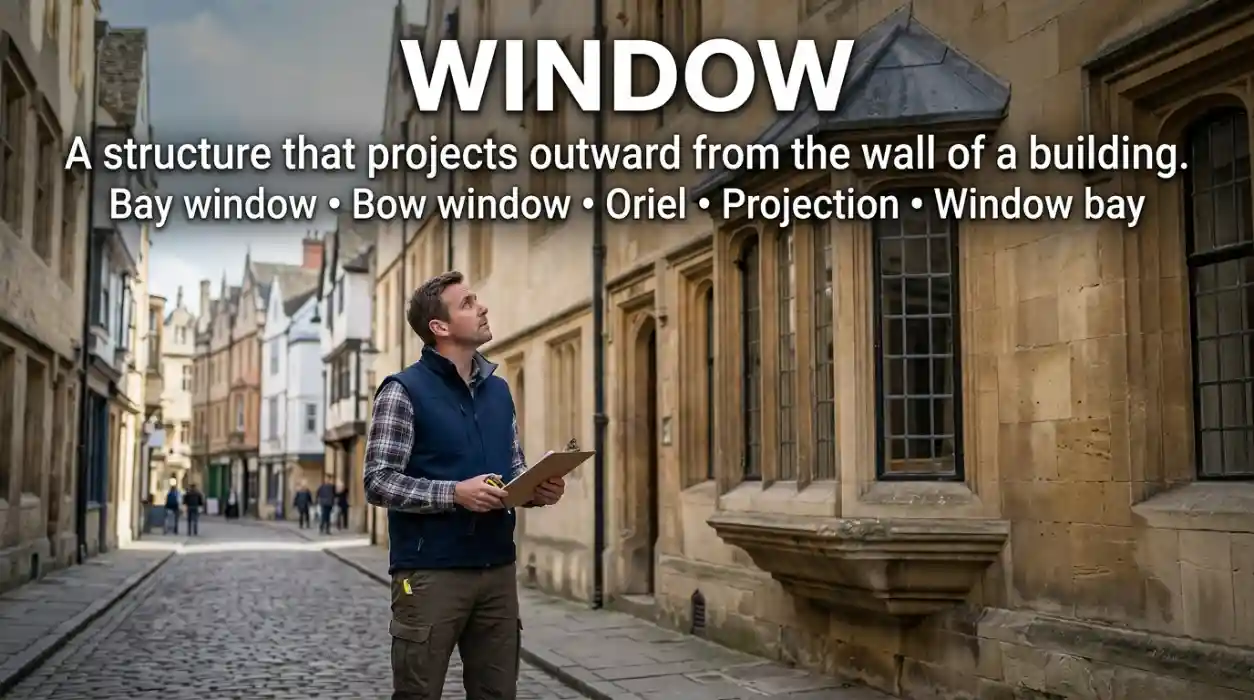
21. Bow Window (Noun Phrase) — US /ˈboʊ ˌwɪn.doʊ/ | UK /ˈbəʊ ˌwɪn.dəʊ/
Meaning: A curved projection made from several windows.
Tone/Register: Architectural.
Examples:
“The dining room has a graceful bow window.”
“The bow window creates extra space.”
22. Dormer (Noun) — US /ˈdɔːr.mɚ/ | UK /ˈdɔː.mə/
Meaning: A roof structure containing a window.
Tone/Register: Architectural.
Examples:
“The attic has a small dormer.”
“Sunlight enters through the dormer.”
23. Hatch (Noun) — US /hætʃ/ | UK /hætʃ/
Meaning: A small opening or access panel, sometimes containing glass or serving a window-like function.
Tone/Register: Technical, practical.
Examples:
“The boat has a small hatch.”
“Open the hatch to improve ventilation.”
24. Vision Panel (Noun Phrase) — US /ˈvɪʒ.ən ˌpæn.əl/ | UK /ˈvɪʒ.ən ˌpæn.əl/
Meaning: A small transparent section in a door or wall that allows people to see through.
Tone/Register: Professional, architectural.
Examples:
“The classroom door has a vision panel.”
“The vision panel improves visibility.”
25. Viewing Panel (Noun Phrase) — US /ˈvjuː.ɪŋ ˌpæn.əl/ | UK /ˈvjuː.ɪŋ ˌpæn.əl/
Meaning: A transparent or open section designed for viewing.
Tone/Register: Technical, neutral.
Examples:
“The viewing panel lets visitors observe the process.”
“The machine has a clear viewing panel.”
26. Observation Window (Noun Phrase) — US /ˌɑːb.zɚˈveɪ.ʃən ˌwɪn.doʊ/ | UK /ˌɒb.zəˈveɪ.ʃən ˌwɪn.dəʊ/
Meaning: A window designed specifically for watching or observing something.
Tone/Register: Formal, technical.
Examples:
“The laboratory has an observation window.”
“Visitors watched through the observation window.”
27. Service Window (Noun Phrase) — US /ˈsɝː.vɪs ˌwɪn.doʊ/ | UK /ˈsɜː.vɪs ˌwɪn.dəʊ/
Meaning: An opening where staff serve customers or exchange items.
Tone/Register: Business, everyday.
Examples:
“Please collect your order at the service window.”
“The ticket service window closes at six.”
28. Ticket Window (Noun Phrase) — US /ˈtɪk.ɪt ˌwɪn.doʊ/ | UK /ˈtɪk.ɪt ˌwɪn.dəʊ/
Meaning: A window where tickets are sold or collected.
Tone/Register: Everyday, public-service.
Examples:
“We bought our tickets at the ticket window.”
“The ticket window opens at noon.”
29. Box-Office Window (Noun Phrase) — US /ˈbɑːks ˌɔː.fɪs ˌwɪn.doʊ/ | UK /ˈbɒks ˌɒf.ɪs ˌwɪn.dəʊ/
Meaning: A window where tickets for entertainment events are sold.
Tone/Register: Entertainment, neutral.
Examples:
“The box-office window opened before the show.”
“She collected the tickets from the box-office window.”
30. Counter Window (Noun Phrase) — US /ˈkaʊn.tɚ ˌwɪn.doʊ/ | UK /ˈkaʊn.tə ˌwɪn.dəʊ/
Meaning: An opening at a counter through which people receive service.
Tone/Register: Everyday, business.
Examples:
“Please speak to someone at the counter window.”
“The clerk stood behind the counter window.”
31. Browser Window (Noun Phrase) — US /ˈbraʊ.zɚ ˌwɪn.doʊ/ | UK /ˈbraʊ.zə ˌwɪn.dəʊ/
Meaning: A window on a computer screen containing a web browser.
Tone/Register: Technical, digital.
Examples:
“Open the page in a new browser window.”
“I accidentally closed the browser window.”
32. Dialog Box (Noun Phrase) — US /ˈdaɪ.ə.lɔːɡ bɑːks/ | UK /ˈdaɪ.ə.lɒɡ bɒks/
Meaning: A small interface area that asks for information or displays a message.
Tone/Register: Technical, computing.
Examples:
“A dialog box appeared on the screen.”
“Enter your details in the dialog box.”
33. Display (Noun) — US /dɪˈspleɪ/ | UK /dɪˈspleɪ/
Meaning: A visible area where digital information is presented; it can overlap with the computing sense of “window.”
Tone/Register: Technical, general.
Examples:
“The information appeared on the display.”
“Move the display to another screen.”
34. Panel (Noun) — US /ˈpæn.əl/ | UK /ˈpæn.əl/
Meaning: A defined section of a screen or interface that can perform a function similar to a window.
Tone/Register: Technical, professional.
Examples:
“Open the settings panel.”
“The navigation panel is on the left.”
35. Viewport (Noun) — US /ˈvjuː.pɔːrt/ | UK /ˈvjuː.pɔːt/
Meaning: The visible portion of a digital document, webpage, image, or graphical environment.
Tone/Register: Technical, computing.
Examples:
“The image extends beyond the viewport.”
“Adjust the viewport to see the entire design.”
36. Screen Area (Noun Phrase) — US /ˈskriːn ˌer.i.ə/ | UK /ˈskriːn ˌeə.ri.ə/
Meaning: A defined part of a computer or device screen.
Tone/Register: Technical, accessible.
Examples:
“The program uses a small screen area.”
“Move the panel to another screen area.”
37. Viewing Area (Noun Phrase) — US /ˈvjuː.ɪŋ ˌer.i.ə/ | UK /ˈvjuː.ɪŋ ˌeə.ri.ə/
Meaning: A space through which something can be viewed.
Tone/Register: Neutral, technical.
Examples:
“The viewing area is large enough for two people.”
“Keep the viewing area clear.”
38. View (Noun) — US /vjuː/ | UK /vjuː/
Meaning: In figurative or interface contexts, a view can mean what is visible through or within a window.
Tone/Register: Neutral, technical.
Examples:
“The new view shows the full document.”
“The window gives us a beautiful view.”
39. Outlook (Noun) — US /ˈaʊt.lʊk/ | UK /ˈaʊt.lʊk/
Meaning: A view or perspective, sometimes connected figuratively with what can be seen through a window.
Tone/Register: Formal, figurative.
Examples:
“The room has a wonderful outlook.”
“The mountain outlook is breathtaking.”
40. Perspective (Noun) — US /pɚˈspek.tɪv/ | UK /pəˈspek.tɪv/
Meaning: A particular way of viewing or understanding something.
Tone/Register: Academic, formal, figurative.
Examples:
“The documentary gives us a new perspective.”
“Travel can offer a different perspective on culture.”
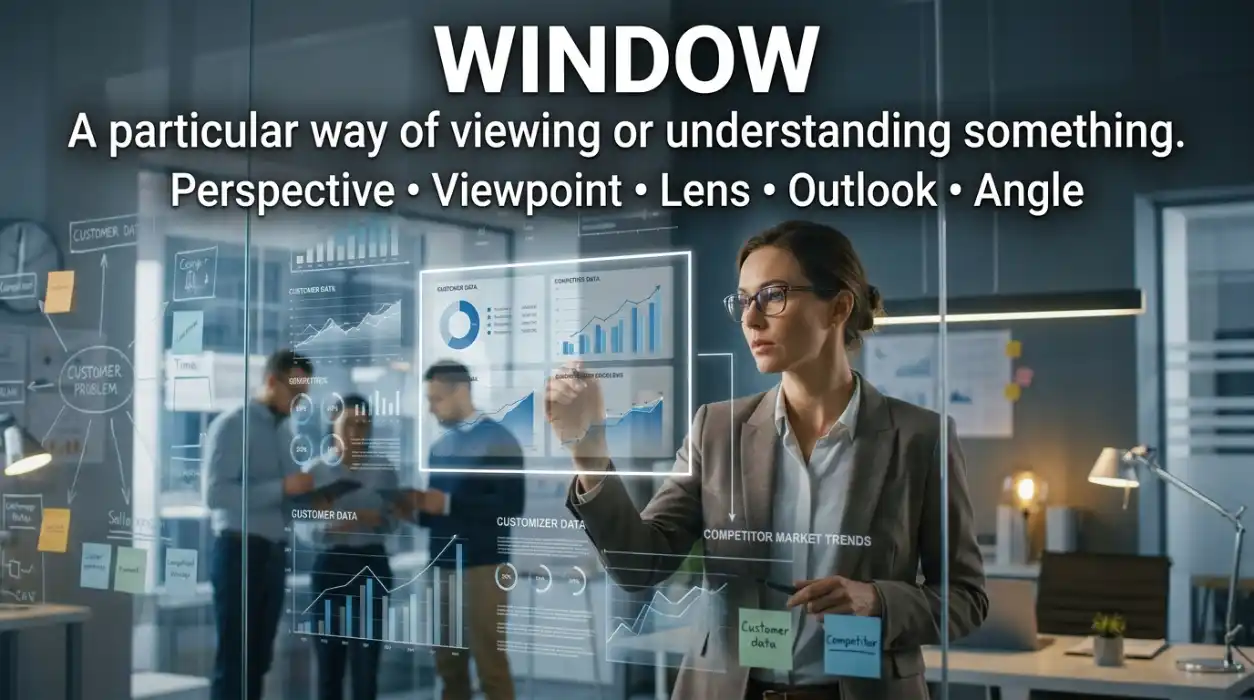
41. Lens (Noun) — US /lenz/ | UK /lenz/
Meaning: A figurative means of viewing, understanding, or interpreting something.
Tone/Register: Academic, figurative.
Examples:
“History provides a useful lens for understanding the event.”
“She examines the issue through a social lens.”
42. Gateway (Noun) — US /ˈɡeɪt.weɪ/ | UK /ˈɡeɪt.weɪ/
Meaning: A figurative entrance to knowledge, experience, or another area.
Tone/Register: Figurative, neutral to formal.
Examples:
“Books can be a gateway to new ideas.”
“The museum became a gateway to local history.”
43. Opportunity (Noun) — US /ˌɑː.pɚˈtuː.nə.t̬i/ | UK /ˌɒp.əˈtʃuː.nə.ti/
Meaning: A favorable chance, especially when “window” refers to a window of opportunity.
Tone/Register: Neutral, professional.
Examples:
“This internship is a valuable opportunity.”
“We finally have an opportunity to make changes.”
44. Chance (Noun) — US /tʃæns/ | UK /tʃɑːns/
Meaning: A possibility or opportunity to do something.
Tone/Register: Everyday.
Examples:
“We have one last chance to catch the train.”
“Give me a chance to explain.”
45. Opening (Noun) — US /ˈoʊ.pən.ɪŋ/ | UK /ˈəʊ.pən.ɪŋ/
Meaning: A favorable opportunity or available space, especially in figurative contexts.
Tone/Register: Neutral, professional.
Examples:
“There is an opening for a new approach.”
“The meeting created an opening for discussion.”
46. Interval (Noun) — US /ˈɪn.t̬ɚ.vəl/ | UK /ˈɪn.tə.vəl/
Meaning: A limited period between two events, sometimes replacing “window” when time is the main idea.
Tone/Register: Formal, academic.
Examples:
“Use the interval to review your notes.”
“We have a short interval before the next session.”
47. Timeframe (Noun) — US /ˈtaɪm.freɪm/ | UK /ˈtaɪm.freɪm/
Meaning: A period during which an action or event is expected to occur.
Tone/Register: Professional, business.
Examples:
“We have a narrow timeframe for completion.”
“The team agreed on a realistic timeframe.”
48. Time Slot (Noun Phrase) — US /ˈtaɪm slɑːt/ | UK /ˈtaɪm slɒt/
Meaning: A particular period available for an activity.
Tone/Register: Everyday, professional.
Examples:
“I found a free time slot tomorrow.”
“Can we book a later time slot?”
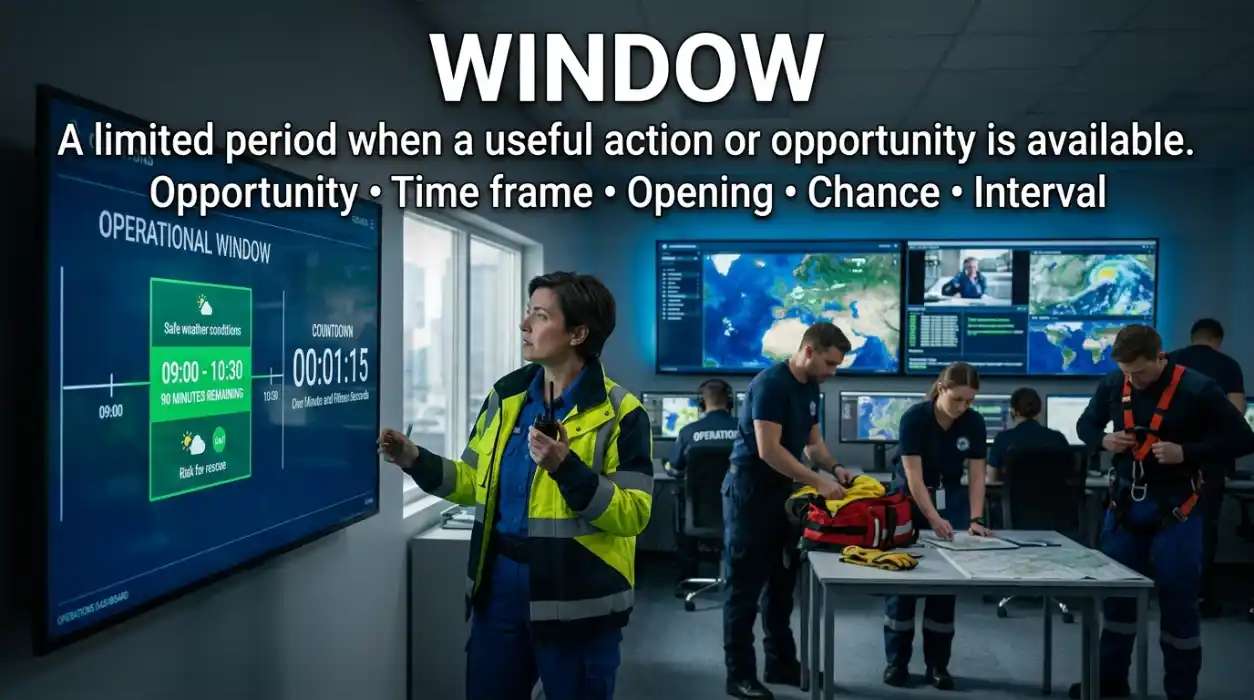
49. Window of Opportunity (Noun Phrase) — US /ˈwɪn.doʊ əv ˌɑː.pɚˈtuː.nə.t̬i/ | UK /ˈwɪn.dəʊ əv ˌɒp.əˈtʃuː.nə.ti/
Meaning: A limited period when a useful action or opportunity is available.
Tone/Register: Professional, figurative.
Examples:
“We have a small window of opportunity.”
“The team acted quickly during the window of opportunity.”
50. Launch Window (Noun Phrase) — US /ˈlɔːntʃ ˌwɪn.doʊ/ | UK /ˈlɔːntʃ ˌwɪn.dəʊ/
Meaning: A specific period during which a launch can take place.
Tone/Register: Technical, aerospace, professional.
Examples:
“The mission has a short launch window.”
“Bad weather could close the launch window.”
Synonyms by Tone
Positive or Welcoming
Some alternatives create a feeling of openness or possibility:
- gateway
- opportunity
- chance
- outlook
- view
- picture window
These words often suggest access, beauty, possibility, or discovery.
Neutral
The most neutral choices include:
- window
- opening
- pane
- windowpane
- glazing
- viewport
- display
- panel
- screen area
- viewing area
These terms focus mainly on function.
Formal or Technical
Use these in professional or academic contexts:
- aperture
- fenestra
- glazed opening
- viewport
- observation window
- rooflight
- glazing
- timeframe
- interval
- launch window
They provide precision but may sound unnecessarily technical in casual speech.
Informal
Everyday alternatives include:
- opening
- chance
- view
- shop window
- storefront
- time slot
The right choice depends strongly on the meaning.
Why Tone Matters
Compare:
“There is an aperture in the wall.”
This sounds technical.
“There is an opening in the wall.”
This sounds ordinary.
“There is a window in the wall.”
This is the most natural choice when the opening is specifically a window.
Similarly:
“We have a timeframe.”
sounds professional, while:
“We have a short window.”
sounds natural in both business and everyday conversation.
“Window” vs Close Alternatives
Pane vs Window
A window is the complete feature.
A pane is one piece or section of glass within it.
You can say:
“The window is broken.”
You can also say:
“One pane of the window is broken.”
The second sentence is more specific.
Window vs Opening
An opening is broader.
Every window can be an opening, but not every opening is a window.
A doorway is an opening. A ventilation gap is an opening. A window is a particular type of opening.
Window vs Opportunity
These are only related in the figurative expression “window of opportunity.”
When “window” means a limited period, “opportunity,” “chance,” “timeframe,” or “time slot” may work depending on the sentence.
How “Window” Changes by Context
Daily Conversation
“Window” is the natural choice for ordinary household situations.
“Please close the window.”
“Can you open the kitchen window?”
Native speakers usually do not replace “window” with a technical word unless the context requires precision.
Writing and Blogging
Writers can vary vocabulary when the context changes.
For architecture, use:
- glazing
- casement
- aperture
- rooflight
- picture window
For retail, use:
- shop window
- storefront
- display window
Professional or Academic English
Technical writing benefits from exact terminology.
An architect might discuss glazing.
A software developer might discuss a viewport.
A researcher might describe a timeframe.
A historian might use perspective or lens figuratively.
Precision matters more than simply finding a different word.
Creative or Informal Use
Creative writers can use “window” metaphorically.
For example:
“The old library was a window into another world.”
A more formal version could use:
“The old library provided access to another cultural perspective.”
The first feels more vivid. The second sounds more analytical.
Common Mistakes Learners Make
Mistake 1: Calling a pane a complete window
A pane is only the glass section.
Less precise:
“The pane needs a new frame.”
Better:
“The window needs a new frame.”
Or:
“The pane needs replacing.”
Mistake 2: Using “aperture” in casual conversation
“Aperture” is correct in technical contexts, but it can sound overly formal.
Instead of:
“Please close the aperture.”
A native speaker would normally say:
“Please close the window.”
Mistake 3: Confusing “shop window” and “storefront”
A shop window is specifically the display area behind glass.
A storefront can include the entire front of a business, including doors, signs, walls, and windows.
Mistake 4: Treating “opportunity” as a physical synonym
“Opportunity” replaces “window” only when the meaning is figurative.
You cannot normally replace:
“Open the window.”
with:
“Open the opportunity.”
Mistake 5: Using “viewport” for a house
“Viewport” belongs mainly to technical, digital, marine, aerospace, or specialized contexts.
For an ordinary house, “window” remains the natural word.
Mistake 6: Overusing synonyms
Good writing does not replace every occurrence of “window.”
If the subject is actually windows, repeating “window” naturally is better than forcing unfamiliar vocabulary.
Register Notes
Everyday: window, opening, pane, chance, view
Professional: glazing, rooflight, observation window, timeframe
Academic: aperture, perspective, lens, interval
Architectural: casement, fenestra, bay window, bow window, picture window
Computing: browser window, viewport, dialog box, panel
Figurative: gateway, lens, perspective, opportunity, opening
Real-Life Mini Scenarios
Workplace
A manager says:
“We have a short window to finish the project.”
Here, window means a limited period.
In a formal report, timeframe may sound more precise.
Social Situation
Someone visiting a new apartment might say:
“I love the big windows.”
A more descriptive sentence could mention a picture window if the window is especially large and designed to provide a broad view.
Media and Pop Culture
A technology article may explain how a new app opens in a browser window.
A documentary about architecture may discuss glazing, casements, and rooflights.
Writing and Storytelling
A novelist might write:
“Moonlight spilled through the window.”
The word “window” is better than “aperture” because the scene is emotional and visual.
Practice Exercise
1. You mean one piece of glass in a window.
A. Pane
B. Gateway
C. Timeframe
D. Outlook
2. An architect describes a technical opening in a wall.
A. Chance
B. Aperture
C. Browser window
D. Storefront
3. A large window provides a wide garden view.
A. Picture window
B. Dialog box
C. Time slot
D. Fenestra
4. You are discussing a web browser.
A. Bay window
B. Browser window
C. Rooflight
D. Casement
5. You mean a short period when something can happen.
A. Pane
B. Glazing
C. Window of opportunity
D. Storefront
6. Which word sounds most technical?
A. Window
B. Aperture
C. Chance
D. View
7. A window projects outward from a building.
A. Bay window
B. Viewport
C. Interval
D. Lens
8. You are discussing the front glass of a car in American English.
A. Rooflight
B. Windshield
C. Shop window
D. Skylight
9. Which term describes glass used as part of a building’s windows?
A. Glazing
B. Gateway
C. Timeframe
D. Perspective
10. A shop displays clothing behind glass.
A. Observation window
B. Shop window
C. Aperture
D. Viewport
Answer key: 1-A | 2-B | 3-A | 4-B | 5-C | 6-B | 7-A | 8-B | 9-A | 10-B
Reflection Task
Write one sentence using window in its physical sense.
Then rewrite it using a more precise alternative such as pane, glazing, aperture, skylight, or picture window.
Authoritative external sources
- Cambridge Dictionary — window — definitions and usage.
- Cambridge Dictionary — window pronunciation — US and UK pronunciation.
- Oxford Learner’s Dictionaries — window — meanings, computing use, figurative use, and word origin.
- Etymonline — window etymology — historical origin and development of the word.
The historical details above are based particularly on the Oxford and Etymonline accounts: window entered English around 1200 from Old Norse vindauga, literally “wind eye,” replacing earlier Old English terms such as eagþyrl and eagduru
Conclusion
A good synonym for window depends on meaning, audience, and context. Choosing “pane,” “aperture,” or “opportunity” can make a sentence much more precise.
Strong vocabulary does not mean replacing familiar words unnecessarily. It means knowing when a more specific word adds clarity, detail, or the right tone.
These alternatives can strengthen essays, blog posts, professional writing, stories, and everyday conversations. They also help learners understand how one common word can carry several meanings.
Practice a few today in emails, essays, descriptions, and conversations. The more naturally you use them, the easier precise English will feel.
FAQs
1. What is the best synonym for window in formal English?
The best formal alternative depends on the meaning. Aperture can describe an opening in technical writing, while glazing refers to glass or a glazed system. For a physical household window, however, “window” is usually clearer and more natural. Formal English does not always require a more complicated synonym.
2. What is another word for window in a house?
For an ordinary house, opening is the broadest alternative, while casement, bay window, picture window, skylight, and rooflight describe particular types. If you mean only the glass, use pane or windowpane. The best term depends on whether you are describing the entire window, its structure, or its glass.
3. What is a synonym for window that means opportunity?
When “window” means a limited opportunity, useful alternatives include chance, opportunity, opening, timeframe, and time slot. For example, “We have a small window to respond” can become “We have a short timeframe to respond.” The exact replacement depends on whether you want to emphasize opportunity or simply available time.
4. What is a sophisticated synonym for window?
Aperture is a sophisticated technical alternative when you mean an opening. Glazing works in architectural contexts when you mean glass or a glazed system. For figurative meanings, lens or perspective can sound more academic. However, sophisticated vocabulary should match the subject; using technical terms unnecessarily can make simple writing less natural.
5. What is the difference between a window and a pane?
A window is the complete structure or opening, while a pane is a section of glass within that window. A single window may contain several panes. Therefore, “the window is damaged” refers broadly to the window, while “one pane is cracked” identifies a specific glass section.

Hasnain Ali is an SEO Content Strategist and the founder of wordvora.com, a trusted vocabulary platform that helps writers, students, professionals, and English learners find accurate synonyms, antonyms, word meanings, and real-life usage examples. He specializes in keyword research, on-page SEO, topical authority, and creating search-first content that aligns with Google’s latest Search Quality and E-E-A-T guidelines. His work focuses on producing clear, well-structured, and reader-friendly resources that satisfy search intent while maintaining high editorial standards.
Through extensive hands-on experience with SEO tools such as Google Search Console, Google Analytics, SEMrush, and Ahrefs, Hasnain researches user search behavior and develops content that is both informative and easy to understand. Every article published on wordvora.com is carefully reviewed for accuracy, readability, and contextual relevance before publication. His mission is to build one of the web’s most reliable English vocabulary resources by providing practical language guidance, trustworthy explanations, and content that helps readers improve their writing, communication, and vocabulary with confidence.