synonym for weather is useful when you want to describe rain, sunshine, wind, heat, or changing outdoor conditions without repeating the same word.
Imagine planning a picnic when dark clouds suddenly appear. You might say, “The weather changed,” but several other expressions can sound more precise.
Learning a synonym for weather helps students, bloggers, content writers, and daily English users describe outdoor conditions naturally and clearly.
Because weather affects daily life, travel, news, and conversation, it appears constantly in English. The right alternative can make your writing more vivid.
What Does “Weather” Really Mean?
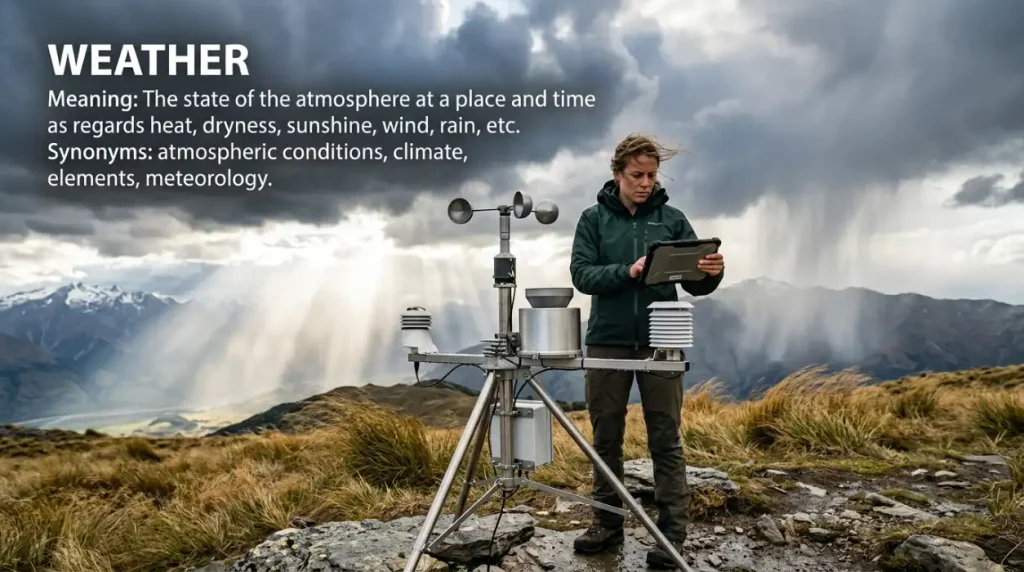
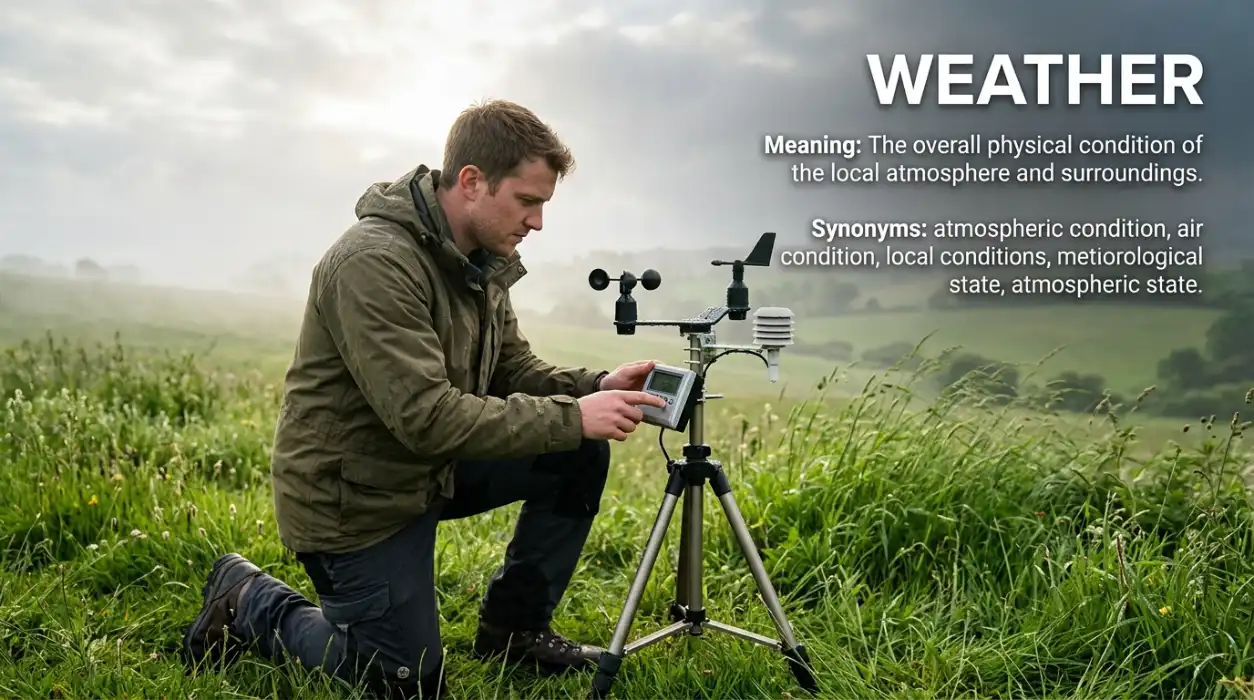
Weather is a noun that refers to the condition of the atmosphere at a particular place and time.
In simple English, weather describes what the air and sky are like outside.
It can include:
- temperature
- rain
- snow
- wind
- clouds
- sunshine
- humidity
- storms
- fog
- atmospheric pressure
For example:
The weather is warm and sunny today.
Native speakers commonly use weather when talking about short-term atmospheric conditions.
It is different from climate, which describes typical weather patterns over a much longer period.
Part of Speech
Weather is primarily a noun when it means atmospheric conditions.
It can also be a verb meaning to survive or endure something difficult.
The old building weathered several severe storms.
However, this article focuses mainly on the noun weather and its useful alternatives.
Connotative Meaning of “Weather”
Connotation (the feeling, association, or emotional suggestion connected with a word) changes depending on context.
Positive Tone
Weather can suggest comfort, beauty, or enjoyment.
We had perfect weather for the wedding.
Words such as sunshine, pleasant conditions, and fair skies can create a positive feeling.
Negative Tone
Weather can also suggest danger, discomfort, or difficulty.
The stormy conditions delayed the flight.
Words such as severe conditions, rough weather, and adverse conditions emphasize difficulty.
Neutral Tone
In factual writing, weather is usually neutral.
The weather will remain cloudy throughout the afternoon.
Likewise, atmospheric conditions, meteorological conditions, and current conditions sound factual and objective.
Etymology of “Weather”
The English word weather comes from Old English weðer, meaning the state of the atmosphere, air, or sky.
The word is related to older Germanic forms. Its basic meaning has remained surprisingly stable over centuries.
Old English: 450–1100
Old English speakers used forms such as weðer to describe atmospheric conditions.
Weather was an important part of everyday vocabulary because farming, travel, sailing, and seasonal life depended heavily on it.
Middle English: 1100–1500
During Middle English, the spelling and pronunciation changed gradually.
Forms such as wether and later weather appeared as English developed through regional variation and French influence.
Modern English: 1500–Present
The modern spelling weather became established.
Today, the word is used globally in everyday conversation, journalism, science, travel writing, storytelling, and digital communication.
It also developed a verbal sense connected with surviving or enduring difficult conditions.
Pronunciation of “Weather”
- US: /ˈwɛðər/
- UK: /ˈweðə/
Syllables
weath-er
Affixation Pattern of “Weather”
Root: weather
Prefix: none
Suffix: none
The word is a basic lexical noun rather than a modern prefixed or suffixed formation.
A related verb can be formed without adding a traditional suffix:
weather → to weather a storm
Synonyms List
Climate (Noun) — US: /ˈklaɪ.mət/ | UK: /ˈklaɪ.mət/
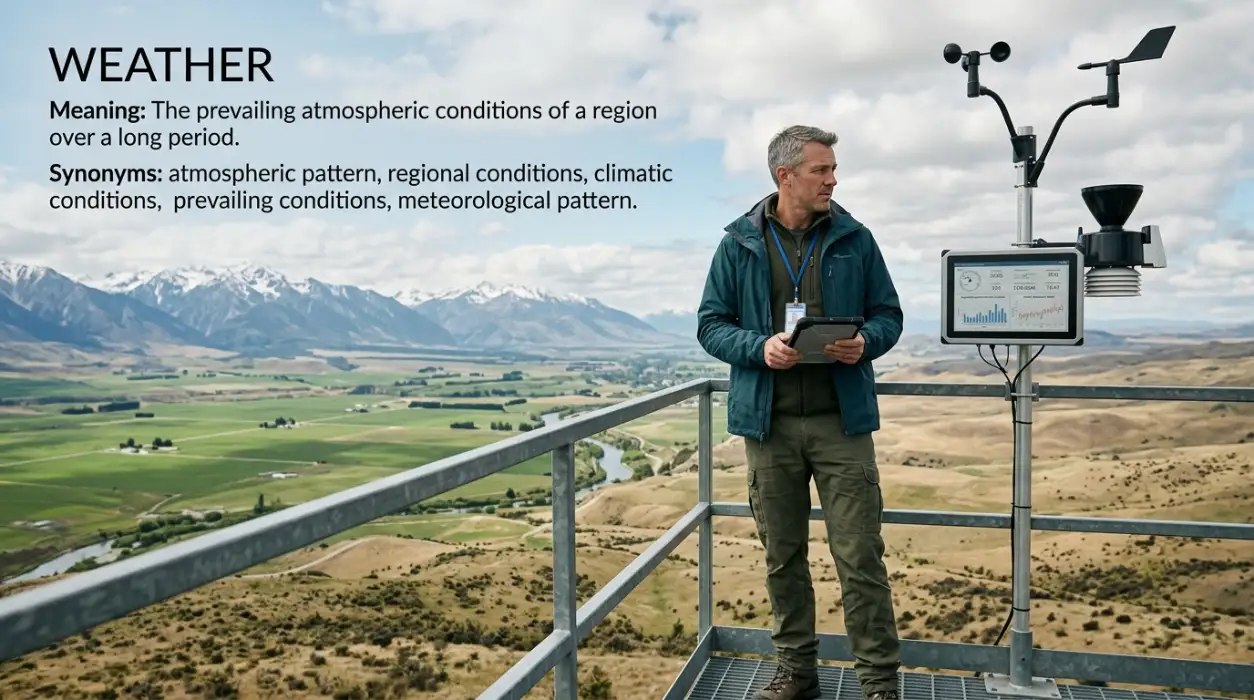
Meaning: The prevailing atmospheric conditions of a region integrated over a long period.
Tone/Register: Standard, Academic
Example:
The mild Mediterranean climate attracts millions of tourists every summer.
Scientists study global changes in climate to predict agricultural shifts.
Elements (Noun) — US: /ˈel.ə.mənts/ | UK: /ˈel.ɪ.mənts/
Meaning: Atmospheric forces such as rain, wind, and severe temperature variations.
Tone/Register: Descriptive, Literary
Example:
Hikers braved the harsh elements to reach the mountain peak before dark.
The old wooden cabin provided shelter from the freezing elements.
Atmospheric Conditions (Noun Phrase) — US: /ˌæt.məsˈfɪr.ɪk kənˈdɪʃ.ənz/ | UK: /ˌæt.məsˈfer.ɪk kənˈdɪʃ.ənz/
Meaning: The exact state of air temperature, pressure, humidity, and wind movement.
Tone/Register: Technical, Scientific
Example:
Pilots check local atmospheric conditions before taking off.
Severe atmospheric conditions delayed the evening flight schedules.
Temperature (Noun) — US: /ˈtem.pɚ.ə.tʃɚ/ | UK: /ˈtem.prə.tʃər/
Meaning: The degree or intensity of heat present in the atmosphere.
Tone/Register: Standard, Everyday
Example:
The sudden drop in temperature signaled an approaching winter storm.
Warm temperature made the afternoon perfect for a beach picnic.
Meteorology (Noun) — US: /ˌmiː.t̬i.əˈrɑː.lə.dʒi/ | UK: /ˌmiː.ti.əˈrɒl.ə.dʒi/
Meaning: The atmospheric science concerned with forecasting and weather phenomena.
Tone/Register: Academic, Scientific
Example:
Students studied local meteorology to understand regional cloud movements.
Modern advances in meteorology improved storm tracking accuracy.
Atmosphere (Noun) — US: /ˈæt.məs.fɪr/ | UK: /ˈæt.məs.fɪər/
Meaning: The mass of air surrounding the earth that produces weather patterns.
Tone/Register: Technical, Descriptive
Example:
Moisture filled the heavy atmosphere before the summer thunderstorm.
Clear blue skies indicated a stable atmosphere across the valley.
Microclimate (Noun) — US: /ˈmaɪ.kroʊˌklaɪ.mət/ | UK: /ˈmaɪ.krəʊˌklaɪ.mət/
Meaning: The localized climate of a small, specific area that differs from surroundings.
Tone/Register: Scientific, Environmental
Example:
The sheltered valley created a unique microclimate for growing fruit trees.
Urban areas often form a warm microclimate due to concrete heat absorption.
Outlook (Noun) — US: /ˈaʊt.lʊk/ | UK: /ˈaʊt.lʊk/
Meaning: A projected forecast detailing upcoming atmospheric conditions.
Tone/Register: Business, Media
Example:
The weekend outlook promises sunny skies and warm breezes.
Farmers reviewed the weekly rain outlook before planting crops.
Conditions (Noun) — US: kənˈdɪʃ.ənz | UK: kənˈdɪʃ.ənz
Meaning: The overall state of the atmosphere regarding safety, visibility, and comfort.
Tone/Register: General, Informative
Example:
Icy road conditions made the morning commute dangerous for drivers.
Favorable conditions allowed the sailing crew to set new time records.
Barometric Pressure (Noun Phrase) — US: /ˌbær.əˈmet.rɪk ˈpreʃ.ɚ/ | UK: /ˌbær.əˈmet.rɪk ˈpreʃ.ər/
Meaning: The force exerted by atmospheric weight, which indicates weather changes.
Tone/Register: Scientific, Technical
Example:
Falling barometric pressure usually signals an incoming rainstorm.
Sensors measured the barometric pressure changes along the coast.
Sky (Noun) — US: /skaɪ/ | UK: /skaɪ/
Meaning: The upper atmosphere viewed from earth, reflecting current light and weather.
Tone/Register: Common, Visual
Example:
Dark clouds filled the afternoon sky before heavy rain began.
A clear blue sky greeted early morning joggers in the park.
Air (Noun) — US: /er/ | UK: /eər/
Meaning: The atmospheric medium surrounding us, characterized by temperature and feeling.
Tone/Register: Everyday, Conversational
Example:
Crisp autumn air refreshed everyone during the morning walk.
Humid air made the afternoon feel much hotter than expected.
Forecast (Noun) — US: /ˈfɔːr.kæst/ | UK: /ˈfɔː.kɑːst/
Meaning: A predicted statement regarding coming atmospheric and thermal conditions.
Tone/Register: Media, Professional
Example:
The morning forecast called for scattered showers across the region.
We checked the weather forecast before packing for the camping trip.
Clime (Noun) — US: /klaɪm/ | UK: /klaɪm/
Meaning: A poetic or literary variation describing a region with specific weather patterns.
Tone/Register: Poetic, Elevated
Example:
Travelers sought sunny climes to escape the cold winter months.
Poets wrote verses praising the gentle breeze of tropical climes.
Environment (Noun) — US: /ɪnˈvaɪ.rən.mənt/ | UK: /ɪnˈvaɪ.rən.mənt/
Meaning: The surrounding natural ambient conditions affecting living organisms.
Tone/Register: Academic, Environmental
Example:
A humid coastal environment supports diverse plant life.
Harsh alpine environments test the endurance of outdoor hikers.
Temperament (Noun) — US: /ˈtem.pɚ.ə.mənt/ | UK: /ˈtem.prə.mənt/
Meaning: A figurative term describing the volatile or shifting mood of local weather.
Tone/Register: Literary, Figurative
Example:
Sailors respected the unpredictable temperament of the northern seas.
Spring weather displayed a changing temperament throughout the week.
State of the Sky (Noun Phrase) — US: /steɪt ʌv ðə skaɪ/ | UK: /steɪt ɒv ðə skaɪ/
Meaning: A descriptive phrase detailing cloud cover, light, and atmospheric clarity.
Tone/Register: Descriptive, Observation
Example:
Observers recorded the state of the sky before the storm hit.
The clear state of the sky promised ideal conditions for stargazing.
Ambient Temperature (Noun Phrase) — US: /ˈæm.bi.ənt ˈtem.pɚ.ə.tʃɚ/ | UK: /ˈæm.bi.ənt ˈtem.prə.tʃər/
Meaning: The baseline air temperature of the surrounding environment.
Tone/Register: Technical, Business
Example:
Sensors tracked the ambient temperature inside the greenhouse.
High ambient temperature forced workers to take frequent hydration breaks.
Season (Noun) — US: /ˈsiː.zən/ | UK: /ˈsiː.zən/
Meaning: A period of the year characterized by specific recurring weather patterns.
Tone/Register: General, Common
Example:
The rainy season brings needed water to agricultural fields.
Tourists love visiting the coastal town during the dry season.
Visibility (Noun) — US: /ˌvɪz.əˈbɪl.ə.t̬i/ | UK: /ˌvɪz.əˈbɪl.ə.ti/
Meaning: The atmospheric distance at which objects can be clearly seen.
Tone/Register: Technical, Legal
Example:
Dense fog reduced visibility on the highway to near zero.
Clear visibility allowed pilots to land safely on the runway.
Humidity (Noun) — US: /hjuːˈmɪd.ə.t̬i/ | UK: /hjuːˈmɪd.ə.ti/
Meaning: The amount of water vapor suspended within the local atmosphere.
Tone/Register: Technical, Everyday
Example:
High humidity made the summer heat feel oppressive.
Low humidity during winter often causes dry air indoors.
Cloudiness (Noun) — US: /ˈklaʊ.di.nəs/ | UK: /ˈklaʊ.di.nəs/
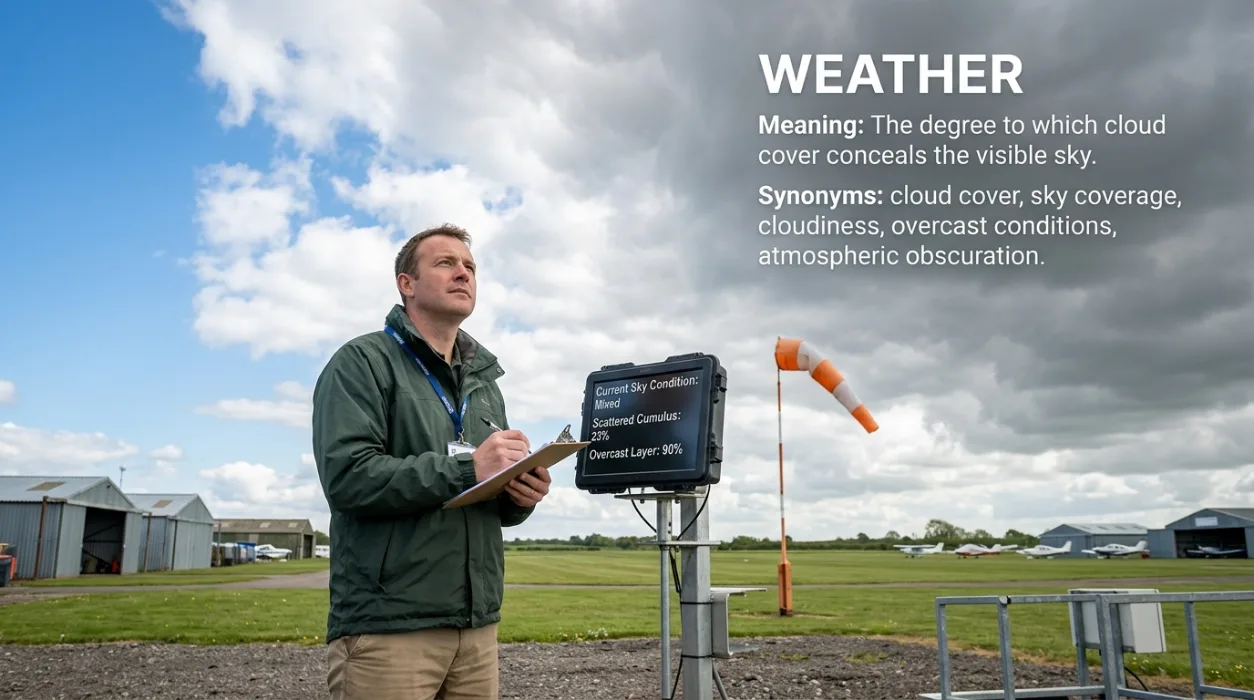
Meaning: The degree to which cloud cover conceals the sky surface.
Tone/Register: Observational, Descriptive
Example:
Increasing cloudiness signaled that rain was likely by evening.
The morning started with cloudiness before clearing up at noon.
Precipitation (Noun) — US: /prɪˌsɪp.əˈteɪ.ʃən/ | UK: /prɪˌsɪp.ɪˈteɪ.ʃən/
Meaning: Any form of water falling from clouds, including rain, snow, or hail.
Tone/Register: Scientific, Academic
Example:
Heavy precipitation refilled regional reservoirs after the drought.
The weather office predicted frozen precipitation overnight.
Air Mass (Noun Phrase) — US: /er mæs/ | UK: /eər mæs/
Meaning: A large volume of air defined by uniform temperature and moisture.
Tone/Register: Scientific, Meteorological
Example:
A cold air mass moved south, bringing frosty winter temperatures.
Colliding air masses triggered severe thunderstorms across the plains.
Thermal State (Noun Phrase) — US: /ˈθɝː.məl steɪt/ | UK: /ˈθɜː.məl steɪt/
Meaning: The precise heat level or thermodynamic condition of ambient air.
Tone/Register: Scientific, Technical
Example:
Engineers calculated the thermal state of the external atmosphere.
Changes in the air’s thermal state influence local wind patterns.
Weather Pattern (Noun Phrase) — US: /ˈweð.ɚ ˈpæt̬.ɚn/ | UK: /ˈweð.ər ˈpæt.ən/
Meaning: Recurring atmospheric conditions that repeat over specific cycles.
Tone/Register: Standard, Educational
Example:
Unusual weather patterns disrupted traditional farming schedules this year.
Climate models predict shifting weather patterns across the continent.
Climatology (Noun) — US: /ˌklaɪ.məˈtɑː.lə.dʒi/ | UK: /ˌklaɪ.məˈtɒl.ə.dʒi/
Meaning: The scientific study of long-term climate behavior and trends.
Tone/Register: Academic, Formal
Example:
Research in climatology helps cities plan better flood infrastructure.
University courses in climatology analyze historical weather records.
Cold Front (Noun Phrase) — US: /koʊld frʌnt/ | UK: /kəʊld frʌnt/
Meaning: The leading edge of a cooler air mass replacing warmer air.
Tone/Register: Technical, Media
Example:
The passing cold front caused temperatures to drop rapidly.
Strong winds accompanied the cold front as it swept across the coast.
Warm Front (Noun Phrase) — US: /wɔːrm frʌnt/ | UK: /wɔːm frʌnt/
Meaning: The boundary where a warm air mass advances over cooler air.
Tone/Register: Technical, Media
Example:
A warm front brought steady rain followed by milder spring weather.
Humidity increased steadily along the advancing warm front.
Atmosphere Quality (Noun Phrase) — US: /ˈæt.məs.fɪr ˈkwɑː.lə.t̬i/ | UK: /ˈæt.məs.fɪər ˈkwɒl.ə.ti/
Meaning: The purity, temperature, and moisture balance of ambient air.
Tone/Register: Environmental, Technical
Example:
Clean mountain air provides superior atmosphere quality for health.
Monitoring teams measured urban atmosphere quality during heatwaves.
Weather System (Noun Phrase) — US: /ˈweð.ɚ ˈsɪs.təm/ | UK: /ˈweð.ər ˈsɪs.təm/
Meaning: An organized atmospheric pattern involving pressure, wind, and precipitation.
Tone/Register: Scientific, Media
Example:
A low-pressure weather system brought heavy snow to the mountains.
Satellites tracked the massive weather system moving across the ocean.
Barometry (Noun) — US: /bəˈrɑː.mə.tri/ | UK: /bəˈrɒm.ɪ.tri/
Meaning: The science of measuring atmospheric pressure to gauge weather shifts.
Tone/Register: Scientific, Specialized
Example:
Advances in barometry enabled earlier warnings for coastal storms.
Nautical officers used barometry to anticipate severe ocean gales.
Aerology (Noun) — US: /eəˈrɒl.ə.dʒi/ | UK: /eəˈrɒl.ə.dʒi/
Meaning: The branch of meteorology dealing with the free upper atmosphere.
Tone/Register: Specialized, Scientific
Example:
Weather balloons gather critical aerology data for flight path planning.
Researchers studied upper aerology to analyze jet stream changes.
Elements of Nature (Noun Phrase) — US: /ˈel.ə.mənts ʌv ˈneɪ.tʃɚ/ | UK: /ˈel.ɪ.mənts ɒv ˈneɪ.tʃər/
Meaning: Natural atmospheric forces, including storms, wind, heat, and rain.
Tone/Register: Literary, Expressive
Example:
The old lighthouse stood strong against the wild elements of nature.
Poets often find inspiration in the changing elements of nature.
Ambient Air (Noun Phrase) — US: /ˈæm.bi.ənt er/ | UK: /ˈæm.bi.ənt eər/
Meaning: The surrounding outdoor air temperature and atmospheric composition.
Tone/Register: Technical, Environmental
Example:
Sensors recorded ambient air quality near the industrial park.
Cool ambient air helped lower the engine’s operating temperature.
Sky Condition (Noun Phrase) — US: /skaɪ kənˈdɪʃ.ən/ | UK: /skaɪ kənˈdɪʃ.ən/
Meaning: The official rating of cloud cover and atmospheric clarity.
Tone/Register: Professional, Aviation
Example:
Aviation reports listed the sky condition as clear with high visibility.
Pilots monitor sky condition updates prior to scheduled flights.
Cloudscape (Noun) — US: /ˈklaʊd.skeɪp/ | UK: /ˈklaʊd.skeɪp/
Meaning: A visual landscape formed by cloud formations across the sky.
Tone/Register: Artistic, Visual
Example:
Artists painted the dramatic cloudscape above the rolling countryside.
Sunset illuminated the vibrant pink cloudscape over the bay.
Heat Index (Noun Phrase) — US: /hiːt ˈɪn.deks/ | UK: /hiːt ˈɪn.deks/
Meaning: A measure indicating how hot weather feels when humidity is factored in.
Tone/Register: Technical, Public Safety
Example:
A high heat index prompted safety warnings for outdoor workers.
Humidity increased the heat index during late July afternoons.
Wind Chill (Noun Phrase) — US: /wɪnd tʃɪl/ | UK: /wɪnd tʃɪl/
Meaning: The cooling effect of wind on exposed air temperatures.
Tone/Register: Public Safety, Media
Example:
The bitter wind chill made freezing temperatures feel even colder.
Winter dress advice considers both air temperature and wind chill.
Sunshine (Noun) — US: /ˈsʌn.ʃaɪn/ | UK: /ˈsʌn.ʃaɪn/
Meaning: Direct sunlight unfiltered by clouds, representing fair weather.
Tone/Register: Everyday, Bright
Example:
Bright sunshine warmed the courtyard after two days of fog.
Children played in the park, enjoying the afternoon sunshine.
Overcast (Noun/Adjective) — US: /ˌoʊ.vɚˈkæst/ | UK: /ˌəʊ.vəˈkɑːst/
Meaning: A atmospheric state completely covered by dull gray clouds.
Tone/Register: Descriptive, General
Example:
The heavy overcast kept temperatures cool throughout the morning.
An oppressive overcast hung low over the industrial city skyline.
Downpour (Noun) — US: /ˈdaʊn.pɔːr/ | UK: /ˈdaʊn.pɔː/
Meaning: A sudden, unusually heavy fall of rain representing stormy weather.
Tone/Register: Common, Expressive
Example:
A sudden downpour soaked commuters waiting at the bus stop.
We waited inside the store until the downpour stopped completely.
Gale (Noun) — US: /ɡeɪl/ | UK: /ɡeɪl/
Meaning: A strong, severe wind event within an active storm system.
Tone/Register: Maritime, Descriptive
Example:
The fierce gale rattled the window frames throughout the night.
Ships sought shelter in the harbor during the unexpected gale.
Tempest (Noun) — US: /ˈtem.pɪst/ | UK: /ˈtem.pɪst/
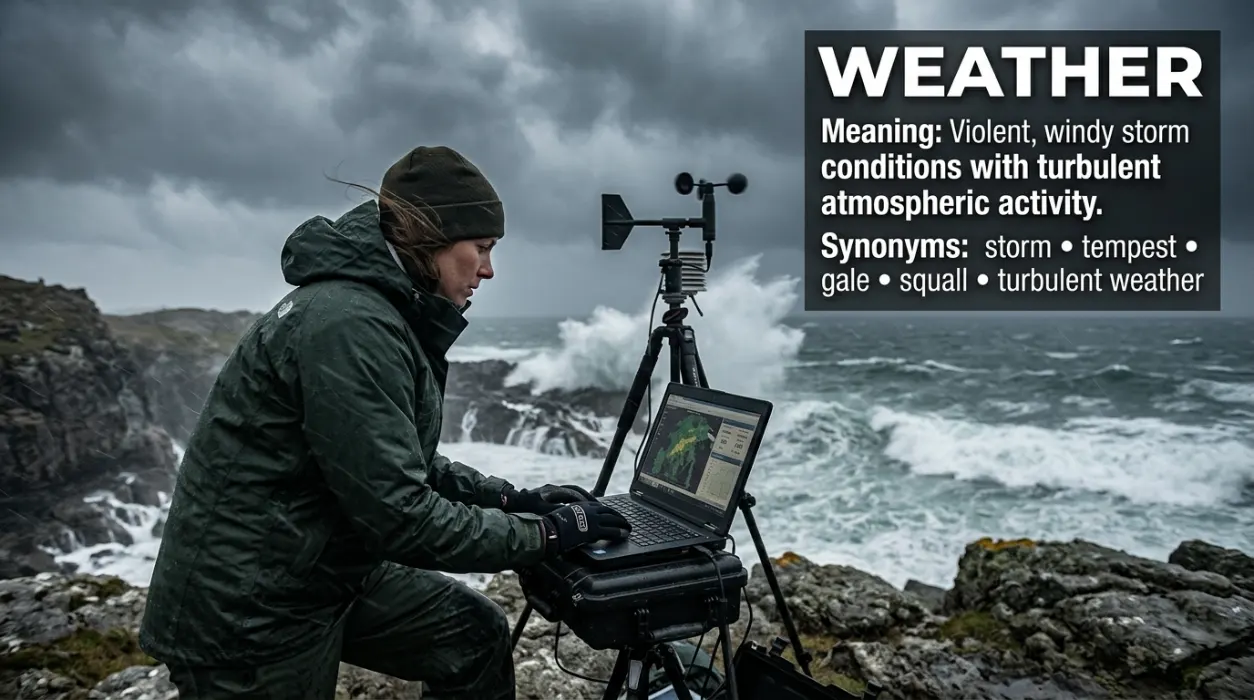
Meaning: A violent, windy storm representing turbulent atmospheric conditions.
Tone/Register: Literary, Dramatic
Example:
Ancient myths describe ships lost at sea during a roaring tempest.
The tempest blew leaves across the yard and knocked down branches.
Squall (Noun) — US: /skwɑːl/ | UK: /skwɔːl/
Meaning: A sudden, intense windstorm often accompanied by rain or snow.
Tone/Register: Maritime, Technical
Example:
Sailors quickly lowered the sails when a squall hit the bay.
A brief snow squall reduced visibility on the mountain road.
Blizzard (Noun) — US: /ˈblɪz.ɚd/ | UK: /ˈblɪz.əd/
Meaning: A severe snowstorm with high winds and extremely low visibility.
Tone/Register: Standard, Safety
Example:
The winter blizzard closed schools and blocked rural highways.
Emergency crews worked tirelessly clearing snow after the blizzard.
Drought (Noun) — US: /draʊt/ | UK: /draʊt/
Meaning: A prolonged period of abnormally low rainfall creating dry conditions.
Tone/Register: Environmental, Standard
Example:
The severe drought forced farmers to conserve irrigation water.
Reservoir levels dropped drastically during the multi-year drought.
Monsoons (Noun) — US: /mɑːnˈsuːnz/ | UK: /mɒnˈsuːnz/
Meaning: Seasonal wind patterns bringing heavy rainfall to specific regions.
Tone/Register: Geographical, Standard
Example:
Farmers welcomed the annual monsoons to water their rice crops.
Heavy monsoons caused minor flooding along low-lying rivers.
Smog (Noun) — US: /smɑːɡ/ | UK: /smɒɡ/
Meaning: Atmospheric fog combined with smoke and industrial pollutants.
Tone/Register: Environmental, Media
Example:
Dense smog covered the city center during stagnant air conditions.
New emission rules aimed to reduce dangerous summer smog levels.
Fog (Noun) — US: /fɑːɡ/ | UK: /fɒɡ/
Meaning: A thick cloud of tiny water droplets suspended near the ground.
Tone/Register: Common, Descriptive
Example:
Thick fog rolled in off the coast, obscuring harbor views.
Drivers slowed down as fog blanketed the valley road.
Haze (Noun) — US: /heɪz/ | UK: /heɪz/
Meaning: Slight obscurity in the air caused by fine dust or smoke particles.
Tone/Register: Descriptive, General
Example:
A warm summer haze lingered over the distant mountain peaks.
Morning sunlight cut softly through the thin valley haze.
Breeze (Noun) — US: /briːz/ | UK: /briːz/
Meaning: A gentle, pleasant wind movement within fair weather conditions.
Tone/Register: Casual, Pleasant
Example:
A cool sea breeze refreshed beachgoers during the afternoon.
Leaves rustled quietly in the light evening breeze.
Gust (Noun) — US: /ɡʌst/ | UK: /ɡʌst/
Meaning: A brief, sudden rush of strong wind interrupting air flow.
Tone/Register: Common, Observational
Example:
A sudden gust of wind blew my hat right off my head.
Strong gusts made steering high-profile vehicles difficult.
Air Temperature (Noun Phrase) — US: /er ˈtem.pɚ.ə.tʃɚ/ | UK: /eər ˈtem.prə.tʃər/
Meaning: The measured heat level of surrounding atmospheric gases.
Tone/Register: Technical, Educational
Example:
Meteorologists measured the air temperature at hourly intervals.
Shade trees help lower urban air temperature naturally during summer.
Environmental State (Noun Phrase) — US: /ɪnˌvaɪ.rənˈmen.t̬əl steɪt/ | UK: /ɪnˌvaɪ.rənˈmen.təl steɪt/
Meaning: The overall physical condition of local atmospheric surroundings.
Tone/Register: Academic, Formal
Example:
Researchers assessed the environmental state before launching the survey.
Maintaining a stable environmental state helps protect fragile habitats.
Synonyms by Tone
Choosing the proper synonym for weather depends heavily on context and register. Therefore, grouping alternatives by tone ensures precise expression across different audiences.
Positive Tone
These options highlight pleasant warmth, clear skies, or refreshing air:
- Sunshine
- Breeze
- Fair conditions
- Ideal outlook
- Pleasant climate
Neutral Tone
These options state meteorological facts, scientific measurements, or environmental states objectively:
- Climate
- Atmospheric conditions
- Meteorology
- Barometric pressure
- Air mass
- Climatology
- Ambient air
Negative Tone
These words stress severe storms, dangerous conditions, or extreme heat:
- Elements
- Tempest
- Blizzard
- Drought
- Downpour
- Gale
- Smog
Playful / Informal
These expressions introduce casual speech, artistic terms, or descriptive imagery:
- Sky
- Air
- Clime
- Cloudscape
- Temperament
Mini Comparison
Weather vs. Climate vs. Meteorology
| Feature | Weather | Climate | Meteorology |
| Primary Focus | Daily atmospheric conditions at a specific time and place. | Long-term average weather patterns over decades. | The scientific study of atmospheric forces and forecasts. |
| Tone | Universal, standard, and descriptive. | Scientific, academic, and authoritative. | Technical, academic, and professional. |
| Best Usage Context | “The weather today is sunny and mild.” | “Desert regions feature an arid climate.” | “She earned a university degree in meteorology.” |
How “Synonym for Weather” Changes by Context
Daily Conversation
In casual speech, people prefer simple choices like forecast, temperature, sky, or air. For instance, a neighbor might ask about checking the morning forecast before going for a walk.
Writing or Blogging
Travel bloggers and content creators select evocative terms like climate, clime, breeze, or elements. Consequently, these descriptive terms paint vivid mental pictures for online readers.
Professional or Academic Tone
Scientific journals, environmental reports, and aviation updates require precise technical vocabulary. Terms such as atmospheric conditions, barometric pressure, microclimate, or aerology ensure clarity.
Creative or Informal Use
Fiction writers use expressive metaphors like temperament, tempest, cloudscape, or the elements. As a result, these literary choices add dramatic tension to wilderness adventure stories.
Common Mistakes & Native Usage
Common Mistakes Learners Make
- Confusing “weather” and “climate”: While related, weather refers to daily short-term states, whereas climate covers long-term multi-year averages.
- Using scientific jargon in everyday speech: Terms like barometric pressure or aerology sound overly stiff in casual conversation.
- Misunderstanding technical fronts: Confusing cold front and warm front can lead to inaccurate forecasts in writing.
Register Notes
- Spoken English: Casual conversations favor forecast, sky, air, heat, and rain.
- Written English: Formal prose uses atmospheric conditions, climatology, precipitation, and ambient air.
- To expand your vocabulary further across academic writing contexts, check out our guide on descriptive language choices.
Real-Life Mini Scenarios
Workplace
During an aviation safety briefing, flight controllers reviewed regional data on atmospheric pressure. Consequently, the team adjusted departure routes to avoid turbulent atmospheric conditions.
Social Situations
While planning a weekend camping trip, friends checked their smartphone apps for updates. They discussed whether the weekend forecast showed any chance of rain.
Media / Pop Culture
A news anchor reported on an incoming winter storm moving across the Midwest. The broadcast highlighted severe warnings regarding high wind chills and frozen precipitation.
Writing or Storytelling
An author wrote a historical novel set aboard a 19th-century sailing vessel. She described the crew battling against the wild elements during a sudden night storm.
Practice Quiz
1. Which synonym carries a formal, scientific tone for short-term atmospheric states?
A) Sky
B) Atmospheric conditions
C) Breeze
D) Air
2. What term refers to long-term average atmospheric patterns of a region?
A) Weather
B) Climate
C) Downpour
D) Gust
3. Which option is an informal, literary term for a regional climate?
A) Aerology
B) Clime
C) Barometry
D) Microclimate
4. What is the key difference between “weather” and “climate”?
A) Climate changes hourly, while weather takes decades
B) Weather refers to short-term states, while climate covers long-term averages
C) Weather applies only to rain, while climate applies to temperature
D) Both terms mean the exact same thing in science
5. Which term describes a sudden, violent windstorm with rain or snow?
A) Squall
B) Breeze
C) Microclimate
D) Outlook
6. Which term fits best in an official aviation report?
A) Cloudscape
B) Sky condition
C) Temperament
D) Clime
7. The scientific study of atmospheric forecasting is called:
A) Meteorology
B) Clime
C) Tempest
D) Breeze
8. Which option is a dramatic, literary term for a violent storm?
A) Tempest
B) Microclimate
C) Ambient air
D) Barometry
9. What term describes water falling from clouds in any form?
A) Visibility
B) Precipitation
C) Climatology
D) Haze
10. Which synonym works best for casual everyday conversation?
A) Barometric pressure
B) Forecast
C) Aerology
D) Microclimate
Application Task
Write one short original sentence describing an outdoor scene or morning trip, using one synonym from this guide (such as forecast, breeze, or elements).
Answer Key
1: B | 2: B | 3: B | 4: B | 5: A | 6: B | 7: A | 8: A | 9: B | 10: B
Conclusion
Understanding weather can help you describe the conditions of the atmosphere at a particular time and place, including temperature, rain, wind, and sunshine. Learning its synonyms, meaning, and examples can improve your English vocabulary and communication skills.
The word weather is commonly used in everyday conversations, forecasts, travel discussions, and descriptions of natural conditions. Knowing its related synonyms can help you express ideas about atmospheric conditions in different ways and make your writing more varied.
By practicing weather in sentences and exploring related words, you can strengthen your vocabulary and writing skills. A clear understanding of this word will help you describe atmospheric conditions naturally, accurately, and confidently in different English contexts.
Frequently Asked Questions
1. What is a good synonym for weather in formal English?
For formal English, atmospheric conditions, meteorological conditions, and prevailing conditions are useful alternatives. The best choice depends on context. Atmospheric conditions is broad and clear, while meteorological conditions sounds more scientific. In a workplace notice, adverse weather may be better when the conditions are causing problems or delays.
2. What is the difference between weather and climate?
Weather describes atmospheric conditions over a short period, such as today, tomorrow, or this week. Climate describes typical weather patterns over a much longer period, often across decades. For example, rain falling today is weather. The usual temperature and rainfall patterns of a region are part of its climate.
3. What is another word for weather conditions?
Useful alternatives include atmospheric conditions, meteorological conditions, current conditions, local conditions, sky conditions, and prevailing conditions. However, they are not interchangeable in every sentence. Sky conditions focuses on the sky, while meteorological conditions has a more technical meaning. Choose the expression that matches the exact information you want to describe.
4. What is a synonym for bad weather?
Depending on the situation, you can say foul weather, severe weather, inclement weather, adverse weather, rough weather, or stormy weather. These expressions have different strengths. Severe weather can imply danger, while inclement weather generally means unpleasant or unfavorable conditions. Foul weather is more traditional and expressive.
5. What can I say instead of “the weather is nice”?
You can make the sentence more specific by saying the skies are clear, conditions are pleasant, it is sunny, the weather is fair, or conditions are warm and dry. Specific descriptions are often better than nice because they tell the reader exactly what makes the weather enjoyable.

Hasnain Ali is an SEO Content Strategist and the founder of wordvora.com, a trusted vocabulary platform that helps writers, students, professionals, and English learners find accurate synonyms, antonyms, word meanings, and real-life usage examples. He specializes in keyword research, on-page SEO, topical authority, and creating search-first content that aligns with Google’s latest Search Quality and E-E-A-T guidelines. His work focuses on producing clear, well-structured, and reader-friendly resources that satisfy search intent while maintaining high editorial standards.
Through extensive hands-on experience with SEO tools such as Google Search Console, Google Analytics, SEMrush, and Ahrefs, Hasnain researches user search behavior and develops content that is both informative and easy to understand. Every article published on wordvora.com is carefully reviewed for accuracy, readability, and contextual relevance before publication. His mission is to build one of the web’s most reliable English vocabulary resources by providing practical language guidance, trustworthy explanations, and content that helps readers improve their writing, communication, and vocabulary with confidence.