
synonym for wishy-washy can save a conversation when “wishy-washy” feels too casual. Imagine a manager giving an answer that never quite says yes or no.
For example, “He sounded hesitant” is more neutral than “He sounded wishy-washy.” The right synonym helps you show exactly what the speaker means.
Learning a synonym for wishy-washy also builds vocabulary. Students, bloggers, writers, and everyday speakers can sound clearer with better word choices.
Because “wishy-washy” is common informal English, knowing its alternatives helps you adjust your tone for emails, essays, conversations, and stories.
What Does “Wishy-Washy” Really Mean?
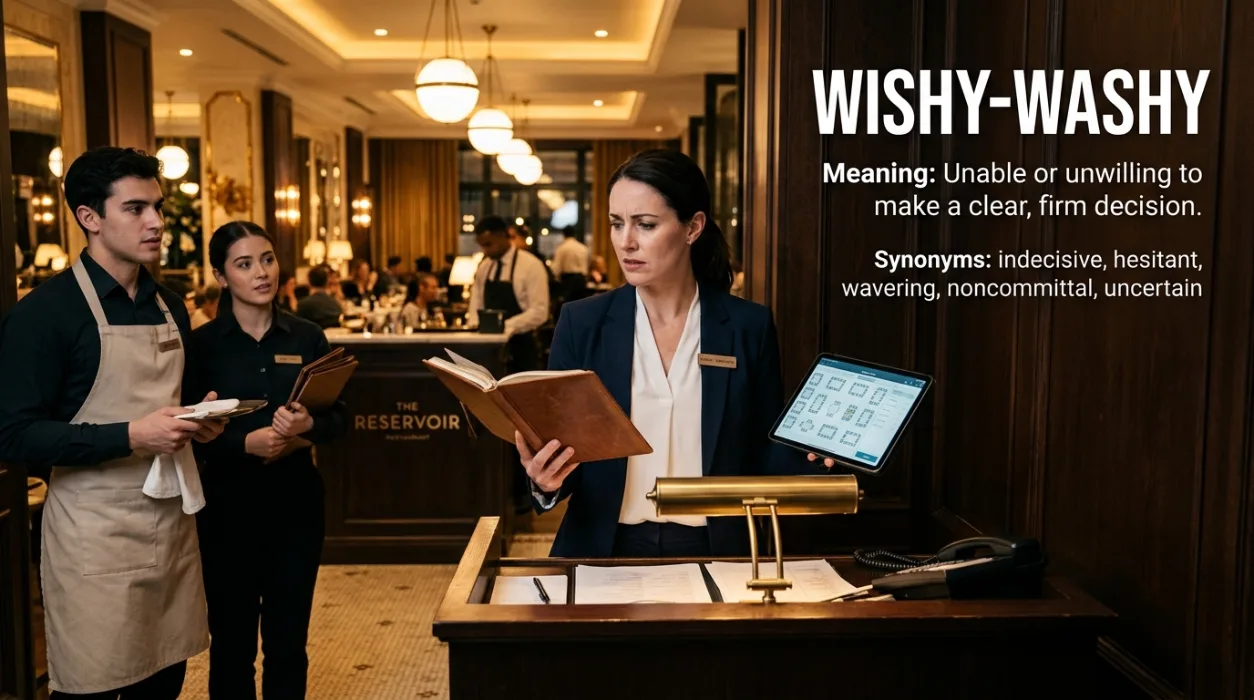
Wishy-washy is an adjective that describes someone or something lacking clear ideas, firm decisions, strength, force, or definite qualities.
In everyday English, it often describes a person who cannot make a firm decision or a statement that avoids taking a clear position.
For example:
“The committee gave a wishy-washy response.”
This suggests that the response was vague, weak, or noncommittal.
Native speakers usually understand wishy-washy as informal and mildly or strongly disapproving. Cambridge classifies it as informal and disapproving, particularly when it describes a lack of firm ideas, principles, or noticeable qualities.
The word can also describe something weak in color, flavor, or substance. For example, someone might call a pale watercolor “wishy-washy.”
Part of Speech
Wishy-washy is an adjective.
Simple definition: not clear, firm, strong, or decisive.
It commonly appears in:
- Everyday conversations
- Opinions and political discussions
- Workplace communication
- Reviews and criticism
- Blogging
- Storytelling
- Discussions about decisions
- Descriptions of weak colors or flavors
Connotative Meaning of “Wishy-Washy”
Connotation means the feeling, attitude, or association that a word carries beyond its basic dictionary meaning.
Positive Tone
“Wishy-washy” itself is rarely positive. However, some alternatives can describe uncertainty without attacking the person.
For example, tentative, cautious, or undecided can sound more neutral and less judgmental.
Negative Tone
The strongest negative alternatives include spineless, gutless, weak, ineffectual, and mealy-mouthed.
These words may suggest criticism of someone’s courage, effectiveness, or willingness to take a position.
Neutral Tone
Words such as uncertain, hesitant, ambivalent, noncommittal, and tentative can describe uncertainty more objectively.
Therefore, they are often better choices in academic or professional writing.
Etymology of “Wishy-Washy”
The history of wishy-washy is surprisingly playful.
The word was first recorded in the late seventeenth century. Etymological sources trace it to a reduplicated form of washy, meaning thin or watery. The figurative sense connected with vacillation or indecision appeared later.
Oxford dates the word to the early eighteenth century and also describes it as a reduplication of washy.
Old English: 450–1100
The modern word wishy-washy did not exist in Old English.
However, Old English already had many words for weakness, uncertainty, doubt, and lack of firmness. Those older vocabulary patterns helped provide the broader semantic territory in which later English developed.
Middle English: 1100–1500
During Middle English, English vocabulary expanded through contact with French, Latin, Norse, and other languages.
Words expressing doubt, hesitation, weakness, and uncertainty became increasingly varied.
Still, wishy-washy itself had not yet entered English.
Modern English: 1500–Present
The reduplicative form emerged in the late seventeenth or early eighteenth century.
Originally, it referred to something weak, thin, or watery. Over time, the meaning expanded toward weak character, weak opinions, and indecision.
Pronunciation
US: /ˈwɪʃ.iˌwɑː.ʃi/
UK: /ˈwɪʃ.iˌwɒʃ.i/
These pronunciations are listed by Cambridge for American and British English.
Syllables
wish-y-wash-y
Affixation Pattern of “Wishy-Washy”
Root: not a conventional single root
Prefix: none
Suffix: none
The expression is a reduplicative compound, rather than a normal prefix-and-suffix formation.
The second part echoes the first with a vowel change, creating a rhythmic form. This pattern can also be seen in expressions such as “dilly-dally” and “shilly-shally.”
Synonyms List
Indecisive (Adjective) — US /ɪnˈdɪsaɪsɪv/ — UK /ˌɪndɪˈsaɪsɪv/
Meaning: Unable or unwilling to make a clear decision.
Tone/Register: Neutral to mildly negative; common.
Example:
She was indecisive about which apartment to rent.
The team’s indecisive response delayed the project.
Irresolute (Adjective) — US /ɪˈrɛzəluːt/ — UK /ɪˈrɛzəluːt/
Meaning: Not determined enough to make a firm choice.
Tone/Register: Formal; literary.
Example:
His irresolute behavior frustrated the committee.
She seemed irresolute when the final vote arrived.
Vacillating (Adjective) — US /ˈvæsəleɪtɪŋ/ — UK /ˈvæsɪleɪtɪŋ/
Meaning: Frequently changing between different choices or opinions.
Tone/Register: Formal; academic.
Example:
The board criticized his vacillating leadership.
Her vacillating position confused the team.
Wavering (Adjective) — US /ˈweɪvərɪŋ/ — UK /ˈweɪvərɪŋ/
Meaning: Becoming uncertain or changing between positions.
Tone/Register: Neutral; common.
Example:
His support for the proposal was wavering.
She gave a wavering answer during the interview.
Hesitant (Adjective) — US /ˈhɛzɪtənt/ — UK /ˈhɛzɪtənt/
Meaning: Slow to act or speak because of uncertainty.
Tone/Register: Neutral; everyday.
Example:
He sounded hesitant when asked about the offer.
She was hesitant to commit to the plan.
Undecided (Adjective) — US /ˌʌndɪˈsaɪdɪd/ — UK /ˌʌndɪˈsaɪdɪd/
Meaning: Not having made a final decision.
Tone/Register: Neutral; everyday.
Example:
I’m still undecided about the move.
The undecided voters were asked to compare both options.
Uncertain (Adjective) — US /ʌnˈsɜrtən/ — UK /ʌnˈsɜːtən/
Meaning: Not confident about what is true, correct, or best.
Tone/Register: Neutral; very common.
Example:
The manager seemed uncertain about the deadline.
We are uncertain about what happens next.
Tentative (Adjective) — US /ˈtɛntətɪv/ — UK /ˈtɛntətɪv/
Meaning: Not fully decided or confident.
Tone/Register: Neutral to formal; professional.
Example:
We made a tentative agreement over lunch.
The date is tentative until everyone confirms.
Noncommittal (Adjective) — US /ˌnɑnkəˈmɪtəl/ — UK /ˌnɒnkəˈmɪtəl/
Meaning: Avoiding a definite statement, opinion, or promise.
Tone/Register: Formal; professional.
Example:
The spokesperson gave a noncommittal answer.
His email remained deliberately noncommittal.
Ambivalent (Adjective) — US /æmˈbɪvələnt/ — UK /æmˈbɪvələnt/
Meaning: Having mixed or conflicting feelings about something.
Tone/Register: Academic; professional.
Example:
She felt ambivalent about changing careers.
He remains ambivalent about moving abroad.
Equivocal (Adjective) — US /ɪˈkwɪvəkəl/ — UK /ɪˈkwɪvəkəl/
Meaning: Deliberately unclear or open to more than one interpretation.
Tone/Register: Formal; academic.
Example:
The report gave an equivocal conclusion.
His equivocal wording left readers uncertain.
Equivocating (Adjective) — US /ɪˈkwɪvəkeɪtɪŋ/ — UK /ɪˈkwɪvəkeɪtɪŋ/
Meaning: Avoiding a direct answer by using deliberately unclear language.
Tone/Register: Formal; critical.
Example:
The witness sounded equivocal during the hearing.
Her equivocating response raised more questions.
Evasive (Adjective) — US /ɪˈveɪsɪv/ — UK /ɪˈveɪsɪv/
Meaning: Avoiding a direct answer or clear position.
Tone/Register: Neutral to negative; common.
Example:
The executive gave an evasive reply.
His evasive comments did not address the complaint.
Hedging (Adjective) — US /ˈhɛdʒɪŋ/ — UK /ˈhɛdʒɪŋ/
Meaning: Using cautious language to avoid making a strong claim.
Tone/Register: Academic; professional.
Example:
The article uses hedging language when discussing the results.
Her hedging response suggested that she was not fully convinced.
Fence-Sitting (Adjective) — US /ˈfɛnsˌsɪtɪŋ/ — UK /ˈfensˌsɪtɪŋ/
Meaning: Avoiding a choice between opposing sides or positions.
Tone/Register: Informal; conversational.
Example:
His fence-sitting annoyed both groups.
The debate exposed her fence-sitting on the issue.
Shilly-Shallying (Adjective) — US /ˈʃɪliˌʃæliɪŋ/ — UK /ˈʃɪliˌʃæliɪŋ/
Meaning: Delaying or avoiding a decision through repeated hesitation.
Tone/Register: Informal; playful.
Example:
Enough shilly-shallying; we need an answer today.
His shilly-shallying wasted the team’s afternoon.
Tergiversating (Adjective) — US /tərˈdʒɪvərseɪtɪŋ/ — UK /tɜːˈdʒɪvəseɪtɪŋ/
Meaning: Avoiding a firm position by changing or disguising one’s views.
Tone/Register: Very formal; uncommon.
Example:
The official was accused of tergiversating on the proposal.
Her tergiversating statements were difficult to follow.
Mealy-Mouthed (Adjective) — US /ˈmiːliˌmaʊθt/ — UK /ˈmiːliˌmaʊθt/
Meaning: Expressing opinions weakly or indirectly to avoid offense or commitment.
Tone/Register: Informal; strongly critical.
Example:
The columnist called the apology mealy-mouthed.
His mealy-mouthed statement satisfied nobody.
Unsettled (Adjective) — US /ʌnˈsɛtəld/ — UK /ʌnˈsetəld/
Meaning: Not fixed, resolved, or firmly decided.
Tone/Register: Neutral; common.
Example:
The question of funding remains unsettled.
Her plans for next year are still unsettled.
Indeterminate (Adjective) — US /ˌɪndɪˈtɜrmənət/ — UK /ˌɪndɪˈtɜːmɪnət/
Meaning: Not clearly determined or defined.
Tone/Register: Formal; academic.
Example:
The outcome remained indeterminate after the first round.
The report described the cause as indeterminate.
Inconstant (Adjective) — US /ɪnˈkɑnstənt/ — UK /ɪnˈkɒnstənt/
Meaning: Frequently changing rather than remaining steady.
Tone/Register: Formal; literary.
Example:
His inconstant attention made the project difficult.
The character is portrayed as inconstant and unreliable.
Fickle (Adjective) — US /ˈfɪkəl/ — UK /ˈfɪkəl/
Meaning: Changing opinions, interests, or loyalties quickly.
Tone/Register: Common; mildly negative.
Example:
Her fickle interest in hobbies amused her friends.
The fickle customer changed his order twice.

Changeable (Adjective) — US /ˈtʃeɪndʒəbəl/ — UK /ˈtʃeɪndʒəbəl/
Meaning: Likely to change rather than remain stable.
Tone/Register: Neutral.
Example:
His changeable opinions made planning difficult.
The team’s changeable strategy confused its supporters.
Unsteady (Adjective) — US /ʌnˈstɛdi/ — UK /ʌnˈstedi/
Meaning: Lacking stability, confidence, or consistency.
Tone/Register: Neutral; common.
Example:
She gave an unsteady response to the question.
His unsteady leadership worried the staff.
Unstable (Adjective) — US /ʌnˈsteɪbəl/ — UK /ʌnˈsteɪbəl/
Meaning: Not stable, consistent, or dependable.
Tone/Register: Neutral to negative.
Example:
The agreement rests on an unstable foundation.
His unstable position changed several times.
Weak (Adjective) — US /wiːk/ — UK /wiːk/
Meaning: Lacking strength, force, confidence, or effectiveness.
Tone/Register: Neutral; extremely common.
Example:
The proposal received a weak response.
Her weak argument failed to persuade the panel.
Feeble (Adjective) — US /ˈfiːbəl/ — UK /ˈfiːbəl/
Meaning: Lacking physical, emotional, or persuasive strength.
Tone/Register: Formal to literary.
Example:
He offered a feeble excuse for missing the meeting.
The campaign produced a feeble response.
Ineffectual (Adjective) — US /ˌɪnɪˈfɛktʃuəl/ — UK /ˌɪnɪˈfektʃuəl/
Meaning: Failing to produce a useful or desired result.
Tone/Register: Formal; professional.
Example:
The committee’s response was ineffectual.
Their ineffectual strategy solved very little.
Ineffective (Adjective) — US /ˌɪnɪˈfɛktɪv/ — UK /ˌɪnɪˈfektɪv/
Meaning: Not successful in producing the intended effect.
Tone/Register: Neutral; professional.
Example:
The company replaced its ineffective policy.
His ineffective explanation created more confusion.
Spineless (Adjective) — US /ˈspaɪnləs/ — UK /ˈspaɪnləs/
Meaning: Lacking courage or firmness when a strong position is needed.
Tone/Register: Informal; strongly negative.
Example:
The critic called the decision spineless.
She rejected the spineless compromise.
Gutless (Adjective) — US /ˈɡʌtləs/ — UK /ˈɡʌtləs/
Meaning: Lacking courage or determination.
Tone/Register: Informal; harsh.
Example:
His friends thought the apology sounded gutless.
The reviewer described the ending as gutless.
Wimpy (Adjective) — US /ˈwɪmpi/ — UK /ˈwɪmpi/
Meaning: Weak, timid, or lacking confidence.
Tone/Register: Informal; childish or playful.
Example:
The character looks tough but acts wimpy.
He gave a wimpy excuse instead of admitting the mistake.
Namby-Pamby (Adjective) — US /ˌnæmbiˈpæmbi/ — UK /ˌnæmbiˈpæmbi/
Meaning: Weak, overly delicate, or lacking firmness.
Tone/Register: Informal; old-fashioned and mocking.
Example:
The coach disliked the team’s namby-pamby attitude.
She described the policy as namby-pamby.
Timid (Adjective) — US /ˈtɪmɪd/ — UK /ˈtɪmɪd/
Meaning: Lacking confidence or courage to act boldly.
Tone/Register: Neutral; common.
Example:
His timid reply did not convince the audience.
She was too timid to challenge the decision.
Cowardly (Adjective) — US /ˈkaʊərdli/ — UK /ˈkaʊədli/
Meaning: Showing a lack of courage, especially when courage is expected.
Tone/Register: Strongly negative.
Example:
The leader was criticized for his cowardly retreat.
Calling someone cowardly can sound personally insulting.
Unassertive (Adjective) — US /ˌʌnəˈsɜrtɪv/ — UK /ˌʌnəˈsɜːtɪv/
Meaning: Not expressing opinions or needs confidently and directly.
Tone/Register: Neutral; professional.
Example:
Her unassertive communication style made meetings harder.
He became more assertive after practicing presentations.
Soft (Adjective) — US /sɔft/ — UK /sɒft/
Meaning: Lacking firmness, force, or toughness in a particular context.
Tone/Register: Informal; context-dependent.
Example:
The director took a soft approach to the complaint.
Critics saw the response as too soft.
Bland (Adjective) — US /blænd/ — UK /blænd/
Meaning: Lacking strong character, interest, or distinctive quality.
Tone/Register: Neutral; common.
Example:
The article felt bland and predictable.
His bland response revealed little about his opinion.
Insipid (Adjective) — US /ɪnˈsɪpɪd/ — UK /ɪnˈsɪpɪd/
Meaning: Lacking interest, energy, flavor, or character.
Tone/Register: Formal; critical.
Example:
The speech was polished but insipid.
Readers found the story surprisingly insipid.
Vapid (Adjective) — US /ˈvæpɪd/ — UK /ˈvæpɪd/
Meaning: Lacking intelligence, liveliness, or stimulating quality.
Tone/Register: Formal; literary.
Example:
The discussion became vapid after lunch.
His commentary sounded vapid and repetitive.
Watery (Adjective) — US /ˈwɔtəri/ — UK /ˈwɔːtəri/
Meaning: Thin or weak in substance, color, flavor, or effect.
Tone/Register: Neutral; descriptive.
Example:
The watercolor looked watery and pale.
The soup tasted watery after being diluted.
Thin (Adjective) — US /θɪn/ — UK /θɪn/
Meaning: Lacking substance, strength, intensity, or richness.
Tone/Register: Neutral; highly flexible.
Example:
The argument was thin on evidence.
Her explanation sounded thin by the end.

Washy (Adjective) — US /ˈwɑʃi/ — UK /ˈwɒʃi/
Meaning: Weak, pale, diluted, or lacking strong character.
Tone/Register: Informal; descriptive.
Example:
The artist avoided washy colors in the final version.
His explanation felt washy and unconvincing.
Diluted (Adjective) — US /daɪˈluːtɪd/ — UK /daɪˈluːtɪd/
Meaning: Weakened by the addition of something or by losing intensity.
Tone/Register: Neutral; professional.
Example:
The final proposal felt diluted after several revisions.
Her message was diluted by too many qualifications.
Pale (Adjective) — US /peɪl/ — UK /peɪl/
Meaning: Lacking strong color or intensity.
Tone/Register: Neutral; descriptive.
Example:
The design uses pale blue throughout.
His criticism was a pale version of his earlier argument.
Faint (Adjective) — US /feɪnt/ — UK /feɪnt/
Meaning: Weak in strength, intensity, or visibility.
Tone/Register: Neutral; common.
Example:
There was only a faint sense of disagreement.
Her faint objection was quickly overlooked.
Colorless (Adjective) — US /ˈkʌlər·ləs/ — UK /ˈkʌlələs/
Meaning: Lacking vividness, personality, or distinctive character.
Tone/Register: Neutral to critical.
Example:
The presentation felt colorless despite good research.
His writing became colorless after too much editing.
Spiritless (Adjective) — US /ˈspɪrɪtləs/ — UK /ˈspɪrɪtləs/
Meaning: Lacking energy, enthusiasm, or liveliness.
Tone/Register: Formal; literary.
Example:
The performance felt spiritless from the opening scene.
The team’s spiritless display disappointed the crowd.
Listless (Adjective) — US /ˈlɪstləs/ — UK /ˈlɪstləs/
Meaning: Lacking energy, enthusiasm, or interest.
Tone/Register: Neutral to literary.
Example:
The audience gave a listless response.
He sounded listless during the interview.
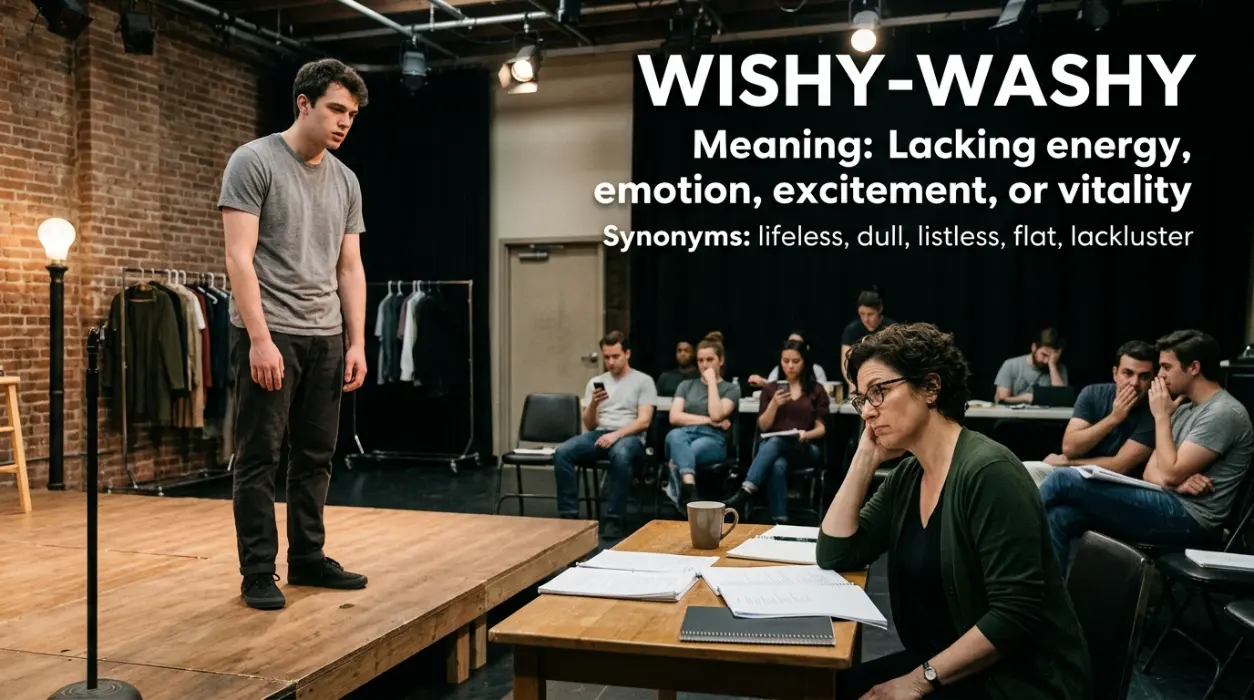
Lifeless (Adjective) — US /ˈlaɪfləs/ — UK /ˈlaɪfləs/
Meaning: Lacking energy, emotion, excitement, or vitality.
Tone/Register: Neutral; common.
Example:
The conversation felt lifeless after the argument.
The writer’s first draft was technically correct but lifeless.
Synonyms by Tone
The best synonym depends on the shade you want to communicate.
Neutral
- uncertain
- hesitant
- undecided
- tentative
- wavering
- unsettled
- unsteady
- changeable
- ambivalent
These choices describe uncertainty without necessarily attacking someone’s character.
Formal or Academic
- irresolute
- vacillating
- equivocal
- indeterminate
- tergiversating
- ineffectual
- jejune
- unassertive
These are useful when you need a more precise or sophisticated vocabulary.
Strongly Negative
- spineless
- gutless
- cowardly
- mealy-mouthed
- weak
- ineffective
- feeble
- ineffectual
Use these carefully because they can criticize a person’s character or competence.
Playful or Informal
- wimpy
- namby-pamby
- shilly-shallying
- fence-sitting
- wishy-washy
These can sound conversational, humorous, sarcastic, or mocking.
Why Tone Matters
Two words can describe a similar idea while creating very different reactions.
Calling someone’s response tentative may sound fair. Calling it spineless sounds openly hostile.
Therefore, vocabulary choice is not only about meaning. It also communicates attitude.
“Wishy-Washy” vs Close Alternatives
Indecisive vs. Wishy-Washy
Wishy-washy is broader and more informal. It can describe weak opinions, vague statements, weak character, or bland qualities.
Indecisive specifically focuses on difficulty making a decision.
Use indecisive in professional or academic writing when you want a precise description.
Wishy-Washy vs Noncommittal
Noncommittal describes someone who avoids expressing a definite opinion, promise, or position.
It is more formal and neutral than wishy-washy.
For example, a politician’s answer can be called noncommittal without suggesting that the speaker is personally weak.
Wishy-Washy vs Vague
Vague means unclear or lacking specific information.
A person can be vague without being indecisive.
Therefore, use vague when the problem is unclear information. Use indecisive when the problem is an inability to choose.
How “Wishy-Washy” Changes by Context
Daily Conversation
In everyday speech, wishy-washy sounds natural when you are criticizing an unclear decision or weak opinion.
“Stop being wishy-washy and just choose one.”
However, it can sound blunt. If you want to be kinder, try hesitant, uncertain, or undecided.
Writing and Blogging
Bloggers often use wishy-washy when they want a conversational tone.
For example:
“Readers don’t want a wishy-washy conclusion.”
In more polished writing, vague, noncommittal, equivocal, or indecisive may sound more precise.
Professional or Academic English
Professional communication usually benefits from specific vocabulary.
Instead of saying:
“The manager was wishy-washy.”
You could write:
“The manager appeared hesitant to make a final decision.”
That version sounds more objective and less personal.
Creative or Informal Writing
In stories, dialogue, humor, and character descriptions, wishy-washy can be expressive.
A character who constantly changes their mind might be described as wishy-washy, fickle, wimpy, or shilly-shallying, depending on the intended personality.
Common Mistakes Learners Make
Mistake 1: Treating Every Synonym as Identical
Indecisive, vague, and weak overlap with “wishy-washy,” but they do not mean the same thing.
Always identify the specific problem first.
Mistake 2: Using Strong Insults in Formal Writing
Words such as gutless, spineless, and cowardly can sound aggressive.
They are usually inappropriate when you need an objective academic or workplace tone.
Mistake 3: Confusing Ambivalence With Indecision
Ambivalent means having mixed feelings.
It does not necessarily mean that someone cannot decide.
For example, you can be ambivalent about moving abroad while still making a clear decision.
Mistake 4: Using “Wishy-Washy” for Every Weak Thing
The word has several senses.
A weak argument might be wishy-washy, but a factual statement with insufficient detail may simply be vague.
Likewise, a pale color can be called wishy-washy, but pale may be more exact.
Register Notes
Wishy-washy is informal and usually disapproving. Cambridge and Oxford both identify its informal usage, especially for unclear or non-firm ideas.
For formal writing, choose a more precise alternative such as noncommittal, equivocal, indecisive, or unassertive.
For professional emails, unclear, tentative, or noncommittal will often sound more constructive.
Real-Life Mini Scenarios
Workplace
A manager avoids approving a project and keeps saying, “We’ll see.”
You could describe the response as noncommittal, tentative, or indecisive.
If you want a stronger criticism, ineffectual or wishy-washy may fit.
Social Situations
A friend changes their restaurant choice three times.
You might say:
“You’re being indecisive.”
For playful teasing, shilly-shallying or fickle could work.
Media and Pop Culture
A public figure gives several answers without clearly supporting either side.
A journalist might describe the comments as equivocal, evasive, or noncommittal.
A casual commentator might simply call them wishy-washy.
Writing and Storytelling
A fictional character avoids every difficult decision.
The narrator could call the character irresolute, wavering, or timid.
For a humorous voice, namby-pamby or wimpy may create a stronger personality.
Practice Exercise
1. Your colleague cannot decide between two meeting dates. Which word fits best?
A. Bland
B. Indecisive
C. Colorless
D. Innocuous
2. A spokesperson refuses to give a definite answer. Which word is most precise?
A. Noncommittal
B. Watery
C. Lifeless
D. Pale
3. A student writes an argument with very little evidence. Which word fits?
A. Thin
B. Fickle
C. Timid
D. Wavering
4. Someone keeps changing their opinion every few minutes. Which word fits best?
A. Fickle
B. Innocuous
C. Subdued
D. Feeble
5. A formal report gives a deliberately unclear conclusion. Which word works best?
A. Wimpy
B. Equivocal
C. Soft
D. Bland
6. A person’s answer avoids taking either side. Which expression fits?
A. Fence-sitting
B. Lifeless
C. Watery
D. Pale
7. A speech contains little energy or enthusiasm. Which word fits best?
A. Lackluster
B. Decisive
C. Assertive
D. Firm
8. Which word is most appropriate for an academic essay?
A. Gutless
B. Wimpy
C. Equivocal
D. Namby-pamby
9. A friend keeps delaying a simple choice in a playful situation. Which expression fits?
A. Shilly-shallying
B. Indeterminate
C. Ineffectual
D. Colorless
10. Someone avoids answering a difficult question directly. Which word fits?
A. Evasive
B. Pale
C. Tepid
D. Spiritless
Answer Key
1-B | 2-A | 3-A | 4-A | 5-B | 6-A | 7-A | 8-C | 9-A | 10-A
Reflection Task
Write one sentence about a real person, decision, article, or conversation using indecisive, tentative, noncommittal, or another synonym from this guide.
Conclusion
Understanding wishy-washy can help you describe someone or something that lacks firmness, clarity, or decisiveness. Learning its synonyms, meaning, and examples can improve your English vocabulary and help you express ideas more precisely.
The phrase wishy-washy is commonly used to describe unclear opinions, weak decisions, or statements that lack confidence. Knowing its related synonyms can help you express uncertainty, indecision, or a lack of commitment in different ways.
By practicing wishy-washy in sentences and exploring related expressions, you can strengthen your vocabulary and communication skills. Understanding this phrase will help you use it naturally and confidently in different English contexts.
FAQs
1. What is the best synonym for wishy-washy in formal English?
For formal English, noncommittal, indecisive, equivocal, irresolute, or unassertive are usually better choices. The best option depends on the meaning. Use noncommittal when someone avoids a definite position, indecisive when someone struggles to choose, and equivocal when language is deliberately unclear.
2. What is a polite synonym for wishy-washy?
Tentative, uncertain, hesitant, and undecided are generally more polite than “wishy-washy.” They describe uncertainty without directly attacking someone’s character. For example, “She sounded tentative about the proposal” is softer than “She sounded wishy-washy about the proposal.”
3. What is the difference between wishy-washy and indecisive?
Indecisive specifically describes difficulty making a decision. Wishy-washy is broader and more informal. It can describe indecision, weak opinions, vague statements, weak character, or even pale colors. Therefore, “indecisive” is usually more precise when the issue is simply decision-making.
4. Can wishy-washy describe writing or an argument?
Yes. “Wishy-washy” can describe writing, arguments, answers, or opinions that lack force, clarity, or definite ideas. However, vague, weak, equivocal, thin, or insipid may be more precise depending on the problem. In academic writing, a specific term is usually preferable.
5. Is wishy-washy a negative word?
Yes. “Wishy-washy” normally carries a negative or disapproving tone. It suggests that someone or something lacks firmness, clarity, strength, or distinctive qualities. Cambridge explicitly labels the word as informal and disapproving.

Hasnain Ali is an SEO Content Strategist and the founder of wordvora.com, a trusted vocabulary platform that helps writers, students, professionals, and English learners find accurate synonyms, antonyms, word meanings, and real-life usage examples. He specializes in keyword research, on-page SEO, topical authority, and creating search-first content that aligns with Google’s latest Search Quality and E-E-A-T guidelines. His work focuses on producing clear, well-structured, and reader-friendly resources that satisfy search intent while maintaining high editorial standards.
Through extensive hands-on experience with SEO tools such as Google Search Console, Google Analytics, SEMrush, and Ahrefs, Hasnain researches user search behavior and develops content that is both informative and easy to understand. Every article published on wordvora.com is carefully reviewed for accuracy, readability, and contextual relevance before publication. His mission is to build one of the web’s most reliable English vocabulary resources by providing practical language guidance, trustworthy explanations, and content that helps readers improve their writing, communication, and vocabulary with confidence.