
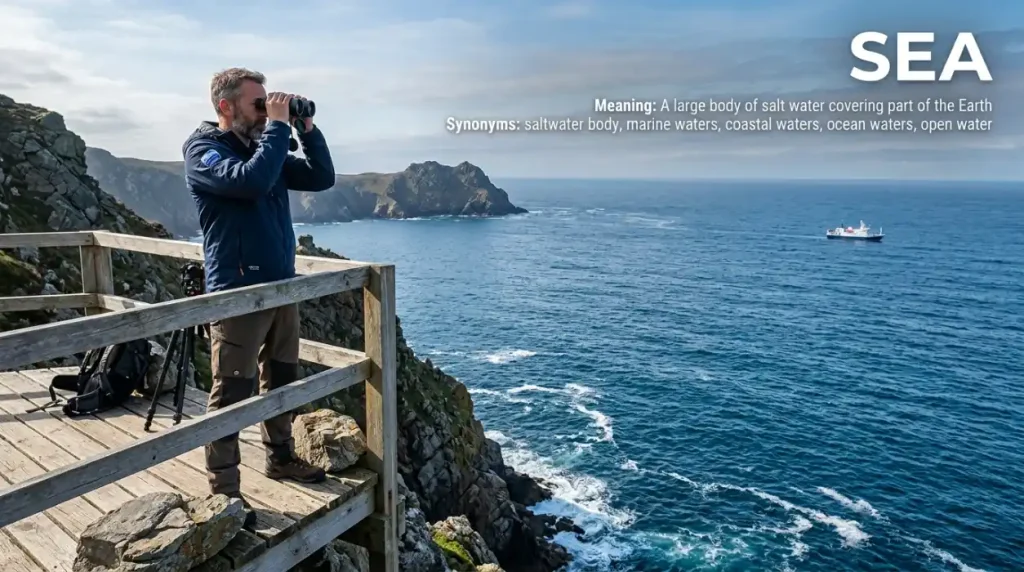
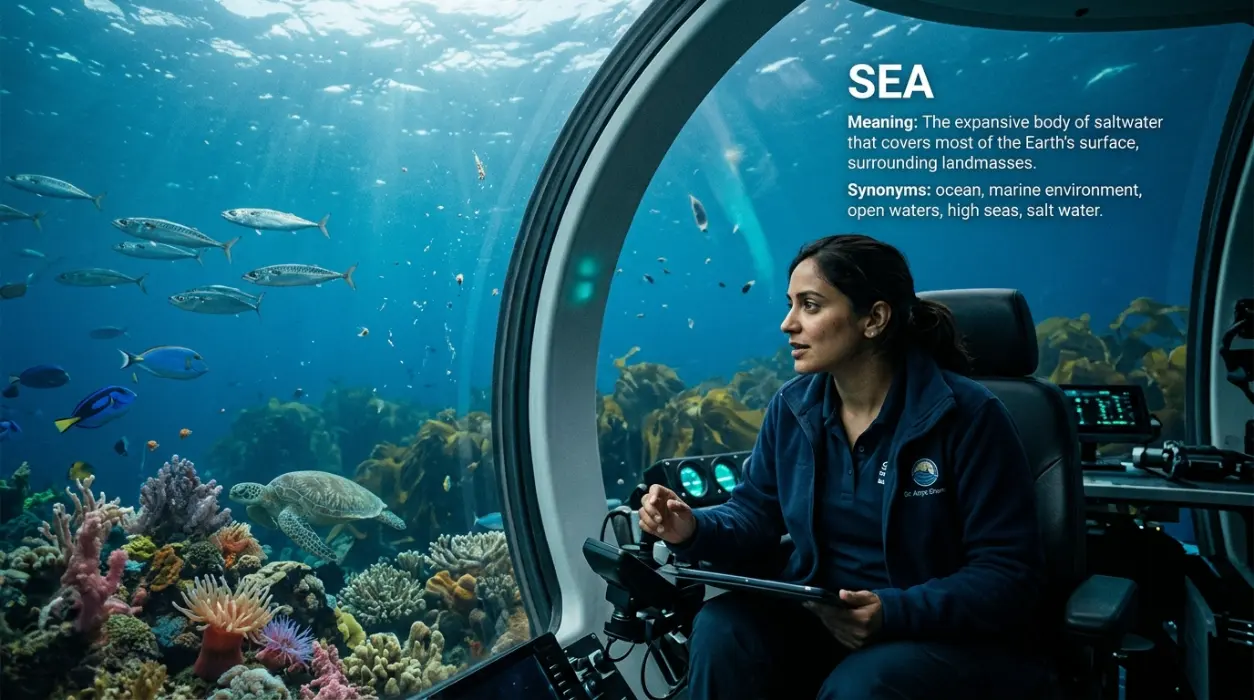
The word sea refers to a large body of salt water that is usually connected to an ocean and partly enclosed by land. It is an important part of the natural world and plays a major role in marine ecosystems, climate, travel, and human life.
Understanding sea can help you describe different aspects of the marine environment, from calm coastal waters to vast stretches of salt water. Learning its synonyms and related terms can also expand your vocabulary and help you express descriptions more clearly.
The word can appear in many contexts, including geography, literature, travel, science, and everyday conversations. Exploring its meanings, synonyms, and examples can make it easier to understand how the word is used in different situations.
By learning sea, its synonyms, meanings, and examples, you can strengthen your English vocabulary and improve your communication skills. This guide will help you use the word accurately and confidently in various contexts.
What Does “Synonyms for Sea” Really Mean?
The phrase “synonyms for sea” refers to alternative vocabulary words that can replace “sea” depending on the context. In standard English, “sea” usually denotes a vast expanse of salt water that covers most of the earth’s surface. However, native speakers also use it figuratively to describe a vast, continuous expanse of any substance or crowd.
Part of speech: Noun.
Definition: A word or phrase that means the same or nearly the same as the body of salt water covering the earth or a vast, sprawling quantity.
Connotative Meaning
(Connotation is the emotional feeling, cultural association, or tone attached to a word beyond its literal dictionary definition.)
- Positive tone: Connotes calming beauty, infinite horizons, inspiring freedom, and soothing coastal breezes.
- Negative tone: Expresses overwhelming danger, dark depths, terrifying storms, and crushing waves.
- Neutral tone: Refers to geographical bodies of water, marine environments, or navigation routes objectively.
Etymology
The word “sea” originates from Old English sǣ, which traces back to Proto-Germanic *saivaz (meaning body of standing water or lake).
- Old English (450–1100): Early speakers used sǣ alongside poetic terms like haf to describe stormy open waters.
- Middle English (1100–1500): Middle English retained see, expanding its usage into maritime trade and nautical prose.
- Modern English (1500–Present): Modern English standardizes “sea” for both global marine bodies and vast non-aquatic expanses.
Pronunciation
- US: /siː/
- UK: /siː/
Syllables & Structure
- Syllables: sea
- Root: sea
- Prefix: None
- Suffix: None
Synonyms List
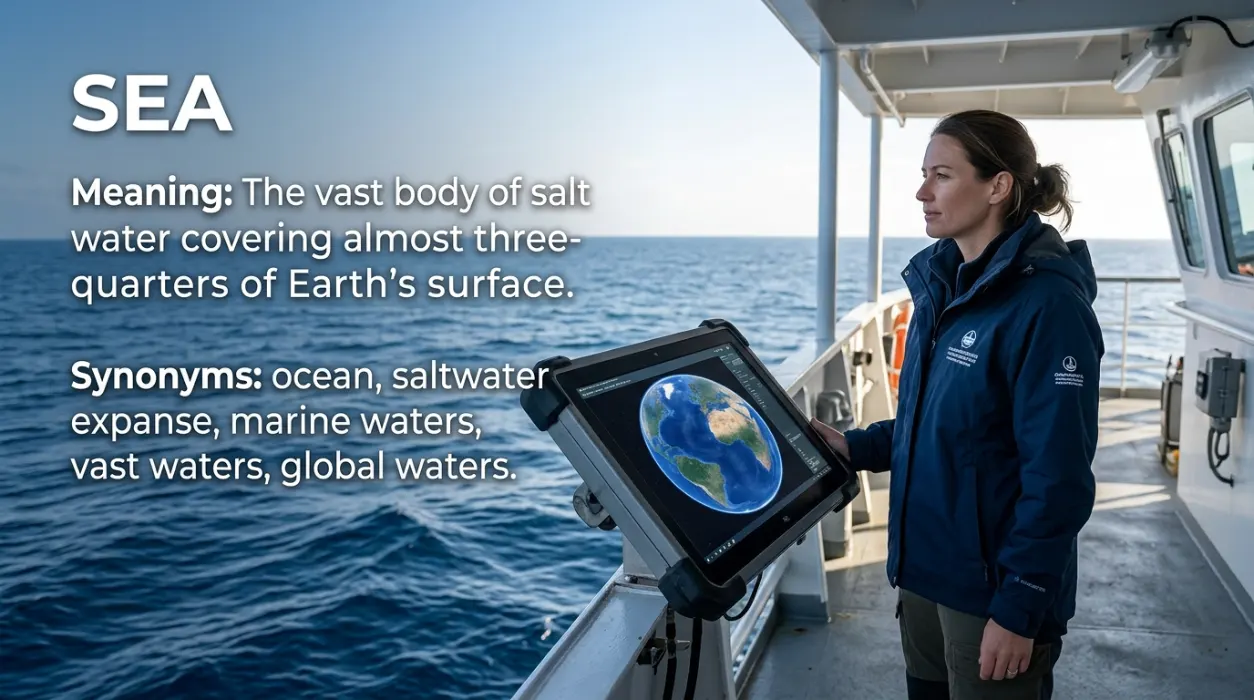
Ocean (Noun) — US: /ˈoʊ.ʃən/ | UK: /ˈəʊ.ʃən/
Meaning: The vast body of salt water that covers almost three-quarters of the earth’s surface.
Tone/Register: Standard, Geographical
Example:
The cruise ship sailed across the calm ocean under a starry sky.
Researchers studied migratory whales swimming through the deep ocean.
Deep (Noun) — US: /diːp/ | UK: /diːp/
Meaning: A poetic or literary term for the profound, vast depths of the sea.
Tone/Register: Literary, Poetic
Example:
Sailors whispered tales of mysterious creatures hiding in the deep.
The sunken ship rested peacefully at the bottom of the deep.
Main (Noun) — US: /meɪn/ | UK: /meɪn/
Meaning: An archaism or poetic term specifically denoting the open ocean.
Tone/Register: Archaic, Literary
Example:
Pirates set sail upon the rolling main in search of island treasure.
The vessel navigated the open main during early dawn hours.
Brine (Noun) — US: /braɪn/ | UK: /braɪn/
Meaning: A salty solution or the salty water of the ocean itself.
Tone/Register: Informal, Maritime
Example:
Fishermen hauled their heavy nets out of the cold brine.
The fresh coastal air smelled strongly of salt and splashing brine.
Drink (Noun) — US: /drɪŋk/ | UK: /drɪŋk/
Meaning: A figurative slang term referring to the ocean, usually in idioms like “Davy Jones’s locker.”
Tone/Register: Colloquial, Nautical
Example:
He accidentally dropped his camera directly into the drink.
The wooden crate fell off the deck and sank into the drink.
Waters (Noun) — US: /ˈwɑː.t̬ɚz/ | UK: /ˈwɔː.təz/
Meaning: An area of sea under a specific jurisdiction or surrounding a geographical region.
Tone/Register: Formal, Technical
Example:
The coast guard monitored all foreign vessels in territorial waters.
Tropical fish thrive in the warm waters surrounding the island reef.
Wave (Noun) — US: /weɪv/ | UK: /weɪv/
Meaning: A poetic singular or collective term representing the undulating sea surface.
Tone/Register: Poetic, Descriptive
Example:
Ancient mariners braved the wild wave to reach new lands.
She stared out at the endless wave stretching toward the horizon.
Deep Blue (Noun) — US: /diːp bluː/ | UK: /diːp bluː/
Meaning: An evocative, color-based idiom for the open ocean waters.
Tone/Register: Creative, Figurative
Example:
Dolphins leaped gracefully out of the deep blue during sunset.
Our sailboat cut smoothly through the sparkling deep blue.
Salt (Noun) — US: /sɑːlt/ | UK: /sɒlt/
Meaning: A traditional maritime nickname for the sea, highlighting its salinity.
Tone/Register: Colloquial, Nautical
Example:
Old sailors spent their entire lives living upon the salt.
The relentless spray of the salt rusted the ship’s metal railing.
Neptune’s Kingdom (Noun Phrase) — US: /ˈnep.tuːnz ˈkɪŋ.dəm/ | UK: /ˈnep.tjuːnz ˈkɪŋ.dəm/
Meaning: A classical mythological metaphor for the entire marine domain.
Tone/Register: Figurative, Mythological
Example:
Divers explored the colorful coral reefs of Neptune’s kingdom.
Submarines descended into the dark corners of Neptune’s kingdom.
Billow (Noun) — US: /ˈbɪl.oʊ/ | UK: /ˈbɪl.əʊ/
Meaning: A large wave or swelling mass of water on the sea surface.
Tone/Register: Literary, Elevated
Example:
The storm created massive billows that rocked the fishing boat.
Sailors struggled against the rising billows during the hurricane.
Foam (Noun) — US: /foʊm/ | UK: /fəʊm/
Meaning: The frothy layer of water produced by breaking waves on the sea.
Tone/Register: Poetic, Visual
Example:
White foam washed over the golden sandy shoreline at high tide.
The ship left a trail of churning foam in its wake.
Abyss (Noun) — US: /əˈbɪs/ | UK: /əˈbɪs/
Meaning: A bottomless or extremely deep chasm within the oceanic trench.
Tone/Register: Dramatic, Academic
Example:
Submersibles journeyed down into the pitch-black ocean abyss.
Scientists discovered strange bioluminescent organisms in the abyss.
High Seas (Noun Phrase) — US: /haɪ siːz/ | UK: /haɪ siːz/
Meaning: The open ocean waters lying outside the territorial jurisdiction of any nation.
Tone/Register: Legal, Maritime
Example:
Naval patrols enforce international law across the high seas.
Merchant ships navigate the high seas to carry international trade cargo.
Offshore Waters (Noun Phrase) — US: /ˌɑːfˈʃɔːr ˈwɑː.t̬ɚz/ | UK: /ˌɒfˈʃɔː ˈwɔː.təz/
Meaning: The regions of the sea located at a distance from the coast.
Tone/Register: Technical, Environmental
Example:
Strong winds generate dangerous currents in offshore waters.
Fishermen head out into offshore waters for deep-sea tuna fishing.
Pelagic Zone (Noun Phrase) — US: /pəˈlædʒ.ɪk zoʊn/ | UK: /pəˈlædʒ.ɪk zəʊn/
Meaning: The open ocean water column not close to the bottom or shore.
Tone/Register: Academic, Scientific
Example:
Tuna and sharks inhabit the expansive pelagic zone of oceans.
Biologists sampled water quality across the upper pelagic zone.
Marine Domain (Noun Phrase) — US: /məˈriːn doʊˈmeɪn/ | UK: /məˈriːn dəˈmeɪn/
Meaning: The entire ecological or geographical system encompassed by saltwater bodies.
Tone/Register: Scientific, Formal
Example:
Conservationists work hard to protect the delicate marine domain.
New environmental laws restrict pollution inside the marine domain.
Expanse (Noun) — US: /ɪkˈspæns/ | UK: /ɪkˈspæns/
Meaning: A wide, continuous area of open water stretching as far as the eye can see.
Tone/Register: Descriptive, General
Example:
Passengers looked out over the vast blue expanse from the top deck.
The airplane flew across an endless expanse of ocean water.
Tide (Noun) — US: /taɪd/ | UK: /taɪd/
Meaning: The alternating rise and fall of the sea, often used figuratively for the sea itself.
Tone/Register: General, Nautical
Example:
Children built sandcastles before the incoming tide washed them away.
The fishing boats returned to harbor with the evening tide.
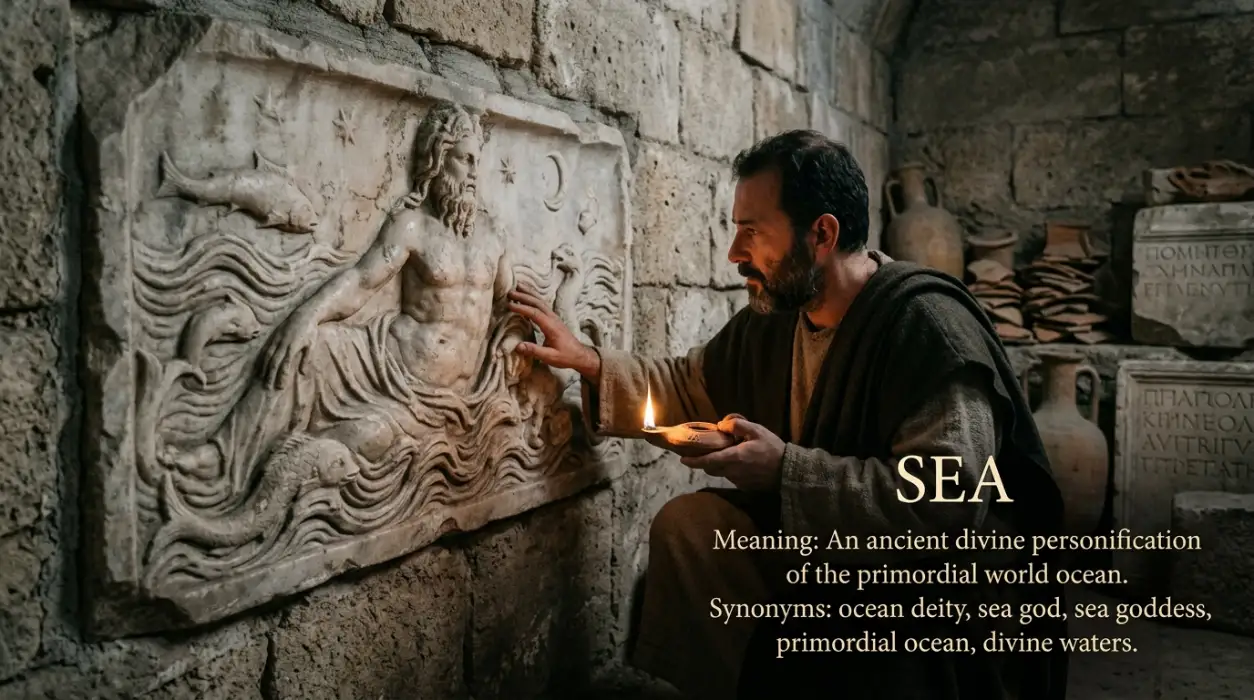
Oceanus (Noun) — US: /oʊˈsiː.ə.nəs/ | UK: /əʊˈsiː.ə.nəs/
Meaning: The ancient divine personification or classical origin of the world ocean.
Tone/Register: Historical, Mythological
Example:
Ancient Greek poets wrote epic verses about the titan Oceanus.
The myth described Oceanus as a giant river encircling the earth.
Gulf (Noun) — US: /ɡʌlf/ | UK: /ɡʌlf/
Meaning: A large area of sea almost surrounded by land with a narrow mouth.
Tone/Register: Geographical, Standard
Example:
Cargo ships sailed smoothly across the calm waters of the gulf.
The coastal city sits right along the edge of the scenic gulf.
Bay (Noun) — US: /beɪ/ | UK: /beɪ/
Meaning: A broad inlet of the sea where the land curves inward.
Tone/Register: Geographical, Common
Example:
Tourists rented kayaks to explore the quiet waters of the bay.
The fishing village overlooks a picturesque sheltered bay.
Sound (Noun) — US: /saʊnd/ | UK: /saʊnd/
Meaning: A long, relatively wide sea passage between two landmasses.
Tone/Register: Geographical, Nautical
Example:
Ferries carry passengers daily across the choppy water sound.
Whales often seek shelter in the protected waters of the sound.
Strait (Noun) — US: /streɪt/ | UK: /streɪt/
Meaning: A narrow passage of water connecting two larger seas or oceans.
Tone/Register: Geographic, Strategic
Example:
Oil tankers navigate carefully through the narrow maritime strait.
The strategic strait links two major trading oceans together.
Firth (Noun) — US: /fɝːθ/ | UK: /fɜːθ/
Meaning: A narrow inlet of the sea, especially in Scotland or northern coastal areas.
Tone/Register: Regional, Geographical
Example:
Seals gathered on the rocky banks along the cold Scottish firth.
The cottage offers panoramic views across the misty coastal firth.
Inlet (Noun) — US: /ˈɪn.let/ | UK: /ˈɪn.lət/
Meaning: A small, narrow arm of sea extending into a coastline or river mouth.
Tone/Register: Technical, Descriptive
Example:
Sailors moored their boat inside a quiet, sheltered inlet during the storm.
The tide rushed quickly into the shallow coastal inlet.
Lagoon (Noun) — US: /ləˈɡuːn/ | UK: /ləˈɡuːn/
Meaning: A stretch of salt water separated from the sea by a low sandbank or coral reef.
Tone/Register: Geographical, Tropical
Example:
Swimmers enjoyed the clear, shallow water of the tropical lagoon.
Coral reefs protect the tranquil lagoon from heavy ocean swells.
Basin (Noun) — US: /ˈbeɪ.sən/ | UK: /ˈbeɪ.sən/
Meaning: A large natural depression on the earth’s surface containing seawater.
Tone/Register: Scientific, Geographic
Example:
Geologists mapped the floor of the deep Mediterranean ocean basin.
Sediment accumulates steadily along the floor of the marine basin.
Estuary (Noun) — US: /ˈes.tʃu.er.i/ | UK: /ˈes.tʃu.ə.ri/
Meaning: The tidal mouth of a large river, where the tide meets the stream.
Tone/Register: Scientific, Environmental
Example:
Freshwater mixes continuously with salt water inside the coastal estuary.
Birds gather in large flocks to feed along the muddy estuary banks.
Fjord (Noun) — US: /fjɔːrd/ | UK: /fjɔːd/
Meaning: A long, narrow, deep inlet of the sea between cliffs, created by glaciers.
Tone/Register: Geographical, Descriptive
Example:
The cruise liner glided past towering ice mountains in the Norwegian fjord.
Tourists photographed waterfalls cascading down cliffs into the quiet fjord.
Sea of Green (Idiomatic Phrase) — US: /siː ʌv ɡriːn/ | UK: /siː ɒv ɡriːn/
Meaning: A vast, unbroken field of grass, trees, or vegetation resembling an ocean.
Tone/Register: Metaphorical, Expressive
Example:
The rolling hills stretched out like an endless sea of green.
From the mountaintop, the forest looked like a vast sea of green.
Sea of Faces (Idiomatic Phrase) — US: /siː ʌv feɪ.sɪz/ | UK: /siː ɒv feɪ.sɪz/
Meaning: A large, overwhelming crowd of people gathered in one place.
Tone/Register: Figurative, Conversational
Example:
The speaker looked out at a sea of faces waiting in the auditorium.
At the stadium concert, the singer faced an energetic sea of faces.
Sea of Red (Idiomatic Phrase) — US: /siː ʌv red/ | UK: /siː ɒv red/
Meaning: A massive visual display of red clothing or falling financial markets.
Tone/Register: Idiomatic, Financial
Example:
Investors panicked when the stock market board turned into a sea of red.
Fans wearing home jerseys transformed the stadium into a sea of red.
Sea of Troubles (Idiomatic Phrase) — US: /siː ʌv ˈtrʌb.əlz/ | UK: /siː ɒv ˈtrʌb.əlz/
Meaning: An overwhelming collection of difficulties, problems, or emotional challenges.
Tone/Register: Literary, Dramatic
Example:
He felt trapped within a sea of troubles after losing his job.
The classic play describes a character struggling against a sea of troubles.
Sea of Change (Idiomatic Phrase) — US: /siː ʌv tʃeɪndʒ/ | UK: /siː ɒv tʃeɪndʒ/
Meaning: A massive, fundamental transformation in circumstances or opinion.
Tone/Register: Expressive, Formal
Example:
New technological tools triggered a total sea of change in modern work.
The company experienced a sea of change after hiring a new director.
Briny Deep (Noun Phrase) — US: /ˈbraɪ.ni diːp/ | UK: /ˈbraɪ.ni diːp/
Meaning: A cheerful, humorous, or classic nautical phrase for the ocean.
Tone/Register: Playful, Nautical
Example:
The old sailor loved telling stories about his years on the briny deep.
Our ship sailed out into the briny deep early Monday morning.
Big Blue (Noun Phrase) — US: /bɪɡ bluː/ | UK: /bɪɡ bluː/
Meaning: A friendly, informal nickname used for the ocean.
Tone/Register: Casual, Colloquial
Example:
Surfers head out into the big blue every weekend to catch waves.
We sat on the sandy dune staring at the big blue.
Davy Jones’s Locker (Idiomatic Phrase) — US: /ˌdeɪ.vi ˈdʒoʊnzɪz ˈlɑː.kɚ/ | UK: /ˌdeɪ.vi ˈdʒəʊnzɪz ˈlɒk.ər/
Meaning: An idiom representing the bottom of the sea, where drowned ships rest.
Tone/Register: Idiomatic, Figurative
Example:
The wooden pirate vessel sank straight down to Davy Jones’s locker.
Lost treasures lie forgotten at the bottom of Davy Jones’s locker.
World Ocean (Noun Phrase) — US: /wɝːld ˈoʊ.ʃən/ | UK: /wɜːld ˈəʊ.ʃən/
Meaning: The interconnected system of Earth’s oceanic waters viewed as a single whole.
Tone/Register: Academic, Environmental
Example:
Climate shifts affect circulation patterns across the global ocean.
Scientists study carbon absorption within the vast world ocean.
Marine Ecosystem (Noun Phrase) — US: /məˈriːn ˈiː.koʊˌsɪs.təm/ | UK: /məˈriːn ˈiː.kəʊˌsɪs.təm/
Meaning: The complex community of organisms living together in ocean waters.
Tone/Register: Scientific, Academic
Example:
Plastic waste poses a serious threat to the delicate marine ecosystem.
Protecting the coastal marine ecosystem helps preserve coral life.
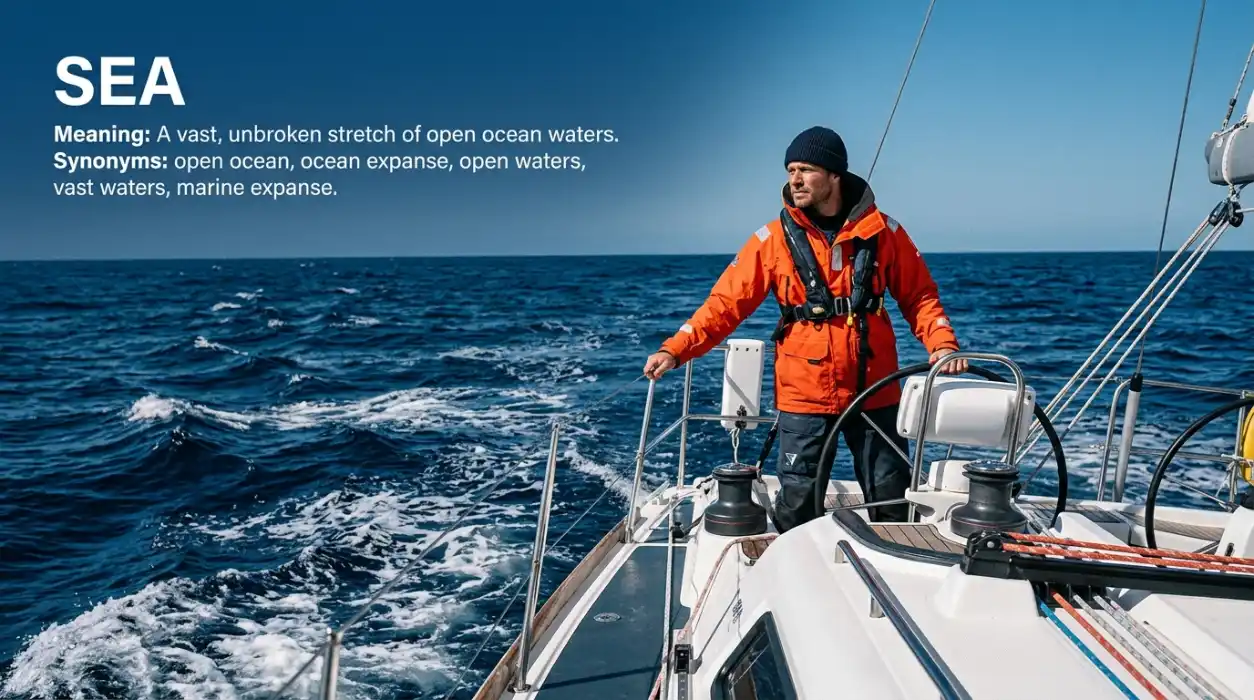
Oceanic Expanse (Noun Phrase) — US: /oʊ.ʃiˈæn.ɪk ɪkˈspæns/ | UK: /əʊ.ʃiˈæn.ɪk ɪkˈspæns/
Meaning: A vast, unbroken stretch of open ocean waters.
Tone/Register: Formal, Descriptive
Example:
Explorers mapped uncharted areas across the wide oceanic expanse.
The satellite captured images of clouds drifting over the oceanic expanse.
Watery Grave (Idiomatic Phrase) — US: /ˈwɑː.t̬ɚ.i ɡreɪv/ | UK: /ˈwɔː.tər.i ɡreɪv/
Meaning: A dramatic idiom for drowning or sinking permanently into the sea.
Tone/Register: Literary, Dramatic
Example:
The brave captain managed to save his crew from a watery grave.
Historical records recall ships that met a watery grave during storms.
Great Water (Noun Phrase) — US: /ɡreɪt ˈwɑː.t̬ɚ/ | UK: /ɡreɪt ˈwɔː.tər/
Meaning: A poetic, traditional, or translation-based name for the open ocean.
Tone/Register: Literary, Archaic
Example:
Native teams traveled across the great water in sturdy canoes.
The ancient travelers looked in awe at the great water before them.
Saltwater Body (Noun Phrase) — US: /ˈsɑːltˌwɑː.t̬ɚ ˈbɑː.di/ | UK: /ˈsɒltˌwɔː.tə ˈbɒd.i/
Meaning: A generic geographical term describing any body of saline water.
Tone/Register: Technical, Educational
Example:
Lakes with high mineral levels can form an inland saltwater body.
Geography classes study how each saltwater body affects climate patterns.
Salt Kingdom (Noun Phrase) — US: /sɑːlt ˈkɪŋ.dəm/ | UK: /sɒlt ˈkɪŋ.dəm/
Meaning: A poetic phrase describing the vast ocean realm.
Tone/Register: Poetic, Creative
Example:
Whales reign supreme inside the cold, majestic salt kingdom.
Tales of sea monsters emerged from the mysterious salt kingdom.
Aquatic Realm (Noun Phrase) — US: /əˈkwæt̬.ɪk relm/ | UK: /əˈkwæt.ɪk relm/
Meaning: The biological domain encompassing all ocean environments.
Tone/Register: Formal, Academic
Example:
Documentary crews filmed stunning footage inside the deep aquatic realm.
Coral reefs serve as vibrant cities within the global aquatic realm.
Blue World (Noun Phrase) — US: /bluː wɝːld/ | UK: /bluː wɜːld/
Meaning: An evocative term describing Earth’s ocean-covered surface.
Tone/Register: Popular, Descriptive
Example:
Astronauts looking down from orbit marvel at our shimmering blue world.
Conservation programs raise public awareness about protecting the blue world.
Surface Waters (Noun Phrase) — US: /ˈsɝː.fɪs ˈwɑː.t̬ɚz/ | UK: /ˈsɜː.fɪs ˈwɔː.təz/
Meaning: The uppermost layer of ocean water exposed to the atmosphere.
Tone/Register: Scientific, Technical
Example:
Solar radiation heats the surface waters during long summer days.
Plankton flourishes abundant in light-filled surface waters.
Deep Waters (Noun Phrase) — US: /diːp ˈwɑː.t̬ɚz/ | UK: /diːp ˈwɔː.təz/
Meaning: Ocean depths far beneath the reach of surface sunlight.
Tone/Register: General, Descriptive
Example:
Specialized equipment is required to explore deep waters safely.
Pressure increases exponentially as submersibles descend into deep waters.
Offshore Sea (Noun Phrase) — US: /ˌɑːfˈʃɔːr siː/ | UK: /ˌɒfˈʃɔː siː/
Meaning: The ocean sector positioned away from coastal bays and harbors.
Tone/Register: Maritime, Standard
Example:
Wind farms placed in the offshore sea produce clean energy efficiently.
Naval vessels conducted training maneuvers out in the offshore sea.
High Tide (Noun) — US: /haɪ taɪd/ | UK: /haɪ taɪd/
Meaning: The point at which the sea reaches its highest level on the shore.
Tone/Register: Standard, Everyday
Example:
Waves swept over the coastal sea wall during high tide yesterday.
Fishermen waited for high tide to launch their heavy wooden boats.
Low Tide (Noun) — US: /loʊ taɪd/ | UK: /ləʊ taɪd/
Meaning: The point at which the sea reaches its lowest level along the beach.
Tone/Register: Standard, Everyday
Example:
Children searched for small crabs in tide pools during low tide.
The muddy harbor floor lay completely exposed at low tide.
Ocean Depth (Noun) — US: /ˈoʊ.ʃən depθ/ | UK: /ˈəʊ.ʃən depθ/
Meaning: The vertical measurement or bottom region of the sea.
Tone/Register: Academic, Precise
Example:
Sonar devices measured the exact ocean depth beneath the vessel.
Unique pressure-resistant life forms inhabit extreme ocean depths.
Water Margin (Noun Phrase) — US: /ˈwɑː.t̬ɚ ˈmɑːr.dʒɪn/ | UK: /ˈwɔː.tər ˈmɑː.dʒɪn/
Meaning: The coastal area where the sea meets the dry land edge.
Tone/Register: Literary, Visual
Example:
Birds scampered along the water margin searching for food.
Sunset created a beautiful red glow along the water margin.
Open Sea (Noun Phrase) — US: /ˈoʊ.pən siː/ | UK: /ˈəʊ.pən siː/
Meaning: The expanse of ocean clear of land obstacles and harbors.
Tone/Register: Maritime, Clear
Example:
Once clear of the narrow harbor, the ship reached the open sea.
Sailing through the open sea requires strong navigation skills.
Deep Water (Noun Phrase) — US: /diːp ˈwɑː.t̬ɚ/ | UK: /diːp ˈwɔː.tər/
Meaning: Offshore ocean regions where the seabed drops to significant depths.
Tone/Register: Neutral, Maritime
Example:
Cargo vessels proceeded cautiously into deep water outside the harbor.
Naval crews conducted training exercises out in deep water.
Billowing Sea (Noun Phrase) — US: /ˈbɪl.oʊ.ɪŋ siː/ | UK: /ˈbɪl.əʊ.ɪŋ siː/
Meaning: An expansive body of sea characterized by rolling, surging waves.
Tone/Register: Descriptive, Literary
Example:
The wooden tall ship swayed gently against the billowing sea.
Photographers captured the majestic light reflecting off the billowing sea.
Marine Waterway (Noun Phrase) — US: /məˈriːn ˈwɑː.t̬ɚ.eɪ/ | UK: /məˈriːn ˈwɔː.tə.weɪ/
Meaning: A navigable sea lane or channel designated for ocean vessel traffic.
Tone/Register: Formal, Technical
Example:
Authorities monitor traffic flow across the busy marine waterway.
Coast guards ensure safe navigation throughout the busy marine waterway.
Offshore Reach (Noun Phrase) — US: /ˌɑːfˈʃɔːr riːtʃ/ | UK: /ˌɒfˈʃɔː riːtʃ/
Meaning: The open stretches of sea lying well beyond coastal territorial waters.
Tone/Register: Technical, Geographical
Example:
Fishermen ventured far into the offshore reach to track tuna shoals.
Weather warnings advised small craft against entering the offshore reach.
Seaboard Waters (Noun Phrase) — US: /ˈsiː.bɔːrd ˈwɑː.t̬ɚz/ | UK: /ˈsiː.bɔːd ˈwɔː.təz/
Meaning: The ocean expanse adjacent to a specific mainland coastline.
Tone/Register: Geographical, Formal
Example:
Marine biologists logged aquatic species inhabiting seaboard waters.
Coastal towns rely heavily on fishing within seaboard waters.
Offshore Swell (Noun Phrase) — US: /ˌɑːfˈʃɔːr swel/ | UK: /ˌɒfˈʃɔː swel/
Meaning: Long, continuous ocean waves moving across open water away from land.
Tone/Register: Maritime, Descriptive
Example:
Surfers waited patiently for the huge offshore swell to reach the reef.
The sailboat crested smoothly over the rolling offshore swell.
Pelagic Depth (Noun Phrase) — US: /pəˈlædʒ.ɪk depθ/ | UK: /pəˈlædʒ.ɪk depθ/
Meaning: The deeper oceanic layers of the open sea away from coastal margins.
Tone/Register: Scientific, Academic
Example:
Submersibles recorded unique thermal vents hidden at pelagic depth.
Bioluminescent creatures flourish in the darkness of pelagic depth.
Marine Waters (Noun Phrase) — US: /məˈriːn ˈwɑː.t̬ɚz/ | UK: /məˈriːn ˈwɔː.təz/
Meaning: Saline ocean bodies encompassed within marine ecosystems and jurisdictions.
Tone/Register: Formal, Environmental
Example:
Conservationists work tirelessly to reduce plastic waste in marine waters.
Strict regulations protect delicate coral life across marine waters.
Open Ocean (Noun Phrase) — US: /ˈoʊ.pən ˈoʊ.ʃən/ | UK: /ˈəʊ.pən ˈəʊ.ʃən/
Meaning: The vast sea expanse unattached to coastlines or landmasses.
Tone/Register: Standard, Geographical
Example:
Migratory whales travel thousands of miles across the open ocean.
Researchers deployed floating sensor buoys into the open ocean.
Ocean Wilderness (Noun Phrase) — US: /ˈoʊ.ʃən ˈwɪl.dɚ.nəs/ | UK: /ˈəʊ.ʃən ˈwɪl.də.nəs/
Meaning: Remote, untouched expanses of open sea uninhabited by human structures.
Tone/Register: Evocative, Descriptive
Example:
Explorers marveled at the undisturbed calm of the ocean wilderness.
Documentary film teams documented rare species within the ocean wilderness.
Salt Expanse (Noun Phrase) — US: /sɑːlt ɪkˈspæns/ | UK: /sɒlt ɪkˈspæns/
Meaning: A literary term for a vast, stretching body of saline water.
Tone/Register: Poetic, Descriptive
Example:
The setting sun cast a brilliant golden sheen across the salt expanse.
Sailors gazed at the endless salt expanse extending toward the horizon.
Offshore Horizon (Noun Phrase) — US: /ˌɑːfˈʃɔːr həˈraɪ.zən/ | UK: /ˌɒfˈʃɔː həˈraɪ.zən/
Meaning: The line where the distant sea surface meets the sky.
Tone/Register: Descriptive, Visual
Example:
Dark storm clouds gathered along the distant offshore horizon.
A solitary cargo vessel appeared on the clear offshore horizon.
Coastal Sea (Noun Phrase) — US: /ˈkoʊ.stəl siː/ | UK: /ˈkəʊ.stəl siː/
Meaning: The region of sea relatively close to land boundaries.
Tone/Register: Standard, Geographic
Example:
Warm temperatures made the coastal sea ideal for afternoon swimming.
Local fisheries rely on rich ecosystems in the coastal sea.
Salt Water (Noun) — US: /ˈsɑːlt ˈwɑː.t̬ɚ/ | UK: /ˈsɒlt ˈwɔː.tər/
Meaning: Saline ocean water, used metonymically to denote the sea itself.
Tone/Register: Informal, General
Example:
He spent his entire childhood swimming in the cool salt water.
The refreshing spray of salt water coated the vessel’s deck.
High Tide Line (Noun Phrase) — US: /haɪ taɪd laɪn/ | UK: /haɪ taɪd laɪn/
Meaning: The ocean margin boundary where peak high tides reach the shore.
Tone/Register: Technical, Geographical
Example:
Beachgoers placed their towels well above the marked high tide line.
Seaweed accumulated along the wet high tide line overnight.
Benthos Zone (Noun Phrase) — US: /ˈben.θɑːs zoʊn/ | UK: /ˈben.θɒs zəʊn/
Meaning: The lowest oceanic ecological zone along the sea floor.
Tone/Register: Academic, Scientific
Example:
Researchers collected soil samples directly from the benthos zone.
Organisms in the benthos zone adapt to extreme pressure conditions.
Oceanic Abyss (Noun Phrase) — US: /oʊ.ʃiˈæn.ɪk əˈbɪs/ | UK: /əʊ.ʃiˈæn.ɪk əˈbɪs/
Meaning: The extremely deep, dark region of the oceanic trenches.
Tone/Register: Dramatic, Academic
Example:
Submersibles illuminated lightless rock structures inside the oceanic abyss.
Mysterious deep-sea creatures dwell within the oceanic abyss.
Offshore Sector (Noun Phrase) — US: /ˌɑːfˈʃɔːr ˈsek.tɚ/ | UK: /ˌɒfˈʃɔː ˈsek.tər/
Meaning: A designated maritime zone situated away from coastal shores.
Tone/Register: Technical, Commercial
Example:
Engineers built wind turbines within the designated offshore sector.
Naval patrols monitor vessel routes throughout the offshore sector.
Mare (Noun) — US: /ˈmɑː.reɪ/ | UK: /ˈmɑː.reɪ/
Meaning: The Latin word for “sea,” used in scientific contexts and lunar ocean names.
Tone/Register: Formal, Scientific
Example:
Astronomers map smooth dark plains on the moon using the term mare.
Historical documents often referred to regional seas as mare.
Sea Realm (Noun Phrase) — US: /siː relm/ | UK: /siː relm/
Meaning: The entire marine territory encompassing sea life and open waters.
Tone/Register: Creative, Poetic
Example:
Ancient myths told stories of legendary gods who ruled the sea realm.
Dolphins move effortlessly through their vast sea realm.
Synonyms by Tone
Choosing the proper synonym for sea depends heavily on context and register. Therefore, grouping alternatives by tone ensures precise expression across different audiences.
Positive Tone
These options highlight serene beauty, vast wonder, or inspiring marine spaces:
- Deep blue
- Big blue
- Lagoon
- Blue world
- Marine domain
- Aquatic realm
Neutral Tone
These options state geographical facts, scientific domains, or coastal locations objectively:
- Ocean
- Waters
- High seas
- Pelagic zone
- Basin
- Offshore waters
- Saltwater body
Negative Tone
These words stress dark depth, terrifying storms, or overwhelming danger:
- Abyss
- Watery grave
- Sea of troubles
- Billow
- Davy Jones’s locker
Playful / Informal
These expressions introduce creative slang, nautical humor, or casual imagery:
- Brine
- Drink
- Salt
- Briny deep
- Sea of green
- Sea of faces
Mini Comparison
Sea vs. Ocean vs. Gulf
| Feature | Sea | Ocean | Gulf |
| Primary Focus | Smaller saltwater expanse, often partly landlocked. | Mass global body of open salt water. | Large sea inlet almost enclosed by land. |
| Tone | Universal, standard, and descriptive. | Scientific, vast, and authoritative. | Geographical, technical, and precise. |
| Best Usage Context | “We swam in the Mediterranean Sea.” | “Whales migrate across the Pacific Ocean.” | “Ships sailed across the Gulf of Mexico.” |
How “Synonyms for Sea” Change by Context
Daily Conversation
In casual speech, people prefer common choices like ocean, water, beach, or informal slang like big blue. For instance, a family might talk about heading down to the ocean for the weekend.
Writing or Blogging
Travel bloggers and content creators select evocative terms like deep blue, expanse, coastline, or lagoons. Consequently, these descriptive terms paint vivid mental pictures for online readers.
Professional or Academic Tone
Scientific journals, environmental reports, and maritime legal texts require precise technical vocabulary. Terms such as pelagic zone, marine domain, high seas, or oceanic expanse ensure clarity.
Creative or Informal Use
Fiction writers use expressive metaphors like briny deep, abyss, billows, or watery grave. As a result, these literary choices add dramatic tension to naval adventure stories.
Common Mistakes & Native Usage
Common Mistakes Learners Make
- Confusing “sea” and “ocean”: While used interchangeably, an ocean is much larger, whereas a sea is smaller and often enclosed by land.
- Using literary archaisms in professional texts: Terms like the main or the briny deep sound out of place in formal academic essays.
- Misinterpreting figurative idioms: Metaphors like sea of faces refer to crowds, not physical bodies of salt water.
Register Notes
- Spoken English: Casual conversations favor ocean, water, drink, and big blue.
- Written English: Formal prose uses high seas, pelagic zone, marine ecosystem, and oceanic expanse.
- To expand your vocabulary further across formal writing contexts, check out our guide on descriptive language choices.
Real-Life Mini Scenarios
Workplace
During an environmental policy meeting, researchers presented data on marine pollution. Consequently, the team agreed to focus cleanup efforts on territorial waters.
Social Situations
While relaxing on the beach, friends watched waves crashing against the sand. They joked about diving straight into the refreshing, briny deep.
Media / Pop Culture
A nature documentary crew filmed humpback whales migrating across the Pacific. The narrator described their journey through the vast pelagic zone.
Writing or Storytelling
An author wrote an adventure novel about 18th-century sailors. She described the captain steering his wooden ship through churning billows during a midnight storm.
Practice Quiz
1. Which synonym carries a formal, scientific tone for open ocean water columns?
A) Drink
B) Pelagic zone
C) Briny deep
D) Salt
2. What term refers to an inlet of the sea enclosed by steep glacial cliffs?
A) Fjord
B) Estuary
C) Gulf
D) Basin
3. Which option is an informal, nautical term for the ocean?
A) Marine domain
B) Brine
C) Oceanic expanse
D) Aquatic realm
4. What is the key difference between a “sea” and an “ocean”?
A) An ocean is smaller and enclosed by mountains
B) A sea is smaller and often partially enclosed by land
C) A sea contains fresh water while oceans contain salt water
D) Both terms mean the same thing in geography
5. Which figurative idiom describes an overwhelming crowd of people?
A) Sea of change
B) Sea of troubles
C) Sea of faces
D) Sea of red
6. Which term fits best in an international maritime law document?
A) High seas
B) Big blue
C) Drink
D) Watery grave
7. A narrow passage connecting two larger seas is called a:
A) Strait
B) Lagoon
C) Basin
D) Fjord
8. Which option is a literary, dramatic term for drowning in the sea?
A) Watery grave
B) Pelagic zone
C) Marine ecosystem
D) Offshore waters
9. What term describes where a river’s fresh water mixes with sea water?
A) Sound
B) Estuary
C) Firth
D) Bay
Application Task
Write one short original sentence describing a coastal scene or marine journey, using one synonym from this guide (such as deep blue, lagoon, or high seas).
Answer Key
1: B | 2: A | 3: B | 4: B | 5: C | 6: A | 7: A | 8: A | 9: B
Conclusion
Understanding sea can help you describe a large body of salt water connected to an ocean and often partly surrounded by land. Learning its synonyms, meaning, and examples can improve your English vocabulary and make your descriptions more vivid.
The word sea is commonly used in geography, travel, literature, science, and everyday conversations. Knowing its related synonyms can help you describe marine environments, coastal areas, and large bodies of water in different ways.
By practicing sea in sentences and exploring related words, you can strengthen your vocabulary and communication skills. A clear understanding of this word will help you use it naturally and confidently in different English contexts.
FAQs
What is the most common synonym for sea?
The most common synonym for sea is ocean. Although oceans represent larger global saltwater bodies, native speakers frequently use both terms interchangeably in daily conversation.
How does a “sea” differ from a “gulf” or “bay”?
A sea is a vast body of salt water, often partially enclosed by land. Conversely, a gulf or bay is an inlet where the sea cuts directly into the coastline.
What is a poetic synonym for sea?
Poetic synonyms for sea include the deep, the main, the wave, and the briny deep. Authors use these expressions to evoke mystery and dramatic emotion.
Can I use “pelagic zone” in casual conversation?
No, pelagic zone is a specialized scientific term. In casual conversation, choose simple terms like open ocean, deep water, or sea.
What idiom means the bottom of the sea?
The phrase Davy Jones’s locker is a famous nautical idiom representing the bottom of the sea, where sunken ships and lost items rest permanently.

Hasnain Ali is an SEO Content Strategist and the founder of wordvora.com, a trusted vocabulary platform that helps writers, students, professionals, and English learners find accurate synonyms, antonyms, word meanings, and real-life usage examples. He specializes in keyword research, on-page SEO, topical authority, and creating search-first content that aligns with Google’s latest Search Quality and E-E-A-T guidelines. His work focuses on producing clear, well-structured, and reader-friendly resources that satisfy search intent while maintaining high editorial standards.
Through extensive hands-on experience with SEO tools such as Google Search Console, Google Analytics, SEMrush, and Ahrefs, Hasnain researches user search behavior and develops content that is both informative and easy to understand. Every article published on wordvora.com is carefully reviewed for accuracy, readability, and contextual relevance before publication. His mission is to build one of the web’s most reliable English vocabulary resources by providing practical language guidance, trustworthy explanations, and content that helps readers improve their writing, communication, and vocabulary with confidence.