
The phrase worked on is commonly used to describe spending time and effort improving, developing, repairing, or completing something. It can be used in everyday conversations, professional settings, academic writing, and many other situations.
Understanding worked on can help you explain what someone did or what they focused their efforts on in the past. Learning its synonyms and related expressions can also make your English vocabulary more varied and useful.
The meaning of worked on can change slightly depending on the context. It may describe completing a task, developing a project, fixing something, or making improvements to an idea, skill, or plan.
By learning worked on, its synonyms, meaning, and examples, you can improve your communication and writing skills. This guide will help you understand the phrase clearly and use it naturally in different English sentences.
What Does “Synonym for Worked On” Really Mean?
The phrase “synonym for worked on” refers to substitute verbs and phrasal verbs that replace “worked on” in past tense contexts. In standard English, “worked on” means having applied physical, mental, or creative effort toward developing, fixing, or improving something. Native speakers use it to describe past projects, completed tasks, personal growth, or mechanical repairs.
Part of speech: Phrasal verb (past tense).
Definition: To have exerted effort to construct, refine, repair, or manage a specific task or target in the past.
Connotative Meaning
(Connotation is the emotional feeling, cultural association, or tone attached to a word beyond its literal dictionary definition.)
- Positive tone: Connotes dedicated effort, strategic initiative, creative development, and active problem-solving.
- Negative tone: Expresses tedious labor, struggle with defects, difficult repairs, or exhausting obstacles.
- Neutral tone: Refers to basic task completion, operational duties, or routine project execution objectively.
Etymology
The phrase combines the past tense of the Old English verb wyrcan (meaning to produce, construct, or perform) with the preposition on (derived from Old English on/an indicating location or target).
- Old English (450–1100): Early speakers used geworht as the past participle of wyrcan to describe physical craftsmanship and agricultural labor.
- Middle English (1100–1500): Middle English shifted the form to wrohte and later worked, broadening its scope to mental efforts.
- Modern English (1500–Present): Modern English paired the past tense verb with “on” to specify targeted focus on past projects.
Pronunciation
- US: /ˈwɝːkt ɑːn/
- UK: /ˈwɜːkt ɒn/
Syllables & Structure
- Syllables: worked-on
- Root: work
- Prefix: None
- Suffix: -ed (past tense marker)
Synonyms List
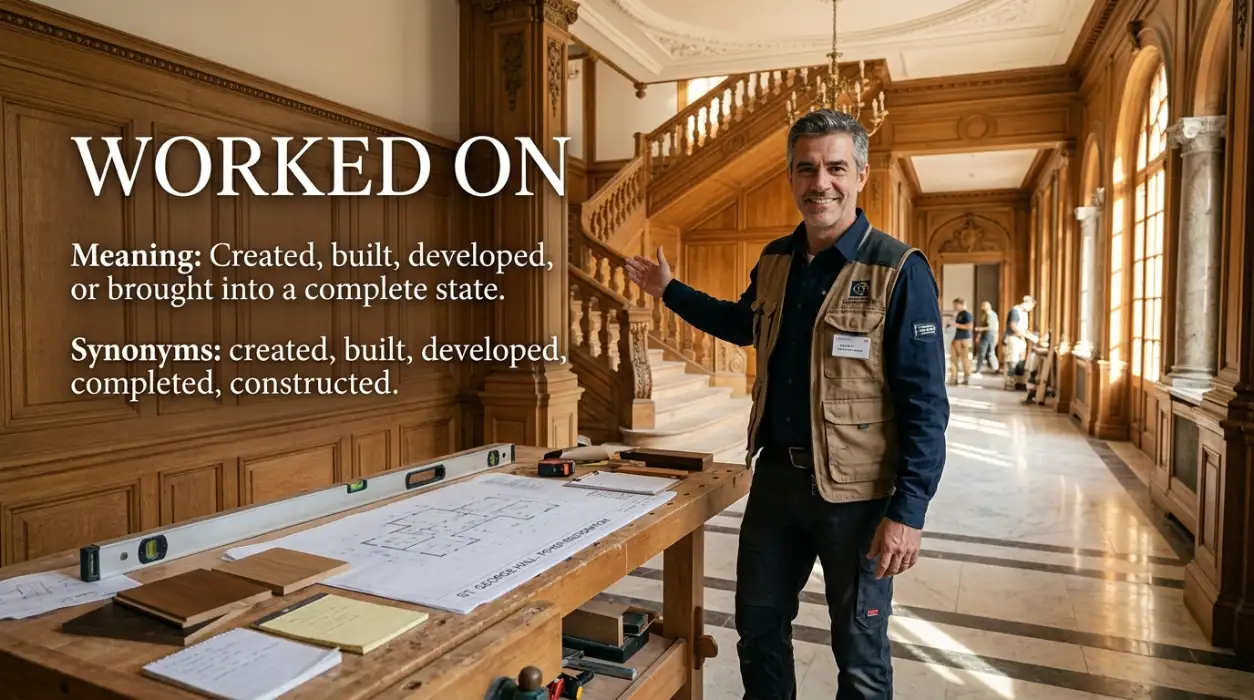
Developed (Verb) — US: /dɪˈvel.əpt/ | UK: /dɪˈvel.əpt/
Meaning: Created, built, or brought a project or product into a complete state.
Tone/Register: Professional, Formal
Example:
The software team developed a new mobile application last year.
She developed a comprehensive training curriculum for new staff.
Refined (Verb) — US: /rɪˈfaɪnd/ | UK: /rɪˈfaɪnd/
Meaning: Improved a plan or draft by making small, deliberate adjustments.
Tone/Register: Formal, Professional
Example:
He refined his research thesis before submitting it to the board.
We refined our marketing message to target young professionals.
Polished (Verb) — US: /ˈpɑː.lɪʃt/ | UK: /ˈpɒl.ɪʃt/
Meaning: Touched up or perfected the final details of a completed project.
Tone/Register: Business, Informal
Example:
She polished her speech slides right before the annual conference.
The author polished the final chapter of her new novel.
Addressed (Verb) — US: /əˈdrest/ | UK: /əˈdrest/
Meaning: Directed focused attention toward resolving a specific issue or concern.
Tone/Register: Professional, Formal
Example:
Managers addressed customer complaints during the morning meeting.
The committee addressed budget concerns before approving the plan.
Tackled (Verb) — US: /ˈtæk.əld/ | UK: /ˈtæk.əld/
Meaning: Undertook a difficult task or complex problem with energy and determination.
Tone/Register: Active, Business
Example:
Engineers tackled the unexpected system outage over the weekend.
He tackled his backed-up inbox early Monday morning.
Cultivated (Verb) — US: /ˈkʌl.tə.veɪ.t̬ɪd/ | UK: /ˈkʌl.tɪ.veɪ.tɪd/
Meaning: Nurtured, fostered, or developed a skill, quality, or relationship over time.
Tone/Register: Formal, Academic
Example:
She cultivated strong client relationships throughout her career.
The teacher cultivated a love for reading among his students.
Enhanced (Verb) — US: /ɪnˈhænst/ | UK: /ɪnˈhɑːnst/
Meaning: Heightened, improved, or increased the overall quality or performance of something.
Tone/Register: Professional, Academic
Example:
The team enhanced site loading speed by clearing old cache files.
New lighting enhanced the security of the building parking lot.
Optimized (Verb) — US: /ˈɑːp.tə.maɪzd/ | UK: /ˈɒp.tɪ.maɪzd/
Meaning: Restructured a system or workflow to achieve peak efficiency.
Tone/Register: Technical, Business
Example:
Data analysts optimized the database queries to save processing time.
We optimized our daily delivery routes to cut fuel expenses.
Tweaked (Verb) — US: /twiːkt/ | UK: /twiːkt/
Meaning: Made minor, quick adjustments to fine-tune a mechanism or document.
Tone/Register: Informal, Casual
Example:
I tweaked the audio settings to reduce background noise during recording.
She tweaked the cake recipe by adding a bit of vanilla extract.
Perfected (Verb) — US: /pɚˈfek.tɪd/ | UK: /pəˈfek.tɪd/
Meaning: Brought a skill, technique, or product to a completely flawless state.
Tone/Register: Elevated, Formal
Example:
The baker perfected his sourdough technique after months of practice.
She perfected her presentation delivery through repeated rehearsals.
Improved (Verb) — US: /ɪmˈpruːvd/ | UK: /ɪmˈpruːvd/
Meaning: Raised the standard, quality, or condition of a given item or situation.
Tone/Register: General, Standard
Example:
Regular exercise improved his physical stamina significantly.
The company improved its customer support response times this quarter.
Fine-tuned (Verb) — US: /ˌfaɪnˈtuːnd/ | UK: /ˌfaɪnˈtjuːnd/
Meaning: Adjusted delicate components or settings to achieve exact accuracy.
Tone/Register: Technical, Professional
Example:
Technicians fine-tuned the telescope before observing the night sky.
We fine-tuned our financial model to reflect market changes.
Executed (Verb) — US: /ˈek.sə.kjuː.t̬ɪd/ | UK: /ˈek.sɪ.kjuː.tɪd/
Meaning: Carried out, completed, or fulfilled a planned initiative or strategy.
Tone/Register: Executive, Formal
Example:
The event planner executed the marketing strategy flawlessly.
Contractors executed the renovation project ahead of schedule.
Pursued (Verb) — US: /pɚˈsuːd/ | UK: /pəˈsjuːd/
Meaning: Followed or strived toward a specific personal or professional goal over time.
Tone/Register: Formal, Professional
Example:
She pursued an advanced degree in environmental science.
The firm pursued new business opportunities across international markets.
Undertook (Verb) — US: /ˌʌn.dɚˈtʊk/ | UK: /ˌʌn.dəˈtʊk/
Meaning: Committed to and started a formal responsibility, study, or enterprise.
Tone/Register: Formal, Academic
Example:
Researchers undertook a massive survey regarding consumer habits.
The city council undertook major road repairs downtown.
Overhauled (Verb) — US: /ˈoʊ.vɚ.hɑːld/ | UK: /ˈəʊ.və.hɔːld/
Meaning: Inspected thoroughly and rebuilt or changed an entire system completely.
Tone/Register: Technical, Business
Example:
The IT division overhauled the corporate network security protocols.
Management overhauled the employee onboarding system this year.
Revamped (Verb) — US: /ˌriːˈvæmpt/ | UK: /ˌriːˈvæmpt/
Meaning: Renovated, redesigned, or modernized the layout, style, or structure of something.
Tone/Register: Modern, Business
Example:
The design agency revamped our brand logo for the campaign.
They revamped the restaurant menu to feature organic options.
Repaired (Verb) — US: /rɪˈperd/ | UK: /rɪˈpeəd/
Meaning: Fixed or restored a damaged, broken, or malfunctioning object to good condition.
Tone/Register: Standard, Practical
Example:
A mechanic repaired the broken transmission in my truck.
Maintenance staff repaired the leaking radiator in the hallway.
Modified (Verb) — US: /ˈmɑː.də.faɪd/ | UK: /ˈmɒd.ɪ.faɪd/
Meaning: Altered or adjusted parts of a plan or structure to suit new requirements.
Tone/Register: Technical, Academic
Example:
Engineers modified the aircraft wing design for better fuel savings.
The teacher modified the test format for remote students.
Adjusted (Verb) — US: /əˈdʒʌs.tɪd/ | UK: /əˈdʒʌs.tɪd/
Meaning: Changed the position, value, or state of something slightly to achieve fit.
Tone/Register: General, Technical
Example:
He adjusted the camera lens focus to capture the sharp portrait.
We adjusted our financial budget after evaluating first-quarter sales.
Upgraded (Verb) — US: /ʌpˈɡreɪ.dɪd/ | UK: /ʌpˈɡreɪ.dɪd/
Meaning: Replaced or raised equipment, software, or standards to a higher tier.
Tone/Register: Business, Tech
Example:
The office upgraded its desktop computers to faster solid-state drives.
She upgraded her subscription to access advanced data analytics.
Fiddled with (Verb Phrase) — US: /ˈfɪd.əld wɪð/ | UK: /ˈfɪd.əld wɪð/
Meaning: Made minor, aimless, or experimental changes to a device or setting.
Tone/Register: Informal, Casual
Example:
He fiddled with the television remote until the picture cleared up.
She fiddled with the radio knob during the long drive home.
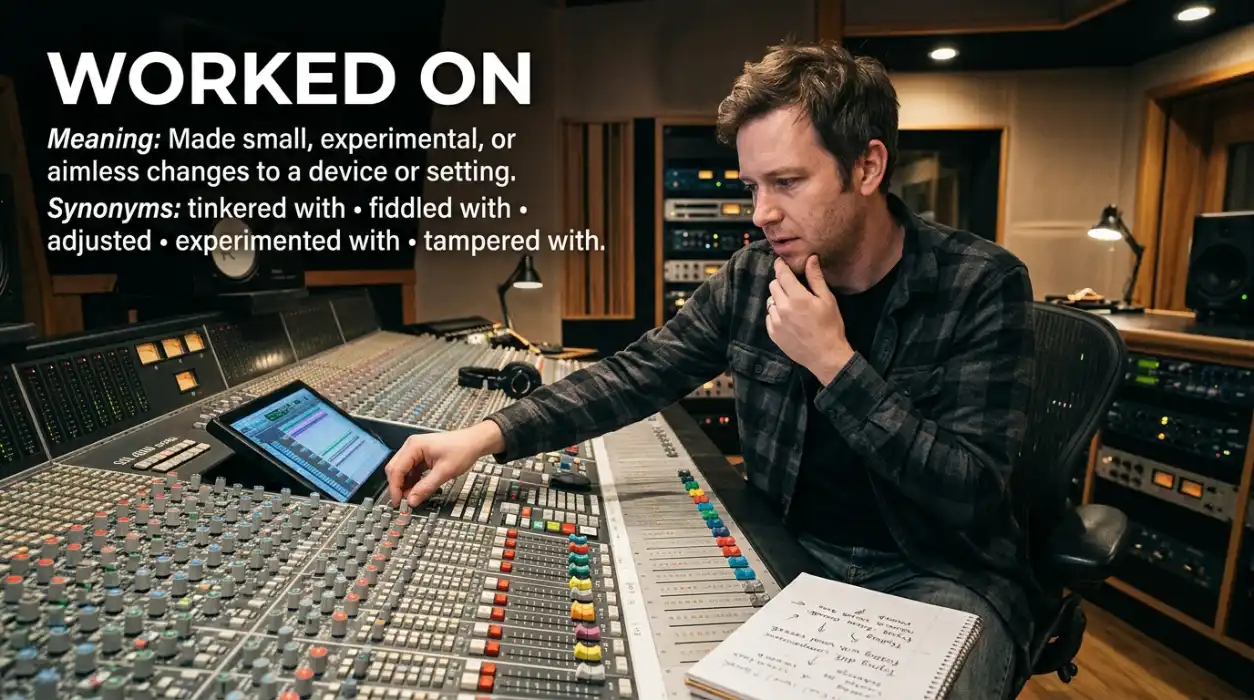
Tinkered with (Verb Phrase) — US: /ˈtɪŋ.kɚd wɪð/ | UK: /ˈtɪŋ.kəd wɪð/
Meaning: Made casual, hands-on, experimental repairs or adjustments to an object.
Tone/Register: Informal, Conversational
Example:
My uncle tinkered with old engines in his backyard garage.
She tinkered with the website code until the layout looked right.
Messed around with (Verb Phrase) — US: /mest əˈraʊnd wɪð/ | UK: /mest əˈraʊnd wɪð/
Meaning: Spent time experimenting or playing with tools or concepts informally.
Tone/Register: Informal, Very Casual
Example:
We messed around with graphic design software over the weekend.
He messed around with different guitar chords during band rehearsal.
Focused on (Verb Phrase) — US: /ˈfoʊ.kəst ɑːn/ | UK: /ˈfəʊ.kəst ɒn/
Meaning: Directed mental energy, effort, and attention toward a target task.
Tone/Register: Standard, Professional
Example:
The study group focused on reviewing organic chemistry formulas.
Our strategy team focused on expanding local retail operations.
Concentrated on (Verb Phrase) — US: /ˈkɑːn.sən.treɪ.t̬ɪd ɑːn/ | UK: /ˈkɒn.sən.treɪ.tɪd ɒn/
Meaning: Applied intense, unbroken mental attention to complete a specific task.
Tone/Register: Formal, Academic
Example:
She concentrated on drafting her research paper summary all afternoon.
The crew concentrated on finishing the roof before the storm hit.
Attended to (Verb Phrase) — US: /əˈten.dɪd tuː/ | UK: /əˈten.dɪd tuː/
Meaning: Took care of, handled, or dealt with a specific operational duty or person.
Tone/Register: Formal, Professional
Example:
The nurse attended to incoming emergency patients quickly.
He attended to pending emails before leaving his office desk.
Targeted (Verb) — US: /ˈtɑːr.ɡə.t̬ɪd/ | UK: /ˈtɑː.ɡɪ.tɪd/
Meaning: Directed energy, resources, or communication toward a specific goal.
Tone/Register: Business, Strategic
Example:
The ad campaign targeted outdoor enthusiasts across the region.
We targeted key operational bottlenecks to speed up production lines.
Advanced (Verb) — US: /ədˈvænst/ | UK: /ədˈvɑːnst/
Meaning: Moved forward or accelerated the progress or development of a cause.
Tone/Register: Elevated, Business
Example:
Her breakthroughs advanced medical research in cellular biology.
The grant advanced community literacy initiatives across the district.
Shaped (Verb) — US: /ʃeɪpt/ | UK: /ʃeɪpt/
Meaning: Molded, guided, or influenced the outcome or form of an idea or project.
Tone/Register: Creative, Strategic
Example:
Historical events shaped the culture of the mountain community.
Constructive criticism shaped her final art portfolio project.
Built on (Verb Phrase) — US: /bɪlt ɑːn/ | UK: /bɪlt ɒn/
Meaning: Used earlier progress or achievements as a foundation for further gains.
Tone/Register: Professional, Encouraging
Example:
The team built on early successes to launch the second product line.
She built on past research to propose a new economic model.
Labored over (Verb Phrase) — US: /ˈleɪ.bɚd ˈoʊ.vɚ/ | UK: /ˈleɪ.bəd ˈrəʊ.və/
Meaning: Spent long hours working with difficulty or painstaking effort on something.
Tone/Register: Expressive, Descriptive
Example:
The architect labored over the blueprint details for several weeks.
He labored over his wedding speech to get every line right.
Struggled with (Verb Phrase) — US: /ˈstrʌɡ.əld wɪð/ | UK: /ˈstrʌɡ.əld wɪð/
Meaning: Experienced significant difficulty or obstacles while handling a task.
Tone/Register: Conversational, Empathetic
Example:
The team struggled with complex server migrations during quarter three.
She struggled with advanced statistics before hiring a private tutor.
Applied oneself to (Verb Phrase) — US: /əˈplaɪd wʌnˈself tuː/ | UK: /əˈplaɪd wʌnˈself tuː/
Meaning: Gave dedicated, serious, and sustained effort toward a subject or task.
Tone/Register: Formal, Educational
Example:
He applied himself to learning software programming over the summer.
She applied herself to mastering classical piano compositions daily.
Drove (Verb) — US: /droʊv/ | UK: /droʊv/
Meaning: Guided, pushed, or led a project forward with energy and determination.
Tone/Register: Executive, Dynamic
Example:
She drove the initiative to transition office records to cloud systems.
Customer demand drove rapid feature updates for the application.
Engineered (Verb) — US: /ˌen.dʒɪˈnɪrd/ | UK: /ˌen.dʒɪˈnɪəd/
Meaning: Skillfully designed, constructed, or brought about a complex system or plan.
Tone/Register: Technical, Business
Example:
Software specialists engineered a secure user login protocol.
The project manager engineered a smooth structural handoff between teams.
Crafted (Verb) — US: /kræf.tɪd/ | UK: /krɑːf.tɪd/
Meaning: Made, designed, or written with meticulous detail, care, and skill.
Tone/Register: Creative, Professional
Example:
The copywriter crafted persuasive ad headlines for the spring launch.
She crafted a detailed policy framework for remote work teams.
Formulated (Verb) — US: /ˈfɔːr.mjə.leɪ.t̬ɪd/ | UK: /ˈfɔː.mjə.leɪ.tɪd/
Meaning: Devised, planned, or stated an idea or strategy in a systematic manner.
Tone/Register: Formal, Academic
Example:
Researchers formulated a clear testing methodology before trials began.
The executive team formulated a strategic plan for regional expansion.
Reorganized (Verb) — US: /riːˈɔːr.ɡə.naɪzd/ | UK: /riːˈɔː.ɡə.naɪzd/
Meaning: Restructured or rearranged the setup, order, or staffing of a system.
Tone/Register: Business, Administrative
Example:
The supervisor reorganized the inventory warehouse for faster access.
They reorganized the editorial board to cover breaking news faster.
Reframed (Verb) — US: /ˌriːˈfreɪmd/ | UK: /ˌriːˈfreɪmd/
Meaning: Replaced the concept or view of a problem to find new solutions.
Tone/Register: Intellectual, Professional
Example:
The consultant reframed the operational issue as an opportunity.
We reframed our marketing narrative to appeal to family buyers.
Streamlined (Verb) — US: /ˈstriːm.laɪnd/ | UK: /ˈstriːm.laɪnd/
Meaning: Simplified a process or system by eliminating redundant steps.
Tone/Register: Business, Technical
Example:
Automation tools streamlined our monthly client billing process.
The team streamlined the supply chain to prevent shipping delays.
Polished up (Verb Phrase) — US: /ˈpɑː.lɪʃt ʌp/ | UK: /ˈpɒl.ɪʃt ʌp/
Meaning: Reviewed and improved an existing draft or skill rapidly.
Tone/Register: Informal, Conversational
Example:
He polished up his resume before applying for the tech position.
She polished up her French vocabulary ahead of her European vacation.
Ironed out (Verb Phrase) — US: /aɪərnd aʊt/ | UK: /aɪənd aʊt/
Meaning: Resolved or cleared away small final difficulties, bugs, or disagreements.
Tone/Register: Business, Informal
Example:
Attorneys ironed out contract disagreements before the closing date.
We ironed out software glitches before launching the platform.
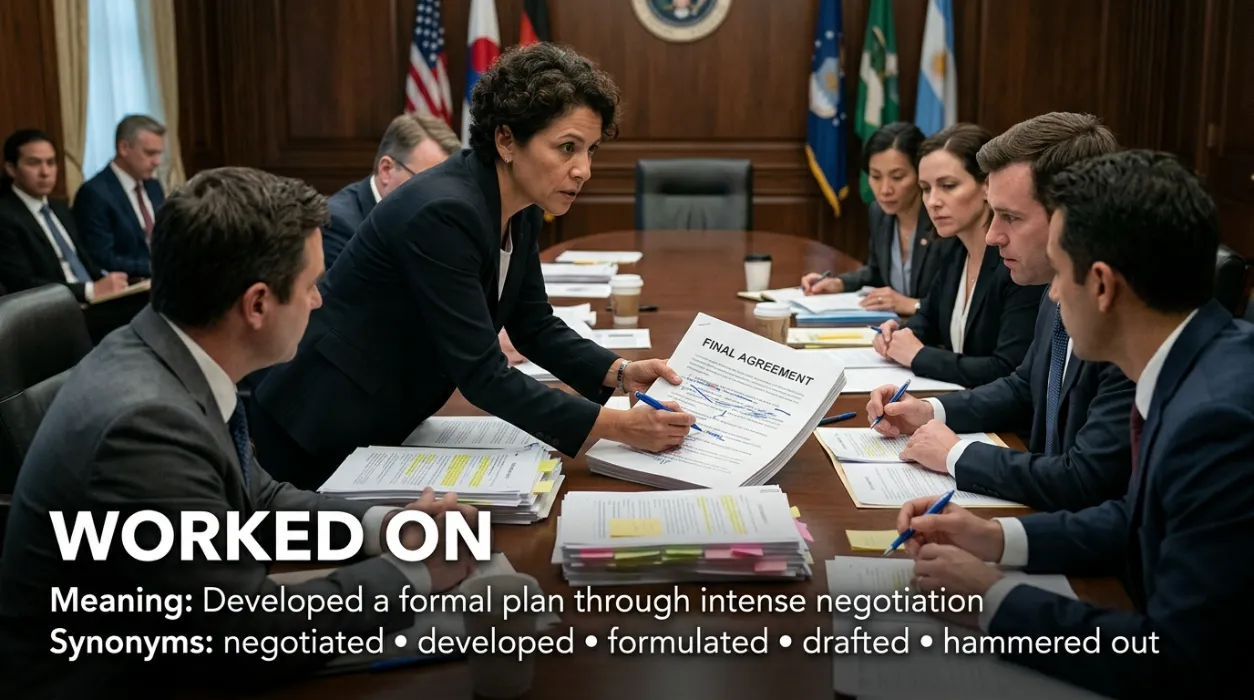
Hammered out (Verb Phrase) — US: /ˈhæm.ɚd aʊt/ | UK: /ˈhæm.əd aʊt/
Meaning: Agreed upon or produced a formal plan through intense negotiation.
Tone/Register: Business, Colloquial
Example:
Union reps and owners hammered out a contract agreement overnight.
The leadership team hammered out next year’s budget priorities.
Patched up (Verb Phrase) — US: /pætʃt ʌp/ | UK: /pætʃt ʌp/
Meaning: Fixed something temporarily or restored a damaged relationship hastily.
Tone/Register: Informal, Casual
Example:
The plumber patched up the pipe until permanent parts arrived.
They patched up their personal differences after a long talk.
Restructured (Verb) — US: /ˌriːˈstrʌk.tʃɚd/ | UK: /ˌriːˈstrʌk.tʃəd/
Meaning: Altered the organizational, financial, or operational framework of a firm.
Tone/Register: Executive, Formal
Example:
The firm restructured its sales divisions to focus on online clients.
Management restructured company debt to lower annual interest costs.
Transformed (Verb) — US: /trænˈsfɔːrmd/ | UK: /trænˈsfɔːmd/
Meaning: Changed the nature, appearance, or function of something completely.
Tone/Register: Dynamic, High-Impact
Example:
The renovation project transformed the abandoned lot into a park.
Digital adoption transformed our customer support operations.
Reconditioned (Verb) — US: /ˌriː.kənˈdɪʃ.ənd/ | UK: /ˌriː.kənˈdɪʃ.ənd/
Meaning: Overhauled and restored a worn machine or piece of hardware to be of use.
Tone/Register: Industrial, Technical
Example:
Engineers reconditioned the factory equipment to extend its usage.
The shop reconditioned used sports gear for local youth leagues.
Adapted (Verb) — US: /əˈdæp.tɪd/ | UK: /əˈdæp.tɪd/
Meaning: Modified existing content or methods to function in new conditions.
Tone/Register: General, Professional
Example:
The director adapted the famous historical novel into a screenplay.
Our sales representatives adapted their pitch for virtual clients.
Re-engineered (Verb) — US: /ˌriː.en.dʒɪˈnɪrd/ | UK: /ˌriː.en.dʒɪˈnɪəd/
Meaning: Completely redesigned a business process or technology from scratch.
Tone/Register: Corporate, Technical
Example:
The tech team re-engineered our database architecture for scale.
Consultants re-engineered the logistics workflow to reduce costs.
Elaborated on (Verb Phrase) — US: /iˈlæb.ə.reɪ.t̬ɪd ɑːn/ | UK: /iˈlæb.ə.reɪ.tɪd ɒn/
Meaning: Added deeper detail, context, or explanation to a concept or draft.
Tone/Register: Academic, Formal
Example:
The speaker elaborated on her economic thesis during the lecture.
He elaborated on his original proposal with comprehensive diagrams.
Shaped up (Verb Phrase) — US: /ʃeɪpt ʌp/ | UK: /ʃeɪpt ʌp/
Meaning: Developed or progressed toward a favorable standard or target state.
Tone/Register: Informal, Casual
Example:
The team’s performance shaped up nicely after additional training.
Her draft shaped up into an impressive magazine article.
Worked out (Verb Phrase) — US: /wɝːkt aʊt/ | UK: /wɜːkt aʊt/
Meaning: Solved, calculated, or reached an agreement regarding a problem.
Tone/Register: Standard, Everyday
Example:
We worked out a fair payment schedule with our supplier.
Analysts worked out the complex logistical details before launch.
Spearheaded (Verb) — US: /ˈspɪr.hed.ɪd/ | UK: /ˈspɪə.hed.ɪd/
Meaning: Led an organized campaign, project, or movement aggressively from the front.
Tone/Register: Executive, Dynamic
Example:
She spearheaded the company’s transition to renewable energy sources.
He spearheaded the local community fundraising campaign.
Championed (Verb) — US: /ˈtʃæm.pi.ənd/ | UK: /ˈtʃæm.pi.ənd/
Meaning: Supported, defended, or promoted a cause, proposal, or project publicly.
Tone/Register: Professional, Inspiring
Example:
The manager championed diversity initiatives across all departments.
She championed the adoption of flexible work hours.
Implemented (Verb) — US: /ˈɪm.plə.men.t̬ɪd/ | UK: /ˈɪm.plɪ.men.tɪd/
Meaning: Put a decision, plan, or system into practical effect or operational use.
Tone/Register: Formal, Corporate
Example:
The IT team implemented new cybersecurity rules across offices.
We implemented automated software tools to handle invoice payments.
Executed (Verb) — US: /ˈek.sə.kjuː.t̬ɪd/ | UK: /ˈek.sɪ.kjuː.tɪd/
Meaning: Carried through to completion a planned action, contract, or design.
Tone/Register: Executive, Formal
Example:
The construction crew executed the blueprint plans precisely.
She executed the marketing campaign with impressive accuracy.
Synonyms by Tone
Selecting a synonym for worked on requires paying attention to context and audience. Therefore, grouping these action verbs by tone makes choosing the right option easy.
Positive Tone
These options highlight growth, leadership, constructive effort, or skill advancement:
- Developed
- Refined
- Cultivated
- Enhanced
- Optimized
- Perfected
- Advanced
- Spearheaded
- Championed
- Executed
Neutral Tone
These terms state task execution, logical adjustments, or operational duties objectively:
- Addressed
- Focused on
- Modified
- Adjusted
- Formulated
- Streamlined
- Adapted
- Implemented
Negative Tone
These words emphasize struggle, tedious effort, heavy repairs, or challenging obstacles:
- Struggled with
- Labored over
- Overhauled
- Patched up
- Reconditioned
Playful / Informal
These casual options work best in relaxed conversations, personal notes, or internal team chats:
- Tweaked
- Tinkered with
- Messed around with
- Fiddled with
- Ironed out
- Hammered out
Mini Comparison
Developed vs. Refined vs. Tackled
| Feature | Developed | Refined | Tackled |
| Primary Focus | Creating or building something new from early stages. | Improving an existing piece of work through subtle, careful edits. | Taking on a hard problem or heavy workload directly. |
| Tone | Constructive, professional, and forward-looking. | Precise, analytical, and perfection-oriented. | Active, energetic, and determined. |
| Best Usage Context | “She developed a new client portal.” | “He refined the software user interface.” | “We tackled the database crisis immediately.” |
How “Worked On” Changes by Context
Daily Conversation
In everyday speech, native speakers prefer relaxed phrases like tweaked, tinkered with, polished up, or worked out. For example, a neighbor might say they tinkered with their lawnmower engine over the weekend.
Writing or Blogging
Bloggers and content creators select active verbs like crafted, shaped, revamped, or refined. Consequently, these vivid verbs keep descriptive articles engaging for online readers.
Professional or Academic Tone
Resumes, business reports, and scholarly papers require strong executive phrasing. Action verbs like executed, spearheaded, streamlined, formulated, or optimized demonstrate leadership and clear technical competence.
Creative or Informal Use
Fiction writers use evocative options like labored over, hammered out, or crafted. As a result, these descriptive choices help build vivid scenes in creative narratives.
Common Mistakes & Native Usage
Common Mistakes Learners Make
- Overusing “worked on” in resumes: Writing “worked on software” sounds passive, whereas strong action verbs like engineered, developed, or optimized sound impactful.
- Using casual slang in corporate reports: Phrases like messed around with sound unprofessional in official business documents.
- Confusing “refined” with “overhauled”: Refined means making minor polish edits, while overhauled means rebuilding an entire structure.
Register Notes
- Spoken English: Casual talks favor tweaked, ironed out, focused on, and patched up.
- Written English: Formal documents demand undertook, executed, streamlined, and addressed.
- To discover more ways to elevate your writing style across professional contexts, explore our comprehensive vocabulary expansion guides.
Real-Life Mini Scenarios
Workplace
During an annual review, a project manager highlighted how she streamlined internal reporting workflows. Consequently, the team saved five hours of admin work every week.
Social Situations
While preparing for a weekend camping trip, friends checked their outdoor gear. They discussed how they tinkered with the camping stove to ensure it lit properly.
Media / Pop Culture
A tech journalist published an article about a major video game launch. The headline explained how game developers worked through the night to optimize graphics performance.
Writing or Storytelling
An author spent months finalizing her historical novel. She labored over the manuscript chapters to ensure historical accuracy throughout the story.

Practice Exercise
1. Which synonym carries a formal tone suited for building a new project?
A) Messed around with
B) Developed
C) Patched up
D) Fiddled with
2. What verb means making small, precise improvements to an existing draft?
A) Overhauled
B) Refined
C) Reorganized
D) Struggled with
3. Which option is an informal phrase meaning to make casual adjustments?
A) Undertook
B) Tinkered with
C) Executed
D) Formulated
4. What is the main difference between “refined” and “overhauled”?
A) Refined means making minor edits; overhauled means rebuilding completely
B) Refined applies only to vehicles; overhauled applies to writing
C) Overhauled is informal; refined is slang
D) Both verbs mean the same thing
5. Which term best describes taking on a hard challenge with determination?
A) Adjusted
B) Tackled
C) Patched up
D) Reframed
6. Which verb works best on a professional resume?
A) Messed around with
B) Streamlined
C) Fiddled with
D) Tried out
7. To simplify a process to increase efficiency is to:
A) Streamline
B) Labor over
C) Struggle with
D) Patch up
8. Which option expresses long, grueling effort on a task?
A) Tweaked
B) Labored over
C) Ironed out
D) Upgraded
9. What phrase means reaching an agreement through intensive discussion?
A) Hammered out
B) Fiddled with
C) Adapted
D) Reconditioned
Application Task
Write one short original sentence describing a past project or hobby task using one action verb from this guide (such as streamlined, tackled, or spearheaded).
Answer Key
1: B | 2: B | 3: B | 4: A | 5: B | 6: B | 7: A | 8: B | 9: A
Conclusion
Understanding worked on can help you describe something that someone spent time improving, developing, repairing, or completing. Learning its synonyms, meaning, and examples can improve your English vocabulary and make your communication more precise.
The phrase worked on is commonly used in everyday conversations, professional settings, academic writing, and practical situations. Knowing its related synonyms can help you express ideas about effort, progress, development, and improvement in different ways.
By practicing it in sentences and exploring related words, you can strengthen your vocabulary and writing skills. Understanding this phrase will help you use it naturally, accurately, and confidently in different English contexts.
FAQs
1. What is the best resume synonym for worked on?
The best resume alternatives for worked on are action verbs like developed, engineered, streamlined, spearheaded, or optimized. These strong action verbs highlight clear leadership and concrete accomplishments to hiring managers.
2. How do “refined” and “developed” differ in meaning?
To develop means to build or construct something new from early concepts. Conversely, to refine means to take an existing draft or product and make minor, careful adjustments to polish its quality.
3. What is a casual or informal synonym for worked on?
Informal alternatives for worked on include phrasal verbs like tweaked, tinkered with, ironed out, polished up, and hammered out. These fit well in casual conversations or internal team chats.
4. Can “tackled” replace “worked on” in every sentence?
No, tackled specifically implies confronting a difficult problem or heavy challenge. Use tackled when emphasizing energy and determination, but use refined or adjusted for lighter polish tasks.
5. Which synonym for worked on fits academic writing best?
In academic contexts, verbs like formulated, undertook, concentrated on, elaborated on, and optimized provide the precise, formal tone expected in scholarly research papers.

Hasnain Ali is an SEO Content Strategist and the founder of wordvora.com, a trusted vocabulary platform that helps writers, students, professionals, and English learners find accurate synonyms, antonyms, word meanings, and real-life usage examples. He specializes in keyword research, on-page SEO, topical authority, and creating search-first content that aligns with Google’s latest Search Quality and E-E-A-T guidelines. His work focuses on producing clear, well-structured, and reader-friendly resources that satisfy search intent while maintaining high editorial standards.
Through extensive hands-on experience with SEO tools such as Google Search Console, Google Analytics, SEMrush, and Ahrefs, Hasnain researches user search behavior and develops content that is both informative and easy to understand. Every article published on wordvora.com is carefully reviewed for accuracy, readability, and contextual relevance before publication. His mission is to build one of the web’s most reliable English vocabulary resources by providing practical language guidance, trustworthy explanations, and content that helps readers improve their writing, communication, and vocabulary with confidence.