
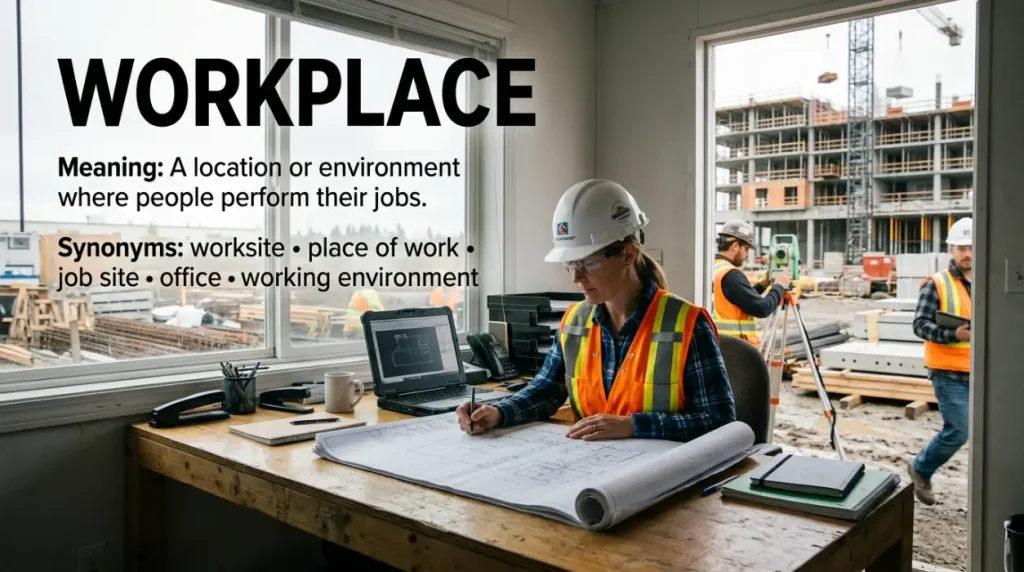
The term workplace refers to a place or environment where people perform their jobs and professional activities. It can describe an office, company, school, factory, shop, or any other setting where work is carried out.
Understanding the workplace can help you talk about professional environments more clearly. Learning its synonyms, meaning, and examples can also expand your English vocabulary and help you choose suitable words for different situations.
The meaning of workplace can vary depending on the context in which it is used. It may refer to a physical location where employees work or, more broadly, to the environment and culture associated with a job.
By learning workplace, its synonyms, meaning, and examples, you can improve your communication and writing skills. This guide will help you understand the term clearly and use it naturally in different English contexts.
What Does “Synonym for Workplace” Really Mean?
The phrase “synonym for workplace” refers to nouns and noun phrases that replace “workplace” in professional, academic, and daily settings. In standard English, a “workplace” is any physical or virtual location where a person performs duties, jobs, or commercial tasks. Native speakers use it to describe offices, factories, remote setups, or general professional environments.
Part of speech: Noun (singular).
Definition: A physical or digital location, setting, or environment where an individual conducts employment duties or professional tasks.
Connotative Meaning
(Connotation is the emotional feeling, cultural association, or tone attached to a word beyond its literal dictionary definition.)
- Positive tone: Connotes collaboration, professional growth, innovation, supportive culture, and modern flexibility.
- Negative tone: Expresses corporate monotony, restrictive supervision, exhausting labor, or toxic office environments.
- Neutral tone: Refers to basic physical premises, job locations, or administrative facilities objectively.
Etymology
The term combines the Old English noun weorc (meaning physical labor, action, or accomplishment) with stede or plaece (derived from Old French place and Latin platea, meaning open space or location).
- Old English (450–1100): Early speakers used weorcstall or weorcstede to describe physical workshops and agricultural sites.
- Middle English (1100–1500): The words werk and place began appearing together in trade guilds and urban craft shops.
- Modern English (1500–Present): Modern English combined the terms into “workplace” during the Industrial Revolution to classify official commercial environments.
Pronunciation
- US: /ˈwɝːk.pleɪs/
- UK: /ˈwɜːk.pleɪs/
Syllables & Structure
- Syllables: work-place
- Root: work
- Prefix: None
- Suffix: None (Compound Noun)
Synonyms List
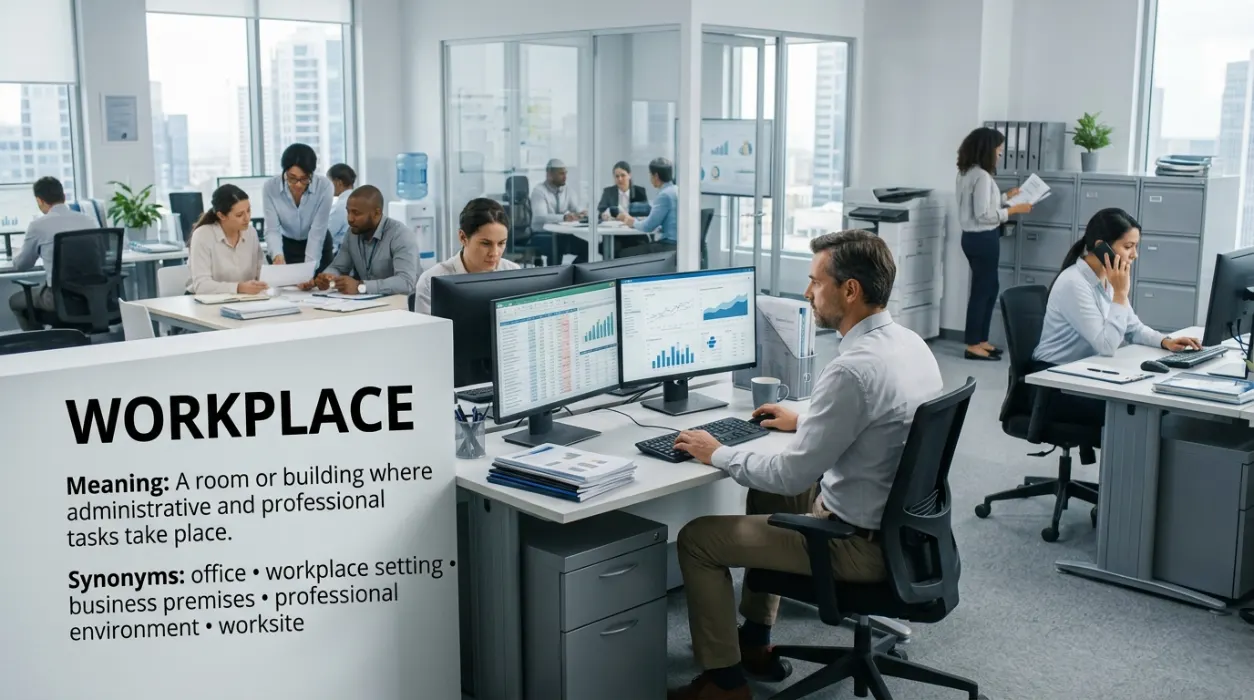
Office (Noun) — US: /ˈɑː.fɪs/ | UK: /ˈɒf.ɪs/
Meaning: A room or building where administrative and professional tasks take place.
Tone/Register: Standard, Professional
Example:
She arrived at the office early to prepare the board presentation.
Our company office operates in the heart of the financial district.
Workstation (Noun) — US: /ˈwɝːkˌsteɪ.ʃən/ | UK: /ˈwɜːkˌsteɪ.ʃən/
Meaning: An assigned desk or computer setup where an employee completes daily duties.
Tone/Register: Technical, Corporate
Example:
He organized his workstation with dual monitors and ergonomic accessories.
Every employee keeps their workstation tidy for the evening shift.
Jobsite (Noun) — US: /ˈdʒɑːb.saɪt/ | UK: /ˈdʒɒb.saɪt/
Meaning: A physical location where active construction, field work, or manual labor takes place.
Tone/Register: Practical, Industrial
Example:
Safety inspectors visited the jobsite to review construction standards.
Workers wore protective helmets while walking across the jobsite.
Workspace (Noun) — US: /ˈwɝːk.speɪs/ | UK: /ˈwɜːk.speɪs/
Meaning: Any physical or digital environment designed for completing individual or group tasks.
Tone/Register: Modern, Flexible
Example:
She created a quiet workspace in her home spare room.
Digital tools provide a shared workspace for remote project teams.
Headquarters (Noun) — US: /ˈhedˌkwɔːr.t̬ɚz/ | UK: /ˌhedˈkwɔː.təz/
Meaning: The primary central facility or main office of an entire corporation or institution.
Tone/Register: Executive, Formal
Example:
Executives gathered at global headquarters to announce annual sales figures.
The firm moved its corporate headquarters to a larger city last year.
Bureau (Noun) — US: /ˈbjʊr.oʊ/ | UK: /ˈbjʊə.rəʊ/
Meaning: An administrative department or specialized office handling specific public business.
Tone/Register: Formal, Governmental
Example:
The news bureau published an urgent report on local economic trends.
He worked as an analyst for the federal weather bureau.
Enterprise (Noun) — US: /ˈen.t̬ɚ.praɪz/ | UK: /ˈen.tə.praɪz/
Meaning: A large business organization or commercial entity operating across markets.
Tone/Register: Formal, Business
Example:
The tech enterprise expanded its operations into international territories.
Managers within the enterprise fostered a culture of digital innovation.
Firm (Noun) — US: /fɝːm/ | UK: /fɜːm/
Meaning: A commercial partnership or professional business organization providing expert services.
Tone/Register: Professional, Formal
Example:
She joined a prestigious law firm after graduating from university.
The accounting firm managed tax filings for hundreds of local businesses.
Establishment (Noun) — US: /ɪˈstæb.lɪʃ.mənt/ | UK: /ɪˈstæb.lɪʃ.mənt/
Meaning: A formal business building, public institution, or commercial residence.
Tone/Register: Formal, Administrative
Example:
The dining establishment passed its health inspection with flying colors.
Local authorities licensed the new commercial establishment last month.
Premises (Noun) — US: /ˈprem.ɪ.sɪz/ | UK: /ˈprem.ɪ.sɪz/
Meaning: The physical land and buildings occupied by a business or corporate entity.
Tone/Register: Legal, Official
Example:
Security guards monitor the company premises around the clock.
Visitors must sign the logbook before entering the factory premises.
Facility (Noun) — US: /fəˈsɪl.ə.t̬i/ | UK: /fəˈsɪl.ə.ti/
Meaning: A building or complex built to serve a specific operational function or service.
Tone/Register: Corporate, Technical
Example:
The medical facility added a new wing for specialized patient care.
Our manufacturing facility operates energy-efficient machinery daily.
Environment (Noun) — US: /ɪnˈvaɪ.rən.mənt/ | UK: /ɪnˈvaɪ.rən.mənt/
Meaning: The overall physical and psychological conditions surrounding workers at a job.
Tone/Register: General, Academic
Example:
Management works hard to maintain a positive work environment.
A quiet environment helps employees focus on complex analytical tasks.
Setting (Noun) — US: /ˈset̬.ɪŋ/ | UK: /ˈset.ɪŋ/
Meaning: The context, surroundings, or physical environment where professional activities happen.
Tone/Register: Descriptive, General
Example:
A collaborative setting encourages creative brainstorming among team members.
The clinical setting requires strict adherence to hygiene standards.
Station (Noun) — US: /ˈsteɪ.ʃən/ | UK: /ˈsteɪ.ʃən/
Meaning: A fixed duty post or assigned work location within an operational facility.
Tone/Register: Operational, Standard
Example:
The technician remained at her station throughout the monitoring process.
Each assembly line worker maintains a clean and organized station.
Shop (Noun) — US: /ʃɑːp/ | UK: /ʃɒp/
Meaning: A retail store or a specialized workshop where craft work or repairs occur.
Tone/Register: Practical, Conversational
Example:
The mechanic spent the morning inspecting engines in his repair shop.
She opened a small print shop near the college campus.
Workshop (Noun) — US: /ˈwɝːk.ʃɑːp/ | UK: /ˈwɜːk.ʃɒp/
Meaning: A room or building where manufacturing, repairs, or hands-on creative crafts are done.
Tone/Register: Hands-on, Practical
Example:
The carpenter crafted custom wooden furniture in his garage workshop.
Engineers gathered in the workshop to test early physical prototypes.
Plant (Noun) — US: /plænt/ | UK: /plɑːnt/
Meaning: An industrial site equipped with machinery for manufacturing goods or power generation.
Tone/Register: Industrial, Technical
Example:
The automotive plant produces hundreds of electric vehicles weekly.
Engineers upgraded the water treatment plant with automated systems.
Factory (Noun) — US: /ˈfæk.tɚ.i/ | UK: /ˈfæk.tər.i/
Meaning: A large building where industrial workers manufacture goods on assembly lines.
Tone/Register: Standard, Industrial
Example:
The textile factory installed new weaving machinery last winter.
Factory workers follow strict safety protocols during every shift.
Mill (Noun) — US: /mɪl/ | UK: /mɪl/
Meaning: A manufacturing building equipped with machinery for processing raw materials.
Tone/Register: Traditional, Industrial
Example:
The paper mill processes timber into packaging materials daily.
Historic towns often grew around the local steel mill.
Site (Noun) — US: /saɪt/ | UK: /saɪt/
Meaning: A designated physical area chosen for operational activities or construction projects.
Tone/Register: General, Technical
Example:
Surveyors evaluated the site before laying the building foundations.
The project manager conducted daily safety walkthroughs at the site.
Depot (Noun) — US: /ˈdiː.poʊ/ | UK: /ˈdep.oʊ/
Meaning: A storage building or central hub for transit vehicles, equipment, or goods.
Tone/Register: Logistics, Operational
Example:
Delivery trucks return to the central depot at the end of each shift.
The bus depot schedules routine maintenance for every transit vehicle.
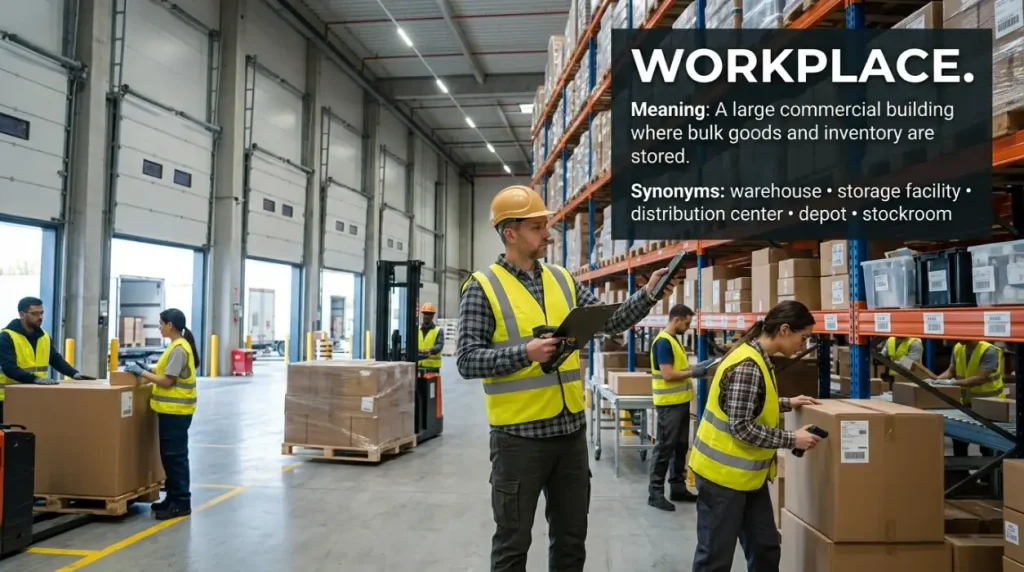
Warehouse (Noun) — US: /ˈwer.haʊs/ | UK: /ˈweə.haʊs/
Meaning: A large commercial building used for storing bulk goods, inventory, or merchandise.
Tone/Register: Logistics, Commercial
Example:
Logistics staff organized the inventory shelves across the main warehouse.
Online orders ship directly from our automated distribution warehouse.
Hub (Noun) — US: /hʌb/ | UK: /hʌb/
Meaning: A central point of activity, region, or digital network where workers connect.
Tone/Register: Modern, Dynamic
Example:
The downtown office serves as a vibrant hub for creative freelancers.
Our regional hub handles client support for the entire continent.
Corporate Office (Noun Phrase) — US: /ˈkɔːr.pɚ.ət ˈɑː.fɪs/ | UK: /ˈkɔː.pər.ət ˈɒf.ɪs/
Meaning: The executive administrative building where business strategies and operations are directed.
Tone/Register: Business, Executive
Example:
The corporate office released the updated policy handbook this morning.
Regional managers traveled to the corporate office for annual reviews.
Branch (Noun) — US: /bræntʃ/ | UK: /brɑːntʃ/
Meaning: A local office or store operating as part of a larger business enterprise.
Tone/Register: Professional, Standard
Example:
She manages a busy branch of the national commercial bank.
The company opened a new branch in the northern suburb.
Field (Noun) — US: /fiːld/ | UK: /fiːld/
Meaning: An outdoor or remote working environment outside a standard corporate office setting.
Tone/Register: Practical, Operational
Example:
Geologists collect rock samples while working out in the field.
Sales representatives spend most of their workweek in the field.
Studio (Noun) — US: /ˈstuː.di.oʊ/ | UK: /ˈstjuː.di.əʊ/
Meaning: A workroom used by artists, photographers, musicians, or broadcast media teams.
Tone/Register: Creative, Specialized
Example:
The artist spent hours painting portraits inside her sunlit studio.
Broadcasters produce morning news shows from an automated television studio.
Agency (Noun) — US: /ˈeɪ.dʒən.si/ | UK: /ˈeɪ.dʒən.si/
Meaning: A specialized business organization providing specific services on behalf of clients.
Tone/Register: Professional, Business
Example:
The advertising agency launched a nationwide marketing campaign this week.
She works at a talent agency representing regional authors.
Practice (Noun) — US: /ˈpræk.tɪs/ | UK: /ˈpræk.tɪs/
Meaning: The professional office or business operation of doctors, lawyers, or specialized consultants.
Tone/Register: Professional, Formal
Example:
Dr. Smith expanded her private medical practice by hiring two specialists.
The legal practice handles corporate merger transactions exclusively.
Complex (Noun) — US: /ˈkɑːm.pleks/ | UK: /ˈkɒm.pleks/
Meaning: A group of connected buildings designed for specific commercial or research purposes.
Tone/Register: Formal, Technical
Example:
The tech firm built a modern research complex near the university campus.
Engineers moved into the new industrial complex this autumn.
Campus (Noun) — US: /ˈkæm.pəs/ | UK: /ˈkæm.pəs/
Meaning: The expansive grounds and buildings belonging to a corporation, hospital, or university.
Tone/Register: Corporate, Modern
Example:
Employees enjoy walking trails across the tech company’s green campus.
The corporate campus includes dining halls, gyms, and flexible workspaces.
Suite (Noun) — US: /swiːt/ | UK: /swiːt/
Meaning: A connected set of corporate rooms allocated to a business inside a commercial building.
Tone/Register: Executive, Professional
Example:
Our consulting team moved into an executive suite on the twentieth floor.
Clients waited comfortably inside the newly renovated reception suite.
Outpost (Noun) — US: /ˈaʊt.poʊst/ | UK: /ˈaʊt.pəʊst/
Meaning: A small, remote, or satellite office established away from a main company location.
Tone/Register: Descriptive, Strategic
Example:
The company opened a small satellite outpost to monitor regional sales.
Engineers at the remote outpost conduct field tests on hardware.
Domain (Noun) — US: /doʊˈmeɪn/ | UK: /dəˈmeɪn/
Meaning: A specific sphere of activity, knowledge, or professional responsibility.
Tone/Register: Elevated, Formal
Example:
Network security falls within the domain of the information technology team.
She managed administrative tasks within her corporate domain efficiently.
Center (Noun) — US: /ˈsen.t̬ɚ/ | UK: /ˈsen.tə/
Meaning: A specialized facility dedicated to a specific operational duty or research objective.
Tone/Register: Corporate, General
Example:
The company established a customer support center to handle incoming inquiries.
Researchers conduct clinical trials at the medical research center.
Base (Noun) — US: /beɪs/ | UK: /beɪs/
Meaning: A primary location or operational center where workers plan tasks or store equipment.
Tone/Register: Practical, Conversational
Example:
The research expedition established a base camp near the mountain trail.
Flight crews return to their operational base after finishing long flights.
Post (Noun) — US: /poʊst/ | UK: /pəʊst/
Meaning: An assigned position, duty station, or location where a worker performs tasks.
Tone/Register: Formal, Structured
Example:
The security officer remained at his assigned post throughout the night.
She reported to her post as the lead supervisor on duty.
Space (Noun) — US: /speɪs/ | UK: /speɪs/
Meaning: A physical area designated for work, creative projects, or professional collaboration.
Tone/Register: Casual, Modern
Example:
We leased a bright commercial space to host our design studio.
He converted his garage into a productive home office space.
Digs (Noun – Plural) — US: /dɪɡz/ | UK: /dɪɡz/
Meaning: Informal temporary lodgings or a casual personal work location.
Tone/Register: Informal, Very Casual
Example:
The creative team set up temporary digs inside an old brick warehouse.
He showed off his new office digs to his visiting colleagues.
Home Office (Noun Phrase) — US: /hoʊm ˈɑː.fɪs/ | UK: /həʊm ˈɒf.ɪs/
Meaning: A dedicated workspace or desk setup located within an employee’s personal residence.
Tone/Register: Standard, Modern
Example:
She upgraded her home office with an ergonomic chair and high-speed web access.
Many remote professionals spend their entire workweek inside a home office.
Remote Environment (Noun Phrase) — US: /rɪˈmoʊt ɪnˈvaɪ.rən.mənt/ | UK: /rɪˈməʊt ɪnˈvaɪ.rən.mənt/
Meaning: A digital or virtual setting where workers complete duties outside traditional corporate offices.
Tone/Register: Professional, Technical
Example:
Employees in a remote environment rely heavily on asynchronous chat software.
Clear communication keeps teams productive across a remote environment.
Virtual Office (Noun Phrase) — US: /ˈvɝː.tʃu.əl ˈɑː.fɪs/ | UK: /ˈvɜː.tʃu.əl ˈɒf.ɪs/
Meaning: An online ecosystem providing digital address, communication, and business services.
Tone/Register: Modern, Tech
Example:
The startup operates using a virtual office to connect team members globally.
Clients contact the firm through a dedicated virtual office platform.
Coworking Space (Noun Phrase) — US: /koʊˈwɝː.kɪŋ speɪs/ | UK: /kəʊˈwɜː.kɪŋ speɪs/
Meaning: A shared physical office where individuals from different companies work independently.
Tone/Register: Modern, Business
Example:
Freelancers reserve desks at the downtown coworking space every weekday.
The coworking space offers shared meeting rooms, hot desks, and reliable Wi-Fi.
Operational Base (Noun Phrase) — US: /ˌɑː.pəˈreɪ.ʃən.əl beɪs/ | UK: /ˌɒp.ərˈeɪ.ʃən.əl beɪs/
Meaning: A central facility where strategic planning, equipment storage, and deployments happen.
Tone/Register: Strategic, Corporate
Example:
The logistics company uses the seaport facility as its operational base.
Engineers set up an operational base to manage regional utility upgrades.
Corporate Setting (Noun Phrase) — US: /ˈkɔːr.pɚ.ət ˈset̬.ɪŋ/ | UK: /ˈkɔː.pər.ət ˈset.ɪŋ/
Meaning: A formal business environment characterized by professional decorum and corporate rules.
Tone/Register: Executive, Formal
Example:
Working inside a corporate setting requires adherence to professional dress codes.
She adapted quickly to the fast-paced demands of a corporate setting.

Business Premises (Noun Phrase) — US: /ˈbɪz.nɪs ˈprem.ɪ.sɪz/ | UK: /ˈbɪz.nɪs ˈprem.ɪ.sɪz/
Meaning: The commercial land and structures owned or rented by an active enterprise.
Tone/Register: Legal, Official
Example:
Unauthorized personnel must not enter the business premises after business hours.
The commercial insurer inspected the business premises before coverage.
Professional Environment (Noun Phrase) — US: /prəˈfeʃ.ən.əl ɪnˈvaɪ.rən.mənt/ | UK: /prəˈfeʃ.ən.əl ɪnˈvaɪ.rən.mənt/
Meaning: A workplace atmosphere shaped by high standards, respect, and career etiquette.
Tone/Register: Formal, Academic
Example:
Maintaining a professional environment builds trust among colleagues and clients.
The internship offers students early exposure to a professional environment.
Production Floor (Noun Phrase) — US: /prəˈdʌk.ʃən flɔːr/ | UK: /prəˈdʌk.ʃən flɔː/
Meaning: The active physical area of a factory where manufacturing machinery is operated.
Tone/Register: Industrial, Technical
Example:
Shift supervisors monitor safety protocols across the busy production floor.
Automation robots move goods efficiently along the production floor.
Commercial Hub (Noun Phrase) — US: /kəˈmɝː.ʃəl hʌb/ | UK: /kəˈmɜː.ʃəl hʌb/
Meaning: A dense economic district or central building housing numerous commercial enterprises.
Tone/Register: Business, Strategic
Example:
The capital city acts as a major commercial hub for international trade.
Tech firms opened new research branches within the regional commercial hub.
Job Location (Noun Phrase) — US: /dʒɑːb loʊˈkeɪ.ʃən/ | UK: /dʒɒb ləʊˈkeɪ.ʃən/
Meaning: The specific geographical or structural placement where work duties occur.
Tone/Register: Standard, Administrative
Example:
Candidates checked the job location before submitting their final employment application.
The company covers travel expenses when employees shift to a new job location.
Duty Post (Noun Phrase) — US: /ˈduː.t̬i poʊst/ | UK: /ˈdjuː.ti pəʊst/
Meaning: An assigned location where an officer or worker must perform mandatory tasks.
Tone/Register: Formal, Structured
Example:
The guard reported to her assigned duty post at six in the morning.
Every employee knows their exact duties while stationed at their duty post.
Service Center (Noun Phrase) — US: /ˈsɝː.vɪs ˈsen.t̬ɚ/ | UK: /ˈsɜː.vɪs ˈsen.tə/
Meaning: A dedicated customer or technical facility focused on repair, maintenance, or aid.
Tone/Register: Corporate, Technical
Example:
He took his vehicle to the authorized service center for routine oil maintenance.
The regional service center handles warranty claims for local clients.
Industrial Site (Noun Phrase) — US: /ɪnˈdʌs.tri.əl saɪt/ | UK: /ɪnˈdʌs.tri.əl saɪt/
Meaning: Land designated for heavy manufacturing, chemical processing, or large factories.
Tone/Register: Industrial, Formal
Example:
Environmental agencies tested air quality around the industrial site.
Trucks transport raw steel materials into the secure industrial site daily.
Working Environment (Noun Phrase) — US: /ˈwɝː.kɪŋ ɪnˈvaɪ.rən.mənt/ | UK: /ˈwɜːk.ɪŋ ɪnˈvaɪ.rən.mənt/
Meaning: The social, mental, and physical conditions under which an employee works.
Tone/Register: General, Educational
Example:
An inclusive working environment boosts employee morale and overall retention.
Ergonomic furniture creates a comfortable working environment for office staff.
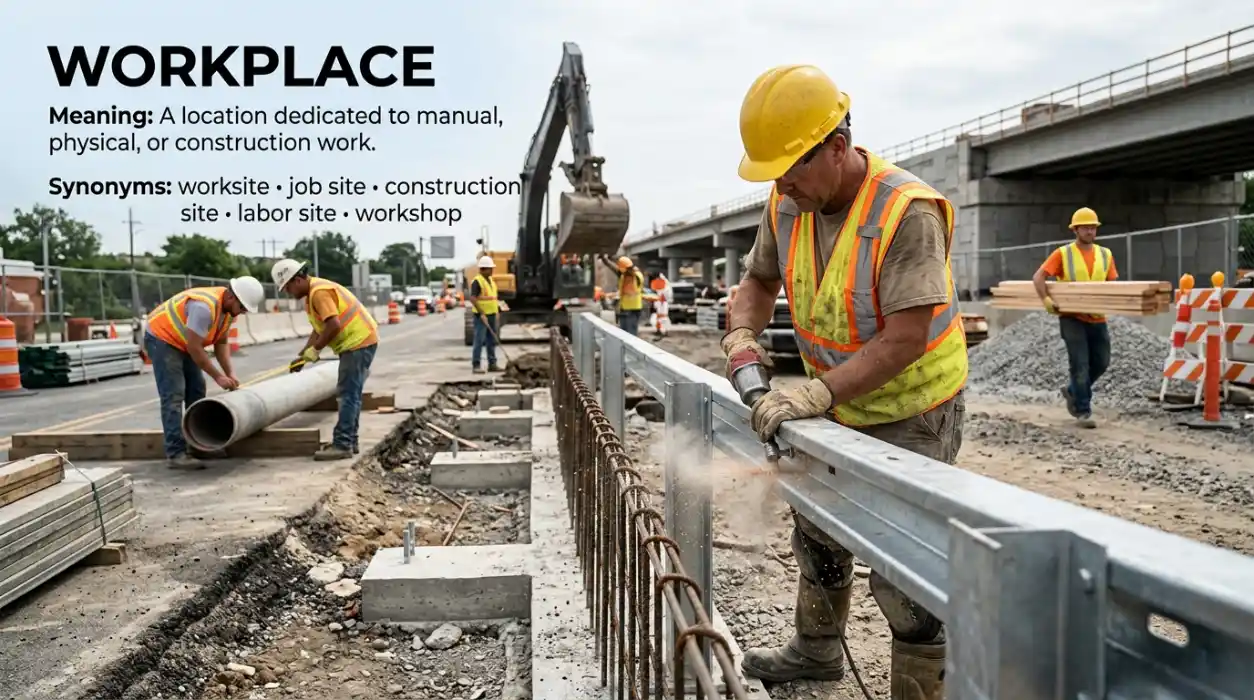
Labor Site (Noun Phrase) — US: /ˈleɪ.bɚ saɪt/ | UK: /ˈleɪ.bə saɪt/
Meaning: A location dedicated to manual, physical, or construction work activities.
Tone/Register: Practical, Industrial
Example:
Contractors established safety barriers around the active labor site.
Workers assembled equipment early in the morning on the labor site.
Synonyms by Tone
Choosing a synonym for workplace requires paying close attention to setting, audience, and register. Grouping these nouns by tone makes it quick and natural to choose the right word.
Positive Tone
These options emphasize collaboration, modern infrastructure, productivity, and supportive corporate culture:
- Workspace
- Campus
- Hub
- Coworking Space
- Professional Environment
- Creative Studio
Neutral Tone
These words state physical premises, administrative departments, or employment locations objectively:
- Office
- Facility
- Premises
- Business Premises
- Workstation
- Job Location
- Working Environment
Negative Tone
These terms carry associations of heavy physical labor, industrial monotony, or rigid routine:
- Factory
- Mill
- Production Floor
- Industrial Site
- Duty Post
Playful / Informal
These relaxed terms fit best in casual conversations, social chats, or creative blogs:
- Digs
- Space
- Home Office
- Shop
Mini Comparison
Office vs. Workspace vs. Premises
| Feature | Office | Workspace | Premises |
| Primary Focus | A specific room or building dedicated to administrative duties. | Any physical or digital setting organized for doing work. | The physical grounds and buildings owned by a business. |
| Tone | Standard, professional, and corporate. | Modern, flexible, and adaptable. | Formal, legal, and official. |
| Best Usage Context | “She walked into her corner office.” | “He set up a productive desk workspace.” | “Visitors must register on the premises.” |
How “Workplace” Changes by Context
Daily Conversation
In everyday speech, people rely on familiar, accessible terms like office, work, job location, or home office. For instance, a neighbor might mention heading into the office three days a week.
Writing or Blogging
Content creators and bloggers opt for engaging, modern phrases such as workspace, coworking space, or creative hub. Consequently, these descriptive terms keep business articles fresh and relevant for online readers.
Professional or Academic Tone
Resumes, corporate reports, and scholarly papers require precise, elevated terminology. Nouns like facility, corporate setting, professional environment, or business premises showcase executive clarity and expertise.
Creative or Informal Use
Fiction writers use evocative, specific terms like workshop, studio, digs, or plant. As a result, these choices build vivid, believable environments in descriptive narratives.
Common Mistakes & Native Usage
Common Mistakes Learners Make
- Confusing “workspace” with “workstation”: A workspace refers to your broader working environment, whereas a workstation specifically means your individual desk or computer desk.
- Using legal jargon in casual speech: Words like premises sound overly rigid in casual conversation. Saying “Come visit my premises” sounds unnatural compared to “Come visit my office.”
- Misusing “campus”: The word campus applies to large, spread-out corporate or educational grounds, not to a single small office room.
Register Notes
- Spoken English: Conversational speech favors office, work, desk, and home setup.
- Written English: Formal writing demands business premises, facility, corporate setting, and professional environment.
- To discover more ways to elevate your writing style across professional contexts, explore our comprehensive vocabulary expansion guides.
Real-Life Mini Scenarios
Workplace
During a quarterly meeting, the executive announced plans to renovate the main facility. Consequently, employees gained access to modern break rooms and ergonomic desks.
Social Situations
While chatting at a weekend gathering, friends discussed their hybrid schedules. They shared tips on how to organize a quiet home office space to reduce distractions.
Media / Pop Culture
A news report highlighted top tech firms opening new satellite offices. The journalist described how these new creative hubs attract talented young professionals.
Writing or Storytelling
An author detailed the protagonist’s daily routine in a historical novel. The character spent long, grueling hours on the factory floor before returning home.
Practice Quiz
1. Which synonym for workplace carries a formal tone best suited for legal documents?
A) Digs
B) Premises
C) Shop
D) Space
2. What term specifically refers to an individual desk or computer setup?
A) Workstation
B) Enterprise
C) Commercial hub
D) Depot
3. Which option represents a modern, shared physical space for freelancers?
A) Mill
B) Coworking space
C) Duty post
D) Industrial site
4. What is the main difference between “office” and “premises”?
A) “Office” refers to administrative rooms; “premises” refers to the entire physical grounds
B) “Office” is informal slang; “premises” is academic
C) “Premises” applies only to remote work
D) Both terms mean the same thing in all contexts
5. Which term best describes a corporate location with multiple buildings and green grounds?
A) Station
B) Campus
C) Post
D) Outpost
6. Which synonym carries an industrial, heavy manufacturing connotation?
A) Production floor
B) Executive suite
C) Virtual office
D) Bureau
7. An outdoor location where construction or field research occurs is a:
A) Home office
B) Jobsite
C) Corporate setting
D) Creative suite
8. Which option is an informal, casual term for an office or room?
A) Digs
B) Facility
C) Establishment
D) Enterprise
9. What phrase describes a digital office ecosystem connecting remote teams online?
A) Plant
B) Virtual office
C) Depot
D) Workshop
Application Task
Write one short original sentence describing your ideal working location using one vocabulary word from this guide (such as coworking space, campus, or studio).
Answer Key
1: B | 2: A | 3: B | 4: A | 5: B | 6: A | 7: B | 8: A | 9: B
Conclusion
Understanding the workplace can help you describe the place or environment where people perform their jobs and professional activities. Learning its synonyms, meaning, and examples can improve your English vocabulary and make your communication more precise.
The term workplace is commonly used in professional conversations, business writing, and everyday discussions about employment. Knowing its related synonyms can help you describe offices, work environments, job settings, and professional spaces in different ways.
By practicing workplace in sentences and exploring related words, you can strengthen your vocabulary and writing skills. Understanding this term will help you use it naturally, accurately, and confidently in different English contexts.
FAQs
1. What does “workplace” mean?
“Workplace” means a place or environment where people work or perform their professional duties.
2. What are synonyms for “workplace”?
Common synonyms include work environment, office, work setting, job site, employment setting, and professional environment.
3. What is an example of “workplace” in a sentence?
Example: A positive workplace can help employees feel comfortable and motivated.
4. Is “workplace” one word or two words?
Workplace is correctly written as one word.
5. Why is understanding “workplace” important?
Understanding “workplace” helps you describe professional environments clearly and use the term correctly in conversations and writing.

Hasnain Ali is an SEO Content Strategist and the founder of wordvora.com, a trusted vocabulary platform that helps writers, students, professionals, and English learners find accurate synonyms, antonyms, word meanings, and real-life usage examples. He specializes in keyword research, on-page SEO, topical authority, and creating search-first content that aligns with Google’s latest Search Quality and E-E-A-T guidelines. His work focuses on producing clear, well-structured, and reader-friendly resources that satisfy search intent while maintaining high editorial standards.
Through extensive hands-on experience with SEO tools such as Google Search Console, Google Analytics, SEMrush, and Ahrefs, Hasnain researches user search behavior and develops content that is both informative and easy to understand. Every article published on wordvora.com is carefully reviewed for accuracy, readability, and contextual relevance before publication. His mission is to build one of the web’s most reliable English vocabulary resources by providing practical language guidance, trustworthy explanations, and content that helps readers improve their writing, communication, and vocabulary with confidence.