
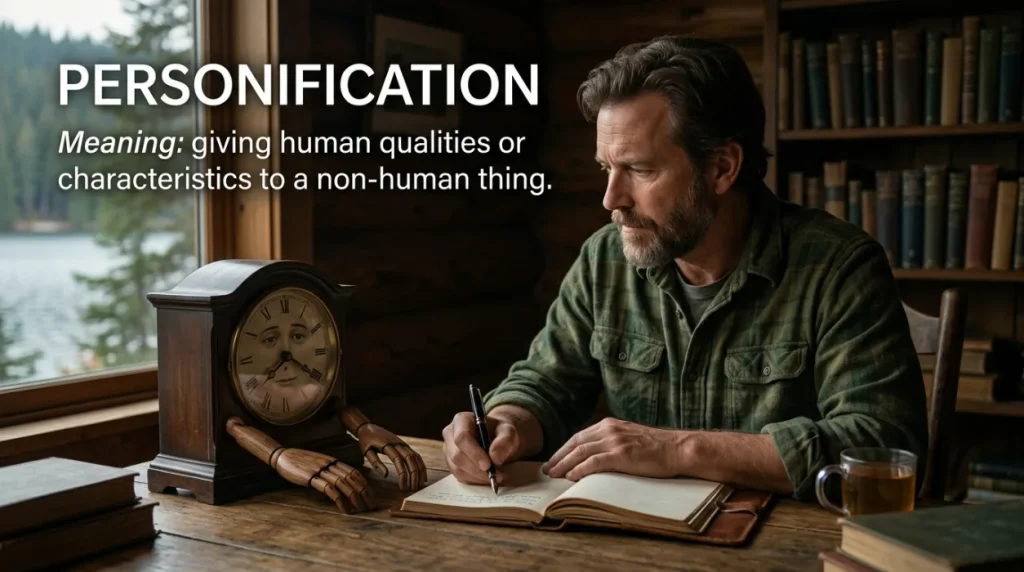
Synonyms for personification can make literary analysis much easier. Imagine a poem where the moon “watches” you or the wind “whispers” through the trees.
That simple technique gives human qualities to something nonhuman. Writers use it to make descriptions feel vivid, emotional, and memorable.
Learning synonyms for personification also expands your literary vocabulary. Students, bloggers, content writers, and everyday English users can describe ideas more precisely.
The term appears often in literature, poetry, essays, storytelling, and media analysis. Knowing synonyms for personification helps you explain the technique with confidence.
What Does “Personification” Really Mean?
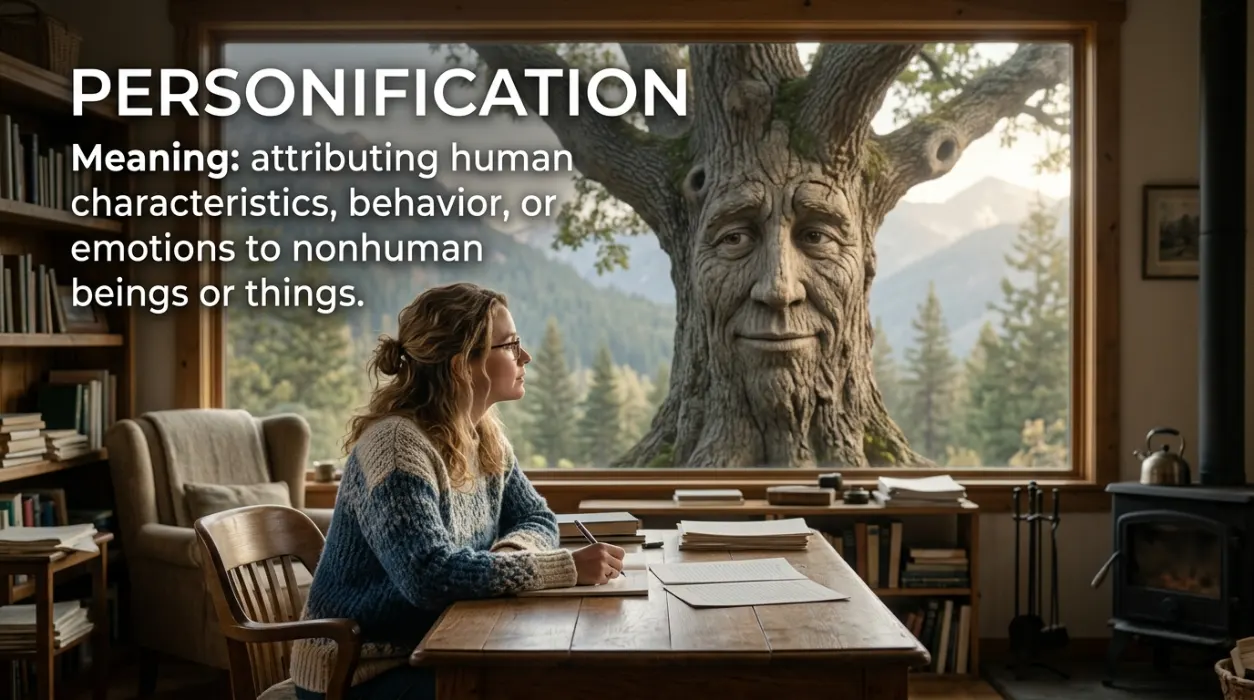
Personification is a literary and rhetorical device that gives human qualities, emotions, actions, intentions, or behaviors to something nonhuman.
In simple English:
Personification means describing a nonhuman thing as if it were a person.
For example:
The old house groaned in the wind.
A house cannot literally groan like a human being. The writer gives the house a human-like action.
Another example is:
The sun smiled over the village.
The sun does not have a human face or emotion. The word “smiled” makes the scene more vivid.
Personification can apply to animals, objects, nature, abstract ideas, places, organizations, and even machines.
Part of Speech
Personification is primarily a noun.
It can refer to:
- A literary device that gives human traits to nonhuman things.
- A person or thing that represents a quality in an especially clear way.
For example:
“The angry sea swallowed the boat” uses personification.
The word can also appear in a different sense:
“She is the personification of kindness.”
Here, the woman represents kindness so strongly that she seems like kindness itself in human form.
How Native English Speakers Understand Personification
Native speakers usually recognize personification as a creative writing technique.
It appears naturally in:
- Poetry
- Fiction
- Children’s literature
- Advertising
- Speeches
- Songs
- Essays
- Journalism
- Film criticism
- Literary analysis
The device works because readers naturally understand human emotions and actions.
When a writer says that “the city never sleeps,” readers understand that the city is active throughout the night. The city has not literally become a person.
Connotative Meaning
Connotation (the emotional or cultural feeling associated with a word beyond its basic definition) can influence how personification feels.
Positive Tone
Personification can create warmth, beauty, humor, comfort, or wonder.
The friendly sun welcomed the children.
The description makes nature feel inviting.
Negative Tone
It can also create fear, sadness, danger, or tension.
The darkness crept toward the frightened traveler.
The human-like verb “crept” creates an unsettling mood.
Neutral Tone
Personification can simply make an explanation or description more vivid.
The clock warned us that we were late.
The clock does not actually warn anyone. The expression simply creates a memorable image.
Etymology
The word personification ultimately comes from Latin roots.
It is connected with Latin persona, meaning “person,” “character,” or “role,” and facere, meaning “to make” or “to do.”
The underlying idea is therefore close to “making something into a person” or representing something as human.
The English word developed through French and Latin-influenced vocabulary.
Old English: 450–1100
There was no established Old English equivalent that directly developed into modern personification.
Old English writers could describe nature, objects, and abstract ideas in vivid ways, but the technical term came much later.
Middle English: 1100–1500
During Middle English, English absorbed many French and Latin literary terms.
The concept of representing abstract qualities through human figures was already important in medieval literature and religious writing.
However, the modern technical form personification was not an Old English inheritance.
Modern English: 1500–Present
The term became established as English literary vocabulary during the development of Renaissance literary criticism.
Modern writers use personification to describe both a rhetorical device and the representation of an abstract quality as a person.
The related classical rhetorical concept, prosopopoeia, is especially important. It refers to giving speech, personality, or a voice to someone or something that cannot literally speak.
Pronunciation
US: /pərˌsɑːnɪfɪˈkeɪʃən/
UK: /pəˌsɒnɪfɪˈkeɪʃən/
The main stress falls on -kay-.
Syllables
per-son-i-fi-ca-tion
Affixation Pattern of “Personification”
Root: person / Latin persona
Prefix: None in the modern English word
Suffixes: -ify + -ation
The related verb personify means “to represent something as a person.”
The suffix -ation forms a noun describing an action, process, or result.
Synonyms List
Anthropomorphism (Noun) — US /ˌænθrəpəˈmɔːrfɪzəm/ | UK /ˌænθrəpəˈmɔːfɪzəm/
Meaning: The attribution of human characteristics, behavior, or emotions to nonhuman beings or things.
Tone/Register: Academic, literary.
Example:
The animated film uses anthropomorphism to make the animals behave like people.
The talking fox is an example of anthropomorphism.
Anthropomorphization (Noun) — US /ˌænθrəpəmɔːrfəˈzeɪʃən/ | UK /ˌænθrəpəmɔːfaɪˈzeɪʃən/
Meaning: The process of giving human characteristics to something nonhuman.
Tone/Register: Academic, technical.
Example:
Anthropomorphization makes the robot seem emotionally aware.
The story relies on anthropomorphization to build sympathy for the machine.
Anthropomorphize (Verb) — US /ˌænθrəpəˈmɔːrfaɪz/ | UK /ˌænθrəpəˈmɔːfaɪz/
Meaning: To describe or treat a nonhuman thing as though it were human.
Tone/Register: Academic, literary.
Example:
The author anthropomorphizes the river throughout the novel.
Children often anthropomorphize their favorite toys.
Anthropomorphic (Adjective) — US /ˌænθrəpəˈmɔːrfɪk/ | UK /ˌænθrəpəˈmɔːfɪk/
Meaning: Having or displaying human-like qualities while remaining nonhuman.
Tone/Register: Academic, descriptive.
Example:
The story features anthropomorphic animals.
The anthropomorphic robot expresses fear and curiosity.
Prosopopoeia (Noun) — US /ˌprɒsəpoʊˈpiːə/ | UK /ˌprɒsəpəˈpiːə/
Meaning: A rhetorical device that gives speech, voice, or human identity to someone or something unable to speak.
Tone/Register: Formal, rhetorical, academic.
Example:
The poem uses prosopopoeia by allowing Death to speak.
The technique gives the abandoned building a human voice.
Prosopopeia (Noun) — US /ˌprɒsəpoʊˈpiːə/ | UK /ˌprɒsəpəˈpiːə/
Meaning: An alternative spelling of prosopopoeia describing the representation of a nonhuman or absent speaker as a speaking person.
Tone/Register: Formal, literary.
Example:
The essay identifies prosopopeia in the poem’s final stanza.
The speaker gives Memory a voice through prosopopeia.
Personify (Verb) — US /pərˈsɑːnɪfaɪ/ | UK /pəˈsɒnɪfaɪ/
Meaning: To represent something nonhuman as having human qualities.
Tone/Register: Neutral, literary.
Example:
The poet personifies the sea as a restless traveler.
The writer personifies winter as an old man.
Personified (Adjective/Verb) — US /pərˈsɑːnɪfaɪd/ | UK /pəˈsɒnɪfaɪd/
Meaning: Described or represented as if something were human.
Tone/Register: Literary, academic.
Example:
The personified storm becomes a major character in the poem.
Fear is personified as a shadow following the narrator.
Humanization (Noun) — US /ˌhjuːmənəˈzeɪʃən/ | UK /ˌhjuːmənaɪˈzeɪʃən/
Meaning: The process of making something seem more human or relatable.
Tone/Register: Neutral, academic.
Example:
The film uses humanization to make the artificial intelligence sympathetic.
The character’s humor contributes to the humanization of the robot.
Humanize (Verb) — US /ˈhjuːmənaɪz/ | UK /ˈhjuːmənaɪz/
Meaning: To give something human qualities or make it easier to relate to as a person.
Tone/Register: Neutral.
Example:
The writer humanizes the city through personal stories.
The documentary humanizes the historical figure.
Humanized (Adjective) — US /ˈhjuːmənaɪzd/ | UK /ˈhjuːmənaɪzd/
Meaning: Presented with qualities that make a nonhuman or abstract subject feel human.
Tone/Register: Neutral, academic.
Example:
The humanized computer becomes emotionally important to the family.
The humanized portrayal makes the abstract idea easier to understand.
Personalization (Noun) — US /ˌpɜːrsənələˈzeɪʃən/ | UK /ˌpɜːsənəlaɪˈzeɪʃən/
Meaning: In literary discussion, the representation of an abstract or impersonal subject through personal characteristics.
Tone/Register: Academic, literary.
Example:
The poem uses personalization to make time seem like an active force.
The personalization of nature strengthens the emotional effect.
Personalize (Verb) — US /ˈpɜːrsənəlaɪz/ | UK /ˈpɜːsənəlaɪz/
Meaning: To represent something impersonal in a more personal or human way.
Tone/Register: Neutral.
Example:
The novelist personalizes grief by giving it a voice.
The poem personalizes the changing seasons.
Allegory (Noun) — US /ˈæləɡɔːri/ | UK /ˈæləɡəri/
Meaning: A story or representation in which characters, events, or images express deeper ideas.
Tone/Register: Literary, academic.
Example:
The novel works as an allegory for political power.
The characters represent larger moral ideas.
Allegorical Representation (Noun Phrase) — US /ˌæləˈɡɔːrɪk ˌreprɪzenˈteɪʃən/ | UK /ˌæləˈɡɒrɪk ˌreprɪzenˈteɪʃən/
Meaning: A representation in which a character or image stands for an abstract concept.
Tone/Register: Academic.
Example:
The figure of Justice is an allegorical representation of fairness.
The painting uses allegorical representation to explore freedom.
Figurative Representation (Noun Phrase) — US /ˈfɪɡjərətɪv ˌreprɪzenˈteɪʃən/ | UK /ˈfɪɡərətɪv ˌreprɪzenˈteɪʃən/
Meaning: A nonliteral representation that communicates an idea through imagery or symbolism.
Tone/Register: Academic, literary.
Example:
The storm provides a figurative representation of the character’s anger.
The writer uses figurative representation throughout the novel.
Figurative Language (Noun) — US /ˈfɪɡjərətɪv ˈlæŋɡwɪdʒ/ | UK /ˈfɪɡərətɪv ˈlæŋɡwɪdʒ/
Meaning: Language that communicates ideas beyond literal meanings.
Tone/Register: Academic, educational.
Example:
Personification is a form of figurative language.
The poem contains several types of figurative language.
Rhetorical Device (Noun Phrase) — US /rɪˈtɔːrɪkəl dɪˈvaɪs/ | UK /rɪˈtɒrɪkəl dɪˈvaɪs/
Meaning: A deliberate language technique used to create emphasis, emotion, or a particular effect.
Tone/Register: Academic, formal.
Example:
The author uses personification as a rhetorical device.
The device makes the argument more memorable.
Figure of Speech (Noun Phrase) — US /ˌfɪɡjər əv ˈspiːtʃ/ | UK /ˌfɪɡər əv ˈspiːtʃ/
Meaning: An expression that uses language in a nonliteral or distinctive way.
Tone/Register: Neutral, educational.
Example:
Personification is a common figure of speech.
The teacher explained the figure of speech with a simple poem.
Figurative Device (Noun Phrase) — US /ˈfɪɡjərətɪv dɪˈvaɪs/ | UK /ˈfɪɡərətɪv dɪˈvaɪs/
Meaning: A literary technique that creates meaning through nonliteral expression.
Tone/Register: Academic.
Example:
The author uses this figurative device to create suspense.
The device gives the setting a stronger personality.
Literary Device (Noun Phrase) — US /ˈlɪtəreri dɪˈvaɪs/ | UK /ˈlɪtrəri dɪˈvaɪs/
Meaning: A technique writers use to create meaning, emotion, structure, or artistic effect.
Tone/Register: Academic, educational.
Example:
Personification is a useful literary device.
The writer combines this device with imagery.
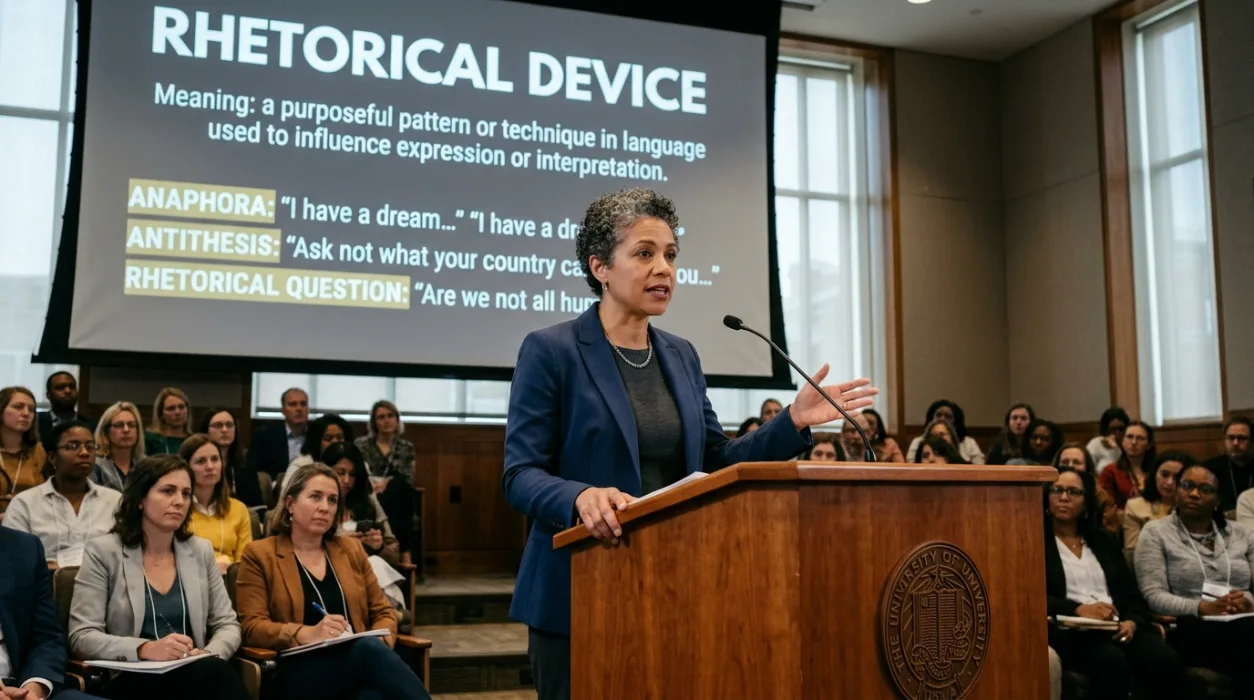
Rhetorical Figure (Noun Phrase) — US /rɪˈtɔːrɪkəl ˈfɪɡjər/ | UK /rɪˈtɒrɪkəl ˈfɪɡə/
Meaning: A purposeful pattern or technique in language used to influence expression or interpretation.
Tone/Register: Formal, rhetorical.
Example:
The rhetorical figure gives the speech emotional force.
The poet uses several rhetorical figures.
Trope (Noun) — US /troʊp/ | UK /trəʊp/
Meaning: A recurring figurative or conceptual way of expressing an idea.
Tone/Register: Academic, literary, media.
Example:
Personification can function as a literary trope.
The novel freshly develops the familiar trope.
Metaphorical Representation (Noun Phrase) — US /ˌmetəˈfɔːrɪkəl ˌreprɪzenˈteɪʃən/ | UK /ˌmetəˈfɒrɪkəl ˌreprɪzenˈteɪʃən/
Meaning: A representation that communicates an idea through metaphorical comparison.
Tone/Register: Academic.
Example:
The winter becomes a metaphorical representation of loneliness.
The image provides a metaphorical representation of loss.
Metaphor (Noun) — US /ˈmetəfɔːr/ | UK /ˈmetəfə/
Meaning: A nonliteral comparison that presents one thing as another.
Tone/Register: Neutral, academic, literary.
Example:
The poem calls time a thief.
That metaphor gives time a powerful identity.
Extended Metaphor (Noun Phrase) — US /ɪkˈstendɪd ˈmetəfɔːr/ | UK /ɪkˈstendɪd ˈmetəfə/
Meaning: A metaphor that continues across several lines, sentences, or sections.
Tone/Register: Literary, academic.
Example:
The poem develops an extended metaphor of life as a journey.
The repeated image connects the story’s major themes.
Symbolic Representation (Noun Phrase) — US /sɪmˈbɑːlɪk ˌreprɪzenˈteɪʃən/ | UK /sɪmˈbɒlɪk ˌreprɪzenˈteɪʃən/
Meaning: An image, object, or character that represents a deeper idea.
Tone/Register: Academic, literary.
Example:
The rising sun becomes a symbolic representation of hope.
The broken mirror provides a symbolic representation of identity.
Symbolism (Noun) — US /ˈsɪmbəˌlɪzəm/ | UK /ˈsɪmbəlɪzəm/
Meaning: The use of images, objects, or actions to represent deeper meanings.
Tone/Register: Academic, literary.
Example:
The poem uses symbolism to explore freedom.
The bird carries strong symbolism throughout the story.
Symbolization (Noun) — US /ˌsɪmbələˈzeɪʃən/ | UK /ˌsɪmbəlaɪˈzeɪʃən/
Meaning: The process of making something function as a symbol for an idea.
Tone/Register: Academic.
Example:
The symbolization of the river adds emotional depth.
The story uses symbolization to connect nature with memory.
Reification (Noun) — US /ˌriːɪfɪˈkeɪʃən/ | UK /ˌreɪɪfɪˈkeɪʃən/
Meaning: Treating an abstract idea as if it were a concrete thing.
Tone/Register: Academic, philosophical.
Example:
The poem uses reification when it treats fear as a physical presence.
The concept becomes almost tangible through reification.
Concretization (Noun) — US /kənˌkriːtəˈzeɪʃən/ | UK /kənˌkriːtaɪˈzeɪʃən/
Meaning: The process of making an abstract idea more concrete or imaginable.
Tone/Register: Academic.
Example:
The writer uses concretization to make loneliness feel visible.
The image provides concretization of an otherwise abstract emotion.
Embodiment (Noun) — US /ɪmˈbɑːdimənt/ | UK /ɪmˈbɒdimənt/
Meaning: A person, character, or thing that represents an idea or quality very strongly.
Tone/Register: Formal, academic.
Example:
The character becomes an embodiment of courage.
The statue serves as an embodiment of national pride.
Embody (Verb) — US /ɪmˈbɑːdi/ | UK /ɪmˈbɒdi/
Meaning: To represent an idea or quality in a clear physical or visible form.
Tone/Register: Formal, versatile.
Example:
The character embodies hope.
The old tree embodies the family’s history.
Incarnation (Noun) — US /ˌɪnkɑːrˈneɪʃən/ | UK /ˌɪnkɑːˈneɪʃən/
Meaning: A person or form that represents an idea, quality, or concept.
Tone/Register: Formal, literary, sometimes religious.
Example:
The heroine becomes an incarnation of justice.
The character is presented as an incarnation of freedom.
Person-like Representation (Noun Phrase) — US /ˈpɜːrsən laɪk ˌreprɪzenˈteɪʃən/ | UK /ˈpɜːsən laɪk ˌreprɪzenˈteɪʃən/
Meaning: A representation that gives a nonhuman subject recognizable human qualities.
Tone/Register: Neutral, explanatory.
Example:
The author creates a person-like representation of the ocean.
The person-like representation makes the setting feel alive.
Human-Like Portrayal (Noun Phrase) — US /ˈhjuːmən laɪk pɔːrˈtreɪəl/ | UK /ˈhjuːmən laɪk pɔːˈtreɪəl/
Meaning: A depiction that makes something nonhuman behave or appear like a person.
Tone/Register: Neutral.
Example:
The novel gives the moon a human-like portrayal.
The human-like portrayal creates an emotional connection.
Human Attribution (Noun Phrase) — US /ˈhjuːmən ˌætrəˈbjuːʃən/ | UK /ˈhjuːmən ˌætrɪˈbjuːʃən/
Meaning: The assignment of human qualities or actions to something nonhuman.
Tone/Register: Academic.
Example:
The poem uses human attribution when the river “remembers.”
Human attribution makes the natural world feel emotionally active.
Attribution of Human Traits (Noun Phrase) — US /ˌætrəˈbjuːʃən əv ˈhjuːmən treɪts/ | UK /ˌætrɪˈbjuːʃən əv ˈhjuːmən treɪts/
Meaning: Giving human emotions, behaviors, or characteristics to a nonhuman subject.
Tone/Register: Academic, explanatory.
Example:
The attribution of human traits makes the storm seem angry.
The author uses this technique to deepen the setting.
Human Trait Attribution (Noun Phrase) — US /ˈhjuːmən treɪt ˌætrəˈbjuːʃən/ | UK /ˈhjuːmən treɪt ˌætrɪˈbjuːʃən/
Meaning: The deliberate assignment of human characteristics to something that is not human.
Tone/Register: Academic.
Example:
Human trait attribution appears throughout the poem.
The technique gives the mountain a strong personality.
Characterization of Nature (Noun Phrase) — US /ˌkærəktəraɪˈzeɪʃən əv ˈneɪtʃər/ | UK /ˌkærəktəraɪˈzeɪʃən əv ˈneɪtʃə/
Meaning: Describing natural forces or objects as if they had personalities or motives.
Tone/Register: Literary, academic.
Example:
The poet uses characterization of nature to portray the sea as hostile.
This technique makes the landscape feel active.
Animated Description (Noun Phrase) — US /ˈænəmeɪtɪd dɪˈskrɪpʃən/ | UK /ˈænɪmeɪtɪd dɪˈskrɪpʃən/
Meaning: A vivid description that makes an object, place, or natural force seem alive or active.
Tone/Register: Literary, descriptive.
Example:
The writer’s animated description makes the forest seem watchful.
The scene gains energy through animated description.
Living Metaphor (Noun Phrase) — US /ˈlɪvɪŋ ˈmetəfɔːr/ | UK /ˈlɪvɪŋ ˈmetəfə/
Meaning: A metaphor that creates a strong sense that an abstract or nonhuman subject is alive.
Tone/Register: Literary, descriptive.
Example:
The river becomes a living metaphor for memory.
The recurring image turns the city into a living metaphor.
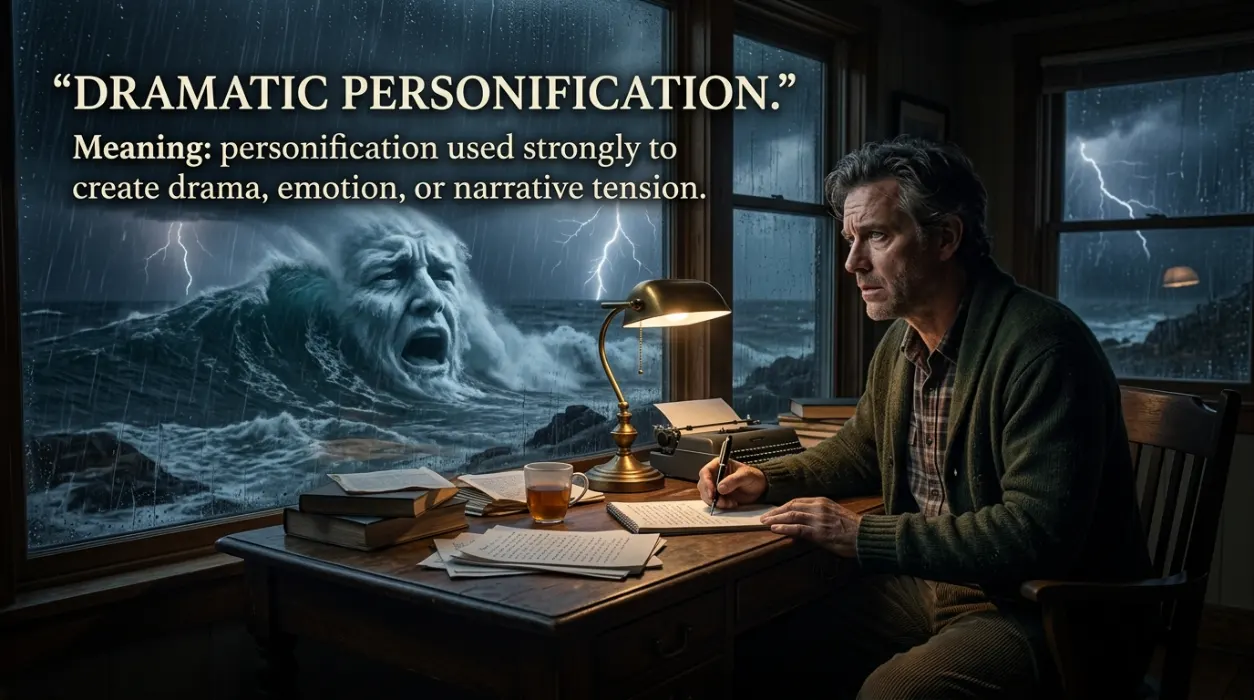
Dramatic Personification (Noun Phrase) — US /drəˈmætɪk pərˌsɑːnɪfɪˈkeɪʃən/ | UK /drəˈmætɪk pəˌsɒnɪfɪˈkeɪʃən/
Meaning: Personification used strongly to create drama, emotion, or narrative tension.
Tone/Register: Literary.
Example:
The storm receives dramatic personification in the final scene.
The author turns death into a dramatic character.
Poetic Personification (Noun Phrase) — US /poʊˈetɪk pərˌsɑːnɪfɪˈkeɪʃən/ | UK /pəʊˈetɪk pəˌsɒnɪfɪˈkeɪʃən/
Meaning: Personification used primarily to create poetic imagery or emotional effect.
Tone/Register: Literary.
Example:
The poem uses poetic personification to make winter seem lonely.
The technique gives the stars an emotional presence.
Figurative Anthropomorphism (Noun Phrase) — US /ˈfɪɡjərətɪv ˌænθrəpəˈmɔːrfɪzəm/ | UK /ˈfɪɡərətɪv ˌænθrəpəˈmɔːfɪzəm/
Meaning: The figurative presentation of something nonhuman with human qualities.
Tone/Register: Academic.
Example:
The story uses figurative anthropomorphism to portray the forest.
The technique encourages readers to emotionally connect with nature.
Symbolic Personification (Noun Phrase) — US /sɪmˈbɑːlɪk pərˌsɑːnɪfɪˈkeɪʃən/ | UK /sɪmˈbɒlɪk pəˌsɒnɪfɪˈkeɪʃən/
Meaning: Personification that gives a human identity to something while also representing a deeper idea.
Tone/Register: Literary, academic.
Example:
The author uses symbolic personification to represent justice as a woman.
The figure becomes both a character and an idea.
Abstract Personification (Noun Phrase) — US /ˈæbstrækt pərˌsɑːnɪfɪˈkeɪʃən/ | UK /ˈæbstrækt pəˌsɒnɪfɪˈkeɪʃən/
Meaning: Personification that gives a human identity to an abstract concept such as love, fear, death, or freedom.
Tone/Register: Academic, literary.
Example:
The poem uses abstract personification for grief.
Fear appears as a silent visitor in the story.
Nature Personification (Noun Phrase) — US /ˈneɪtʃər pərˌsɑːnɪfɪˈkeɪʃən/ | UK /ˈneɪtʃə pəˌsɒnɪfɪˈkeɪʃən/
Meaning: Personification that gives human qualities to natural objects, forces, or environments.
Tone/Register: Literary, academic.
Example:
Nature personification makes the wind seem playful.
The poem gives the mountains a protective role.
Pathetic Fallacy (Noun) — US /pəˈθetɪk ˈfæləsi/ | UK /pəˈθetɪk ˈfæləsi/
Meaning: A literary technique in which human emotions are projected onto nature or the environment.
Tone/Register: Literary, academic.
Example:
The gloomy weather reflects the character’s sadness through pathetic fallacy.
The dark clouds reinforce the poem’s emotional mood.
Animism (Noun) — US /ˈænəˌmɪzəm/ | UK /ˈænɪmɪzəm/
Meaning: The belief that natural objects, places, or phenomena possess spirits or forms of life.
Tone/Register: Academic, anthropological.
Example:
The story draws on animism when the forest receives a spiritual identity.
The cultural tradition presents nature as alive.
Animation (Noun) — US /ˌænəˈmeɪʃən/ | UK /ˌænɪˈmeɪʃən/
Meaning: In literary analysis, the representation of something as lively, active, or alive.
Tone/Register: Literary, academic.
Example:
The poem creates animation in an otherwise silent landscape.
The description gives the old building unusual energy.
Allegorical Personification (Noun Phrase) — US /ˌæləˈɡɔːrɪk pərˌsɑːnɪfɪˈkeɪʃən/ | UK /ˌæləˈɡɒrɪk pəˌsɒnɪfɪˈkeɪʃən/
Meaning: Personification that turns an abstract concept into a character representing that concept.
Tone/Register: Formal, literary.
Example:
The writer uses allegorical personification to portray Justice as a judge.
The character represents a moral principle.
Embodied Abstraction (Noun Phrase) — US /ɪmˈbɑːdid æbˈstrækʃən/ | UK /ɪmˈbɒdid æbˈstrækʃən/
Meaning: An abstract idea represented through a recognizable person or character.
Tone/Register: Academic, literary.
Example:
The character becomes an embodied abstraction of hope.
The novel turns freedom into an embodied abstraction.
Conceptual Personification (Noun Phrase) — US /kənˈseptʃuəl pərˌsɑːnɪfɪˈkeɪʃən/ | UK /kənˈseptʃuəl pəˌsɒnɪfɪˈkeɪʃən/
Meaning: Personification used to give a recognizable human identity to an abstract concept.
Tone/Register: Academic.
Example:
Conceptual personification makes justice easier to visualize.
The poem gives time a distinct personality.
Figurative Humanization (Noun Phrase) — US /ˈfɪɡjərətɪv ˌhjuːmənəˈzeɪʃən/ | UK /ˈfɪɡərətɪv ˌhjuːmənaɪˈzeɪʃən/
Meaning: The figurative process of making a nonhuman subject seem emotionally or behaviorally human.
Tone/Register: Academic, literary.
Example:
Figurative humanization makes the abandoned house seem lonely.
The story uses figurative humanization to create empathy.
Synonyms by Tone
Tone matters because these terms do not carry identical meanings.
Positive or Admiring
These choices can emphasize creativity, vividness, insight, or meaningful representation:
- Embody
- Embodiment
- Discerning representation
- Humanization
- Symbolic representation
- Figurative language
- Metaphorical representation
Use these when your analysis focuses on artistic effectiveness.
Neutral
These terms describe the technique without strongly judging it:
- Personify
- Personified
- Anthropomorphism
- Anthropomorphic
- Figurative representation
- Literary device
- Figure of speech
- Rhetorical device
- Symbolism
- Allegory
These work well in school assignments and explanatory articles.
Negative or Critical
Some related concepts can carry criticism:
- Reification
- Pathetic fallacy
- Over-anthropomorphism, when used critically
- Human attribution, when the analysis questions whether the technique distorts reality
These should be used carefully because they do not simply mean “personification.”
Playful or Informal
For simple explanations, you can say:
- Giving human qualities
- Giving voice to the nonhuman
- Human-like portrayal
- Living representation
- Animated description
These expressions help ESL learners understand the underlying idea without heavy literary terminology.
Personification vs. Close Alternatives
Personification vs. Anthropomorphism
These concepts overlap strongly.
Personification usually refers to a literary or rhetorical technique that gives human qualities to something nonhuman.
Anthropomorphism has a broader meaning. It can describe animals, objects, machines, gods, or other entities that are represented as behaving like humans.
A talking animal in a children’s story is often both anthropomorphic and personified.
Personification vs. Metaphor
A metaphor makes a nonliteral comparison.
Personification is more specific. It gives human traits to something nonhuman.
The city is a jungle.
This is a metaphor.
The city never sleeps.
This is personification because the city receives a human ability or behavior.
Personification vs. Pathetic Fallacy
Pathetic fallacy is narrower.
It specifically involves projecting human emotions onto nature.
The angry storm attacked the village.
This can be described as personification. It may also be discussed as pathetic fallacy because the storm receives a human emotion.
How Personification Changes by Context
Daily Conversation
People use simple personification constantly without thinking about it.
Examples include:
My phone is acting strange.
The computer hates me today.
The speaker does not literally believe the machine has feelings. The expression makes frustration easier to communicate.
Writing and Blogging
Personification can make ordinary subjects more engaging.
Instead of writing:
The wind moved through the trees.
A writer might say:
The wind danced through the trees.
The second version creates a clearer mental image.
Bloggers can use this technique when explaining technology, nature, places, food, or abstract ideas.
Professional or Academic Writing
Academic writers should use personification carefully.
Some expressions have become so common that they sound natural:
The evidence suggests that…
The study examines…
However, writers should avoid creating confusion by assigning strong human intentions to institutions or data.
In literary analysis, explicit terminology is useful:
The poet personifies death as a silent visitor.
That sentence clearly identifies the technique.
Creative and Informal Writing
Creative writing offers the greatest freedom.
A novelist can give a storm, house, road, river, city, or memory a personality.
The technique becomes especially powerful when the personification supports the story’s emotional theme.
Real-Life Mini Scenarios
Workplace
Imagine an employee writing:
The deadline is chasing us.
The deadline cannot physically chase anyone. The writer personifies it to express pressure.
A more formal report might say:
The approaching deadline is creating time pressure.
The second version is less figurative.
Social Situations
Someone might say:
My alarm clock betrayed me this morning.
The alarm clock did not intentionally betray the speaker.
The personification simply adds humor to an ordinary experience.
Media and Pop Culture
Animated films frequently use anthropomorphism.
Animals may talk, wear clothes, form relationships, and make decisions like humans.
Literary analysis can describe this as anthropomorphism, personification, or both, depending on the specific scene.
Writing and Storytelling
A novelist might write:
The abandoned house watched every visitor.
The house cannot literally watch.
The writer gives it a human action to create mystery and suspense.
Common Mistakes Learners Make
Mistake 1: Calling Every Metaphor Personification
Not every metaphor gives human qualities.
Her voice was velvet.
This is metaphorical language, but it is not personification.
The writer does not give velvet human behavior.
Mistake 2: Confusing Anthropomorphism and Personification
The terms overlap, but anthropomorphism can describe broader human-like behavior.
Personification is especially common as a literary and rhetorical label.
Mistake 3: Assuming Personification Must Involve Speaking
A nonhuman subject does not have to speak.
The flowers danced in the breeze.
This is personification even though the flowers say nothing.
Mistake 4: Using “Allegory” as a Direct Synonym
An allegory can contain personification.
However, an allegory is a broader narrative or symbolic structure.
Therefore, the two terms should not be treated as exact equivalents.
Mistake 5: Thinking Personification Must Be Serious
Writers use it for humor too.
My laptop decided to quit five minutes before the deadline.
The humorous effect comes from treating the laptop as though it made a deliberate decision.
Mistake 6: Overusing Personification
Too much figurative language can make writing feel exaggerated.
Use personification when it adds an image, emotion, voice, or memorable quality.
Native Usage Notes
Native speakers often use personification without labeling it.
Expressions such as “the sun smiled,” “the wind whispered,” “time flies,” and “the city never sleeps” can feel completely natural.
In formal literary analysis, however, naming the technique shows precision.
For example:
The poet personifies the wind to create a sense of freedom.
That is stronger than simply saying:
The poet uses nice words about the wind.
Practice Exercise
1. “The wind whispered through the trees.” What literary technique is used?
A. Personification
B. Hyperbole
C. Irony
D. Alliteration
2. Which term describes giving human behavior to animals?
A. Anthropomorphism
B. Repetition
C. Understatement
D. Onomatopoeia
3. “Time is a thief” is primarily an example of:
A. Metaphor
B. Literal language
C. Dialogue
D. Personification only
4. “The angry clouds gathered above the town” can be described as:
A. Personification
B. Technical writing
C. Literal description
D. Definition
5. Which term is most appropriate when an abstract concept becomes a character?
A. Allegorical personification
B. Literal comparison
C. Plain description
D. Euphemism
6. A poem allows Death to speak directly to the reader. Which specialized term may apply?
A. Prosopopoeia
B. Simile
C. Pun
D. Oxymoron
7. Which word describes a broader practice of giving human characteristics to nonhuman entities?
A. Anthropomorphism
B. Assonance
C. Rhyme
D. Irony
8. “The city never sleeps” gives the city:
A. A human behavior
B. A numerical value
C. A historical date
D. A literal sleeping schedule
9. A writer projects sadness onto rain. Which related literary term may apply?
A. Pathetic fallacy
B. Alliteration
C. Paradox
D. Pun
10. Which term describes a deeper meaning represented through an object or image?
A. Symbolism
B. Pronunciation
C. Dialogue
D. Grammar
Reflection task:
Write one original sentence that personifies an object, animal, natural force, place, or abstract idea. Then identify the human quality you gave it.
Answer key: 1-A | 2-A | 3-A | 4-A | 5-A | 6-A | 7-A | 8-A | 9-A | 10-A
Conclusion
Learning synonyms for personification does more than expand vocabulary. It helps you recognize how writers turn ordinary objects, nature, and ideas into vivid experiences.
Knowing related terms such as anthropomorphism, metaphor, symbolism, and prosopopoeia makes literary analysis clearer. Each word gives you a more precise way to explain meaning.
Students can use these distinctions in essays, while bloggers and writers can use them to create clearer explanations. Better vocabulary also improves everyday communication.
Start small by choosing one term today. Use it in an essay, email, reading note, or original sentence, then compare it with personification to sharpen your understanding.
Frequently Asked Questions
1. What are the closest synonyms for personification in literary analysis?
The closest terms are anthropomorphism, prosopopoeia, and humanization, although they are not exact equivalents. Personification specifically gives human traits to nonhuman subjects. Anthropomorphism is broader, while prosopopoeia often focuses on giving speech or a voice to something unable to speak. Choose the term that matches the exact technique in the passage.
2. Is anthropomorphism the same as personification?
Anthropomorphism and personification overlap, but they are not always identical. Anthropomorphism broadly describes nonhuman entities behaving or appearing like humans. Personification usually refers to a rhetorical or literary technique that assigns human characteristics to an object, animal, natural force, place, or abstract idea.
3. What is another word for personification in poetry?
In poetry, anthropomorphism, prosopopoeia, and humanization can sometimes describe closely related techniques. However, “personification” remains the clearest general term. If a poem gives a nonhuman subject a speaking voice, prosopopoeia may provide a more precise literary description.
4. What is the difference between personification and metaphor?
A metaphor creates a nonliteral comparison, while personification specifically gives human qualities to something nonhuman. For example, “The classroom was a zoo” is a metaphor. “The classroom screamed with excitement” uses personification because the classroom receives a human-like action.
5. What is personification called when nature has human emotions?
This can be called pathetic fallacy when human emotions are projected specifically onto nature. For example, describing rain as “sad” gives nature a human emotional quality. The same example may also qualify as personification, but pathetic fallacy provides a narrower literary label.

Hasnain Ali is an SEO Content Strategist and the founder of wordvora.com, a trusted vocabulary platform that helps writers, students, professionals, and English learners find accurate synonyms, antonyms, word meanings, and real-life usage examples. He specializes in keyword research, on-page SEO, topical authority, and creating search-first content that aligns with Google’s latest Search Quality and E-E-A-T guidelines. His work focuses on producing clear, well-structured, and reader-friendly resources that satisfy search intent while maintaining high editorial standards.
Through extensive hands-on experience with SEO tools such as Google Search Console, Google Analytics, SEMrush, and Ahrefs, Hasnain researches user search behavior and develops content that is both informative and easy to understand. Every article published on wordvora.com is carefully reviewed for accuracy, readability, and contextual relevance before publication. His mission is to build one of the web’s most reliable English vocabulary resources by providing practical language guidance, trustworthy explanations, and content that helps readers improve their writing, communication, and vocabulary with confidence.