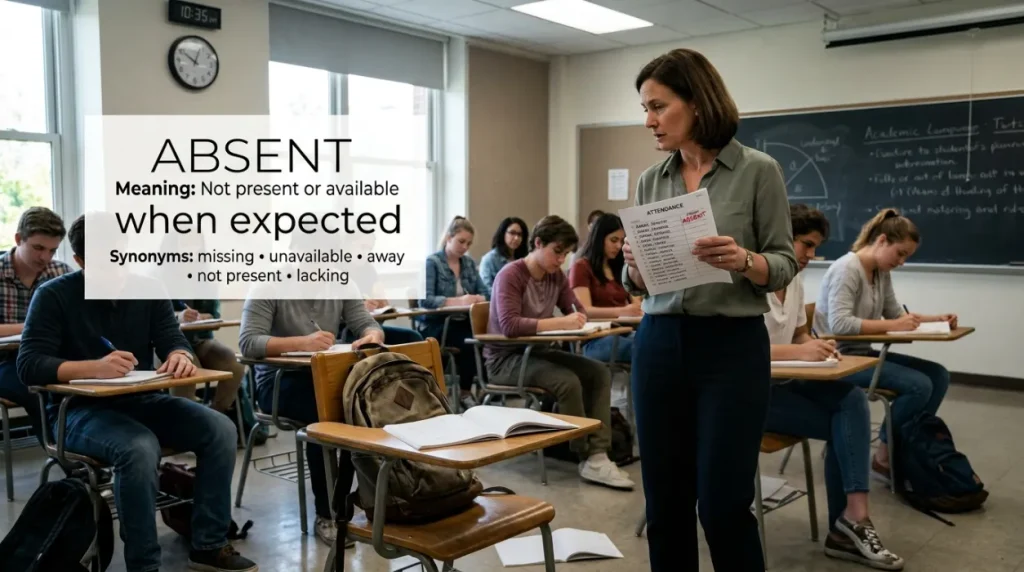
The word absent is commonly used to describe someone or something that is not present in a particular place or situation. It can also describe a missing quality, feature, or condition, depending on the context.
Understanding absent can help you communicate clearly when talking about missing people, objects, qualities, or things that are not available. Learning its synonyms, meaning, and examples can also expand your English vocabulary.
The meaning of absent can vary slightly depending on how it is used in a sentence. It may refer to someone who is away from a place or something that is missing, unavailable, or lacking.
By learning absent, its synonyms, meaning, and examples, you can improve your vocabulary and writing skills. This guide will help you understand the word clearly and use it naturally and confidently in different English contexts.
Core Meaning of Absent
The word “absent” describes someone or something that is not present in a given place, meeting, or context.
Native speakers use it to indicate physical non-attendance or mental distraction during conversations and work events.
In English grammar, “absent” functions primarily as an adjective, though it can also act as a preposition or verb.
Definition: Not present in a place, occasion, or entity, or mentally lost in thought.
Connotation and Tone
Connotation refers to the emotional feeling or cultural association that a word carries beyond its literal dictionary definition.
- Positive tone: Off enjoying a well-deserved vacation or taking time to rest and recharge peacefully.
- Negative tone: Trashing responsibilities, slacking off, or failing to show up when expected by teammates.
- Neutral tone: Simply not present due to standard scheduling, routine remote work, or physical distance.
Etymology and History
The word “absent” originates from the Latin term absens, which means “to be away” or “not present.”
- Old English (450–1100): The concept was expressed using Germanic roots like aweard (awayward) before Latin influences merged.
- Middle English (1100–1500): Adopted through Old French, absent, quickly entering formal legal and academic texts.
- Modern English (1500–Present): Expanded to describe both physical non-presence and mental distraction or daydreaming.

Pronunciation and Syllable Structure
- US Pronunciation: /ˈæb.sənt/
- UK Pronunciation: /ˈæb.sənt/
- Syllables: ab-sent
Affixation Pattern:
- Root: es- (Latin root meaning “to be”)
- Prefix: ab- (Latin prefix meaning “away from”)
- Suffix: -ent (Adjectival suffix denoting state or condition)
Synonyms List
Missing (Adjective) — US: /ˈmɪs.ɪŋ/ | UK: /ˈmɪs.ɪŋ/
Meaning: Not present in the expected place, often causing concern or search efforts.
Tone/Register: Neutral / General
Examples:
- Sarah noticed her keys were missing from the kitchen counter.
- Three key documents were missing from the project file.
Away (Adjective) — US: /əˈweɪ/ | UK: /əˈweɪ/
Meaning: Located at a distance or not present at a specific home or workplace.
Tone/Register: Casual / General
Examples:
- Mark will be away from his desk until Tuesday afternoon.
- Our manager is away on a business trip this week.
Gone (Adjective) — US: /ɡɔːn/ | UK: /ɡɒn/
Meaning: Having departed or no longer remaining in a particular place.
Tone/Register: Informal / General
Examples:
- By the time I arrived, everyone was already gone.
- All the fresh coffee was gone before the meeting started.
Unavailable (Adjective) — US: /ˌʌn.əˈveɪ.lə.bəl/ | UK: /ˌʌn.əˈveɪ.lə.bəl/
Meaning: Not accessible, free, or ready to assist or participate at a given time.
Tone/Register: Professional / Business
Examples:
- The director is currently unavailable for phone calls.
- Customer support will remain unavailable during the holiday weekend.
Truant (Adjective) — US: /ˈtruː.ənt/ | UK: /ˈtruː.ənt/
Meaning: Staying away from school or work without permission or valid justification.
Tone/Register: Formal / Legal / Educational
Examples:
- The school administrator called the parents of the truant student.
- Persistent truant behavior leads to disciplinary measures.
Off (Adjective) — US: /ɔːf/ | UK: /ɒf/
Meaning: Away from work, duty, or regular duties for rest or vacation.
Tone/Register: Casual / Daily
Examples:
- Jessica takes every second Friday off to spend time with family.
- He seems a bit off today, barely paying attention to the presentation.
Distracted (Adjective) — US: /dɪˈstræk.tɪd/ | UK: /dɪˈstræk.tɪd/
Meaning: Mentally absent or failing to pay attention to current surroundings.
Tone/Register: General / Conversational
Examples:
- David seemed distracted during the afternoon board meeting.
- A distracted driver causes unnecessary risks on busy roads.
Inattentive (Adjective) — US: /ˌɪn.əˈten.tɪv/ | UK: /ˌɪn.əˈten.tɪv/
Meaning: Failing to give proper care, focus, or attention to someone or something.
Tone/Register: Academic / Formal
Examples:
- The teacher noticed several inattentive students near the back row.
- Inattentive listening often results in basic workplace errors.
Vacant (Adjective) — US: /ˈveɪ.kənt/ | UK: /ˈveɪ.kənt/
Meaning: Showing no thought, expression, or mental presence, or physically empty.
Tone/Register: Literary / Descriptive
Examples:
- He stared at the wall with a completely vacant expression.
- The apartment remained vacant for three months before renting.
Abstracted (Adjective) — US: /æbˈstræk.tɪd/ | UK: /æbˈstræk.tɪd/
Meaning: Deeply engrossed in thought and completely oblivious to immediate surroundings.
Tone/Register: Formal / Literary
Examples:
- She gave an abstracted nod while continuing to type her manuscript.
- His abstracted manner made colleagues think he was worried.
Non-attending (Adjective) — US: /nɑːn əˈtend.ɪŋ/ | UK: /nɒn əˈtend.ɪŋ/
Meaning: Refusing or failing to attend a scheduled class, event, or function.
Tone/Register: Formal / Institutional
Examples:
- Non-attending members will lose their voting privileges next term.
- The report highlights the rising number of non-attending students.
Lacking (Adjective) — US: /ˈlæk.ɪŋ/ | UK: /ˈlæk.ɪŋ/
Meaning: Missing or totally absent where something is expected or required.
Tone/Register: Neutral / Analytical
Examples:
- Essential resources were lacking during the initial project rollout.
- The novel was engaging, though emotional depth was lacking.
Vanished (Adjective) — US: /ˈvæn.ɪʃt/ | UK: /ˈvæn.ɪʃt/
Meaning: Disappeared suddenly and completely without leaving any trace or explanation.
Tone/Register: Dramatic / Descriptive
Examples:
- The missing files seemed to have completely vanished from the computer drive.
- Historical relics remained vanished for centuries before discovery.
Elsewhere (Adverb/Adjective) — US: /ˌelsˈwer/ | UK: /ˌelsˈweər/
Meaning: Present in another place or having one’s attention directed elsewhere.
Tone/Register: General / Neutral
Examples:
- Her focus was clearly elsewhere during the team discussion.
- The products are manufactured locally but sold elsewhere.
Remiss (Adjective) — US: /rɪˈmɪs/ | UK: /rɪˈmɪs/
Meaning: Lacking care or attention to duty; negligent in presence or duty.
Tone/Register: Formal / Professional
Examples:
- I would be remiss if I failed to mention our team’s effort.
- The guard was remiss in checking visitor credentials yesterday.
Preoccupied (Adjective) — US: /priːˈɑː.kjə.paɪd/ | UK: /priːˈɒk.jʊ.paɪd/
Meaning: Completely engrossed in thoughts, making one mentally absent to others.
Tone/Register: Conversational / Professional
Examples:
- Liam looked preoccupied during lunch and barely spoke a word.
- She was too preoccupied with deadline stress to enjoy dinner.
Oblivious (Adjective) — US: /əˈblɪv.i.əs/ | UK: /əˈblɪv.i.əs/
Meaning: Entirely unaware of or not noticing what is happening around oneself.
Tone/Register: Expressive / Descriptive
Examples:
- He walked down the street, oblivious to the pouring rain.
- The team remained oblivious to the sudden strategy shift.
Empty (Adjective) — US: /ˈemp.ti/ | UK: /ˈemp.ti/
Meaning: Containing nothing or lacking occupants; physically absent of content.
Tone/Register: Daily / General
Examples:
- The conference room was empty long before five o’clock.
- She returned to an empty office after the weekend.
Uninvolved (Adjective) — US: /ˌʌn.ɪnˈvɑːlvd/ | UK: /ˌʌn.ɪnˈvɒlvd/
Meaning: Not participating, connected, or mentally engaged in a specific activity.
Tone/Register: Formal / Academic
Examples:
- Uninvolved parents rarely attend school performance reviews.
- He stayed quiet and completely uninvolved during the debate.
Defaulting (Adjective) — US: /dɪˈfɑːlt.ɪŋ/ | UK: /dɪˈfɔːlt.ɪŋ/
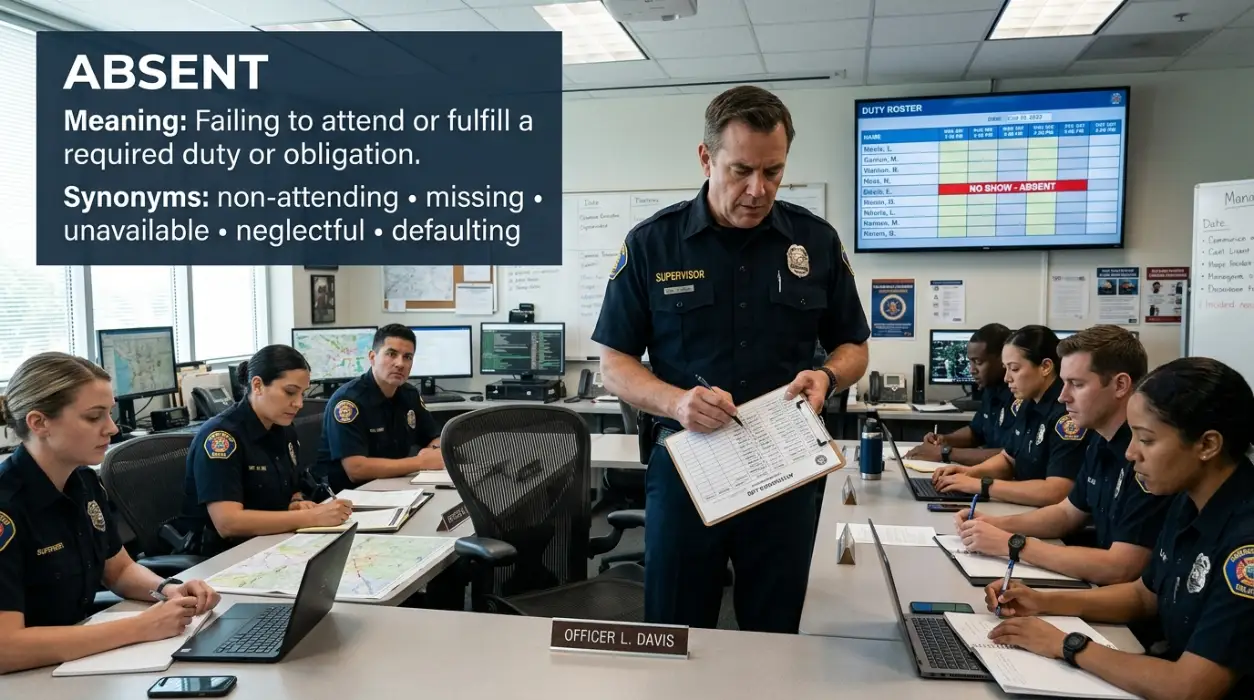
Meaning: Failing to fulfill a duty, obligation, or required attendance.
Tone/Register: Formal / Business
Examples:
- Defaulting members were removed from the official organization list.
- The company took action against defaulting contractual partners.
Daydreaming (Adjective) — US: /ˈdeɪ.driː.mɪŋ/ | UK: /ˈdeɪ.driː.mɪŋ/
Meaning: Lost in pleasant thoughts, causing mental absence from current tasks.
Tone/Register: Informal / Everyday
Examples:
- The daydreaming student stared out the window during math class.
- Daydreaming employees often miss essential presentation details.
Spacey (Adjective) — US: /ˈspeɪ.si/ | UK: /ˈspeɪ.si/
Meaning: Out of touch with reality; mentally absent or dazed.
Tone/Register: Informal / Casual
Examples:
- I felt spacey after working a twelve-hour night shift.
- Her spacey response suggested she hadn’t heard the question.
Unaccounted-for (Adjective) — US: /ˌʌn.əˈkaʊn.tɪd fɔːr/ | UK: /ˌʌn.əˈkaʊn.tɪd fɔː/
Meaning: Not present and whose current whereabouts are completely unknown.
Tone/Register: Official / Journalistic
Examples:
- Two hikers remain unaccounted-for following the sudden winter storm.
- All company assets were cataloged, leaving zero budget items unaccounted-for.
Omitted (Adjective) — US: /oʊˈmɪt.ɪd/ | UK: /əˈmɪt.ɪd/
Meaning: Left out, excluded, or absent from a list, document, or group.
Tone/Register: Academic / Professional
Examples:
- Important references were omitted from the final report draft.
- The team leader was accidentally omitted from the email chain.
Forgetful (Adjective) — US: /fɚˈɡet.fəl/ | UK: /fəˈɡet.fəl/
Meaning: Apt to forget; showing absent-mindedness in daily responsibilities.
Tone/Register: General / Everyday
Examples:
- My grandfather has grown increasingly forgetful over recent years.
- Being tired makes even sharp professionals unusually forgetful.
Absentee (Adjective) — US: /ˌæb.sənˈtiː/ | UK: /ˌæb.sənˈtiː/
Meaning: Regularly or habitually absent from a position, duty, or property.
Tone/Register: Formal / Business / Academic
Examples:
- The absentee landlord rarely inspects the condition of the property.
- High absentee rates in winter heavily impact team performance.
Delinquent (Adjective) — US: /dɪˈlɪŋ.kwənt/ | UK: /dɪˈlɪŋ.kwənt/
Meaning: Failing in a duty, obligation, or required attendance.
Tone/Register: Formal / Legal
Examples:
- The committee sent warnings to delinquent members who missed three consecutive meetings.
- Delinquent account holders must clear their overdue balances promptly.
Negligent (Adjective) — US: /ˈneɡ.lɪ.dʒənt/ | UK: /ˈneɡ.lɪ.dʒənt/
Meaning: Failing to exercise proper care or presence where attention is expected.
Tone/Register: Legal / Formal
Examples:
- The inspector was deemed negligent for missing critical safety flaws.
- Being negligent about routine maintenance causes long-term system damage.
Lost (Adjective) — US: /lɔːst/ | UK: /lɒst/
Meaning: Absorbed in thought to the point of being unaware of physical surroundings.
Tone/Register: General / Descriptive
Examples:
- Clara was completely lost in thought and missed her bus stop.
- He looked lost during the advanced software presentation.
Distant (Adjective) — US: /ˈdɪs.tənt/ | UK: /ˈdɪs.tənt/
Meaning: Mentally withdrawn, aloof, or emotionally unengaged with others.
Tone/Register: Conversational / Descriptive
Examples:
- Mark seemed distant throughout dinner and barely said a word.
- Her distant behavior suggested she was processing heavy personal news.
Unreachable (Adjective) — US: /ʌnˈriː.tʃə.bəl/ | UK: /ʌnˈriː.tʃə.bəl/
Meaning: Impossible to contact or get in touch with at a given time.
Tone/Register: Business / Professional
Examples:
- The sales director remains unreachable while traveling overseas.
- Emergency services were unreachable due to power grid failures.
Non-present (Adjective) — US: /nɑːn ˈprez.ənt/ | UK: /nɒn ˈprez.ənt/
Meaning: Not existing or located in the specified environment or session.
Tone/Register: Academic / Technical
Examples:
- Non-present participants can submit their feedback via the online portal.
- The study tracked behavior in both present and non-present test subjects.
Away-from-desk (Adjective) — US: /əˈweɪ frəm desk/ | UK: /əˈweɪ frəm desk/
Meaning: Temporarily absent from one’s immediate workspace or online workstation.
Tone/Register: Corporate / Professional
Examples:
- Her status icon changed to away-from-desk during the lunch hour.
- Please leave a message if I am away-from-desk during business hours.
Wandering (Adjective) — US: /ˈwɑːn.dɚ.ɪŋ/ | UK: /ˈwɒn.dər.ɪŋ/
Meaning: Unfocused or drifting mentally away from the task at hand.
Tone/Register: Descriptive / Informal
Examples:
- The speaker noticed several wandering minds in the crowded auditorium.
- A wandering attention span makes long research reading difficult.
Deserting (Adjective) — US: /dɪˈzɝː.tɪŋ/ | UK: /dɪˈzɜː.tɪŋ/
Meaning: Abandoning or leaving a post, duty, or location without permission.
Tone/Register: Formal / Dramatic
Examples:
- Deserting staff members were replaced immediately to keep production moving.
- The company took strict disciplinary action against deserting personnel.
Unaware (Adjective) — US: /ˌʌn.əˈwer/ | UK: /ˌʌn.əˈweər/
Meaning: Having no knowledge or perception of what is occurring around oneself.
Tone/Register: General / Daily
Examples:
- He walked right past his friend, completely unaware of her presence.
- Management was unaware of the logistical delays occurring at the warehouse.
Missing-in-action (Adjective) — US: /ˌmɪs.ɪŋ.ɪnˈæk.ʃən/ | UK: /ˌmɪs.ɪŋ.ɪnˈæk.ʃən/
Meaning: Unaccounted for or absent when action or participation is required.
Tone/Register: Informal / Idiomatic
Examples:
- Our lead designer has been missing-in-action since early this morning.
- Two team members went missing-in-action right before the presentation start time.
Out (Adjective) — US: /aʊt/ | UK: /aʊt/
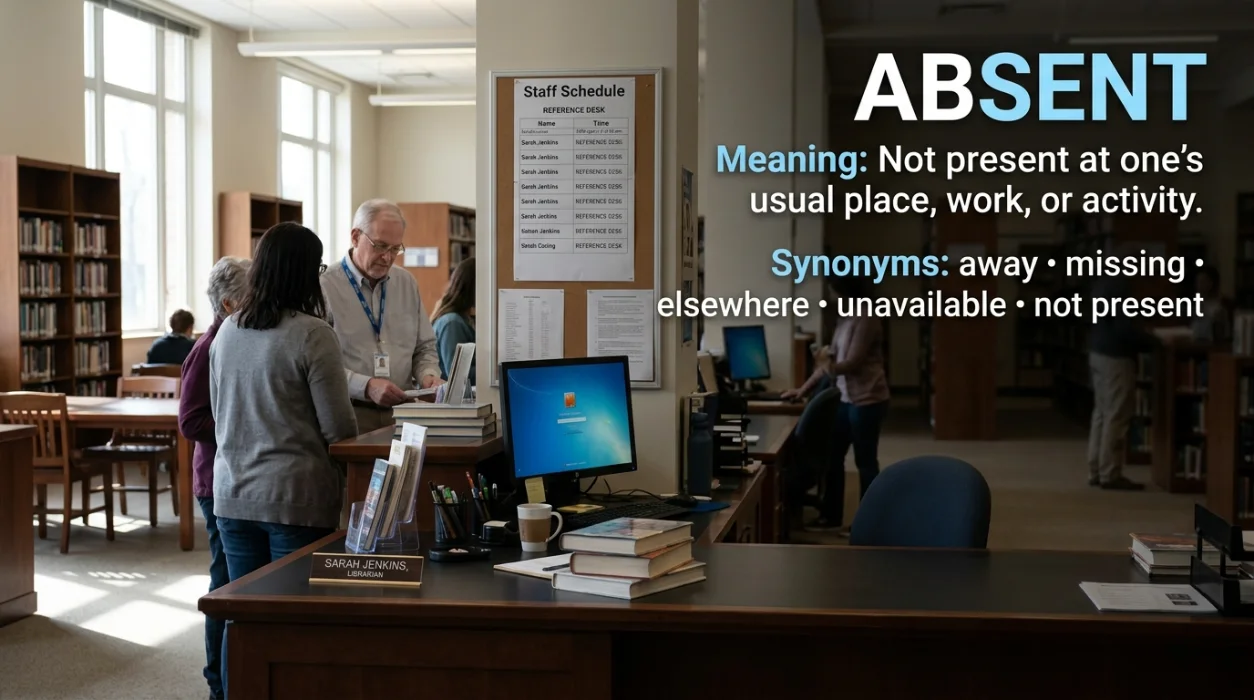
Meaning: Not present at one’s usual place of work, residence, or activity.
Tone/Register: Casual / Everyday
Examples:
- Dr. Evans is out for the rest of the day.
- They were out when the delivery driver dropped off the package.
Unoccupied (Adjective) — US: /ʌnˈɑː.kjə.paɪd/ | UK: /ʌnˈɒk.jʊ.paɪd/
Meaning: Free, empty, or without anyone currently present inside or at the location.
Tone/Register: Neutral / Formal
Examples:
- You can use the meeting room on the third floor since it is unoccupied.
- Unoccupied desks were quickly repurposed for the incoming interns.
Ghosting (Adjective/Participle) — US: /ˈɡoʊ.stɪŋ/ | UK: /ˈɡəʊ.stɪŋ/
Meaning: Suddenly becoming absent or non-responsive without explanation.
Tone/Register: Casual / Modern Slang
Examples:
- The contractor stopped responding and went completely ghosting on the client.
- Ghosting job applicants after interviews creates a negative company reputation.
Detached (Adjective) — US: /dɪˈtætʃt/ | UK: /dɪˈtætʃt/
Meaning: Emotionally or mentally disconnected from current events or surroundings.
Tone/Register: Academic / Analytical
Examples:
- He maintained a detached attitude during the intense group argument.
- A detached approach helps investigators stay objective during interviews.
Unattended (Adjective) — US: /ˌʌn.əˈten.dɪd/ | UK: /ˌʌn.əˈten.dɪd/
Meaning: Lacking personal presence, supervision, or care.
Tone/Register: Formal / Public Policy
Examples:
- Luggage must not be left unattended anywhere inside the airport terminal.
- Unattended vehicles in loading zones will be towed at the owner’s expense.
Faraway (Adjective) — US: /ˈfɑːr.ə.weɪ/ | UK: /ˈfɑː.rə.weɪ/
Meaning: Dreamy or mentally absent, suggesting thoughts are somewhere else.
Tone/Register: Literary / Expressive
Examples:
- She looked out at the ocean with a faraway look in her eyes.
- His faraway expression showed he was thinking about home.
Unseen (Adjective) — US: /ʌnˈsiːn/ | UK: /ʌnˈsiːn/
Meaning: Present in spirit or impact while remaining physically absent or hidden.
Tone/Register: Literary / General
Examples:
- The director remained unseen throughout the entire rehearsal process.
- Unseen forces impacted the market performance during the last quarter.
Absent-minded (Adjective) — US: /ˌæb.səntˈmaɪn.dɪd/ | UK: /ˌæb.səntˈmaɪn.dɪd/
Meaning: Frequently forgetful or mentally absent due to distraction.
Tone/Register: Conversational / General
Examples:
- The absent-minded professor forgot where he placed his reading glasses.
- Being absent-minded in the kitchen can cause minor cooking mistakes.
Synonyms by Tone
Tone Breakdown
Understanding tone helps you select the right synonym for absent based on context and audience expectations.
- Positive / Neutral: Away, Unavailable, Off, Vacant, Elsewhere.
- Negative: Truant, Remiss, Inattentive, Defaulting, Unaccounted-for.
- Playful / Informal: Spacey, Daydreaming, Gone, Distracted.
Tone matters because using a harsh term like “truant” in a casual business email can sound overly accusatory.
Mini Comparison: Absent vs. Missing vs. Distracted
| Feature | Absent | Missing | Distracted |
| Primary Focus | Physical or mental non-presence | Physical loss or unexpected absence | Mental non-presence only |
| Emotional Connotation | Neutral | Concerned or urgent | Mildly critical or protective |
| Best Context | School, work, formal schedules | Lost items, missing persons | Meetings, lectures, conversations |
Use absent when stating facts about attendance. Switch to missing when non-presence causes worry, and choose distracted for mental distance.
Context-Based Usage
Daily Conversation
In casual chats, native speakers prefer shorter, natural words. You will frequently hear “away,” “gone,” or “off.” For example: “Tom is off today, so call back tomorrow.”
Writing and Blogging
Content creators use descriptive terms like “vacant,” “distracted,” or “oblivious” to build vivid pictures and keep readers engaged without repeating the focus keyword.
Professional and Academic Tone
In business or scholarly settings, precision is mandatory. Words like “unavailable,” “non-attending,” or “omitted” maintain formal standards in emails and research papers.
Common Mistakes and Native Usage
Learners often confuse physical absence with mental absence. Calling a daydreaming colleague “truant” creates confusion because “truant” specifically implies unauthorized physical absence from school or work.
Another common mistake is mixing register. Writing “the manager was spacey” in a formal corporate report damages professional credibility.
Native Usage Tip: For smooth writing, vary your word choices based on whether you are describing physical location or mental focus. Writing clearly improves your overall vocabulary and reader engagement.
Real-Life Mini Scenarios
- Workplace: When a team member takes leave, state that they are unavailable or away rather than missing.
- Social Situations: If a friend seems quiet at dinner, describe them as preoccupied or distracted.
- Storytelling: Describe an abandoned house with vacant rooms or a mysterious figure who suddenly vanished.
Conclusion
Understanding absent can help you describe someone or something that is not present, available, or included in a particular situation. Learning its synonyms, meaning, and examples can improve your English vocabulary and make your communication more precise.
The word absent is commonly used in everyday conversations, academic writing, professional settings, and descriptions of missing people or things. Knowing its related synonyms can help you express ideas about being away, missing, unavailable, or lacking in different ways.
By practicing absent in sentences and exploring related words, you can strengthen your vocabulary and writing skills. A clear understanding of this word will help you use it naturally, accurately, and confidently in different English contexts.

Practice Exercise
Which word best fits a student who skips school without permission?
A) Vacant
B) Truant
C) Unavailable
D) Omitted
Choose the professional term for a boss who cannot take a phone call:
A) Spacey
B) Daydreaming
C) Unavailable
D) Gone
If your car keys are not on the hook where you left them, they are:
A) Missing
B) Inattentive
C) Remiss
D) Defaulting
Which word describes someone lost in thought during a lecture?
A) Omitted
B) Distracted
C) Vacant
D) Unaccounted-for
What term best fits an apartment with no tenants inside?
A) Vacant
B) Truant
C) Remiss
D) Inattentive
Which synonym carries an informal, casual tone?
A) Non-attending
B) Defaulting
C) Spacey
D) Remiss
What word implies complete failure to fulfill a professional duty?
A) Remiss
B) Away
C) Distracted
D) Daydreaming
If a name was left off an invitation list, it was:
A) Spacey
B) Truant
C) Omitted
D) Vacant
Two travelers lost in a forest with no news are currently:
A) Daydreaming
B) Unaccounted-for
C) Off
D) Vacant
Someone who does not notice a falling object nearby is:
A) Oblivious
B) Non-attending
C) Omitted
D) Defaulting
Reflection Task: Write one original sentence using the synonym “preoccupied” to describe a workplace situation.
Answer Key: 1-B, 2-C, 3-A, 4-B, 5-A, 6-C, 7-A, 8-C, 9-B, 10-A
FAQs
What is the most common synonym for absent in business emails?
The most professional and widely used synonym in business contexts is “unavailable.” It is polite, neutral, and clearly communicates that someone cannot attend a meeting or answer messages without disclosing unnecessary personal details.
How does “absent” differ from “absent-minded”?
“Absent” primarily refers to physical non-presence at a venue or event. “Absent-minded,” however, specifically describes a mental state where a person is forgetful, distracted, or not paying attention to their immediate surroundings.
Can “vacant” be used as a direct synonym for absent?
Yes, “vacant” serves as a synonym when describing empty physical spaces like offices or apartments, or when describing a blank, mentally absent facial expression where a person appears entirely detached from their surroundings.
Which synonym for absent fits legal or formal documents best?
In formal legal or official documentation, terms like “non-attending,” “defaulting,” or “unaccounted-for” are preferred because they deliver precise, unambiguous definitions regarding compliance, presence, and contractual responsibilities.
What is a casual slang word for being mentally absent?
In informal, everyday English, people frequently use words like “spacey” or “zoned out” to describe someone who is mentally absent, daydreaming, or failing to pay attention during a conversation.

Hasnain Ali is an SEO Content Strategist and the founder of wordvora.com, a trusted vocabulary platform that helps writers, students, professionals, and English learners find accurate synonyms, antonyms, word meanings, and real-life usage examples. He specializes in keyword research, on-page SEO, topical authority, and creating search-first content that aligns with Google’s latest Search Quality and E-E-A-T guidelines. His work focuses on producing clear, well-structured, and reader-friendly resources that satisfy search intent while maintaining high editorial standards.
Through extensive hands-on experience with SEO tools such as Google Search Console, Google Analytics, SEMrush, and Ahrefs, Hasnain researches user search behavior and develops content that is both informative and easy to understand. Every article published on wordvora.com is carefully reviewed for accuracy, readability, and contextual relevance before publication. His mission is to build one of the web’s most reliable English vocabulary resources by providing practical language guidance, trustworthy explanations, and content that helps readers improve their writing, communication, and vocabulary with confidence.