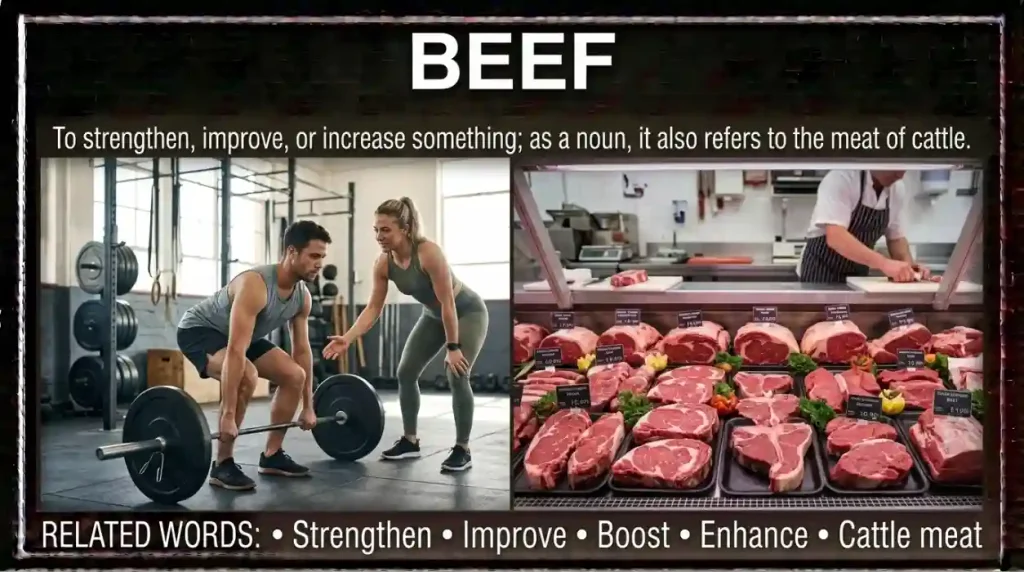
Synonyms for beef depend on the meaning you intend. Beef can mean meat from cattle, a disagreement, a complaint, or physical strength. Alternatives include conflict, grievance, complaint, muscle, and strength. The right choice depends on the sentence and context.
Synonyms for beef can make your English clearer and more expressive. Imagine a friend saying, “I have beef with my neighbor.” They mean a disagreement, not a problem with dinner.
The word beef appears in everyday conversation, food writing, workplace discussions, and internet slang. Its meaning changes with context, so choosing a precise alternative matters.
Learning related words helps students improve essays, bloggers avoid repetition, and content writers create natural copy. Everyday English users can also express frustration, disagreement, or physical strength more accurately.
Whether you are writing a story or chatting with friends, understanding synonyms for beef helps you choose words that fit your message. Let’s explore 50 useful options with meanings and examples.
What Does “Beef” Really Mean?
Beef is a noun with several common meanings. It most often refers to meat from cattle. In informal English, it can also describe a complaint, a personal disagreement, or a conflict with another person.
In some informal contexts, beef can refer to strength, bulk, or added substance. For example, “This argument needs more beef” means it needs stronger evidence or more detail.
Native speakers usually understand the intended meaning from the surrounding words. “We ate beef for dinner” refers to food, while “They have beef with each other” describes a dispute.
Connotative Meaning
(Connotation is the feeling, attitude, or association that a word carries beyond its basic dictionary meaning.)
- Positive tone: In expressions such as “beef up the proposal,” the word can suggest improvement, reinforcement, or greater strength.
- Negative tone: “I have beef with him” often suggests resentment, a complaint, or an ongoing disagreement.
- Neutral tone: In a recipe or menu, beef simply names a type of meat without expressing an attitude.
Etymology
The English word beef came through Anglo-French and Old French boef, from Latin bos, meaning “ox” or “cow.” The word originally referred to the animal or its meat, depending on context.
- Old English (450–1100): English commonly used cū for a cow and ox for an ox. The modern word beef was not yet established in English.
- Middle English (1100–1500): Following the Norman Conquest, French vocabulary entered English. Beef developed from Anglo-French and Old French forms associated with cattle and their meat.
- Modern English (1500–present): Beef became the standard word for cattle meat. Later, informal expressions expanded its meanings to include disputes, complaints, and strength.
Pronunciation (US and UK IPA)
- US: /biːf/
- UK: /biːf/
Syllables
Beef: beef (one syllable)
Affixation Pattern of “Beef”
- Root: beef
- Prefix: None in the basic word
- Suffix: None in the basic word
Related forms include beefy (adjective) and beef up (phrasal verb). These forms add descriptive or action-based meanings.
Synonyms List
Important note: Beef has several distinct senses. The alternatives below are grouped by meaning, because a word for meat cannot automatically replace a word for a dispute or strength. Some are close synonyms; others are natural alternatives in specific expressions.
Meat and Food-Related Alternatives
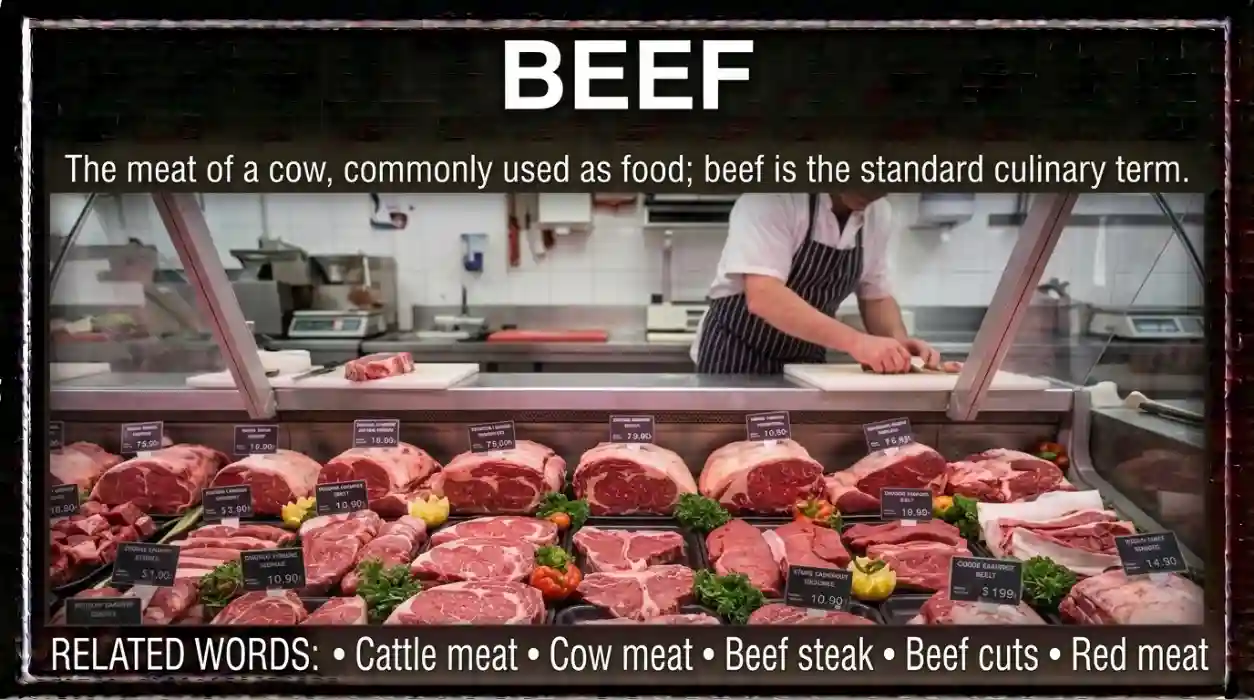
1. Cow meat (noun) — US: /kaʊ miːt/ | UK: /kaʊ miːt/
Meaning: An informal descriptive phrase for meat from a cow, though beef is the standard culinary term.
Tone/Register: Neutral, descriptive.
Examples:
- The recipe calls for cow meat, onions, and tomatoes.
- In everyday English, most cooks would simply call it beef.
2. Cattle meat (noun) — US: /ˈkætəl miːt/ | UK: /ˈkætəl miːt/
Meaning: Meat obtained from cattle, often used in explanatory or technical descriptions.
Tone/Register: Neutral, technical.
Examples:
- The report compares cattle meat production across several regions.
- The label explains how cattle meat is processed.
3. Red meat (noun) — US: /ˌrɛd ˈmiːt/ | UK: /ˌred ˈmiːt/
Meaning: Meat that is generally red when raw, including beef, lamb, and pork in many dietary classifications.
Tone/Register: Neutral, nutritional.
Examples:
- She eats less red meat than she used to.
- The article discusses the role of red meat in different diets.
4. Steak (noun) — US: /steɪk/ | UK: /steɪk/
Meaning: A slice of meat, commonly beef, cut for grilling, frying, or broiling.
Tone/Register: Neutral, culinary.
Examples:
- He ordered a steak with roasted vegetables.
- Let the steak rest before slicing it.
5. Roast beef (noun) — US: /ˌroʊst ˈbiːf/ | UK: /ˌrəʊst ˈbiːf/
Meaning: Beef cooked by roasting, often served sliced.
Tone/Register: Neutral, culinary.
Examples:
- We served roast beef at the family gathering.
- Leftover roast beef makes a quick sandwich.
6. Ground beef (noun) — US: /ˌɡraʊnd ˈbiːf/ | UK: /ˌɡraʊnd ˈbiːf/
Meaning: Beef minced or ground into small pieces for dishes such as burgers and meat sauces.
Tone/Register: Neutral, everyday.
Examples:
- I bought ground beef for tonight’s tacos.
- Cook the ground beef thoroughly before serving it.
7. Minced beef (noun) — US: /ˌmɪnst ˈbiːf/ | UK: /ˌmɪnst ˈbiːf/
Meaning: Beef chopped or ground into very small pieces; this is the usual British English term for what Americans call ground beef.
Tone/Register: Neutral, culinary; especially British English.
Examples:
- She used minced beef to make cottage pie.
- The shop sells lean minced beef in sealed packs.
8. Brisket (noun) — US: /ˈbrɪskɪt/ | UK: /ˈbrɪskɪt/
Meaning: A cut of beef from the lower chest, often cooked slowly to make it tender.
Tone/Register: Neutral, culinary.
Examples:
- The brisket cooked slowly for several hours.
- He served smoked brisket with a fresh salad.
9. Beefsteak (noun) — US: /ˈbiːfˌsteɪk/ | UK: /ˈbiːfˌsteɪk/
Meaning: A steak cut from beef, sometimes used in traditional food descriptions.
Tone/Register: Neutral, culinary; somewhat old-fashioned in some contexts.
Examples:
- The old cookbook includes a simple beefsteak recipe.
- She seasoned the beefsteak with pepper and herbs.
10. Beef cut (noun) — US: /ˈbiːf ˌkʌt/ | UK: /ˈbiːf ˌkʌt/
Meaning: A specific portion of a cow used for cooking, such as chuck, rib, or sirloin.
Tone/Register: Neutral, culinary.
Examples:
- The butcher explained which beef cut works best for stewing.
- Choose a tender beef cut for quick cooking.
Conflict, Disagreement, and Complaint Alternatives
These words work when beef means a problem between people, a grievance, or a complaint.
11. Dispute (noun) — US: /dɪˈspjuːt/ | UK: /dɪˈspjuːt/
Meaning: A disagreement in which two or more people have opposing views or interests.
Tone/Register: Neutral to formal.
Examples:
- The neighbors settled their dispute over the fence.
- A payment dispute delayed the project.
12. Conflict (noun) — US: /ˈkɑːnflɪkt/ | UK: /ˈkɒnflɪkt/
Meaning: A serious disagreement or clash between people, groups, or ideas.
Tone/Register: Neutral, professional.
Examples:
- The manager helped resolve the conflict between colleagues.
- Their conflicting priorities created tension.
13. Argument (noun) — US: /ˈɑːrɡjəmənt/ | UK: /ˈɑːɡjəmənt/
Meaning: A disagreement expressed through words, sometimes heatedly.
Tone/Register: Neutral, everyday.
Examples:
- They had an argument about the travel plans.
- One calm conversation ended the argument.
14. Feud (noun) — US: /fjuːd/ | UK: /fjuːd/
Meaning: A prolonged, often bitter dispute between people or groups.
Tone/Register: Informal to neutral; often dramatic.
Examples:
- The two families have had a feud for years.
- Their online feud attracted public attention.
15. Clash (noun) — US: /klæʃ/ | UK: /klæʃ/
Meaning: A strong disagreement or direct opposition between people, opinions, or interests.
Tone/Register: Neutral, journalistic.
Examples:
- A clash over deadlines delayed the launch.
- Their personalities often clash during meetings.
16. Quarrel (noun) — US: /ˈkwɔːrəl/ | UK: /ˈkwɒrəl/
Meaning: An angry disagreement, usually between people who know each other.
Tone/Register: Neutral, conversational.
Examples:
- The couple had a brief quarrel over household chores.
- Their quarrel ended before dinner.
17. Row (noun) — US: /raʊ/ | UK: /raʊ/
Meaning: A noisy or angry argument, especially in British English.
Tone/Register: Informal; particularly British.
Examples:
- They had a row about who should drive.
- The neighbors’ row woke everyone up.
18. Spat (noun) — US: /spæt/ | UK: /spæt/
Meaning: A short, relatively minor argument or disagreement.
Tone/Register: Informal.
Examples:
- The teammates had a spat over a missed pass.
- Their little spat was forgotten by lunchtime.
19. Grievance (noun) — US: /ˈɡriːvəns/ | UK: /ˈɡriːvəns/
Meaning: A complaint about unfair treatment or something believed to be wrong.
Tone/Register: Formal, workplace, legal.
Examples:
- The employee filed a grievance about the schedule.
- Management invited staff to discuss their grievances.
20. Complaint (noun) — US: /kəmˈpleɪnt/ | UK: /kəmˈpleɪnt/
Meaning: A statement that something is wrong, unsatisfactory, or unfair.
Tone/Register: Neutral, professional.
Examples:
- She made a complaint about the delayed delivery.
- The hotel responded to every customer complaint.
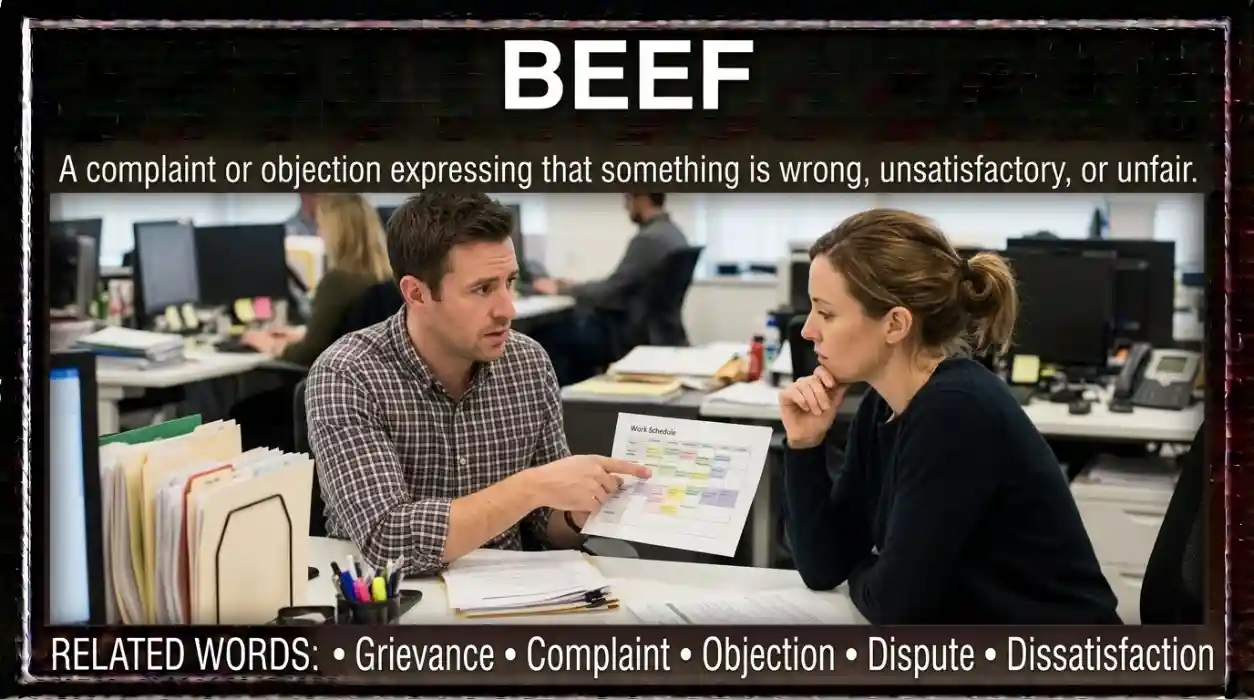
21. Beef (noun, slang sense) — US: /biːf/ | UK: /biːf/
Meaning: An informal term for a personal disagreement, grievance, or ongoing issue.
Tone/Register: Informal, conversational.
Examples:
- I have no beef with your decision.
- Their beef started over a misunderstanding.
22. Issue (noun) — US: /ˈɪʃuː/ | UK: /ˈɪʃuː/
Meaning: A matter, concern, or problem that needs attention.
Tone/Register: Neutral, professional.
Examples:
- We need to discuss the issue before Friday.
- She raised an issue with the new policy.
23. Problem (noun) — US: /ˈprɑːbləm/ | UK: /ˈprɒbləm/
Meaning: A situation that causes difficulty or needs a solution.
Tone/Register: Neutral, everyday.
Examples:
- Their main problem was poor communication.
- Let’s solve the problem without blaming anyone.
24. Tension (noun) — US: /ˈtenʃən/ | UK: /ˈtenʃən/
Meaning: A feeling of strain or unease between people who disagree or feel uncomfortable.
Tone/Register: Neutral, descriptive.
Examples:
- There was tension in the room after the meeting.
- A direct conversation eased the tension.
25. Grudge (noun) — US: /ɡrʌdʒ/ | UK: /ɡrʌdʒ/
Meaning: Lasting resentment toward someone because of a past wrong.
Tone/Register: Negative, informal to neutral.
Examples:
- He still holds a grudge over the old dispute.
- She decided not to carry a grudge into the new year.
26. Complaint (noun) — US: /kəmˈpleɪnt/ | UK: /kəmˈpleɪnt/
Meaning: An expression of dissatisfaction, especially about a service, decision, or experience.
Tone/Register: Neutral, everyday or formal.
Examples:
- His complaint focused on the lack of clear instructions.
- The team listened carefully to each complaint.
27. Beefing (noun/gerund) — US: /ˈbiːfɪŋ/ | UK: /ˈbiːfɪŋ/
Meaning: Informal slang for arguing or maintaining a conflict with someone.
Tone/Register: Very informal, slang.
Examples:
- The two artists have been beefing online for weeks.
- I’m tired of the constant beefing in the group chat.
28. Hostility (noun) — US: /hɑːˈstɪləti/ | UK: /hɒˈstɪləti/
Meaning: Unfriendly, antagonistic, or openly opposed behavior.
Tone/Register: Formal, negative.
Examples:
- Hostility between the departments slowed the work.
- She responded to criticism without showing hostility.
29. Resentment (noun) — US: /rɪˈzentmənt/ | UK: /rɪˈzentmənt/
Meaning: Bitter or persistent displeasure caused by feeling mistreated or overlooked.
Tone/Register: Neutral to formal, negative.
Examples:
- Resentment grew after the promotion decision.
- Honest feedback helped clear up years of resentment.
30. Rivalry (noun) — US: /ˈraɪvəlri/ | UK: /ˈraɪvəlri/
Meaning: Competition between people or groups, sometimes accompanied by tension or ill feeling.
Tone/Register: Neutral; can be playful or intense.
Examples:
- The rivalry between the two teams is legendary.
- Friendly rivalry pushed both students to improve.
Strength, Power, and Substance Alternatives
In expressions such as “beef up the report,” the word points to greater strength, size, detail, or impact. These alternatives fit particular contexts rather than every use of beef.
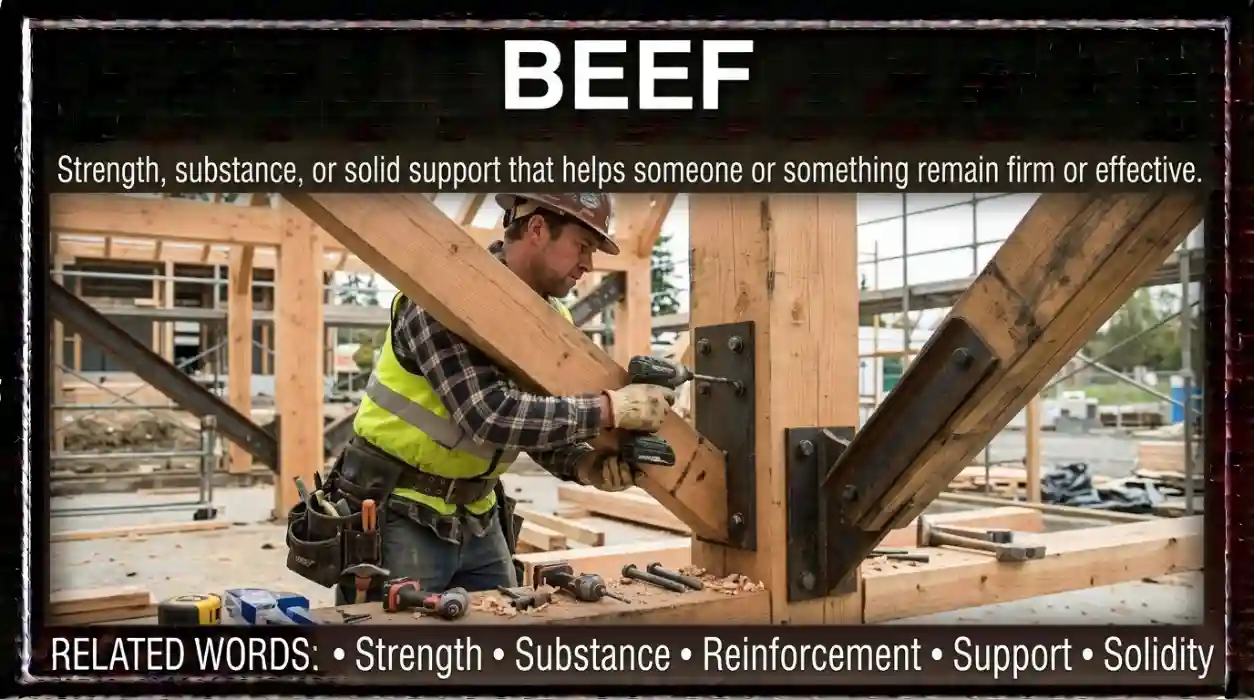
31. Strength (noun) — US: /streŋθ/ | UK: /streŋθ/
Meaning: The ability to exert force or withstand pressure; it can also mean the quality that makes an argument effective.
Tone/Register: Neutral, widely used.
Examples:
- Her strength helped her finish the race.
- The strength of his evidence impressed the panel.
32. Muscle (noun) — US: /ˈmʌsəl/ | UK: /ˈmʌsəl/
Meaning: Physical power or, figuratively, the influence and resources used to achieve something.
Tone/Register: Neutral to informal.
Examples:
- The team needs more muscle to move the equipment.
- The organization used its political muscle to support the proposal.
33. Power (noun) — US: /ˈpaʊər/ | UK: /ˈpaʊə/
Meaning: The ability to act, influence others, or produce a strong effect.
Tone/Register: Neutral, professional.
Examples:
- The new motor has enough power for the job.
- Clear evidence gave her argument more power.
34. Force (noun) — US: /fɔːrs/ | UK: /fɔːs/
Meaning: Physical strength or the intensity with which something acts or affects people.
Tone/Register: Neutral, formal or everyday.
Examples:
- The door would not open without considerable force.
- The final paragraph gives the story emotional force.
35. Vigor (noun) — US: /ˈvɪɡər/ | UK: /ˈvɪɡə/
Meaning: Physical energy, enthusiasm, or active strength.
Tone/Register: Neutral to formal.
Examples:
- She returned to training with renewed vigor.
- The speaker defended the proposal with vigor.
36. Robustness (noun) — US: /roʊˈbʌstnəs/ | UK: /rəʊˈbʌstnəs/
Meaning: The quality of being strong, durable, or able to perform reliably under pressure.
Tone/Register: Formal, technical, professional.
Examples:
- The engineers tested the robustness of the system.
- The study examines the robustness of the results.
37. Bulk (noun) — US: /bʌlk/ | UK: /bʌlk/
Meaning: Size, volume, or a large amount of material.
Tone/Register: Neutral, descriptive.
Examples:
- The bodybuilder added bulk through training.
- The report needs more bulk to cover the missing details.
38. Substance (noun) — US: /ˈsʌbstəns/ | UK: /ˈsʌbstəns/
Meaning: The meaningful content, importance, or solid basis of something.
Tone/Register: Neutral to formal.
Examples:
- The essay has style but needs more substance.
- Her proposal offered substance as well as ambition.
39. Reinforcement (noun) — US: /ˌriːɪnˈfɔːrsmənt/ | UK: /ˌriːɪnˈfɔːsmənt/
Meaning: Extra support or material added to make something stronger.
Tone/Register: Neutral, technical or professional.
Examples:
- The bridge required reinforcement before reopening.
- The argument gained reinforcement from new evidence.
40. Backbone (noun) — US: /ˈbækboʊn/ | UK: /ˈbækbəʊn/
Meaning: The strength of character or central support that helps someone or something remain firm.
Tone/Register: Informal to neutral, figurative.
Examples:
- It took backbone to admit the mistake.
- Trust is the backbone of a healthy team.
General Alternatives for Adding Detail or Improving Impact
These words are useful when beef up means to make something fuller, stronger, more convincing, or more substantial.
41. Enhance (verb) — US: /ɪnˈhæns/ | UK: /ɪnˈhɑːns/
Meaning: To improve the quality, value, or effectiveness of something.
Tone/Register: Neutral to formal.
Examples:
- Add a clear example to enhance the explanation.
- Better lighting can enhance the photographs.
42. Strengthen (verb) — US: /ˈstreŋθən/ | UK: /ˈstreŋθən/
Meaning: To make something physically or figuratively stronger.
Tone/Register: Neutral, professional.
Examples:
- We need more data to strengthen the conclusion.
- Regular practice will strengthen your speaking skills.
43. Reinforce (verb) — US: /ˌriːɪnˈfɔːrs/ | UK: /ˌriːɪnˈfɔːs/
Meaning: To add support, repeat a message, or make something more secure.
Tone/Register: Neutral to formal.
Examples:
- The teacher used a diagram to reinforce the lesson.
- New evidence reinforced the original finding.
44. Expand (verb) — US: /ɪkˈspænd/ | UK: /ɪkˈspænd/
Meaning: To make something larger or develop it by adding information, space, or scope.
Tone/Register: Neutral, academic or professional.
Examples:
- Expand the introduction with a practical example.
- The company plans to expand its research team.
45. Elaborate (verb) — US: /ɪˈlæbəreɪt/ | UK: /ɪˈlæbəreɪt/
Meaning: To add details or explain an idea more fully.
Tone/Register: Neutral to formal.
Examples:
- Could you elaborate on your final point?
- She elaborated on the plan during the meeting.
46. Bolster (verb) — US: /ˈboʊlstər/ | UK: /ˈbəʊlstə/
Meaning: To support or strengthen something, especially confidence, an argument, or a position.
Tone/Register: Formal, professional.
Examples:
- The latest figures bolstered the team’s confidence.
- One strong example can bolster your argument.
47. Augment (verb) — US: /ɔːɡˈment/ | UK: /ɔːɡˈment/
Meaning: To increase or supplement something by adding more to it.
Tone/Register: Formal, academic or technical.
Examples:
- The researchers augmented the dataset with new observations.
- A short case study can augment the report.
48. Fortify (verb) — US: /ˈfɔːrtɪfaɪ/ | UK: /ˈfɔːtɪfaɪ/
Meaning: To strengthen or protect something physically or figuratively.
Tone/Register: Formal, descriptive.
Examples:
- The team fortified its position with documented evidence.
- A balanced breakfast can help fortify you for a busy morning.
49. Improve (verb) — US: /ɪmˈpruːv/ | UK: /ɪmˈpruːv/
Meaning: To make something better in quality, performance, or condition.
Tone/Register: Neutral, everyday.
Examples:
- Revise the draft to improve its clarity.
- Daily conversation can improve your confidence in English.
50. Develop (verb) — US: /dɪˈveləp/ | UK: /dɪˈveləp/
Meaning: To build, extend, or bring something to a more advanced or complete state.
Tone/Register: Neutral, academic or professional.
Examples:
- The writer developed the idea into a full article.
- We need to develop a stronger response to the feedback.
Synonyms by Tone
Tone helps you select a word that suits the audience and situation. A casual expression may sound friendly among friends but unprofessional in a formal report.
Positive or constructive
- Strength and improvement: strength, vigor, enhance, strengthen, reinforce, bolster, improve.
- Support and resilience: backbone, robustness, fortify.
Neutral
- General disagreement: dispute, argument, issue, problem, clash.
- Food-related language: red meat, steak, ground beef, minced beef, roast beef.
- Adding information: expand, elaborate, develop, substance.
Negative
- Long-running resentment: feud, grudge, resentment, hostility.
- Dissatisfaction or strain: grievance, complaint, tension.
Playful or informal
- Casual disagreement: beef, spat, row, quarrel, beefing.
- Competition: rivalry.
Choose the word that reflects the seriousness of the situation. A spat suggests a minor disagreement, while a feud implies a longer and more bitter conflict.
“Beef” vs. Close Alternatives
| Word | Main meaning | Tone | Best use |
|---|---|---|---|
| Beef | Informal grievance or conflict; also meat | Casual or neutral | Conversation, slang, food |
| Dispute | A disagreement over a matter | Neutral to formal | Work, policy, legal or factual disagreements |
| Grievance | A complaint about unfair treatment | Formal | Workplace concerns or official complaints |
| Strengthen | Make something stronger | Neutral to formal | Improving an argument, plan, or structure |
| Enhance | Improve quality or value | Professional | Polishing a process, design, or explanation |
Quick comparison: “I have beef with him” sounds casual and personal. “I have a dispute with him” sounds more neutral and specific. “I have a grievance” suggests that you believe you were treated unfairly. In writing, strengthen or enhance is often clearer than the slang phrase beef up.
How “Beef” Changes by Context
Daily conversation: Friends might say, “What’s your beef?” to ask why someone is upset. This is informal and may sound confrontational if the relationship is not friendly.
Writing and blogging: Use precise alternatives to avoid ambiguity. Complaint works for a customer experience, dispute for a disagreement, and strengthen for improving an argument.
Professional or academic tone: Prefer concern, grievance, conflict, or dispute when discussing interpersonal problems. Use reinforce, expand, or substantiate when developing an idea.
Creative or informal use: Slang such as beef and beefing can make dialogue feel contemporary. It fits casual speech, social media, and character conversations, but it may date a story or feel unsuitable in formal narration.
Common Mistakes Learners Make
- Treating every alternative as interchangeable: Steak is a type of beef dish or cut, not a synonym for an interpersonal disagreement.
- Using slang in formal writing: “I have beef with the policy” may sound casual. “I have concerns about the policy” is more suitable in a professional email.
- Confusing a complaint with a conflict: A complaint expresses dissatisfaction. A conflict involves opposition between people, groups, or interests.
- Overusing “beef up”: The phrase is natural in conversation, but formal writing may benefit from strengthen, expand, or reinforce.
- Assuming a rivalry is always hostile: A rivalry can be friendly competition. A feud usually implies more bitterness.
- Using “red meat” as an exact substitute: Red meat includes more than beef, so the terms are not identical.
Register Notes
In spoken English, beef, beefing, spat, and row can sound natural in casual contexts. In formal writing, dispute, grievance, conflict, and complaint usually communicate the issue more precisely.
For food, ground beef is common in American English, while minced beef is standard in British English. Choose the term that suits your audience.
Real-Life Mini Scenarios
Workplace:
A colleague feels overlooked for a promotion. Instead of saying, “She has beef with the manager,” a formal report could say, “She raised a grievance about the promotion process.”
Social situation:
Two friends disagree over weekend plans. Calling it a spat suggests a small, temporary argument rather than a serious conflict.
Media and pop culture:
When two performers trade public insults online, a headline may describe their disagreement as a feud or say they are beefing. The wording suggests a public, ongoing dispute.
Writing and storytelling:
An essay feels too thin. Rather than saying, “Beef up the essay,” a teacher might advise, “Expand the analysis and strengthen your evidence.”

Practice Exercise
1. Two neighbors disagree about a property boundary. Which word fits a formal description?
A. Steak
B. Dispute
C. Vigor
D. Bulk
2. An employee believes a supervisor treated them unfairly. What might they file?
A. A grievance
B. A rivalry
C. A brisket
D. A spat
3. Two friends have a small argument and make up an hour later. Which word fits best?
A. Hostility
B. Feud
C. Spat
D. Robustness
4. You want to say that a report needs more supporting detail. Which verb is suitable?
A. Quarrel
B. Expand
C. Grudge
D. Steak
5. Which word best describes a long-running, bitter disagreement between two families?
A. Feud
B. Issue
C. Enhance
D. Roast beef
6. A professional email needs a neutral word for dissatisfaction with a service. Choose the best option.
A. Beefing
B. Complaint
C. Bulk
D. Backbone
7. Which word means to make an argument more convincing by adding support?
A. Bolster
B. Quarrel
C. Row
D. Brisket
8. Which term is most appropriate for minced beef in British English?
A. Muscle
B. Grudge
C. Minced beef
D. Conflict
9. A writer wants to say that an essay lacks meaningful ideas. Which noun fits?
A. Substance
B. Steak
C. Row
D. Beefing
10. Which word describes unfriendly, antagonistic behavior?
A. Enhancement
B. Hostility
C. Roast beef
D. Expansion
Reflection task:
Write one original sentence using dispute, grievance, strengthen, or beef up. Then rewrite it using a different word and explain how the tone changes.
Answer key: 1-B, 2-A, 3-C, 4-B, 5-A, 6-B, 7-A, 8-C, 9-A, 10-B
Suggested External Sources
For further vocabulary and language research, consult these established references:
- Merriam-Webster Dictionary — definitions, usage notes, and word history.
- Cambridge Dictionary — learner-friendly meanings and British and American pronunciation.
- Oxford English Dictionary — detailed etymology and historical word development.
- Collins Dictionary — definitions, examples, and regional usage notes.
Use dictionary entries to verify a word’s meaning and pronunciation before using it in formal or academic writing.
Conclusion
Learning synonyms for beef helps you distinguish food, disagreement, resentment, and strength. The right word makes your meaning clearer and prevents confusing or awkward sentences.
A varied vocabulary improves essays, blog posts, emails, and everyday conversations. Words such as dispute, grievance, bolster, and enhance let you communicate with greater precision.
Pay attention to context and tone. A casual phrase may work with friends, while a neutral or formal alternative is better for professional communication.
Put your learning into practice: write a sentence with three new words, then use them in an email, an essay, or a daily conversation. Small steps build confidence.
Frequently Asked Questions
1. What does “I have beef with someone” mean?
“I have beef with someone” is an informal expression meaning that you have a problem, disagreement, or grievance with that person. It often suggests lingering annoyance or unresolved tension. The phrase is common in casual speech and online conversations. In formal writing, I have a disagreement with them or I have concerns about their actions may sound more appropriate.
2. What is a professional way to say “I have beef with someone”?
A professional alternative depends on the issue. Use I have concerns about this decision for a disagreement, I would like to resolve this conflict for an ongoing interpersonal problem, or I wish to raise a formal grievance for alleged unfair treatment. These phrases explain the problem without the slang or confrontational tone that beef can carry.
3. Is “beef” slang for an argument?
Yes. In informal English, beef can mean a disagreement, complaint, or personal conflict. For example, “They have beef” means that they have a problem with each other. It is not limited to one argument; the word can also refer to a lingering issue. Its slang sense is especially common in casual conversation and popular culture.
4. What is the difference between “beef,” “grudge,” and “feud”?
Beef is a broad informal term for a problem or disagreement. A grudge is resentment someone continues to feel about a past wrong. A feud is a prolonged conflict between people or groups. Someone may hold a grudge after a single incident, while a feud usually involves ongoing hostility or repeated disputes.
5. What does “beef up” mean in writing?
Beef up means to make something stronger, fuller, or more substantial. A writer might beef up an essay by adding evidence, examples, and clearer explanations. In formal or academic work, alternatives such as strengthen, expand, reinforce, or develop may be more precise. The best choice depends on whether you are adding detail, improving quality, or providing stronger support.

Hasnain Ali is an SEO Content Strategist and the founder of wordvora.com, a trusted vocabulary platform that helps writers, students, professionals, and English learners find accurate synonyms, antonyms, word meanings, and real-life usage examples. He specializes in keyword research, on-page SEO, topical authority, and creating search-first content that aligns with Google’s latest Search Quality and E-E-A-T guidelines. His work focuses on producing clear, well-structured, and reader-friendly resources that satisfy search intent while maintaining high editorial standards.
Through extensive hands-on experience with SEO tools such as Google Search Console, Google Analytics, SEMrush, and Ahrefs, Hasnain researches user search behavior and develops content that is both informative and easy to understand. Every article published on wordvora.com is carefully reviewed for accuracy, readability, and contextual relevance before publication. His mission is to build one of the web’s most reliable English vocabulary resources by providing practical language guidance, trustworthy explanations, and content that helps readers improve their writing, communication, and vocabulary with confidence.